
Two views on text structure Using Rhetorical Structure



- Slides: 36
Two views on text structure: Using Rhetorical Structure Theory and Register & Genre Theory to improve students’ academic writing Helmut Gruber Birgit Huemer Dept. of Linguistics University of Vienna e-mail: helmut. k. gruber@univie. ac. at birgit. huemer@univie. ac. at
Database of the study: Macro-level: Text corpus: 19 student term papers (77. 233 words) written in four academic disciplines, associated with four departments (social history, business studies, business psychology) at two Austrian universities and 7 seven papers of Linguistics students in Vienna. All in all 26 papers.
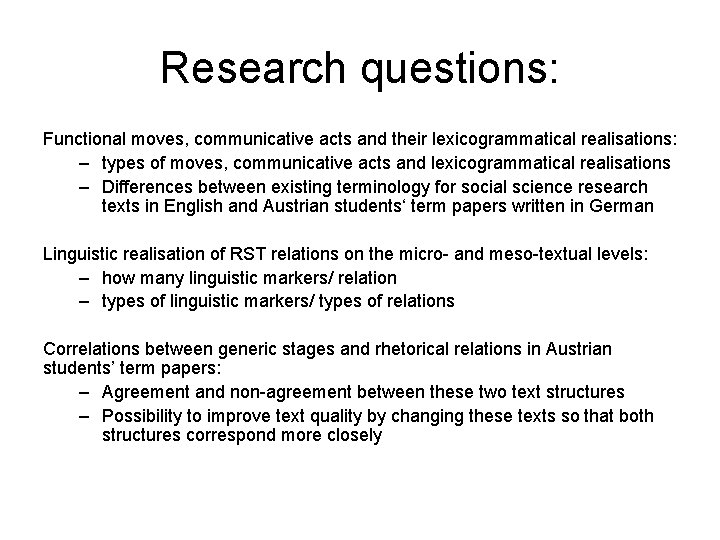
Research questions: Functional moves, communicative acts and their lexicogrammatical realisations: – types of moves, communicative acts and lexicogrammatical realisations – Differences between existing terminology for social science research texts in English and Austrian students‘ term papers written in German Linguistic realisation of RST relations on the micro- and meso-textual levels: – how many linguistic markers/ relation – types of linguistic markers/ types of relations Correlations between generic stages and rhetorical relations in Austrian students’ term papers: – Agreement and non-agreement between these two text structures – Possibility to improve text quality by changing these texts so that both structures correspond more closely
Generic structure
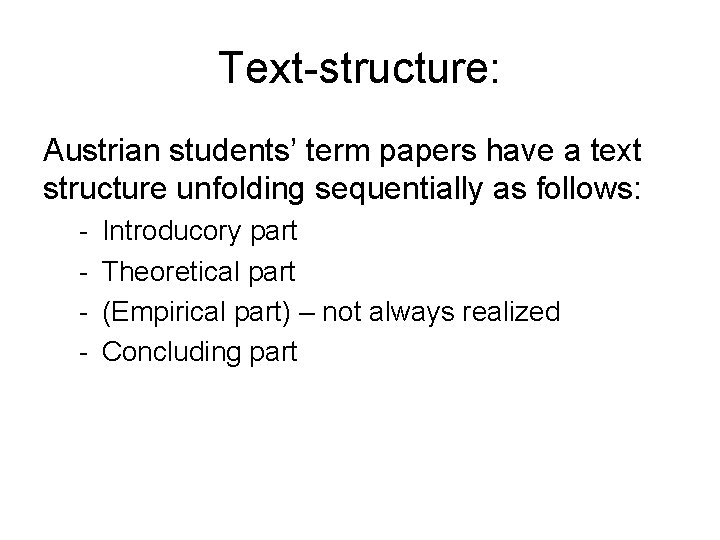
Text-structure: Austrian students’ term papers have a text structure unfolding sequentially as follows: - Introducory part Theoretical part (Empirical part) – not always realized Concluding part
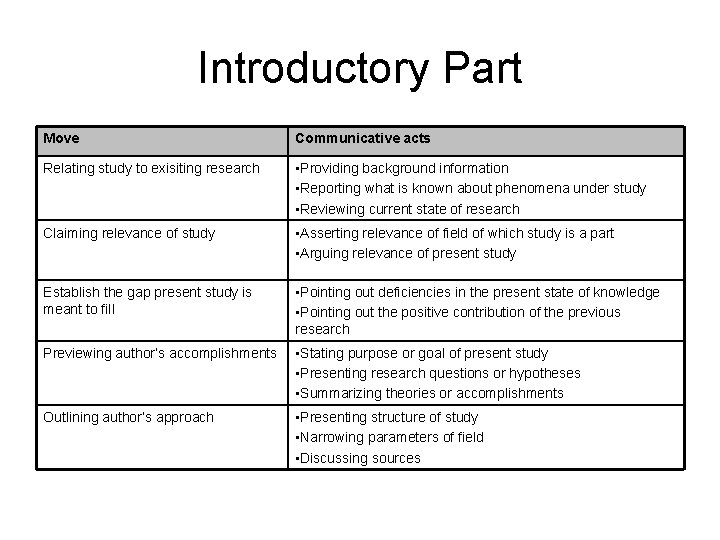
Introductory Part Move Communicative acts Relating study to exisiting research • Providing background information • Reporting what is known about phenomena under study • Reviewing current state of research Claiming relevance of study • Asserting relevance of field of which study is a part • Arguing relevance of present study Establish the gap present study is meant to fill • Pointing out deficiencies in the present state of knowledge • Pointing out the positive contribution of the previous research Previewing author’s accomplishments • Stating purpose or goal of present study • Presenting research questions or hypotheses • Summarizing theories or accomplishments Outlining author’s approach • Presenting structure of study • Narrowing parameters of field • Discussing sources
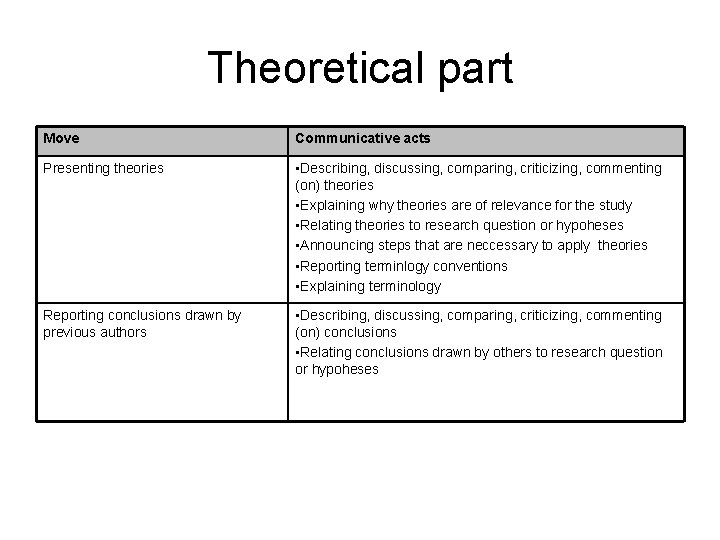
Theoretical part Move Communicative acts Presenting theories • Describing, discussing, comparing, criticizing, commenting (on) theories • Explaining why theories are of relevance for the study • Relating theories to research question or hypoheses • Announcing steps that are neccessary to apply theories • Reporting terminlogy conventions • Explaining terminology Reporting conclusions drawn by previous authors • Describing, discussing, comparing, criticizing, commenting (on) conclusions • Relating conclusions drawn by others to research question or hypoheses
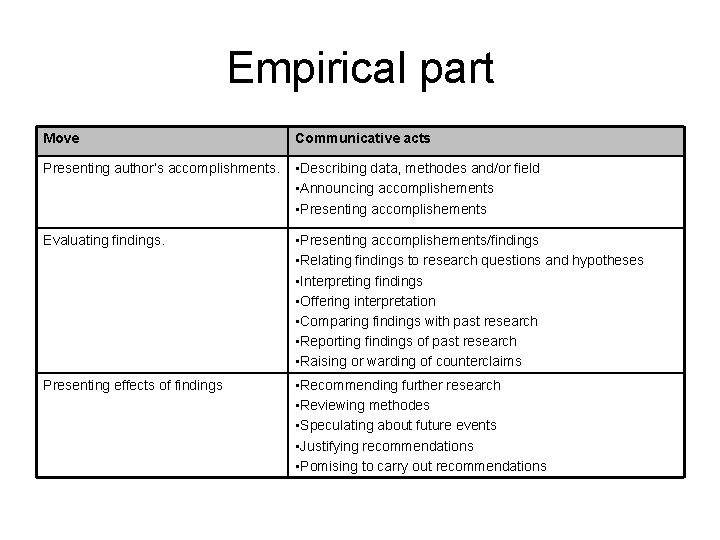
Empirical part Move Communicative acts Presenting author’s accomplishments. • Describing data, methodes and/or field • Announcing accomplishements • Presenting accomplishements Evaluating findings. • Presenting accomplishements/findings • Relating findings to research questions and hypotheses • Interpreting findings • Offering interpretation • Comparing findings with past research • Reporting findings of past research • Raising or warding of counterclaims Presenting effects of findings • Recommending further research • Reviewing methodes • Speculating about future events • Justifying recommendations • Pomising to carry out recommendations
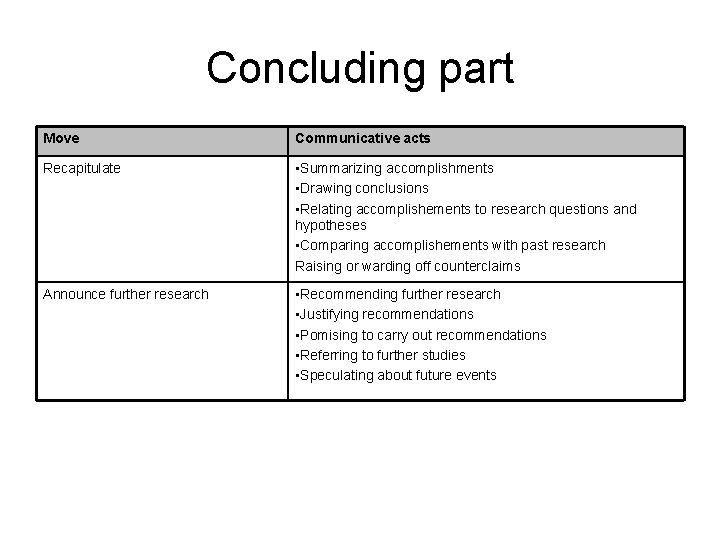
Concluding part Move Communicative acts Recapitulate • Summarizing accomplishments • Drawing conclusions • Relating accomplishements to research questions and hypotheses • Comparing accomplishements with past research Raising or warding off counterclaims Announce further research • Recommending further research • Justifying recommendations • Pomising to carry out recommendations • Referring to further studies • Speculating about future events
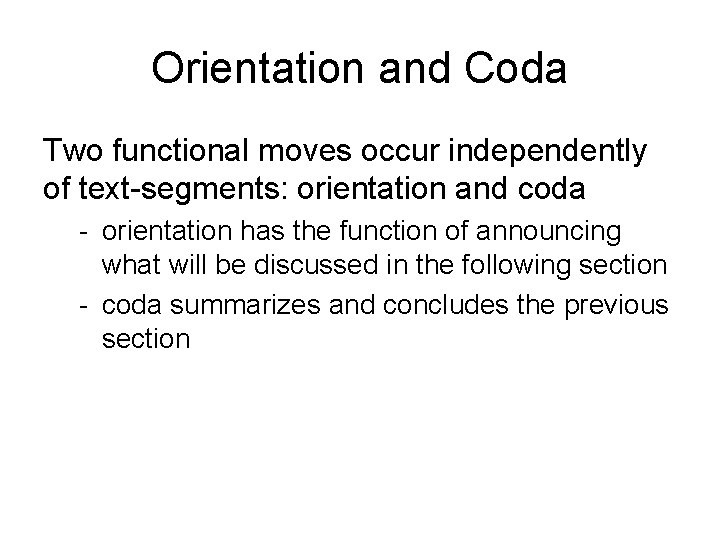
Orientation and Coda Two functional moves occur independently of text-segments: orientation and coda - orientation has the function of announcing what will be discussed in the following section - coda summarizes and concludes the previous section
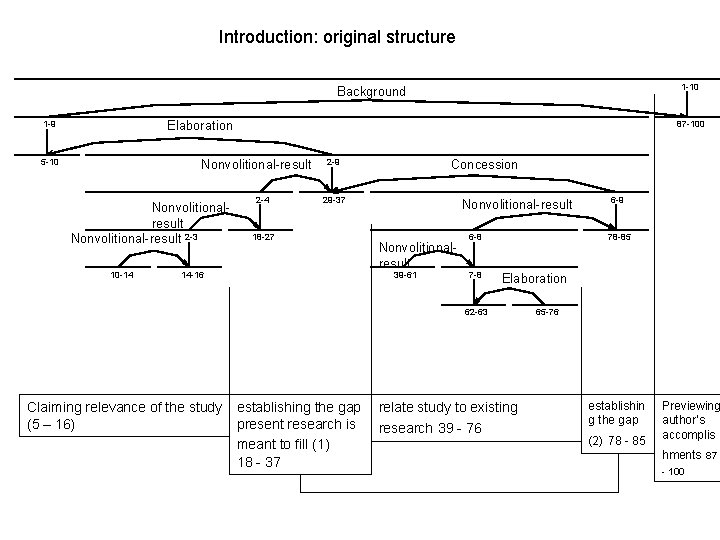
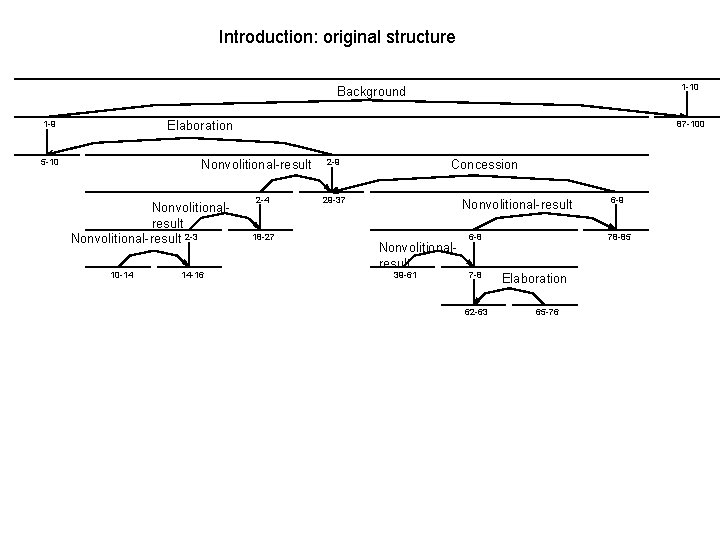
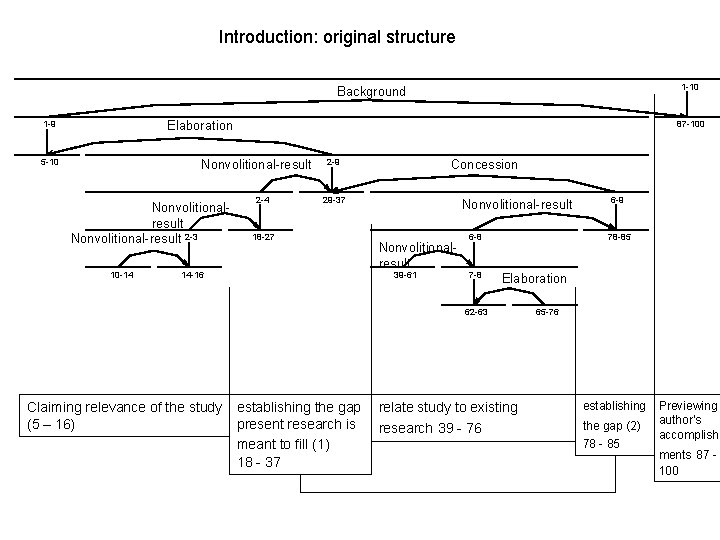
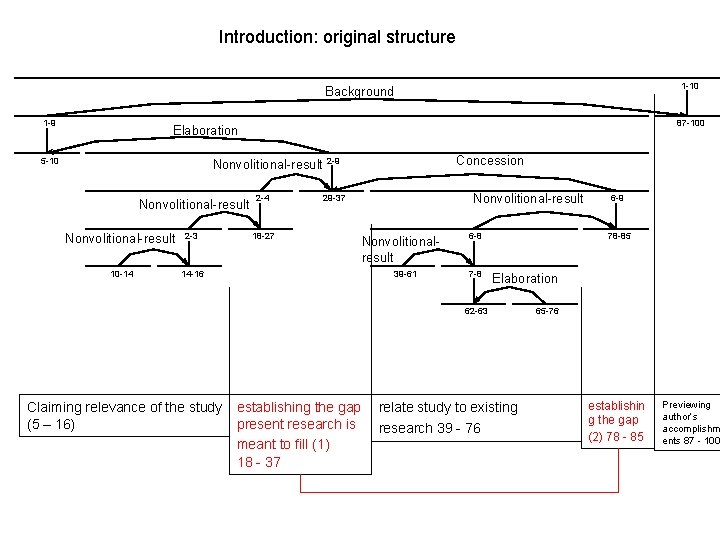
Introduction: original structure 1 -10 Background Elaboration 1 -9 5 -10 87 -100 Nonvolitional-result 2 -3 10 -14 2 -9 Concession 29 -37 18 -27 14 -16 Nonvolitional-result Nonvolitionalresult 39 -61 6 -8 78 -85 Elaboration 62 -63 Claiming relevance of the study (5 – 16) establishing the gap present research is meant to fill (1) 18 - 37 6 -9 relate study to existing research 39 - 76 65 -76 establishin g the gap (2) 78 - 85 Previewing author’s accomplis hments 87 - 100
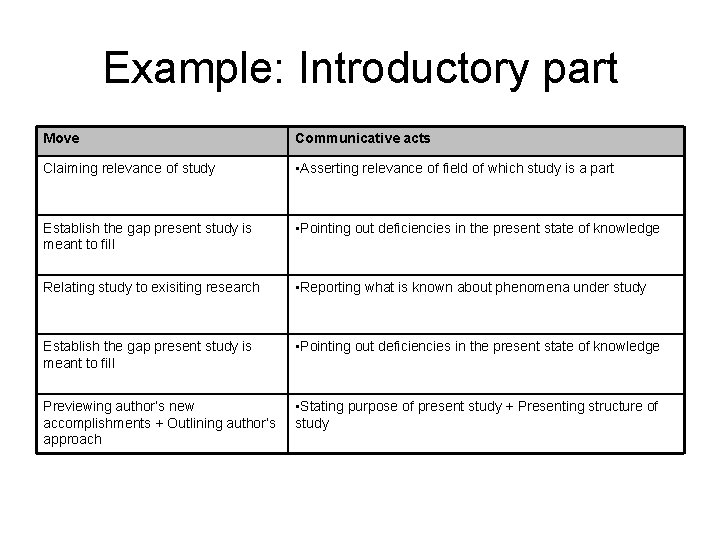
Example: Introductory part Move Communicative acts Claiming relevance of study • Asserting relevance of field of which study is a part Establish the gap present study is meant to fill • Pointing out deficiencies in the present state of knowledge Relating study to exisiting research • Reporting what is known about phenomena under study Establish the gap present study is meant to fill • Pointing out deficiencies in the present state of knowledge Previewing author’s new accomplishments + Outlining author’s approach • Stating purpose of present study + Presenting structure of study
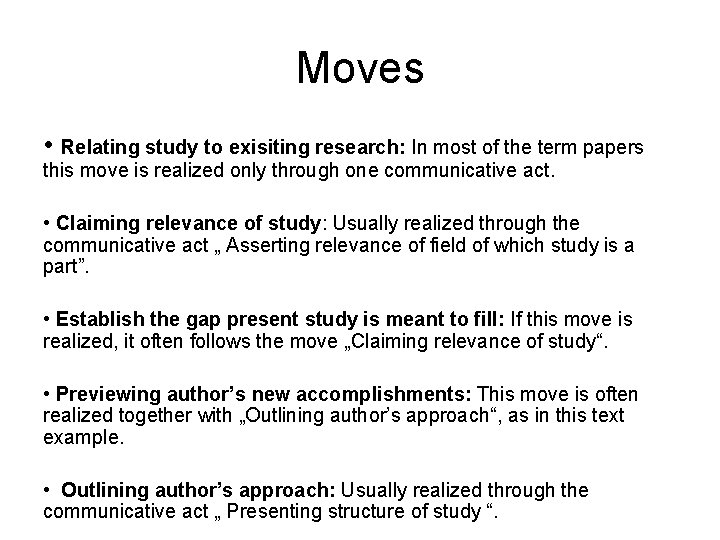
Moves • Relating study to exisiting research: In most of the term papers this move is realized only through one communicative act. • Claiming relevance of study: Usually realized through the communicative act „ Asserting relevance of field of which study is a part”. • Establish the gap present study is meant to fill: If this move is realized, it often follows the move „Claiming relevance of study“. • Previewing author’s new accomplishments: This move is often realized together with „Outlining author’s approach“, as in this text example. • Outlining author’s approach: Usually realized through the communicative act „ Presenting structure of study “.
Lexicogramatical realizations
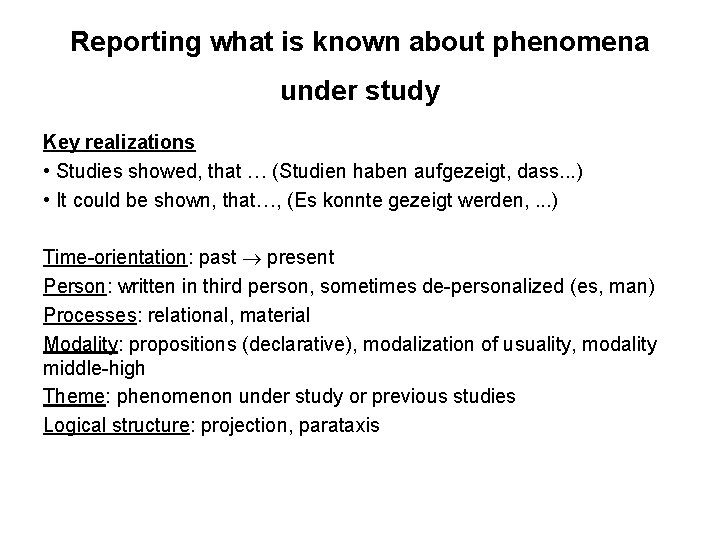
Reporting what is known about phenomena under study Key realizations • Studies showed, that … (Studien haben aufgezeigt, dass. . . ) • It could be shown, that…, (Es konnte gezeigt werden, . . . ) Time-orientation: past present Person: written in third person, sometimes de-personalized (es, man) Processes: relational, material Modality: propositions (declarative), modalization of usuality, modality middle-high Theme: phenomenon under study or previous studies Logical structure: projection, parataxis
Rhetorical structures
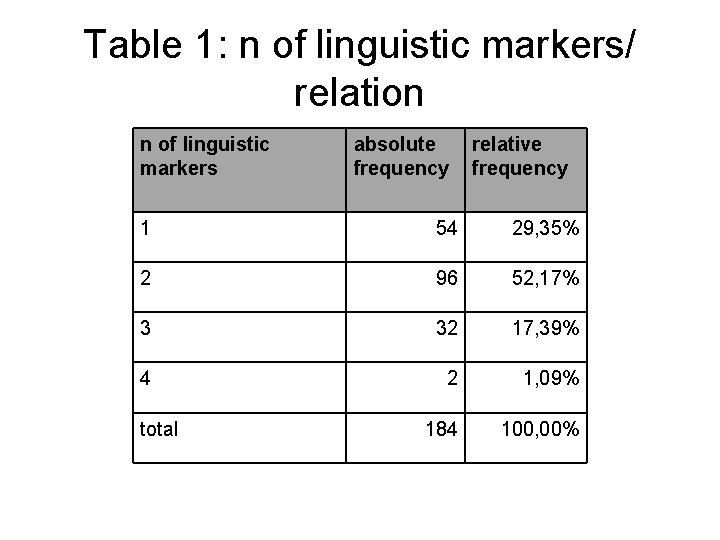
Table 1: n of linguistic markers/ relation n of linguistic markers absolute frequency relative frequency 1 54 29, 35% 2 96 52, 17% 3 32 17, 39% 4 2 1, 09% 184 100, 00% total
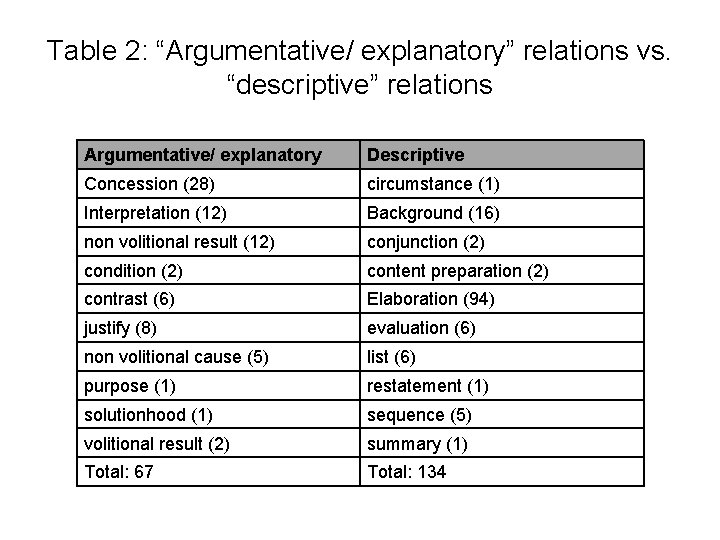
Table 2: “Argumentative/ explanatory” relations vs. “descriptive” relations Argumentative/ explanatory Descriptive Concession (28) circumstance (1) Interpretation (12) Background (16) non volitional result (12) conjunction (2) condition (2) content preparation (2) contrast (6) Elaboration (94) justify (8) evaluation (6) non volitional cause (5) list (6) purpose (1) restatement (1) solutionhood (1) sequence (5) volitional result (2) summary (1) Total: 67 Total: 134
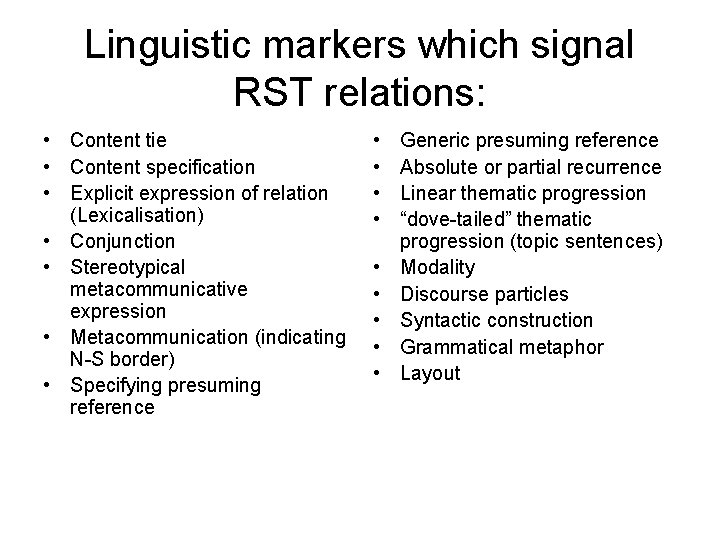
Linguistic markers which signal RST relations: • Content tie • Content specification • Explicit expression of relation (Lexicalisation) • Conjunction • Stereotypical metacommunicative expression • Metacommunication (indicating N-S border) • Specifying presuming reference • • • Generic presuming reference Absolute or partial recurrence Linear thematic progression “dove-tailed” thematic progression (topic sentences) Modality Discourse particles Syntactic construction Grammatical metaphor Layout
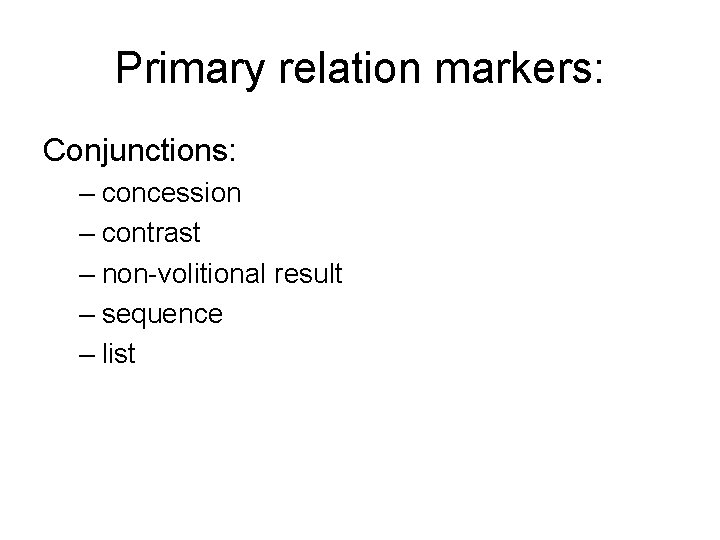
Primary relation markers: Conjunctions: – concession – contrast – non-volitional result – sequence – list
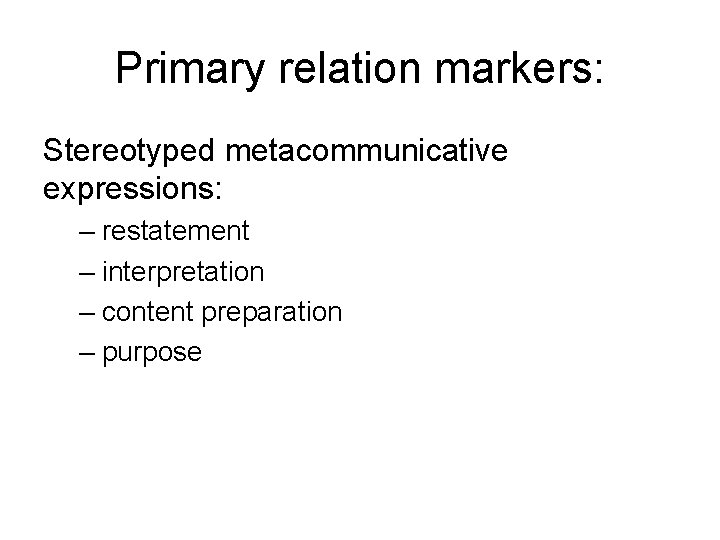
Primary relation markers: Stereotyped metacommunicative expressions: – restatement – interpretation – content preparation – purpose
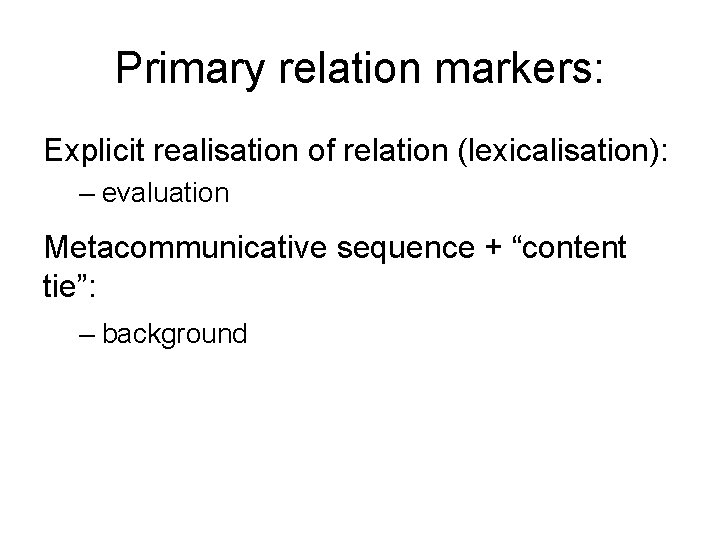
Primary relation markers: Explicit realisation of relation (lexicalisation): – evaluation Metacommunicative sequence + “content tie”: – background
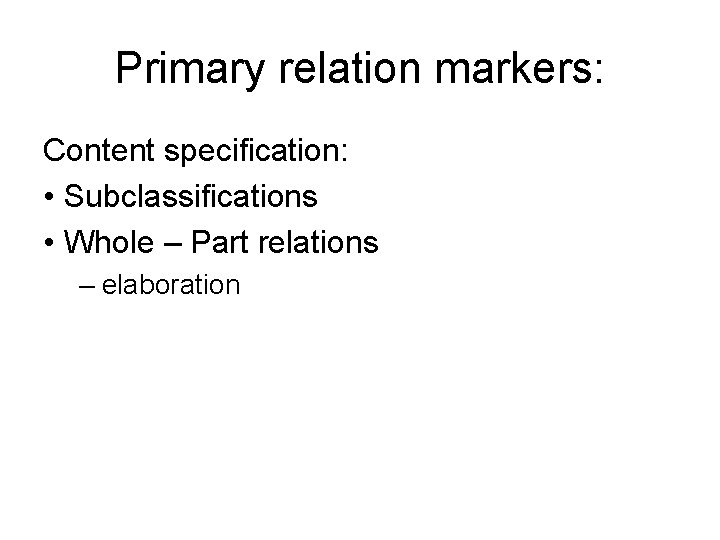
Primary relation markers: Content specification: • Subclassifications • Whole – Part relations – elaboration
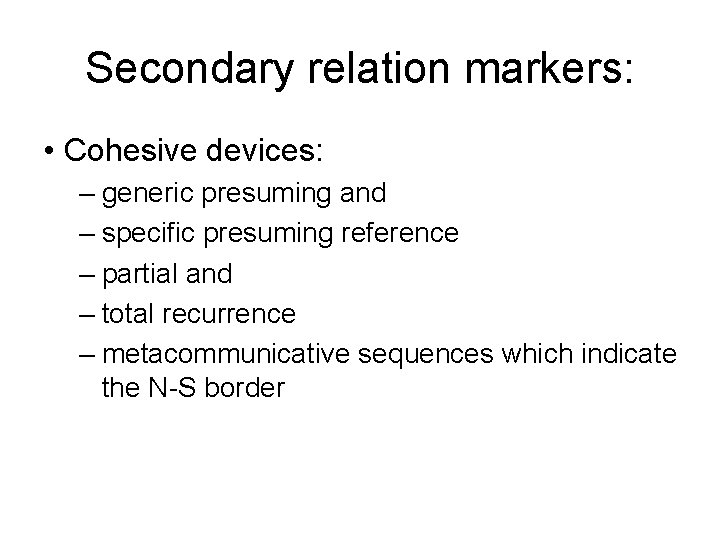
Secondary relation markers: • Cohesive devices: – generic presuming and – specific presuming reference – partial and – total recurrence – metacommunicative sequences which indicate the N-S border
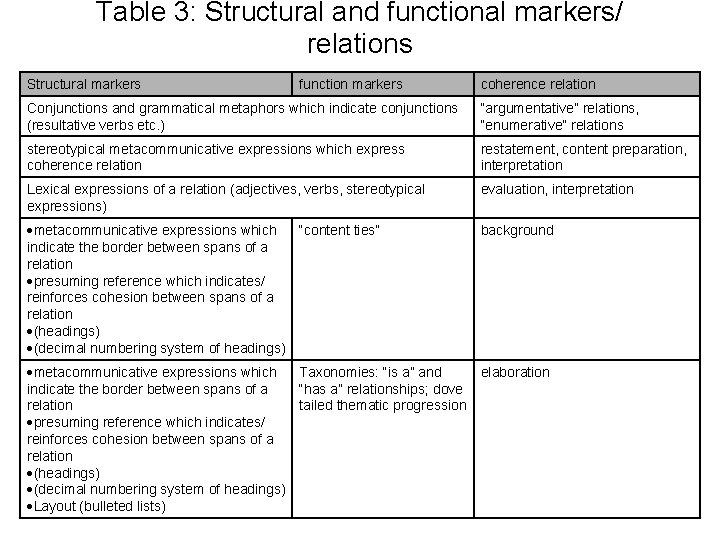
Table 3: Structural and functional markers/ relations Structural markers function markers coherence relation Conjunctions and grammatical metaphors which indicate conjunctions (resultative verbs etc. ) “argumentative” relations, “enumerative” relations stereotypical metacommunicative expressions which express coherence relation restatement, content preparation, interpretation Lexical expressions of a relation (adjectives, verbs, stereotypical expressions) evaluation, interpretation metacommunicative expressions which “content ties” indicate the border between spans of a relation presuming reference which indicates/ reinforces cohesion between spans of a relation (headings) (decimal numbering system of headings) background metacommunicative expressions which Taxonomies: “is a” and elaboration indicate the border between spans of a “has a” relationships; dove relation tailed thematic progression presuming reference which indicates/ reinforces cohesion between spans of a relation (headings) (decimal numbering system of headings) Layout (bulleted lists)
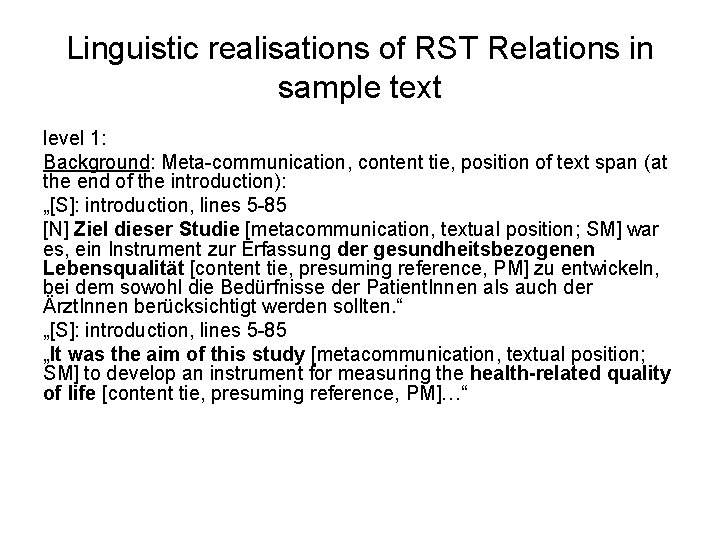
Linguistic realisations of RST Relations in sample text level 1: Background: Meta-communication, content tie, position of text span (at the end of the introduction): „[S]: introduction, lines 5 -85 [N] Ziel dieser Studie [metacommunication, textual position; SM] war es, ein Instrument zur Erfassung der gesundheitsbezogenen Lebensqualität [content tie, presuming reference, PM] zu entwickeln, bei dem sowohl die Bedürfnisse der Patient. Innen als auch der Ärzt. Innen berücksichtigt werden sollten. “ „[S]: introduction, lines 5 -85 „It was the aim of this study [metacommunication, textual position; SM] to develop an instrument for measuring the health-related quality of life [content tie, presuming reference, PM]…“
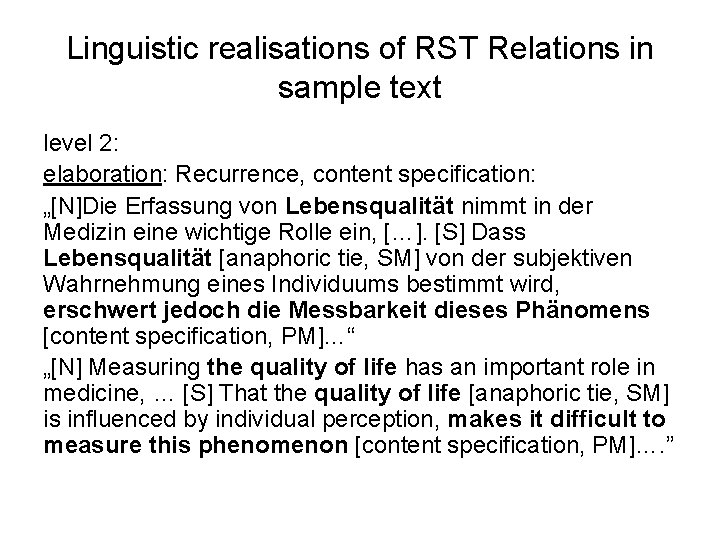
Linguistic realisations of RST Relations in sample text level 2: elaboration: Recurrence, content specification: „[N]Die Erfassung von Lebensqualität nimmt in der Medizin eine wichtige Rolle ein, […]. [S] Dass Lebensqualität [anaphoric tie, SM] von der subjektiven Wahrnehmung eines Individuums bestimmt wird, erschwert jedoch die Messbarkeit dieses Phänomens [content specification, PM]…“ „[N] Measuring the quality of life has an important role in medicine, … [S] That the quality of life [anaphoric tie, SM] is influenced by individual perception, makes it difficult to measure this phenomenon [content specification, PM]…. ”
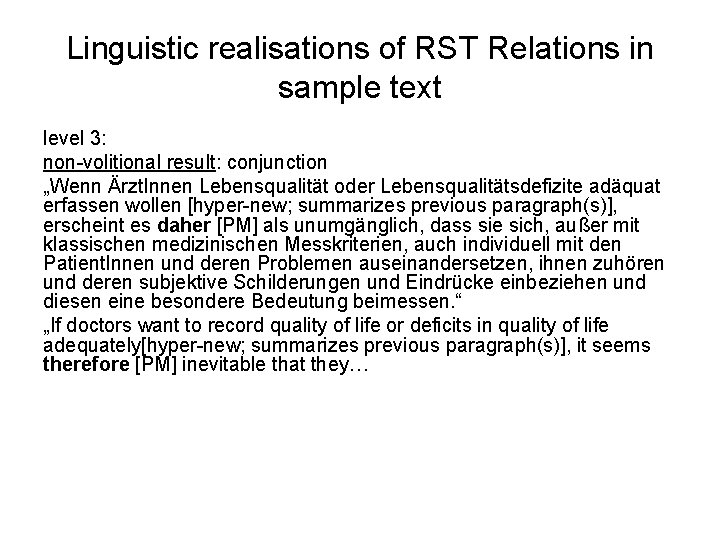
Linguistic realisations of RST Relations in sample text level 3: non-volitional result: conjunction „Wenn Ärzt. Innen Lebensqualität oder Lebensqualitätsdefizite adäquat erfassen wollen [hyper-new; summarizes previous paragraph(s)], erscheint es daher [PM] als unumgänglich, dass sie sich, außer mit klassischen medizinischen Messkriterien, auch individuell mit den Patient. Innen und deren Problemen auseinandersetzen, ihnen zuhören und deren subjektive Schilderungen und Eindrücke einbeziehen und diesen eine besondere Bedeutung beimessen. “ „If doctors want to record quality of life or deficits in quality of life adequately[hyper-new; summarizes previous paragraph(s)], it seems therefore [PM] inevitable that they…
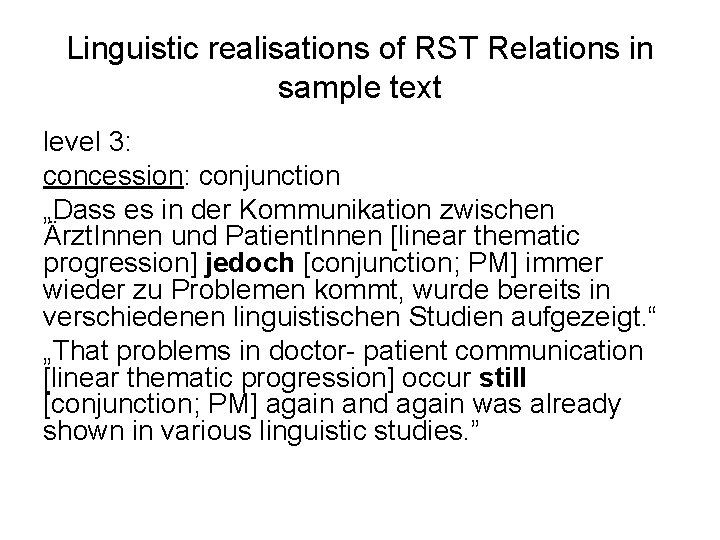
Linguistic realisations of RST Relations in sample text level 3: concession: conjunction „Dass es in der Kommunikation zwischen Ärzt. Innen und Patient. Innen [linear thematic progression] jedoch [conjunction; PM] immer wieder zu Problemen kommt, wurde bereits in verschiedenen linguistischen Studien aufgezeigt. “ „That problems in doctor- patient communication [linear thematic progression] occur still [conjunction; PM] again and again was already shown in various linguistic studies. ”
Introduction: original structure 1 -10 Background Elaboration 1 -9 5 -10 87 -100 Nonvolitional-result 2 -3 10 -14 14 -16 2 -4 18 -27 2 -9 Concession 29 -37 Nonvolitional-result Nonvolitionalresult 39 -61 6 -8 7 -8 62 -63 6 -9 78 -85 Elaboration 65 -76
Introduction: original structure 1 -10 Background Elaboration 1 -9 5 -10 87 -100 Nonvolitional-result 2 -3 10 -14 2 -9 Concession 29 -37 18 -27 14 -16 Nonvolitional-result Nonvolitionalresult 39 -61 6 -8 78 -85 Elaboration 62 -63 Claiming relevance of the study (5 – 16) establishing the gap present research is meant to fill (1) 18 - 37 6 -9 relate study to existing research 39 - 76 65 -76 establishing the gap (2) 78 - 85 Previewing author’s accomplish ments 87 100
Introduction: original structure 1 -10 Background 1 -9 87 -100 Elaboration 5 -10 Concession Nonvolitional-result 2 -9 Nonvolitional-result 2 -3 10 -14 14 -16 2 -4 Nonvolitional-result 29 -37 18 -27 Nonvolitionalresult 39 -61 6 -8 78 -85 Elaboration 62 -63 Claiming relevance of the study (5 – 16) establishing the gap present research is meant to fill (1) 18 - 37 6 -9 relate study to existing research 39 - 76 65 -76 establishin g the gap (2) 78 - 85 Previewing author’s accomplishm ents 87 - 100
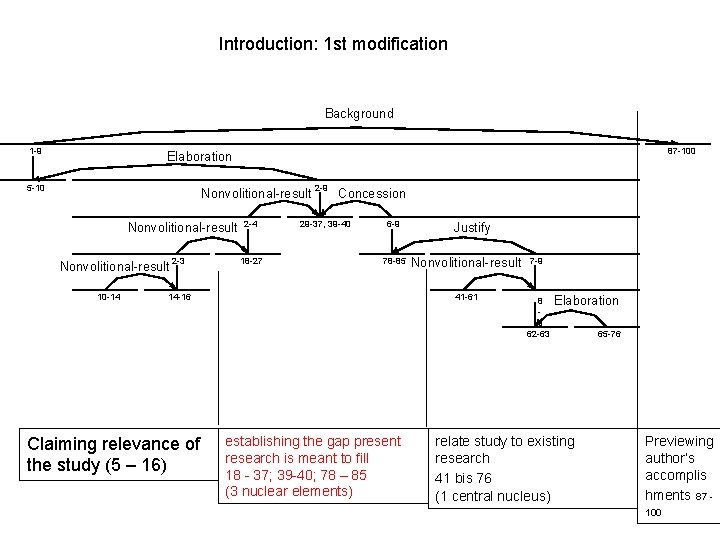
Introduction: 1 st modification Background 1 -9 87 -100 Elaboration 5 -10 Nonvolitional-result 10 -14 2 -3 2 -4 18 -27 2 -9 Concession 29 -37, 39 -40 6 -9 78 -85 14 -16 Claiming relevance of the study (5 – 16) establishing the gap present research is meant to fill 18 - 37; 39 -40; 78 – 85 (3 nuclear elements) Justify Nonvolitional-result 7 -9 41 -61 8 9 62 -63 Elaboration relate study to existing research 41 bis 76 (1 central nucleus) 65 -76 Previewing author’s accomplis hments 87 100
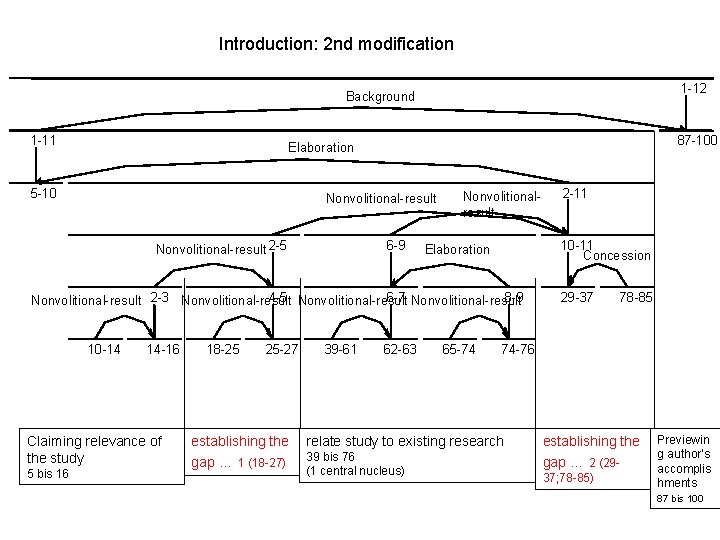
Introduction: 2 nd modification 1 -12 Background 1 -11 87 -100 Elaboration 5 -10 Nonvolitional-result 2 -5 6 -9 Nonvolitionalresult 10 -11 Concession Elaboration 4 -5 Nonvolitional-result 6 -7 Nonvolitional-result 8 -9 Nonvolitional-result 2 -3 Nonvolitional-result 10 -14 14 -16 Claiming relevance of the study 5 bis 16 18 -25 25 -27 establishing the gap … 1 (18 -27) 39 -61 62 -63 65 -74 29 -37 78 -85 74 -76 relate study to existing research 39 bis 76 (1 central nucleus) 2 -11 establishing the gap … 2 (2937; 78 -85) Previewin g author’s accomplis hments 87 bis 100
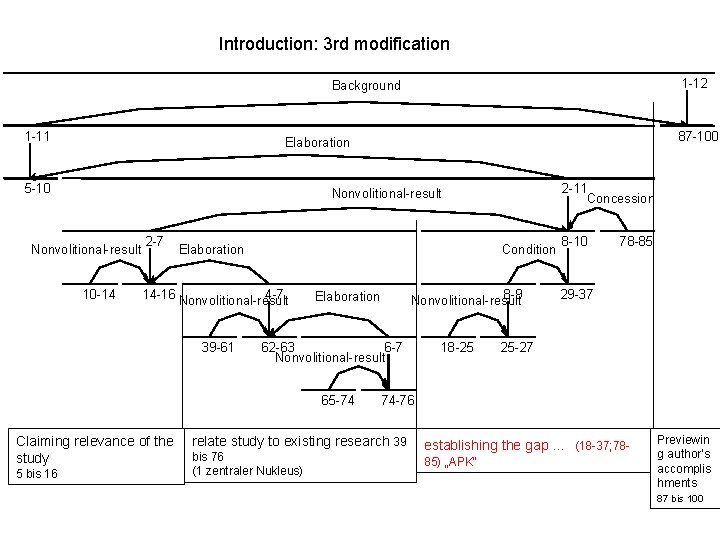
Introduction: 3 rd modification 1 -12 Background 1 -11 5 -10 2 -11 Concession Nonvolitional-result 10 -14 2 -7 Elaboration Condition 14 -16 Nonvolitional-result 4 -7 39 -61 Claiming relevance of the study 8 -9 Nonvolitional-result Elaboration 62 -63 6 -7 Nonvolitional-result 65 -74 5 bis 16 87 -100 Elaboration 78 -85 29 -37 25 -27 74 -76 relate study to existing research 39 bis 76 (1 zentraler Nukleus) 18 -25 8 -10 establishing the gap … (18 -37; 7885) „APK“ Previewin g author’s accomplis hments 87 bis 100
The end