
TWO TRAIT CROSSES Mendel also studied two separate
- Slides: 26
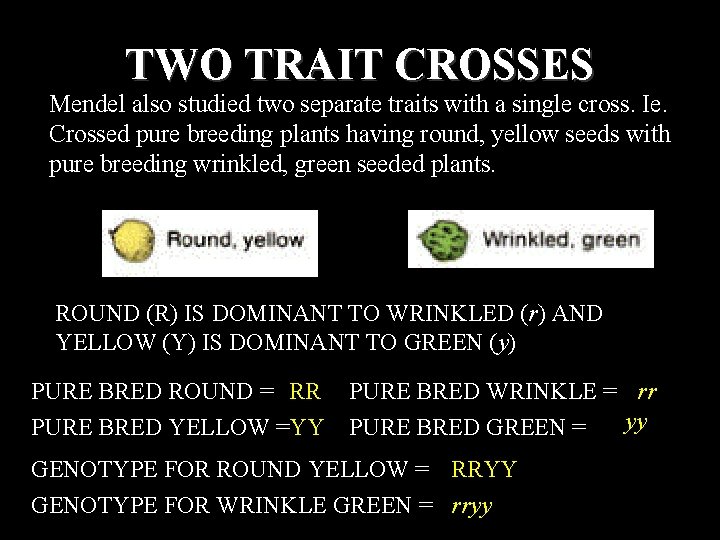
TWO TRAIT CROSSES Mendel also studied two separate traits with a single cross. Ie. Crossed pure breeding plants having round, yellow seeds with pure breeding wrinkled, green seeded plants. ROUND (R) IS DOMINANT TO WRINKLED (r) AND YELLOW (Y) IS DOMINANT TO GREEN (y) PURE BRED ROUND = RR PURE BRED YELLOW =YY PURE BRED WRINKLE = rr yy PURE BRED GREEN = GENOTYPE FOR ROUND YELLOW = RRYY GENOTYPE FOR WRINKLE GREEN = rryy
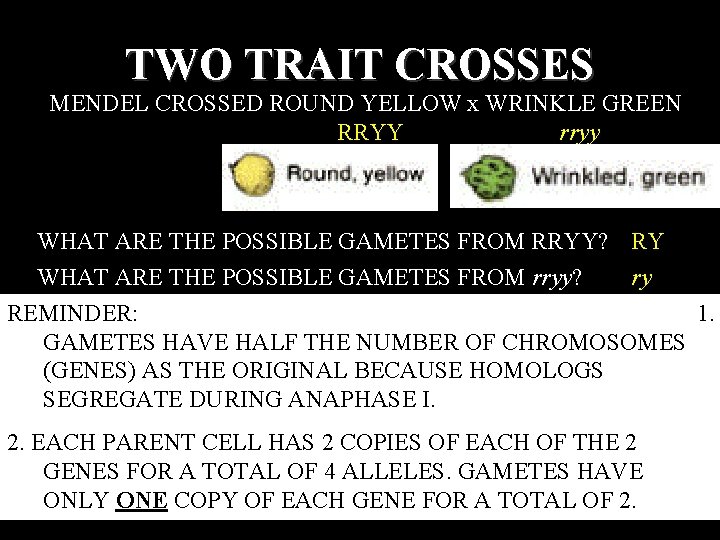
TWO TRAIT CROSSES MENDEL CROSSED ROUND YELLOW x WRINKLE GREEN RRYY rryy WHAT ARE THE POSSIBLE GAMETES FROM RRYY? RY WHAT ARE THE POSSIBLE GAMETES FROM rryy? ry REMINDER: 1. GAMETES HAVE HALF THE NUMBER OF CHROMOSOMES (GENES) AS THE ORIGINAL BECAUSE HOMOLOGS SEGREGATE DURING ANAPHASE I. 2. EACH PARENT CELL HAS 2 COPIES OF EACH OF THE 2 GENES FOR A TOTAL OF 4 ALLELES. GAMETES HAVE ONLY ONE COPY OF EACH GENE FOR A TOTAL OF 2.
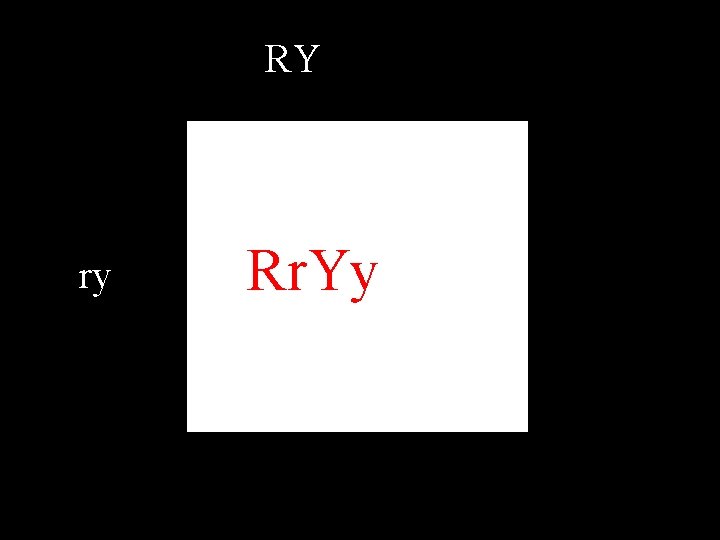
RY ry Rr. Yy
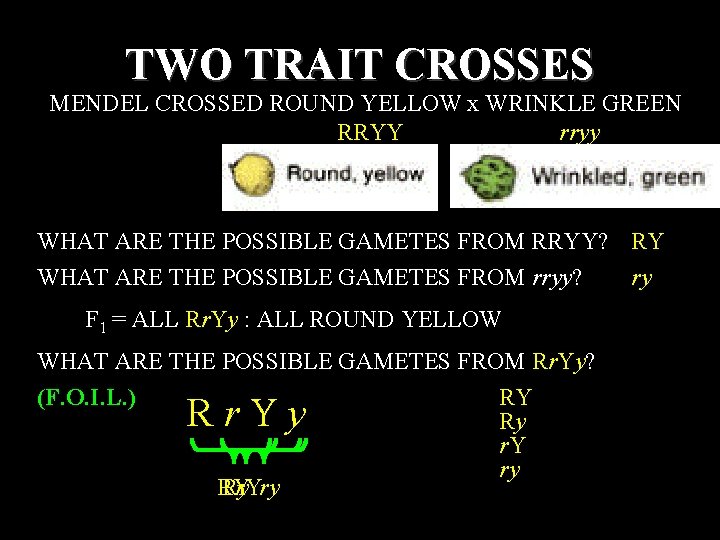
TWO TRAIT CROSSES MENDEL CROSSED ROUND YELLOW x WRINKLE GREEN RRYY rryy WHAT ARE THE POSSIBLE GAMETES FROM RRYY? RY WHAT ARE THE POSSIBLE GAMETES FROM rryy? ry F 1 = ALL Rr. Yy : ALL ROUND YELLOW WHAT ARE THE POSSIBLE GAMETES FROM Rr. Yy? (F. O. I. L. ) RY Ry r. Y ry RY Ry r. Yry Rr. Yy
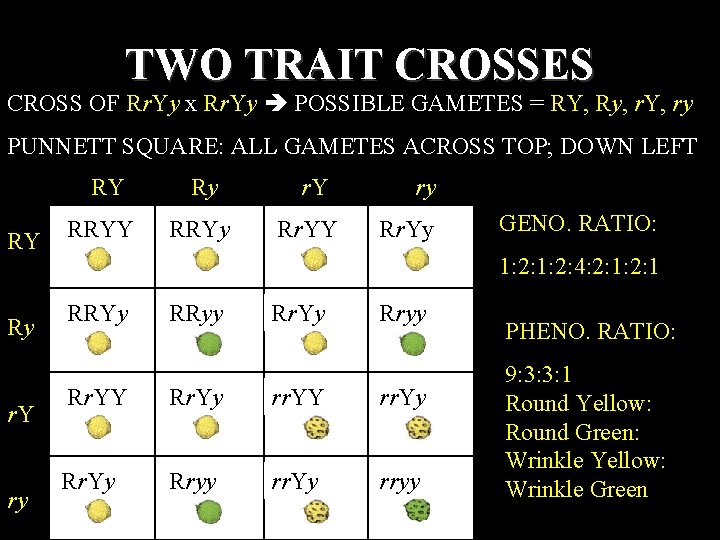
TWO TRAIT CROSSES CROSS OF Rr. Yy x Rr. Yy POSSIBLE GAMETES = RY, Ry, r. Y, ry PUNNETT SQUARE: ALL GAMETES ACROSS TOP; DOWN LEFT RY RY Ry r. Y ry RRYY Ry RRYy r. Y Rr. YY ry Rr. Yy GENO. RATIO: 1: 2: 4: 2: 1 RRYy RRyy Rr. Yy Rryy Rr. YY Rr. Yy rr. YY rr. Yy Rryy rr. Yy rryy PHENO. RATIO: 9: 3: 3: 1 Round Yellow: Round Green: Wrinkle Yellow: Wrinkle Green
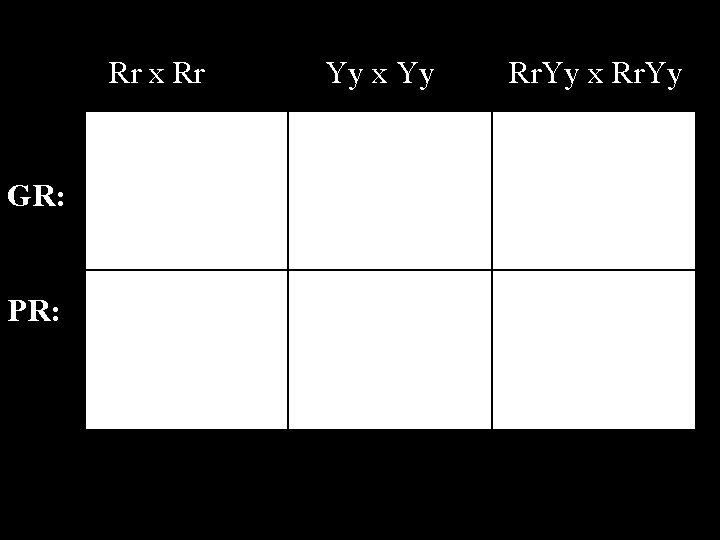
Rr x Rr GR: PR: Yy x Yy Rr. Yy x Rr. Yy
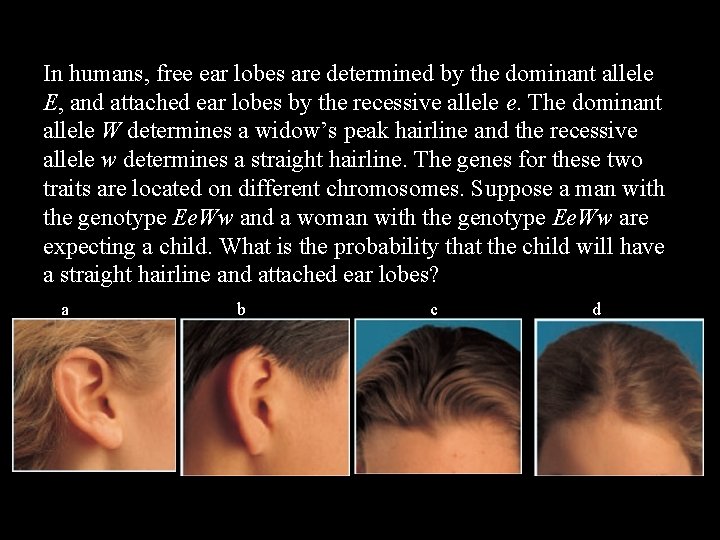
In humans, free ear lobes are determined by the dominant allele E, and attached ear lobes by the recessive allele e. The dominant allele W determines a widow’s peak hairline and the recessive allele w determines a straight hairline. The genes for these two traits are located on different chromosomes. Suppose a man with the genotype Ee. Ww and a woman with the genotype Ee. Ww are expecting a child. What is the probability that the child will have a straight hairline and attached ear lobes? a b c d
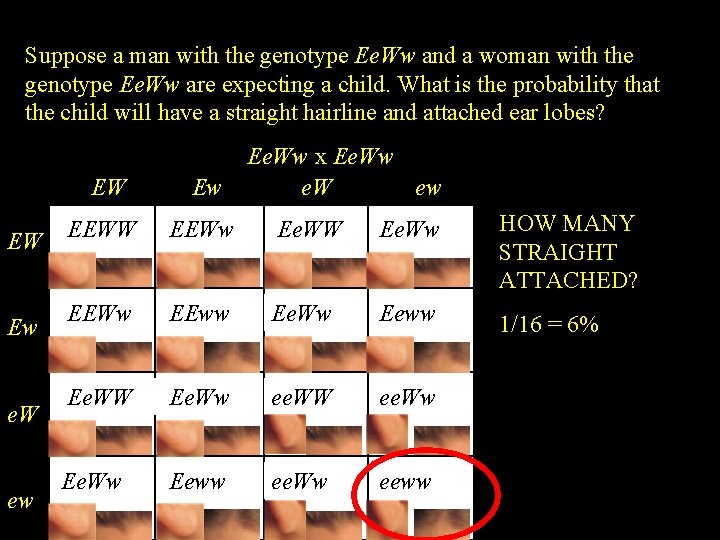
Suppose a man with the genotype Ee. Ww and a woman with the genotype Ee. Ww are expecting a child. What is the probability that the child will have a straight hairline and attached ear lobes? EW Ew e. W ew Ee. Ww x Ee. Ww e. W ew EW Ew EEWW EEWw Ee. WW Ee. Ww HOW MANY STRAIGHT ATTACHED? EEWw EEww Ee. Ww Eeww 1/16 = 6% Ee. WW Ee. Ww ee. WW ee. Ww Eeww ee. Ww eeww
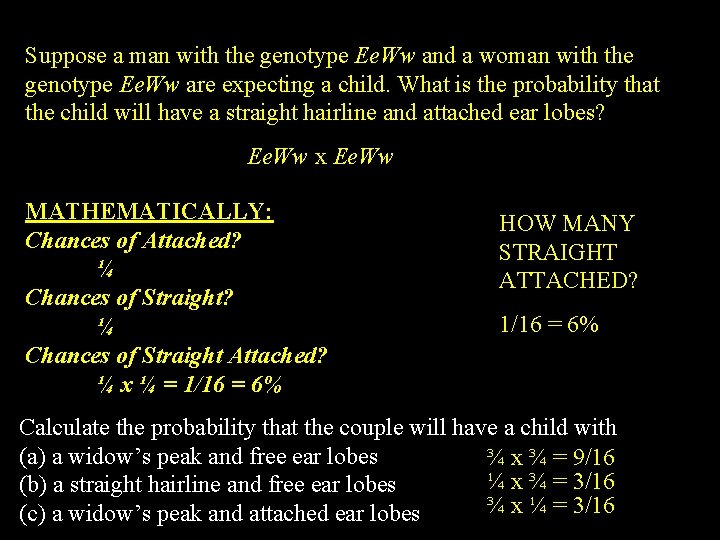
Suppose a man with the genotype Ee. Ww and a woman with the genotype Ee. Ww are expecting a child. What is the probability that the child will have a straight hairline and attached ear lobes? Ee. Ww x Ee. Ww MATHEMATICALLY: Chances of Attached? ¼ Chances of Straight Attached? ¼ x ¼ = 1/16 = 6% HOW MANY STRAIGHT ATTACHED? 1/16 = 6% Calculate the probability that the couple will have a child with (a) a widow’s peak and free ear lobes ¾ x ¾ = 9/16 ¼ x ¾ = 3/16 (b) a straight hairline and free ear lobes ¾ x ¼ = 3/16 (c) a widow’s peak and attached ear lobes
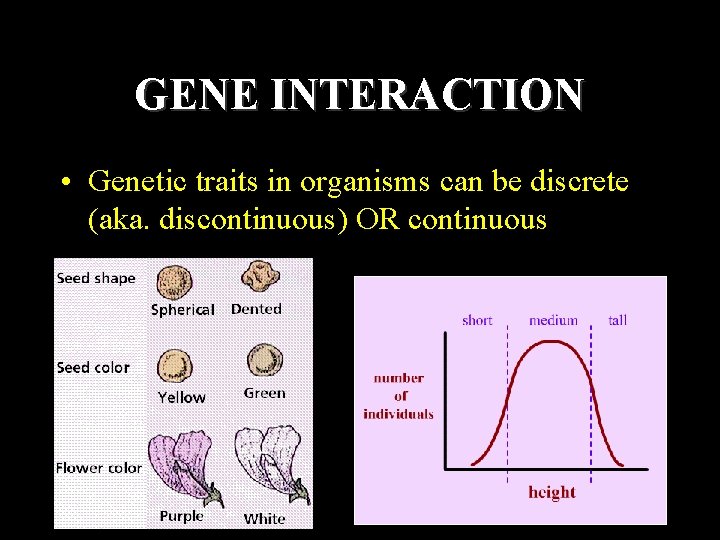
GENE INTERACTION • Genetic traits in organisms can be discrete (aka. discontinuous) OR continuous
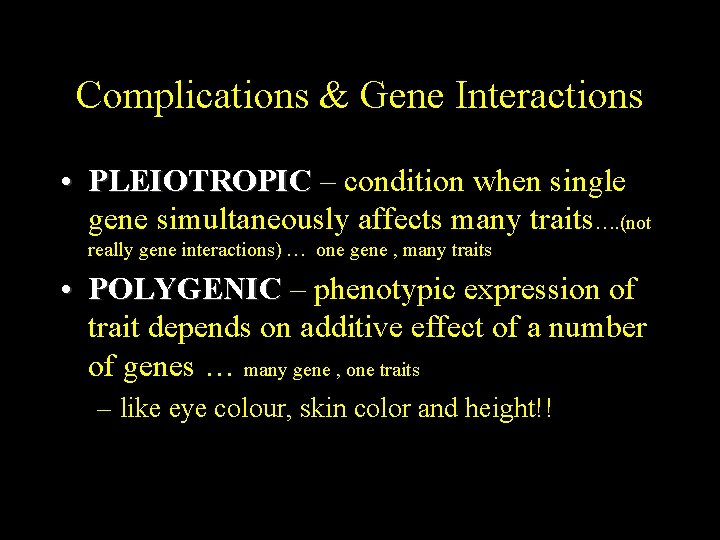
Complications & Gene Interactions • PLEIOTROPIC – condition when single gene simultaneously affects many traits…. (not really gene interactions) … one gene , many traits • POLYGENIC – phenotypic expression of trait depends on additive effect of a number of genes … many gene , one traits – like eye colour, skin color and height!!
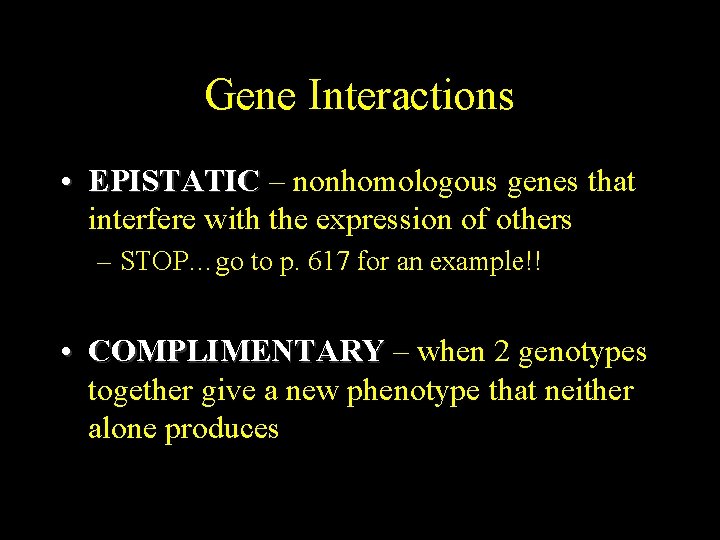
Gene Interactions • EPISTATIC – nonhomologous genes that interfere with the expression of others – STOP…go to p. 617 for an example!! • COMPLIMENTARY – when 2 genotypes together give a new phenotype that neither alone produces
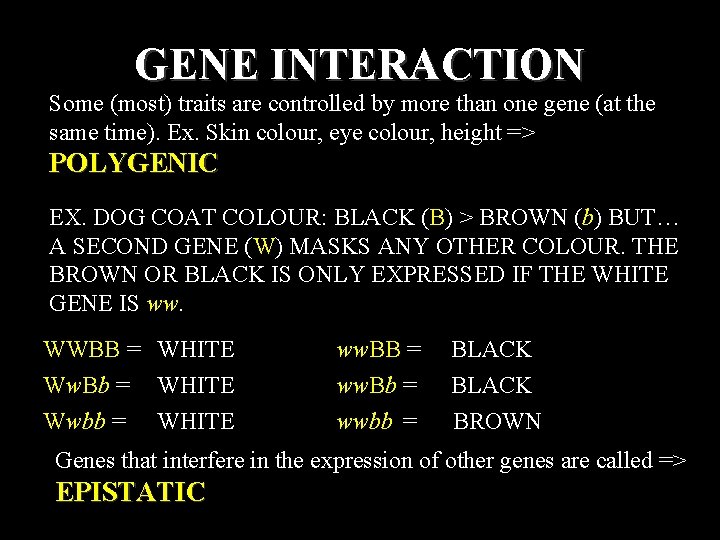
GENE INTERACTION Some (most) traits are controlled by more than one gene (at the same time). Ex. Skin colour, eye colour, height => POLYGENIC EX. DOG COAT COLOUR: BLACK (B) > BROWN (b) BUT… A SECOND GENE (W) MASKS ANY OTHER COLOUR. THE BROWN OR BLACK IS ONLY EXPRESSED IF THE WHITE GENE IS ww. WWBB = WHITE Ww. Bb = WHITE Wwbb = WHITE ww. BB = ww. Bb = wwbb = BLACK BROWN Genes that interfere in the expression of other genes are called => EPISTATIC
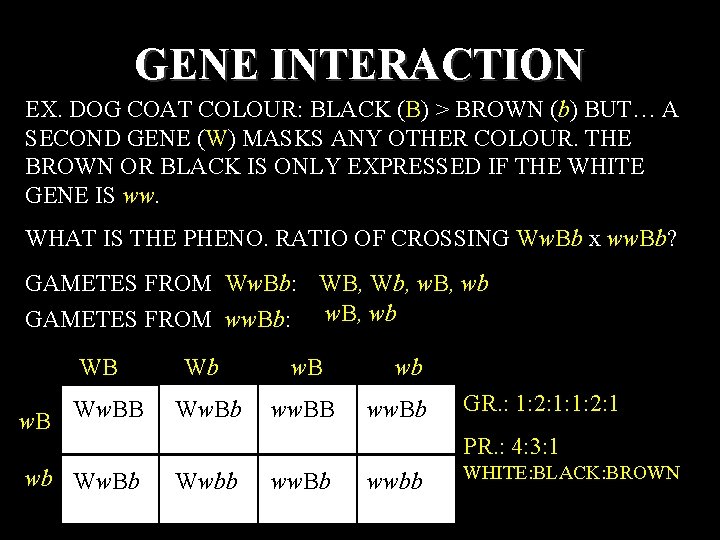
GENE INTERACTION EX. DOG COAT COLOUR: BLACK (B) > BROWN (b) BUT… A SECOND GENE (W) MASKS ANY OTHER COLOUR. THE BROWN OR BLACK IS ONLY EXPRESSED IF THE WHITE GENE IS ww. WHAT IS THE PHENO. RATIO OF CROSSING Ww. Bb x ww. Bb? GAMETES FROM Ww. Bb: WB, Wb, w. B, wb GAMETES FROM ww. Bb: w. B, wb WB Wb w. B Ww. Bb wb Ww. Bb Wwbb w. B ww. BB wb ww. Bb GR. : 1: 2: 1 PR. : 4: 3: 1 ww. Bb wwbb WHITE: BLACK: BROWN
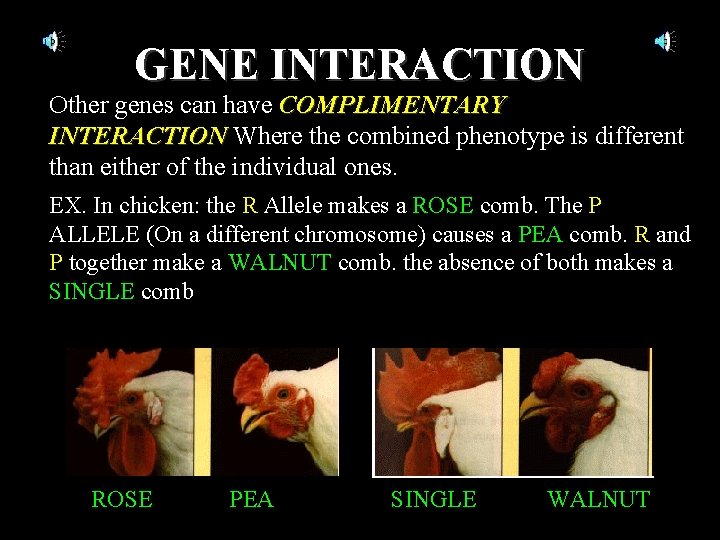
GENE INTERACTION Other genes can have COMPLIMENTARY INTERACTION Where the combined phenotype is different than either of the individual ones. EX. In chicken: the R Allele makes a ROSE comb. The P ALLELE (On a different chromosome) causes a PEA comb. R and P together make a WALNUT comb. the absence of both makes a SINGLE comb ROSE PEA SINGLE WALNUT
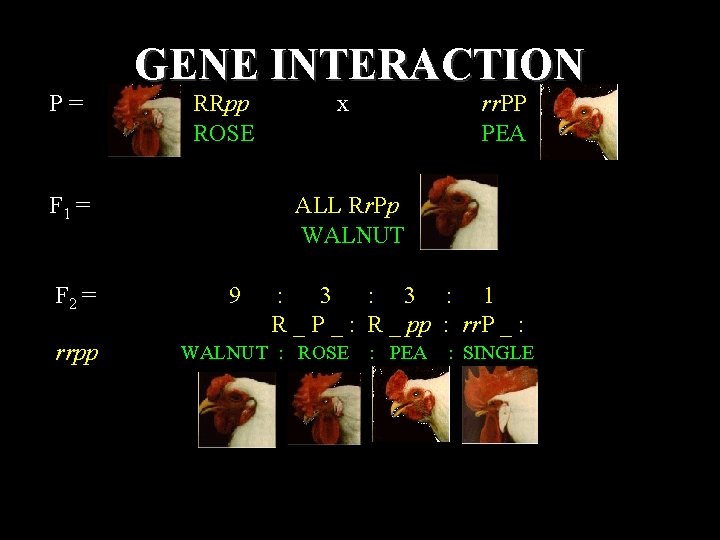
P= GENE INTERACTION RRpp ROSE F 1 = F 2 = rrpp x rr. PP PEA ALL Rr. Pp WALNUT 9 : 3 : 1 R _ P _ : R _ pp : rr. P _ : WALNUT : ROSE : PEA : SINGLE
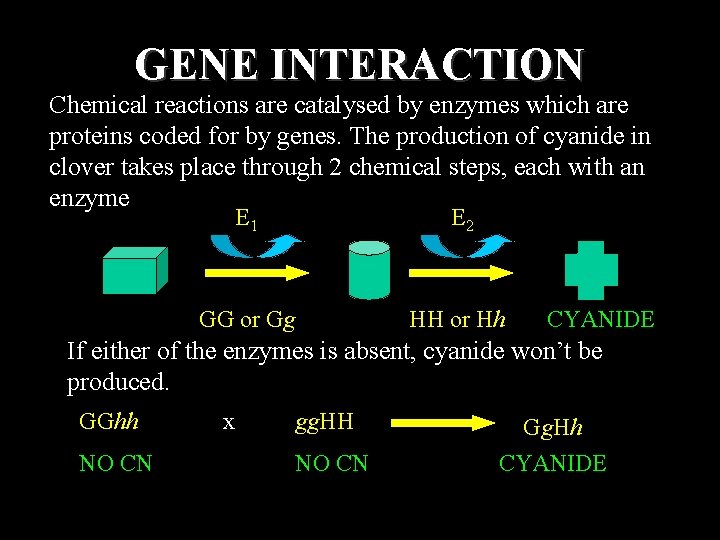
GENE INTERACTION Chemical reactions are catalysed by enzymes which are proteins coded for by genes. The production of cyanide in clover takes place through 2 chemical steps, each with an enzyme E 1 E 2 GG or Gg HH or Hh CYANIDE If either of the enzymes is absent, cyanide won’t be produced. GGhh NO CN x gg. HH NO CN Gg. Hh CYANIDE
GENE INTERACTION Some single genes can cause many different effects in the body (many “phenotypes”). These genes are called PLEIOTROPIC. EX. Marfan syndrome EX. Sickle cell anemia => normal hemoglobin carries oxygen on red blood cells (HAHA) A point mutation (HS) Causes mis-shaped hemoglobin = sickle cell. Because of this, hemoglobin can’t carry oxygen very well. Many effects come from the homozygous condition (HSHS): Fatigue, weakness, enlarged spleen, rhumatism, pneumonia, heart/kidney/lung damage, stroke. Interestingly, sickle cell gives resistence to malaria. People who are HAHS have an advantage.
EFFECTS OF THE ENVIRONMENT ON PHENOTYPE The environment can cause genes to express themselves in different ways. Ex. Freckles – only expressed after sun exposure - Some water plants grow different shaped leaves under water than above water.
PAGE 619, 18. 5 QUESTIONS #1 -4
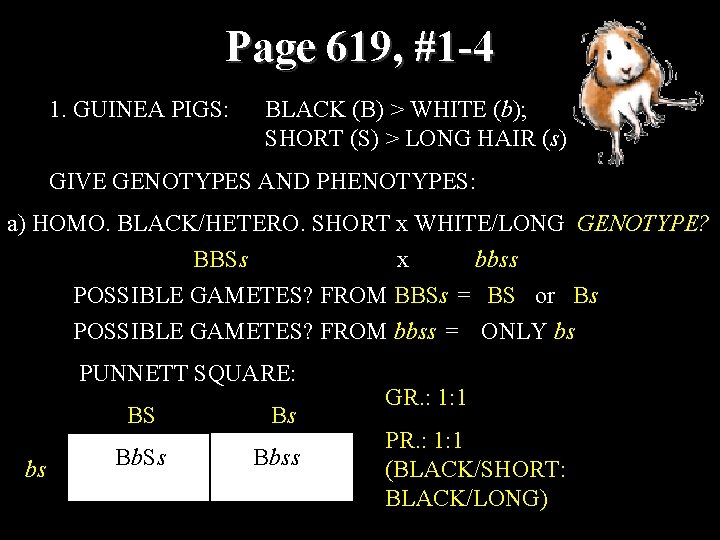
Page 619, #1 -4 1. GUINEA PIGS: BLACK (B) > WHITE (b); SHORT (S) > LONG HAIR (s) GIVE GENOTYPES AND PHENOTYPES: a) HOMO. BLACK/HETERO. SHORT x WHITE/LONG GENOTYPE? BBSs x bbss POSSIBLE GAMETES? FROM BBSs = BS or Bs POSSIBLE GAMETES? FROM bbss = ONLY bs PUNNETT SQUARE: BS bs Bb. Ss Bs Bbss GR. : 1: 1 PR. : 1: 1 (BLACK/SHORT: BLACK/LONG)
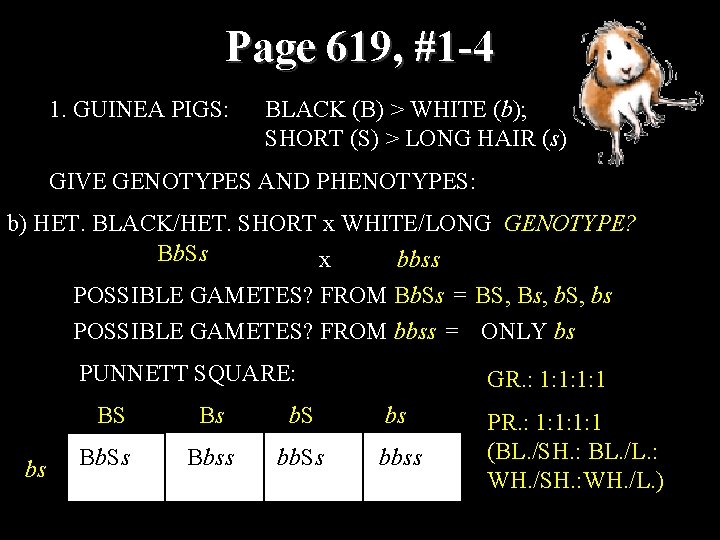
Page 619, #1 -4 1. GUINEA PIGS: BLACK (B) > WHITE (b); SHORT (S) > LONG HAIR (s) GIVE GENOTYPES AND PHENOTYPES: b) HET. BLACK/HET. SHORT x WHITE/LONG GENOTYPE? Bb. Ss x bbss POSSIBLE GAMETES? FROM Bb. Ss = BS, Bs, b. S, bs POSSIBLE GAMETES? FROM bbss = ONLY bs PUNNETT SQUARE: BS bs `Bb. Ss GR. : 1: 1 Bs b. S bs Bbss bb. Ss bbss PR. : 1: 1 (BL. /SH. : BL. /L. : WH. /SH. : WH. /L. )
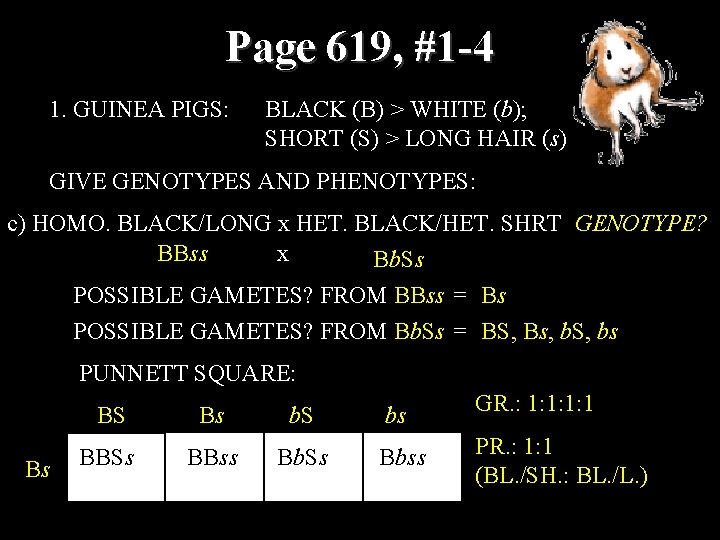
Page 619, #1 -4 1. GUINEA PIGS: BLACK (B) > WHITE (b); SHORT (S) > LONG HAIR (s) GIVE GENOTYPES AND PHENOTYPES: c) HOMO. BLACK/LONG x HET. BLACK/HET. SHRT GENOTYPE? BBss x Bb. Ss POSSIBLE GAMETES? FROM BBss = Bs POSSIBLE GAMETES? FROM Bb. Ss = BS, Bs, b. S, bs PUNNETT SQUARE: BS Bs `BBSs Bs b. S bs GR. : 1: 1 BBss Bb. Ss Bbss PR. : 1: 1 (BL. /SH. : BL. /L. )
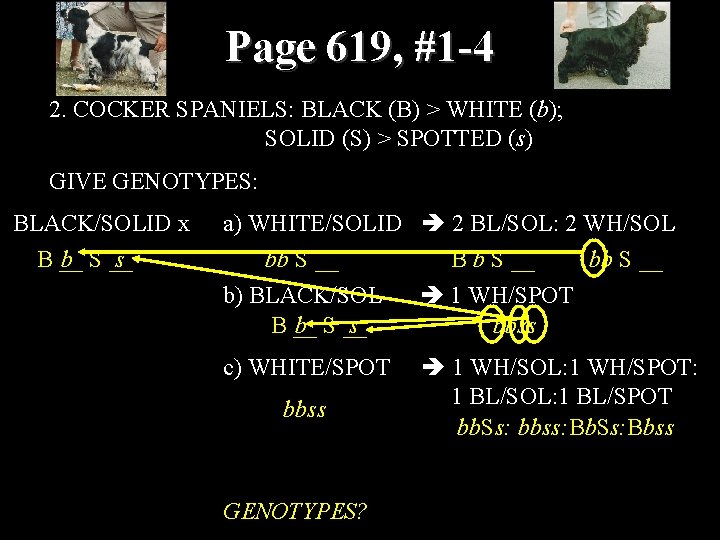
Page 619, #1 -4 2. COCKER SPANIELS: BLACK (B) > WHITE (b); SOLID (S) > SPOTTED (s) GIVE GENOTYPES: BLACK/SOLID x B __ b S __ s a) WHITE/SOLID 2 BL/SOL: 2 WH/SOL bb S __ B b S __ b) BLACK/SOL B __ b S __ s 1 WH/SPOT bbss c) WHITE/SPOT 1 WH/SOL: 1 WH/SPOT: 1 BL/SOL: 1 BL/SPOT bb. Ss: bbss: Bb. Ss: Bbss bbss GENOTYPES?
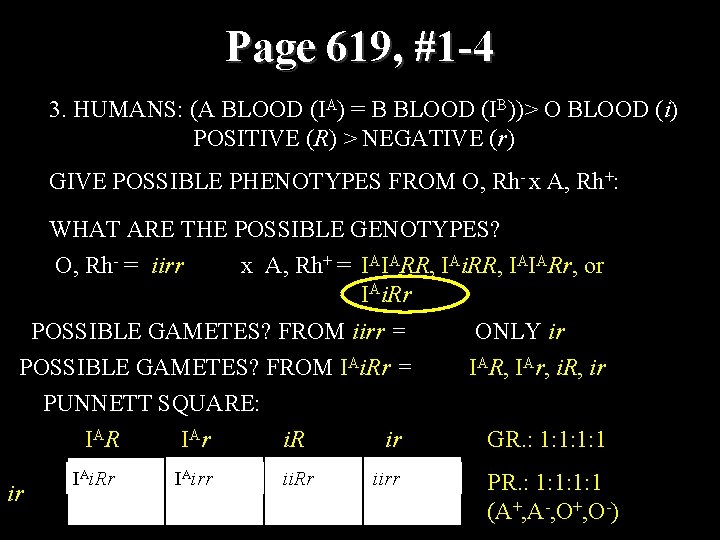
Page 619, #1 -4 3. HUMANS: (A BLOOD (IA) = B BLOOD (IB))> O BLOOD (i) POSITIVE (R) > NEGATIVE (r) GIVE POSSIBLE PHENOTYPES FROM O, Rh- x A, Rh+: WHAT ARE THE POSSIBLE GENOTYPES? O, Rh- = iirr x A, Rh+ = IAIARR, IAi. RR, IAIARr, or IAi. Rr POSSIBLE GAMETES? FROM iirr = POSSIBLE GAMETES? FROM IAi. Rr = PUNNETT SQUARE: IA R IA r i. R ir ir `IAi. Rr IAirr ii. Rr iirr ONLY ir IAR, IAr, i. R, ir GR. : 1: 1 PR. : 1: 1 (A+, A-, O+, O-)
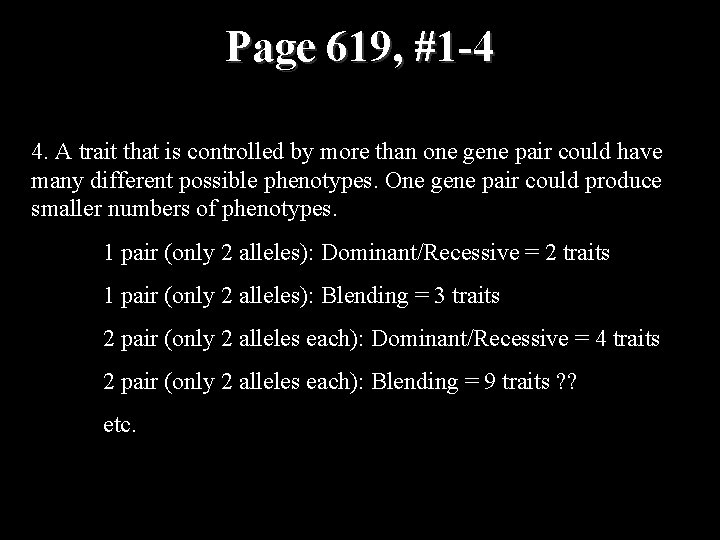
Page 619, #1 -4 4. A trait that is controlled by more than one gene pair could have many different possible phenotypes. One gene pair could produce smaller numbers of phenotypes. 1 pair (only 2 alleles): Dominant/Recessive = 2 traits 1 pair (only 2 alleles): Blending = 3 traits 2 pair (only 2 alleles each): Dominant/Recessive = 4 traits 2 pair (only 2 alleles each): Blending = 9 traits ? ? etc.