
TWO OBJECTS AND TENSION 1 Atwoods Machine Two
TWO OBJECTS AND TENSION

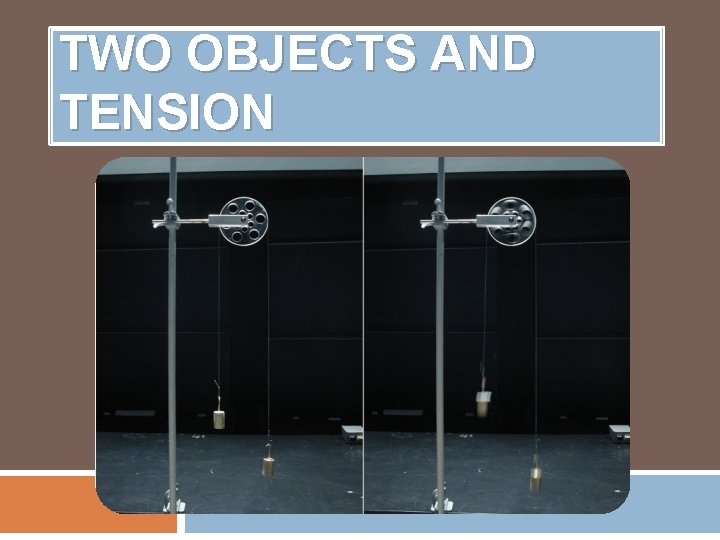
1) Atwood’s Machine: Two masses suspended by a pulley Diagram: Include all forces at work on the two masses. • Both masses have a Fg that pull downwards, but since they are connected by a pulley those forces work in opposition. • The masses will accelerate so that the heavy mass moves downward. • Since they are attached by a rope the acceleration of the masses must be equal.
Note that there is a force of TENSION (T) that exists along the rope. Tension acts the same as all other forces, with two important peculiarities: 1) It is an internal force, acting along the rope in BOTH directions. 2) It cancels out of the total net force equation (so long as the rope is not stretching)
The Strategies: • When solving these problems it is easiest for us to choose the direction of the larger mass moving downwards as the positive direction. · Remember that the acceleration on the two masses MUST BE EQUAL. · It can also be easier to conceptualize this problem if we “unfold” the masses and lay them out in a line, while keeping all of our forces as they are… …I know that sounds weird so, here’s an example.
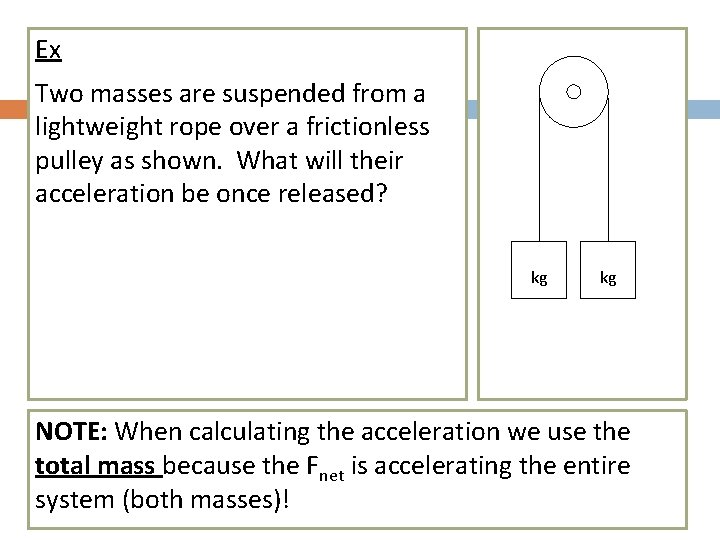
Ex Two masses are suspended from a lightweight rope over a frictionless pulley as shown. What will their acceleration be once released? kg kg NOTE: When calculating the acceleration we use the total mass because the Fnet is accelerating the entire system (both masses)!
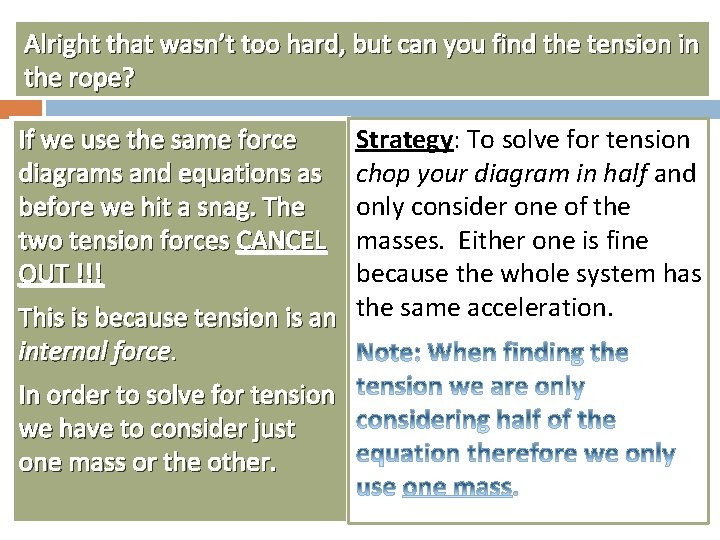
Alright that wasn’t too hard, but can you find the tension in the rope? If we use the same force diagrams and equations as before we hit a snag. The two tension forces CANCEL OUT !!! Strategy: To solve for tension chop your diagram in half and only consider one of the masses. Either one is fine because the whole system has This is because tension is an the same acceleration. internal force. In order to solve for tension we have to consider just one mass or the other.
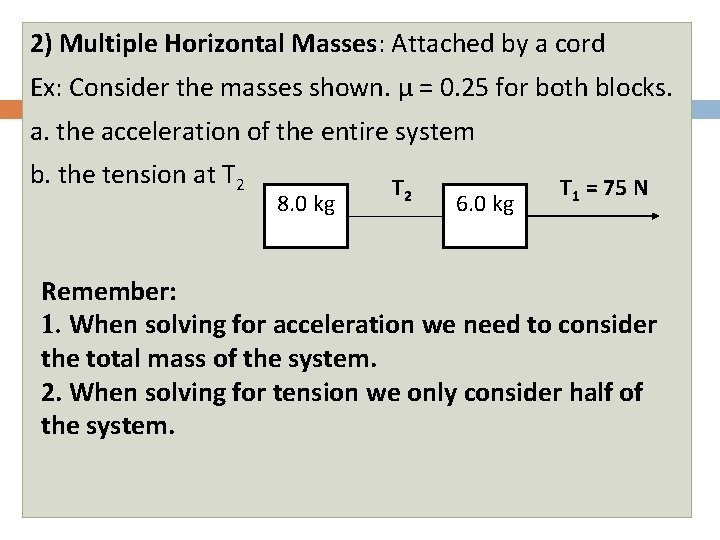
2) Multiple Horizontal Masses: Attached by a cord Ex: Consider the masses shown. µ = 0. 25 for both blocks. a. the acceleration of the entire system b. the tension at T 2 8. 0 kg T 2 6. 0 kg T 1 = 75 N Remember: 1. When solving for acceleration we need to consider the total mass of the system. 2. When solving for tension we only consider half of the system.
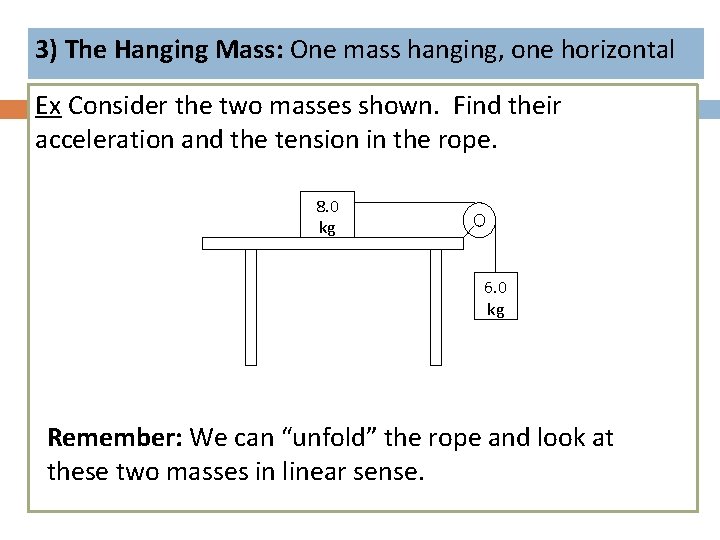
3) The Hanging Mass: One mass hanging, one horizontal Ex Consider the two masses shown. Find their acceleration and the tension in the rope. 8. 0 kg 6. 0 kg Remember: We can “unfold” the rope and look at these two masses in linear sense.
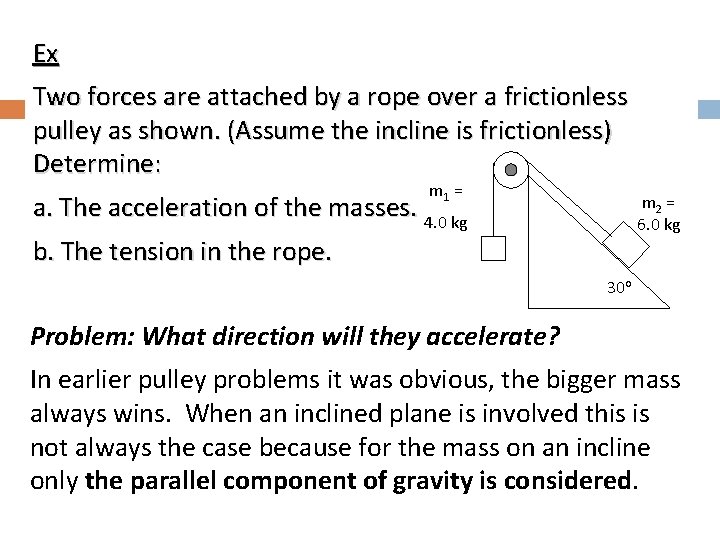
Ex Two forces are attached by a rope over a frictionless pulley as shown. (Assume the incline is frictionless) Determine: m 1 = a. The acceleration of the masses. 4. 0 kg m 2 = 6. 0 kg b. The tension in the rope. 30 o Problem: What direction will they accelerate? In earlier pulley problems it was obvious, the bigger mass always wins. When an inclined plane is involved this is not always the case because for the mass on an incline only the parallel component of gravity is considered.
So determine the forces on each one separately and see which one is the winner. Force 1 =____ Force 2 = _____ Ok, so the winner in this case is Fg 1 so we will take the direction it moves as positive….
Once we know the magnitude of the forces at work on the two blocks, this problem becomes very similar to the simpler pulley questions. Now solve for the acceleration and tension.
Strategy: 1. Draw free body diagrams for every object. 2. Find the net force for each direction of each free body diagram. Remember how to do directions on an incline. 3. Solve using algebra (most likely substitution and elimination) for the unknown variables.
- Slides: 12