
Two Managerial Levers to Reduce Safety Inventory Safety
- Slides: 38
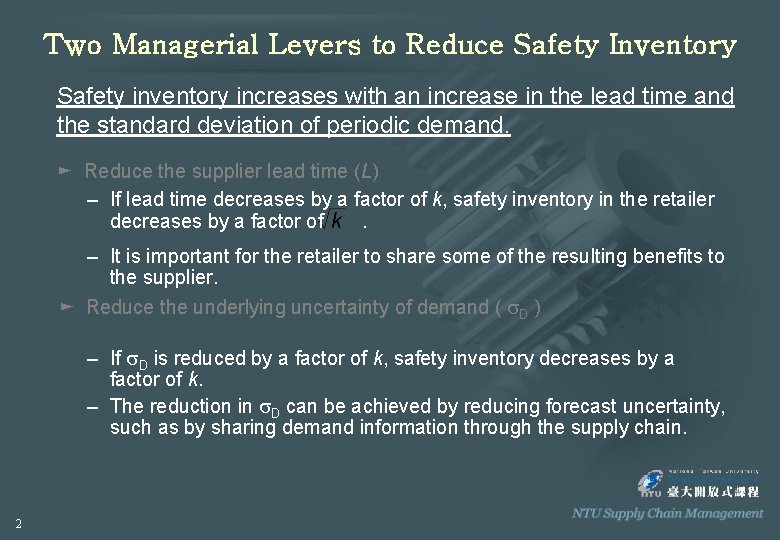
Two Managerial Levers to Reduce Safety Inventory Safety inventory increases with an increase in the lead time and the standard deviation of periodic demand. ► Reduce the supplier lead time (L) – If lead time decreases by a factor of k, safety inventory in the retailer decreases by a factor of. – It is important for the retailer to share some of the resulting benefits to the supplier. ► Reduce the underlying uncertainty of demand ( s. D ) – If s. D is reduced by a factor of k, safety inventory decreases by a factor of k. – The reduction in s. D can be achieved by reducing forecast uncertainty, such as by sharing demand information through the supply chain. 2
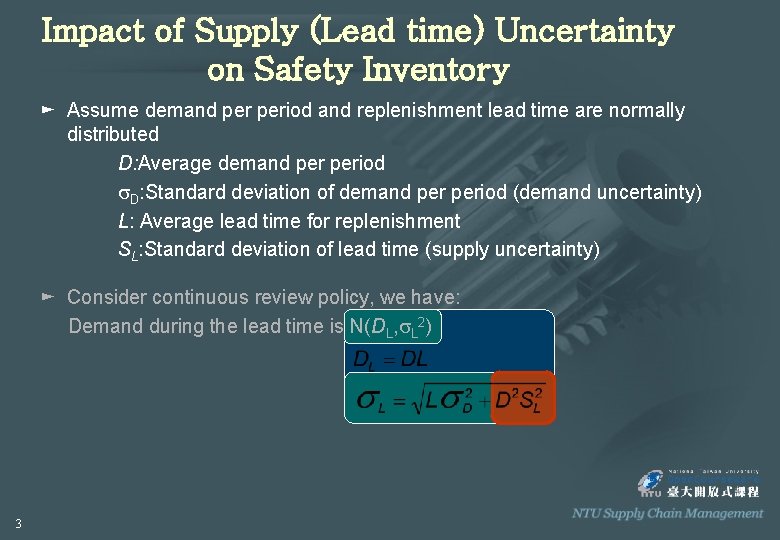
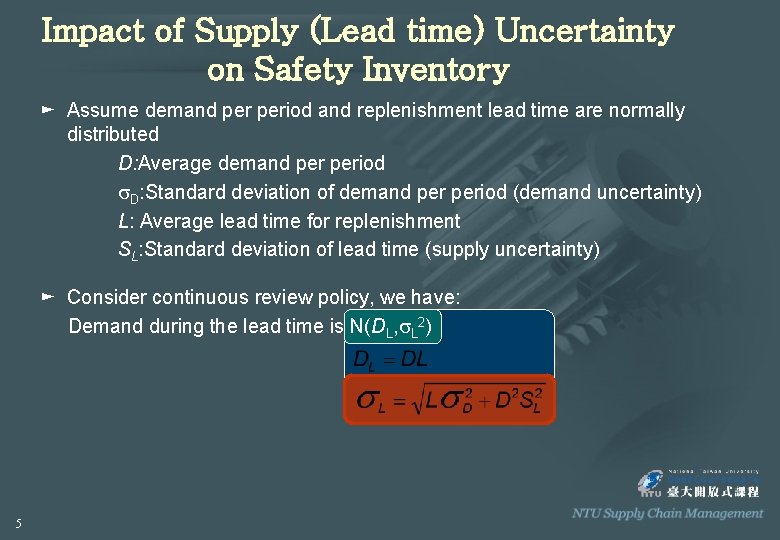
Impact of Supply (Lead time) Uncertainty on Safety Inventory ► Assume demand period and replenishment lead time are normally distributed D: Average demand period s. D: Standard deviation of demand period (demand uncertainty) L: Average lead time for replenishment SL: Standard deviation of lead time (supply uncertainty) ► Consider continuous review policy, we have: Demand during the lead time is N(DL, s. L 2) 3
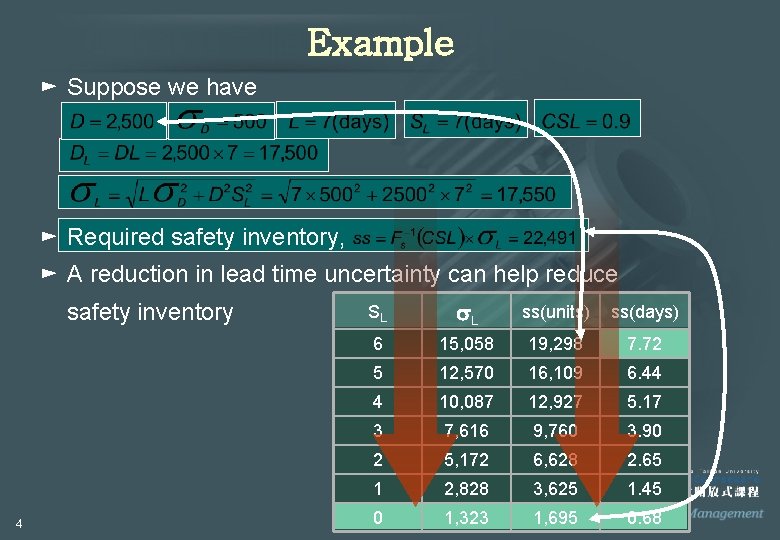
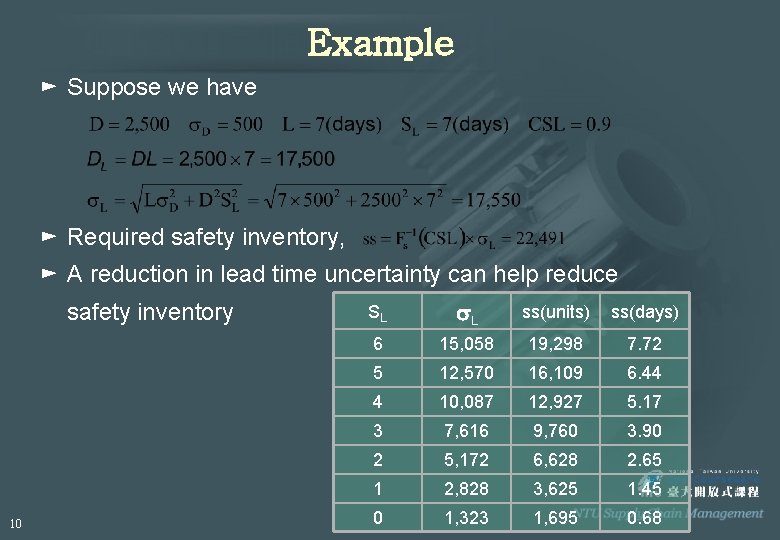
Example ► Suppose we have ► Required safety inventory, ► A reduction in lead time uncertainty can help reduce safety inventory 4 SL s. L ss(units) ss(days) 6 15, 058 19, 298 7. 72 5 12, 570 16, 109 6. 44 4 10, 087 12, 927 5. 17 3 7, 616 9, 760 3. 90 2 5, 172 6, 628 2. 65 1 2, 828 3, 625 1. 45 0 1, 323 1, 695 0. 68
Impact of Supply (Lead time) Uncertainty on Safety Inventory ► Assume demand period and replenishment lead time are normally distributed D: Average demand period s. D: Standard deviation of demand period (demand uncertainty) L: Average lead time for replenishment SL: Standard deviation of lead time (supply uncertainty) ► Consider continuous review policy, we have: Demand during the lead time is N(DL, s. L 2) 5
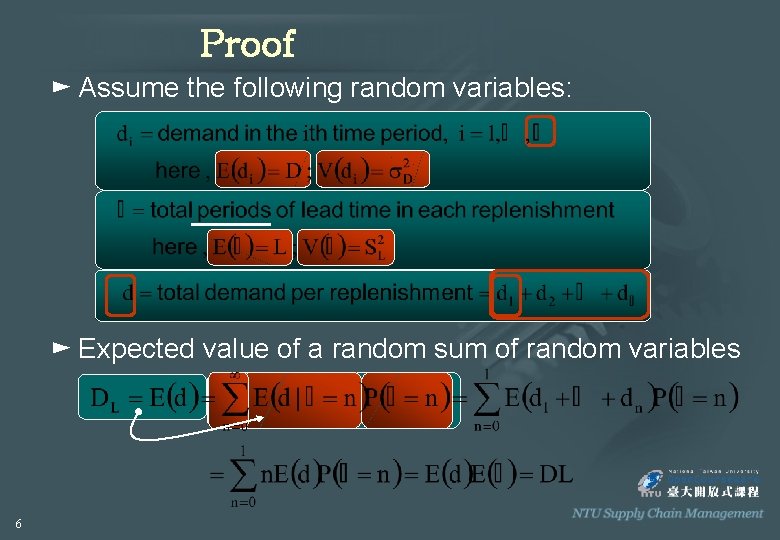
Proof ► Assume the following random variables: ► Expected value of a random sum of random variables 6
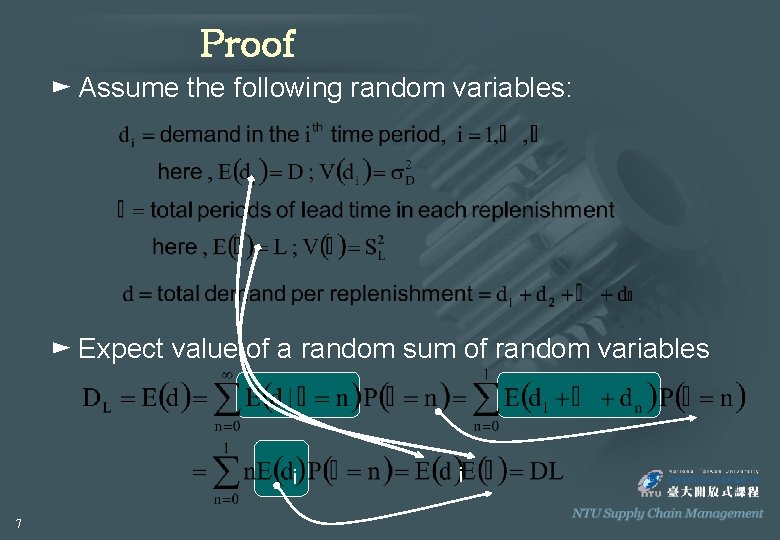
Proof ► Assume the following random variables: ► Expect value of a random sum of random variables i 7 i
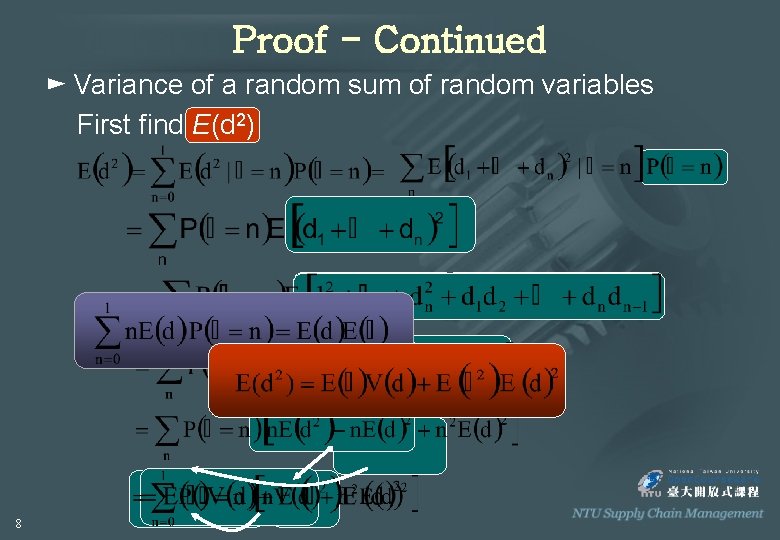
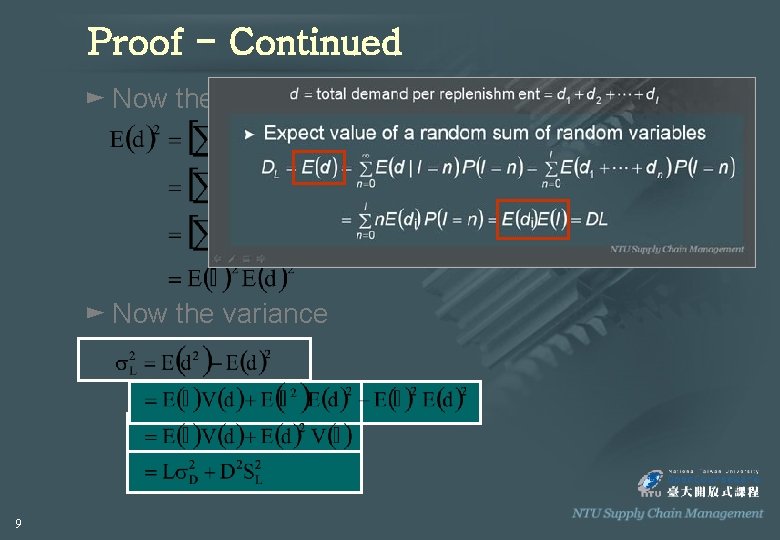
Proof - Continued ► Variance of a random sum of random variables First find E(d 2) 8
Proof - Continued ► Now the square of the mean ► Now the variance 9
Example ► Suppose we have ► Required safety inventory, ► A reduction in lead time uncertainty can help reduce safety inventory 10 SL s. L ss(units) ss(days) 6 15, 058 19, 298 7. 72 5 12, 570 16, 109 6. 44 4 10, 087 12, 927 5. 17 3 7, 616 9, 760 3. 90 2 5, 172 6, 628 2. 65 1 2, 828 3, 625 1. 45 0 1, 323 1, 695 0. 68
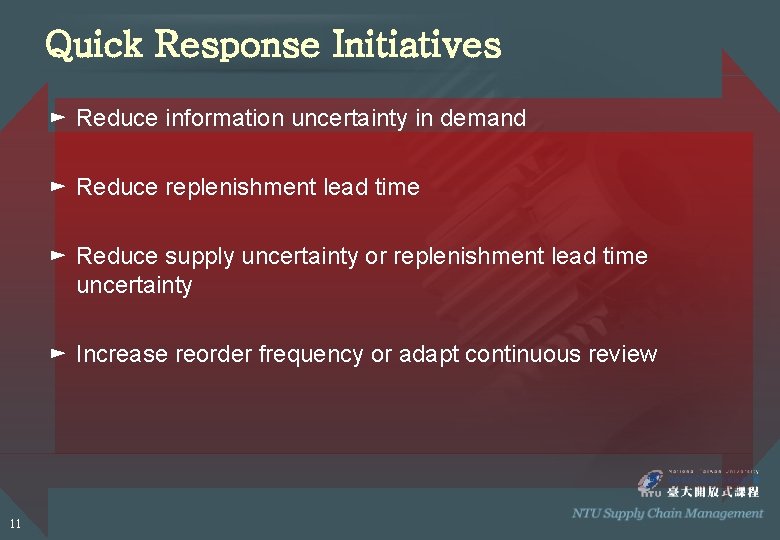
Quick Response Initiatives ► Reduce information uncertainty in demand ► Reduce replenishment lead time ► Reduce supply uncertainty or replenishment lead time uncertainty ► Increase reorder frequency or adapt continuous review 11
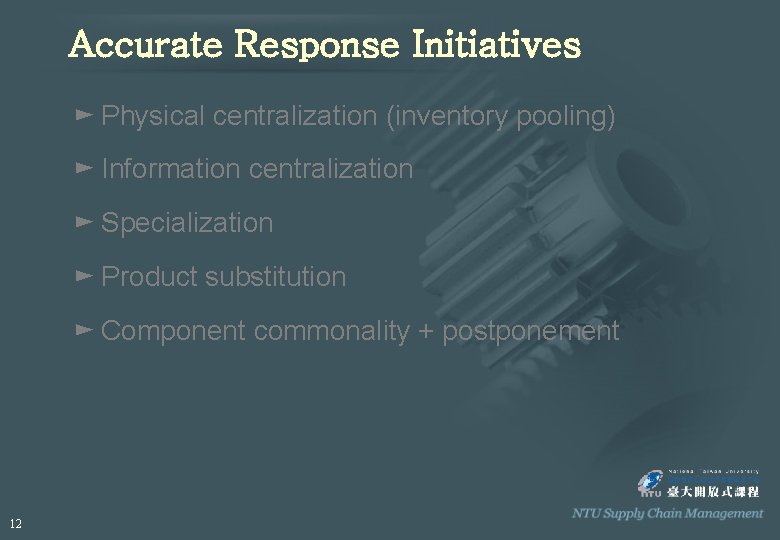
Accurate Response Initiatives ► Physical centralization (inventory pooling) ► Information centralization ► Specialization ► Product substitution ► Component commonality + postponement 12
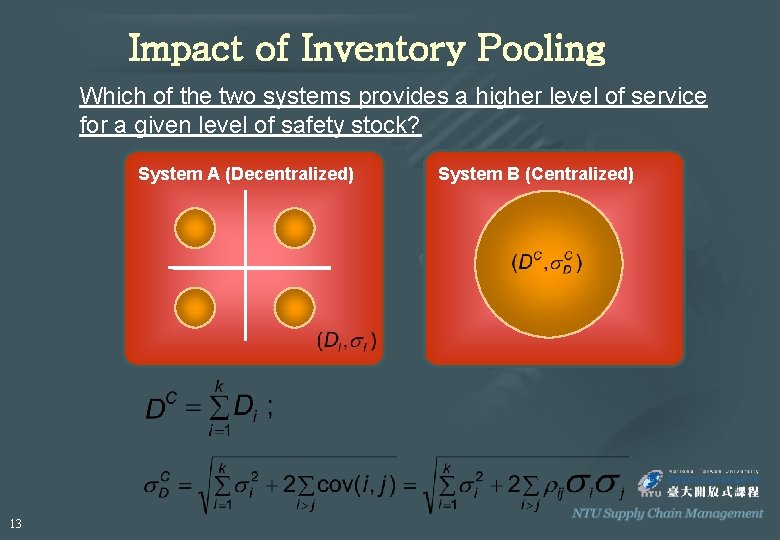
Impact of Inventory Pooling Which of the two systems provides a higher level of service for a given level of safety stock? System A (Decentralized) 13 System B (Centralized)
Factors Affecting Value of Inventory Pooling ► Demand Correlation ► Coefficient of variation of demand ► Product value ► Transportation cost 14
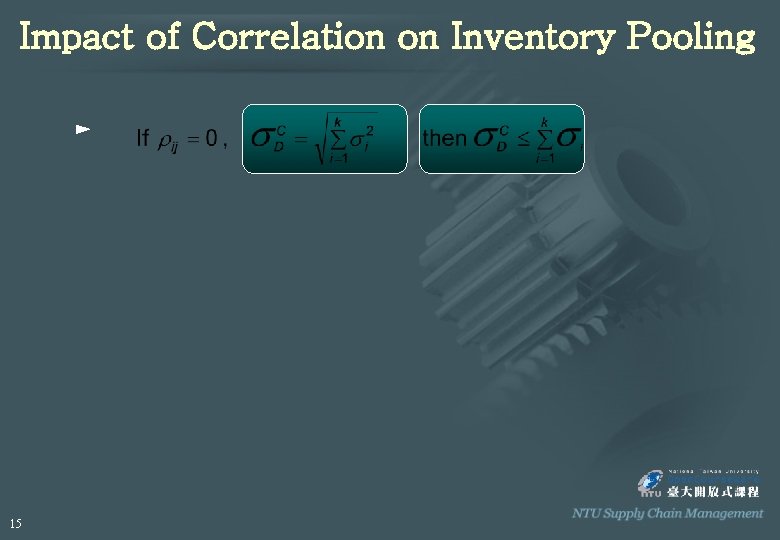
Impact of Correlation on Inventory Pooling ► 15
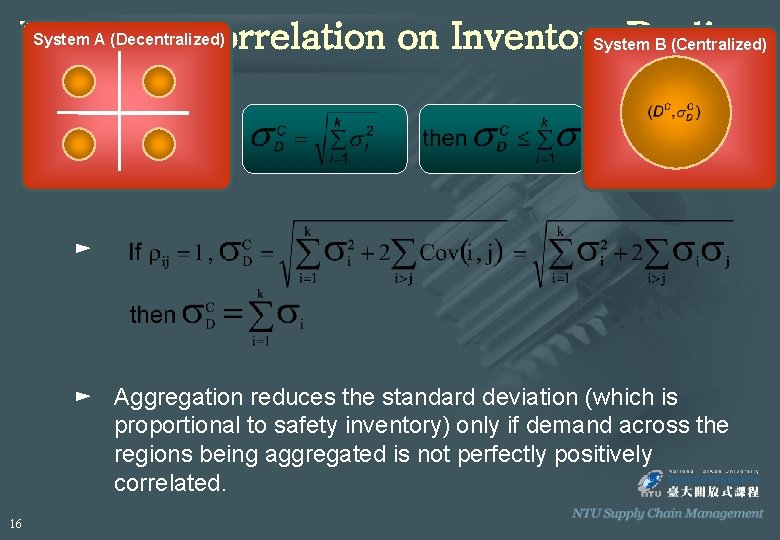
System A (Decentralized) Impact of Correlation on Inventory Pooling System B (Centralized) > ► ► Aggregation reduces the standard deviation (which is proportional to safety inventory) only if demand across the regions being aggregated is not perfectly positively correlated. 16
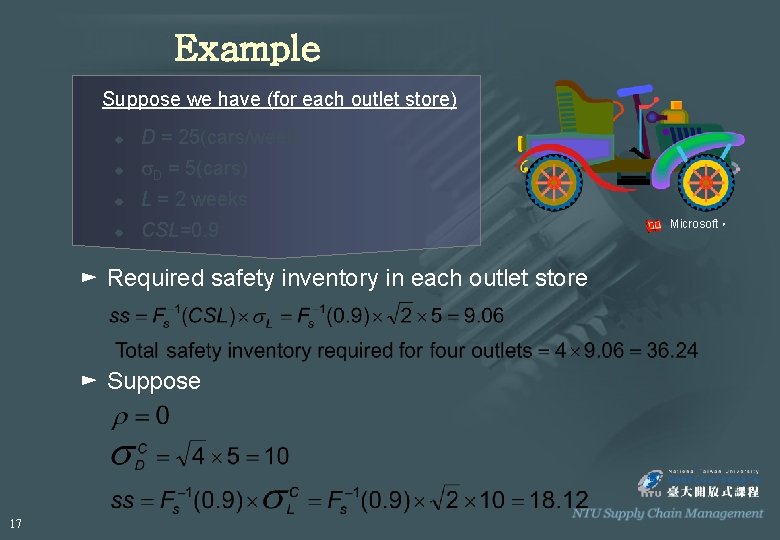
Example Suppose we have (for each outlet store) u D = 25(cars/week) u s. D = 5(cars) u L = 2 weeks u CSL=0. 9 ► Required safety inventory in each outlet store ► Suppose 17 Microsoft。
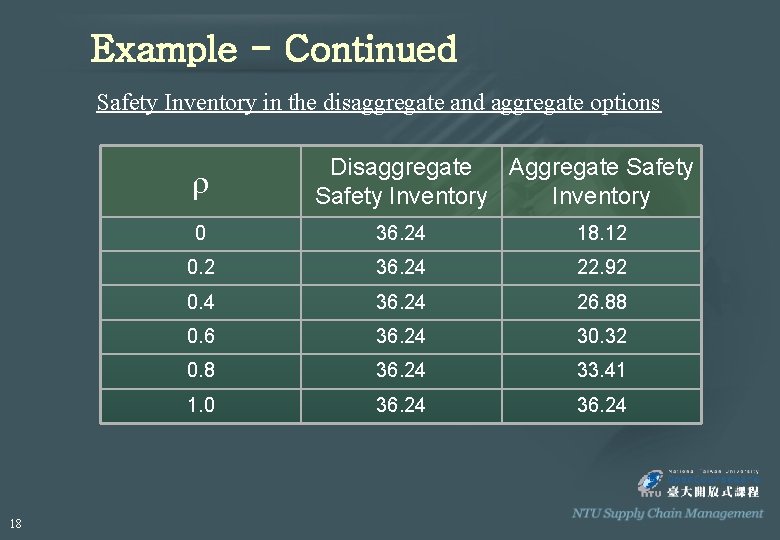
Example - Continued Safety Inventory in the disaggregate and aggregate options r 18 Disaggregate Aggregate Safety Inventory 0 36. 24 18. 12 0. 2 36. 24 22. 92 0. 4 36. 24 26. 88 0. 6 36. 24 30. 32 0. 8 36. 24 33. 41 1. 0 36. 24
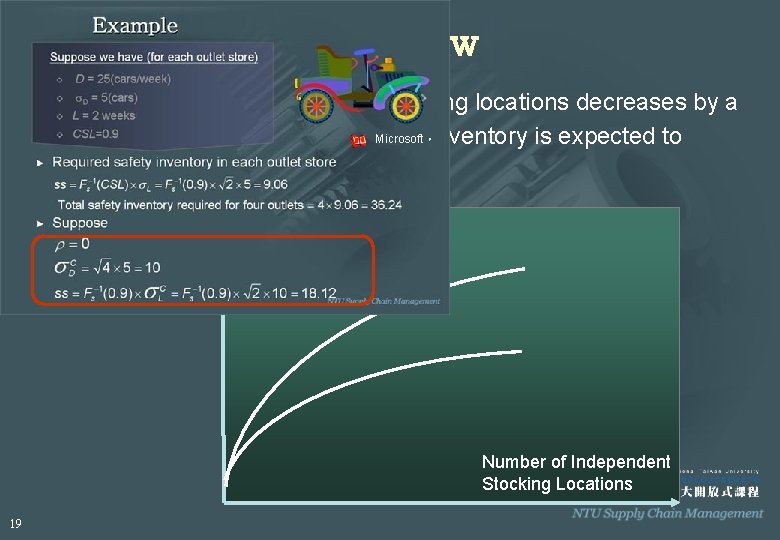
Square Root Law ► If number of independent stocking locations decreases by a Microsoft。inventory is expected to factor of n, the average safety decrease by a factor of. Total Safety Inventory Number of Independent Stocking Locations 19
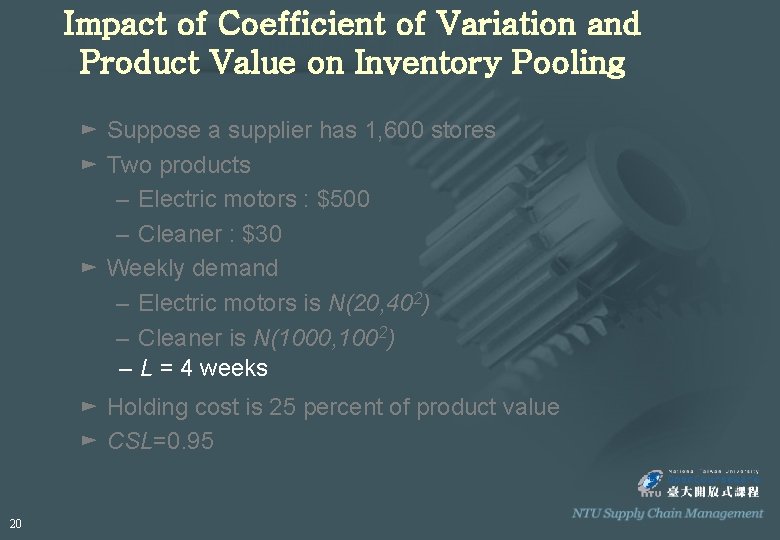
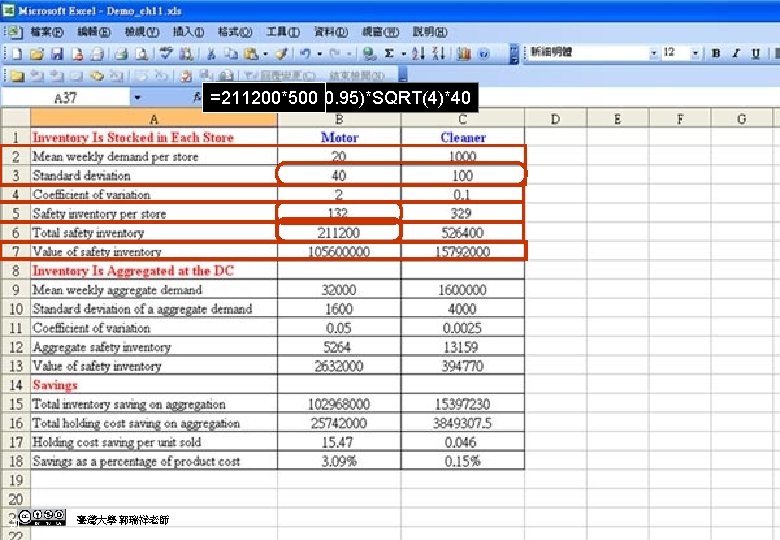
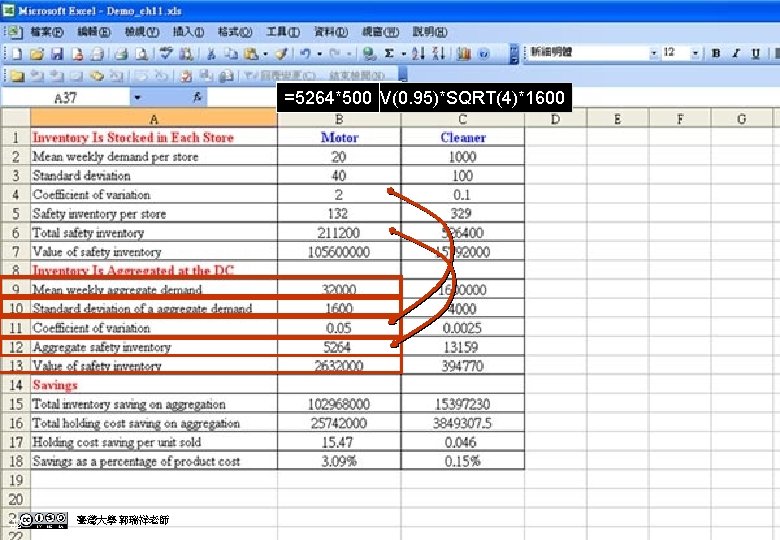
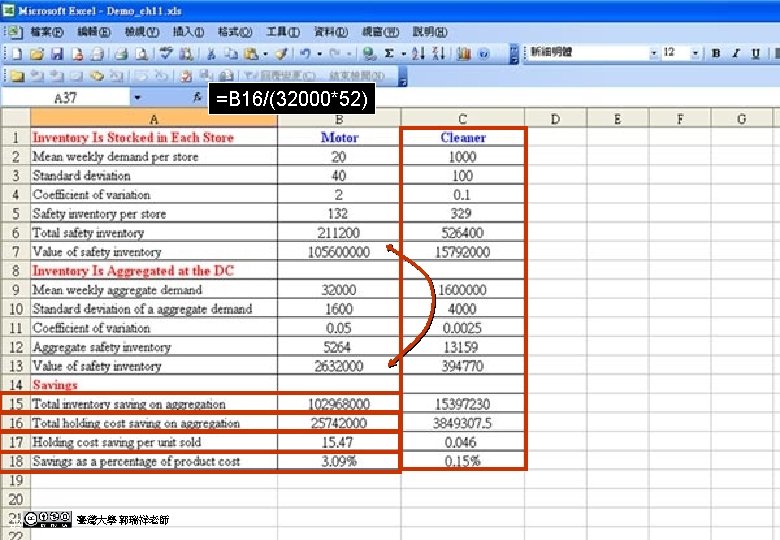
Impact of Coefficient of Variation and Product Value on Inventory Pooling ► Suppose a supplier has 1, 600 stores ► Two products – Electric motors : $500 – Cleaner : $30 ► Weekly demand – Electric motors is N(20, 402) – Cleaner is N(1000, 1002) – L = 4 weeks ► Holding cost is 25 percent of product value ► CSL=0. 95 20
Value of Aggregation Motors Cleaner 20 1, 000 40 100 2. 0 0. 1 132 329 211, 200 526, 400 $105, 600, 000 $15, 792, 000 Mean weekly aggregate demand 32, 000 1, 600, 000 Standard deviation of a aggregate demand 1, 600 4, 000 0. 05 0. 0025 5, 264 13, 159 $2, 632, 000 $394, 770 $102, 968, 000 $15, 397, 230 $25, 742, 000 $3, 849, 308 Holding cost saving per unit sold $15. 47 $0. 046 Savings as a percentage of product cost 3. 09% 0. 15% Inventory Is Stocked in Each Store Mean weekly demand per store > The higher the B 3/B 2 =211200*500 =132*1600 =NORMSINV(0. 95)*SQRT(4)*40 Standard deviation coefficient of variation Coefficient of variation (and product value), Safety inventory per store the greater the Total safety inventory reduction in safety inventory as a result of Value of safety inventory Is Aggregated at the DC centralization. Coefficient of variation Aggregate safety inventory Value of safety inventory Savings Total inventory saving on aggregation Total holding cost saving on aggregation 21 臺灣大學 郭瑞祥老師
Value of Aggregation > The higher the coefficient of variation (and product value), the greater the reduction in safety inventory as a result of centralization. Motors Cleaner Mean weekly demand per store 20 1, 000 =20*1600 =5264*500 =NORMSINV(0. 95)*SQRT(4)*1600 =SQRT(1600)*40 =B 10/B 9 Standard deviation 40 100 Coefficient of variation 2. 0 0. 1 Safety inventory per store 132 329 211, 200 526, 400 $105, 600, 000 $15, 792, 000 Mean weekly aggregate demand 32, 000 1, 600, 000 Standard deviation of a aggregate demand 1, 600 4, 000 0. 05 0. 0025 5, 264 13, 159 $2, 632, 000 $394, 770 $102, 968, 000 $15, 397, 230 $25, 742, 000 $3, 849, 308 Holding cost saving per unit sold $15. 47 $0. 046 Savings as a percentage of product cost 3. 09% 0. 15% Inventory Is Stocked in Each Store Total safety inventory Value of safety inventory Is Aggregated at the DC Coefficient of variation Aggregate safety inventory Value of safety inventory Savings Total inventory saving on aggregation Total holding cost saving on aggregation 22 臺灣大學 郭瑞祥老師
Value of Aggregation Motors Cleaner 20 1, 000 40 100 2. 0 0. 1 132 329 211, 200 526, 400 $105, 600, 000 $15, 792, 000 Mean weekly aggregate demand 32, 000 1, 600, 000 Standard deviation of a aggregate demand 1, 600 4, 000 0. 05 0. 0025 5, 264 13, 159 $2, 632, 000 $394, 770 $102, 968, 000 $15, 397, 230 $25, 742, 000 $3, 849, 308 Holding cost saving per unit sold $15. 47 $0. 046 Savings as a percentage of product cost 3. 09% 0. 15% Inventory Is Stocked in Each Store Mean weekly demand per store > The higher the =B 15*0. 25 =B 16/(32000*52) =B 7 -B 13 Standard deviation coefficient of variation Coefficient of variation (and product value), Safety inventory per store the greater the Total safety inventory reduction in safety inventory as a result of Value of safety inventory Is Aggregated at the DC centralization. Coefficient of variation Aggregate safety inventory Value of safety inventory Savings Total inventory saving on aggregation Total holding cost saving on aggregation 23 臺灣大學 郭瑞祥老師
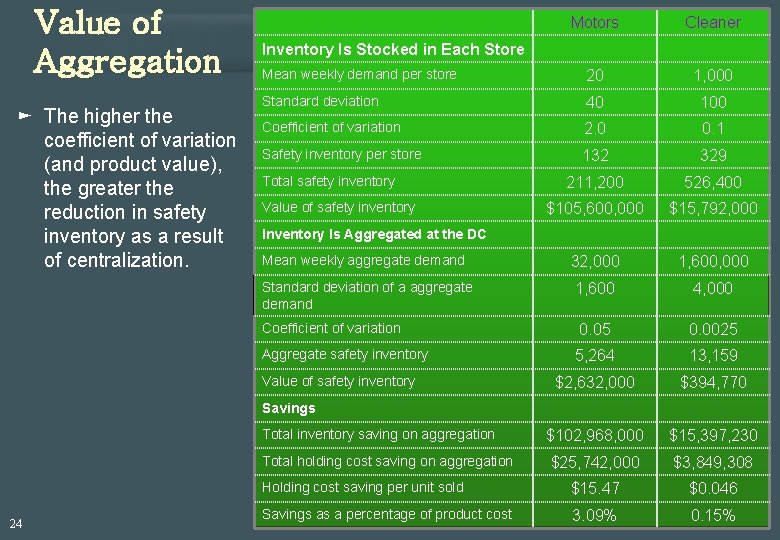
Value of Aggregation ► The higher the coefficient of variation (and product value), the greater the reduction in safety inventory as a result of centralization. Motors Cleaner Mean weekly demand per store 20 1, 000 Standard deviation 40 100 Coefficient of variation 2. 0 0. 1 Safety inventory per store 132 329 211, 200 526, 400 $105, 600, 000 $15, 792, 000 Mean weekly aggregate demand 32, 000 1, 600, 000 Standard deviation of a aggregate demand 1, 600 4, 000 0. 05 0. 0025 5, 264 13, 159 $2, 632, 000 $394, 770 $102, 968, 000 $15, 397, 230 $25, 742, 000 $3, 849, 308 Holding cost saving per unit sold $15. 47 $0. 046 Savings as a percentage of product cost 3. 09% 0. 15% Inventory Is Stocked in Each Store Total safety inventory Value of safety inventory Is Aggregated at the DC Coefficient of variation Aggregate safety inventory Value of safety inventory Savings Total inventory saving on aggregation Total holding cost saving on aggregation 24
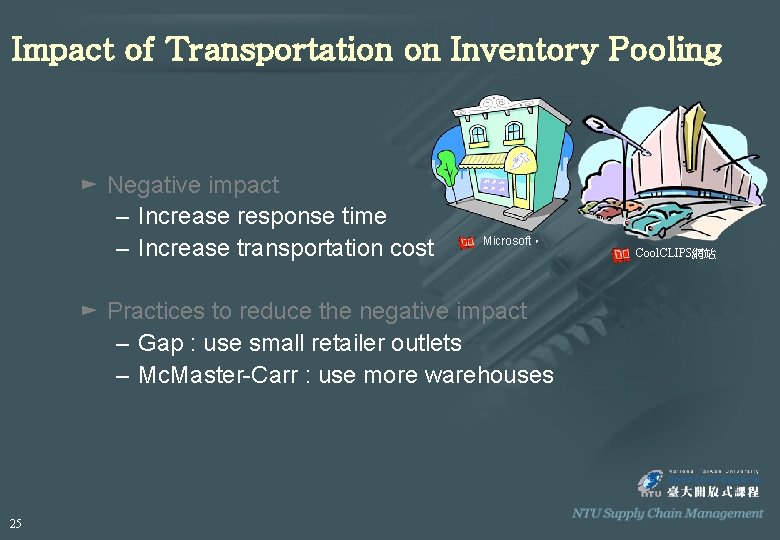
Impact of Transportation on Inventory Pooling ► Negative impact – Increase response time – Increase transportation cost Microsoft。 ► Practices to reduce the negative impact – Gap : use small retailer outlets – Mc. Master-Carr : use more warehouses 25 Cool. CLIPS網站
Information Centralization Use information centralization to virtually aggregate inventory across all warehouses or stores even though the inventory is physically separated. ► Benefits – Orders are filled from the warehouse or store closest to the customer, keeping transportation cost low. ► Examples 26 Microsoft。 – Wholesales : Mc. Master Carr use information centralization to pick up products from the closest warehouse – Retailer : Gap uses information centralization to pick up products from the closest store – Retailer : Wal-Mart use information centralization to Microsoft。 exchange products between stores
Specialization - Allocation of Products to Stocking Locations - ► A product that does not sell well in a geographical region should not be carried in inventory by the warehouse or retail store located there. ► If aggregation reduces the required safety inventory by a large amount, it is better to carry the product in one central location. If not, it is better to carry the product in multiple decentralization locations to reduce response time and transportation cost. ► Slow-moving items are better distributed by a centralization location. ► Fast-moving items are better distributed by decentralization locations. ► High-value items provide a greater benefit from centralization Microsoft。 than low-value items. ► Emergency item should be located close to customers. 27
Product Substitution ► Substitution refers to the use of one product to satisfy demand for a different product. ► Manufacturer-Driven One-Way Substitution – Aggregating demand across the products reduces safety inventory. – Value of substitution increases as demand uncertainty increases. – If the cost differential between two products is very small, substitution is preferred. As the cost differential increases, the benefit of substitution decreases. – If demand between two products is strongly positively correlated, there is little value in substitution. 28
Customer-Driven Two-Way Substitution ► Recognition of customer-driven substitution and joint management of inventory across substitutable products allow a supply chain to reduce the required safety inventory. ► In a retailing store, substitute products should be placed near each other. In the online channel, substitution requires a retailer to present the availability of substitute products if the one the customer requests is out of stock. ► The greater the demand uncertainty, the greater the benefit of substitution. The lower the correlation of demand between substitutable products, the greater the benefit form exploiting substitution. 29
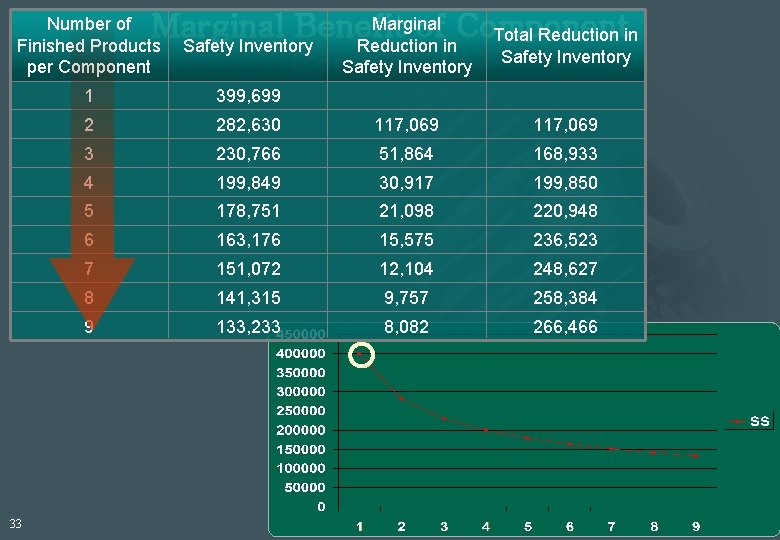
Component Commonality ► When common components are designed across different finished products, the demand for each component is then an aggregation of the demand for all the finished products. Component demand is thus more predictable than the demand for any one finished product. ► As a component is used in more finished products, it needs to be more flexible. As a result, the cost of producing the component typically increases with increasing commonality. VECTORLOGO。 Microsoft。 ► Component commonality reduces the safety inventory required. The marginal benefit, however, decreases with increasing commonality. 30
Example ► Suppose Dell manufactures 27 different PCs, with three distinct components : processor, memory, and hard drive. ► In the disaggregate option, Dell designs 3*27=81 distinct components. ► In the common component option, Dell designs 3 distinct processors, 3 memory units, and 3 hard drives. Each component is thus used in 9 different PCs. ► Suppose for each PC, the monthly demand is N(5000, 30002) ► The replenishment lead time for each component is one month. ► CSL=0. 95 Microsoft。 31 Microsoft。 Wikipedia
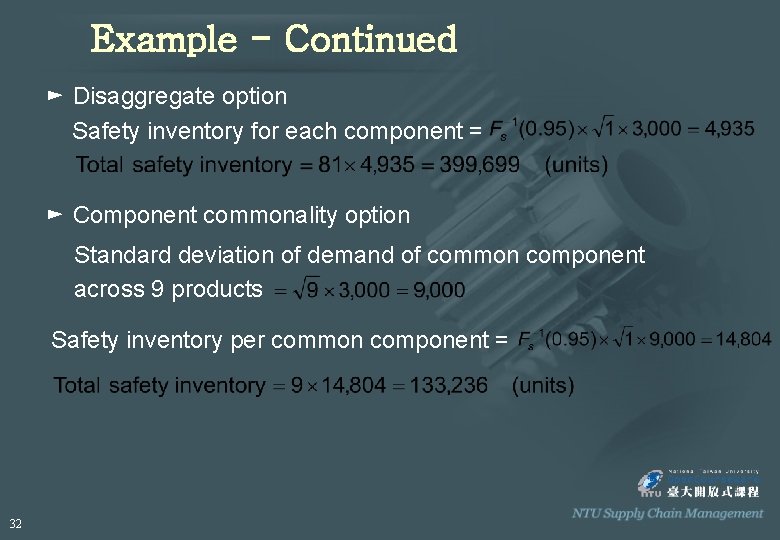
Example - Continued ► Disaggregate option Safety inventory for each component = ► Component commonality option Standard deviation of demand of common component across 9 products Safety inventory per common component = 32
Marginal Benefit of Component Total Reduction in Safety Inventory Commonality Number of Finished Products per Component 33 1 399, 699 2 282, 630 117, 069 3 230, 766 51, 864 168, 933 4 199, 849 30, 917 199, 850 5 178, 751 21, 098 220, 948 6 163, 176 15, 575 236, 523 7 151, 072 12, 104 248, 627 8 141, 315 9, 757 258, 384 9 133, 233 8, 082 266, 466
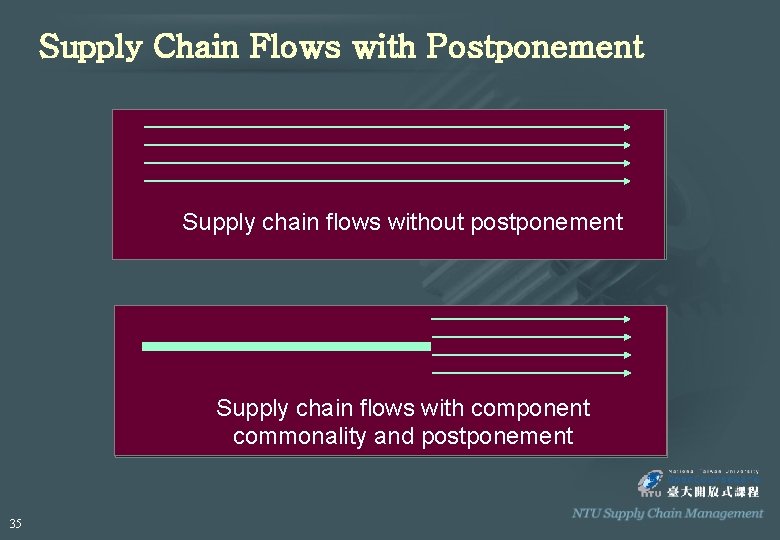
Postponement ► Postponement is the ability of a supply chain to delay product differentiation or customization until closer to the time the product is sold. ► The goal is to have common components in the supply chain for most of the push phase and move product differentiation as close to the pull phase of the supply chain as possible. ► Dell uses assemble-to-order for its postponement strategy. ► Benetton switches the production sequence to postpone the color customization of the knit garments. ► Postponement allows a supply chain to exploit aggregation to reduce safety inventories without hurting product availability. 34
Supply Chain Flows with Postponement Supply chain flows without postponement Supply chain flows with component commonality and postponement 35
版權聲明 頁碼 授權條件 作者/來源 26 本作品轉載自Microsoft Office 2007多媒體藝廊,依據Microsoft 服務合約及著 作權法第 46、52、65條合理使用。 27 本作品轉載自Microsoft Office 2007多媒體藝廊,依據Microsoft 服務合約及著 作權法第 46、52、65條合理使用。 30 VECTORLOGO(http: //www. allfreelogo. com/logo/hp-logo. html) 本作品轉載自VECTORLOGO網站,依據其版權聲明 (http: //www. allfreelogo. com/privacy-policy/)與著作權法第 46、52、65條合理使用。 31 本作品轉載自clipartoday網站 ( http: //www. clipartoday. com/clipart/objects/tools_184085. html ) ,瀏 覽日期 2012/1/9。依據著作權法第 46、52、65條合理使用。 31 37 作品 Wikimedia Commons 本作品轉載自http: //commons. wikimedia. org/wiki/File: Dell_Logo. png,瀏覽日期 2011/12/28。