
Two levels of interpretation The interpretations of the


- Slides: 36
Two levels of interpretation The interpretations of the historic site or monument occur at two distinctly different levels: professional and popular
professional • The professional staff examines all the available evidence in order to reconstruct the monument either hypothetically or in full-scale, three-dimensional actuality. * • professional staff – architect, archaeologist, art historian, social historian • available evidence --excavations, buildings, artifacts, and documents
popular • It* becomes possible to interpret the monument for the education or edification of the general public. • Interpretation at this secondary level is becoming a subspecialty in itself.
Orthodox archaeology has always based its interpretation of a given site or monument upon : • artifact itself • literature related to it (moving back and forth from artifact to document to ensure as accurate an interpretation as possible. )
Shortcomings: of Orthodox archaeology prehistoric-sites : • there will be no documentation at all • it will often be verbal rather than graphic, with all the uncertainties and ambiguities which that implies.
How to deal with that problem? • Three Experiments: • Helen Bullock researches Colonial Williamsburg (southeastern Virginia ) • The Danish Experiment: Hans. Ole Hansen investigates Iron Age culture of Denmark • THE Plimoth Plantation Experiment: James Deetz reconstructed Puritan village of Plimoth Plantation
Helen Bullock researches Colonial Williamsburg • Main job: To restore the Williamsburg kitchens • resources to begin with: • dozens of kitchens in varying states of decay, repair, and alteration, and a unique collection of cookbooks of the era a hue and growing collection of culinary tools, utensils, • and fireplace equipment; • these resources did not afford sufficiently precise guides to the restoration and furnishing of specific kitchens.
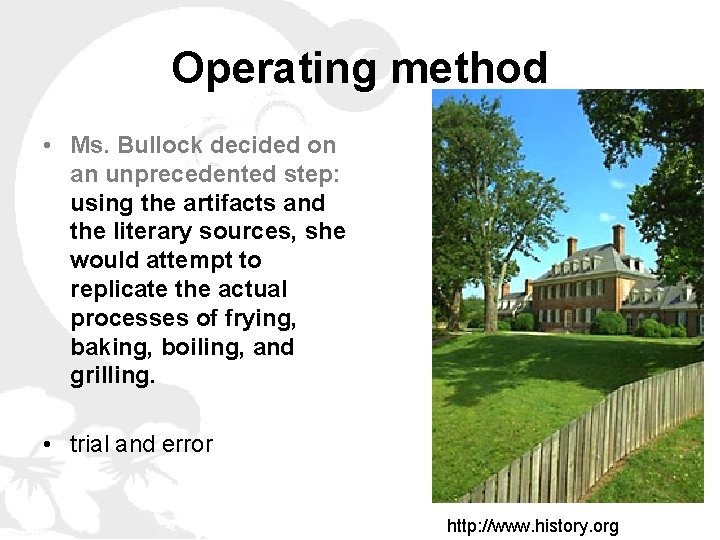
Operating method • Ms. Bullock decided on an unprecedented step: using the artifacts and the literary sources, she would attempt to replicate the actual processes of frying, baking, boiling, and grilling. • trial and error http: //www. history. org
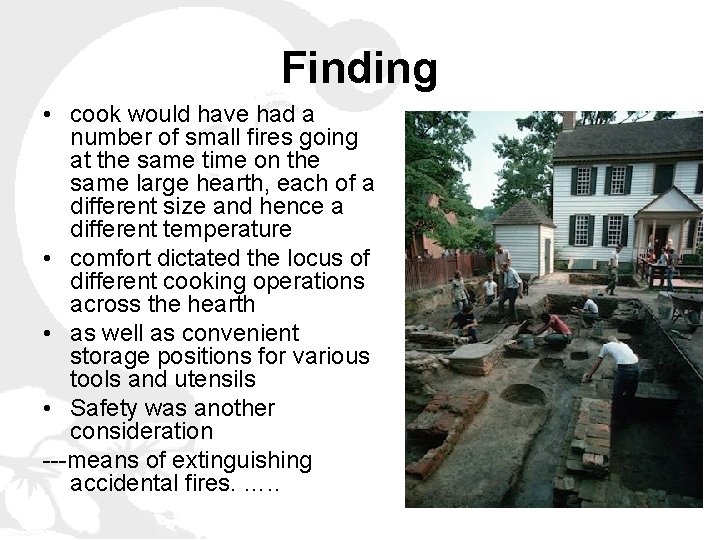
Finding • cook would have had a number of small fires going at the same time on the same large hearth, each of a different size and hence a different temperature • comfort dictated the locus of different cooking operations across the hearth • as well as convenient storage positions for various tools and utensils • Safety was another consideration ---means of extinguishing accidental fires. …. .
important contribution to interpretive methodology • new dimension for historical research and interpretation • the centric of studies has been literally transferred from the classroom to the actual monument
Has been developed in response to special situations where orthodox methods are inadequate : • • prehistoric monuments and sites , where there is no written record physical remains are too scanty or disturbed the written record too fragmentary to furnish a safe basis for preservation, restoration, or reconstruction. In an effort to span more safely the voids left by such missing archival or archaeological data, as well as to check out the assumptions of previous scholars new specialists are developing new routines for themselves and their students …
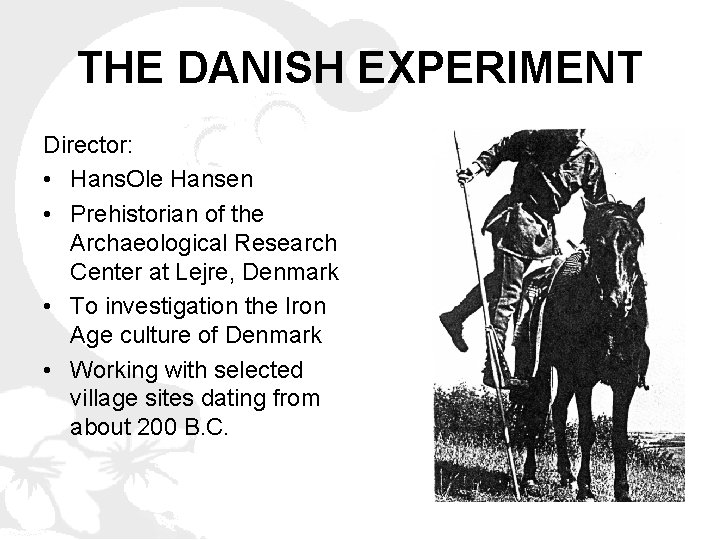
THE DANISH EXPERIMENT Director: • Hans. Ole Hansen • Prehistorian of the Archaeological Research Center at Lejre, Denmark • To investigation the Iron Age culture of Denmark • Working with selected village sites dating from about 200 B. C.
Focus on 1、The first consisted in new methods of interpreting the results of orthodox archaeological investigations l l l Can the so-called flint scraper really scrape skins? Do the clay structures normally interpreted as meatsmoking ovens really smoke meat? or the so-called pottery kilns really fire pottery? By erecting posts in the pattern of postholes, do you get an accurate three-dimensional replica of the Iron Age house? And if so, can you live in it?
Focus on 2、The second in trying to determine prehistoric ways of life from these archaeofacts. l l given the known type of corn grown in the Neolithic period, and the known implements of tillage, harvesting, and milling, what would the yield per acre be? given the looms attested by archaeology, how many worker-hours would be needed to produce the Iron Age garments actually found in Danish peat bogs? How would they be worn? How warm would they be?
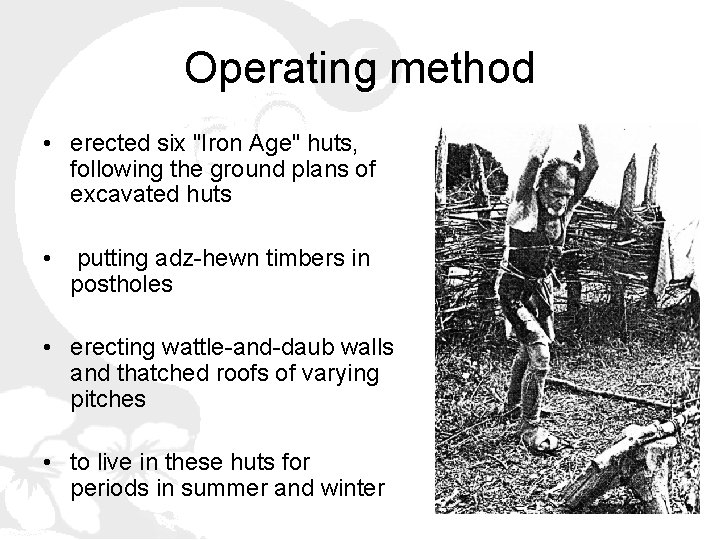
Operating method • erected six "Iron Age" huts, following the ground plans of excavated huts • putting adz-hewn timbers in postholes • erecting wattle-and-daub walls and thatched roofs of varying pitches • to live in these huts for periods in summer and winter
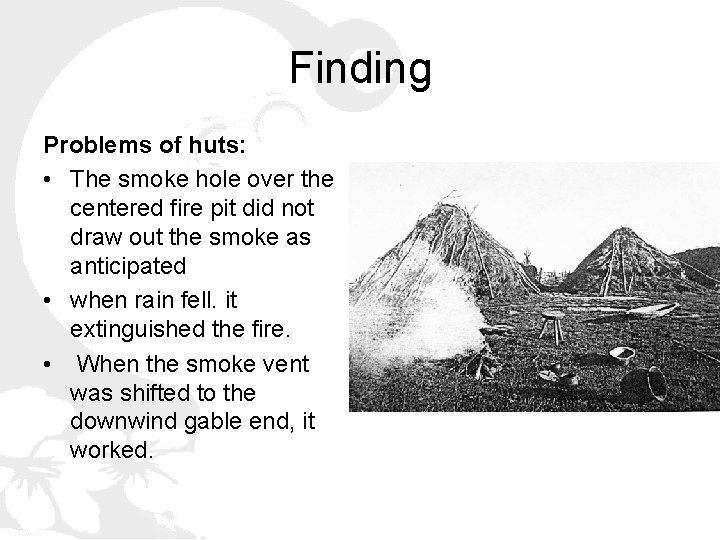
Finding Problems of huts: • The smoke hole over the centered fire pit did not draw out the smoke as anticipated • when rain fell. it extinguished the fire. • When the smoke vent was shifted to the downwind gable end, it worked.
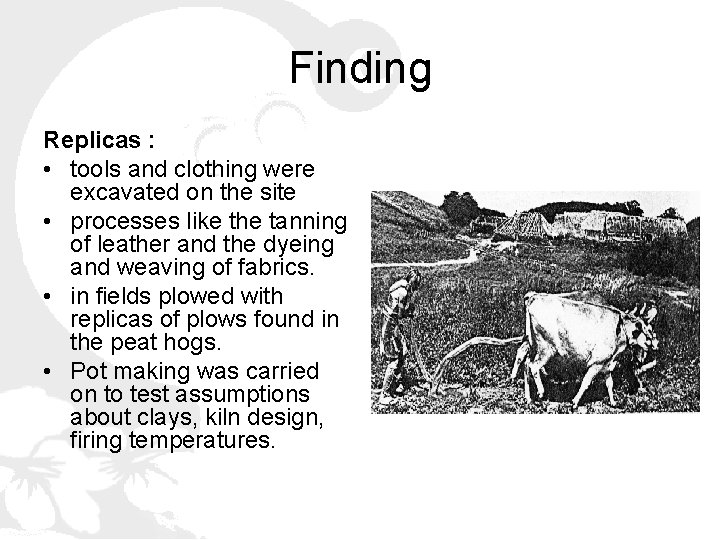
Finding Replicas : • tools and clothing were excavated on the site • processes like the tanning of leather and the dyeing and weaving of fabrics. • in fields plowed with replicas of plows found in the peat hogs. • Pot making was carried on to test assumptions about clays, kiln design, firing temperatures.
contribution to interpretive methodology • raise the level of prehistory and further the education of young historians • the experiments have attracted such widespread popular interest
THE PLIMOTH PLANTATION EXPERIMENT • Location: Puritan village of Plimoth Plantation near Plymouth, Massachusetts • Purpose of the project: to understand the way of life in the colony's first ten years after 1627.
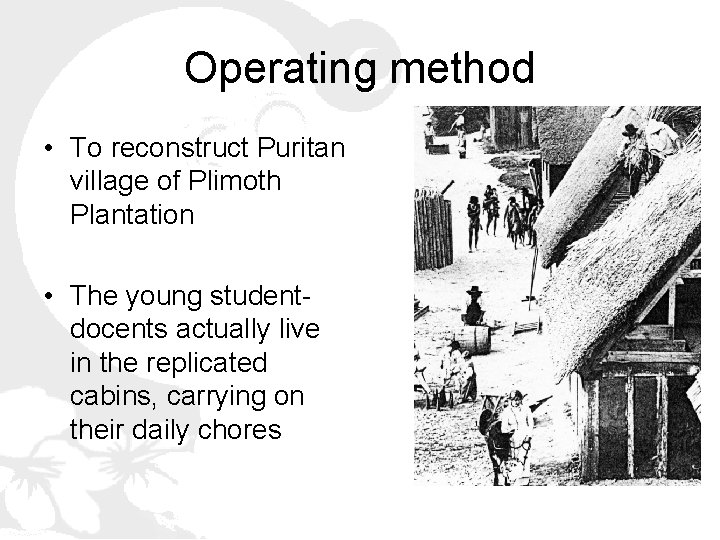
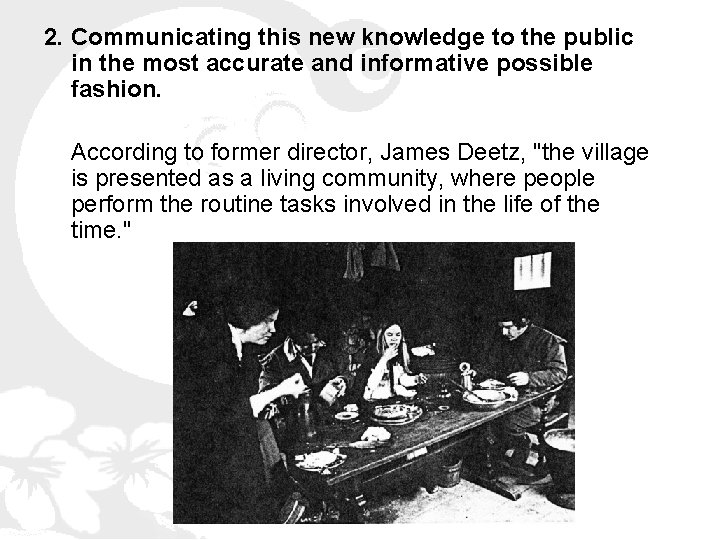
Operating method • To reconstruct Puritan village of Plimoth Plantation • The young studentdocents actually live in the replicated cabins, carrying on their daily chores
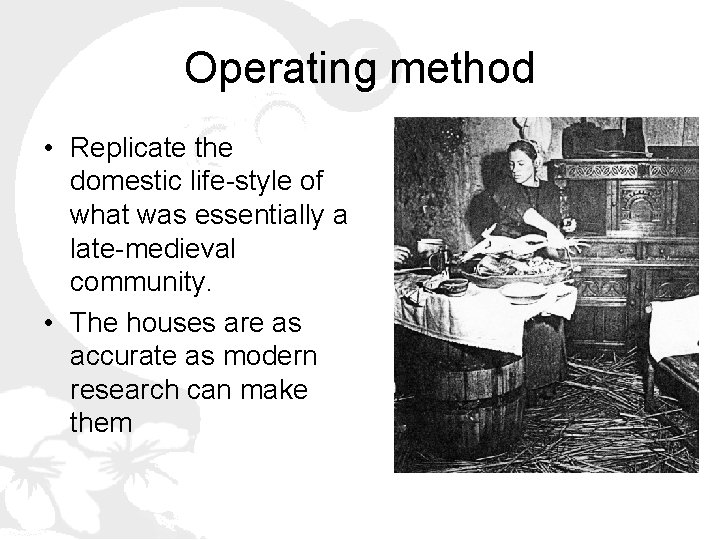
Operating method • Replicate the domestic life-style of what was essentially a late-medieval community. • The houses are as accurate as modern research can make them
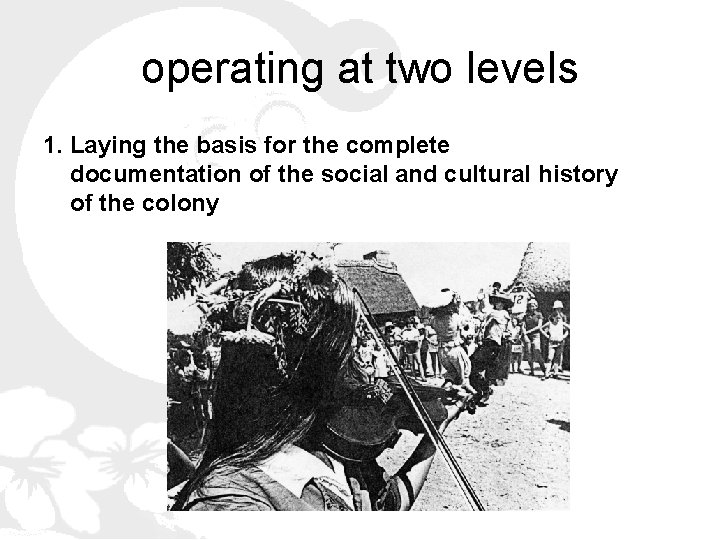
operating at two levels 1. Laying the basis for the complete documentation of the social and cultural history of the colony
2. Communicating this new knowledge to the public in the most accurate and informative possible fashion. According to former director, James Deetz, "the village is presented as a living community, where people perform the routine tasks involved in the life of the time. "
Compare • Lejre is fundamentally a research facility aimed at enriching the training of archaeologists and anthropologists. It is only incidentally a site aimed at educating the general public. • Plimoth Plantation, on the other hand, is primarily aimed at educating the general public only incidentally is it proving to be a valuable experience for young archaeologists and anthropologists
SITE INTERPRETATION FOR THE PUBLIC The most effective way to teach history to the general public is by interpreting historical incidents in terms of the actual scenes in which they occurred. It is easy to… • enrich the visitor's understanding of the monument • imprinting historical information on the visitor's memory.
Medium between monument and public 1. Guided tours led by trained docents 2. Equipping the visitor with individual headphone sets and taped lectures covering a predetermined route through the monument 3. son-et-lumiere performance for a massed audience 4. Documentary films on the monument 5. Live demonstrations of relevant activities 6. Guidebooks which visitors can consult as they move in and around the site.
Medium between monument and public-- docents In Europe : • The visiting public sees only guards or custodians, never docents • Licensed professional guides must be hired by the individual tourist In the United States: • Interpretation is much more active, the most usual form being that of docents leading small groups on guided tours through the monument. • Theft is a serious problem
Docents requirement (1) the educational program of the institution itself (2) the training of the decent in the historical background architectural significance of the building (3) the personality of the decent.
conclusion • One of the best of all ways to interpret the historic building is to re-create the activities and processes which it was originally designed to facilitate or expedite. • Enriching the training of archaeologists and anthropologists. • Educating the general public.
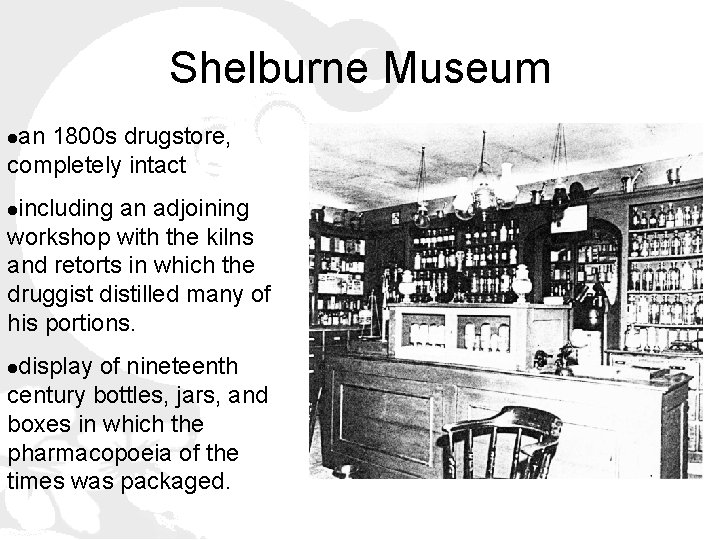
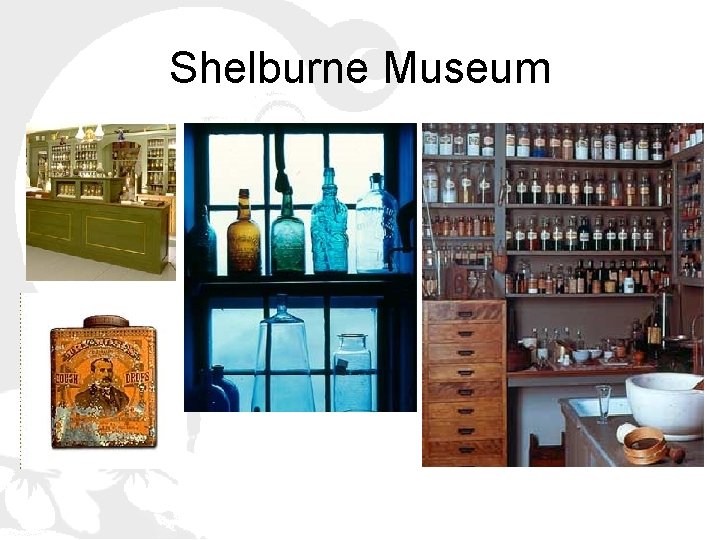
Shelburne Museum an 1800 s drugstore, completely intact l including an adjoining workshop with the kilns and retorts in which the druggist distilled many of his portions. l display of nineteenth century bottles, jars, and boxes in which the pharmacopoeia of the times was packaged. l
Shelburne Museum
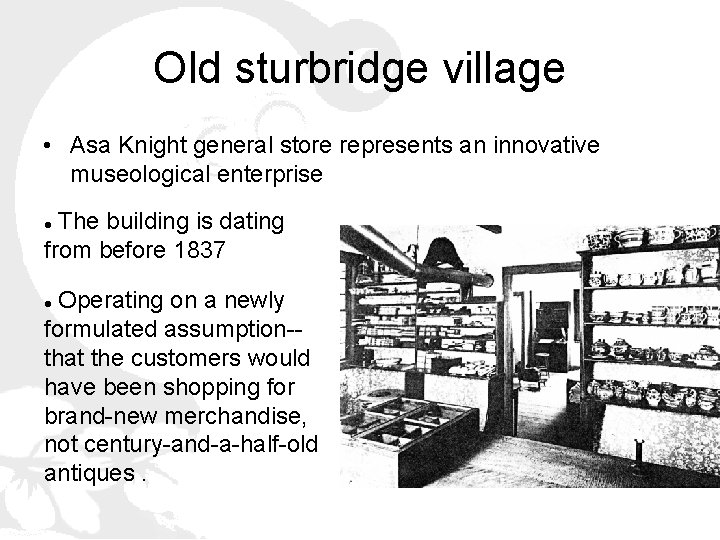
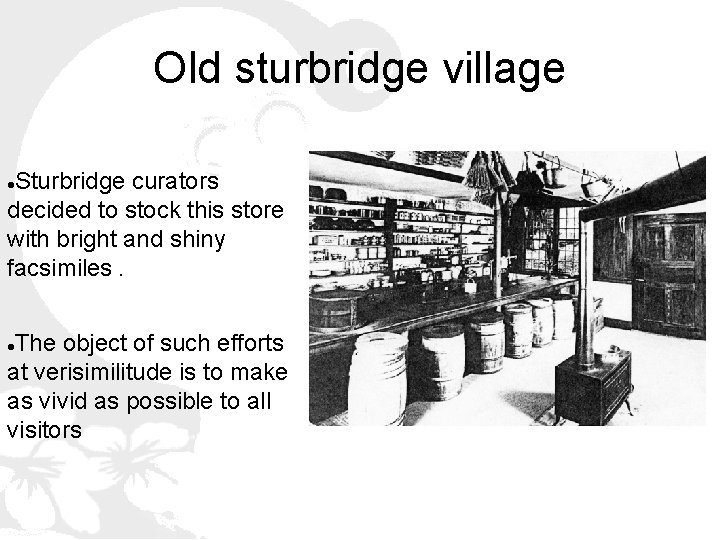
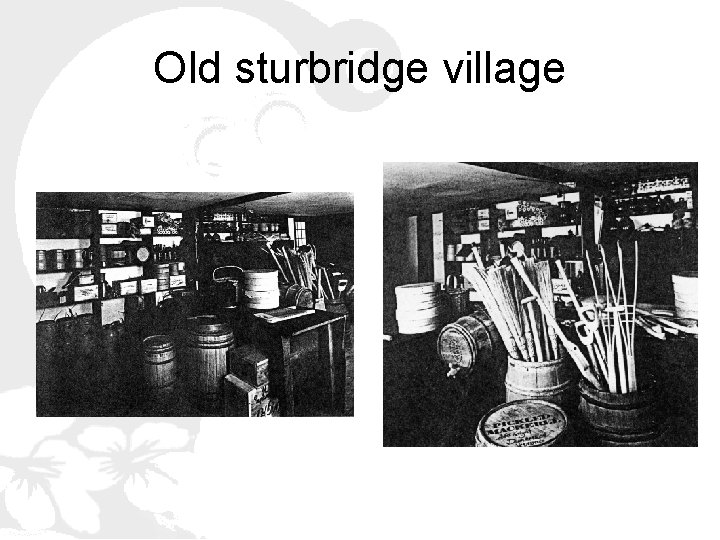
Old sturbridge village • Asa Knight general store represents an innovative museological enterprise The building is dating from before 1837 l Operating on a newly formulated assumption-that the customers would have been shopping for brand-new merchandise, not century-and-a-half-old antiques. l
Old sturbridge village Sturbridge curators decided to stock this store with bright and shiny facsimiles. l The object of such efforts at verisimilitude is to make as vivid as possible to all visitors l
Old sturbridge village