
Two Level Logic Optimization TwoLevel Logic Minimization PLA

- Slides: 25
Two Level Logic Optimization
Two-Level Logic Minimization • PLA Implementation Ex: F 0 = A + B’C’ F 1 = AC’ + AB F 2 = B’C’ + AB product term AB, AC’, B’C’, A AB AC’ B’C’ A F 0 F 1 F 2 A B C Goals: 1. product term => No. of rows 2. literal in the input part => speed 3. literal in the output part => speed
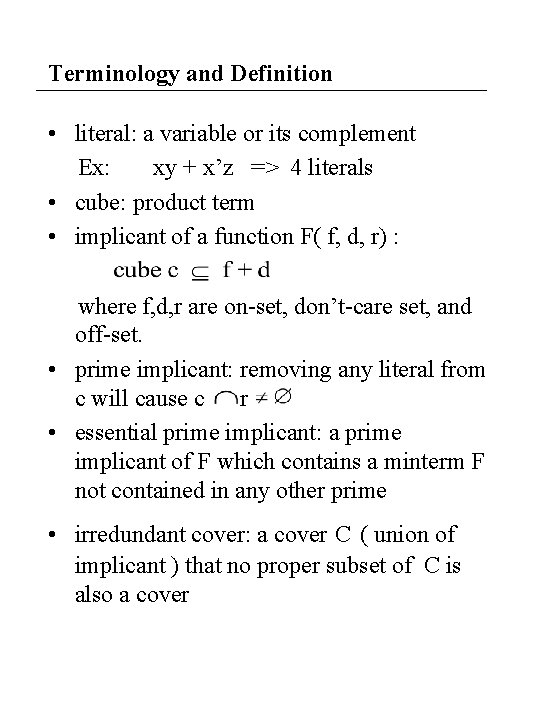
Terminology and Definition • literal: a variable or its complement Ex: xy + x’z => 4 literals • cube: product term • implicant of a function F( f, d, r) : where f, d, r are on-set, don’t-care set, and off-set. • prime implicant: removing any literal from c will cause c r • essential prime implicant: a prime implicant of F which contains a minterm F not contained in any other prime • irredundant cover: a cover C ( union of implicant ) that no proper subset of C is also a cover
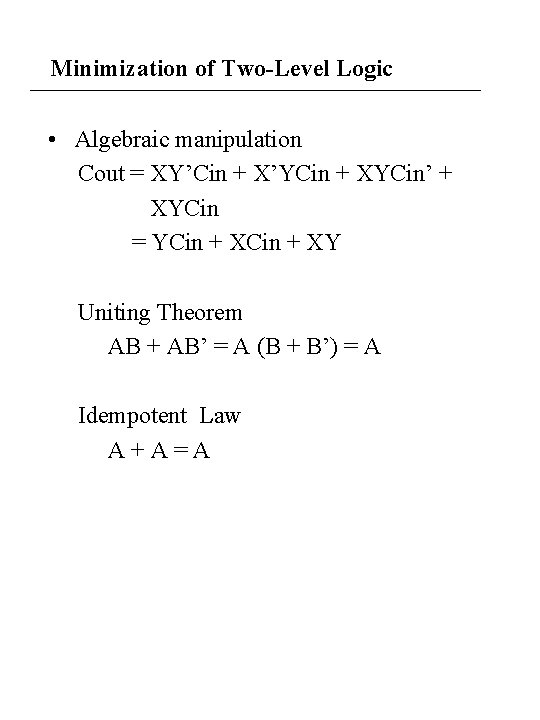
Minimization of Two-Level Logic • Algebraic manipulation Cout = XY’Cin + X’YCin + XYCin’ + XYCin = YCin + XY Uniting Theorem AB + AB’ = A (B + B’) = A Idempotent Law A+A=A
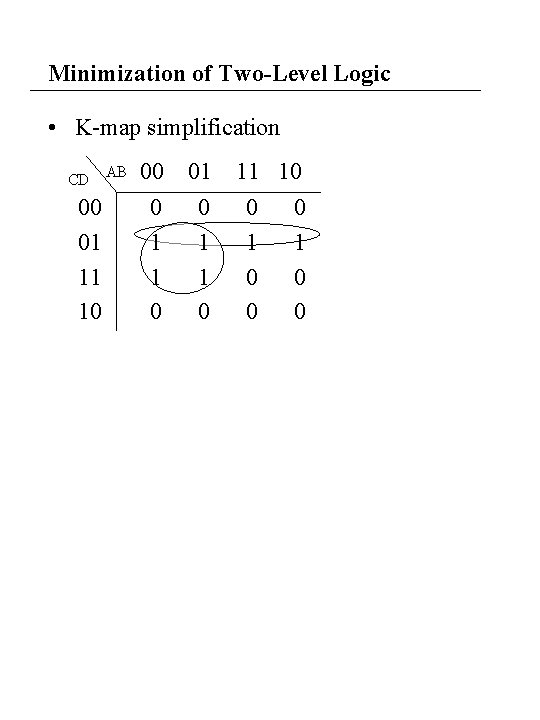
Minimization of Two-Level Logic • K-map simplification CD 00 01 11 10 AB 00 01 0 11 10 0 1 0 0
Exact Minimization of Two-Level Logic • Quine-Mc. Clusky (1) generate all primes (2) find a minimum cover
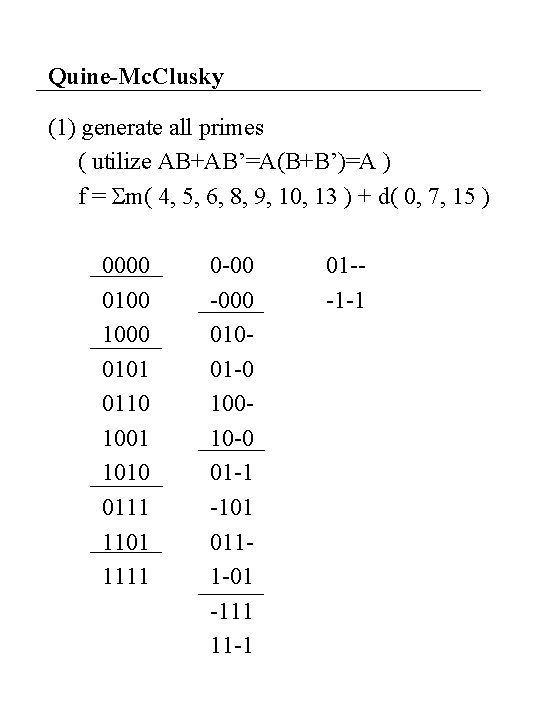
Quine-Mc. Clusky (1) generate all primes ( utilize AB+AB’=A(B+B’)=A ) f = Sm( 4, 5, 6, 8, 9, 10, 13 ) + d( 0, 7, 15 ) 0000 0100 1000 0101 0110 1001 1010 0111 1101 1111 0 -00 -000 01001 -0 10010 -0 01 -1 -101 0111 -01 -111 11 -1 01 --1 -1
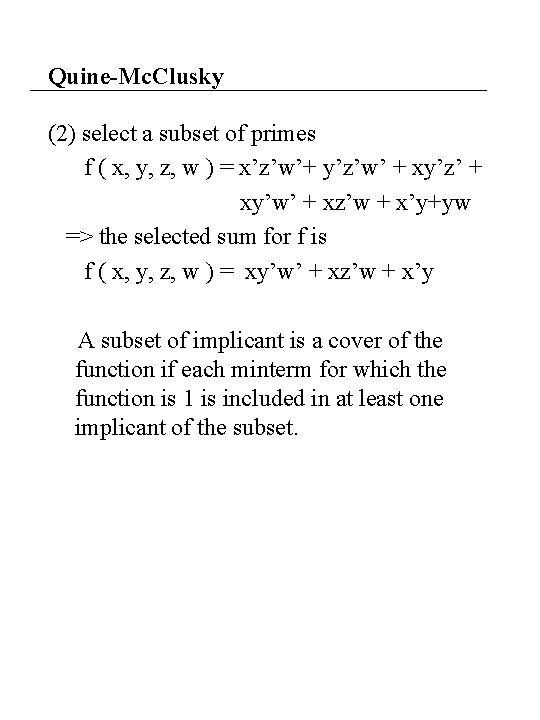
Quine-Mc. Clusky (2) select a subset of primes f ( x, y, z, w ) = x’z’w’+ y’z’w’ + xy’z’ + xy’w’ + xz’w + x’y+yw => the selected sum for f is f ( x, y, z, w ) = xy’w’ + xz’w + x’y A subset of implicant is a cover of the function if each minterm for which the function is 1 is included in at least one implicant of the subset.
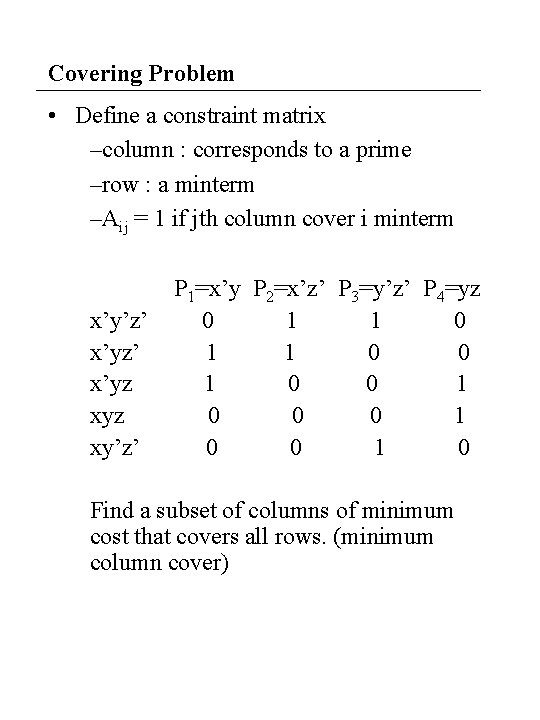
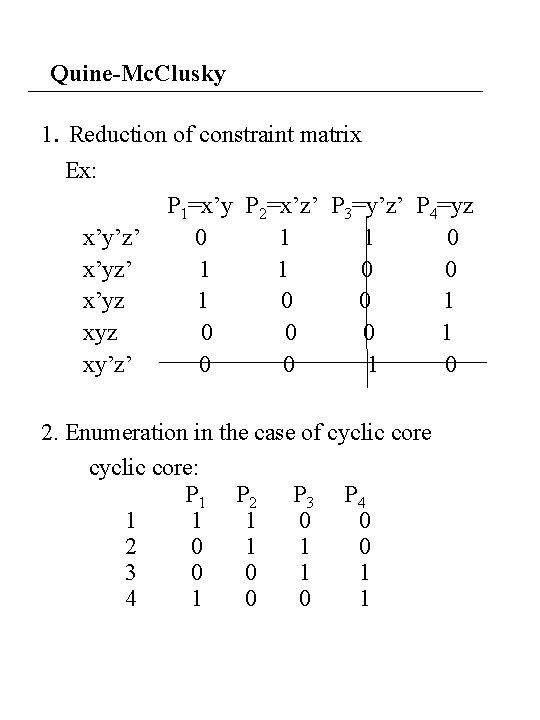
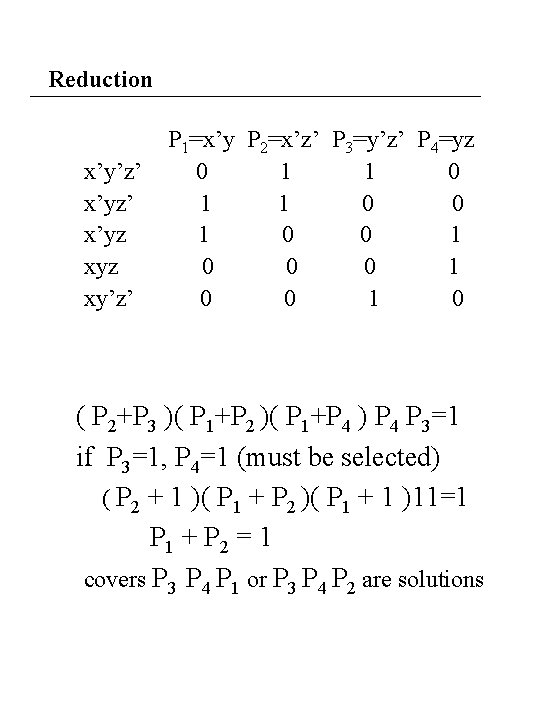
Covering Problem • Define a constraint matrix –column : corresponds to a prime –row : a minterm –Aij = 1 if jth column cover i minterm x’y’z’ x’yz xy’z’ P 1=x’y P 2=x’z’ P 3=y’z’ P 4=yz 0 1 1 0 0 1 0 Find a subset of columns of minimum cost that covers all rows. (minimum column cover)
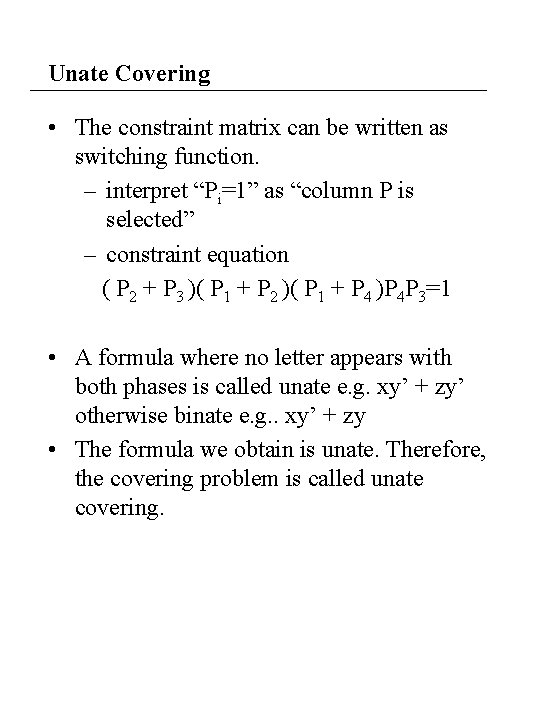
Unate Covering • The constraint matrix can be written as switching function. – interpret “Pi=1” as “column P is selected” – constraint equation ( P 2 + P 3 )( P 1 + P 2 )( P 1 + P 4 )P 4 P 3=1 • A formula where no letter appears with both phases is called unate e. g. xy’ + zy’ otherwise binate e. g. . xy’ + zy • The formula we obtain is unate. Therefore, the covering problem is called unate covering.
Quine-Mc. Clusky 1. Reduction of constraint matrix Ex: x’y’z’ x’yz xy’z’ P 1=x’y P 2=x’z’ P 3=y’z’ P 4=yz 0 1 1 0 0 1 0 2. Enumeration in the case of cyclic core: P 1 P 2 P 3 P 4 1 1 1 0 0 2 0 1 1 0 3 0 0 1 1 4 1 0 0 1
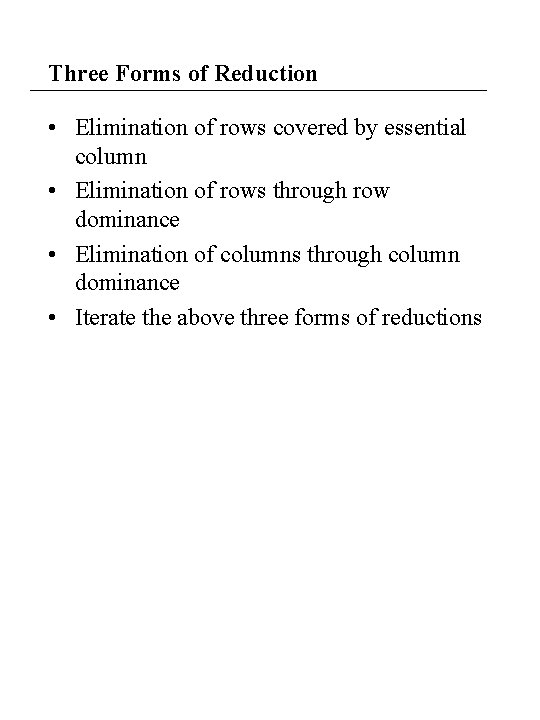
Three Forms of Reduction • Elimination of rows covered by essential column • Elimination of rows through row dominance • Elimination of columns through column dominance • Iterate the above three forms of reductions
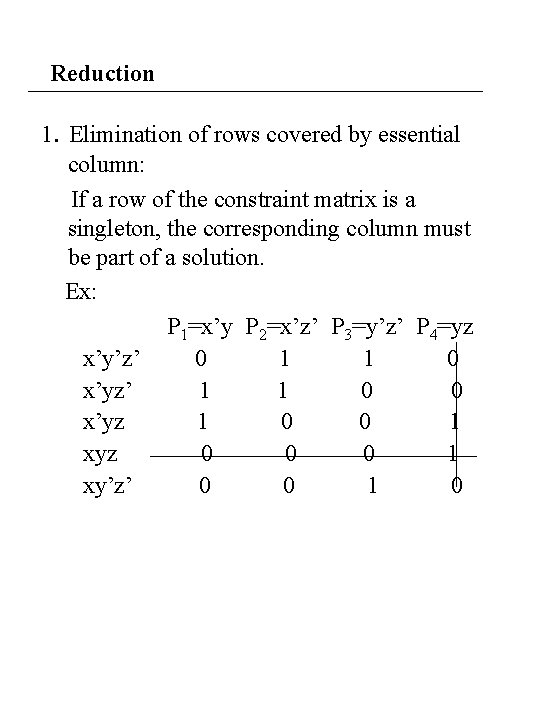
Reduction 1. Elimination of rows covered by essential column: If a row of the constraint matrix is a singleton, the corresponding column must be part of a solution. Ex: P 1=x’y P 2=x’z’ P 3=y’z’ P 4=yz x’y’z’ 0 1 1 0 x’yz’ 1 1 0 0 x’yz 1 0 0 1 xyz 0 0 0 1 xy’z’ 0 0 1 0
Reduction x’y’z’ x’yz xy’z’ P 1=x’y P 2=x’z’ P 3=y’z’ P 4=yz 0 1 1 0 0 1 0 ( P 2+P 3 )( P 1+P 2 )( P 1+P 4 ) P 4 P 3=1 if P 3=1, P 4=1 (must be selected) ( P 2 + 1 )( P 1 + P 2 )( P 1 + 1 )11=1 P 1 + P 2 = 1 covers P 3 P 4 P 1 or P 3 P 4 P 2 are solutions
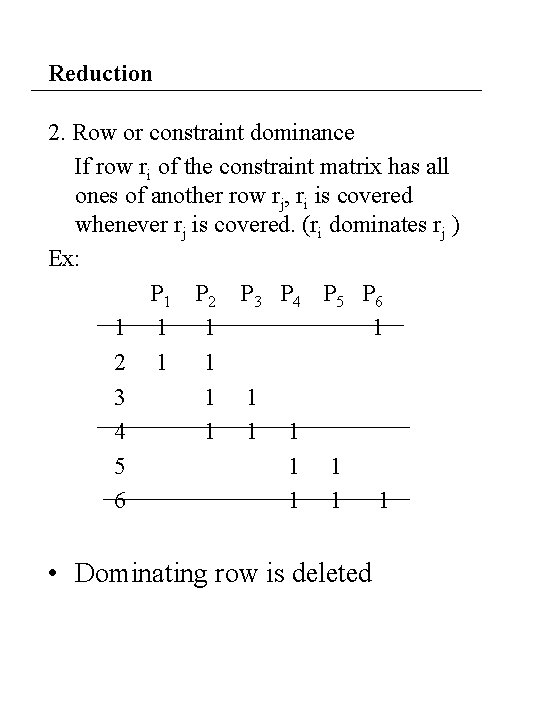
Reduction 2. Row or constraint dominance If row ri of the constraint matrix has all ones of another row rj, ri is covered whenever rj is covered. (ri dominates rj ) Ex: P 1 P 2 P 3 P 4 P 5 P 6 1 1 2 1 1 3 1 1 4 1 1 1 5 1 1 6 1 1 1 • Dominating row is deleted
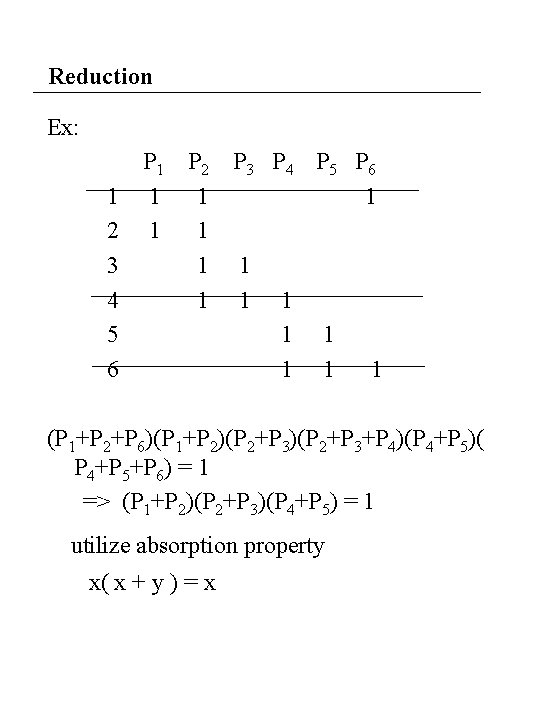
Reduction Ex: 1 2 3 4 5 6 P 1 P 2 P 3 P 4 P 5 P 6 1 1 1 1 (P 1+P 2+P 6)(P 1+P 2)(P 2+P 3+P 4)(P 4+P 5)( P 4+P 5+P 6) = 1 => (P 1+P 2)(P 2+P 3)(P 4+P 5) = 1 utilize absorption property x( x + y ) = x
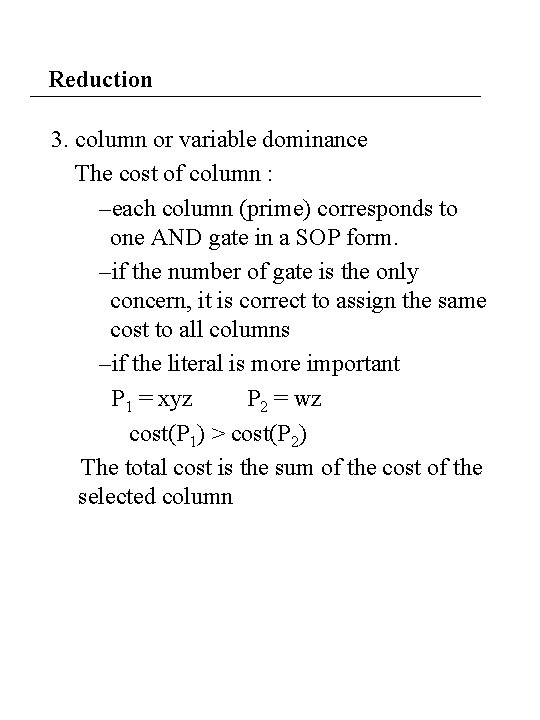
Reduction 3. column or variable dominance The cost of column : –each column (prime) corresponds to one AND gate in a SOP form. –if the number of gate is the only concern, it is correct to assign the same cost to all columns –if the literal is more important P 1 = xyz P 2 = wz cost(P 1) > cost(P 2) The total cost is the sum of the cost of the selected column
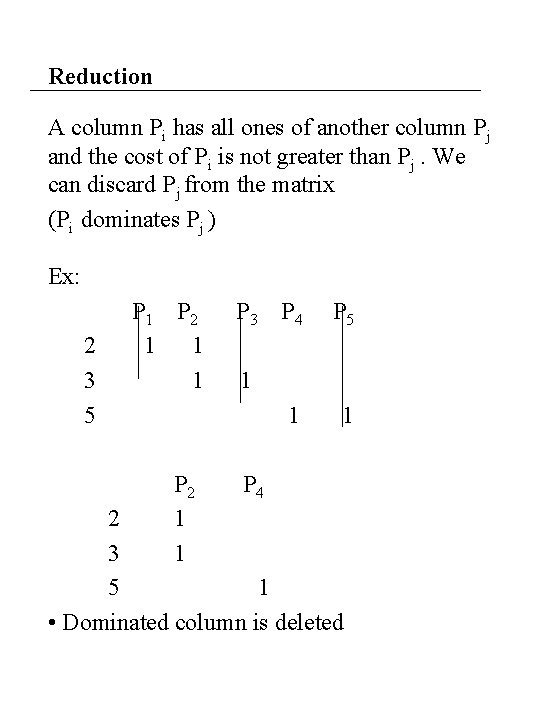
Reduction A column Pi has all ones of another column Pj and the cost of Pi is not greater than Pj. We can discard Pj from the matrix (Pi dominates Pj ) Ex: 2 3 5 P 1 P 2 1 1 1 P 3 P 4 1 1 P 2 1 1 P 5 1 P 4 2 3 5 1 • Dominated column is deleted
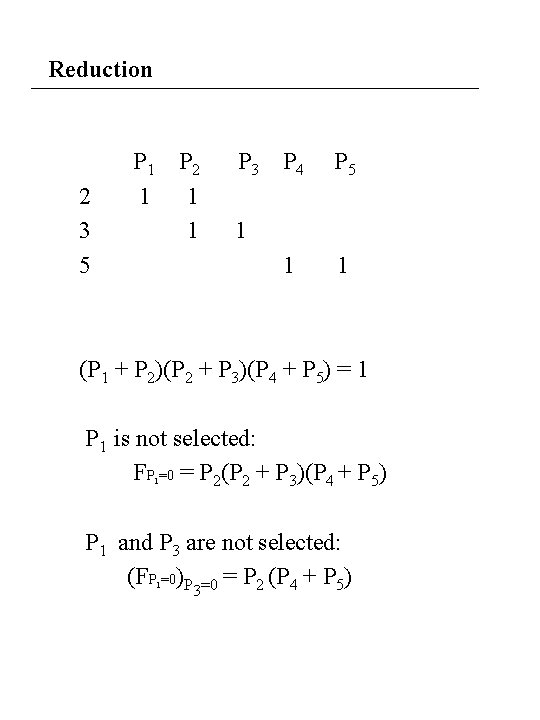
Reduction 2 3 5 P 1 P 2 1 1 1 P 3 P 4 P 5 1 1 1 (P 1 + P 2)(P 2 + P 3)(P 4 + P 5) = 1 P 1 is not selected: FP =0 = P 2(P 2 + P 3)(P 4 + P 5) 1 P 1 and P 3 are not selected: (FP =0)P 3=0 = P 2 (P 4 + P 5) 1
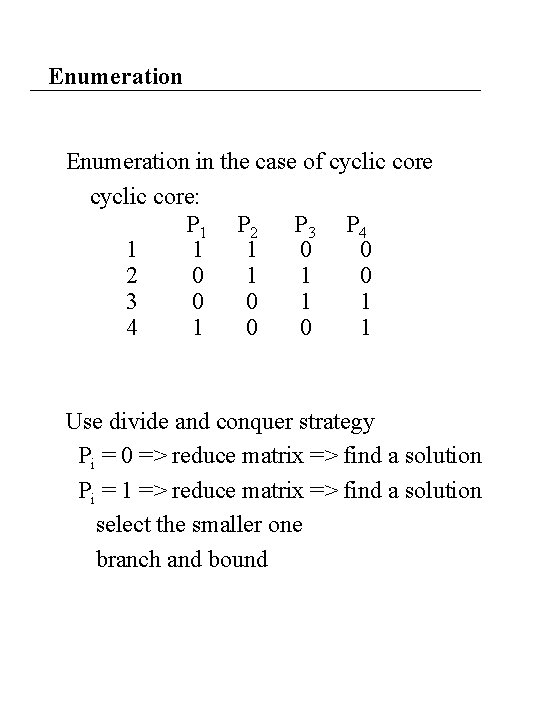
Enumeration in the case of cyclic core: P 1 P 2 P 3 P 4 1 1 1 0 0 2 0 1 1 0 3 0 0 1 1 4 1 0 0 1 Use divide and conquer strategy Pi = 0 => reduce matrix => find a solution Pi = 1 => reduce matrix => find a solution select the smaller one branch and bound
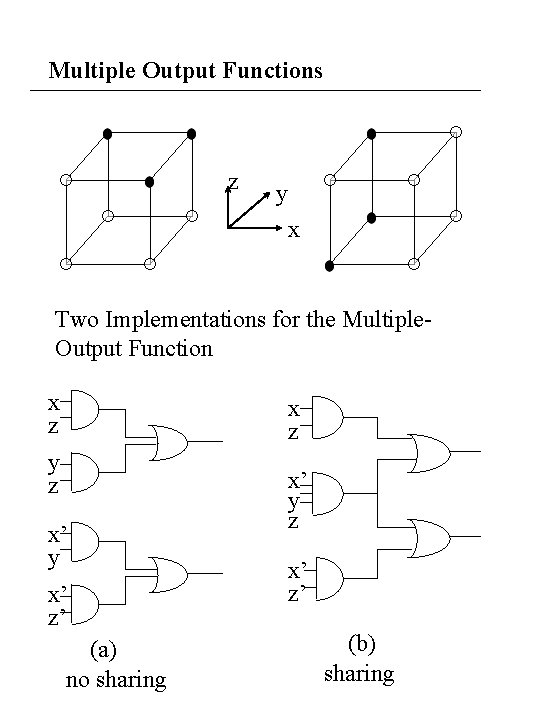
Multiple Output Functions z y x Two Implementations for the Multiple. Output Function x z y z x’ y x’ z’ (a) no sharing x’ y z x’ z’ (b) sharing
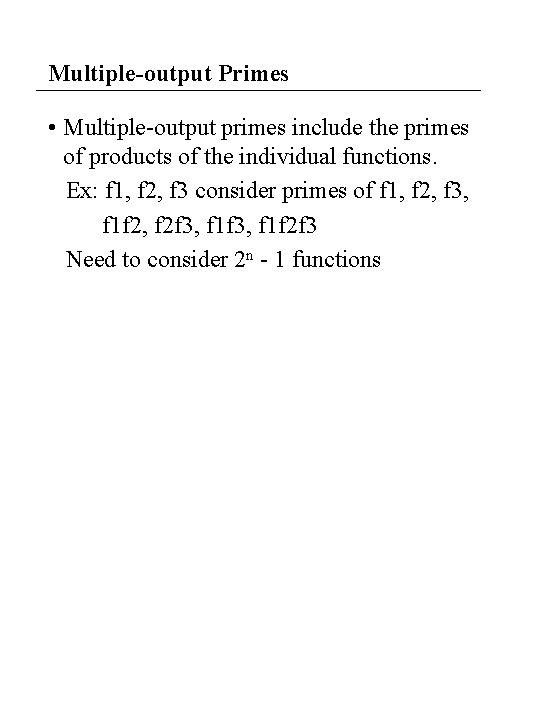
Multiple-output Primes • Multiple-output primes include the primes of products of the individual functions. Ex: f 1, f 2, f 3 consider primes of f 1, f 2, f 3, f 1 f 2, f 2 f 3, f 1 f 2 f 3 Need to consider 2 n - 1 functions
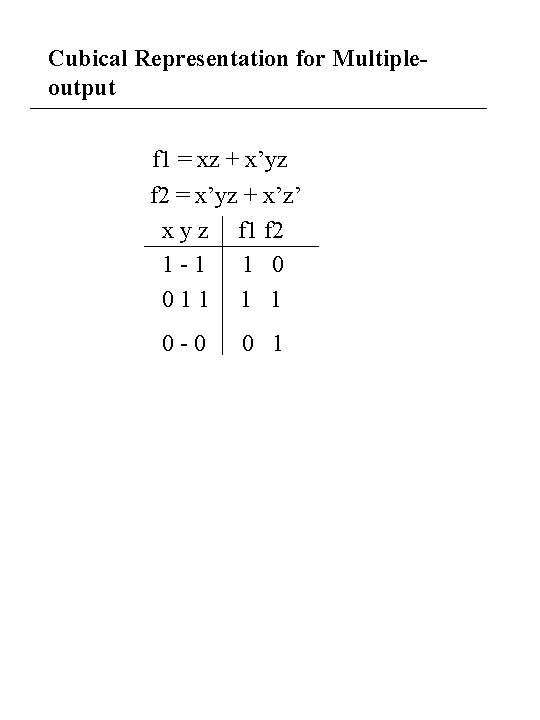
Cubical Representation for Multipleoutput f 1 = xz + x’yz f 2 = x’yz + x’z’ x y z f 1 f 2 1 -1 1 0 011 1 1 0 -0 0 1
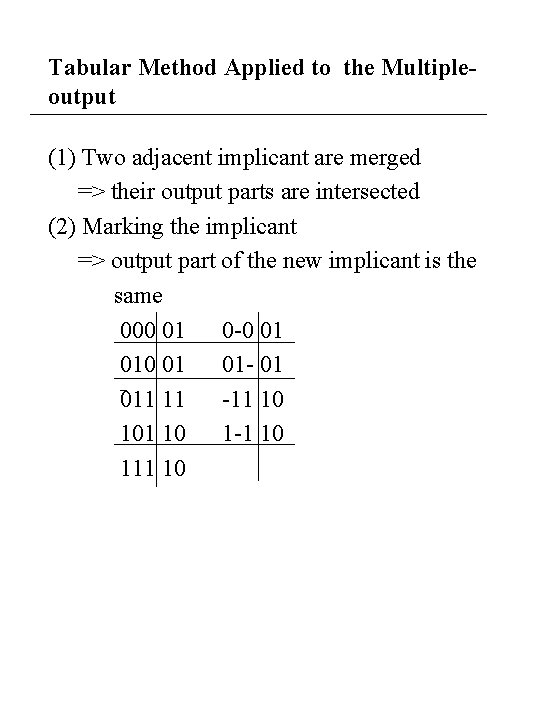
Tabular Method Applied to the Multipleoutput (1) Two adjacent implicant are merged => their output parts are intersected (2) Marking the implicant => output part of the new implicant is the same 000 01 0 -0 01 01 - 01 011 11 -11 10 101 10 1 -1 10 111 10
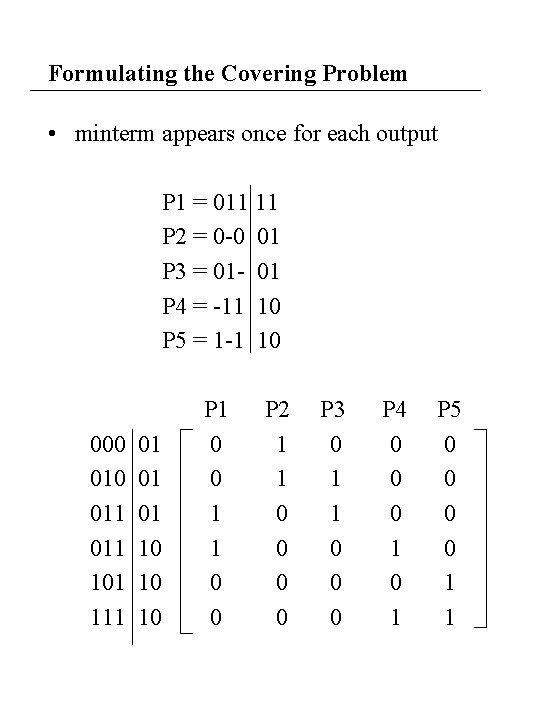
Formulating the Covering Problem • minterm appears once for each output P 1 = 011 11 P 2 = 0 -0 01 P 3 = 01 - 01 P 4 = -11 10 P 5 = 1 -1 10 000 011 011 101 111 01 01 01 10 10 10 P 1 0 0 1 1 0 0 P 2 1 1 0 0 P 3 0 1 1 0 0 0 P 4 0 0 0 1 P 5 0 0 1 1