
Two Interactive Lessons Based on The Communicative Language
Two Interactive Lessons Based on The Communicative Language Approach and Cooperative Learning
Communicative Language Teaching Approach • Interaction is both a means and a goal. • It’s Process Oriented. • The Learner’s Personal Experiences are highlighted. • http: //en. wikipedia. org/wiki/Communicative_lang uage_teaching#Classroom_activities_used_in_C LT
Cooperative Learning • Small Teams • Diverse skills, abilities, learning styles, backgrounds • Task based activities
Cooperative Learning Basic Elements • Positive Interdependence (The group sinks or swims together) • Face to Face Interaction • Both Individual and Group Accountability • Interpersonal Skills • Group Processing (Roles, Responsibilities & Communication)
Links to Cooperative Learning • http: //edtech. kennesaw. edu/intech/cooperativelearning. htm • http: //www. cde. ca. gov/sp/el/er/cooplrng. asp • http: //literacy. kent. edu/cra/cooperative/coop. html • http: //www 1. fccj. edu/mxgorman/sccl/lesson_plans. htm
Inside-Outside Circle Goal – Communicative Interaction Applicability: • Introduce new material or review previous content • Create open ended questions or discreet point items • Adapt to any content area
Benefits • It builds rapport • It provides a quick change of pace and energy boost • It targets different learning styles • It’s FUN!

Special Considerations • Arrange classroom furniture to provide space for circle(s). • On nice days, students love to go outside. • Students with physical disabilities can easily participate by sitting in chair in inner circle.
Lesson Preparation • Write questions on index cards (open-ended, short answer, or discreet point). • Write answers, clues, prompts or nothing on back. • Prepare half as many cards as the number of students in your class.
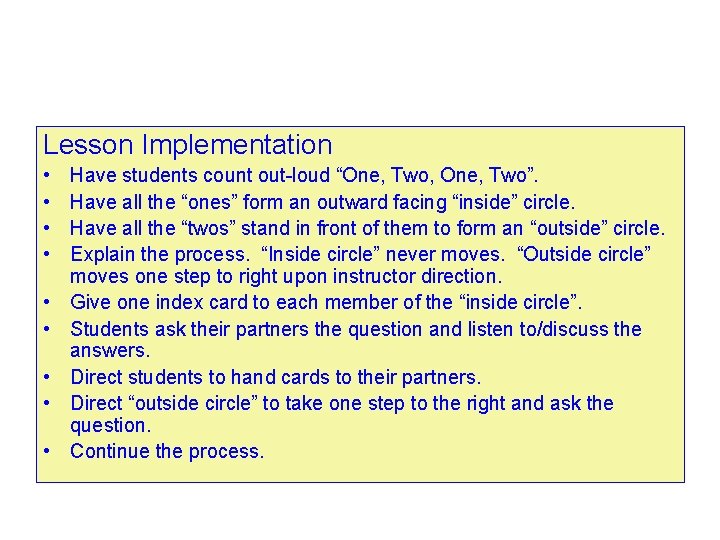
Lesson Implementation • • • Have students count out-loud “One, Two, One, Two”. Have all the “ones” form an outward facing “inside” circle. Have all the “twos” stand in front of them to form an “outside” circle. Explain the process. “Inside circle” never moves. “Outside circle” moves one step to right upon instructor direction. Give one index card to each member of the “inside circle”. Students ask their partners the question and listen to/discuss the answers. Direct students to hand cards to their partners. Direct “outside circle” to take one step to the right and ask the question. Continue the process.
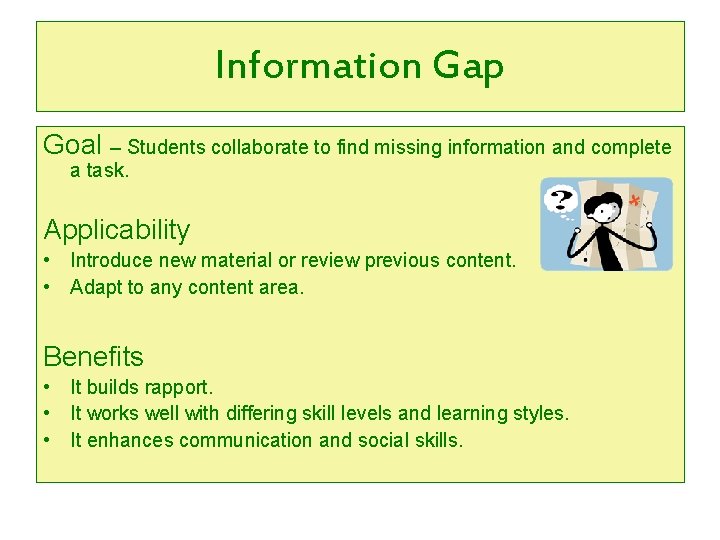
Information Gap Goal – Students collaborate to find missing information and complete a task. Applicability • Introduce new material or review previous content. • Adapt to any content area. Benefits • It builds rapport. • It works well with differing skill levels and learning styles. • It enhances communication and social skills.
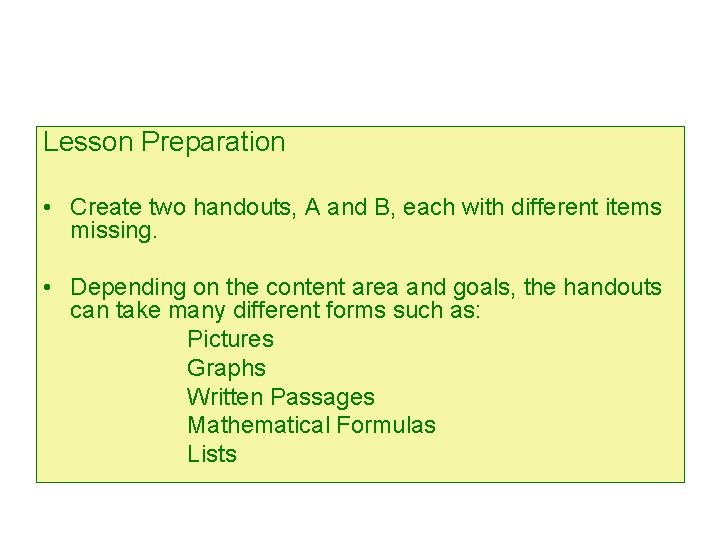
Lesson Preparation • Create two handouts, A and B, each with different items missing. • Depending on the content area and goals, the handouts can take many different forms such as: Pictures Graphs Written Passages Mathematical Formulas Lists
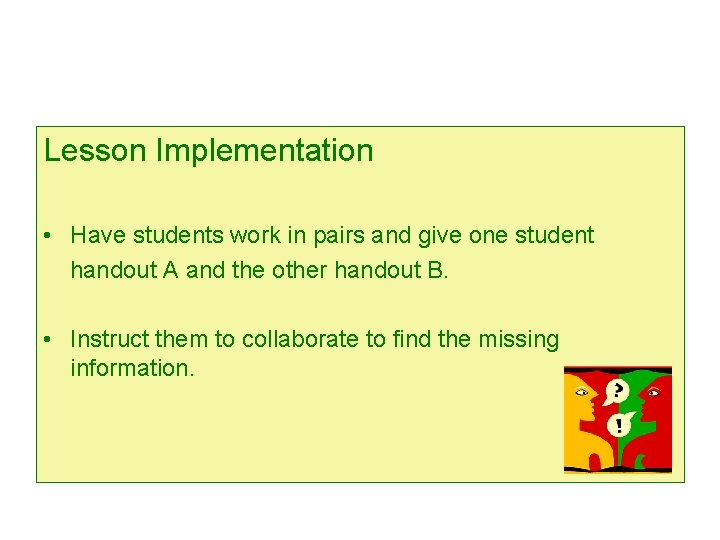
Lesson Implementation • Have students work in pairs and give one student handout A and the other handout B. • Instruct them to collaborate to find the missing information.
Depending upon the content area and goal of the lesson, this collaboration may take many forms such as: • Discussing the deleted points of an argument • Figuring out the missing steps of a mathematical equation • Determining the needed supporting points of a topic sentence • Identifying the missing punctuation of a citation • Noticing differences between two pictures • Etc.
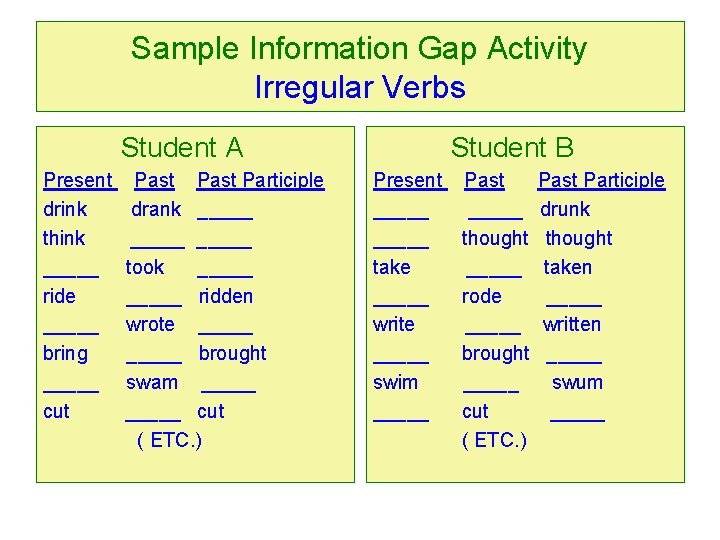
Sample Information Gap Activity Irregular Verbs Student A Present drink think _____ ride _____ bring _____ cut Past Participle drank _____ took _____ ridden wrote _____ brought swam _____ cut ( ETC. ) Student B Present _____ take _____ write _____ swim _____ Past _____ thought _____ rode _____ brought _____ cut ( ETC. ) Past Participle drunk thought taken _____ written _____ swum _____
Thanks for your time, and have FUN: ☺Interacting ☺Communicating ☺Collaborating ☺Learning
- Slides: 16