
Two Four Six Eighthow do literacy dyslexia and
![References: American Speech-Language-Hearing Association. (2016 a). Code of ethics [Ethics]. Available from www. asha.](https://slidetodoc.com/presentation_image/302057f8e974269f86881db5bb902466/image-92.jpg "References: American Speech-Language-Hearing Association. (2016 a). Code of ethics [Ethics]. Available from www. asha.")
- Slides: 94
Two, Four, Six, Eight…how do literacy, dyslexia, and CAS relate? Mary Cousino, M. A. , CCC/SLP
Mary Cousino, MA, CCC-SLP • Mary worked at Nationwide Children's Hospital (NCH) from 2006 until May, 2020. Prior to that she was employed by Ohio Health/Riverside Methodist Hospital from 1988 -2006. She has extensive experience in pediatric speech/language disorders, as well as management experience in the NCH large and growing Department of Speech Pathology. During the past few years, Mary’s major clinical focus has been on CAS, and from that, an intense interest in reading disorders and the connection between the two has also emerged. Mary was working at NCH as a Clinical Specialist, working with both Dyslexia and CAS, until her retirement in May, 2020.
Disclosure • I am receiving a fee for this conference, but I have no additional financial or non-financial relationships to disclose.
SLP Awareness
The scope of practice for SLPs includes reading and writing disorders yes no
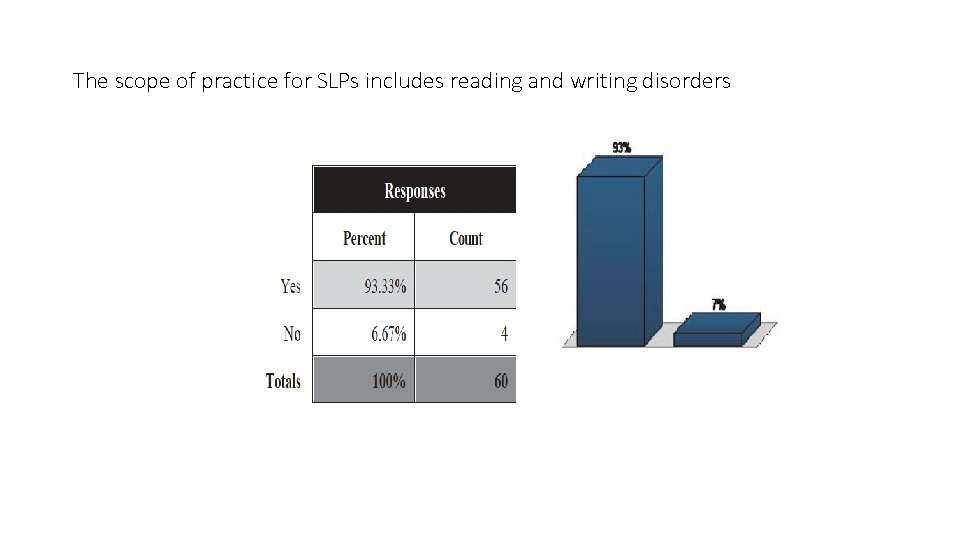
The scope of practice for SLPs includes reading and writing disorders
Can you provide a description of the CTOPP and what it assesses? yes no
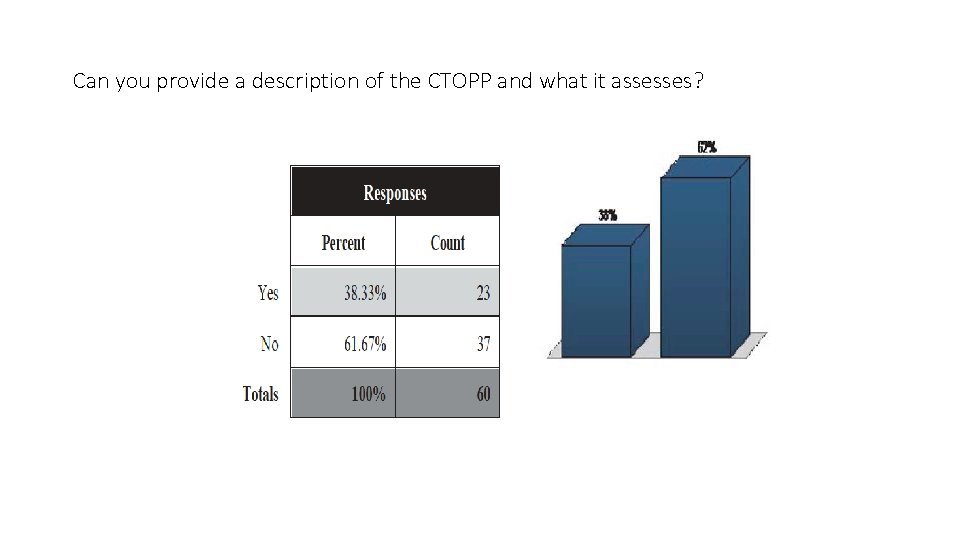
Can you provide a description of the CTOPP and what it assesses?
How frequently do you incorporate phonological awareness into your treatment sessions? never seldom often always
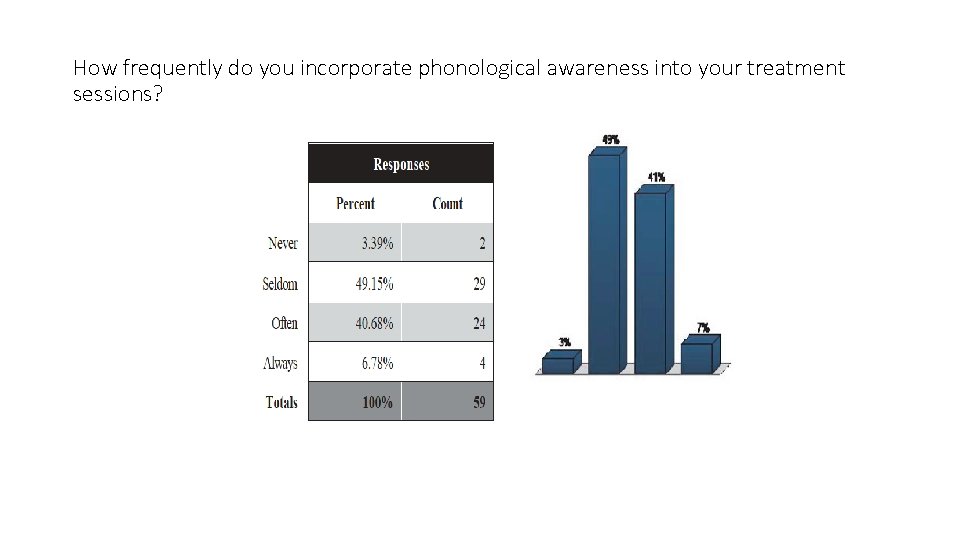
How frequently do you incorporate phonological awareness into your treatment sessions?
Are you providing reading assistance to your patients during treatment? never seldom often always
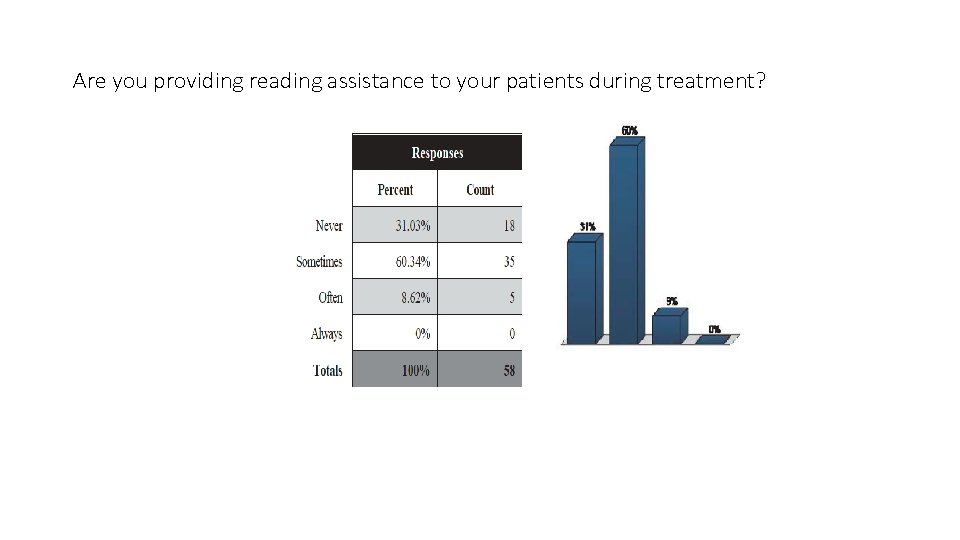
Are you providing reading assistance to your patients during treatment?
Can you explain the relationship between Dyslexia and CAS? yes no
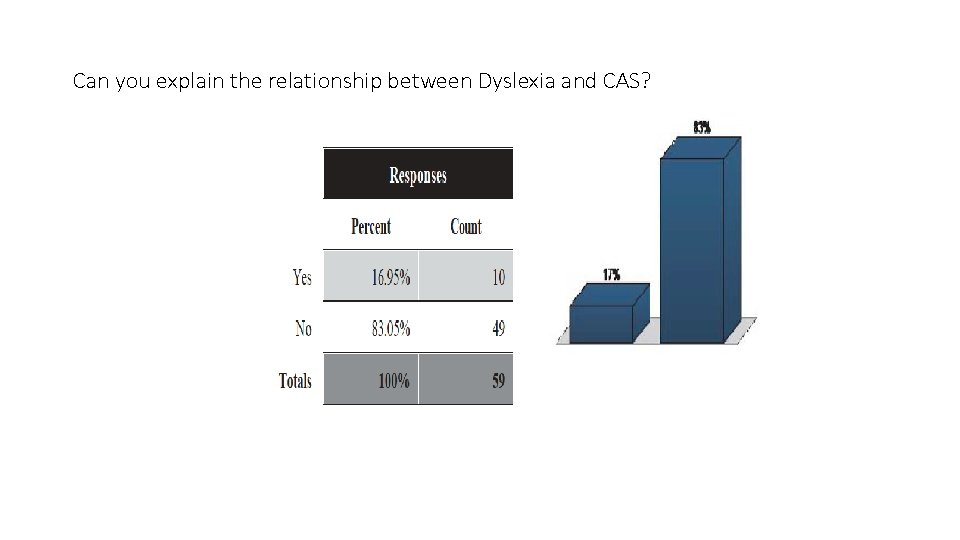
Can you explain the relationship between Dyslexia and CAS?
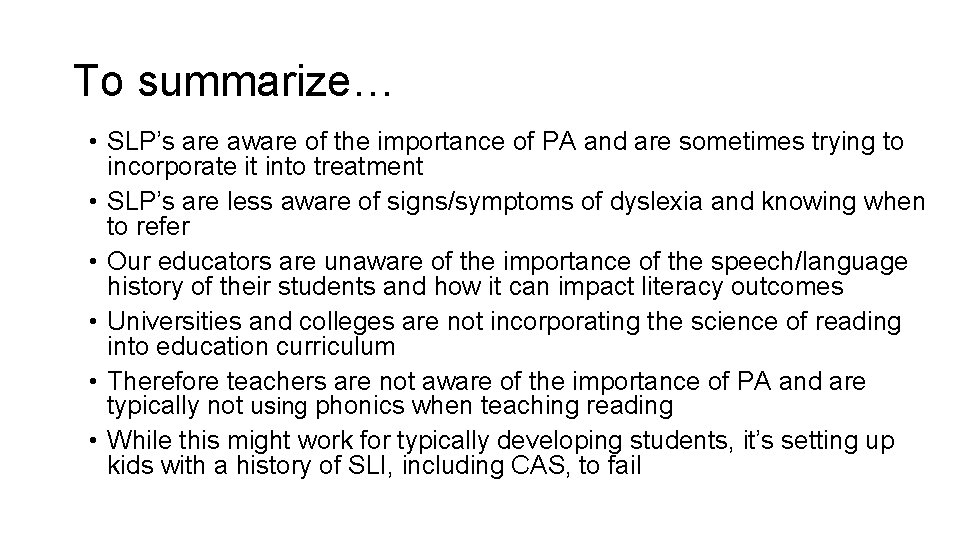
To summarize… • SLP’s are aware of the importance of PA and are sometimes trying to incorporate it into treatment • SLP’s are less aware of signs/symptoms of dyslexia and knowing when to refer • Our educators are unaware of the importance of the speech/language history of their students and how it can impact literacy outcomes • Universities and colleges are not incorporating the science of reading into education curriculum • Therefore teachers are not aware of the importance of PA and are typically not using phonics when teaching reading • While this might work for typically developing students, it’s setting up kids with a history of SLI, including CAS, to fail
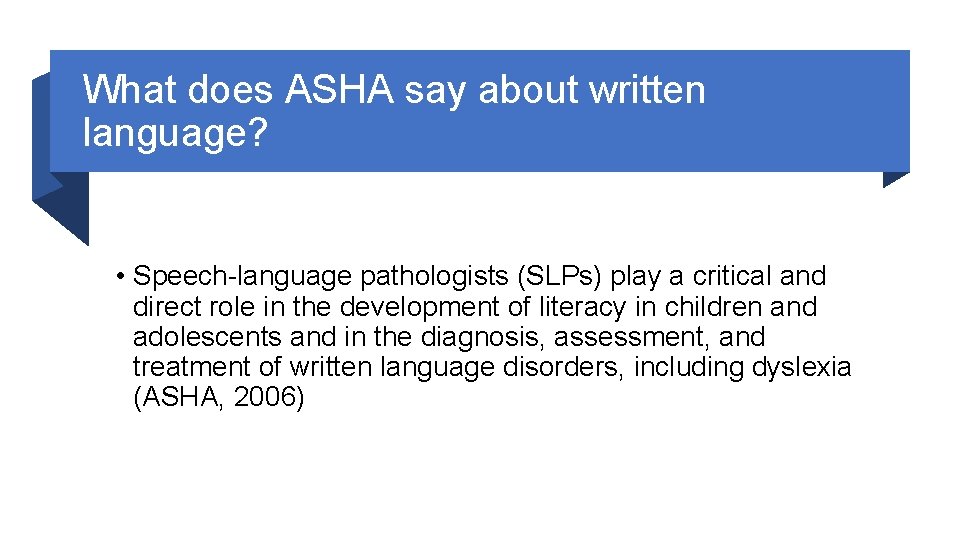
What does ASHA say about written language? • Speech-language pathologists (SLPs) play a critical and direct role in the development of literacy in children and adolescents and in the diagnosis, assessment, and treatment of written language disorders, including dyslexia (ASHA, 2006)
Why should we address written language? • SLPs have unique knowledge about the subsystems of language (i. e. , phonology, morphology, syntax, semantics, and pragmatics) as they relate to spoken and written language and knowledge of the metalinguistic skills required for reading and writing (e. g. , phonological, semantic, orthographic, and morphological awareness) • spoken language provides the foundation for the development of reading and writing abilities • spoken and written language have a reciprocal relationship • children with spoken language problems often have difficulty learning to read and write • instruction in one modality (spoken or written) can result in growth in the other modality
Roles of the SLP in addressing written language. Among many roles we are to: • Provide prevention information to individuals and groups known to be at risk for written language disorders as well as to individuals working with those at risk • Help to prevent written language problems by fostering language acquisition and emergent literacy • Serving as a member of the interprofessional team within the schools and providing a focus on the language underpinnings of the curriculum to help students meet state curriculum standards (see interprofessional education/interprofessional practice [IPE/IPP])
Roles: A Caveat The role of the SLP in literacy intervention may vary by setting and availability of other professionals (e. g. , reading teacher and resource personnel) who also provide written language intervention. Regardless of the SLP's specific role, it is important that intervention be collaborative. As indicated in the Code of Ethics (ASHA, 2016 a), SLPs who serve this population should be specifically educated and appropriately trained to do so.
What does the research say?
A look at the link between CAS and dyslexia.
The link… • There is a known link between severe sound disorders, CAS, other specific language deficits and Dyslexia • Children with speech-language impairment are 4 to 5 times more likely to have difficulty reading than the general population. • These difficulties in reading and spelling persist into adulthood.
Prevalence • Among children with speech and language impairment, the cumulative incidence of a writing disorder was 61. 4% for boys and 55. 1% for girls at age 19 years (Katusic et al. , 2009). • Studies of elementary-age children from Iowa (Catts, Fey, Tomblin, & Zhang, 2002) and New Jersey (Flax et al. , 2003) revealed a reading disability and specific language impairment comorbidity of 50% and 68%, respectively. • Several studies (Badian, 1999; Flannery, Liederman, Daly, & Schultz, 2000; Katusic et al. , 2009) have reported that boys are 2– 3 times more likely than girls to have a literacy disorder.
Four factors that increase risk of written language disorder in children with CAS (Gillon, Moriarty, 2007) 1: Nature of the disorder inconsistent speech in CAS provides inadequate input to child’s developing linguistic system • Multi-deficit model of CAS impacts several levels of the speech processing chain (Ozane, 2005). • Multi-deficit model predicts children with CAS are at risk for reading/spelling difficulties since it impacts phonological awareness
Four factors that increase risk of written language disorder in children with CAS: 2) the presence of phonological awareness difficulties • Phonological awareness skills have proven to be strong predictors in early reading outcomes • Phonological representation deficit (Marquardt, et al. , 2002) has been hypothesized to account for phonological awareness, speech and motor planning deficits of CAS • Poor phonological representation deficit impairs child’s ability to build smaller linguistic structures into larger ones such as syllables from phonemes and phrases from words
#2 continued 2) the presence of phonological awareness difficulties • Phonological representations appear to be acquired and refined over time as language develops (Scarborough & Brady, 2002). • The phonological representation deficit of CAS therefore places the core disorder in representation systems and consequently predicts difficulties with reading and spelling
Phonological Representation • A phonological representation is the mental representation of the sounds and combinations of sounds that comprise words in a particular spoken language. Goswami U, 2012) (Goswami U, 2012) • Phonological representations; • acoustic level: the phonological representation for a word form is analyzed in terms of the raw signal, for example, in terms of pitch, loudness, and duration. • linguistic level, the word form is described in terms of the vocal tract and the ways that it constrains the production of speech sounds (manner and place) • cognitive level: phonological representation is described in terms of its assumed constituent elements, namely consonant phonemes and vowel phonemes.
Four factors that increase risk of written language disorder in children with CAS: 3) Genetic Risk Factors • (Lewis, et al. , 2004) looked at the family history of 22 children with CAS aged 3 to 10 years. Results revealed that 86% of the kids with CAS had a least one nuclear family member with: speech/language and/or reading disorder (but very small incidence of family member also having CAS) • Findings suggest that families of children with CAS hold more affected genes for speech language disorder and dyslexia • Additionally, children with speech impairment and children with dyslexia show similar breakdowns in phonological processing
Four factors that increase risk of written language disorder in children with CAS: 4) Cumulative Negative Effects from Early Reading Difficulty • Unresolved speech and language impairment, along with poor phonological awareness ability, suggests that kids with CAS will struggle with early reading acquisition upon school entry • This difficulty with early reading development places children at risk for persistent reading and spelling difficulty throughout later school years (Hogan, et al. , 2005. ) • These difficulties lead to cascading effects in literacy development
Research Findings (Mc. Neill, Gillon, Dodd, 2008). • Children with CAS have poorer phonological awareness than children with inconsistent speech disorder and typical language development • More children with CAS performed below their expected age level than comparison groups in phonological awareness, letter-sound knowledge and decoding tasks. • There was no difference in the performance of the CAS and ISD groups on the phonological representation task • ** (Inconsistent speech disorder is defined as: child produces different misarticulations upon repeated production of the same word without evidence of motor planning deficits)
Research Findings (Mc. Neill, Gillon, Dodd, 2008). • Authors speculated that no distinction noted in phonological representations of the two groups could be due to the following reasons: • ISD may also have difficulty with phonological representations • Phonological representation task given to the two groups may not have been sensitive enough to detect differences • Perhaps differing causes contributing to phonological representation issues in each group
Clinical implications (Mc. Neill, Gillon, Dodd, 2008) • “The use of integrated treatment models that simultaneously target speech, phonological awareness and reading is critical to ensure treatment is efficient and effective in improving these children’s oral and written language development. ”
Exploring the Overlap Between Dyslexia and Speech Sound Production Deficits (Cabbage, et al. , 2018) • One of the strongest indicators of phonological weakness is poor phonological awareness (Farquharson, et al. , 2014; Swan & Goswami, 1997). • Poor literacy outcomes have long been linked to children with poor phonological awareness (Bruck, 1992; Wagner & Torgesen, 1987). • Even after learning how to read, individuals with dyslexia continue to show poor phonological awareness, particularly for tasks that require phoneme-level sensitivity (Pennington, et al. , 1990; Snowling, et al. , 1997; Wilson and Lesaux, 2001).
Exploring the Overlap Between Dyslexia and Speech Sound Production Deficits (Cabbage, et al. , 2018) • In addition to poor phonological awareness, individuals with dyslexia exhibit other areas of phonological weakness including: • Poor phonological memory (Brady, et al. , 1983) • Poor speech perception (Rosen, 2003) • Poor letter-sound decoding skills (Stanovich & Siegel, 1984)
Exploring the Overlap Between Dyslexia and Speech Sound Production Deficits (Cabbage, et al. , 2018) In addition to poor phonological awareness, individuals with dyslexia exhibit other areas of phonological weakness including: Poor phonological memory (Brady, et al. , 1983) Poor speech perception (Rosen, 2003) Poor letter-sound decoding skills (Stanovich & Siegel, 1984)
Exploring the Overlap Between Dyslexia and Speech Sound Production Deficits (Cabbage, et al. , 2018) Catts (1986) sought to characterize speech production error patterns in children with dyslexia These children produced more speech production errors than peers in picture naming tasks, in multi-syllabic word repetition tasks, and when repeating short phrases. These errors were word or phrase specific misarticulations (amunimum for aluminum) as opposed systematic sound errors (such as /w/ for /r/ substitution typical of children with a speech sound disorder
Exploring the Overlap Between Dyslexia and Speech Sound Production Deficits (Cabbage, et al. , 2018) • Speech disorder and dyslexia are highly co-morbid • This co-morbidity can lead to challenges
Challenges in identification of dyslexia • Resolution of speech disorder prior to school entry • Quantity and type of speech errors made by dyslexic children may not be sufficient to warrant a clinical diagnosis of speech sound disorder, so they may not be under direct care of an SLP • Children with speech disorders may have poorer reading outcomes/weak literacy skills but may not fully qualify for a formal dx of dyslexia
Exploring the Overlap Between Dyslexia and Speech Sound Production Deficits (Cabbage, et al. , 2018) • SLP’s are on the frontline for identifying pre-school and Exploring the Overlap Between Dyslexia and school aged children at risk for dyslexia Speech Sound Production Deficits (Cabbage, et al. , 2018) • Education of school professionals in types of speech errors made by dyslexics • Recommend phonological skills assessment in all children with speech sound disorder
Exploring the Overlap Between Dyslexia and Speech Sound Production Deficits (Cabbage, et al. , 2018) Exploring the Overlap Between Dyslexia and • Include receptive measures of phonological processing Speech Sound Production Deficits (Cabbage, et al. , 2018) • Include incorporating multi-syllabic word production tasks and/or non-word repetition tasks to assess speech production • Pre and post testing of PA skills upon therapy enrollment and discharge
NOT all children who exhibit spoken language impairments have difficulty learning how to read and write Some children with speech impairment show typical development in written language attainment (Johnson, et al. , 1999) Whereas others fall into high risk category for persistent reading issues (Johnson, et al. , 1999) So how do we distinguish between the two?
What’s the missing link?
Predicting literacy outcomes (Gillon, 2004) Appears to be dependent on linguistic profile of child • Particularly about phonological awareness • Children with articulation impairment only and good phonological awareness skills are not generally at risk for literacy difficulties • However, children with severe deficits in phonological, semantic, syntactic or spoken language are highly likely to have difficulty with written language throughout their school years
Hard Words, APM Reports (Hanford, 2018) Research shows that children who don't learn to read by the end of third grade are likely to remain poor readers for the rest of their lives More than 60 percent of American fourth-graders are not proficient readers, according to the National Assessment of Educational Progress, and it's been that way since testing began in the 1990 s.
Hard Words, APM Reports (Hanford, 2018) Take away from scientific research on reading is: • Learning to read is not a natural process • While we use our eyes to read, the starting point for reading is sound • In order to become a reader a child has to figure out how the words they hear or know connect to letters on the page • Writing is a code that humans developed to represent speech sounds • Kids have to crack that code in order to become readers
Tying it all Together
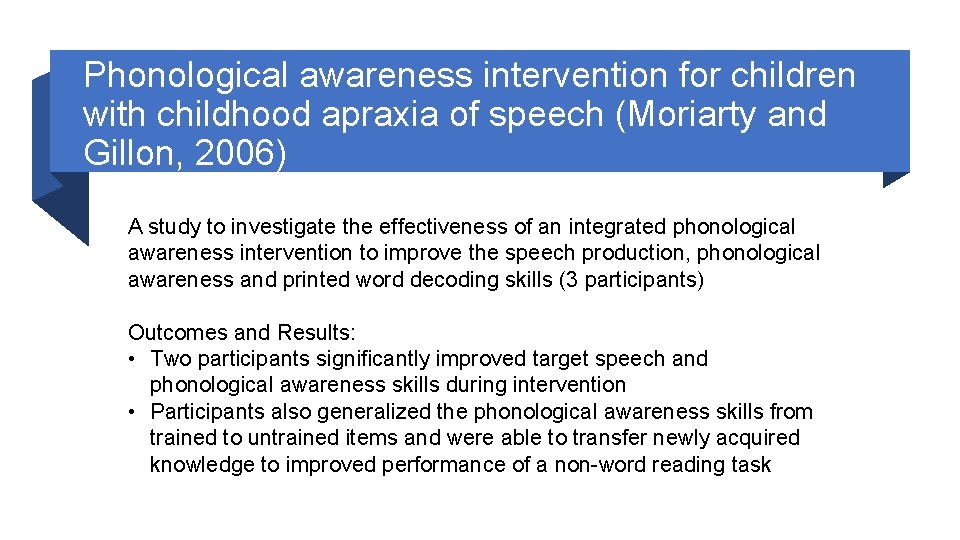
Phonological awareness intervention for children with childhood apraxia of speech (Moriarty and Gillon, 2006) A study to investigate the effectiveness of an integrated phonological awareness intervention to improve the speech production, phonological awareness and printed word decoding skills (3 participants) Outcomes and Results: • Two participants significantly improved target speech and phonological awareness skills during intervention • Participants also generalized the phonological awareness skills from trained to untrained items and were able to transfer newly acquired knowledge to improved performance of a non-word reading task
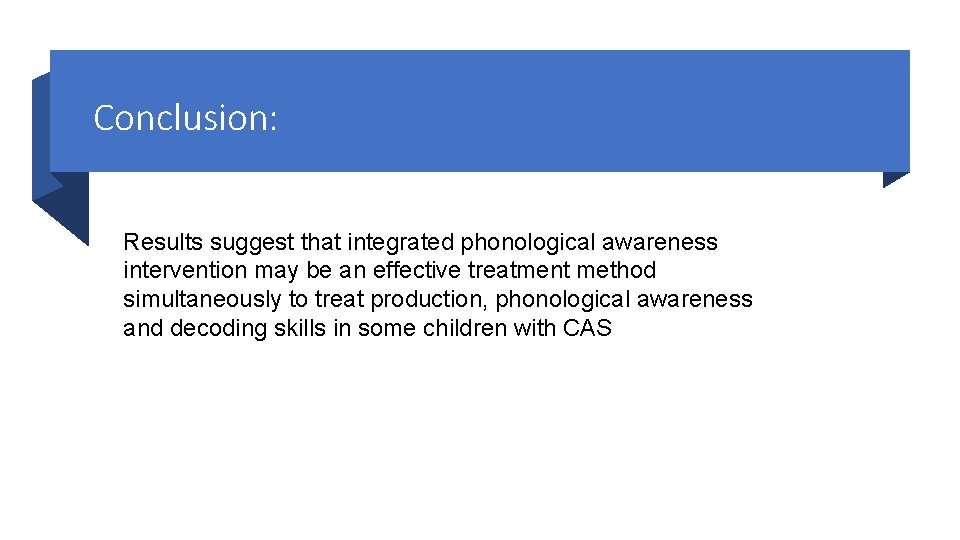
Conclusion: Results suggest that integrated phonological awareness intervention may be an effective treatment method simultaneously to treat production, phonological awareness and decoding skills in some children with CAS
Treatment – what we have all been waiting for!
Integrated Phonological Awareness (IPA) • Third of the EBP for treatments for CAS • The intervention is based on activities implemented in the Gillon (2005), Moriarty and Gillon, (2006) and Mc. Neill (2007) intervention studies. The findings from these research investigations indicated that the program was effective in facilitating significant improvement in speech production, early reading and spelling development in preschool children with speech impairment and in children aged 4 -7 years diagnosed with childhood apraxia of speech.
IPA: Aims of the program 1. Enhance letter knowledge (letter sound and letter name) 2. Facilitate phonological awareness particularly at the phoneme level 3. Improve speech intelligibility
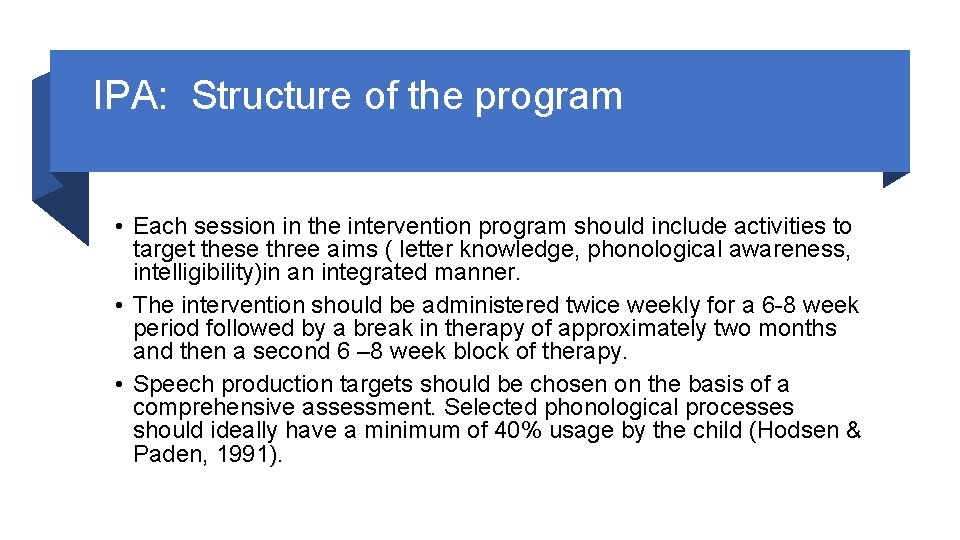
IPA: Structure of the program • Each session in the intervention program should include activities to target these three aims ( letter knowledge, phonological awareness, intelligibility)in an integrated manner. • The intervention should be administered twice weekly for a 6 -8 week period followed by a break in therapy of approximately two months and then a second 6 – 8 week block of therapy.
IPA: Structure of the program • Each session in the intervention program should include activities to target these three aims ( letter knowledge, phonological awareness, intelligibility)in an integrated manner. • The intervention should be administered twice weekly for a 6 -8 week period followed by a break in therapy of approximately two months and then a second 6 – 8 week block of therapy. • Speech production targets should be chosen on the basis of a comprehensive assessment. Selected phonological processes should ideally have a minimum of 40% usage by the child (Hodsen & Paden, 1991).
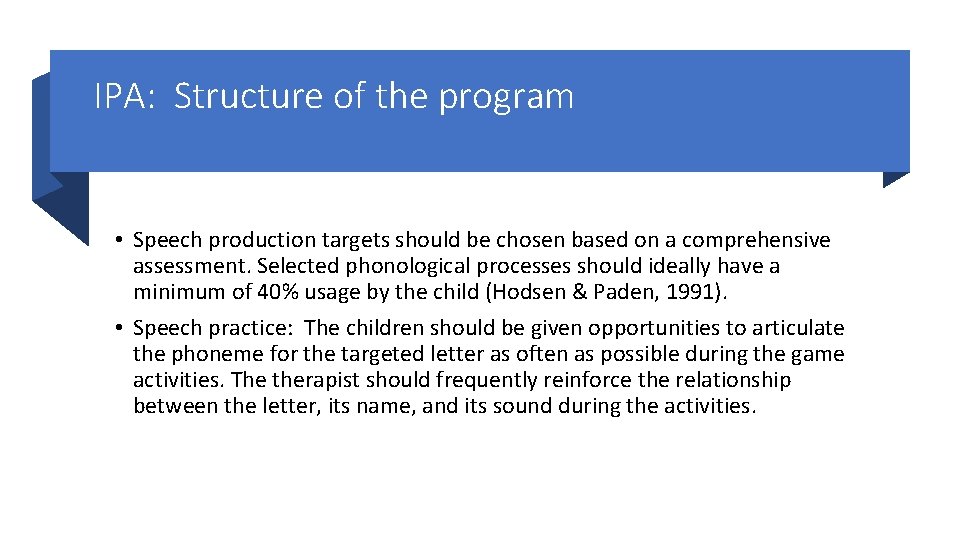
IPA: Structure of the program • Speech production targets should be chosen based on a comprehensive assessment. Selected phonological processes should ideally have a minimum of 40% usage by the child (Hodsen & Paden, 1991). • Speech practice: The children should be given opportunities to articulate the phoneme for the targeted letter as often as possible during the game activities. The therapist should frequently reinforce the relationship between the letter, its name, and its sound during the activities.
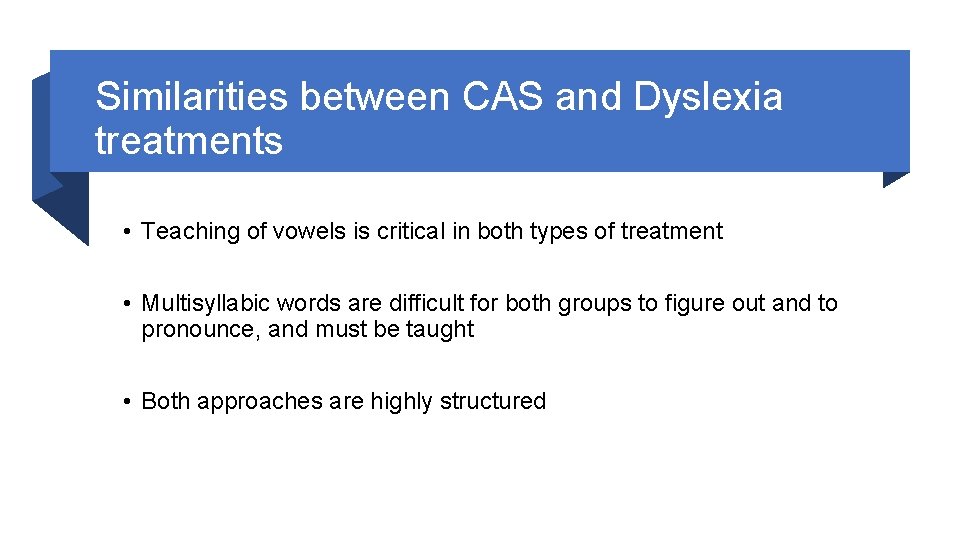
Similarities between CAS and Dyslexia treatments • Teaching of vowels is critical in both types of treatment • Multisyllabic words are difficult for both groups to figure out and to pronounce, and must be taught • Both approaches are highly structured
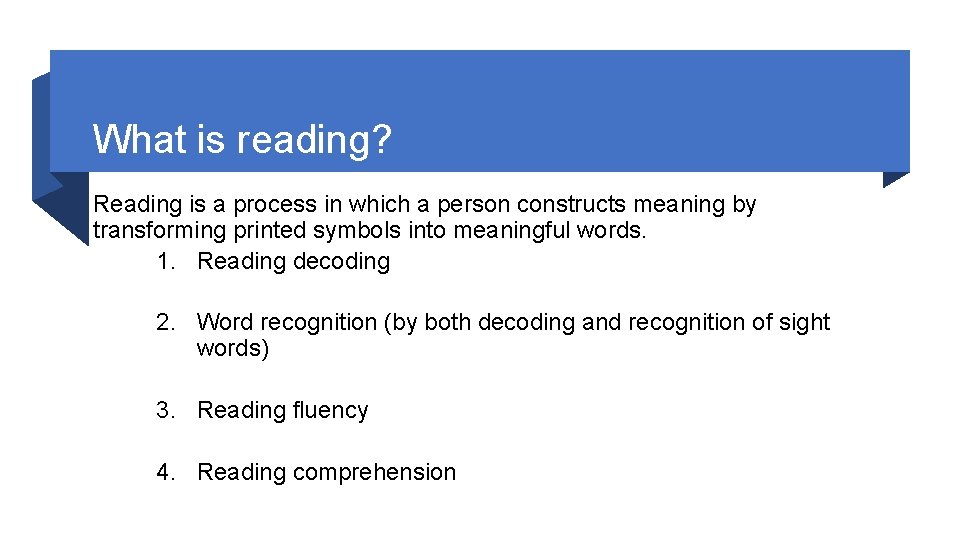
What is reading? Reading is a process in which a person constructs meaning by transforming printed symbols into meaningful words. 1. Reading decoding 2. Word recognition (by both decoding and recognition of sight words) 3. Reading fluency 4. Reading comprehension
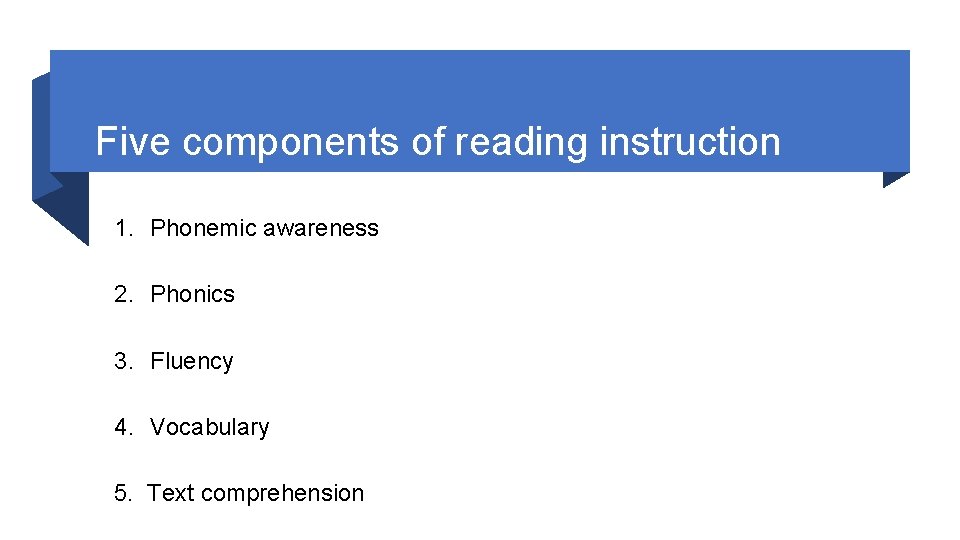
Five components of reading instruction 1. Phonemic awareness 2. Phonics 3. Fluency 4. Vocabulary 5. Text comprehension
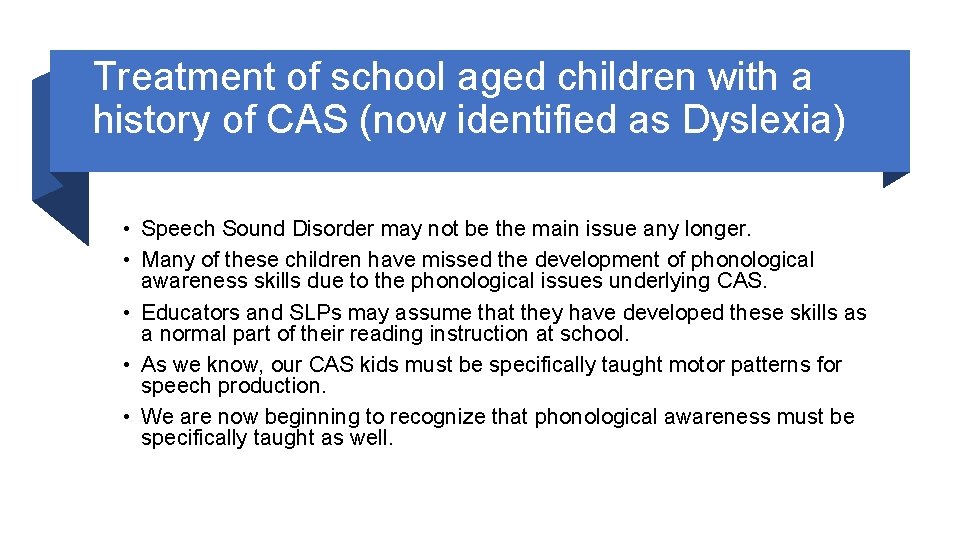
Treatment of school aged children with a history of CAS (now identified as Dyslexia) • Speech Sound Disorder may not be the main issue any longer. • Many of these children have missed the development of phonological awareness skills due to the phonological issues underlying CAS. • Educators and SLPs may assume that they have developed these skills as a normal part of their reading instruction at school. • As we know, our CAS kids must be specifically taught motor patterns for speech production. • We are now beginning to recognize that phonological awareness must be specifically taught as well.
Assessment to treatment. Assessment shows the weaknesses. We start at the weakest point, and even with some of our school age patients, that may begin with learning the alphabet.
Emergent Literacy – preschool age or developmental level The child develops an awareness of print and an understanding of the functions of literacy The child develops foundational skills that are the precursors to reading and writing In other words, Phonological Awareness
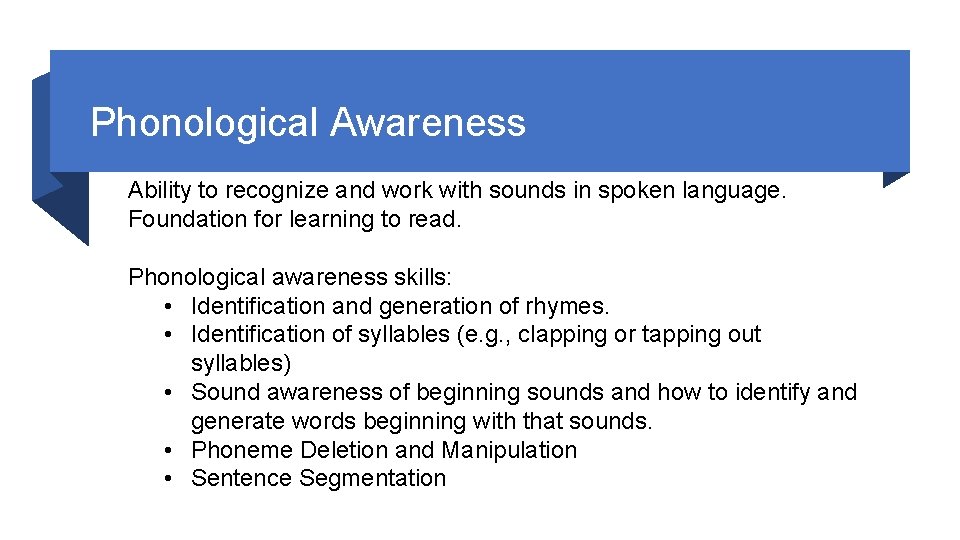
Phonological Awareness Ability to recognize and work with sounds in spoken language. Foundation for learning to read. Phonological awareness skills: • Identification and generation of rhymes. • Identification of syllables (e. g. , clapping or tapping out syllables) • Sound awareness of beginning sounds and how to identify and generate words beginning with that sounds. • Phoneme Deletion and Manipulation • Sentence Segmentation
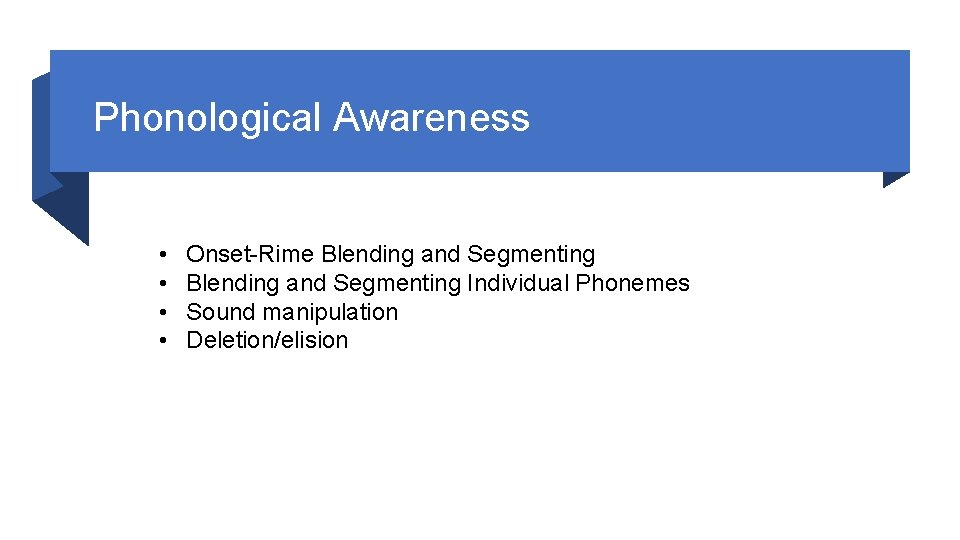
Phonological Awareness • • Onset-Rime Blending and Segmenting Individual Phonemes Sound manipulation Deletion/elision
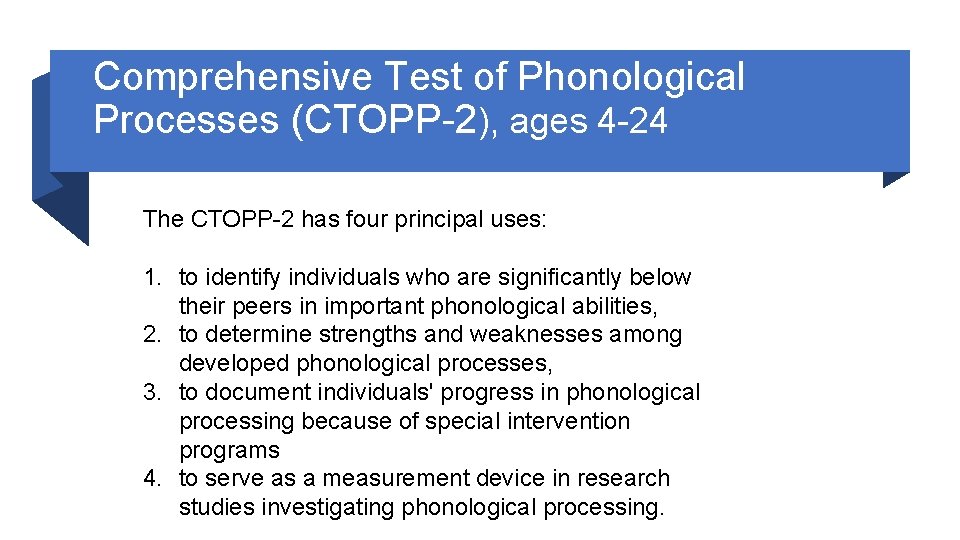
Comprehensive Test of Phonological Processes (CTOPP-2), ages 4 -24 The CTOPP-2 has four principal uses: 1. to identify individuals who are significantly below their peers in important phonological abilities, 2. to determine strengths and weaknesses among developed phonological processes, 3. to document individuals' progress in phonological processing because of special intervention programs 4. to serve as a measurement device in research studies investigating phonological processing.
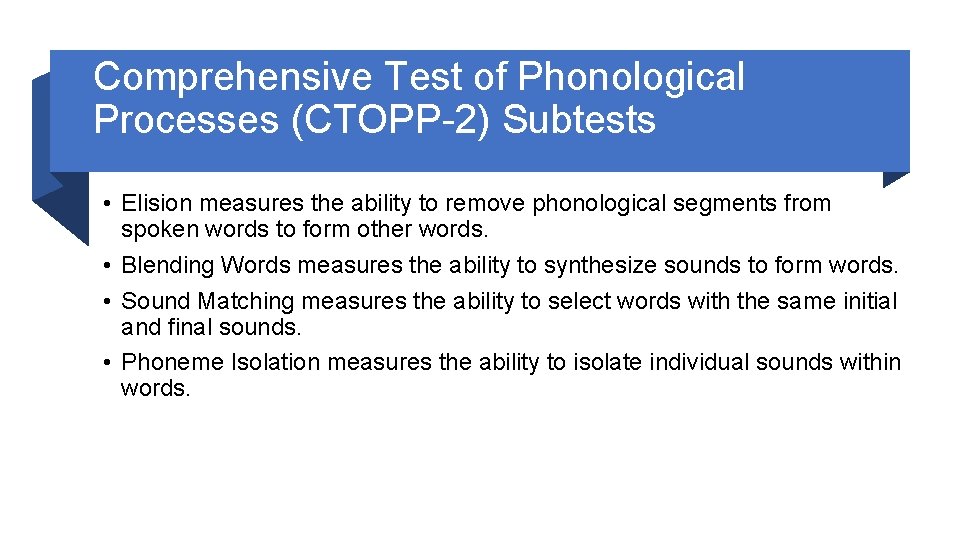
Comprehensive Test of Phonological Processes (CTOPP-2) Subtests • Elision measures the ability to remove phonological segments from spoken words to form other words. • Blending Words measures the ability to synthesize sounds to form words. • Sound Matching measures the ability to select words with the same initial and final sounds. • Phoneme Isolation measures the ability to isolate individual sounds within words.
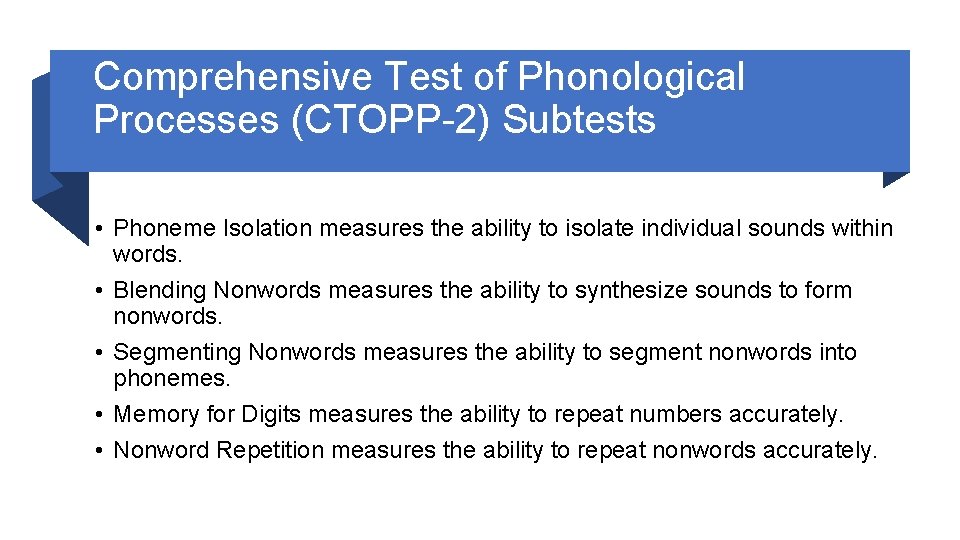
Comprehensive Test of Phonological Processes (CTOPP-2) Subtests • Phoneme Isolation measures the ability to isolate individual sounds within words. • Blending Nonwords measures the ability to synthesize sounds to form nonwords. • Segmenting Nonwords measures the ability to segment nonwords into phonemes. • Memory for Digits measures the ability to repeat numbers accurately. • Nonword Repetition measures the ability to repeat nonwords accurately.
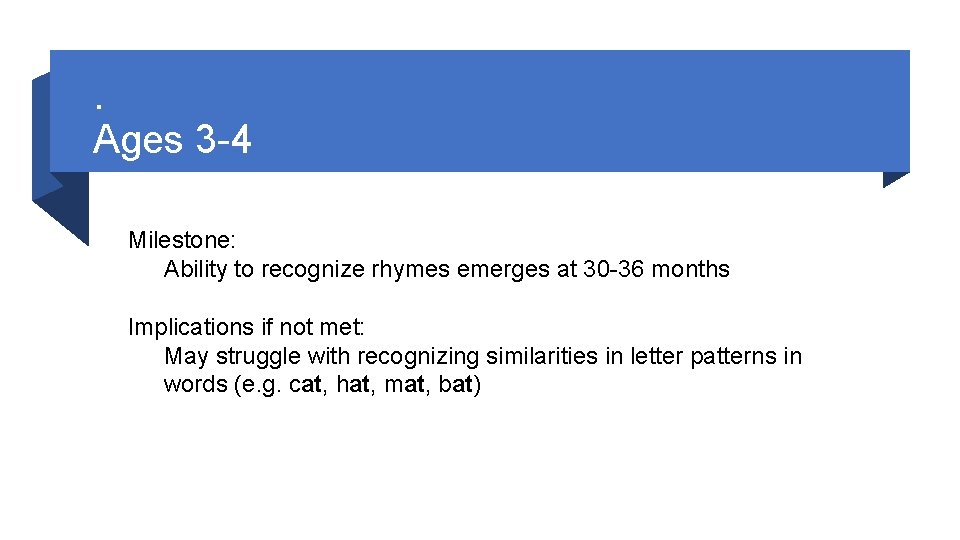
. Ages 3 -4 Milestone: Ability to recognize rhymes emerges at 30 -36 months Implications if not met: May struggle with recognizing similarities in letter patterns in words (e. g. cat, hat, mat, bat)
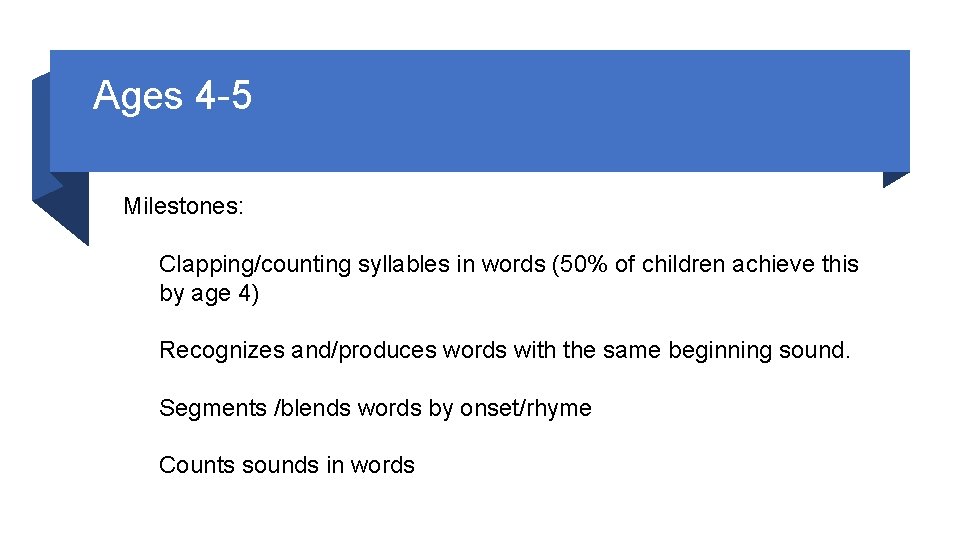
Ages 4 -5 Milestones: Clapping/counting syllables in words (50% of children achieve this by age 4) Recognizes and/produces words with the same beginning sound. Segments /blends words by onset/rhyme Counts sounds in words
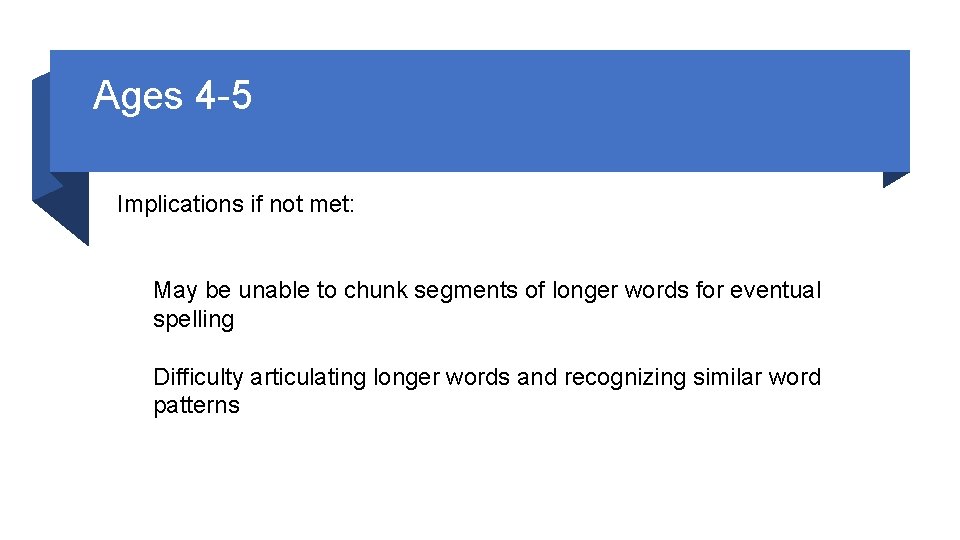
Ages 4 -5 Implications if not met: May be unable to chunk segments of longer words for eventual spelling Difficulty articulating longer words and recognizing similar word patterns
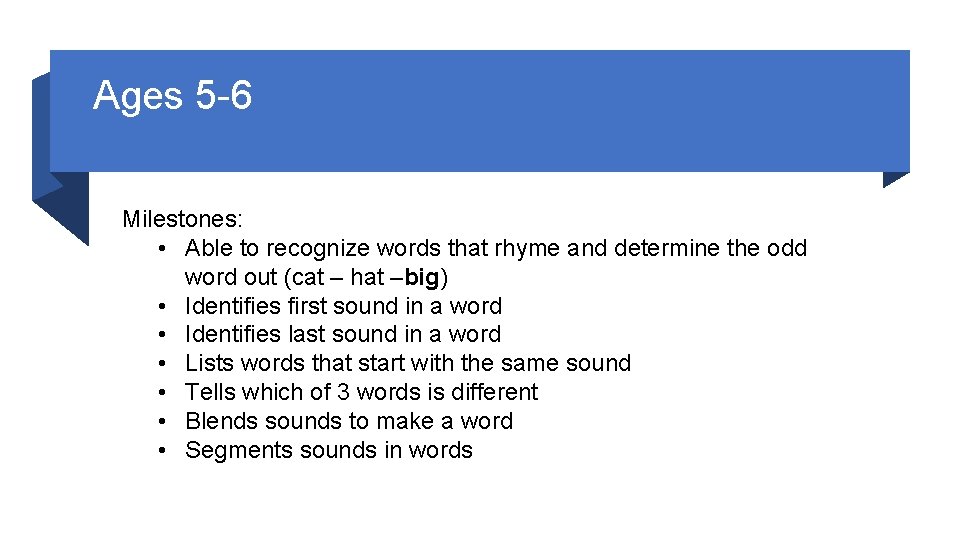
Ages 5 -6 Milestones: • Able to recognize words that rhyme and determine the odd word out (cat – hat –big) • Identifies first sound in a word • Identifies last sound in a word • Lists words that start with the same sound • Tells which of 3 words is different • Blends sounds to make a word • Segments sounds in words
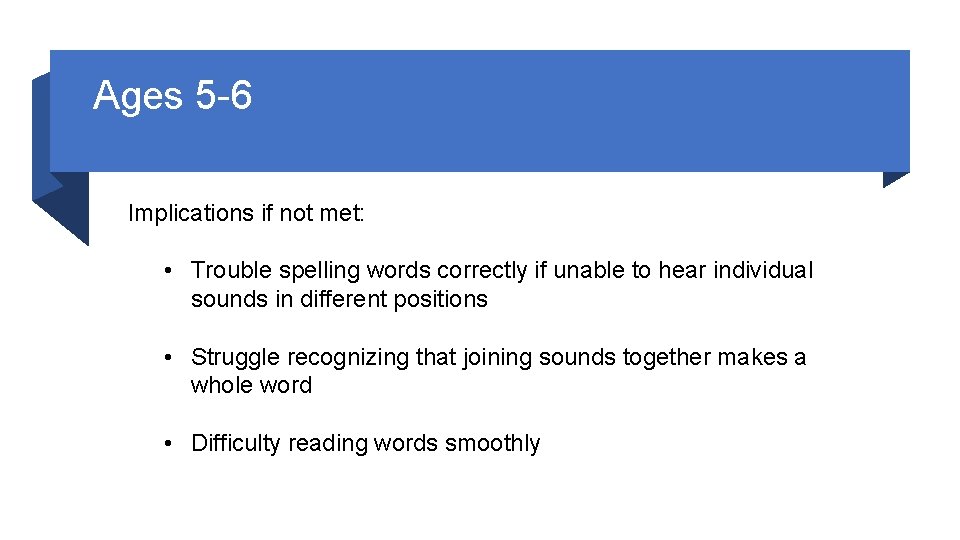
Ages 5 -6 Implications if not met: • Trouble spelling words correctly if unable to hear individual sounds in different positions • Struggle recognizing that joining sounds together makes a whole word • Difficulty reading words smoothly
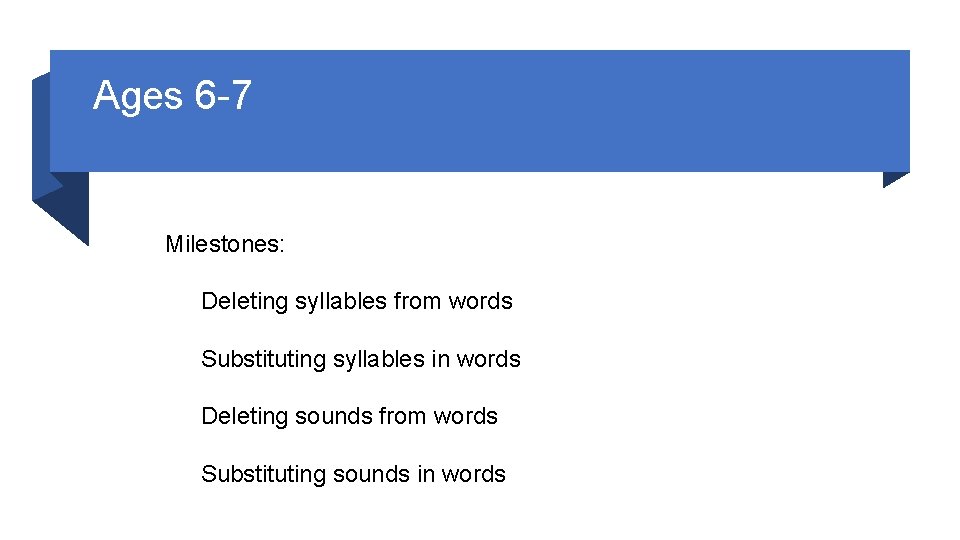
Ages 6 -7 Milestones: Deleting syllables from words Substituting syllables in words Deleting sounds from words Substituting sounds in words
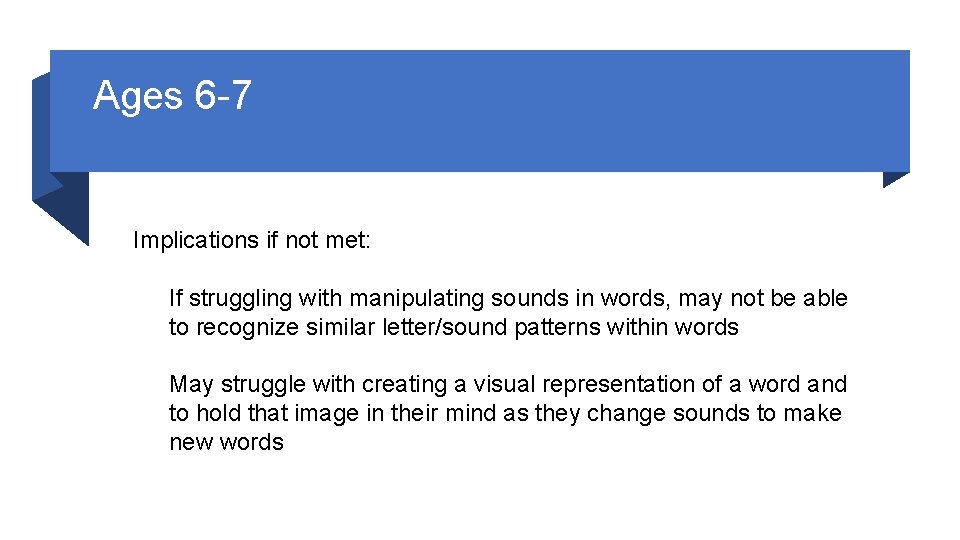
Ages 6 -7 Implications if not met: If struggling with manipulating sounds in words, may not be able to recognize similar letter/sound patterns within words May struggle with creating a visual representation of a word and to hold that image in their mind as they change sounds to make new words
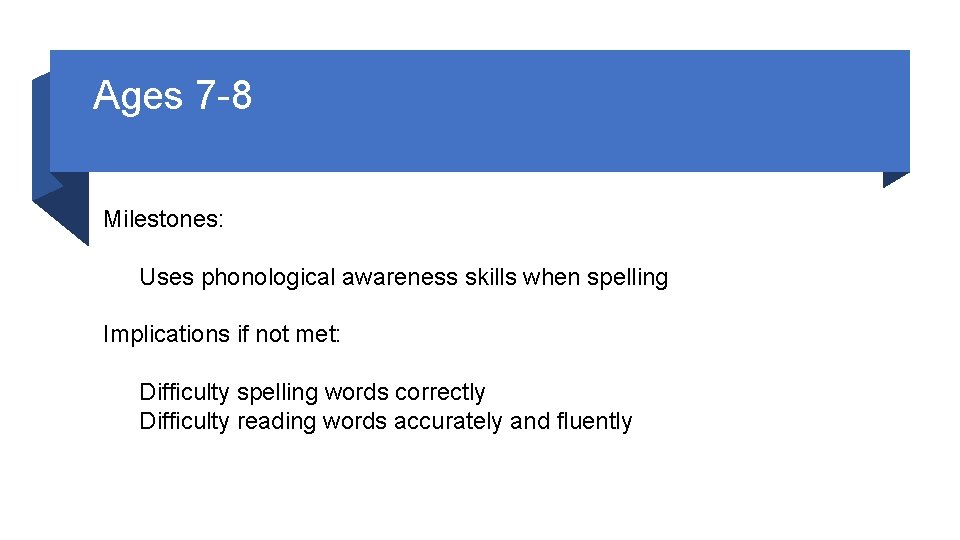
Ages 7 -8 Milestones: Uses phonological awareness skills when spelling Implications if not met: Difficulty spelling words correctly Difficulty reading words accurately and fluently
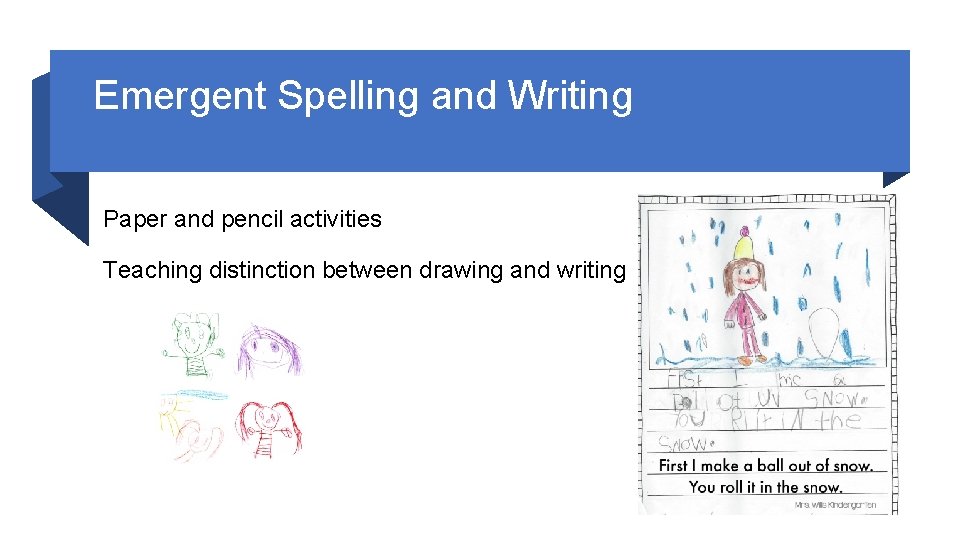
Emergent Spelling and Writing Paper and pencil activities Teaching distinction between drawing and writing
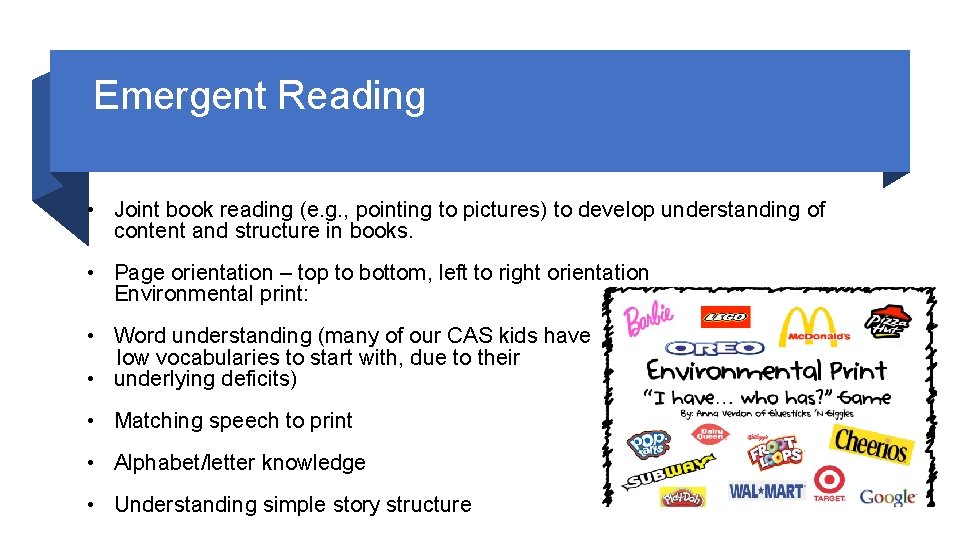
Emergent Reading • Joint book reading (e. g. , pointing to pictures) to develop understanding of content and structure in books. • Page orientation – top to bottom, left to right orientation Environmental print: • Word understanding (many of our CAS kids have low vocabularies to start with, due to their • underlying deficits) • Matching speech to print • Alphabet/letter knowledge • Understanding simple story structure
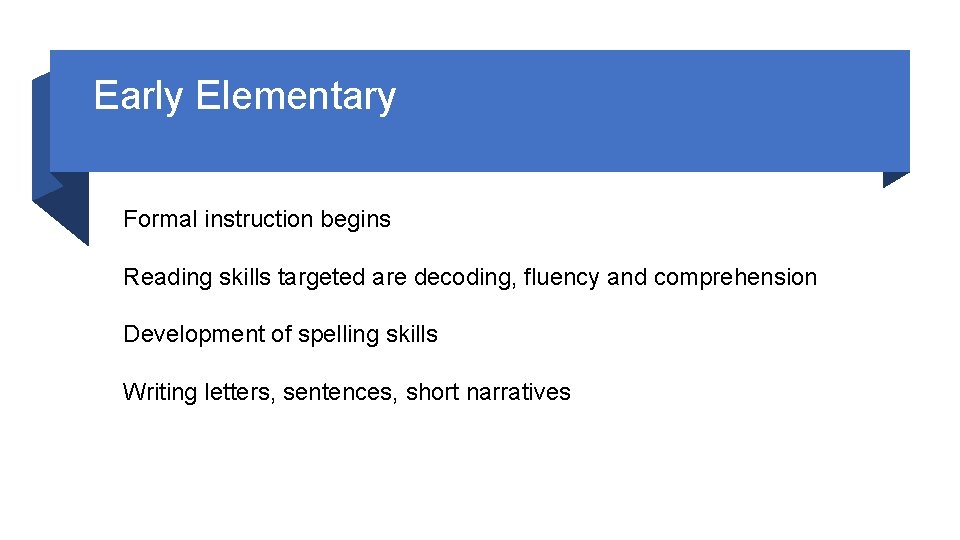
Early Elementary Formal instruction begins Reading skills targeted are decoding, fluency and comprehension Development of spelling skills Writing letters, sentences, short narratives
Reading • • Sight words Sound-symbol correspondence Spelling patterns Improving decoding-identification of sounds and blending sounds into words Increasing reading fluency Encourage interest in narratives Story retelling Determine meanings from context cues
Writing • Practice writing upper case and lower-case letters and first and last names • Encourage story telling using pictures and labeling pictures with words • Writing brief stories and journal entries • Grammatically correct sentence types using writing conventions such as capitalization and punctuation • How to plan and edit
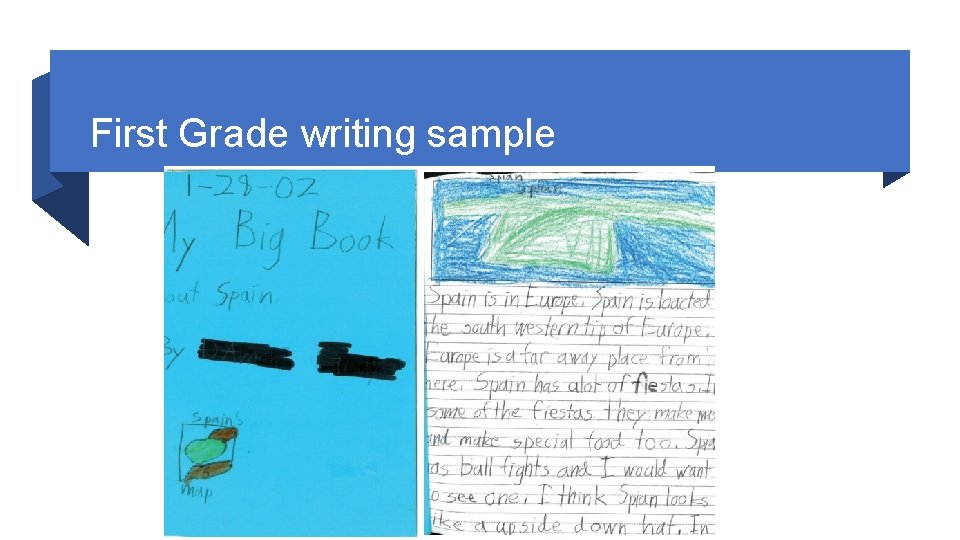
First Grade writing sample
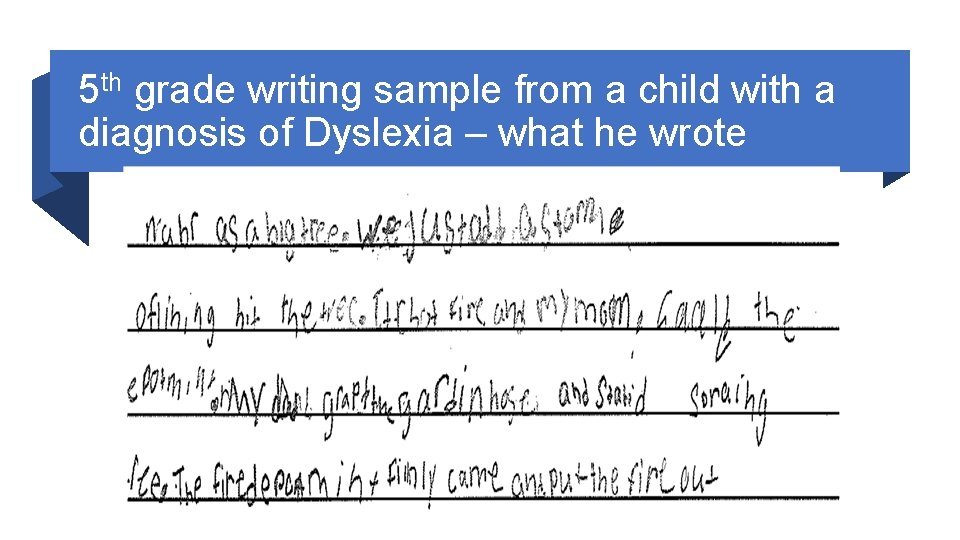
5 th grade writing sample from a child with a diagnosis of Dyslexia – what he wrote
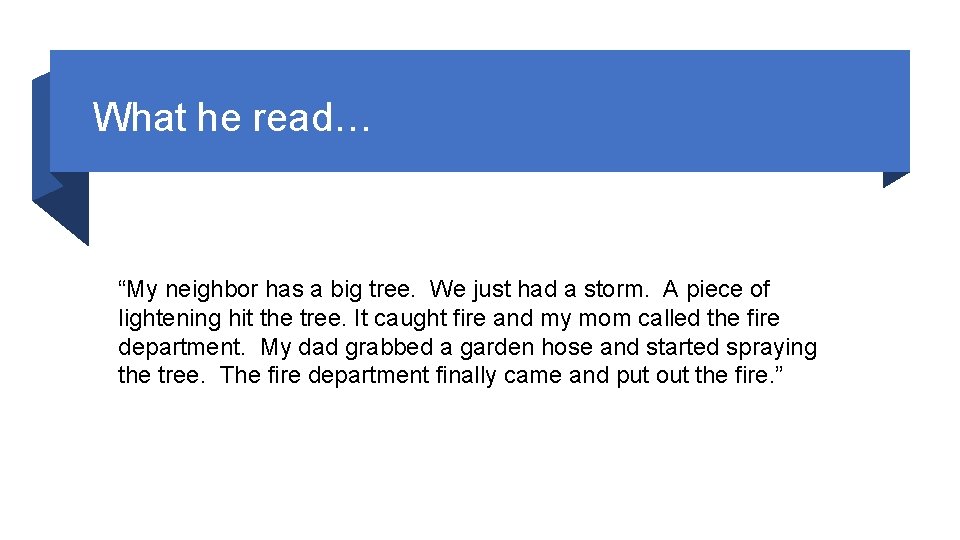
What he read… “My neighbor has a big tree. We just had a storm. A piece of lightening hit the tree. It caught fire and my mom called the fire department. My dad grabbed a garden hose and started spraying the tree. The fire department finally came and put out the fire. ”
Later Elementary and Above • Focuses on teaching rules, techniques, and principles for acquisition and understanding of information • High level vocabulary, including understanding of morphemes, and how to decipher morphologically complex words. • Metacognition becomes important and is defined as: • “awareness or analysis of one’s own learning or thinking processes” (Merriman-Webster Dictionary) • Emphasis on how to learn rather than what to learn. • Learning to read leads to reading to learn
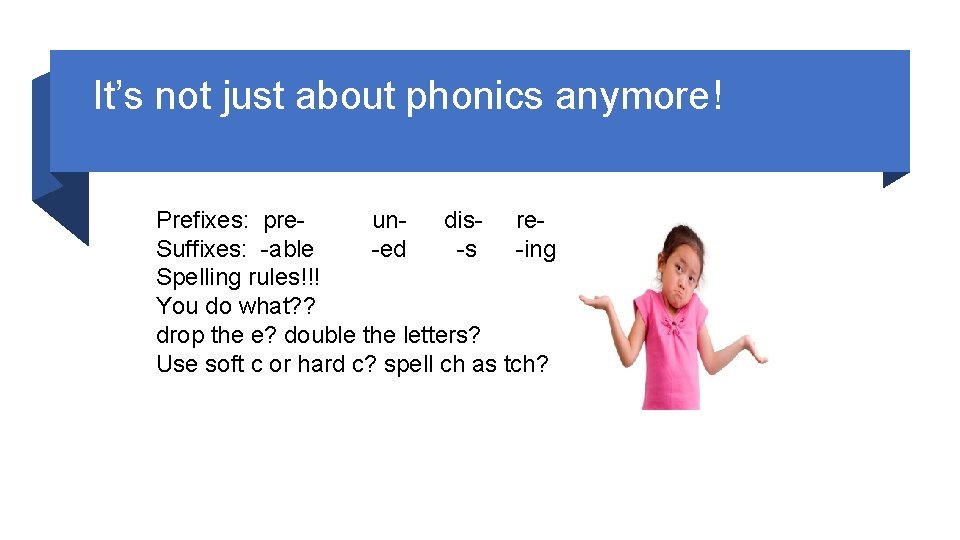
It’s not just about phonics anymore! Prefixes: preun- dis- re. Suffixes: -able -ed -s -ing Spelling rules!!! You do what? ? drop the e? double the letters? Use soft c or hard c? spell ch as tch?
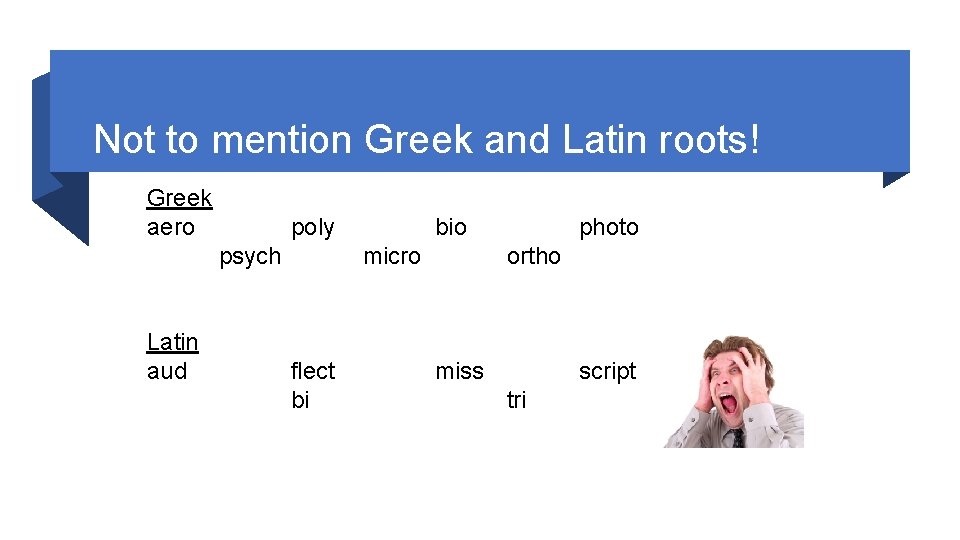
Not to mention Greek and Latin roots! Greek aero poly psych Latin aud bio micro flect bi photo ortho miss script tri
Remember who you are working with when it comes to literacy. • Know the age and functional level of who you are working with, and what they are capable of developmentally. • For developmentally delayed students, work with their developmental level in goals, but use their chronological age in choosing materials.
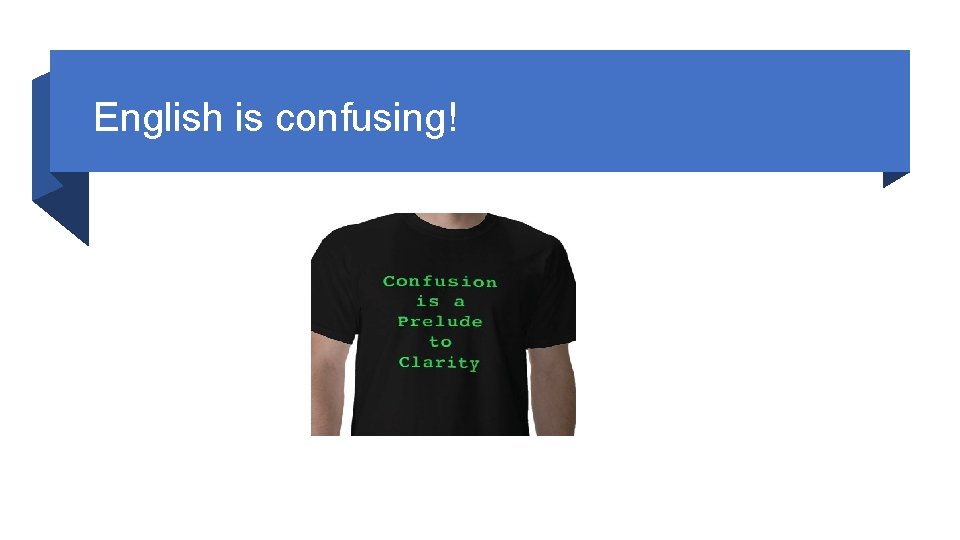
English is confusing!
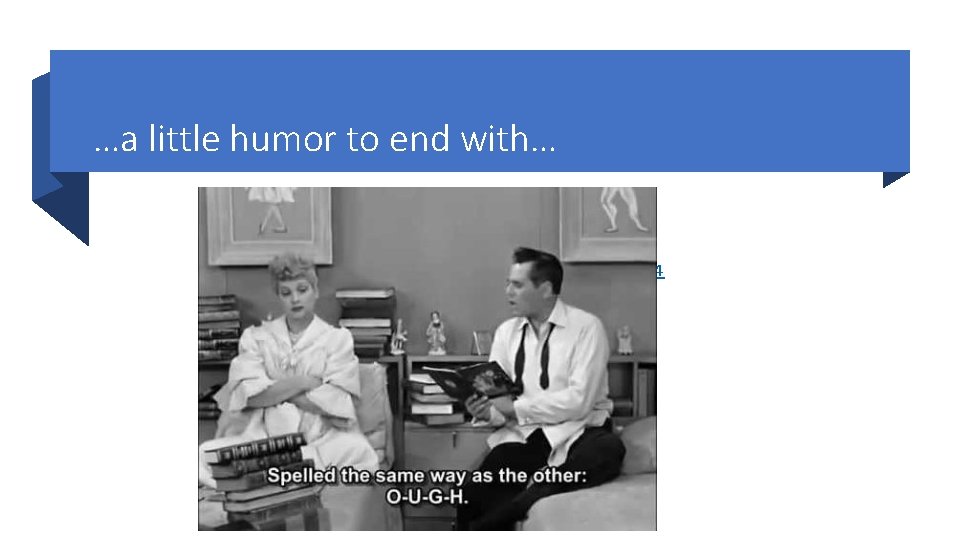
…a little humor to end with… https: //www. youtube. com/watch? v=u. ZV 40 f 0 c. XF 4
Questions?
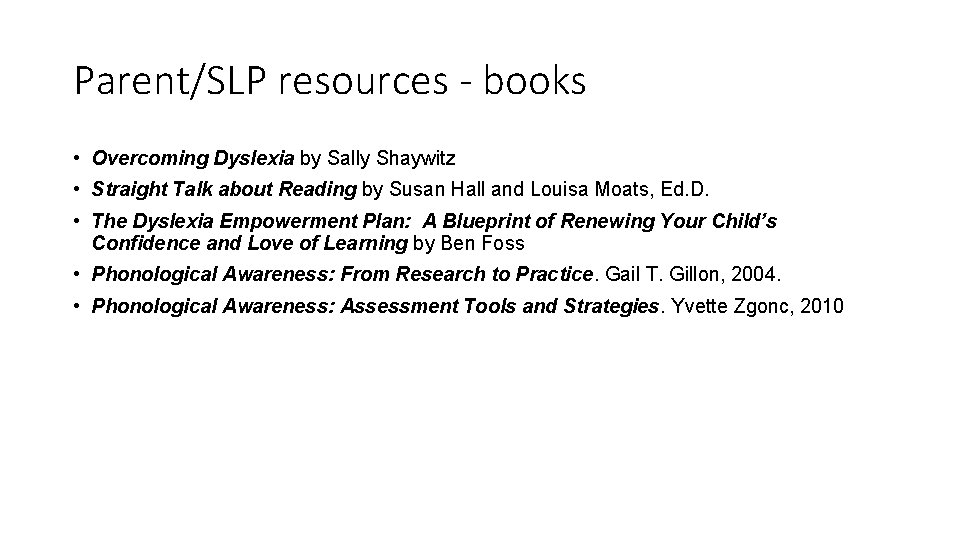
Parent/SLP resources - books • Overcoming Dyslexia by Sally Shaywitz • Straight Talk about Reading by Susan Hall and Louisa Moats, Ed. D. • The Dyslexia Empowerment Plan: A Blueprint of Renewing Your Child’s Confidence and Love of Learning by Ben Foss • Phonological Awareness: From Research to Practice. Gail T. Gillon, 2004. • Phonological Awareness: Assessment Tools and Strategies. Yvette Zgonc, 2010
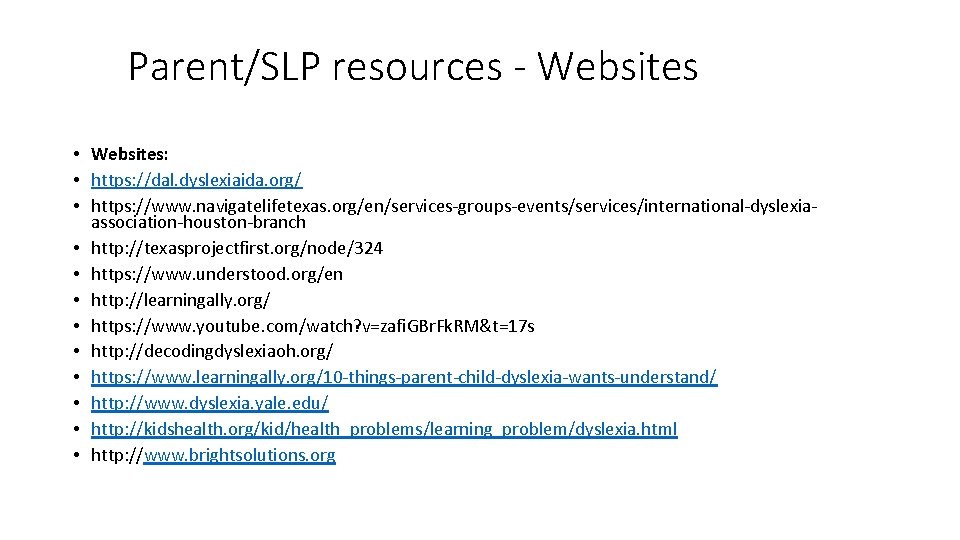
Parent/SLP resources - Websites • Websites: • https: //dal. dyslexiaida. org/ • https: //www. navigatelifetexas. org/en/services-groups-events/services/international-dyslexiaassociation-houston-branch • http: //texasprojectfirst. org/node/324 • https: //www. understood. org/en • http: //learningally. org/ • https: //www. youtube. com/watch? v=zafi. GBr. Fk. RM&t=17 s • http: //decodingdyslexiaoh. org/ • https: //www. learningally. org/10 -things-parent-child-dyslexia-wants-understand/ • http: //www. dyslexia. yale. edu/ • http: //kidshealth. org/kid/health_problems/learning_problem/dyslexia. html • http: //www. brightsolutions. org
References: American Speech-Language-Hearing Association. (2016 a). Code of ethics [Ethics]. Available from www. asha. org/policy American Speech-Language-Hearing Association. (2016 b). Scope of practice in speech-language pathology [Scope of practice]. Available from www. asha. org/policy Catts, H. W. , Fey, M. E. , Tomblin, J. B. , & Zhang, X. (2002). A longitudinal investigation of reading outcomes in children with language impairments. Journal of Speech, Language, and Hearing Research, 45, 1142– 1157 Badian, N. A. (1999). Reading disability defined as a discrepancy between listening and reading comprehension: A longitudinal study of stability, gender differences, and prevalence. Journal of Learning Disabilities, 32, 138– 148 Cabbage, KL, Farquharson, K, Iuzzini-Seigel, J, Zuk, J, & Hogan, TP (2018). Exploring the Overlap Between Dyslexia and Speech Sound Production Deficits. Language, Speech and Hearing Services in Schools, 49, 4, 774 -786 https: //doi. org/10. 1044/2018_LSHSS-DYSLC-18 -0008
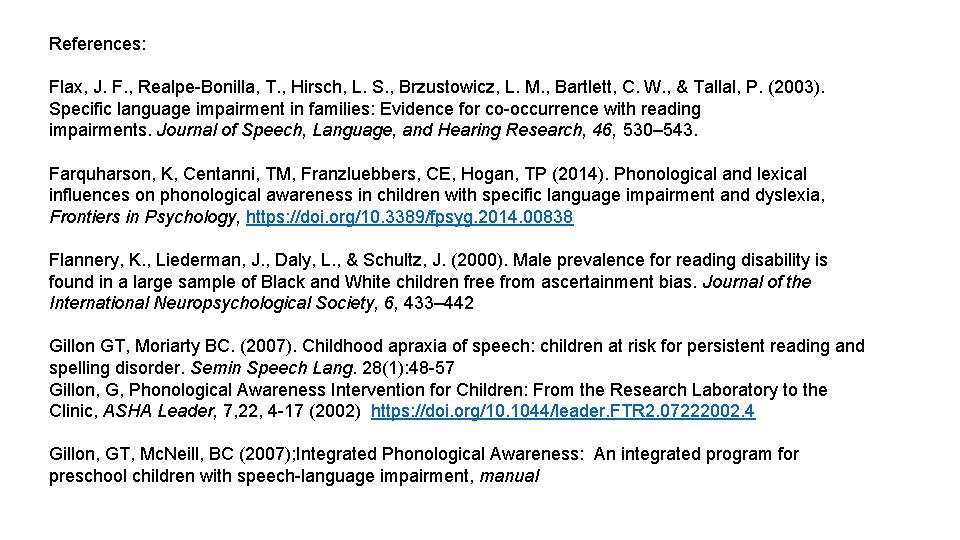
References: Flax, J. F. , Realpe-Bonilla, T. , Hirsch, L. S. , Brzustowicz, L. M. , Bartlett, C. W. , & Tallal, P. (2003). Specific language impairment in families: Evidence for co-occurrence with reading impairments. Journal of Speech, Language, and Hearing Research, 46, 530– 543. Farquharson, K, Centanni, TM, Franzluebbers, CE, Hogan, TP (2014). Phonological and lexical influences on phonological awareness in children with specific language impairment and dyslexia, Frontiers in Psychology, https: //doi. org/10. 3389/fpsyg. 2014. 00838 Flannery, K. , Liederman, J. , Daly, L. , & Schultz, J. (2000). Male prevalence for reading disability is found in a large sample of Black and White children free from ascertainment bias. Journal of the International Neuropsychological Society, 6, 433– 442 Gillon GT, Moriarty BC. (2007). Childhood apraxia of speech: children at risk for persistent reading and spelling disorder. Semin Speech Lang. 28(1): 48 -57 Gillon, G, Phonological Awareness Intervention for Children: From the Research Laboratory to the Clinic, ASHA Leader, 7, 22, 4 -17 (2002) https: //doi. org/10. 1044/leader. FTR 2. 07222002. 4 Gillon, GT, Mc. Neill, BC (2007); Integrated Phonological Awareness: An integrated program for preschool children with speech-language impairment, manual
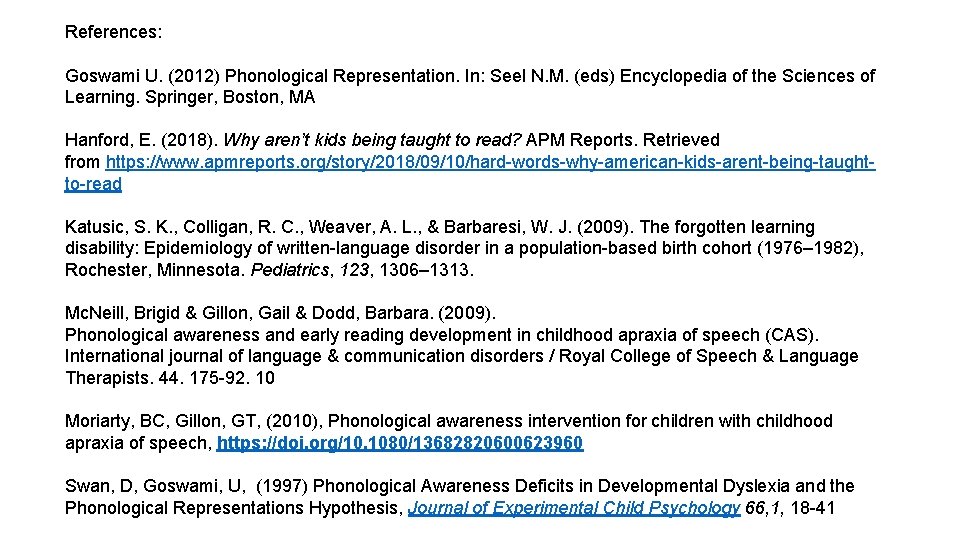
References: Goswami U. (2012) Phonological Representation. In: Seel N. M. (eds) Encyclopedia of the Sciences of Learning. Springer, Boston, MA Hanford, E. (2018). Why aren’t kids being taught to read? APM Reports. Retrieved from https: //www. apmreports. org/story/2018/09/10/hard-words-why-american-kids-arent-being-taughtto-read Katusic, S. K. , Colligan, R. C. , Weaver, A. L. , & Barbaresi, W. J. (2009). The forgotten learning disability: Epidemiology of written-language disorder in a population-based birth cohort (1976– 1982), Rochester, Minnesota. Pediatrics, 123, 1306– 1313. Mc. Neill, Brigid & Gillon, Gail & Dodd, Barbara. (2009). Phonological awareness and early reading development in childhood apraxia of speech (CAS). International journal of language & communication disorders / Royal College of Speech & Language Therapists. 44. 175 -92. 10 Moriarty, BC, Gillon, GT, (2010), Phonological awareness intervention for children with childhood apraxia of speech, https: //doi. org/10. 1080/13682820600623960 Swan, D, Goswami, U, (1997) Phonological Awareness Deficits in Developmental Dyslexia and the Phonological Representations Hypothesis, Journal of Experimental Child Psychology 66, 1, 18 -41