
Two First Year Seminar Course Designs for Science
- Slides: 19
Two First Year Seminar Course Designs for Science and Mathematics Majors Helmut Knaust Department of Mathematical Sciences The University of Texas at El Paso Math Fest ∙ Lexington KY · August 4, 2011 © The University of Texas at El Paso
Overview 1. 2. 3. 4. The University of Texas at El Paso The FYS at UTEP Design #1: “Scientific Revolutions” Design #2: “Boolean Algebras” © The University of Texas at El Paso
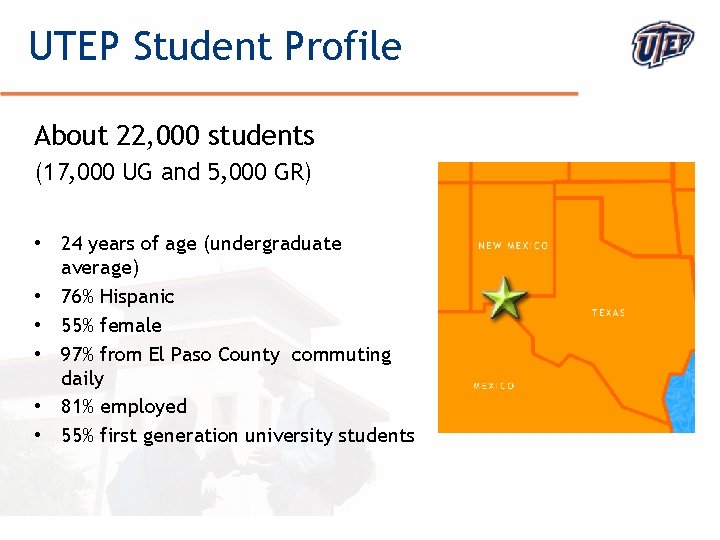
UTEP Student Profile About 22, 000 students (17, 000 UG and 5, 000 GR) • 24 years of age (undergraduate average) • 76% Hispanic • 55% female • 97% from El Paso County commuting daily • 81% employed • 55% first generation university students © The University of Texas at El Paso
UNIV 1301 • Started more than 10 years ago • Required course for all incoming freshmen (there is an alternative course UNIV 2350 for transfer students) • About 1300 students take the course in the fall semester, 150 in the spring • 28 students per section © The University of Texas at El Paso
UNIV 1301 – Course Goals Students will: • examine the roles and responsibilities crucial for success in college. • practice essential academic success skills. • build a network of faculty, staff and peers. • assess and understand their interests, abilities, and values. • become involved in UTEP activities and utilize campus resources. © The University of Texas at El Paso
UNIV 1301 – Course Setup The course consists of two parts: • About 50% of the course is devoted to student “survival” skills. • The rest of the course is dedicated to a “theme”, picked by the instructor. • Some course sections are intended for all majors, some have a restricted audience. • The instructional team consists of the instructor, a peer leader, a librarian and an academic advisor. © The University of Texas at El Paso
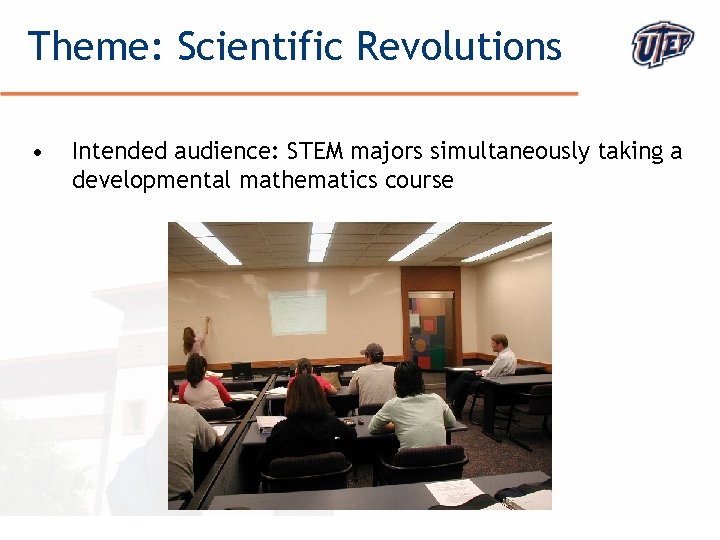
Theme: Scientific Revolutions • Intended audience: STEM majors simultaneously taking a developmental mathematics course © The University of Texas at El Paso
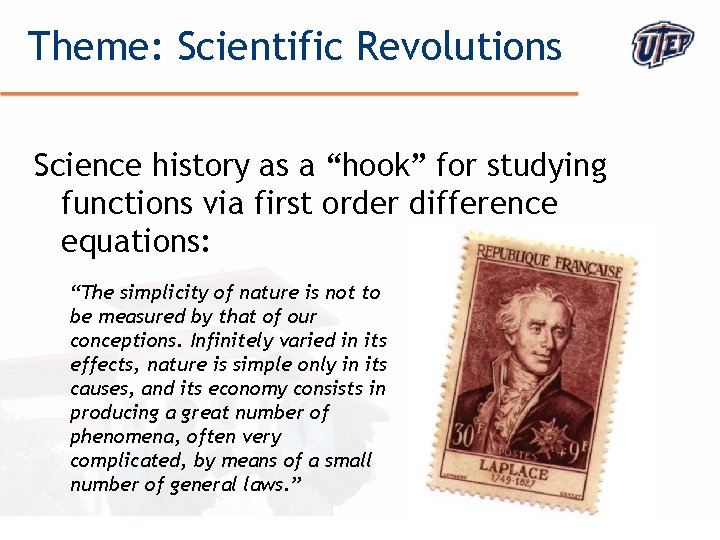
Theme: Scientific Revolutions Science history as a “hook” for studying functions via first order difference equations: “The simplicity of nature is not to be measured by that of our conceptions. Infinitely varied in its effects, nature is simple only in its causes, and its economy consists in producing a great number of phenomena, often very complicated, by means of a small number of general laws. ” © The University of Texas at El Paso
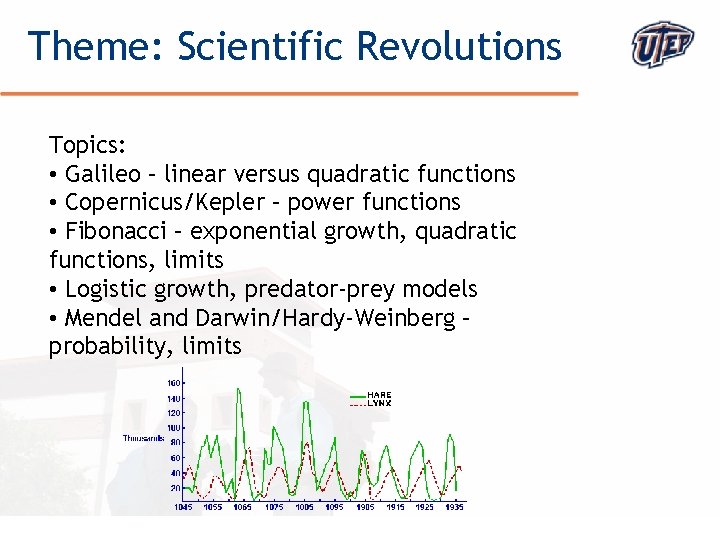
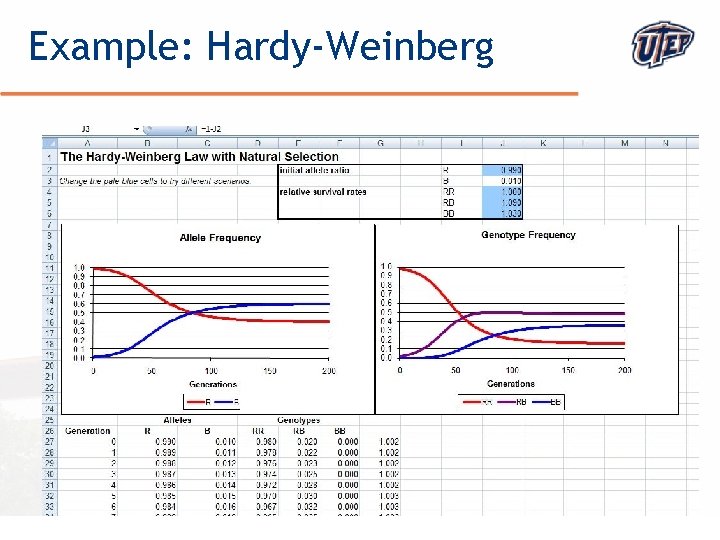
Theme: Scientific Revolutions Topics: • Galileo – linear versus quadratic functions • Copernicus/Kepler – power functions • Fibonacci – exponential growth, quadratic functions, limits • Logistic growth, predator-prey models • Mendel and Darwin/Hardy-Weinberg – probability, limits © The University of Texas at El Paso
Theme: Scientific Revolutions Extensive use of Excel spreadsheets: • They are the perfect tool to visualize the solutions of difference equations • They allow to cover more advanced subjects by reducing the amount of algebra needed by the students © The University of Texas at El Paso
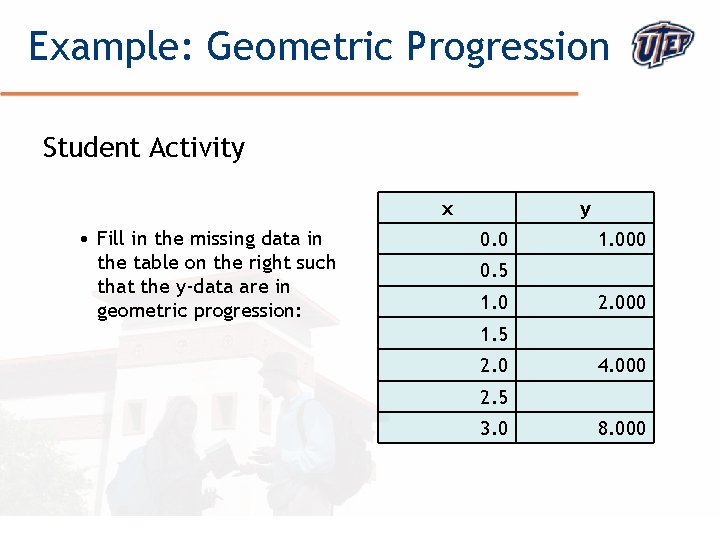
Example: Geometric Progression Student Activity x • Fill in the missing data in the table on the right such that the y-data are in geometric progression: y 0. 0 1. 000 0. 5 1. 0 2. 000 1. 5 2. 0 4. 000 2. 5 3. 0 © The University of Texas at El Paso 8. 000
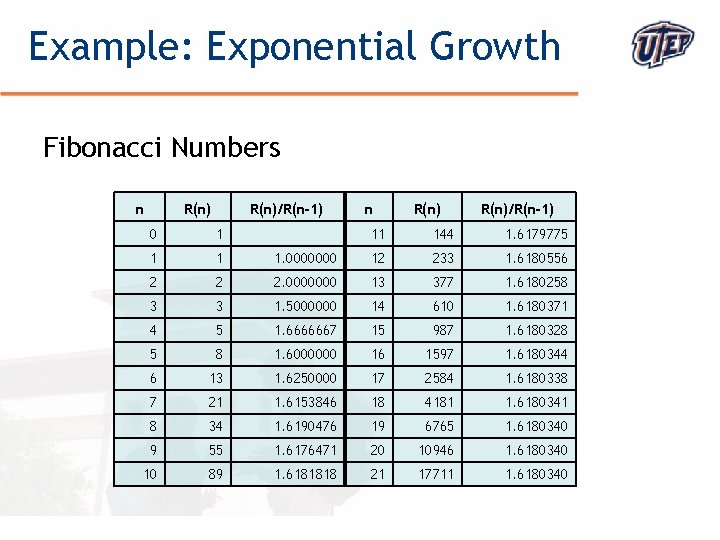
Example: Exponential Growth Fibonacci Numbers n R(n)/R(n-1) 0 1 1 1 2 n R(n)/R(n-1) 11 144 1. 6179775 1. 0000000 12 233 1. 6180556 2 2. 0000000 13 377 1. 6180258 3 3 1. 5000000 14 610 1. 6180371 4 5 1. 6666667 15 987 1. 6180328 5 8 1. 6000000 16 1597 1. 6180344 6 13 1. 6250000 17 2584 1. 6180338 7 21 1. 6153846 18 4181 1. 6180341 8 34 1. 6190476 19 6765 1. 6180340 9 55 1. 6176471 20 10946 1. 6180340 10 89 1. 6181818 21 17711 1. 6180340 © The University of Texas at El Paso
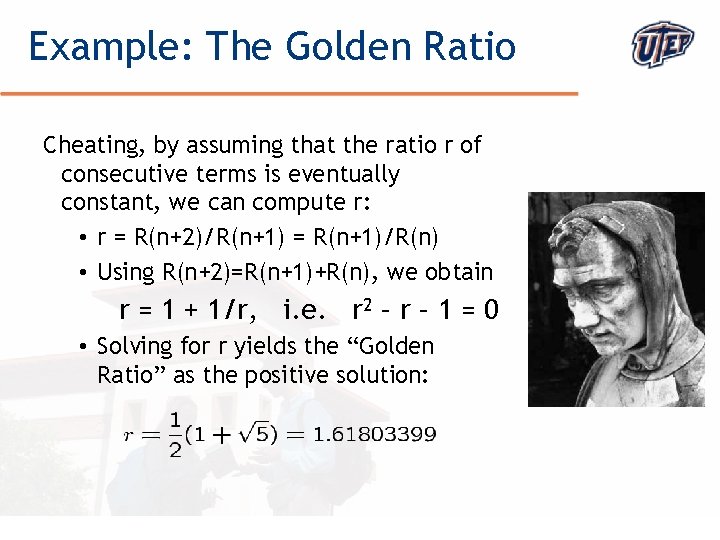
Example: The Golden Ratio Cheating, by assuming that the ratio r of consecutive terms is eventually constant, we can compute r: • r = R(n+2)/R(n+1) = R(n+1)/R(n) • Using R(n+2)=R(n+1)+R(n), we obtain r = 1 + 1/r, i. e. r 2 – r – 1 = 0 • Solving for r yields the “Golden Ratio” as the positive solution: © The University of Texas at El Paso
Example: Hardy-Weinberg © The University of Texas at El Paso
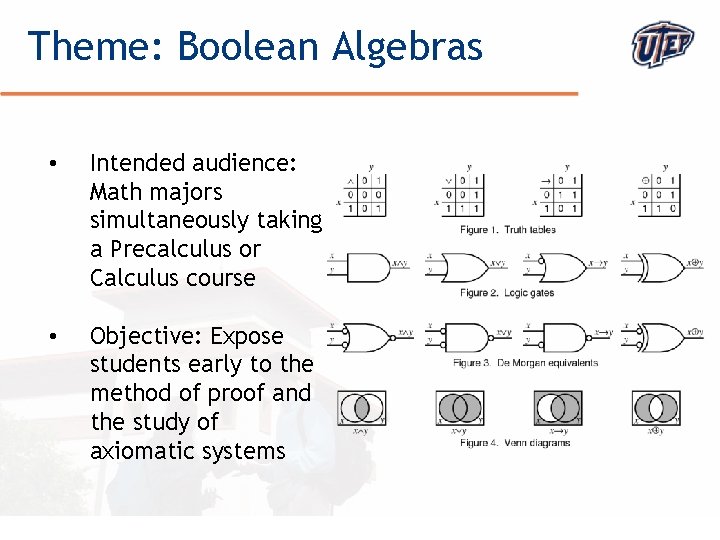
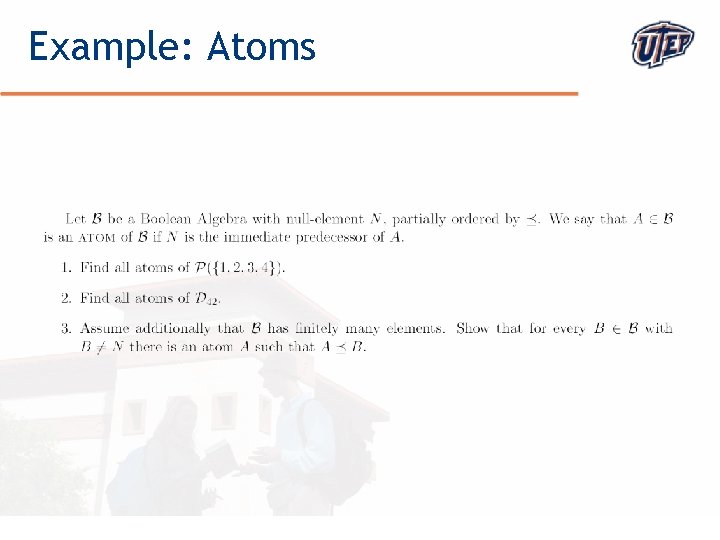
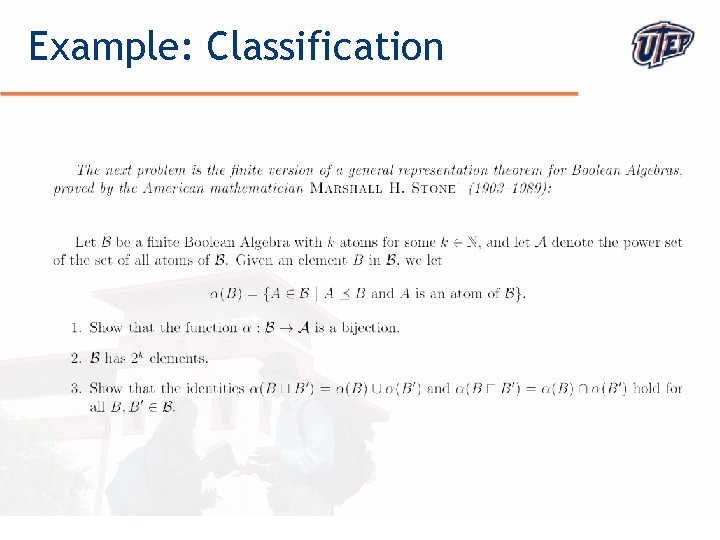
Theme: Boolean Algebras • Intended audience: Math majors simultaneously taking a Precalculus or Calculus course • Objective: Expose students early to the method of proof and the study of axiomatic systems © The University of Texas at El Paso
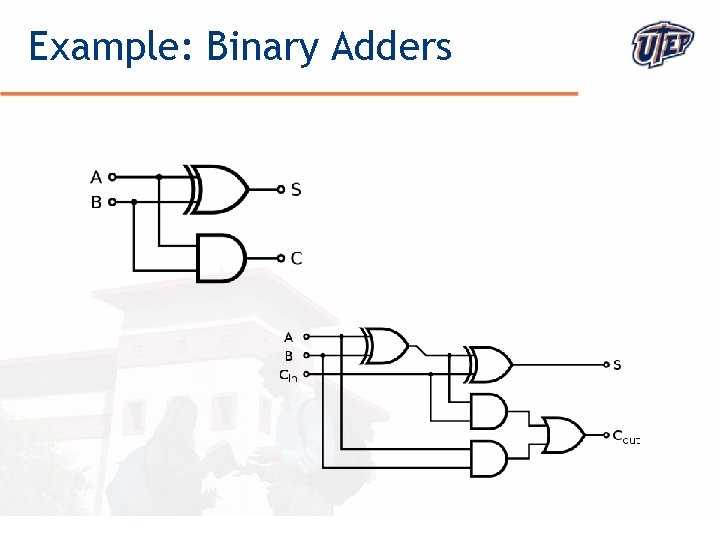
Example: Binary Adders © The University of Texas at El Paso
Example: Atoms © The University of Texas at El Paso
Example: Classification © The University of Texas at El Paso
References Dan Kalman, Elementary Mathematical Models. Mathematical Association of America, 1997. Franz Jehle, Boolesche Algebra. Bayerischer Schulbuch Verlag, 1971. Projektgruppe Fernstudium – Universität Bielefeld, Mathematisches Vorsemester. Springer-Verlag, 1974. Contact Info Helmut Knaust hknaust@utep. edu © The University of Texas at El Paso