
Two Fingerspelling Keyboard Layouts for UTYCC Myanmar Sign
Two Fingerspelling Keyboard Layouts for UT-YCC Myanmar Sign Language with Op. U Myanmar Sign. Writing Symposium 2018 Supervisor – Dr. Hnin Aye Thant Co-supervisors – Dr. Ye Kyaw Thu, Daw Swe Zin Moe Presented by Hlaing Myat Nwe 1
Group Memebers Hlaing Myat Nwe Ye Kyaw Thu Hnin Wai Hlaing Swe Zin Moe Khaing Hsu Wai Hnin Aye Thant Nandar Win Min 2
Outlines of Presentation Introduction Contributions Objectives Myanmar Sign Language Sign. Writing Fingerspelling Keyboard Layouts for MSW Evaluations Discussion Conclusion References 3
Introduction Myanmar deaf people mainly use Myanmar Sign Language (MSL) as an essential communication language among them. They have difficulties in relation to written languages with orally spoken words. Sign. Writing is used for writing sign language in other countries for their deaf people. There is no Myanmar language specific Sign. Writing text editor for Myanmar Deaf society yet. 4
Introduction (Cont‟d) Sign. Writing will be useful for Deaf children education and documentation of sign language literature in Myanmar. In the our paper, two fingerspelling keyboard layouts was proposed, one is based on pronunciation of Myanmar characters and another is based on the shapes of Sign. Writing symbols. A user study with both hearing-impaired and hearing users was conducted and the comparisons are made between two keyboard layouts in terms of CPM and Likert scale feedbacks. 5
Contributions This system is the first Sign. Writing text input interface for Myanmar fingerspelling characters with Sign. Writing Building Myanmar Sign. Writing dictionary will be useful for future researchers who want to do researching about Sign. Writing and Myanmar Sign Language 6
Objectives To develop Myanmar Sign. Writing Dictionary for Myanmar Sign Language To implement Myanmar Sign. Writing Text Input Interface To provide writing system for Myanmar Deaf people To improve the quality of Deaf Education in Myanmar 7
Schools for the Deaf in Myanmar Four Schools for the deaf in Myanmar: 1. Mary Chapman School for the Deaf in Yangon (est. 1904) 2. School for the Deaf, Mandalay (est. 1964) 3. Immanuel School for the Deaf in Kalay (est. 2005) 4. School for the Deaf, Tarmwe Yangon (est. 2014) In Myanmar, sign languages used in each region are not the same. 8
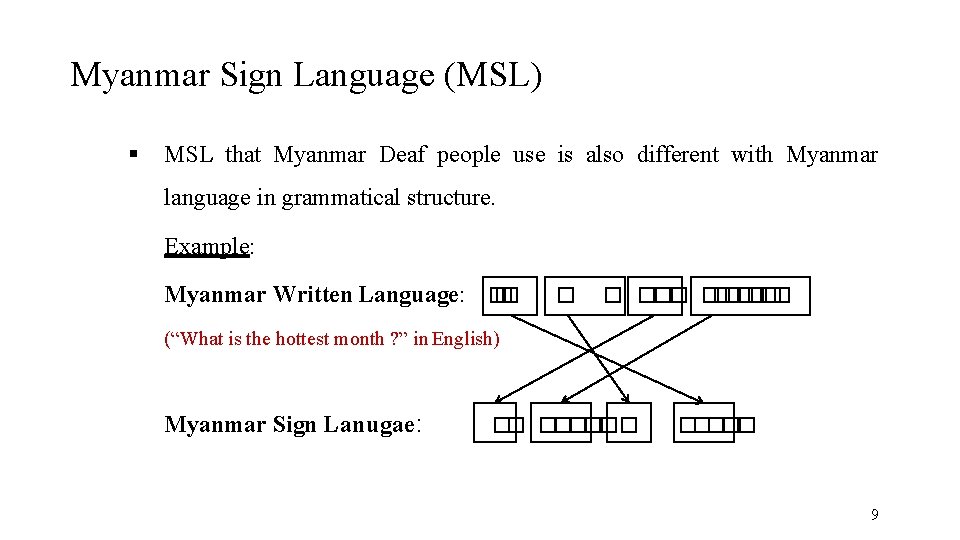
Myanmar Sign Language (MSL) MSL that Myanmar Deaf people use is also different with Myanmar language in grammatical structure. Example: Myanmar Written Language: � � ��� ������ � � (“What is the hottest month ? ” in English) Myanmar Sign Lanugae: �� ����� 9
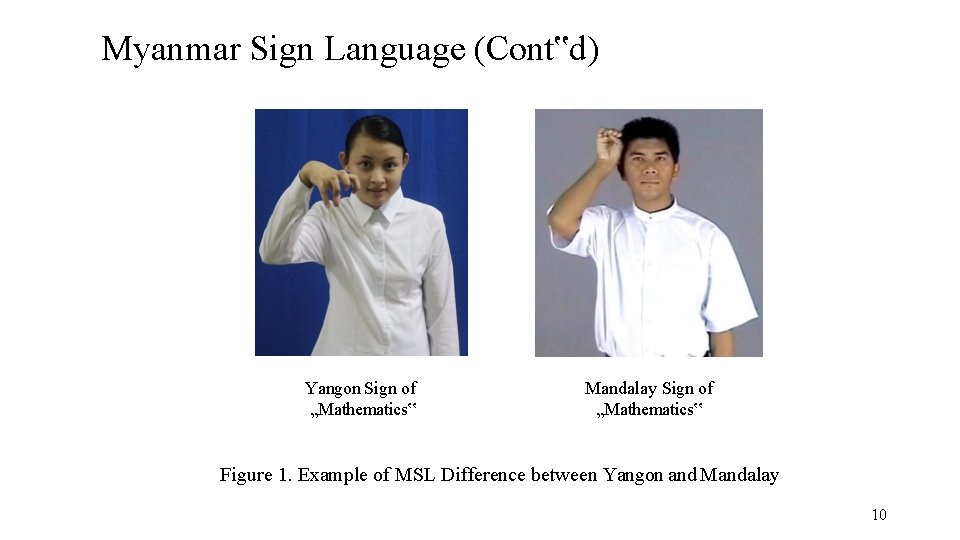
Myanmar Sign Language (Cont‟d) Yangon Sign of „Mathematics‟ Mandalay Sign of „Mathematics‟ Figure 1. Example of MSL Difference between Yangon and Mandalay 10
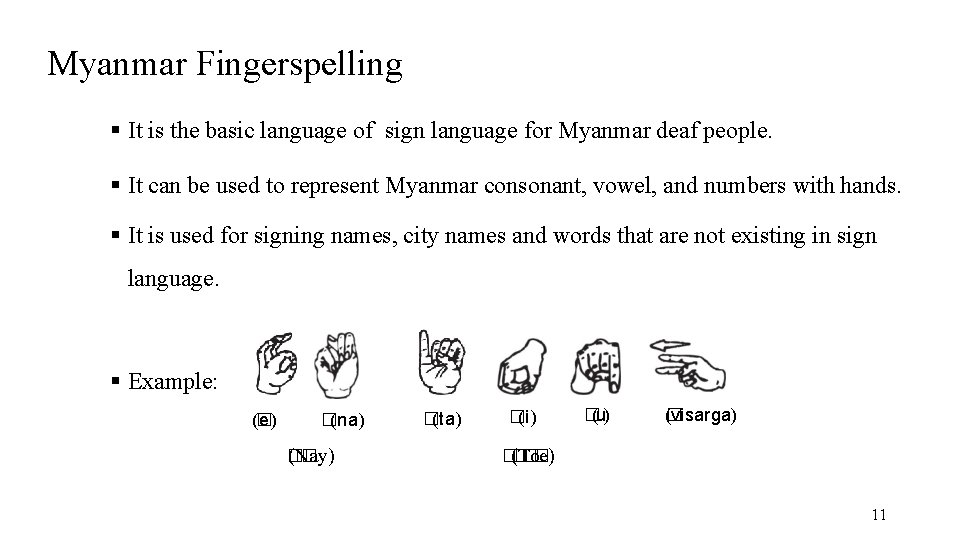
Myanmar Fingerspelling It is the basic language of sign language for Myanmar deaf people. It can be used to represent Myanmar consonant, vowel, and numbers with hands. It is used for signing names, city names and words that are not existing in sign language. Example: (e) � �(na) � (Nay) � �(ta) �(i) �(u) (visarga) � �(Toe) ��� 11
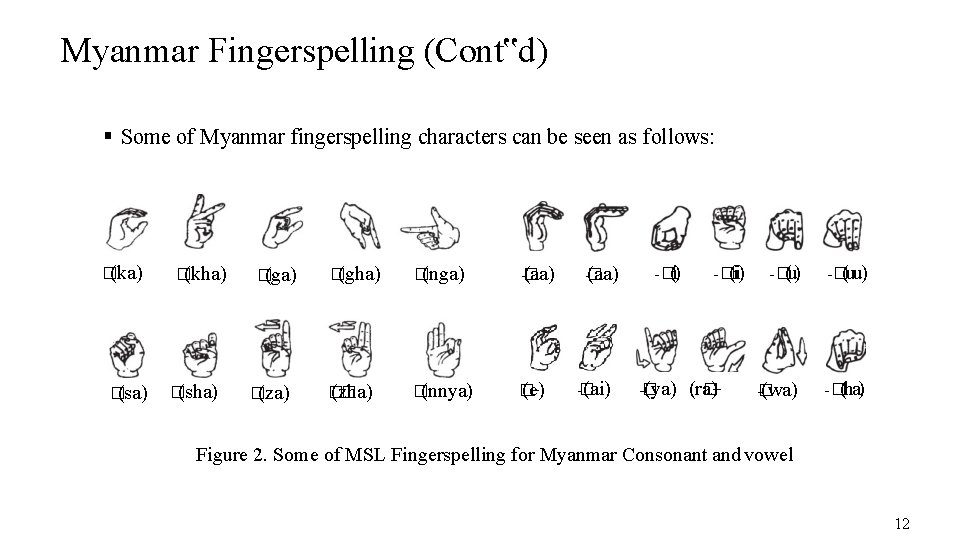
Myanmar Fingerspelling (Cont‟d) Some of Myanmar fingerspelling characters can be seen as follows: � (ka) � (sa) �(kha) �(sha) � (ga) �(za) �(gha) �(nga) -� (aa) � (zha) � �(nnya) � (e) - -� (aa) -� (ai) -�(i) -� (ya) -�(ii) (ra) �- -�(u) -�(uu) � -(wa) -�(ha) Figure 2. Some of MSL Fingerspelling for Myanmar Consonant and vowel 12
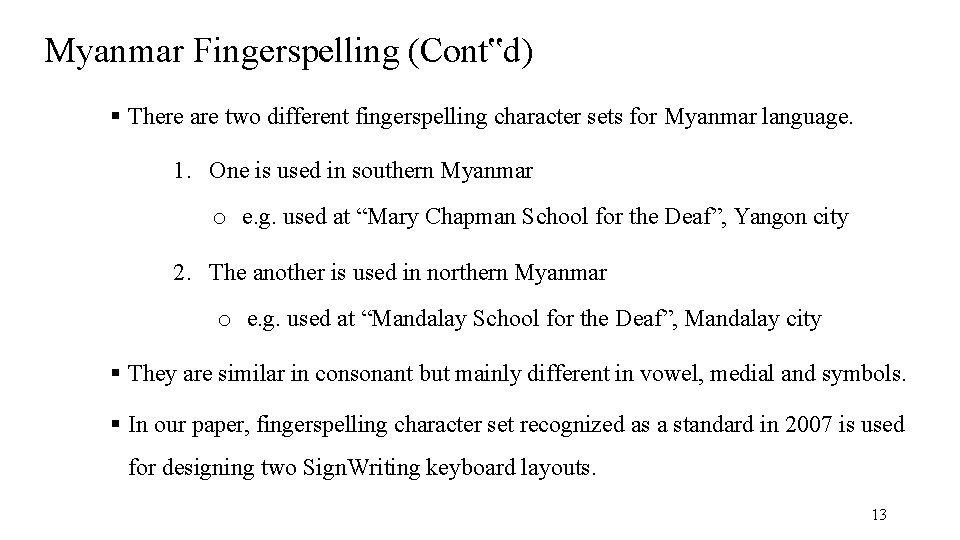
Myanmar Fingerspelling (Cont‟d) There are two different fingerspelling character sets for Myanmar language. 1. One is used in southern Myanmar o e. g. used at “Mary Chapman School for the Deaf”, Yangon city 2. The another is used in northern Myanmar o e. g. used at “Mandalay School for the Deaf”, Mandalay city They are similar in consonant but mainly different in vowel, medial and symbols. In our paper, fingerspelling character set recognized as a standard in 2007 is used for designing two Sign. Writing keyboard layouts. 13
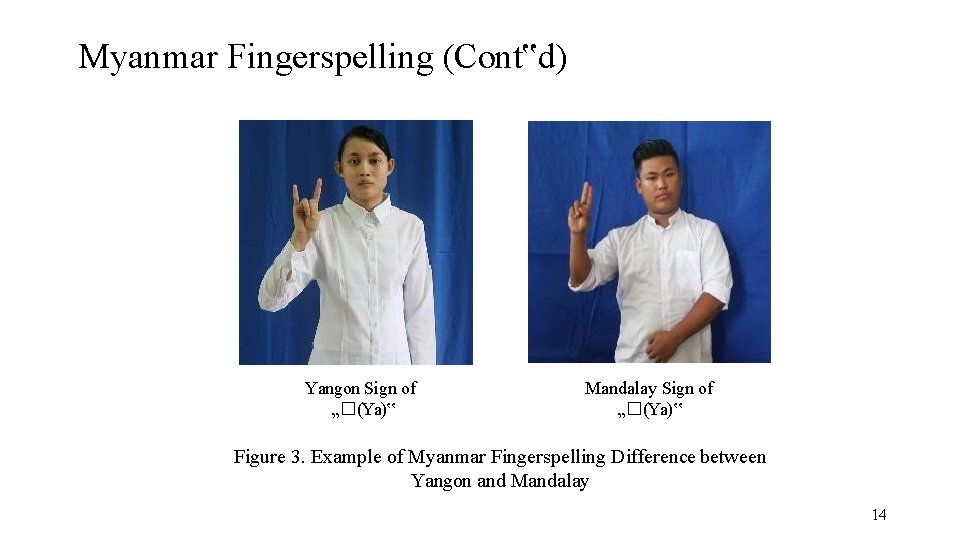
Myanmar Fingerspelling (Cont‟d) Yangon Sign of „�(Ya)‟ Mandalay Sign of „�(Ya)‟ Figure 3. Example of Myanmar Fingerspelling Difference between Yangon and Mandalay 14
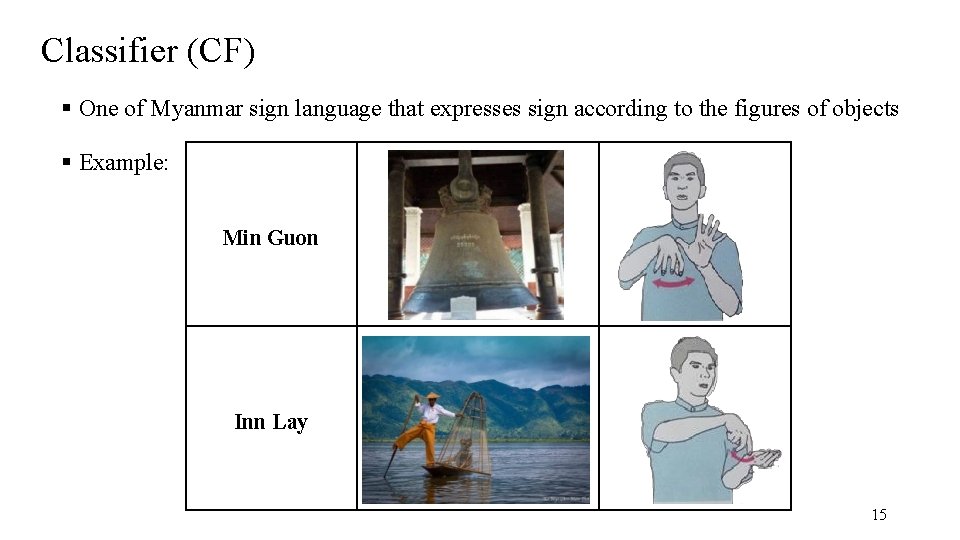
Classifier (CF) One of Myanmar sign language that expresses sign according to the figures of objects Example: Min Guon Inn Lay 15
Sign. Writing In the 1974, Valerie Sutton invented for deaf people to write and read sign languages. It is becoming the written form for sign language in over 40 countries. There are two view-points: the signer’s viewpoints and the addressee’s viewpoints. There are two main perspectives: front and top. International Sign. Writing Alphabet (ISWA) includes all symbols used to write the handshapes, movements, facial expressions, and body movements. 16
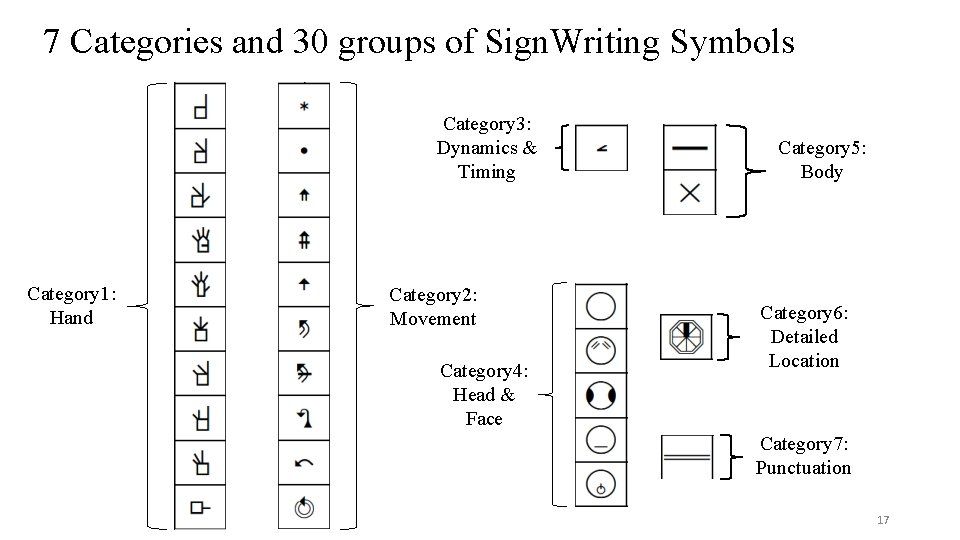
7 Categories and 30 groups of Sign. Writing Symbols Category 3: Dynamics & Timing Category 1: Hand Category 2: Movement Category 4: Head & Face Category 5: Body Category 6: Detailed Location Category 7: Punctuation 17
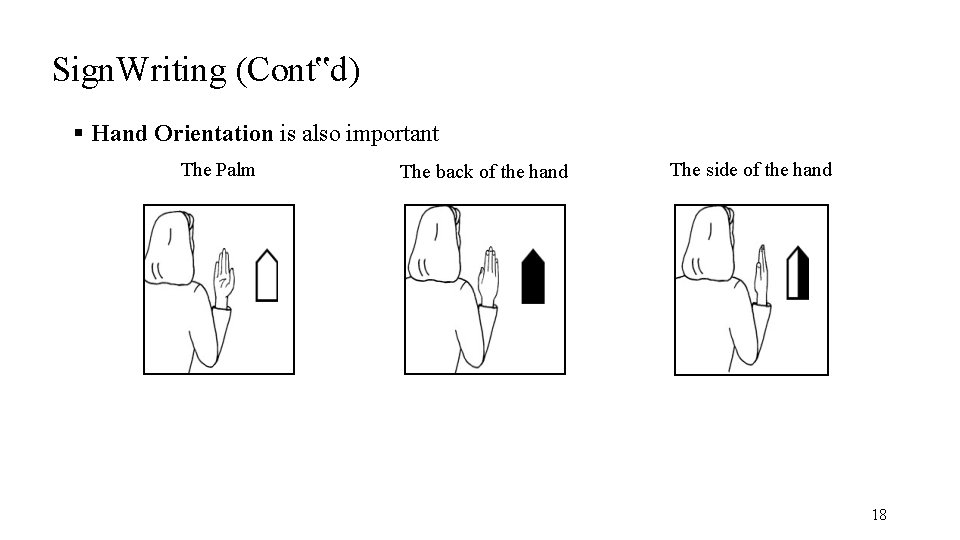
Sign. Writing (Cont‟d) Hand Orientation is also important The Palm The back of the hand The side of the hand 18
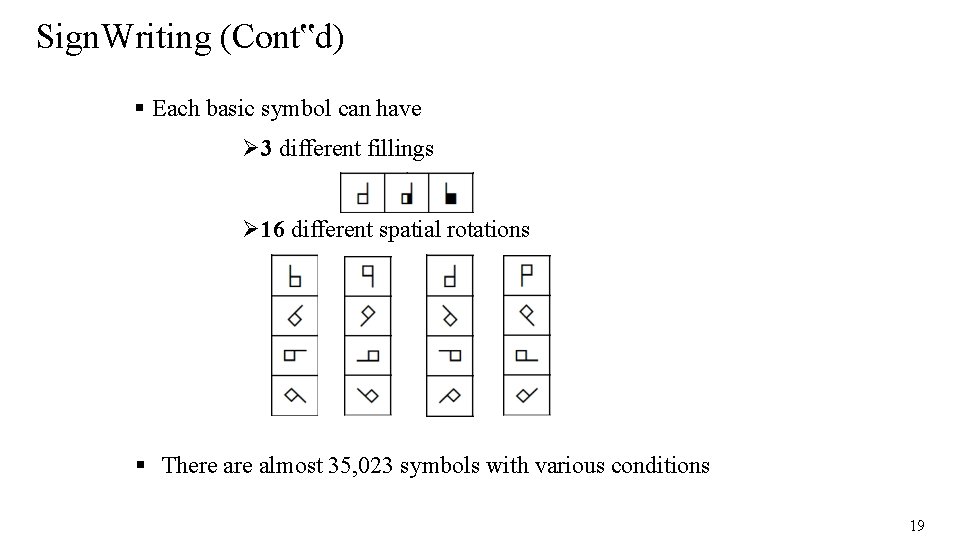
Sign. Writing (Cont‟d) Each basic symbol can have 3 different fillings 16 different spatial rotations There almost 35, 023 symbols with various conditions 19
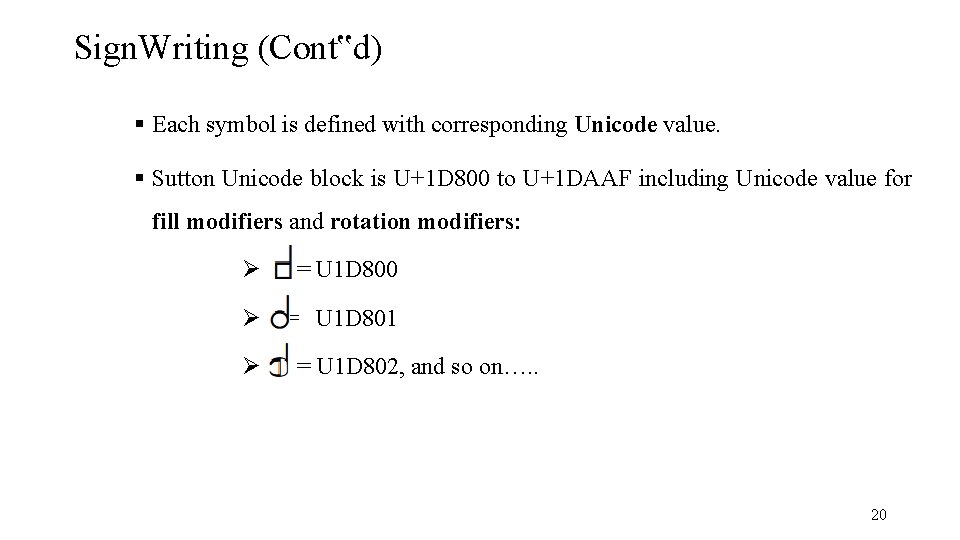
Sign. Writing (Cont‟d) Each symbol is defined with corresponding Unicode value. Sutton Unicode block is U+1 D 800 to U+1 DAAF including Unicode value for fill modifiers and rotation modifiers: = U 1 D 800 = U 1 D 801 = U 1 D 802, and so on…. . 20
Challenges We are considering to propose a user-friendly Myanmar Sign. Writing text input interface The main challenge is how to organize or grouping many Sign. Writing symbols for Myanmar Sign. Writing So as a first step, we only focus on typing Myanmar fingerspelling characters with Sign. Writing 21
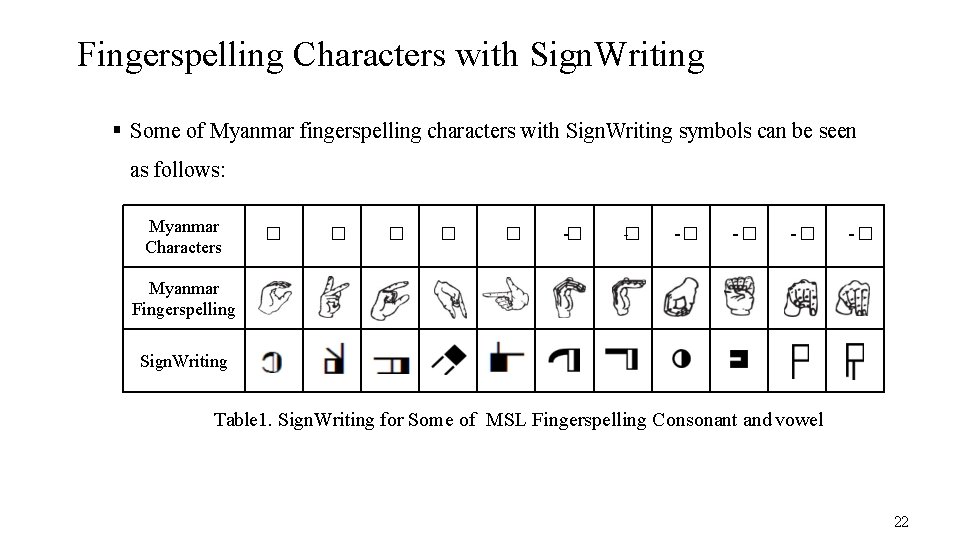
Fingerspelling Characters with Sign. Writing Some of Myanmar fingerspelling characters with Sign. Writing symbols can be seen as follows: Myanmar Characters � � � -� -� -� Myanmar Fingerspelling Sign. Writing Table 1. Sign. Writing for Some of MSL Fingerspelling Consonant and vowel 22
Two Fingerspelling Keyboard Layouts for MSW In the proposed paper, two Myanmar fingerspelling keyboard layouts for Myanmar Sign. Writing are implemented. Typing Sign. Writing symbols are different with typing Myanmar characters. To type a Sign. Writing symbol, at least two keys (i. e. symbol modifier and fill modifier keys) are needed to press. The typing order is symbol key, filling key and rotation key. 23
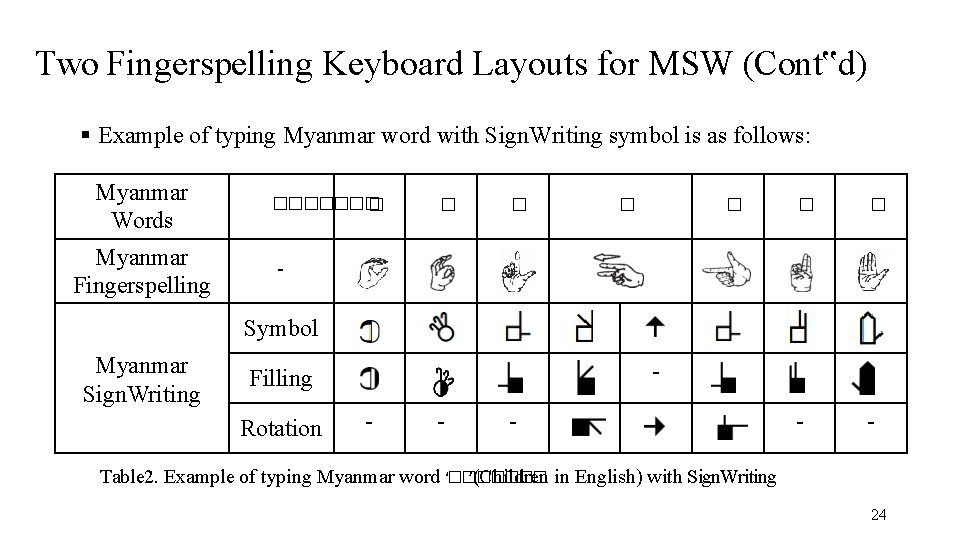
Two Fingerspelling Keyboard Layouts for MSW (Cont‟d) Example of typing Myanmar word with Sign. Writing symbol is as follows: Myanmar Words Myanmar Fingerspelling ������� � � � - - - Symbol Myanmar Sign. Writing - Filling Rotation - - - Table 2. Example of typing Myanmar word ‘������� ’(Children in English) with Sign. Writing 24
Two Fingerspelling Keyboard Layouts for MSW (Cont‟d) These keyboard layouts were implemented for Linux or Unix like operating system computers using X Keyboard Extension (XKB). The XKB is a part of the X Window System that extends the ability to control the keyboard and provides access to internal translation tables of keyboard codes. In our paper, True. Type font of Sutton Sign. Writing built with the Sign. Writing 2010 Tools was used to display Myanmar fingerspelling characters with Sign. Writing. 25
Phonetic-based Keyboard Layout for Myanmar Sign. Writing The mapping of Myanmar characters on English QWERTY keyboard based on their phonetic similarities with English characters such as Symbol of “� ” (Ka) on k key Symbol of “� ” (Ga) on g key Symbol of “� ” (Ca) on s key Symbol of “� ” (Cha) on S (Shift + s) key and so on The concept is same with the k. Kg (��� ) Myanmar keyboard. 26
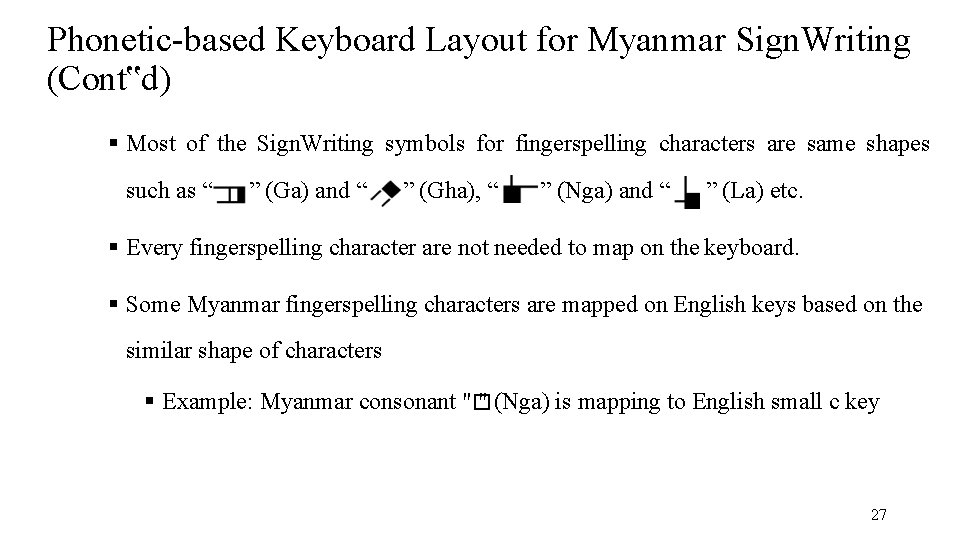
Phonetic-based Keyboard Layout for Myanmar Sign. Writing (Cont‟d) Most of the Sign. Writing symbols for fingerspelling characters are same shapes such as “ ” (Ga) and “ ” (Gha), “ ” (Nga) and “ ” (La) etc. Every fingerspelling character are not needed to map on the keyboard. Some Myanmar fingerspelling characters are mapped on English keys based on the similar shape of characters Example: Myanmar consonant "� " (Nga) is mapping to English small c key 27
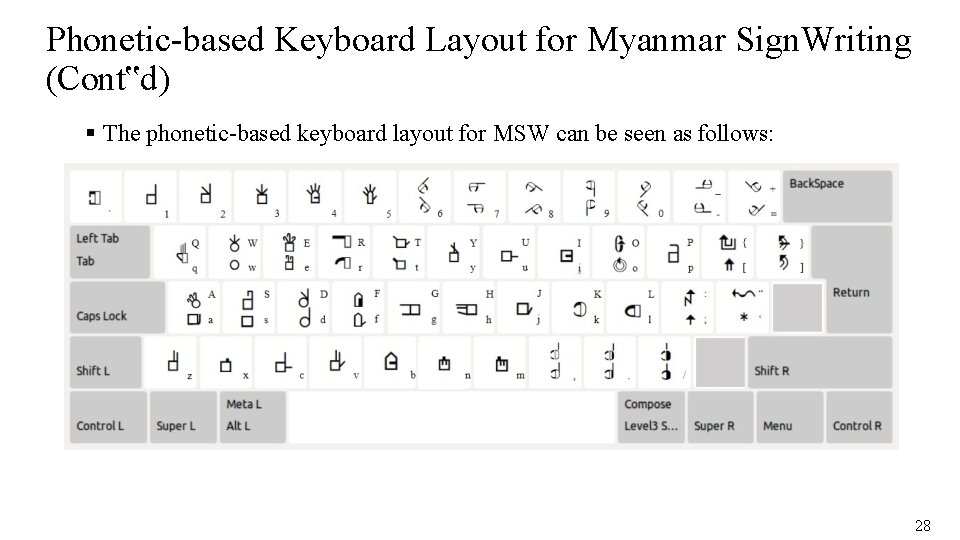
Phonetic-based Keyboard Layout for Myanmar Sign. Writing (Cont‟d) The phonetic-based keyboard layout for MSW can be seen as follows: 28
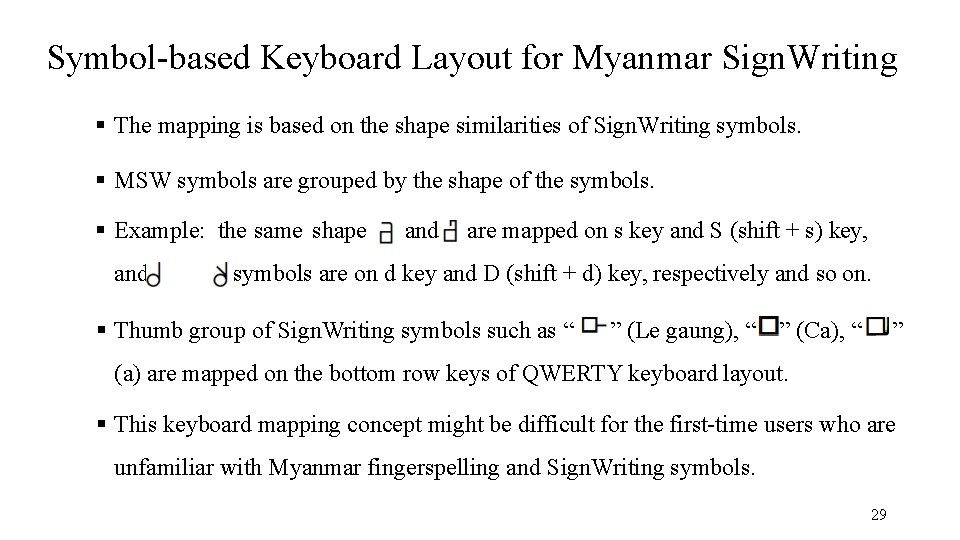
Symbol-based Keyboard Layout for Myanmar Sign. Writing The mapping is based on the shape similarities of Sign. Writing symbols. MSW symbols are grouped by the shape of the symbols. Example: the same shape and are mapped on s key and S (shift + s) key, symbols are on d key and D (shift + d) key, respectively and so on. Thumb group of Sign. Writing symbols such as “ ” (Le gaung), “ ” (Ca), “ ” (a) are mapped on the bottom row keys of QWERTY keyboard layout. This keyboard mapping concept might be difficult for the first-time users who are unfamiliar with Myanmar fingerspelling and Sign. Writing symbols. 29
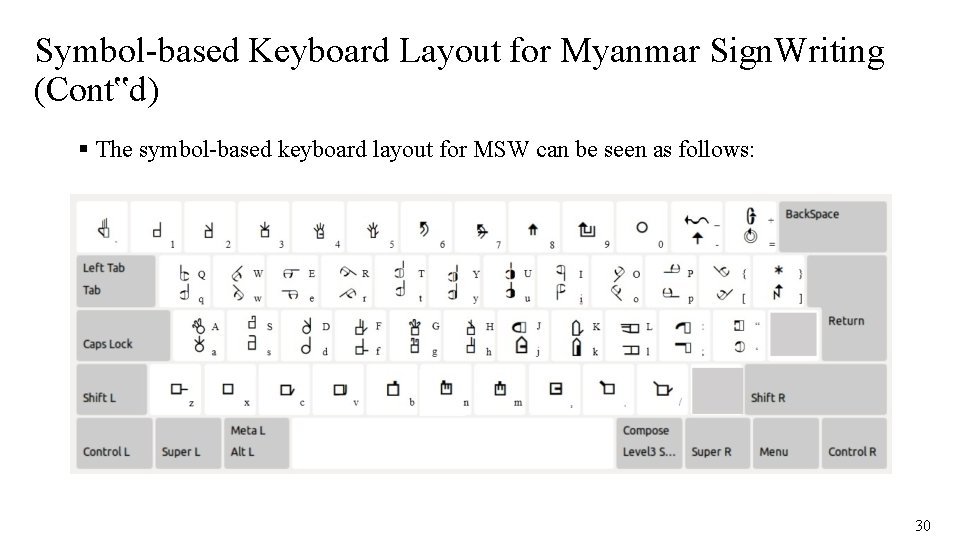
Symbol-based Keyboard Layout for Myanmar Sign. Writing (Cont‟d) The symbol-based keyboard layout for MSW can be seen as follows: 30
Methodology For User study, Participants 19 volunteer participants (9 males and 10 female) Two types of users Hearing-impaired users and Hearing users Location School for the Deaf, Mandalay None of them had prior experience with Sign. Writing symbols for Myanmar fingerspelling characters. 31
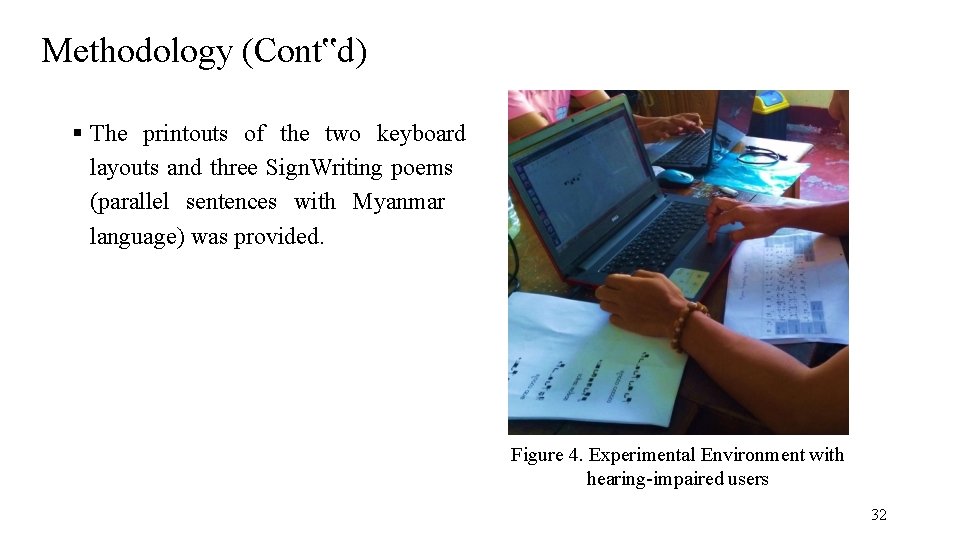
Methodology (Cont‟d) The printouts of the two keyboard layouts and three Sign. Writing poems (parallel sentences with Myanmar language) was provided. Figure 4. Experimental Environment with hearing-impaired users 32
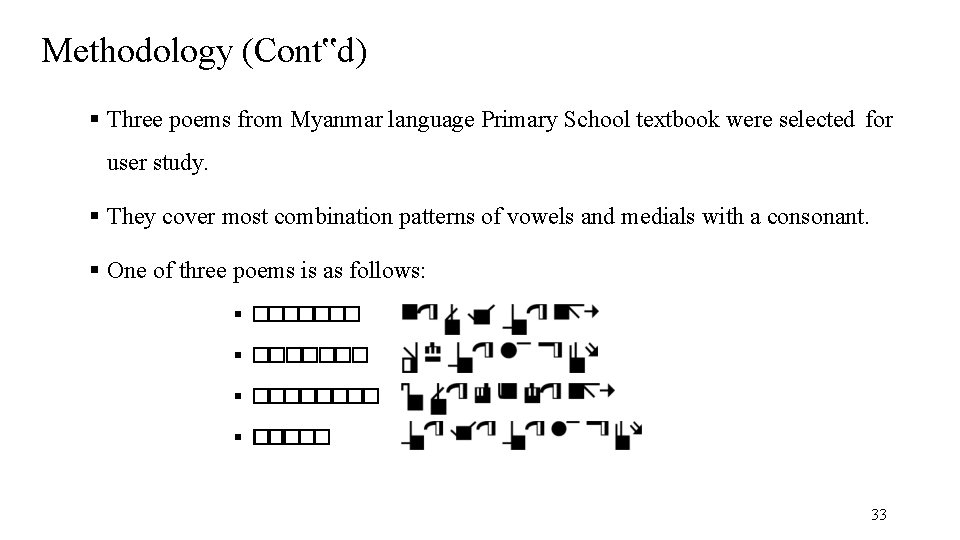
Methodology (Cont‟d) Three poems from Myanmar language Primary School textbook were selected for user study. They cover most combination patterns of vowels and medials with a consonant. One of three poems is as follows: ������� ����� 33
Procedures of User Experiment 1. About Sign. Writing and two keyboard layout mapping concepts are introduced to all participants. 2. How to type Myanmar Sign. Writing characters for all Myanmar consonants (characters Ka to A) are demonstrated. 3. All Myanmar consonants (characters Ka to A) are allowed to practice typing for two times to get some level of understanding on two keyboard layouts. 4. Typing speed of all participants for each poem for 10 times are recorded. 5. Participants are made discussion and their feedbacks, suggestions and comments are collected. 34
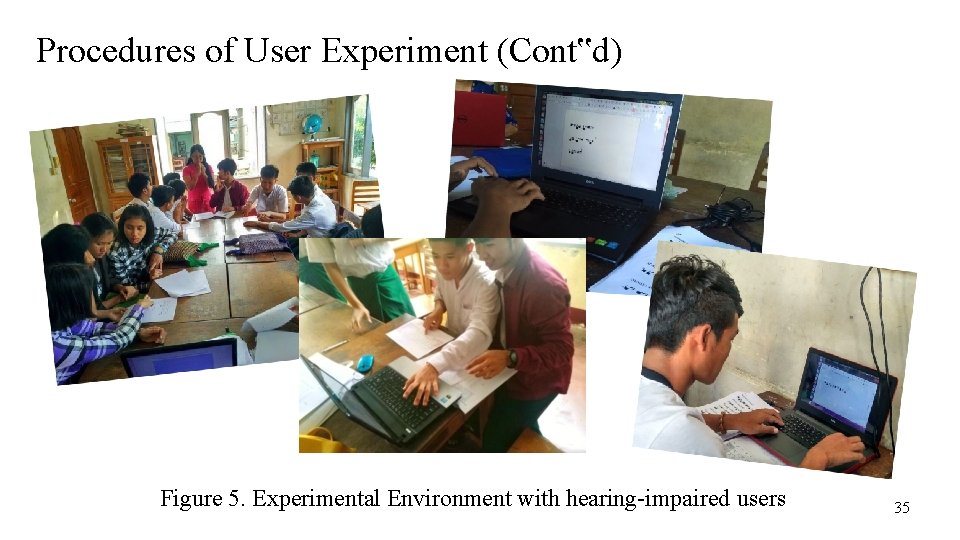
Procedures of User Experiment (Cont‟d) Figure 5. Experimental Environment with hearing-impaired users 35
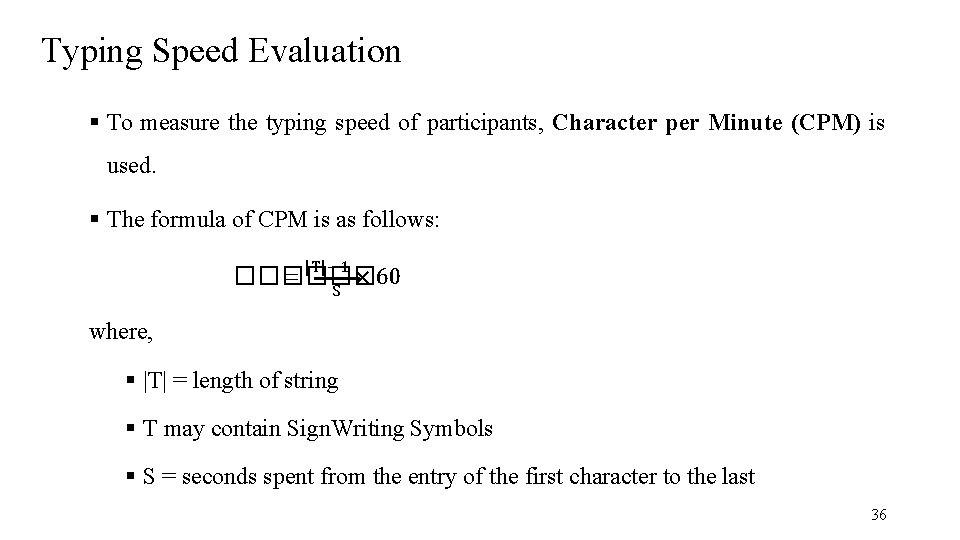
Typing Speed Evaluation To measure the typing speed of participants, Character per Minute (CPM) is used. The formula of CPM is as follows: ������ = |T|− 1 × 60 S where, |T| = length of string T may contain Sign. Writing Symbols S = seconds spent from the entry of the first character to the last 36
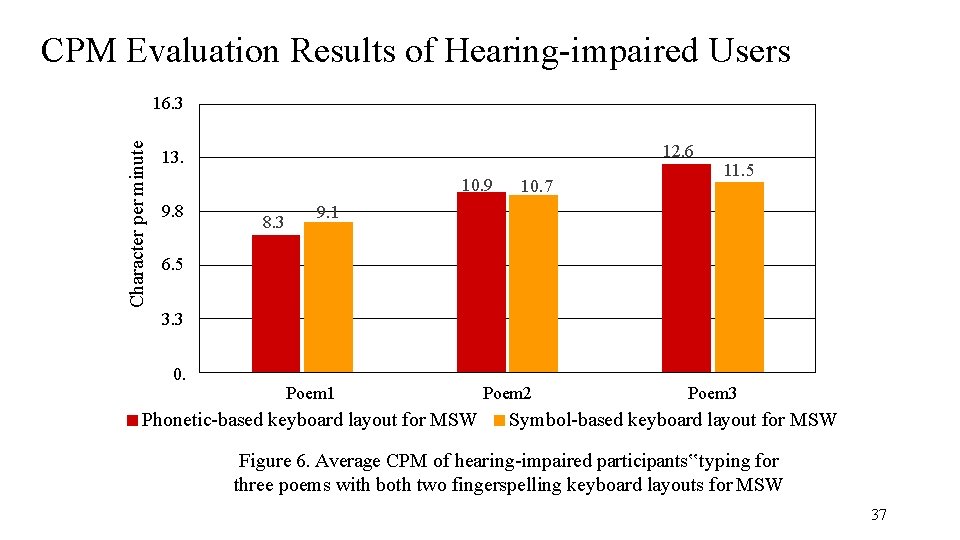
CPM Evaluation Results of Hearing-impaired Users Character per minute 16. 3 12. 6 13. 10. 9 9. 8 8. 3 10. 7 11. 5 9. 1 6. 5 3. 3 0. Poem 1 Phonetic-based keyboard layout for MSW Poem 2 Poem 3 Symbol-based keyboard layout for MSW Figure 6. Average CPM of hearing-impaired participants‟ typing for three poems with both two fingerspelling keyboard layouts for MSW 37
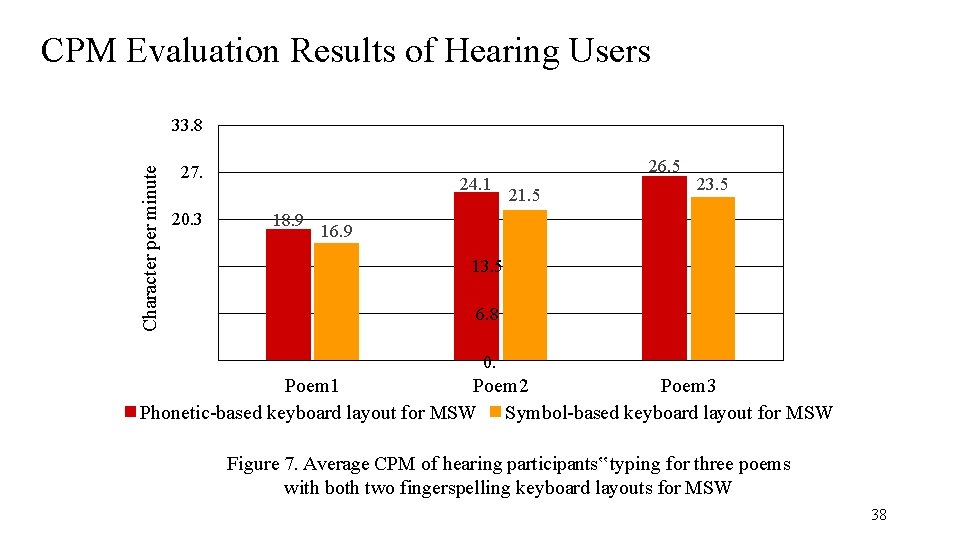
CPM Evaluation Results of Hearing Users Character per minute 33. 8 27. 20. 3 24. 1 18. 9 26. 5 21. 5 23. 5 16. 9 13. 5 6. 8 0. Poem 1 Poem 2 Poem 3 Phonetic-based keyboard layout for MSW Symbol-based keyboard layout for MSW Figure 7. Average CPM of hearing participants‟ typing for three poems with both two fingerspelling keyboard layouts for MSW 38
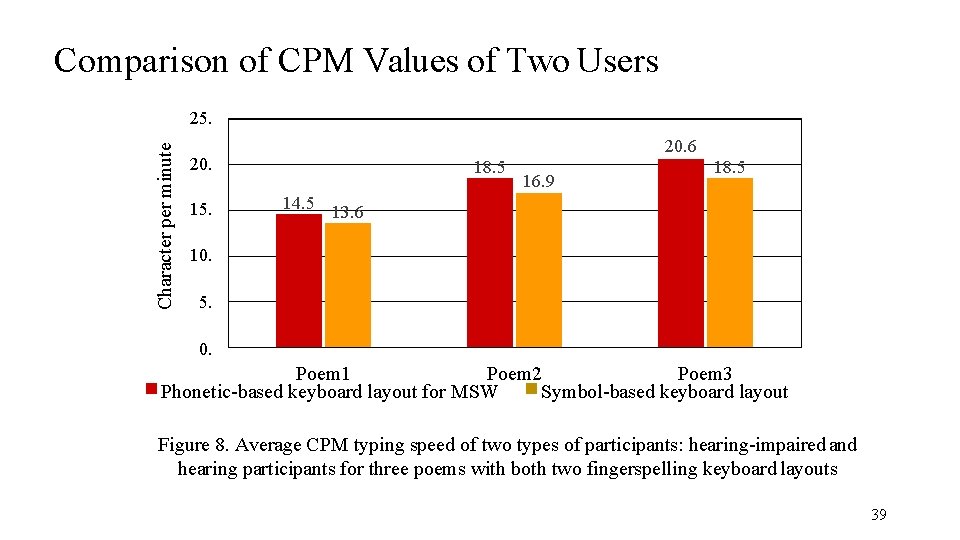
Comparison of CPM Values of Two Users Character per minute 25. 20. 6 20. 15. 18. 5 16. 9 18. 5 14. 5 13. 6 10. 5. 0. Poem 1 Poem 2 Poem 3 Phonetic-based keyboard layout for MSW Symbol-based keyboard layout Figure 8. Average CPM typing speed of two types of participants: hearing-impaired and hearing participants for three poems with both two fingerspelling keyboard layouts 39
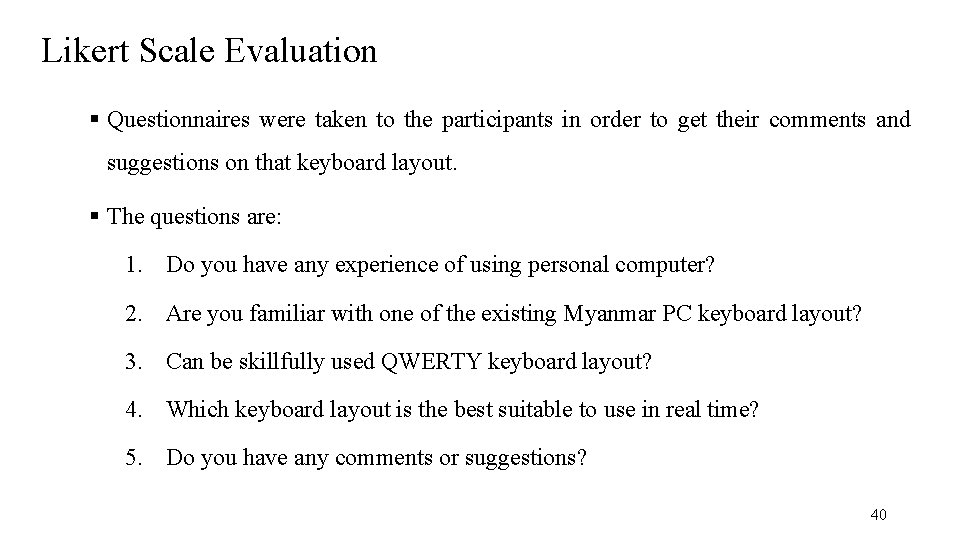
Likert Scale Evaluation Questionnaires were taken to the participants in order to get their comments and suggestions on that keyboard layout. The questions are: 1. Do you have any experience of using personal computer? 2. Are you familiar with one of the existing Myanmar PC keyboard layout? 3. Can be skillfully used QWERTY keyboard layout? 4. Which keyboard layout is the best suitable to use in real time? 5. Do you have any comments or suggestions? 40
Likert Scale Evaluation (Cont‟d) Four Likert scales (1 to 5) are made to rate the user-friendliness of two fingerspelling keyboard layouts for Myanmar Sign Writing. The scales are: 1. Difficult-easy 2. Slow-fast 3. Dislike-like 4. Impossible-possible • Likert scales value 1 is the most negative, 3 is neutral and 5 is the most positive. 41
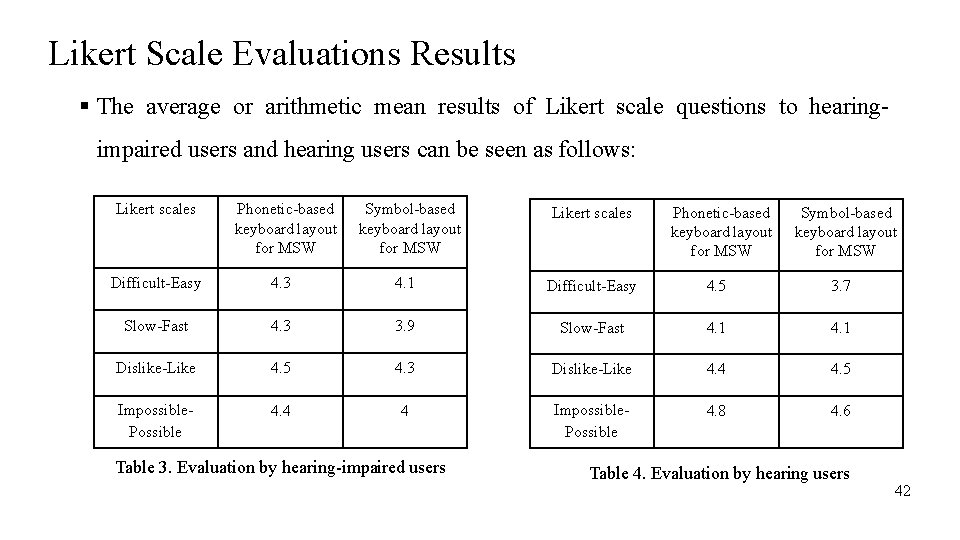
Likert Scale Evaluations Results The average or arithmetic mean results of Likert scale questions to hearingimpaired users and hearing users can be seen as follows: Likert scales Phonetic-based keyboard layout for MSW Symbol-based keyboard layout for MSW Difficult-Easy 4. 3 4. 1 Difficult-Easy 4. 5 3. 7 Slow-Fast 4. 3 3. 9 Slow-Fast 4. 1 Dislike-Like 4. 5 4. 3 Dislike-Like 4. 4 4. 5 Impossible. Possible 4. 4 4 Impossible. Possible 4. 8 4. 6 Table 3. Evaluation by hearing-impaired users Table 4. Evaluation by hearing users 42
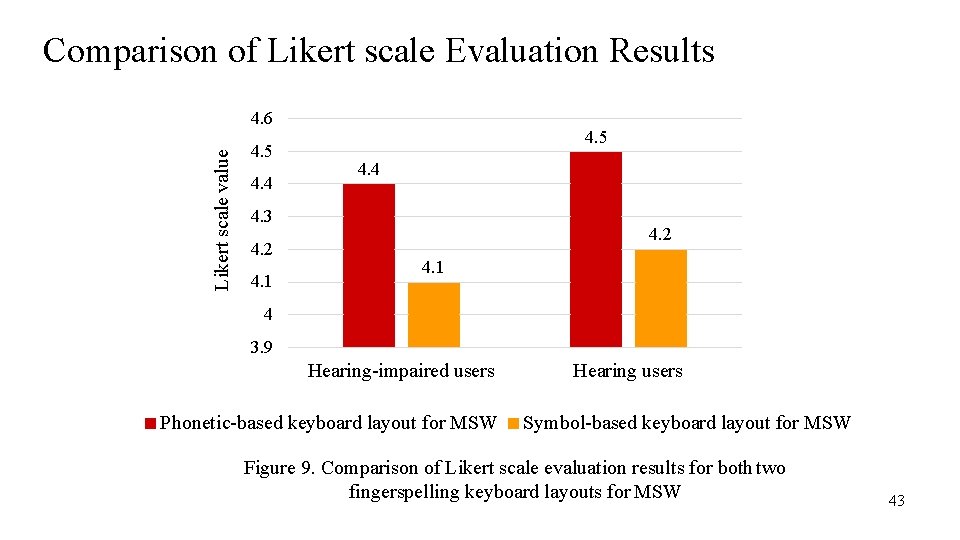
Comparison of Likert scale Evaluation Results Likert scale value 4. 6 4. 5 4. 4 4. 3 4. 2 4. 1 4 3. 9 Hearing-impaired users Phonetic-based keyboard layout for MSW Hearing users Symbol-based keyboard layout for MSW Figure 9. Comparison of Likert scale evaluation results for both two fingerspelling keyboard layouts for MSW 43
Discussion • Experiment was made with 8 hearing-impaired users and 11 hearing users. • Hearing users achieved maximum typing speed 26. 5 CPM with phonetic-based keyboard and 23. 5 CPM with symbol-based keyboard. • Hearing-impaired users achieved 12. 6 CPM with phonetic-based keyboard and 11. 5 CPM with symbol-based keyboard. • The results of two users are very different because of hearing-impaired users are not familiar with computer keyboard but the results of two keyboard layouts are not significantly different. 44
Discussion (Cont‟d) • From the evaluations in terms of both CPM and Likert scale, both of the keyboard layouts are applicable for typing Myanmar fingerspelling Sign. Writing. • Based on users‟ comments, suggestions and Likert scale values, phonetic-based keyboard layout is more flexible to use for both users. . 45
Conclusion This research introduced the first study of Myanmar Sign. Writing and the Myanmar Sign. Writing text input interface system of Myanmar sign language for Myanmar deaf society. Reading and writing Myanmar sign languages with Sign. Writing are effective in Deaf Education and communicating with each other. In our paper, two fingerspelling keyboard layouts for Myanmar Sign. Writing: phonetic-based and symbol-based keyboard layouts have been proposed. 46
Conclusion (Cont‟d) Among two fingerspelling keyboard layouts, the phonetic-based keyboard layout is more flexible to use for both hearing-impaired users and hearing users based on the results of experiments. Two-fingerspelling keyboard layouts were shared with the public via Git. Hub, and can be downloaded and used on your Ubuntu desktop computer. (https: //github. com/ye-kyawthu/Myanmar. Sign. Writing-Fingerspelling-Keyboards) The future work is the implementation of Sign. Writing Text Input Interface for Myanmar Deaf people to write Myanmar sign language. 47
Reference 1. “Myanmar Sign Language Dictionary (Vol: 1)”, Mandalay School for the Deaf, 2007 2. “Text book of Speaking and Myanmar Sign Communication”, Mary Chapman School for the Deaf, 1988 3. “Text book of Primary Myanmar”, Mandalay School for the Deaf 4. Mac. Kenzie, I. S. and Aleks Oniszczak, “A Comparison of Two Input Methods for Keypads on Mobile Devices” 5. Valerie Sutton and Adam Frost: Manual book about Sign. Writing Hand Symbols in the International Sign. Writing Alphabet 2010 6. Ye Kyaw Thu†, Sai Aung Win Maung‡ and Yoshiyori Urano†: Direct Keyboard Mapping (DKM) Layout for Myanmar Fingerspelling Text Input 7. Sutton Sign. Writing, Unicode Standard, 10. 0 8. https: //en. wikipedia. org/wiki/Sign. Writing 9. https: //en. wikipedia. org/wiki/Sign. Language 10. https: //github. com/ye-kyaw-thu/k. Kg-Myanmar-keyboard/ 48
List of Publications • Swe Zin Moe, Hlaing Myat Nwe, Hnin Wai Hlaing, Ye Kyaw Thu, Hnin Aye Thant, Nandar Win Min, “Myanmar Sign Language (MSL) Corpus for Emergency Domain”, PACLING 2017 conference, Yangon, Myanmar. (Demo and Poster) • Swe Zin Moe, Ye Kyaw Thu, Hlaing Myat Nwe, Hnin Wai Hlaing, Ni Htwe Aung, Hnin Aye Thant, Nandar Win Min, “Corpus Building for Machine Translation between Myanmar Sign Language and Myanmar Written Text”, World Deaf Day 2017, 14 th Sept. 2017, Mandalay Community Center, Chan Aye Tharzan Township, Mandalay, Myanmar. (Poster) • Swe Zin Moe, Hnin Wai Hlaing, Ye Kyaw Thu, Hlaing Myat Nwe, Ni Htwe Aung, Hnin Aye Thant, Nandar Win Min, “�� �� � ������ � � ”, � � International � � � ��� �� � � Day � ��o� f. Persons � � ���� with �� Disabilities 2017, 3 rd Dec. 2017, Wilson Hotel, No. 31(E), Yangon-Mandalay Main Road, Maha Aung Myay Township, Mandalay, Myanmar. (Demo and Poster) • Hlaing Myat Nwe, Ye Kyaw Thu, Hnin Wai Hlaing, Swe Zin Moe, Ni Htwe Aung, Hnin Aye Thant, Nandar Win Min, "Two Fingerspelling Keyboard layouts for Myanmar Sign. Writing", International Day of Persons with Disabilities 2017, 3 rd Dec. 2017, Wilson Hotel, No. 31(E), Yangon-Mandalay Main Road, Maha Aung Myay Township, Mandalay, Myanmar. (Demo and Poster) 49
List of Publications • Hlaing Myat Nwe, Ye Kyaw Thu, Hnin Wai Hlaing, Swe Zin Moe, Ni Htwe Aung, Hnin Aye Thant, Nanda Win Min, "Two Fingerspelling Keyboard Layouts for Myanmar Sign. Writing", In Proceedings of ICCA 2018, February 22 -23, 2018, Yangon, Myanmar, pp. 290 -298. (Paper) • Swe Zin Moe, Ye Kyaw Thu, Hnin Wai Hlaing, Hlaing Myat Nwe, Ni Htwe Aung, Hnin Aye Thant, Nandar Win Min, "Statistical Machine Translation between Myanmar Sign Language and Myanmar Written Text", In Proceedings of ICCA 2018, February 22 -23, 2018, Yangon, Myanmar, pp. 217 -227. (Paper) • Hnin Wai Hlaing, Ye Kyaw Thu, Swe Zin Moe, Hlaing Myat Nwe, Ni Htwe Aung, Nandar Win Min, Hnin Aye Thant, “Statistical Machine Translation between Myanmar Sign Language and Myanmar Sign. Writing”, at the First International Symposium on Artificial Intelligence for ASEAN Development, ASEAN-AI 2018, Phuket, Thailand, 26 th March 2018. (Paper) 50
Contact Hlaing Myat Nwe University of Technology (Yatanarpon Cyber City), Pyin Oo Lwin, Myanmar hlaingmyatnwe. nwe@gmail. com Ye Kyaw Thu Language and Speech Science Research Lab. , Waseda University, Japan wasedakuma@gmail. com 51
52
- Slides: 52