
Two examples of LHC Risk assessment and reliability
Two examples of LHC Risk assessment and reliability analysis activities CLIC collaboration meeting, CERN, 3 November 2011 S. Wagner, CERN, sigrid. wagner@cern. ch
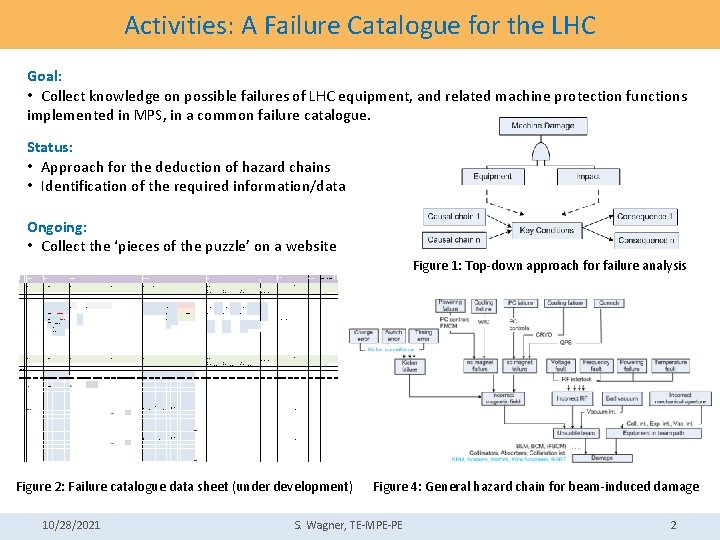
Activities: A Failure Catalogue for the LHC Goal: • Collect knowledge on possible failures of LHC equipment, and related machine protection functions implemented in MPS, in a common failure catalogue. Status: • Approach for the deduction of hazard chains • Identification of the required information/data Ongoing: • Collect the ‘pieces of the puzzle’ on a website Figure 1: Top-down approach for failure analysis OPERATION BEAM EQUIPMENT CONSEQUENCES MEASURE S DETAILS Pre-Failure No Operation status/mode SPS Beam (circulating) 1) particle energy intensity Component 1. . n condition group/system Failure 1. . n # modules device(s) Component n Failure n group/system # modules device(s) Consequences unprot. 4) Beam Condition beam loss optim. location pessim. optim. level pessim. comment/description CONSEQUENCES CONTACT REFERENCE Failure Preventio n Failure 1. . n SPS circ. SPS extr. Protection System LHC circ. Consequences unprot. passive optim. pessim. Cause/Causal chain Add. Charact. Cause/Causal chain Additional characteristic monitored syst. /comp. parameter measure syst. /comp measure COMMON no beam protons 450 Ge. V no beam probe (<1. 4 e 10@450 Ge. V) nominal ions nonset-up/safe (<5 e 11@450 Ge. V) nominal <CNGS> <Hi. Rad. Mat high intensity > (>5 e 11@450 Ge. V) stable exact unstable CNGS see sheet 'Component. Failure' whole SPS 1: possibly damage beyond repair Failure ID local orbit distorsion Failure ID local trajectory distorsion Failure ID local orbit distorsion technical failure partial Transfer line 2: serious damage, repair expected to take many months (19/9/08) Description global orbit distorsion Description global trajectory distorsion Description global orbit distorsion operational failure Ring 3: damage, repair expected to take days to weeks grouped 1…k (interlocked) monitoring maintenance failure Extraction line technical failure beam in abort gap below threshold extact operational failure beam in abort gap above threshold maintenance failure Hi. Rad. Mat collimators and absorbers see sheet Prevention. Protection exact No Operation status/mode SPS Beam (circulating) 1) particle energy intensity Component 1. . n condition 2)group/system Failure 1. . n # modules device(s) Component n Failure n group/system # modules device(s) Consequences unprot. Beam Condition beam loss location level optim. pessim. optim. pessim. None (will continue circulating in SPS) All beam lost as not sufficiently kicked for extratction but lost elsewhere in the SPS none MSE/SPS Vaccuum chamber 2. . 3 (higher for first magnets in none the chain, less for last ones) comment/description Cause/Causal chain Preventio n Failure 1. . n SPS circ. SPS extr. Add. Charact. Cause/Causal chain LHC circ. Add. Charact. Cause/Causal chain Add. Charact. Protection System Additional characteristic passive monitored syst. /comp. parameter measure syst. /comp measure INJECTION (1) SPS beam operation protons 450 Ge. V nominal Bumper H(4): common grouped angle non-nominal JW. VK, JU . -too small (for extraction) TED. 4 Bumper current surveilance SPS coll aperture nonnominal w: corresponding to above scenario, except damage not limited to locations upstream TED. 4 . -open Might touch the MSE/vaccuum chamber . -too big (for extraction) TED. 4 Lost on MSE aperture nonnominal . -open w: corresponding to above scenario, except damage not limited to locations upstream TED. 4 Figure 2: Failure catalogue data sheet (under development) 10/28/2021 Figure 4: General hazard chain for beam-induced damage S. Wagner, TE-MPE-PE 2

Activities: Quantitative Reliability Studies Goal: Comparison of different subsystem architectures in terms of machine safety and availability Table 3: Scenario probabilities for the different interface architectures THEOR Mission completed False trigger Demand success Demand missed False missed A 0. 794900509 0. 076157726 0. 128479697 0. 000462069 B 1 0. 739878188 0. 135531124 0. 124582722 7. 96489 E-06 B 2 0. 849922829 0. 016784327 0. 132376671 0. 000916173 C 1 0. 688664561 0. 19089764 0. 120432112 5. 68622 E-06 C 2 0. 842305442 0. 024798093 0. 132883942 1. 25222 E-05 C 3 0. 853731523 0. 012777444 0. 132123036 0. 001367998 B 0 0. 739872761 0. 07683858 0. 124181566 0. 000408912 0. 058698 C 0 0. 823763666 0. 04435782 0. 131855425 2. 30891 E-05 Type of result: Probabilities for scenarios related to machine safety (Demand missed) and availability (Mission completed) 10/28/2021 S. Wagner, TE-MPE-PE 3

Conclusion: Potential Contribution Potential contribution to CLIC WP Machine Protection & Operational Scenarios, Task Reliability, Availability: • 2012, 1 CERN post-doc fellow (% tbd) – Guidance in setting up a failure catalogue – Method(s) for analyses in terms of machine safety and availability – Support in risk assessment and management tasks 10/28/2021 S. Wagner, TE-MPE-PE 4
- Slides: 4