
two chair dialogue sequence cookery tips c t
- Slides: 1
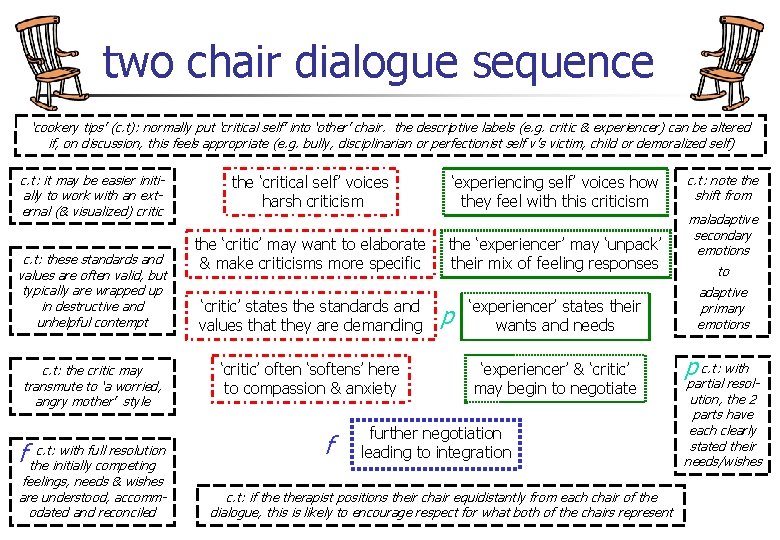
two chair dialogue sequence ‘cookery tips’ (c. t): normally put ‘critical self’ into ‘other’ chair. the descriptive labels (e. g. critic & experiencer) can be altered if, on discussion, this feels appropriate (e. g. bully, disciplinarian or perfectionist self v’s victim, child or demoralized self) c. t: it may be easier initially to work with an external (& visualized) critic c. t: these standards and values are often valid, but typically are wrapped up in destructive and unhelpful contempt c. t: the critic may transmute to ‘a worried, angry mother’ style with full resolution f thec. t: initially competing feelings, needs & wishes are understood, accommodated and reconciled the ‘critical self’ voices harsh criticism the ‘critic’ may want to elaborate & make criticisms more specific ‘critic’ states the standards and values that they are demanding ‘critic’ often ‘softens’ here to compassion & anxiety f ‘experiencing self’ voices how they feel with this criticism c. t: note the shift from the ‘experiencer’ may ‘unpack’ their mix of feeling responses maladaptive secondary emotions to ‘experiencer’ states their wants and needs adaptive primary emotions p ‘experiencer’ & ‘critic’ may begin to negotiate further negotiation leading to integration c. t: if therapist positions their chair equidistantly from each chair of the dialogue, this is likely to encourage respect for what both of the chairs represent p c. t: with partial resolution, the 2 parts have each clearly stated their needs/wishes