
Two approaches to airspace design using Genetic Algorithms
- Slides: 35
Two approaches to airspace design using Genetic Algorithms EN-002 Designing 3 D ATC Sectors by using a “Genetic Algorithm”-based methodology EN-011 Airspace Design using a Workload Nodebased GA José Manuel Rísquez Xavier Ruiz-Hernández EIWAC - Tokyo, 11 th November 2010
ingeniería y consultoría de transport engineering and consultancy Two approaches to airspace design using Genetic Algorithms Index Two approaches to airspace design using Genetic Algorithms: common introduction EN-002 Designing 3 D ATC Sectors by using a “Genetic Algorithm”-based methodology EN-011 Airspace Design using a Workload Nodebased GA Conclusions on airspace design using GA 2
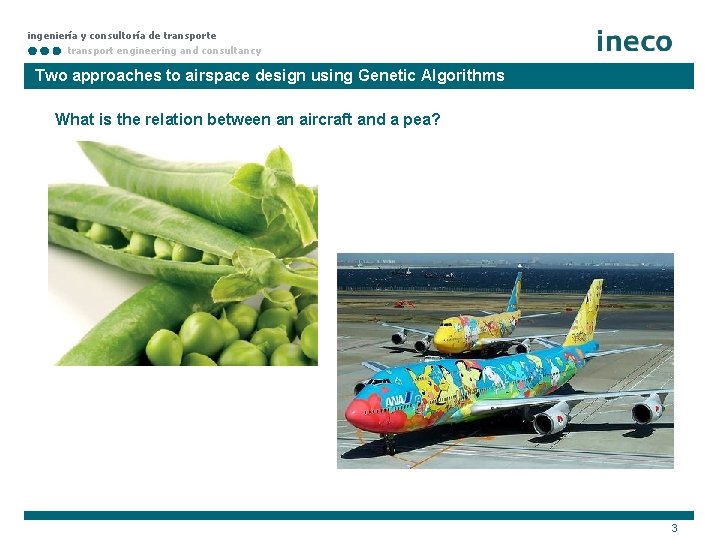
ingeniería y consultoría de transport engineering and consultancy Two approaches to airspace design using Genetic Algorithms What is the relation between an aircraft and a pea? 3
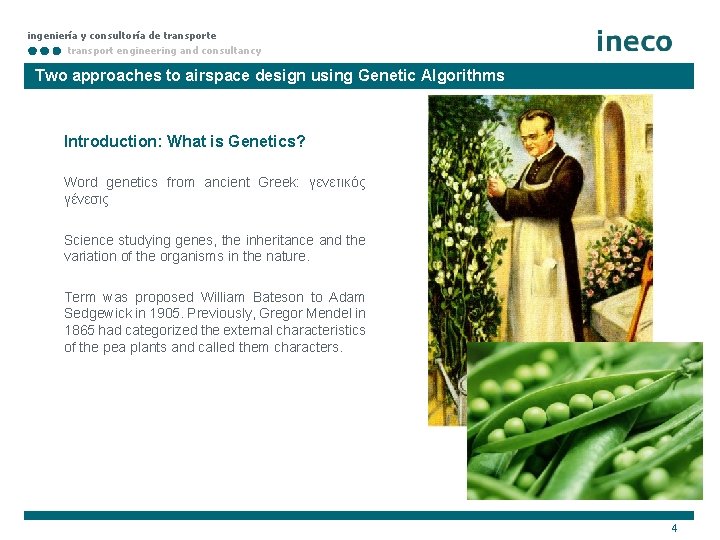
ingeniería y consultoría de transport engineering and consultancy Two approaches to airspace design using Genetic Algorithms Introduction: What is Genetics? Word genetics from ancient Greek: γενετικός γένεσις Science studying genes, the inheritance and the variation of the organisms in the nature. Term was proposed William Bateson to Adam Sedgewick in 1905. Previously, Gregor Mendel in 1865 had categorized the external characteristics of the pea plants and called them characters. 4
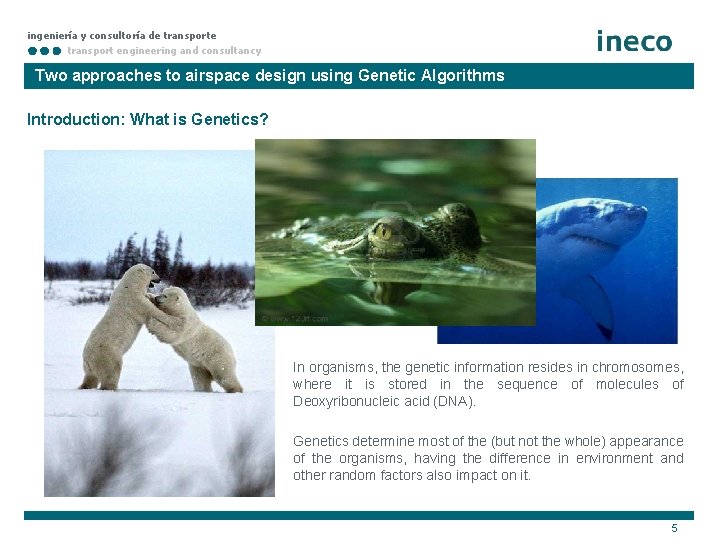
ingeniería y consultoría de transport engineering and consultancy Two approaches to airspace design using Genetic Algorithms Introduction: What is Genetics? In organisms, the genetic information resides in chromosomes, where it is stored in the sequence of molecules of Deoxyribonucleic acid (DNA). Genetics determine most of the (but not the whole) appearance of the organisms, having the difference in environment and other random factors also impact on it. 5
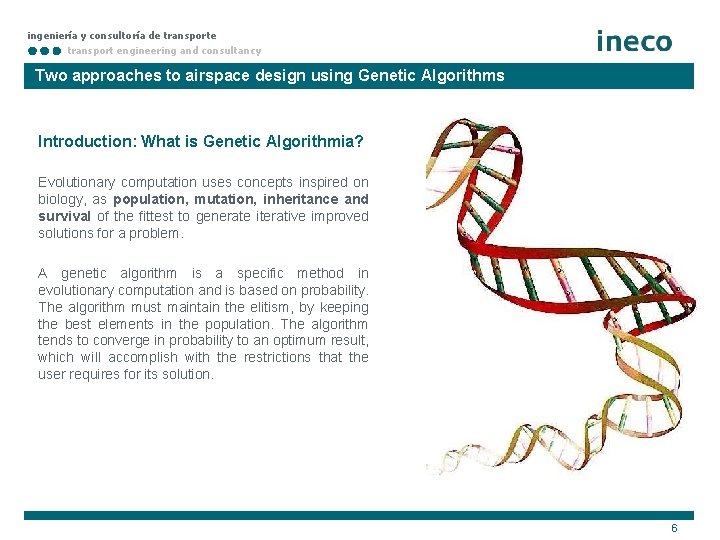
ingeniería y consultoría de transport engineering and consultancy Two approaches to airspace design using Genetic Algorithms Introduction: What is Genetic Algorithmia? Evolutionary computation uses concepts inspired on biology, as population, mutation, inheritance and survival of the fittest to generate iterative improved solutions for a problem. A genetic algorithm is a specific method in evolutionary computation and is based on probability. The algorithm must maintain the elitism, by keeping the best elements in the population. The algorithm tends to converge in probability to an optimum result, which will accomplish with the restrictions that the user requires for its solution. 6
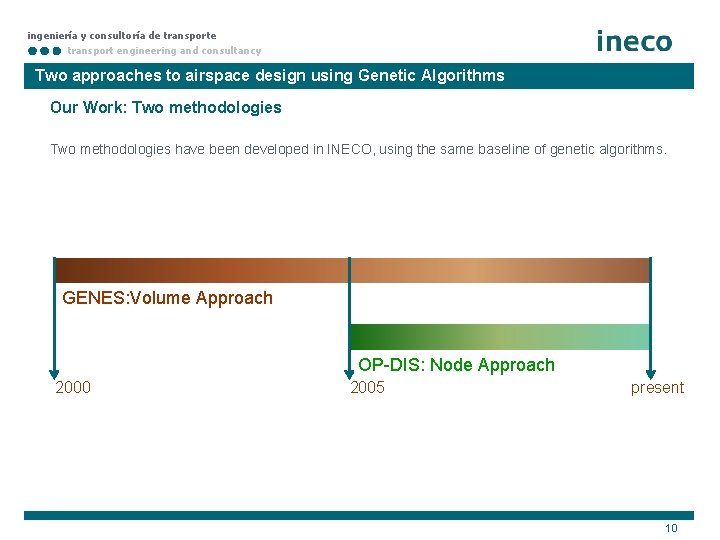
ingeniería y consultoría de transport engineering and consultancy Two approaches to airspace design using Genetic Algorithms Our Work: Two methodologies have been developed in INECO, using the same baseline of genetic algorithms. GENES: Volume Approach OP-DIS: Node Approach 2000 2005 present 10
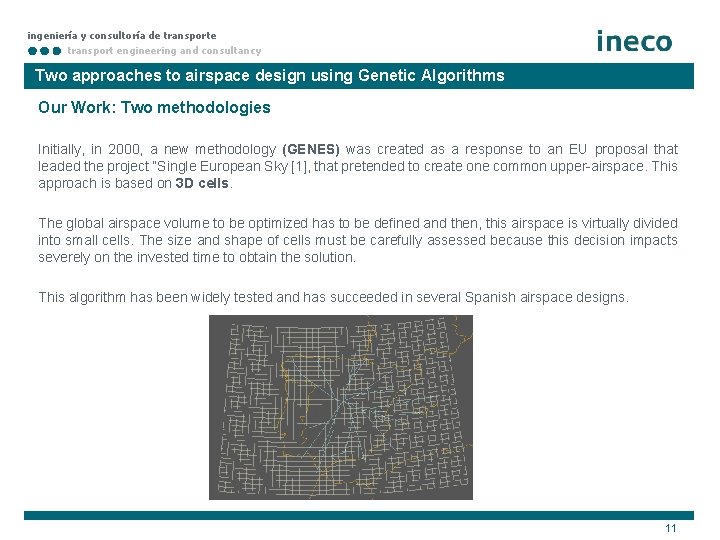
ingeniería y consultoría de transport engineering and consultancy Two approaches to airspace design using Genetic Algorithms Our Work: Two methodologies Initially, in 2000, a new methodology (GENES) was created as a response to an EU proposal that leaded the project “Single European Sky [1], that pretended to create one common upper-airspace. This approach is based on 3 D cells. The global airspace volume to be optimized has to be defined and then, this airspace is virtually divided into small cells. The size and shape of cells must be carefully assessed because this decision impacts severely on the invested time to obtain the solution. This algorithm has been widely tested and has succeeded in several Spanish airspace designs. 11
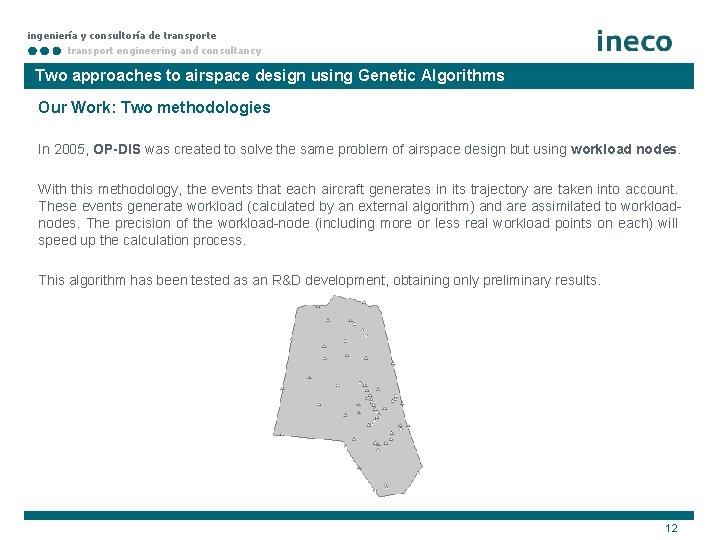
ingeniería y consultoría de transport engineering and consultancy Two approaches to airspace design using Genetic Algorithms Our Work: Two methodologies In 2005, OP-DIS was created to solve the same problem of airspace design but using workload nodes. With this methodology, the events that each aircraft generates in its trajectory are taken into account. These events generate workload (calculated by an external algorithm) and are assimilated to workloadnodes. The precision of the workload-node (including more or less real workload points on each) will speed up the calculation process. This algorithm has been tested as an R&D development, obtaining only preliminary results. 12
EN 002 - Designing 3 D ATC Sectors by using a “Genetic Algorithm”based methodology – José Manuel Rísquez
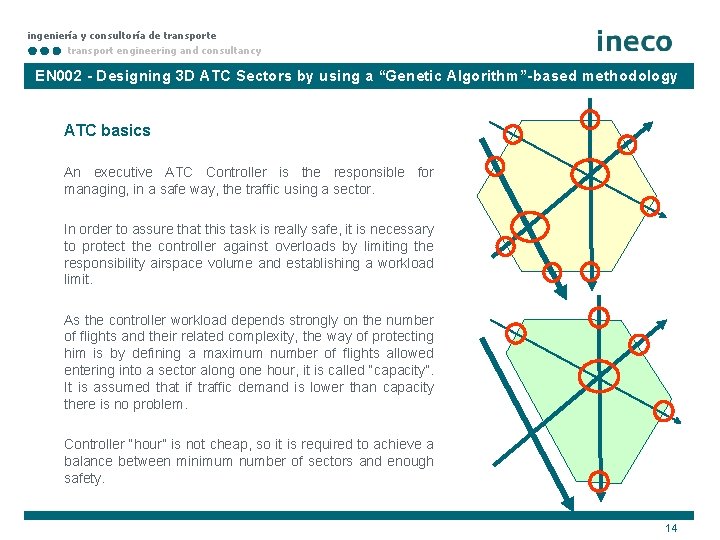
ingeniería y consultoría de transport engineering and consultancy EN 002 - Designing 3 D ATC Sectors by using a “Genetic Algorithm”-based methodology ATC basics An executive ATC Controller is the responsible for managing, in a safe way, the traffic using a sector. In order to assure that this task is really safe, it is necessary to protect the controller against overloads by limiting the responsibility airspace volume and establishing a workload limit. As the controller workload depends strongly on the number of flights and their related complexity, the way of protecting him is by defining a maximum number of flights allowed entering into a sector along one hour, it is called “capacity”. It is assumed that if traffic demand is lower than capacity there is no problem. Controller “hour” is not cheap, so it is required to achieve a balance between minimum number of sectors and enough safety. 14
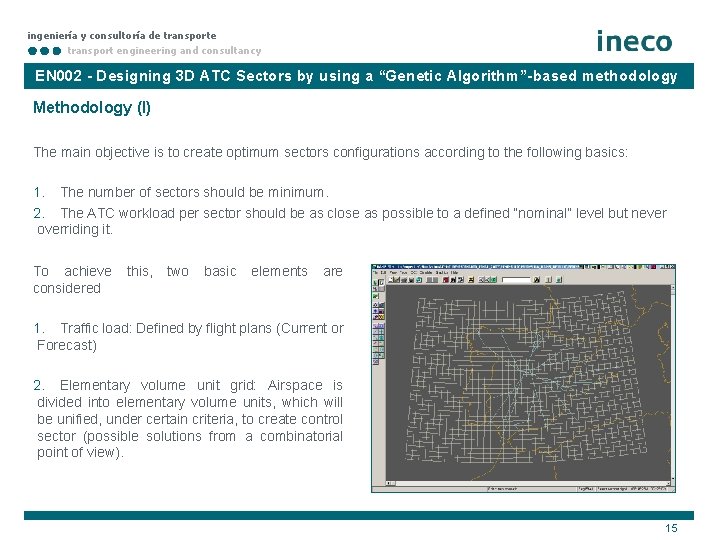
ingeniería y consultoría de transport engineering and consultancy EN 002 - Designing 3 D ATC Sectors by using a “Genetic Algorithm”-based methodology Methodology (I) The main objective is to create optimum sectors configurations according to the following basics: 1. The number of sectors should be minimum. 2. The ATC workload per sector should be as close as possible to a defined “nominal” level but never overriding it. To achieve considered this, two basic elements are 1. Traffic load: Defined by flight plans (Current or Forecast) 2. Elementary volume unit grid: Airspace is divided into elementary volume units, which will be unified, under certain criteria, to create control sector (possible solutions from a combinatorial point of view). 15
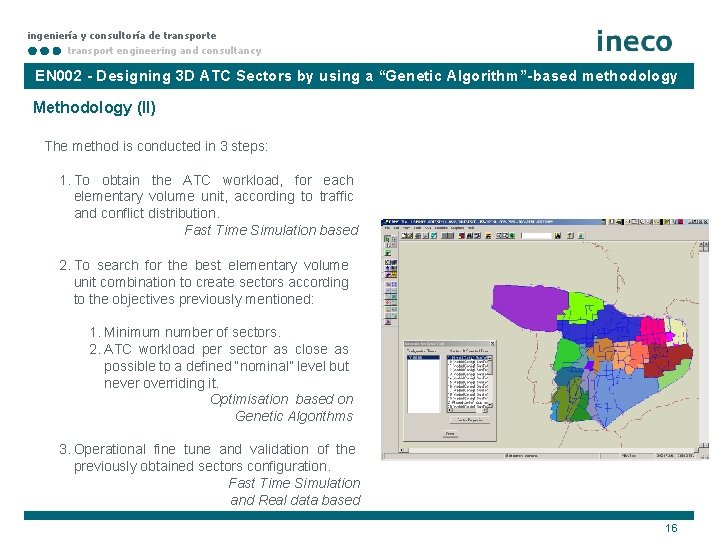
ingeniería y consultoría de transport engineering and consultancy EN 002 - Designing 3 D ATC Sectors by using a “Genetic Algorithm”-based methodology Methodology (II) The method is conducted in 3 steps: 1. To obtain the ATC workload, for each elementary volume unit, according to traffic and conflict distribution. Fast Time Simulation based 2. To search for the best elementary volume unit combination to create sectors according to the objectives previously mentioned: 1. Minimum number of sectors. 2. ATC workload per sector as close as possible to a defined “nominal” level but never overriding it. Optimisation based on Genetic Algorithms 3. Operational fine tune and validation of the previously obtained sectors configuration. Fast Time Simulation and Real data based 16
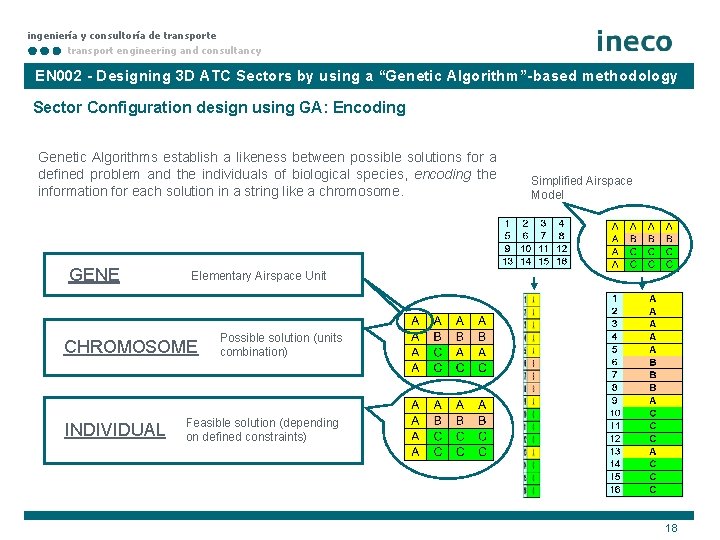
ingeniería y consultoría de transport engineering and consultancy EN 002 - Designing 3 D ATC Sectors by using a “Genetic Algorithm”-based methodology Sector Configuration design using GA: Encoding Genetic Algorithms establish a likeness between possible solutions for a defined problem and the individuals of biological species, encoding the information for each solution in a string like a chromosome. GENE Elementary Airspace Unit CHROMOSOME INDIVIDUAL Simplified Airspace Model Possible solution (units combination) Feasible solution (depending on defined constraints) 18
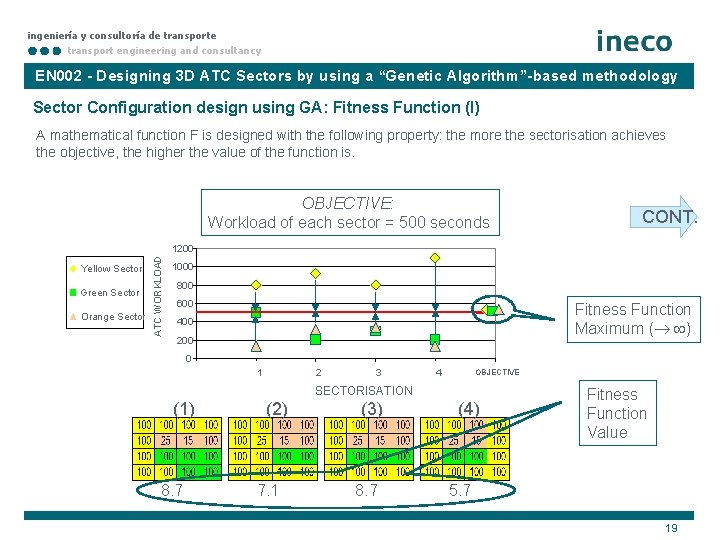
ingeniería y consultoría de transport engineering and consultancy EN 002 - Designing 3 D ATC Sectors by using a “Genetic Algorithm”-based methodology Sector Configuration design using GA: Fitness Function (I) A mathematical function F is designed with the following property: the more the sectorisation achieves the objective, the higher the value of the function is. OBJECTIVE: Workload of each sector = 500 seconds CONT. Yellow Sector Green Sector Orange Sector ATC WORKLOAD 1200 1000 800 600 Fitness Function Maximum ( ) 400 200 0 1 2 3 4 OBJECTIVE SECTORISATION (1) 8. 7 (2) 7. 1 (3) 8. 7 (4) Fitness Function Value 5. 7 19
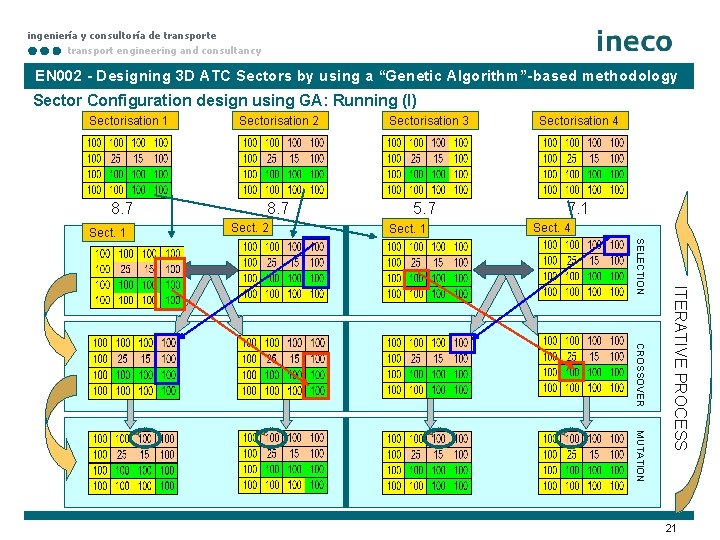
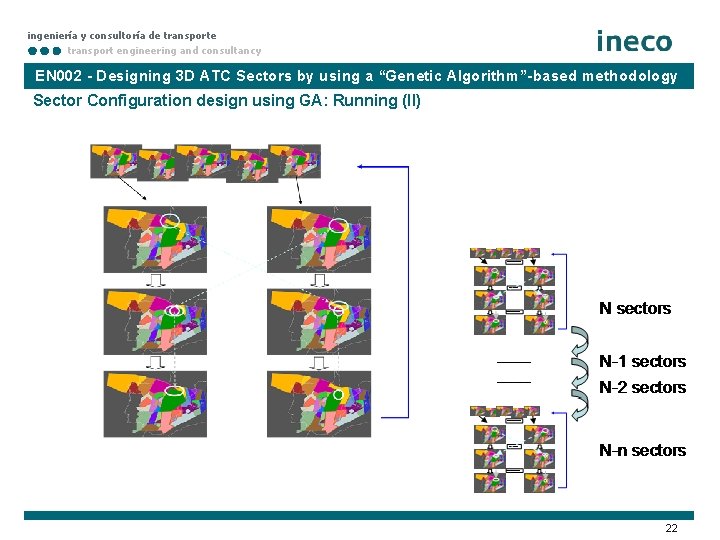
ingeniería y consultoría de transport engineering and consultancy EN 002 - Designing 3 D ATC Sectors by using a “Genetic Algorithm”-based methodology Sector Configuration design using GA: Running (I) Sectorisation 1 8. 7 Sect. 2 Sectorisation 3 5. 7 Sect. 1 Sectorisation 4 7. 1 Sect. 4 CROSSOVER MUTATION ITERATIVE PROCESS SELECTION Sect. 1 Sectorisation 2 21
ingeniería y consultoría de transport engineering and consultancy EN 002 - Designing 3 D ATC Sectors by using a “Genetic Algorithm”-based methodology Sector Configuration design using GA: Running (II) 22
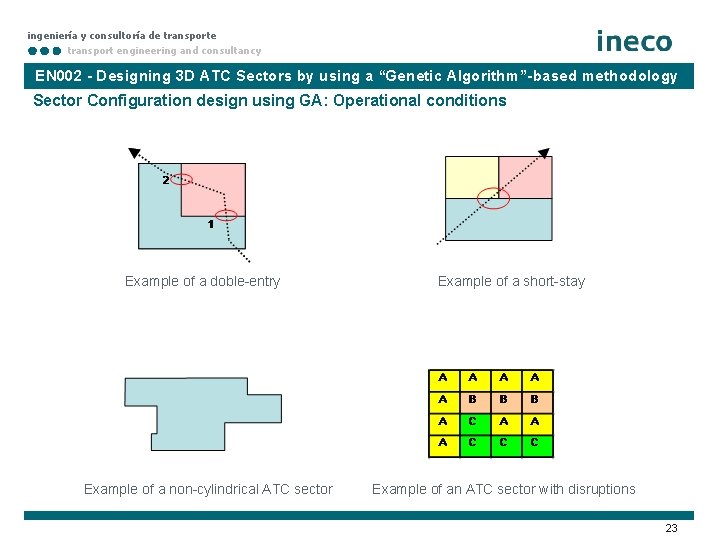
ingeniería y consultoría de transport engineering and consultancy EN 002 - Designing 3 D ATC Sectors by using a “Genetic Algorithm”-based methodology Sector Configuration design using GA: Operational conditions Example of a doble-entry Example of a non-cylindrical ATC sector Example of a short-stay Example of an ATC sector with disruptions 23
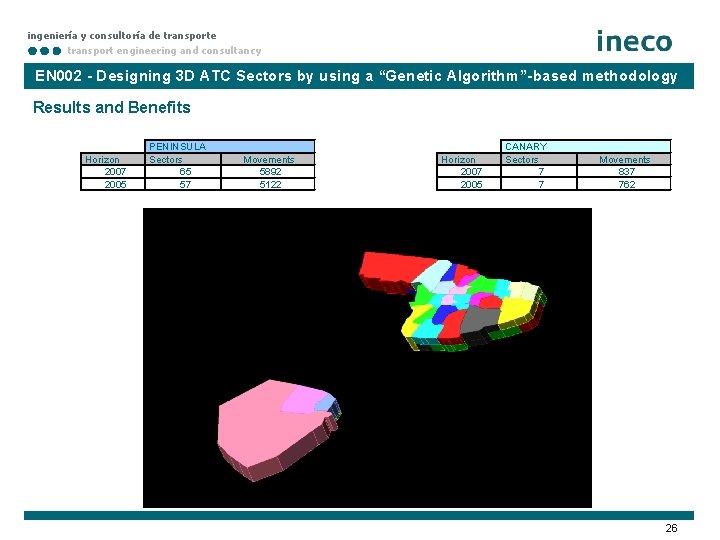
ingeniería y consultoría de transport engineering and consultancy EN 002 - Designing 3 D ATC Sectors by using a “Genetic Algorithm”-based methodology Results and Benefits Main benefits of this method could be classified according to the scope: Long term: to support new airspace organisation by indicating sector configuration that best fit the requirements of the demand. As an example of this capability, this algorithm was exploited in the Spanish Single Sky project a R+D initiative which aims to optimise the available resources of the Air Navigation System, by a new organisation of the Airspace Structure (routes and sectors), to best fit the forecast demand (2005 and 2007 time horizons) according to safety, environment, capacity and efficiency criteria. Short term: to produce homogeneous alternatives to current proposals for sector configurations modification beyond the local ATC experience. In this sense, this algorithm is being used to support several projects for TMA airspace re-organisation in Spain. 24
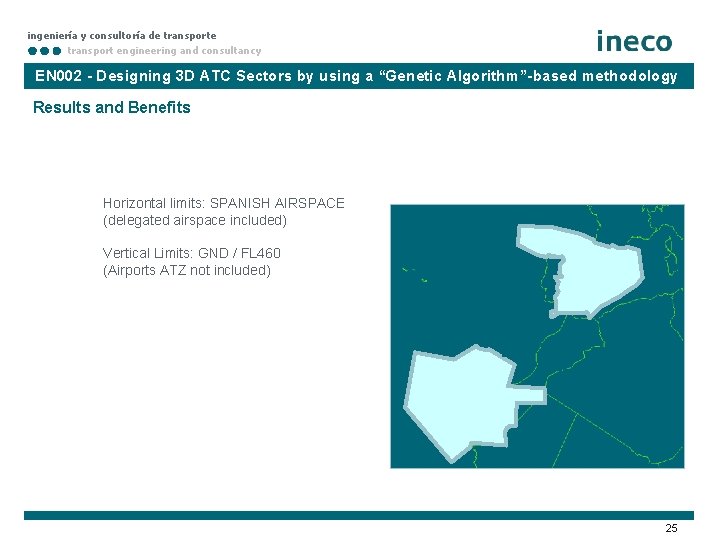
ingeniería y consultoría de transport engineering and consultancy EN 002 - Designing 3 D ATC Sectors by using a “Genetic Algorithm”-based methodology Results and Benefits Horizontal limits: SPANISH AIRSPACE (delegated airspace included) Vertical Limits: GND / FL 460 (Airports ATZ not included) 25
ingeniería y consultoría de transport engineering and consultancy EN 002 - Designing 3 D ATC Sectors by using a “Genetic Algorithm”-based methodology Results and Benefits Horizon 2007 2005 PENINSULA Sectors 65 57 Movements 5892 5122 Horizon 2007 2005 CANARY Sectors 7 7 Movements 837 762 26
EN 011 – Airspace Design using a Workload Node-based GA Xavier Ruiz-Hernández
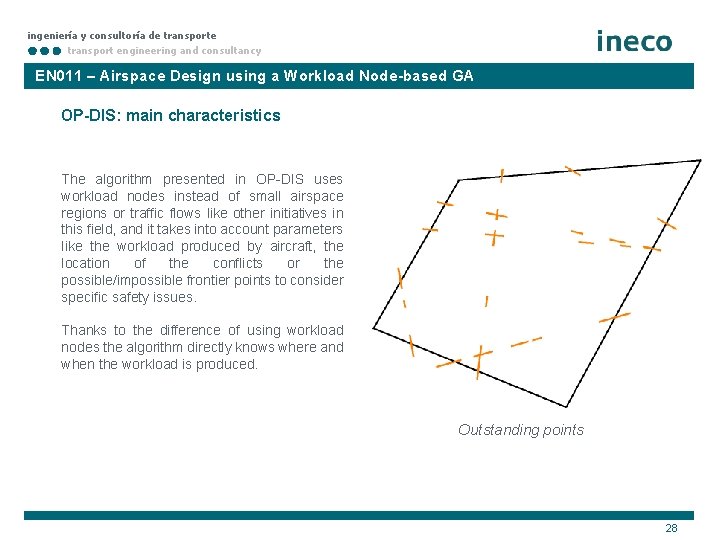
ingeniería y consultoría de transport engineering and consultancy EN 011 – Airspace Design using a Workload Node-based GA OP-DIS: main characteristics The algorithm presented in OP-DIS uses workload nodes instead of small airspace regions or traffic flows like other initiatives in this field, and it takes into account parameters like the workload produced by aircraft, the location of the conflicts or the possible/impossible frontier points to consider specific safety issues. Thanks to the difference of using workload nodes the algorithm directly knows where and when the workload is produced. Outstanding points 28
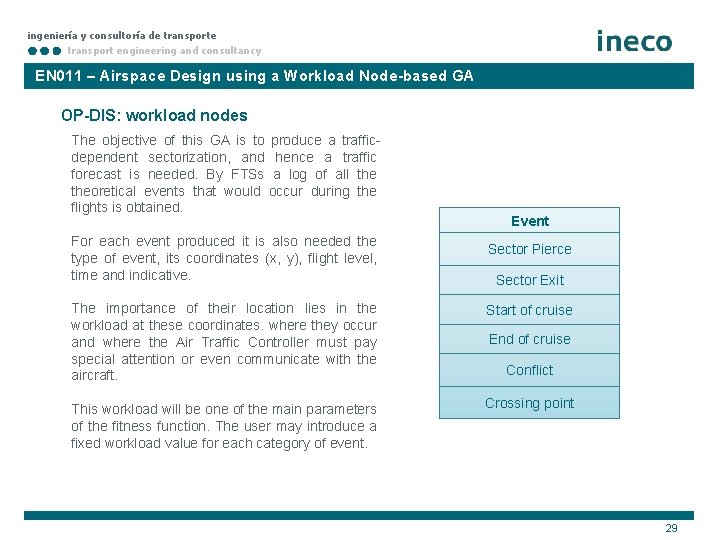
ingeniería y consultoría de transport engineering and consultancy EN 011 – Airspace Design using a Workload Node-based GA OP-DIS: workload nodes The objective of this GA is to produce a trafficdependent sectorization, and hence a traffic forecast is needed. By FTSs a log of all theoretical events that would occur during the flights is obtained. For each event produced it is also needed the type of event, its coordinates (x, y), flight level, time and indicative. Event Sector Pierce Sector Exit The importance of their location lies in the workload at these coordinates. where they occur and where the Air Traffic Controller must pay special attention or even communicate with the aircraft. Start of cruise This workload will be one of the main parameters of the fitness function. The user may introduce a fixed workload value for each category of event. Crossing point End of cruise Conflict 29
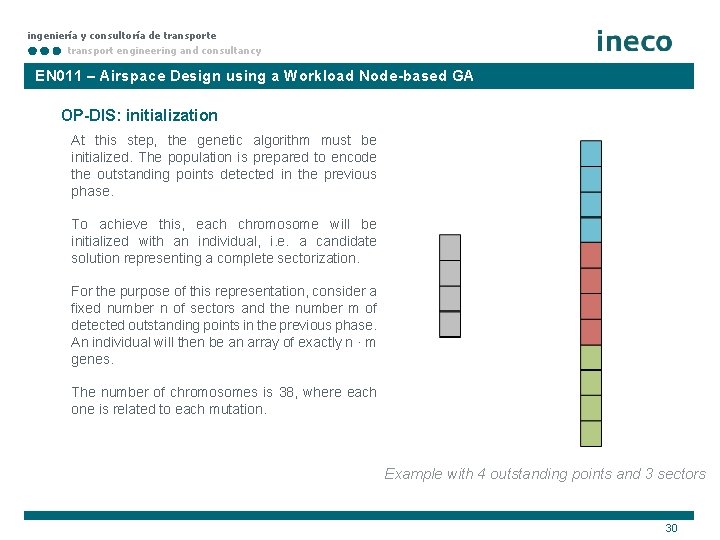
ingeniería y consultoría de transport engineering and consultancy EN 011 – Airspace Design using a Workload Node-based GA OP-DIS: initialization At this step, the genetic algorithm must be initialized. The population is prepared to encode the outstanding points detected in the previous phase. To achieve this, each chromosome will be initialized with an individual, i. e. a candidate solution representing a complete sectorization. For the purpose of this representation, consider a fixed number n of sectors and the number m of detected outstanding points in the previous phase. An individual will then be an array of exactly n · m genes. The number of chromosomes is 38, where each one is related to each mutation. Example with 4 outstanding points and 3 sectors 30
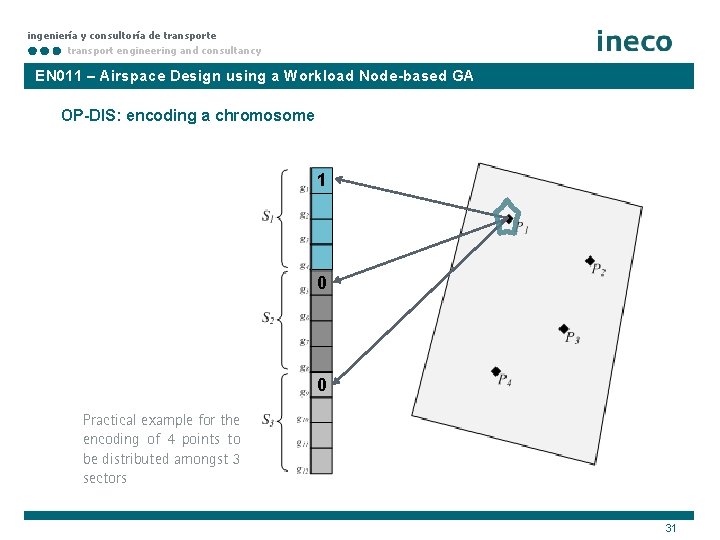
ingeniería y consultoría de transport engineering and consultancy EN 011 – Airspace Design using a Workload Node-based GA OP-DIS: encoding a chromosome 1 0 0 Practical example for the encoding of 4 points to be distributed amongst 3 sectors 31
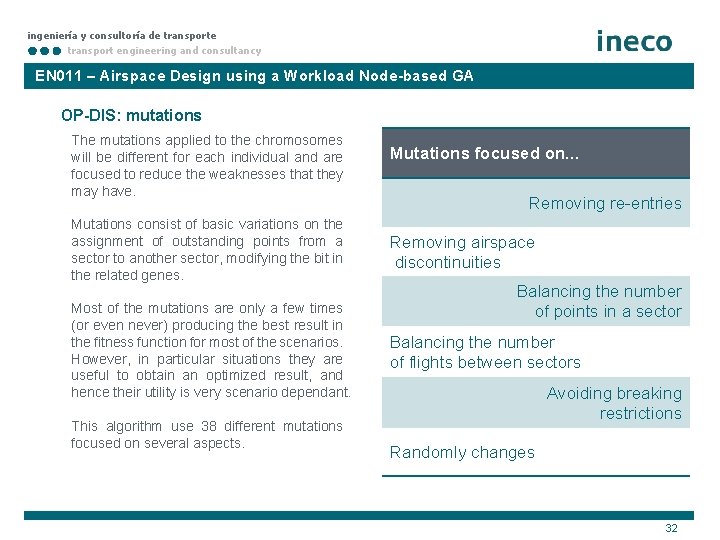
ingeniería y consultoría de transport engineering and consultancy EN 011 – Airspace Design using a Workload Node-based GA OP-DIS: mutations The mutations applied to the chromosomes will be different for each individual and are focused to reduce the weaknesses that they may have. Mutations focused on… Removing re-entries Mutations consist of basic variations on the assignment of outstanding points from a sector to another sector, modifying the bit in the related genes. Removing airspace discontinuities Most of the mutations are only a few times (or even never) producing the best result in the fitness function for most of the scenarios. However, in particular situations they are useful to obtain an optimized result, and hence their utility is very scenario dependant. Balancing the number of flights between sectors This algorithm use 38 different mutations focused on several aspects. Balancing the number of points in a sector Avoiding breaking restrictions Randomly changes 32
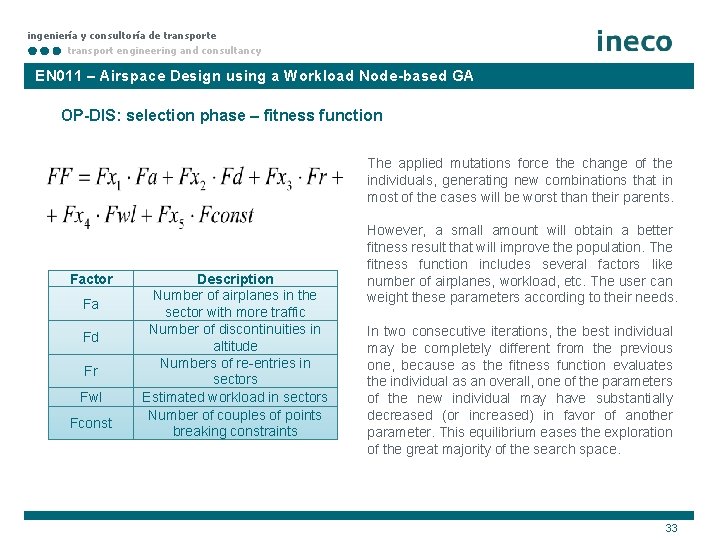
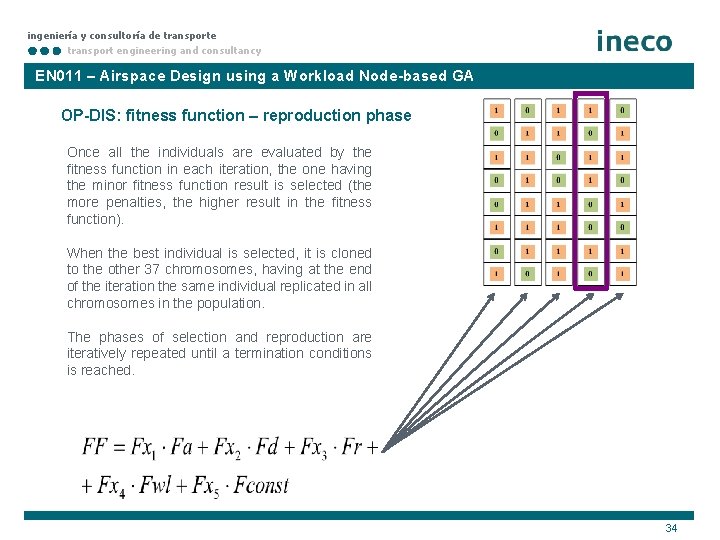
ingeniería y consultoría de transport engineering and consultancy EN 011 – Airspace Design using a Workload Node-based GA OP-DIS: selection phase – fitness function The applied mutations force the change of the individuals, generating new combinations that in most of the cases will be worst than their parents. Factor Fa Fd Fr Fwl Fconst Description Number of airplanes in the sector with more traffic Number of discontinuities in altitude Numbers of re-entries in sectors Estimated workload in sectors Number of couples of points breaking constraints However, a small amount will obtain a better fitness result that will improve the population. The fitness function includes several factors like number of airplanes, workload, etc. The user can weight these parameters according to their needs. In two consecutive iterations, the best individual may be completely different from the previous one, because as the fitness function evaluates the individual as an overall, one of the parameters of the new individual may have substantially decreased (or increased) in favor of another parameter. This equilibrium eases the exploration of the great majority of the search space. 33
ingeniería y consultoría de transport engineering and consultancy EN 011 – Airspace Design using a Workload Node-based GA OP-DIS: fitness function – reproduction phase Once all the individuals are evaluated by the fitness function in each iteration, the one having the minor fitness function result is selected (the more penalties, the higher result in the fitness function). When the best individual is selected, it is cloned to the other 37 chromosomes, having at the end of the iteration the same individual replicated in all chromosomes in the population. The phases of selection and reproduction are iteratively repeated until a termination conditions is reached. 34
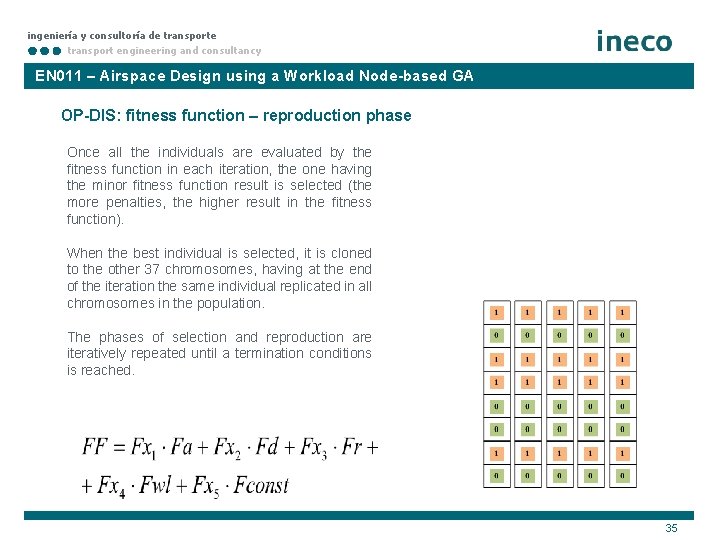
ingeniería y consultoría de transport engineering and consultancy EN 011 – Airspace Design using a Workload Node-based GA OP-DIS: fitness function – reproduction phase Once all the individuals are evaluated by the fitness function in each iteration, the one having the minor fitness function result is selected (the more penalties, the higher result in the fitness function). When the best individual is selected, it is cloned to the other 37 chromosomes, having at the end of the iteration the same individual replicated in all chromosomes in the population. The phases of selection and reproduction are iteratively repeated until a termination conditions is reached. 35
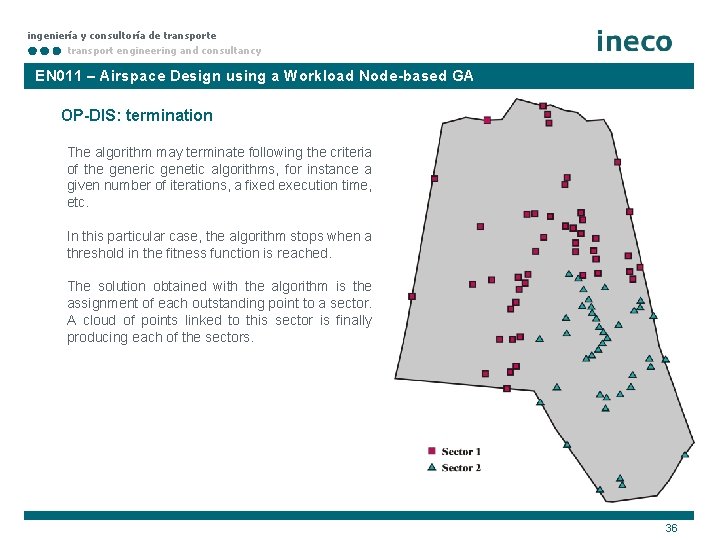
ingeniería y consultoría de transport engineering and consultancy EN 011 – Airspace Design using a Workload Node-based GA OP-DIS: termination The algorithm may terminate following the criteria of the generic genetic algorithms, for instance a given number of iterations, a fixed execution time, etc. In this particular case, the algorithm stops when a threshold in the fitness function is reached. The solution obtained with the algorithm is the assignment of each outstanding point to a sector. A cloud of points linked to this sector is finally producing each of the sectors. 36
ingeniería y consultoría de transport engineering and consultancy EN 011 – Airspace Design using a Workload Node-based GA OP-DIS: evolution and future steps • Clouds of points vs closed polygons: loose of precision • Improvement of mutations • Analysis of random mutations and initialization • Usability of an obtained proposal: training ATCo period 37
ingeniería y consultoría de transport engineering and consultancy Two approaches to airspace design using Genetic Algorithms Conclusions Both approaches, based on GAs, have proven successful in medium-term planning phase and great airspace volumes, being able to take into account: “Demand Capacity Balance” issues by means of balancing Workload and Human Resources parameters Solutions must fix to flight trajectories (nowadays concept (fixed route structure) or SESAR concept (e. g. user-preferred trajectories)) Military reservations (e. g. VGA – Variable Geometry Area) Traffic demand variability by offering new and quick Dynamic Sectorisations (OP-DIS capability). 38
ingeniería y consultoría de transport engineering and consultancy Two approaches to airspace design using Genetic Algorithms Thank you very much for your attention! 貴重なお時間を大変ありがとうございました。 39
ingeniería y consultoría de transport engineering and consultancy Two approaches to airspace design using Genetic Algorithms Who we are INECO Ingeniería y Economía del Transporte, S. A. Avenida del Partenón 4, 4 th floor 28042 – Madrid Spain http: //www. ineco. es Our work EN-002 Designing 3 D ATC Sectors by using a “Genetic Algorithm”-based methodology José Manuel Rísquez jrisquez@ineco. es Contributors Víctor Bustos vbustos@ineco. es EN-011 Airspace Design using a Workload Node-based GA Xavier Ruiz Hernández xavier. ruiz@ineco. es Fernando Gómez Comendador fgomez@ineco. es 40