
Twister 2 Design of a Big Data Toolkit
Twister 2: Design of a Big Data Toolkit Supun Kamburugamuve, Kannan Govindarajan, Pulasthi Wickramasinghe, Vibhatha Abeykon, Geoffrey Fox Digital Science` Center Indiana University Bloomington skamburu@indiana. edu, Exa. MPI 2017 1
Motivation • Use of public clouds increasing rapidly • Edge computing adding another dimension • Clouds becoming diverse with subsystems containing GPU’s, FPGA’s, high performance networks, storage, memory • Rich software stacks • HPC (High Performance Computing) for Parallel Computing • Apache for Big Data Software Stack ABDS – much more popular than HPC • Big data systems are characterized by • Low-performance • High-usability • Event driven computing model is becoming mainstream • HPC – Asynchronous many task systems (AMT) • All major big data frameworks • Services in the form of Function as a Service (Faa. S) 2
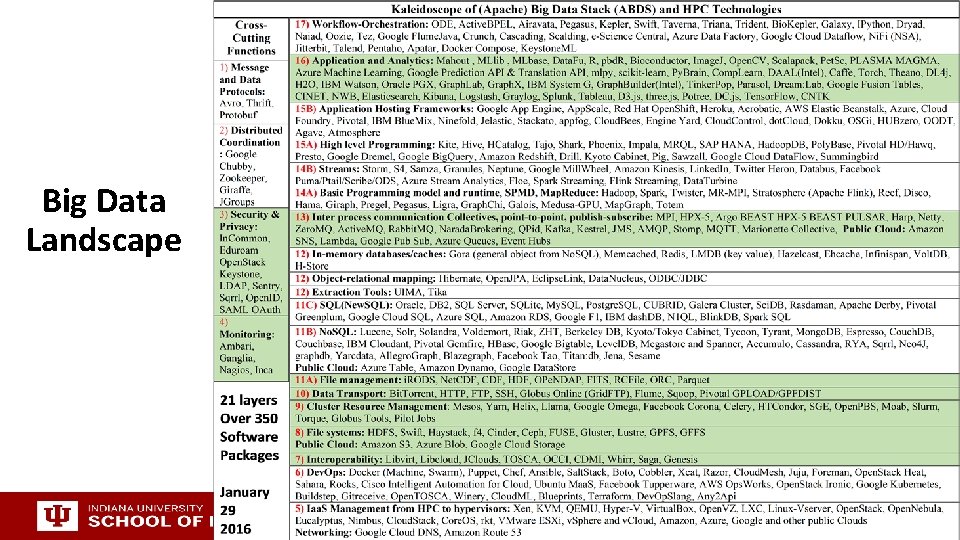
Big Data Landscape 3
Comparing Spark Flink and MPI • On Global Machine Learning GML. • Note Spark and Flink are successful on LML not GML and currently LML is more common than GML 4
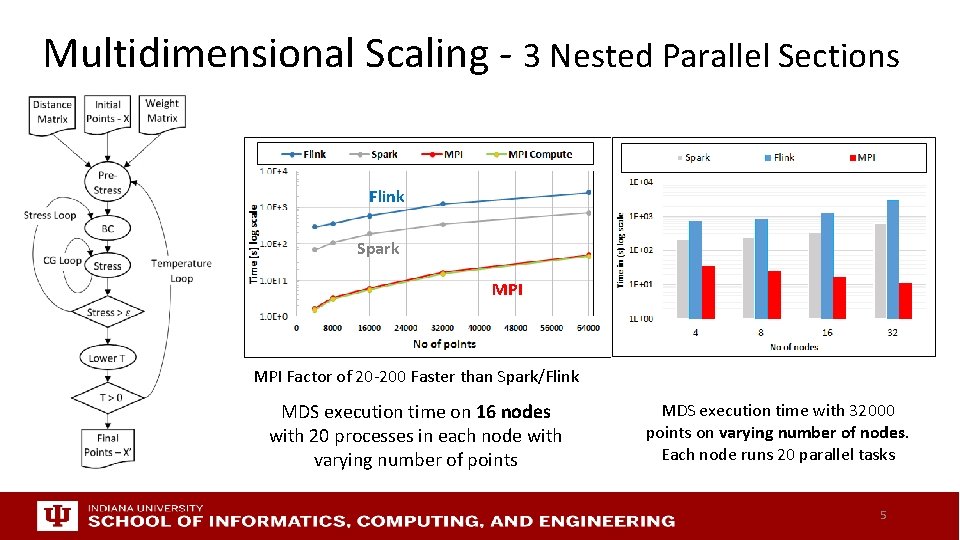
Multidimensional Scaling - 3 Nested Parallel Sections Flink Spark MPI Factor of 20 -200 Faster than Spark/Flink MDS execution time on 16 nodes with 20 processes in each node with varying number of points MDS execution time with 32000 points on varying number of nodes. Each node runs 20 parallel tasks 5
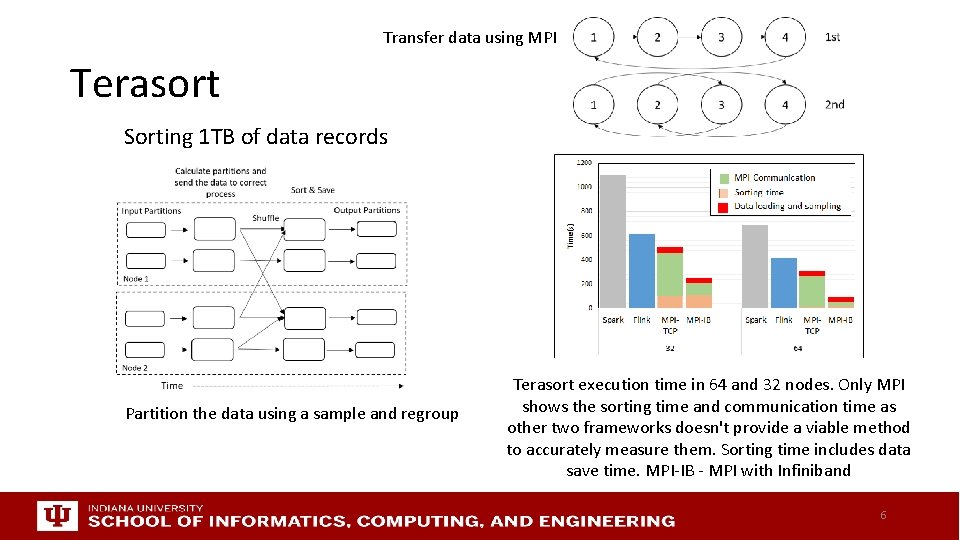
Transfer data using MPI Terasort Sorting 1 TB of data records Partition the data using a sample and regroup Terasort execution time in 64 and 32 nodes. Only MPI shows the sorting time and communication time as other two frameworks doesn't provide a viable method to accurately measure them. Sorting time includes data save time. MPI-IB - MPI with Infiniband 6
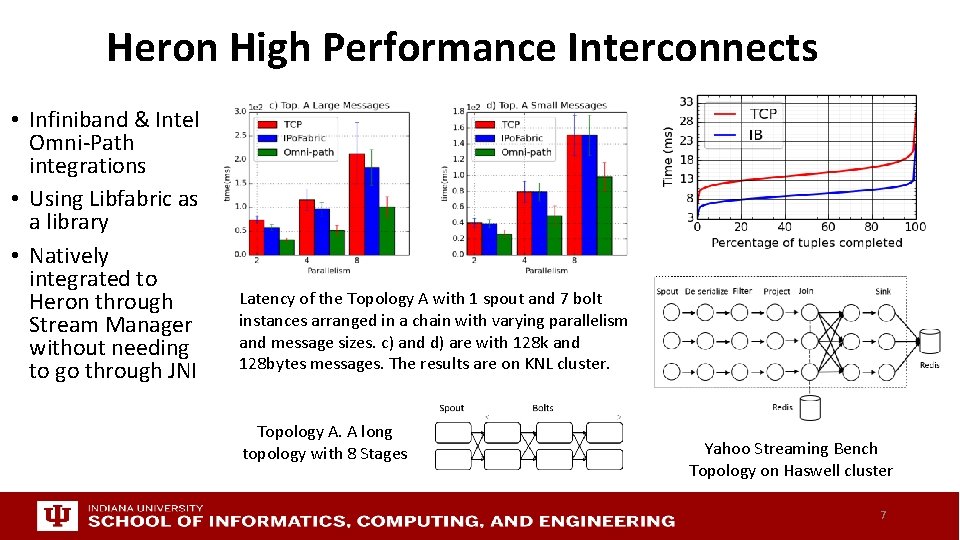
Heron High Performance Interconnects • Infiniband & Intel Omni-Path integrations • Using Libfabric as a library • Natively integrated to Heron through Stream Manager without needing to go through JNI Latency of the Topology A with 1 spout and 7 bolt instances arranged in a chain with varying parallelism and message sizes. c) and d) are with 128 k and 128 bytes messages. The results are on KNL cluster. Topology A. A long topology with 8 Stages Yahoo Streaming Bench Topology on Haswell cluster 7
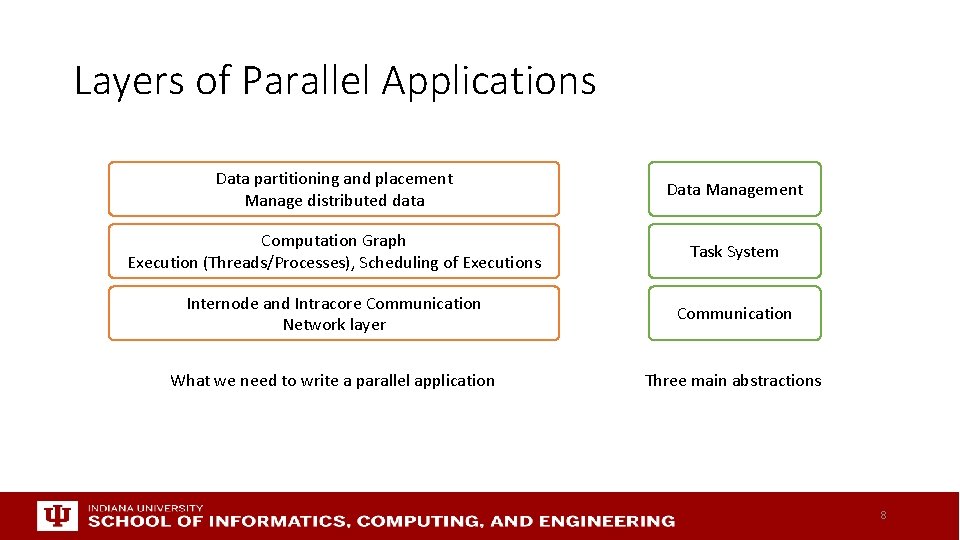
Layers of Parallel Applications Data partitioning and placement Manage distributed data Data Management Computation Graph Execution (Threads/Processes), Scheduling of Executions Task System Internode and Intracore Communication Network layer Communication What we need to write a parallel application Three main abstractions 8
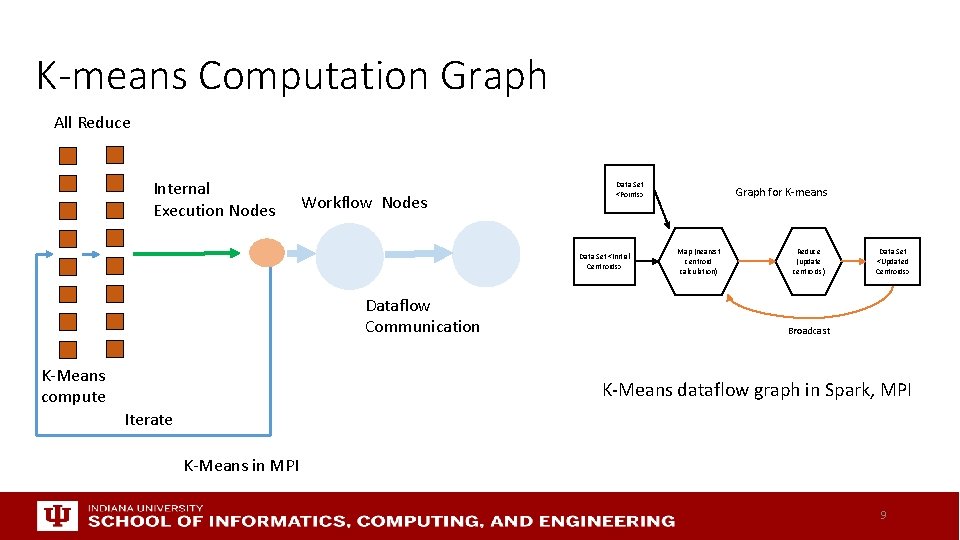
K-means Computation Graph All Reduce Internal Execution Nodes Workflow Nodes Data Set <Points> Data Set <Initial Centroids> Dataflow Communication K-Means compute Graph for K-means Map (nearest centroid calculation) Reduce (update centroids) Data Set <Updated Centroids> Broadcast K-Means dataflow graph in Spark, MPI Iterate K-Means in MPI 9
Apache Big data Systems • Top down designs targeting one type of applications • Users want to use them for every type of application • Monolithic designs with fixed choices • Harder to change • Low performance • Software engineering • Not targeting advanced hardware • Only high level APIs/abstractions available • Harder for an advanced user to optimize an application 10
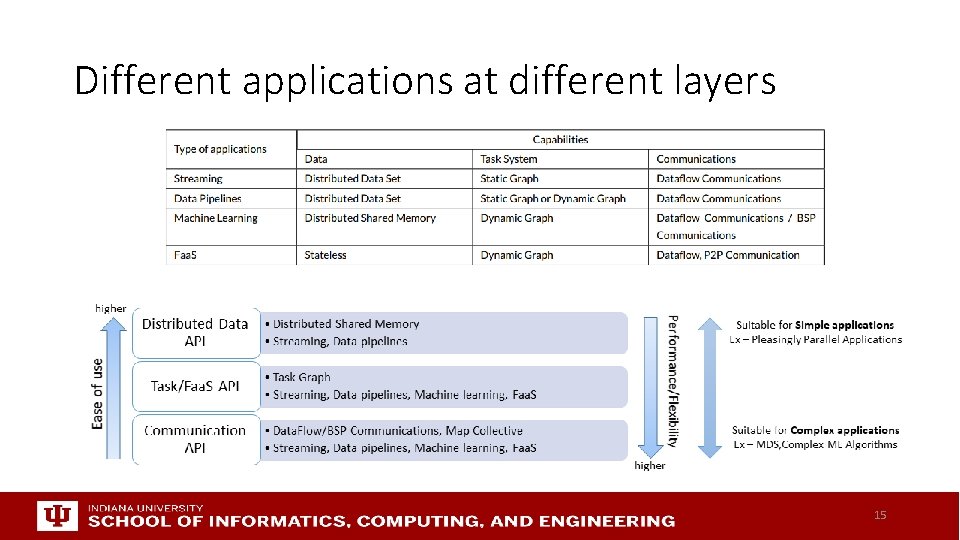
Requirements • Large scale simulation requirements are well understood • We identify 4 types of applications • • Data pipelines Streaming Machine learning Function as a Service • Big Data requirements are not clear but there a few key use types 1) Pleasingly parallel processing (including local machine learning LML) as of different tweets from different users with perhaps Map. Reduce style of statistics and visualizations; possibly Streaming 2) Database model with queries again supported by Map. Reduce for horizontal scaling 3) Global Machine Learning GML with single job using multiple nodes as classic parallel computing 4) Deep Learning certainly needs HPC 11
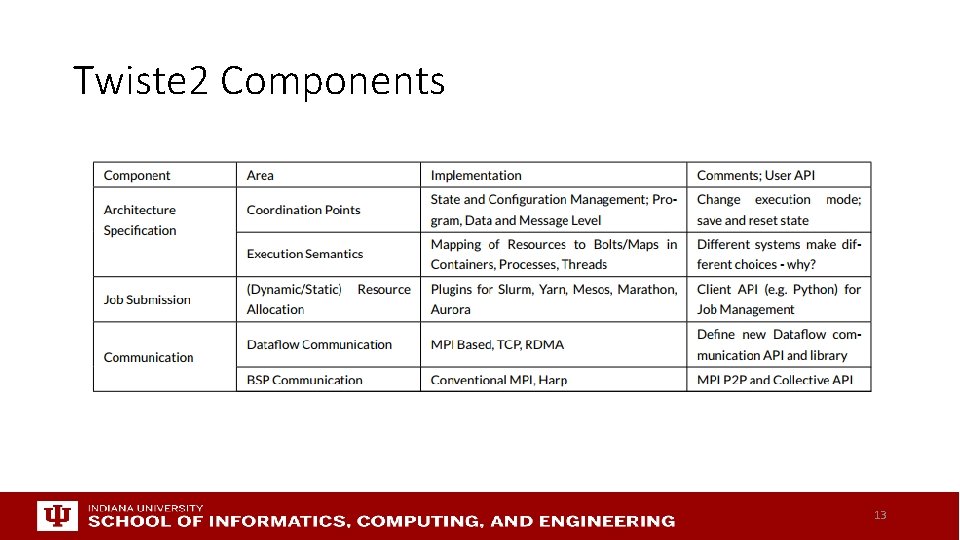
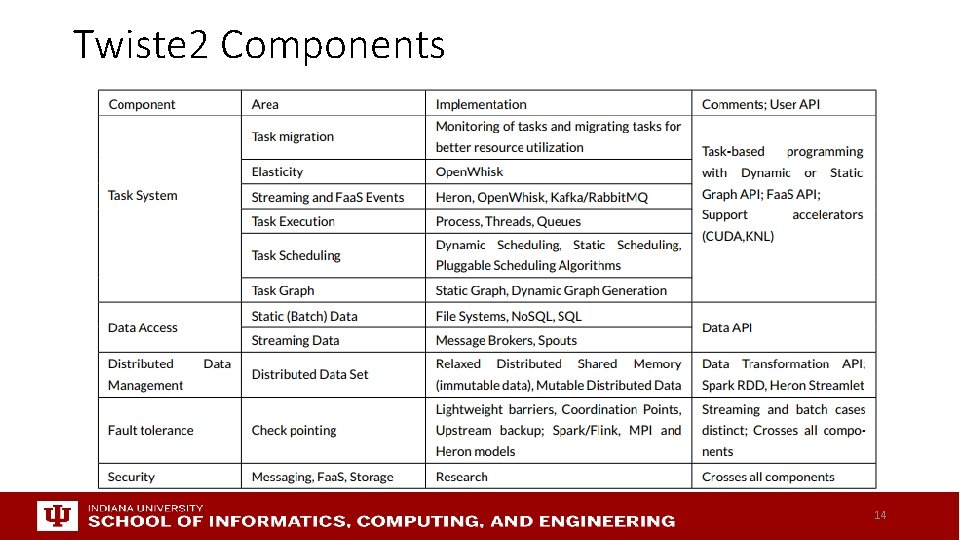
Twiste 2 Approach • Clearly define functional layers • Develop base layers as independent components • Use interoperable common abstractions but multiple polymorphic implementations. • Allow users to pick and choose according to requirements • Communication + Data Management • Communication + Static graph • Use HPC features when possible 12
Twiste 2 Components 13
Twiste 2 Components 14
Different applications at different layers 15
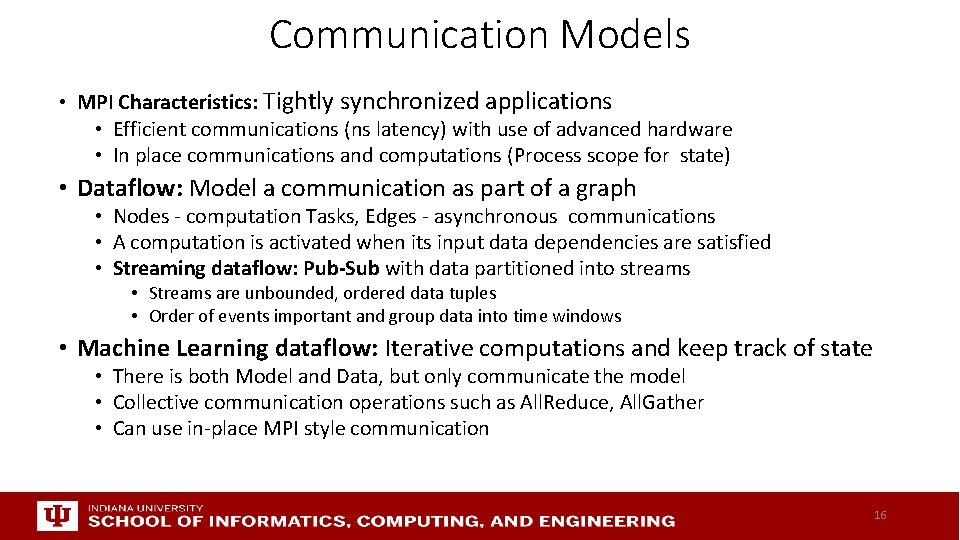
Communication Models • MPI Characteristics: Tightly synchronized applications • Efficient communications (ns latency) with use of advanced hardware • In place communications and computations (Process scope for state) • Dataflow: Model a communication as part of a graph • Nodes - computation Tasks, Edges - asynchronous communications • A computation is activated when its input data dependencies are satisfied • Streaming dataflow: Pub-Sub with data partitioned into streams • Streams are unbounded, ordered data tuples • Order of events important and group data into time windows • Machine Learning dataflow: Iterative computations and keep track of state • There is both Model and Data, but only communicate the model • Collective communication operations such as All. Reduce, All. Gather • Can use in-place MPI style communication 16
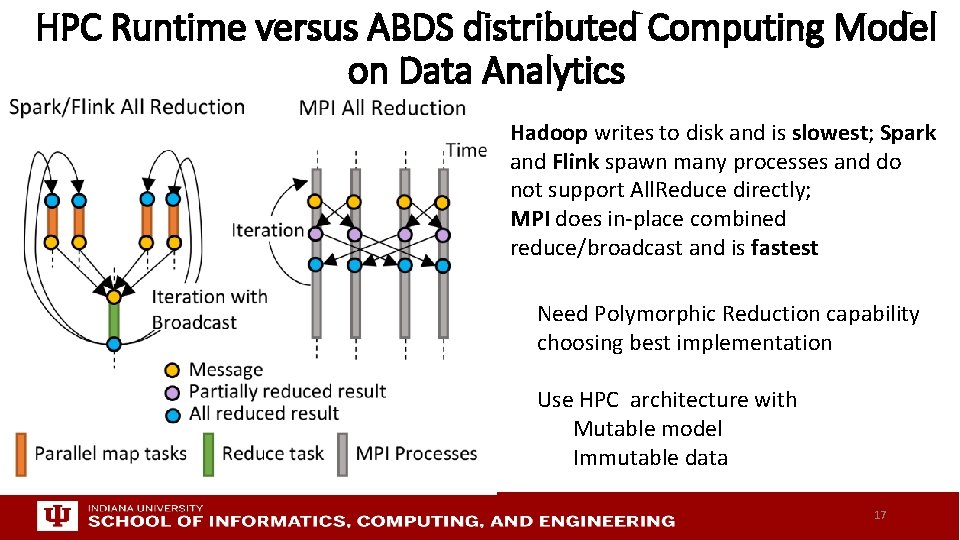
HPC Runtime versus ABDS distributed Computing Model on Data Analytics Hadoop writes to disk and is slowest; Spark and Flink spawn many processes and do not support All. Reduce directly; MPI does in-place combined reduce/broadcast and is fastest Need Polymorphic Reduction capability choosing best implementation Use HPC architecture with Mutable model Immutable data 17
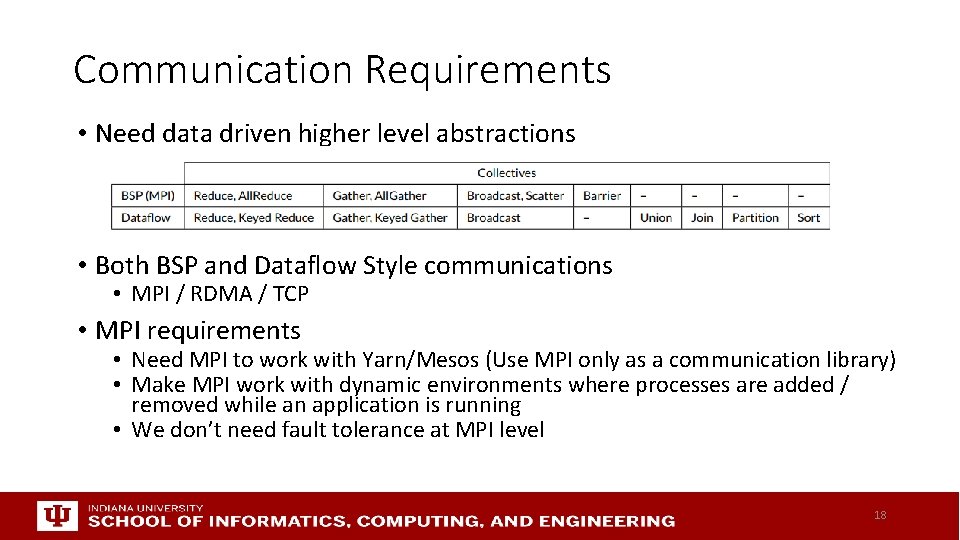
Communication Requirements • Need data driven higher level abstractions • Both BSP and Dataflow Style communications • MPI / RDMA / TCP • MPI requirements • Need MPI to work with Yarn/Mesos (Use MPI only as a communication library) • Make MPI work with dynamic environments where processes are added / removed while an application is running • We don’t need fault tolerance at MPI level 18
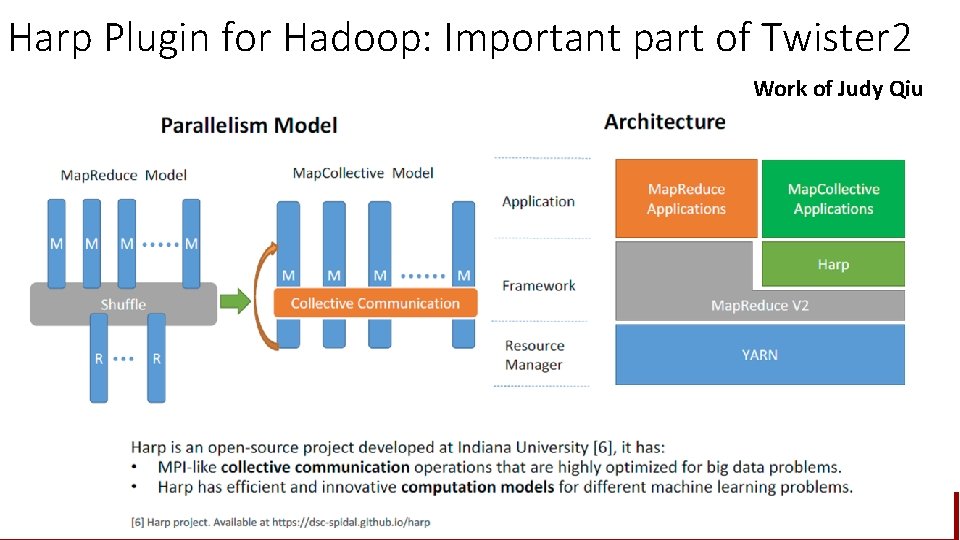
Harp Plugin for Hadoop: Important part of Twister 2 Work of Judy Qiu 10/16/2021 19
Task System • Generate computation graph dynamically • Dynamic scheduling of tasks • Allow fine grained control of the graph • Generate computation graph statically • Dynamic or static scheduling • Suitable for streaming and data query applications • Hard to express complex computations, especially with loops • Hybrid approach • Combine both static and dynamic graphs 10/16/2021 20
Summary of Twister 2: Next Generation HPC Cloud + Edge + Grid • We suggest an event driven computing model built around Cloud and HPC and spanning batch, streaming, and edge applications • Highly parallel on cloud; possibly sequential at the edge • We have built a high performance data analysis library SPIDAL • We have integrated HPC into many Apache systems with HPC-ABDS • We have done a preliminary analysis of the different runtimes of Hadoop, Spark, Flink, Storm, Heron, Naiad, DARMA (HPC Asynchronous Many Task) • There are different technologies for different circumstances but can be unified by high level abstractions such as communication collectives • Obviously MPI best for parallel computing (by definition) • Apache systems use dataflow communication which is natural for them • No standard dataflow library (why? ). Add Dataflow primitives in MPI-4? • MPI could adopt some of tools of Big Data as in Coordination Points (dataflow nodes), State management with RDD (datasets) 21
- Slides: 21