
Twister 2 Design and initial implementation of a

- Slides: 51
Twister 2: Design and initial implementation of a Big Data Toolkit 4 th International Winter School on Big Data Timişoara, Romania, January 22 -26, 2018 http: //grammars. grlmc. com/Big. Dat 2018/ January 25, 2018 Geoffrey Fox gcf@indiana. edu http: //www. dsc. soic. indiana. edu/, http: //spidal. org/ http: //hpc-abds. org/kaleidoscope/ Department of Intelligent Systems Engineering School of Informatics and Computing, Digital Science Center Indiana University Bloomington 1
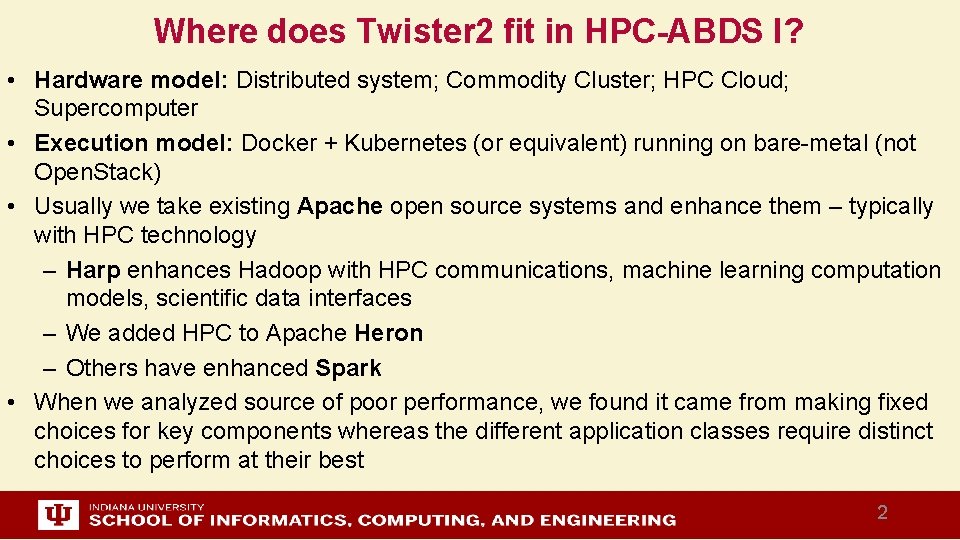
Where does Twister 2 fit in HPC-ABDS I? • Hardware model: Distributed system; Commodity Cluster; HPC Cloud; Supercomputer • Execution model: Docker + Kubernetes (or equivalent) running on bare-metal (not Open. Stack) • Usually we take existing Apache open source systems and enhance them – typically with HPC technology – Harp enhances Hadoop with HPC communications, machine learning computation models, scientific data interfaces – We added HPC to Apache Heron – Others have enhanced Spark • When we analyzed source of poor performance, we found it came from making fixed choices for key components whereas the different application classes require distinct choices to perform at their best 2
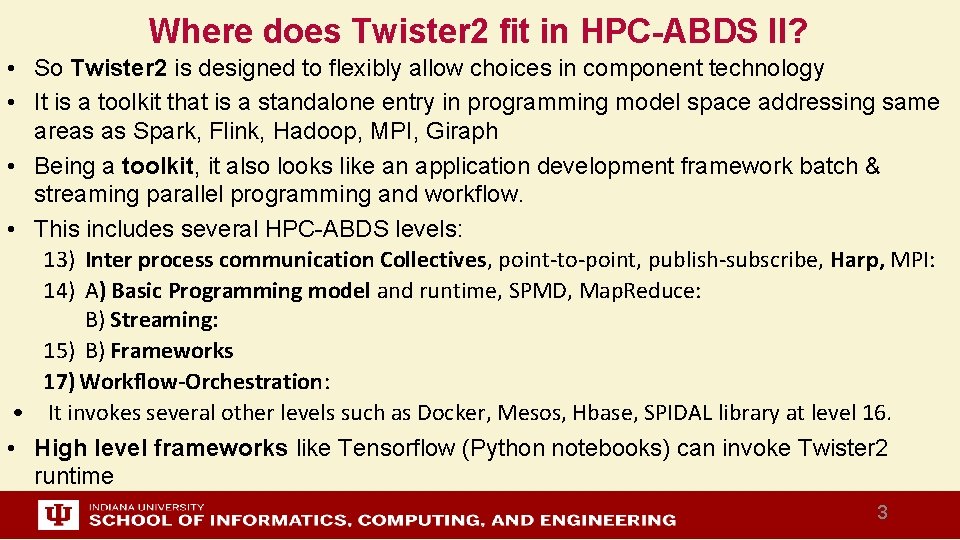
Where does Twister 2 fit in HPC-ABDS II? • So Twister 2 is designed to flexibly allow choices in component technology • It is a toolkit that is a standalone entry in programming model space addressing same areas as Spark, Flink, Hadoop, MPI, Giraph • Being a toolkit, it also looks like an application development framework batch & streaming parallel programming and workflow. • This includes several HPC-ABDS levels: 13) Inter process communication Collectives, point-to-point, publish-subscribe, Harp, MPI: 14) A) Basic Programming model and runtime, SPMD, Map. Reduce: B) Streaming: 15) B) Frameworks 17) Workflow-Orchestration: • It invokes several other levels such as Docker, Mesos, Hbase, SPIDAL library at level 16. • High level frameworks like Tensorflow (Python notebooks) can invoke Twister 2 runtime 3
http: //www. iterativemapreduce. org/ Comparing Spark Flink and MPI: On Global Machine Learning. Note Spark and Flink are successful on Local Machine Learning – not Global Machine Learning Communication Model and its implementation matter! 4
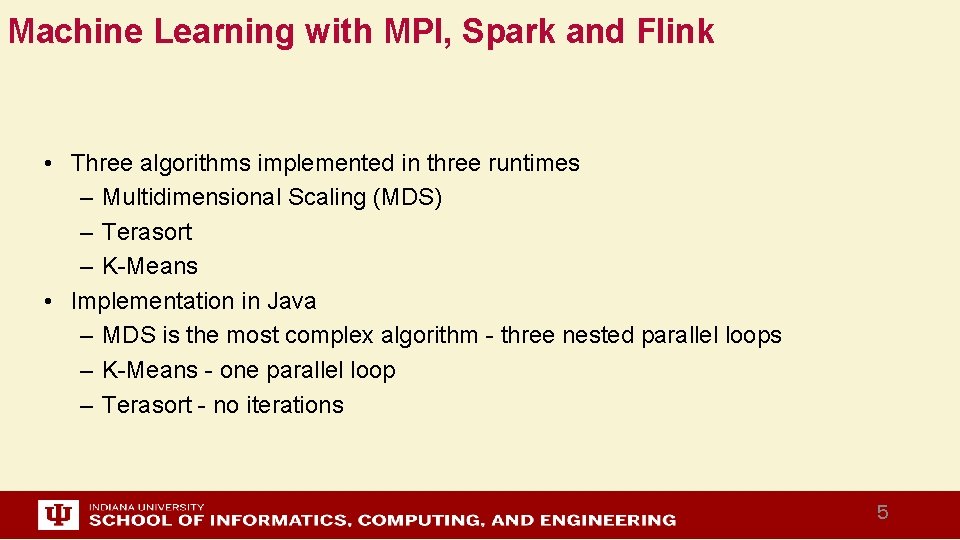
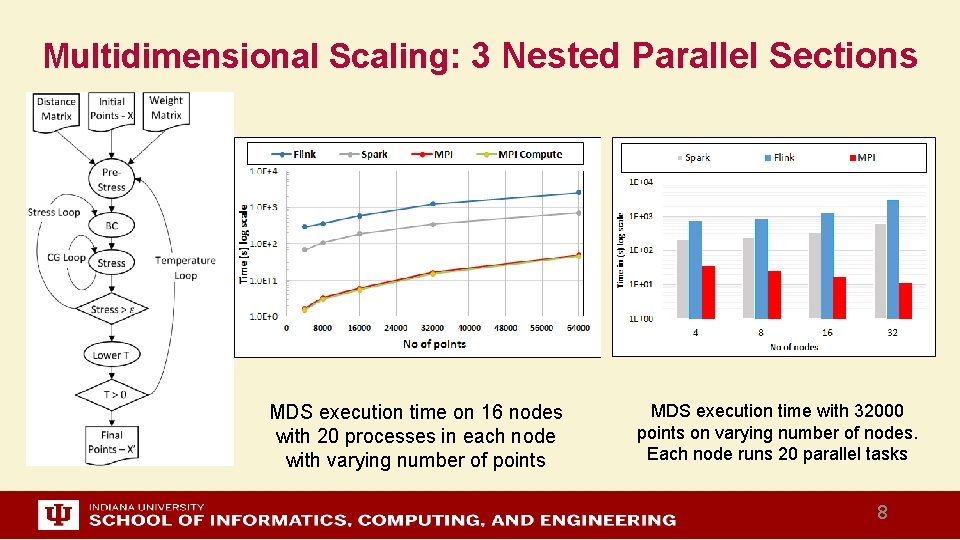
Machine Learning with MPI, Spark and Flink • Three algorithms implemented in three runtimes – Multidimensional Scaling (MDS) – Terasort – K-Means • Implementation in Java – MDS is the most complex algorithm - three nested parallel loops – K-Means - one parallel loop – Terasort - no iterations 5
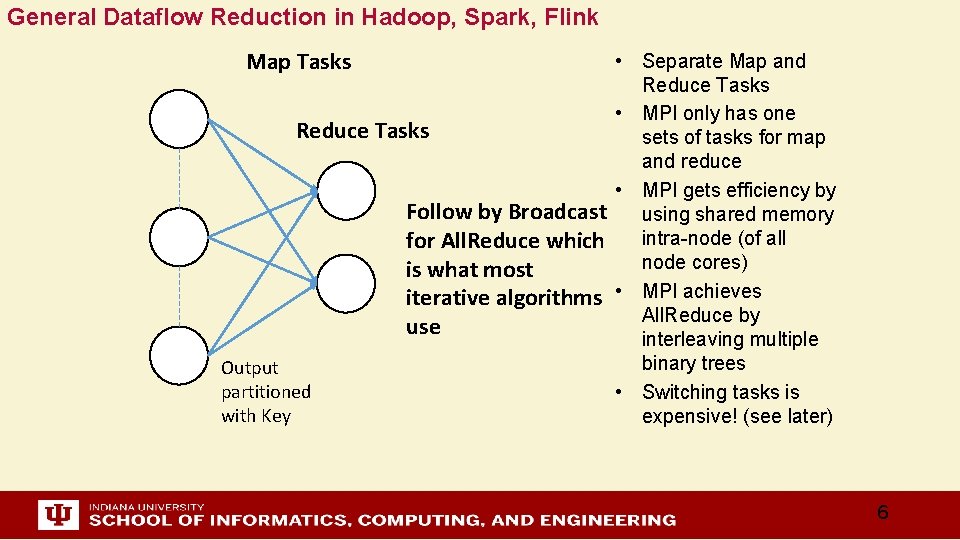
General Dataflow Reduction in Hadoop, Spark, Flink Map Tasks • Separate Map and Reduce Tasks • MPI only has one Reduce Tasks sets of tasks for map and reduce • MPI gets efficiency by Follow by Broadcast using shared memory intra-node (of all for All. Reduce which node cores) is what most iterative algorithms • MPI achieves All. Reduce by use interleaving multiple binary trees Output partitioned • Switching tasks is with Key expensive! (see later) 6
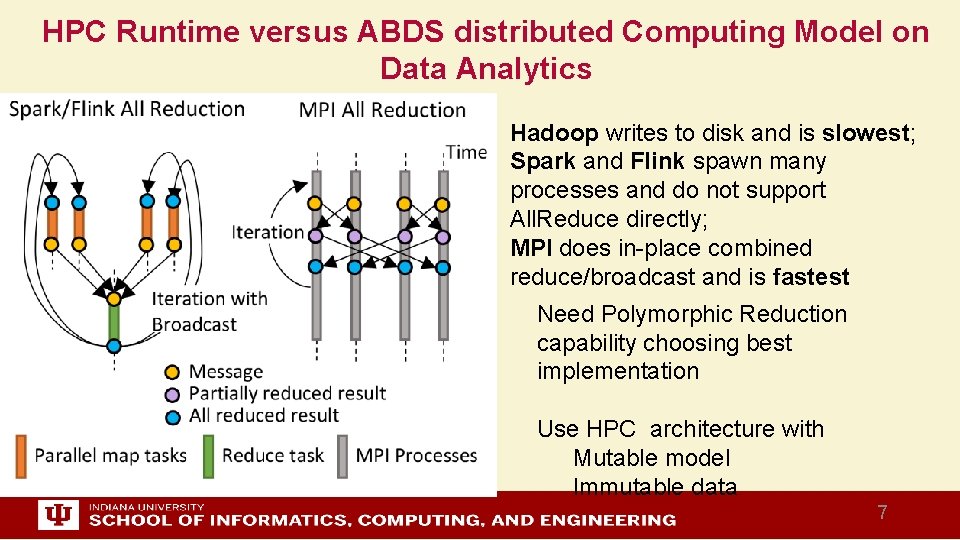
HPC Runtime versus ABDS distributed Computing Model on Data Analytics Hadoop writes to disk and is slowest; Spark and Flink spawn many processes and do not support All. Reduce directly; MPI does in-place combined reduce/broadcast and is fastest Need Polymorphic Reduction capability choosing best implementation Use HPC architecture with Mutable model Immutable data 7
Multidimensional Scaling: 3 Nested Parallel Sections MDS execution time on 16 nodes with 20 processes in each node with varying number of points MDS execution time with 32000 points on varying number of nodes. Each node runs 20 parallel tasks 8
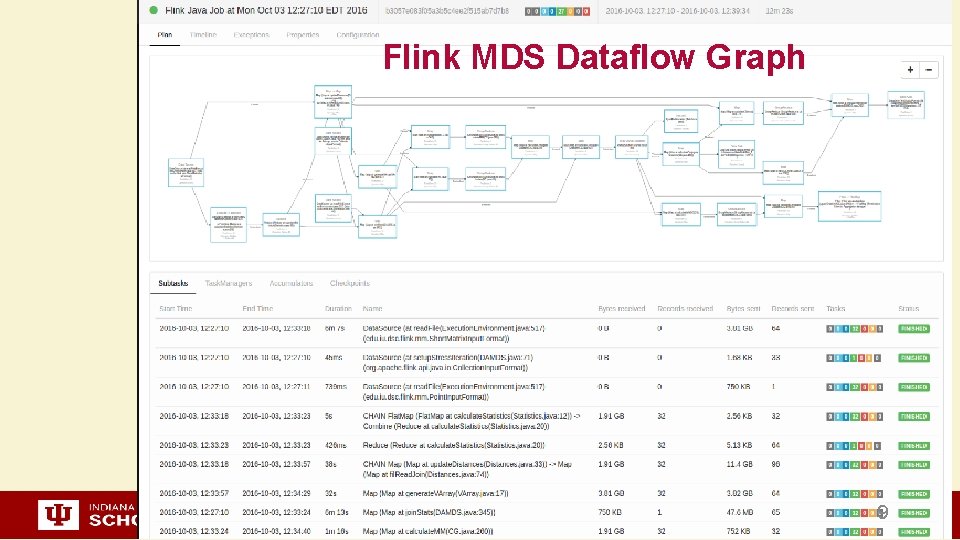
Flink MDS Dataflow Graph 9
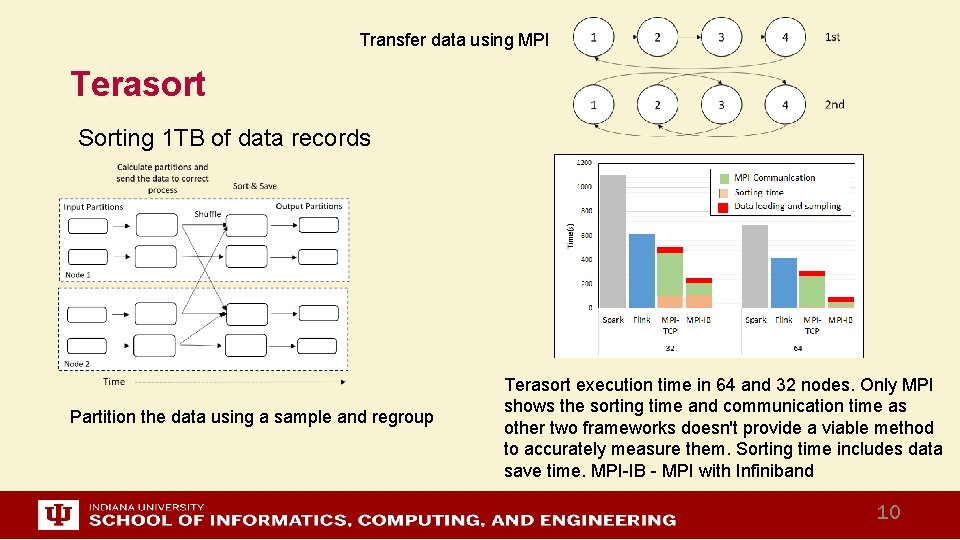
Transfer data using MPI Terasort Sorting 1 TB of data records Partition the data using a sample and regroup Terasort execution time in 64 and 32 nodes. Only MPI shows the sorting time and communication time as other two frameworks doesn't provide a viable method to accurately measure them. Sorting time includes data save time. MPI-IB - MPI with Infiniband 10
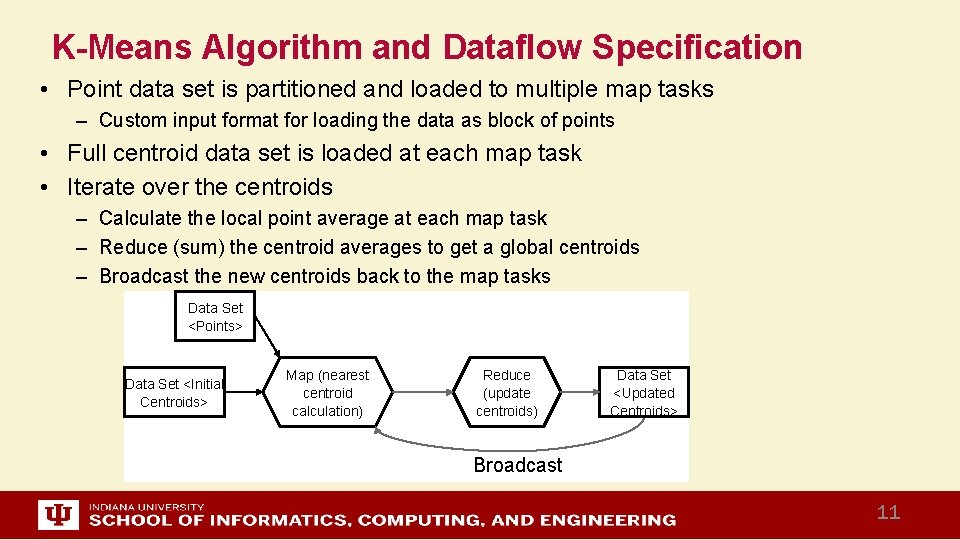
K-Means Algorithm and Dataflow Specification • Point data set is partitioned and loaded to multiple map tasks – Custom input format for loading the data as block of points • Full centroid data set is loaded at each map task • Iterate over the centroids – Calculate the local point average at each map task – Reduce (sum) the centroid averages to get a global centroids – Broadcast the new centroids back to the map tasks Data Set <Points> Data Set <Initial Centroids> Map (nearest centroid calculation) Reduce (update centroids) Data Set <Updated Centroids> Broadcast 11
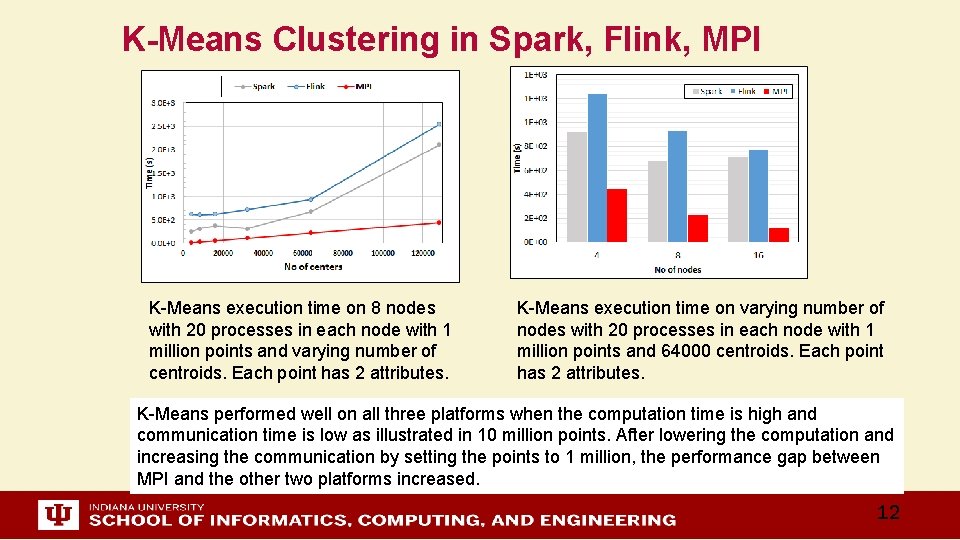
K-Means Clustering in Spark, Flink, MPI K-Means execution time on 8 nodes with 20 processes in each node with 1 million points and varying number of centroids. Each point has 2 attributes. K-Means execution time on varying number of nodes with 20 processes in each node with 1 million points and 64000 centroids. Each point has 2 attributes. K-Means performed well on all three platforms when the computation time is high and communication time is low as illustrated in 10 million points. After lowering the computation and increasing the communication by setting the points to 1 million, the performance gap between MPI and the other two platforms increased. 12
http: //www. iterativemapreduce. org/ Streaming Data and HPC Apache Heron with Infiniband Omnipath Parallel performance increased by using HPC interconnects 13
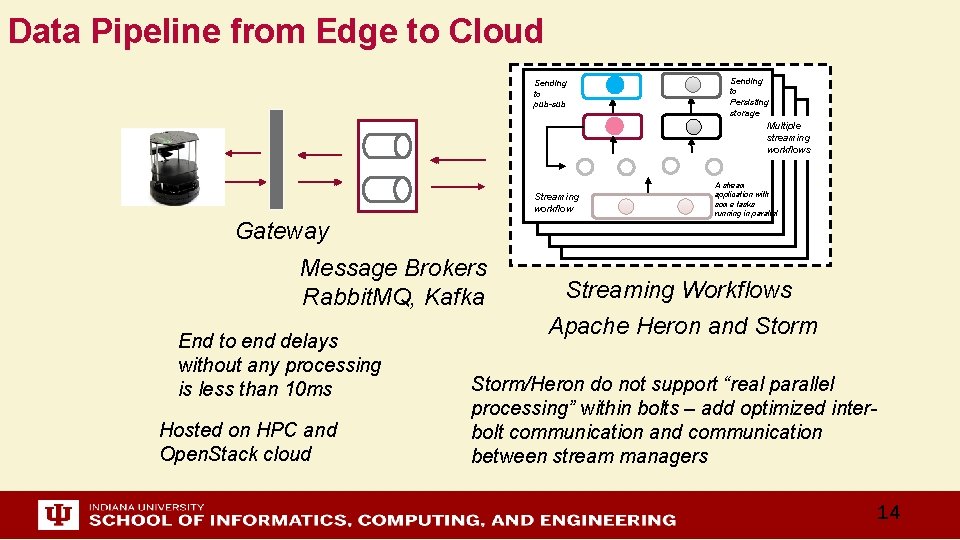
Data Pipeline from Edge to Cloud Sending to pub-sub Sending to Persisting storage Multiple streaming workflows Streaming workflow Gateway Message Brokers Rabbit. MQ, Kafka End to end delays without any processing is less than 10 ms Hosted on HPC and Open. Stack cloud A stream application with some tasks running in parallel Streaming Workflows Apache Heron and Storm/Heron do not support “real parallel processing” within bolts – add optimized interbolt communication and communication between stream managers 14
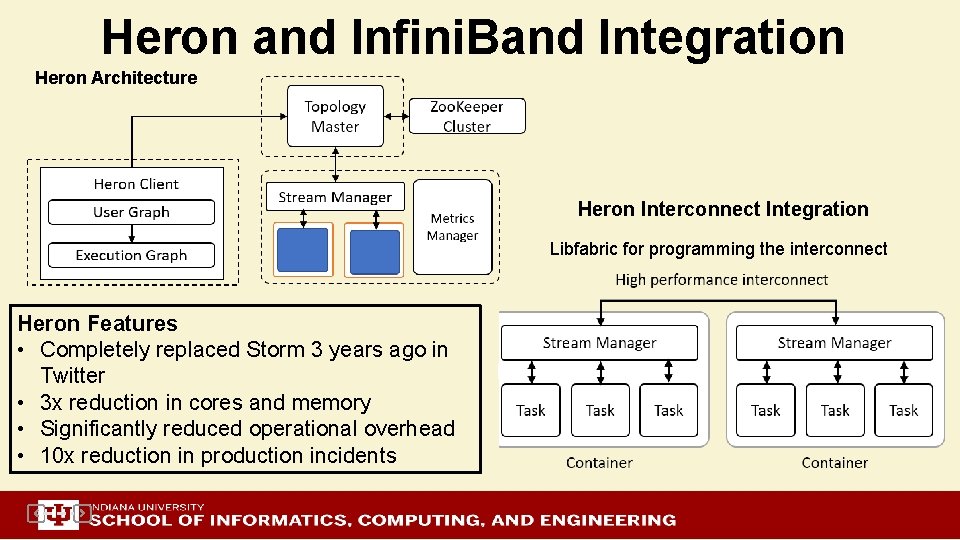
Heron and Infini. Band Integration Heron Architecture Heron Interconnect Integration Libfabric for programming the interconnect Heron Features • Completely replaced Storm 3 years ago in Twitter • 3 x reduction in cores and memory • Significantly reduced operational overhead • 10 x reduction in production incidents
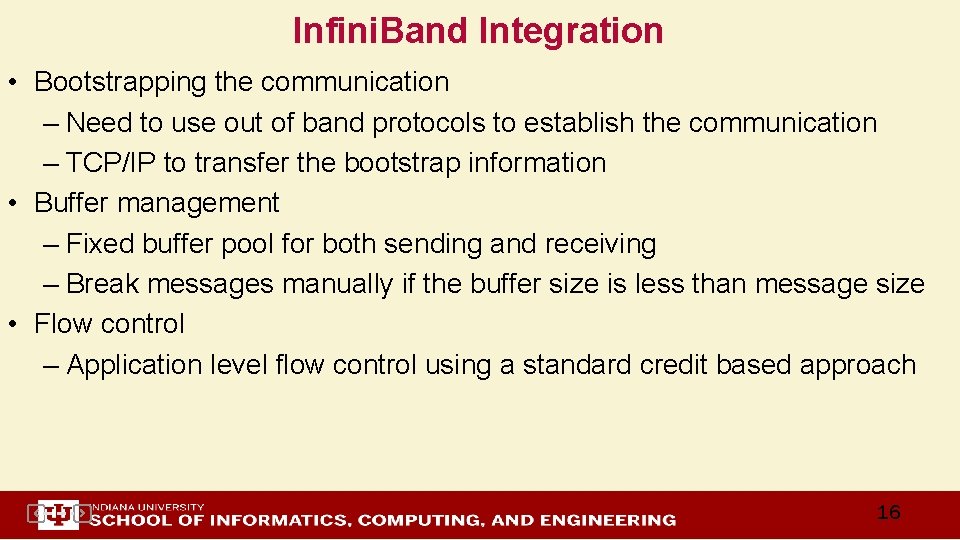
Infini. Band Integration • Bootstrapping the communication – Need to use out of band protocols to establish the communication – TCP/IP to transfer the bootstrap information • Buffer management – Fixed buffer pool for both sending and receiving – Break messages manually if the buffer size is less than message size • Flow control – Application level flow control using a standard credit based approach 16
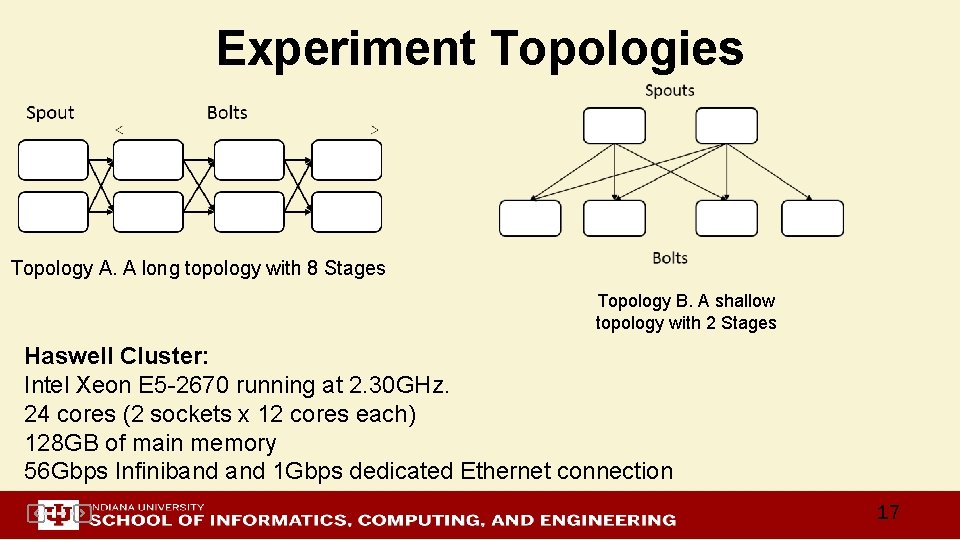
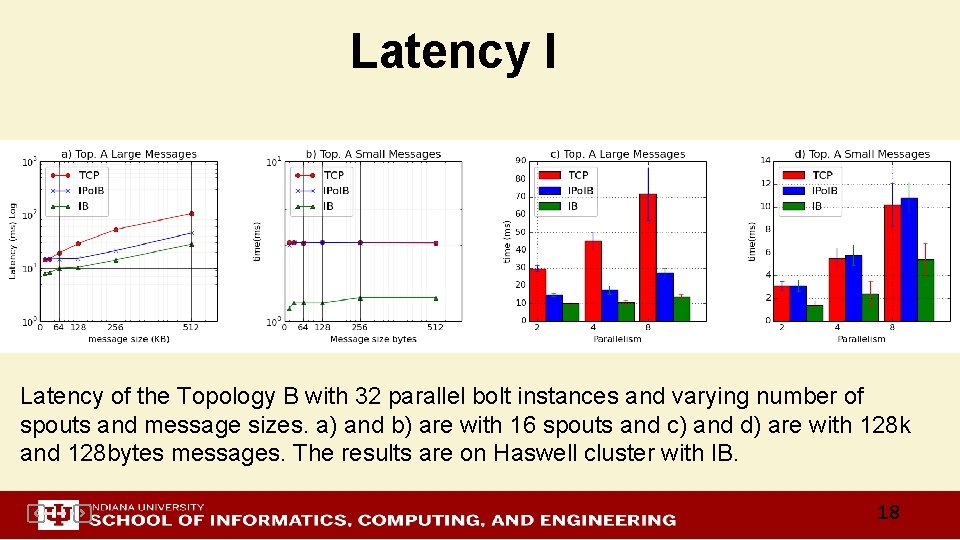
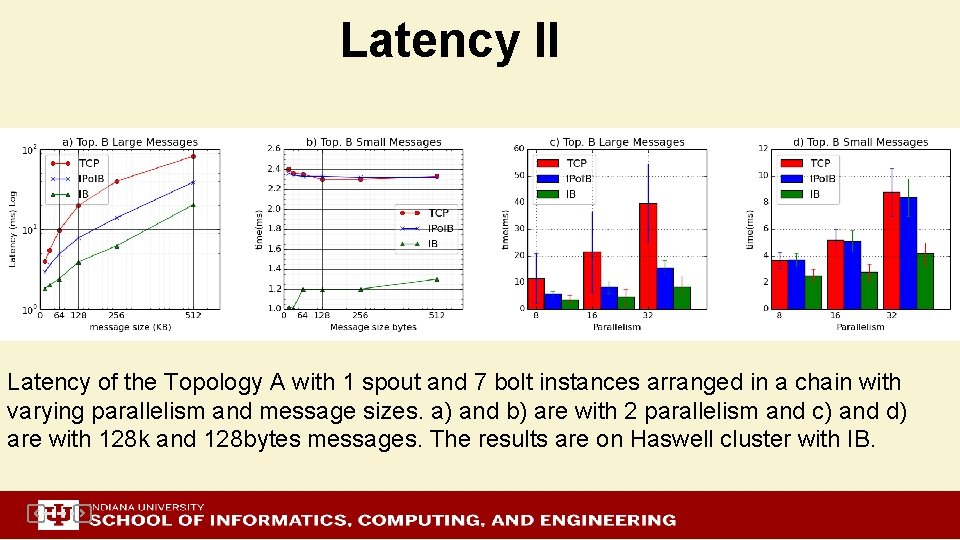
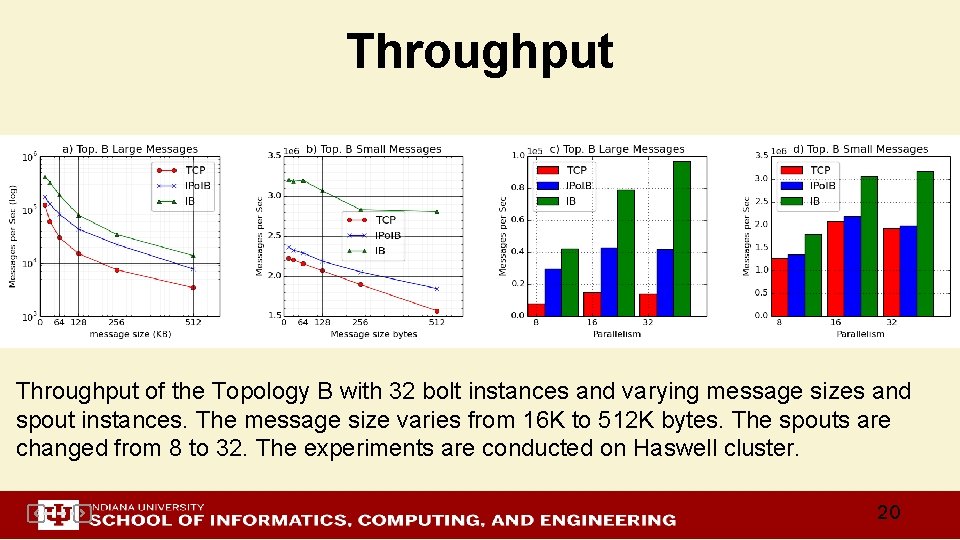
Experiment Topologies Topology A. A long topology with 8 Stages Topology B. A shallow topology with 2 Stages Haswell Cluster: Intel Xeon E 5 -2670 running at 2. 30 GHz. 24 cores (2 sockets x 12 cores each) 128 GB of main memory 56 Gbps Infiniband 1 Gbps dedicated Ethernet connection 17
Latency I Latency of the Topology B with 32 parallel bolt instances and varying number of spouts and message sizes. a) and b) are with 16 spouts and c) and d) are with 128 k and 128 bytes messages. The results are on Haswell cluster with IB. 18
Latency II Latency of the Topology A with 1 spout and 7 bolt instances arranged in a chain with varying parallelism and message sizes. a) and b) are with 2 parallelism and c) and d) are with 128 k and 128 bytes messages. The results are on Haswell cluster with IB.
Throughput of the Topology B with 32 bolt instances and varying message sizes and spout instances. The message size varies from 16 K to 512 K bytes. The spouts are changed from 8 to 32. The experiments are conducted on Haswell cluster. 20
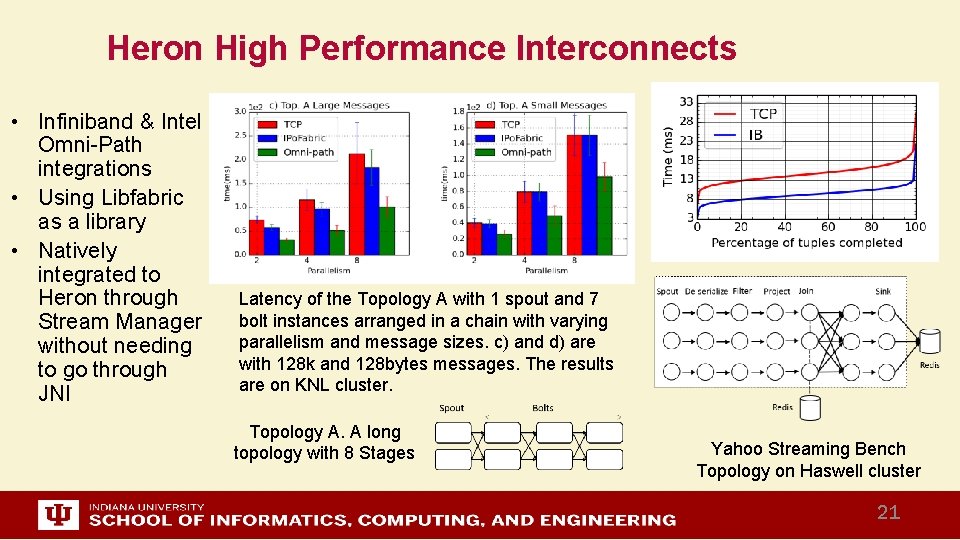
Heron High Performance Interconnects • Infiniband & Intel Omni-Path integrations • Using Libfabric as a library • Natively integrated to Heron through Stream Manager without needing to go through JNI Latency of the Topology A with 1 spout and 7 bolt instances arranged in a chain with varying parallelism and message sizes. c) and d) are with 128 k and 128 bytes messages. The results are on KNL cluster. Topology A. A long topology with 8 Stages Yahoo Streaming Bench Topology on Haswell cluster 21
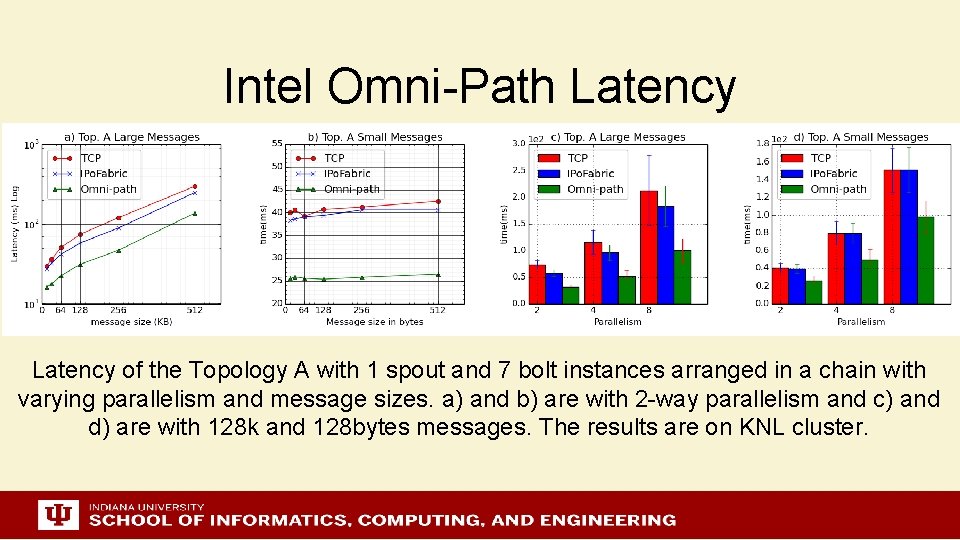
Intel Omni-Path Latency of the Topology A with 1 spout and 7 bolt instances arranged in a chain with varying parallelism and message sizes. a) and b) are with 2 -way parallelism and c) and d) are with 128 k and 128 bytes messages. The results are on KNL cluster.
http: //www. iterativemapreduce. org/ Dataflow Execution Various Scales Dataflow is great but performance/implementation depend on grain size 23
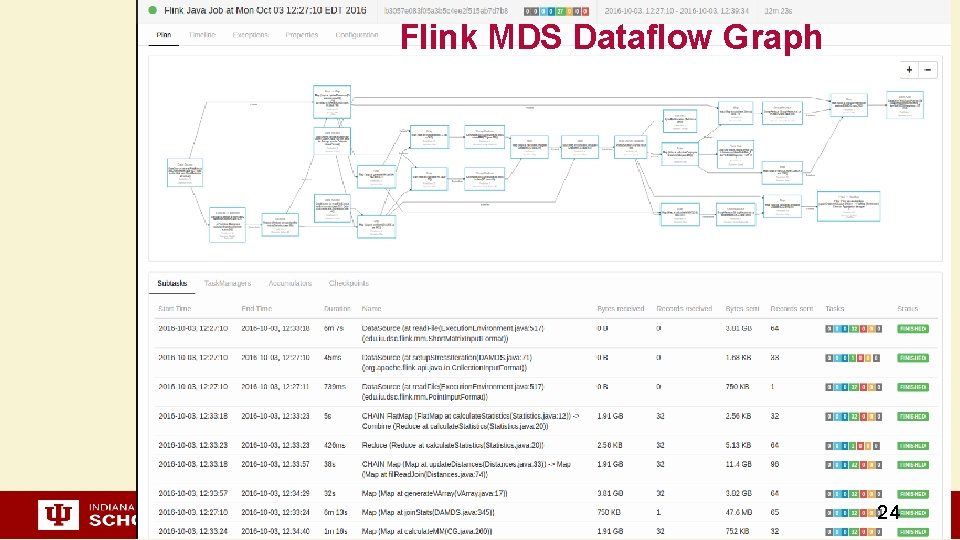
Flink MDS Dataflow Graph 24
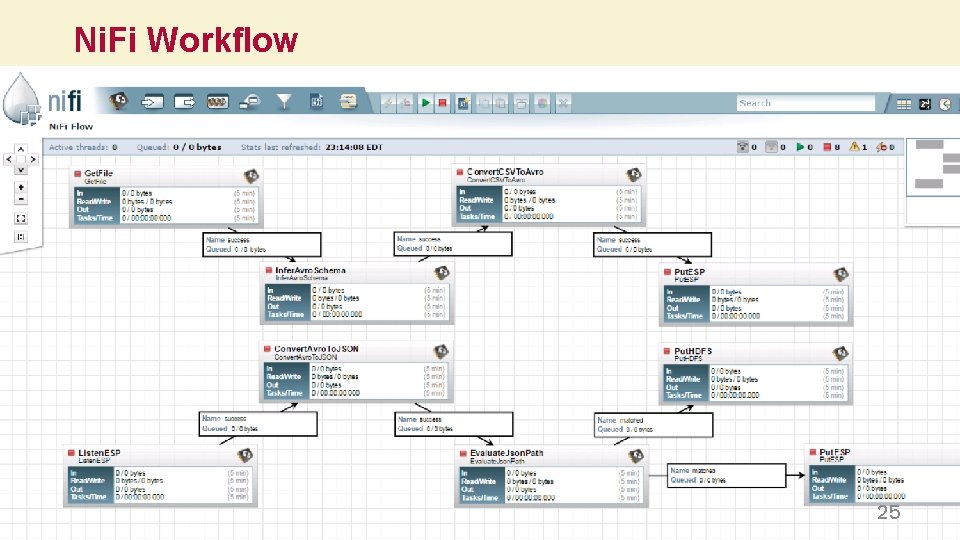
Ni. Fi Workflow 25
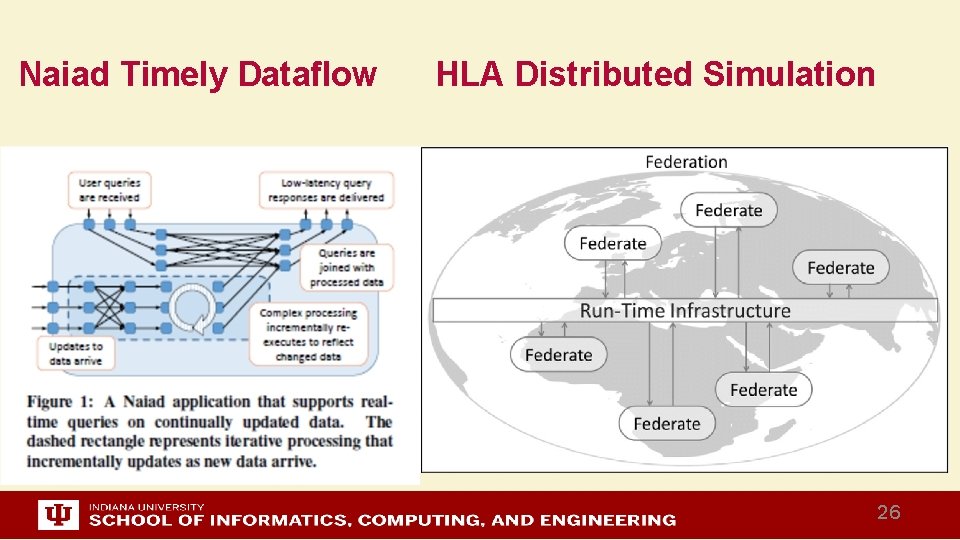
Naiad Timely Dataflow HLA Distributed Simulation 26
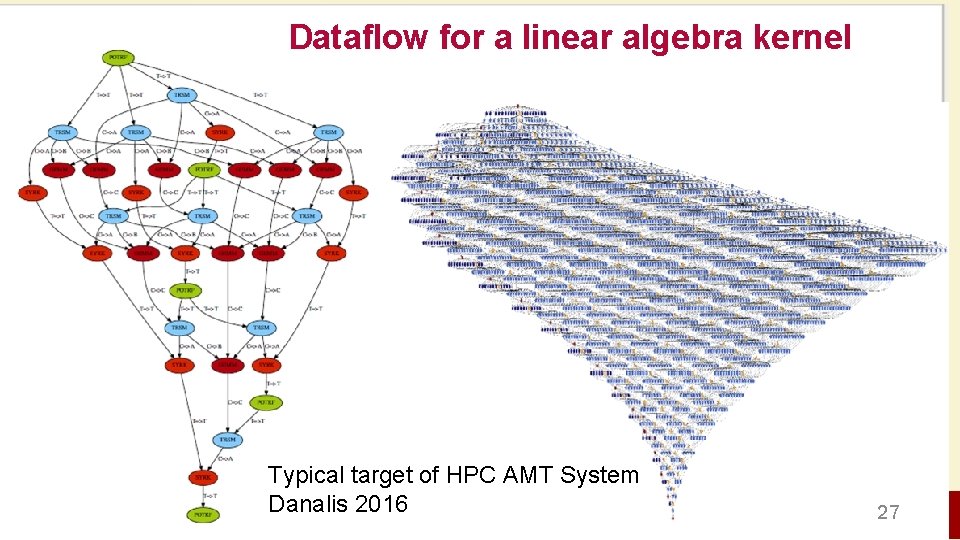
Dataflow for a linear algebra kernel Typical target of HPC AMT System Danalis 2016 27
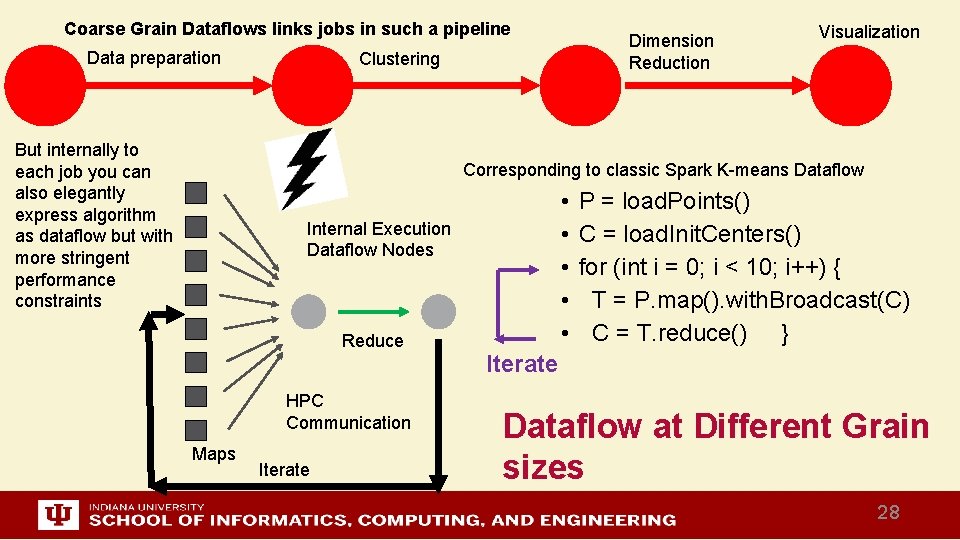
Coarse Grain Dataflows links jobs in such a pipeline Data preparation But internally to each job you can also elegantly express algorithm as dataflow but with more stringent performance constraints Dimension Reduction Clustering Visualization Corresponding to classic Spark K-means Dataflow • • • Internal Execution Dataflow Nodes Reduce HPC Communication Maps Iterate P = load. Points() C = load. Init. Centers() for (int i = 0; i < 10; i++) { T = P. map(). with. Broadcast(C) C = T. reduce() } Iterate Dataflow at Different Grain sizes 28
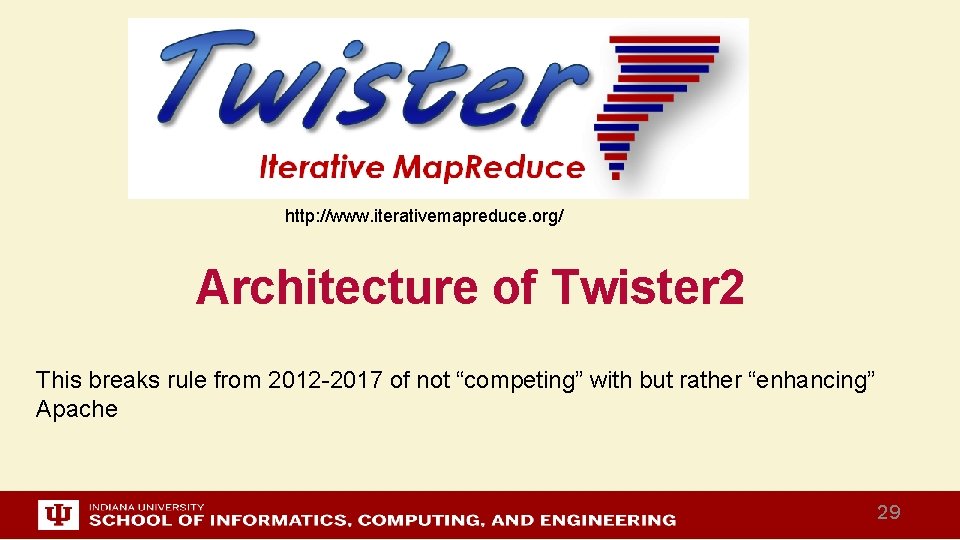
http: //www. iterativemapreduce. org/ Architecture of Twister 2 This breaks rule from 2012 -2017 of not “competing” with but rather “enhancing” Apache 29
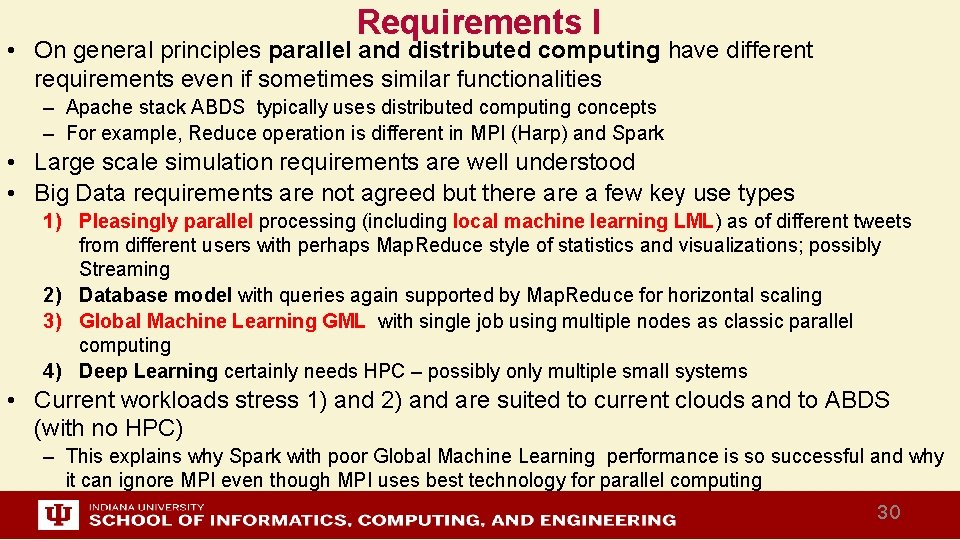
Requirements I • On general principles parallel and distributed computing have different requirements even if sometimes similar functionalities – Apache stack ABDS typically uses distributed computing concepts – For example, Reduce operation is different in MPI (Harp) and Spark • Large scale simulation requirements are well understood • Big Data requirements are not agreed but there a few key use types 1) Pleasingly parallel processing (including local machine learning LML) as of different tweets from different users with perhaps Map. Reduce style of statistics and visualizations; possibly Streaming 2) Database model with queries again supported by Map. Reduce for horizontal scaling 3) Global Machine Learning GML with single job using multiple nodes as classic parallel computing 4) Deep Learning certainly needs HPC – possibly only multiple small systems • Current workloads stress 1) and 2) and are suited to current clouds and to ABDS (with no HPC) – This explains why Spark with poor Global Machine Learning performance is so successful and why it can ignore MPI even though MPI uses best technology for parallel computing 30
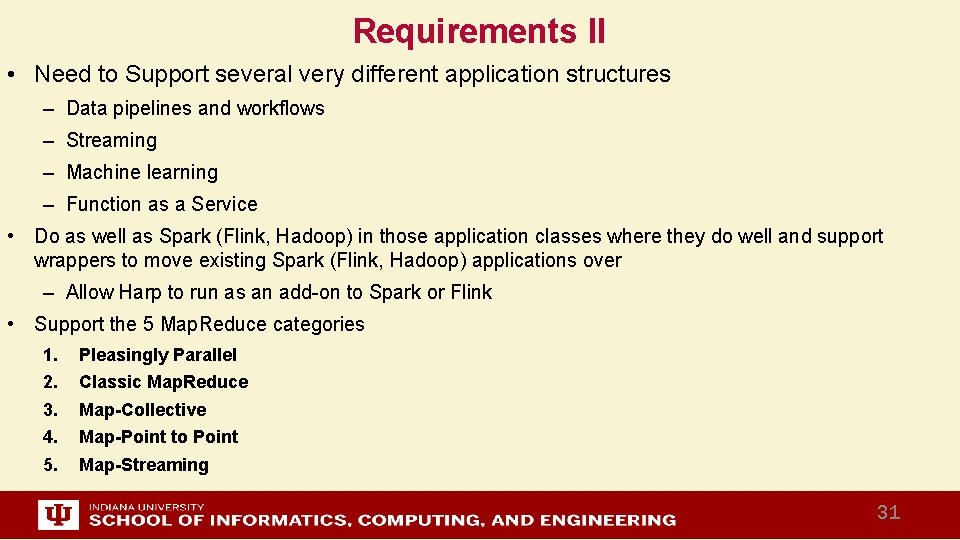
Requirements II • Need to Support several very different application structures – Data pipelines and workflows – Streaming – Machine learning – Function as a Service • Do as well as Spark (Flink, Hadoop) in those application classes where they do well and support wrappers to move existing Spark (Flink, Hadoop) applications over – Allow Harp to run as an add-on to Spark or Flink • Support the 5 Map. Reduce categories 1. 2. 3. 4. 5. Pleasingly Parallel Classic Map. Reduce Map-Collective Map-Point to Point Map-Streaming 31
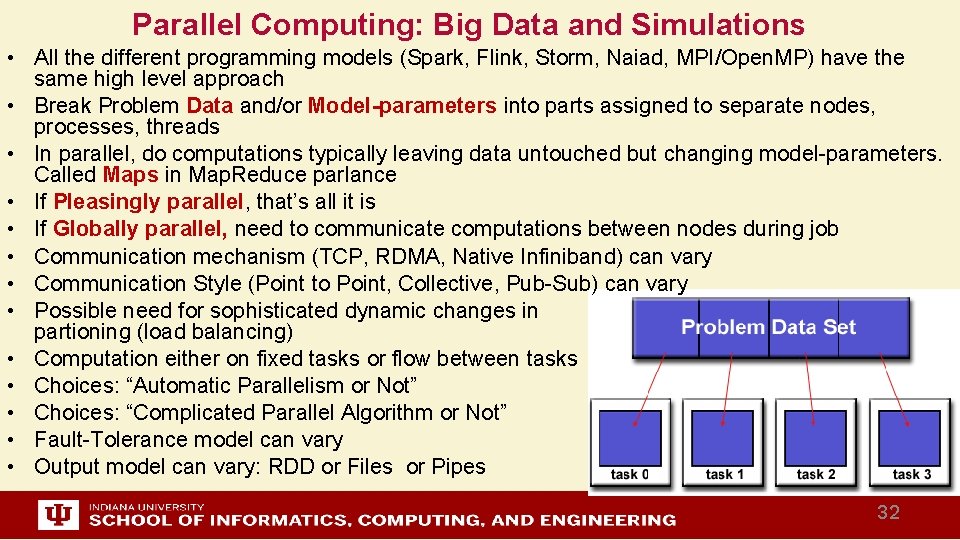
Parallel Computing: Big Data and Simulations • All the different programming models (Spark, Flink, Storm, Naiad, MPI/Open. MP) have the same high level approach • Break Problem Data and/or Model-parameters into parts assigned to separate nodes, processes, threads • In parallel, do computations typically leaving data untouched but changing model-parameters. Called Maps in Map. Reduce parlance • If Pleasingly parallel, that’s all it is • If Globally parallel, need to communicate computations between nodes during job • Communication mechanism (TCP, RDMA, Native Infiniband) can vary • Communication Style (Point to Point, Collective, Pub-Sub) can vary • Possible need for sophisticated dynamic changes in partioning (load balancing) • Computation either on fixed tasks or flow between tasks • Choices: “Automatic Parallelism or Not” • Choices: “Complicated Parallel Algorithm or Not” • Fault-Tolerance model can vary • Output model can vary: RDD or Files or Pipes 32
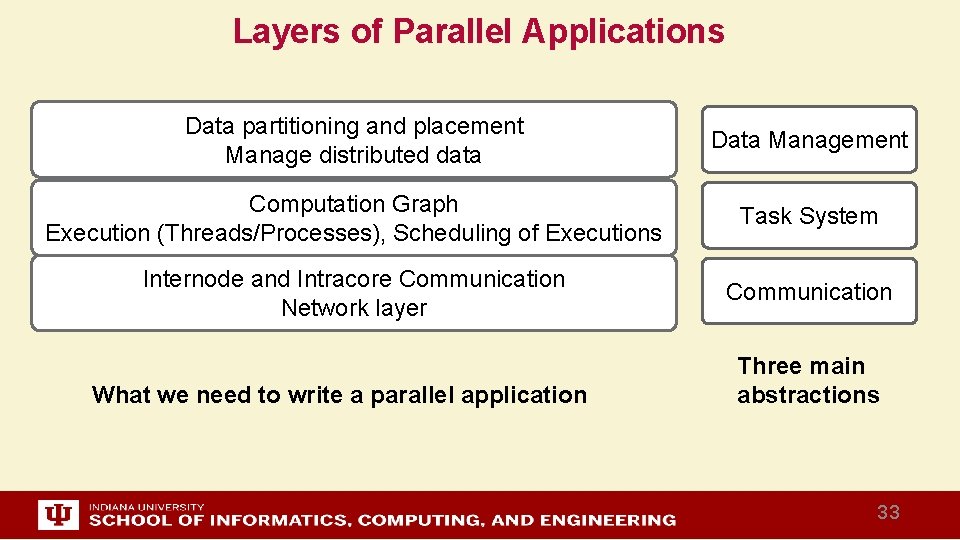
Layers of Parallel Applications Data partitioning and placement Manage distributed data Data Management Computation Graph Execution (Threads/Processes), Scheduling of Executions Task System Internode and Intracore Communication Network layer Communication What we need to write a parallel application Three main abstractions 33
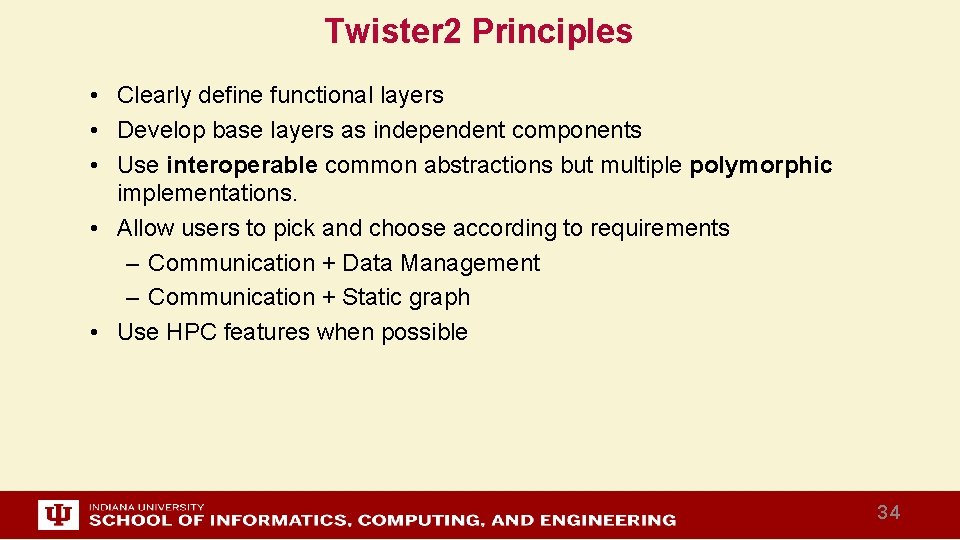
Twister 2 Principles • Clearly define functional layers • Develop base layers as independent components • Use interoperable common abstractions but multiple polymorphic implementations. • Allow users to pick and choose according to requirements – Communication + Data Management – Communication + Static graph • Use HPC features when possible 34
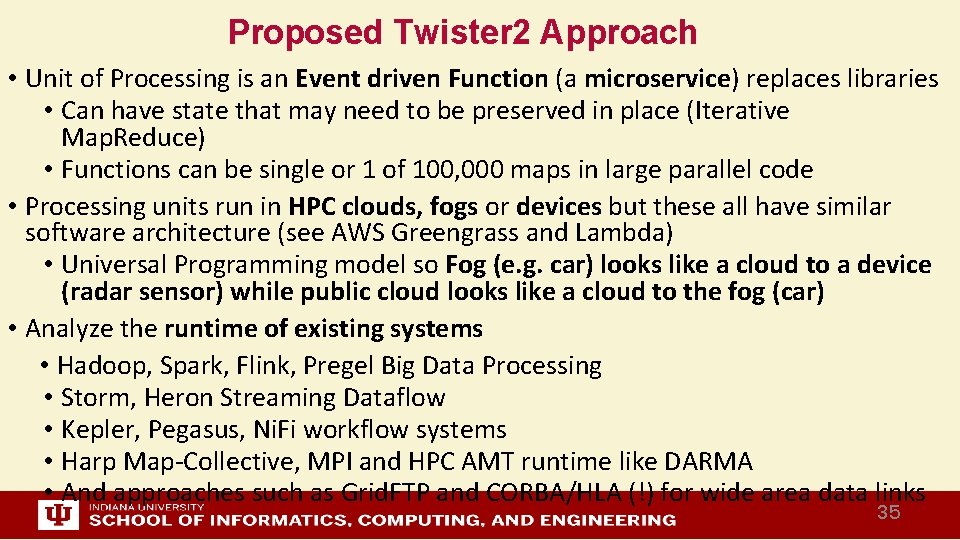
Proposed Twister 2 Approach • Unit of Processing is an Event driven Function (a microservice) replaces libraries • Can have state that may need to be preserved in place (Iterative Map. Reduce) • Functions can be single or 1 of 100, 000 maps in large parallel code • Processing units run in HPC clouds, fogs or devices but these all have similar software architecture (see AWS Greengrass and Lambda) • Universal Programming model so Fog (e. g. car) looks like a cloud to a device (radar sensor) while public cloud looks like a cloud to the fog (car) • Analyze the runtime of existing systems • Hadoop, Spark, Flink, Pregel Big Data Processing • Storm, Heron Streaming Dataflow • Kepler, Pegasus, Ni. Fi workflow systems • Harp Map-Collective, MPI and HPC AMT runtime like DARMA • And approaches such as Grid. FTP and CORBA/HLA (!) for wide area data links 35
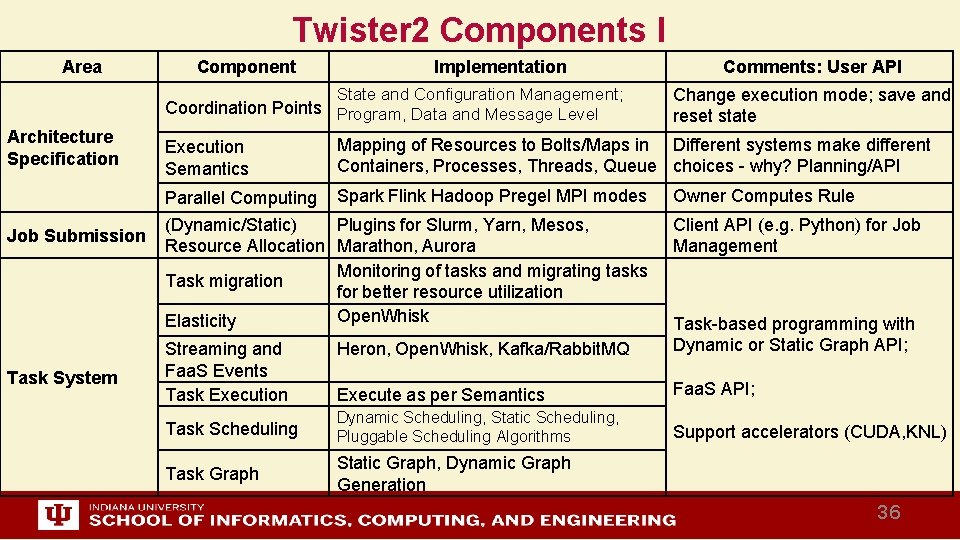
Twister 2 Components I Area Component Implementation State and Configuration Management; Coordination Points Program, Data and Message Level Architecture Specification Job Submission Task System Execution Semantics Comments: User API Change execution mode; save and reset state Mapping of Resources to Bolts/Maps in Different systems make different Containers, Processes, Threads, Queue choices - why? Planning/API Parallel Computing Spark Flink Hadoop Pregel MPI modes (Dynamic/Static) Plugins for Slurm, Yarn, Mesos, Resource Allocation Marathon, Aurora Monitoring of tasks and migrating tasks Task migration for better resource utilization Open. Whisk Elasticity Owner Computes Rule Client API (e. g. Python) for Job Management Heron, Open. Whisk, Kafka/Rabbit. MQ Task-based programming with Dynamic or Static Graph API; Execute as per Semantics Faa. S API; Task Scheduling Dynamic Scheduling, Static Scheduling, Pluggable Scheduling Algorithms Support accelerators (CUDA, KNL) Task Graph Static Graph, Dynamic Graph Generation Streaming and Faa. S Events Task Execution 36
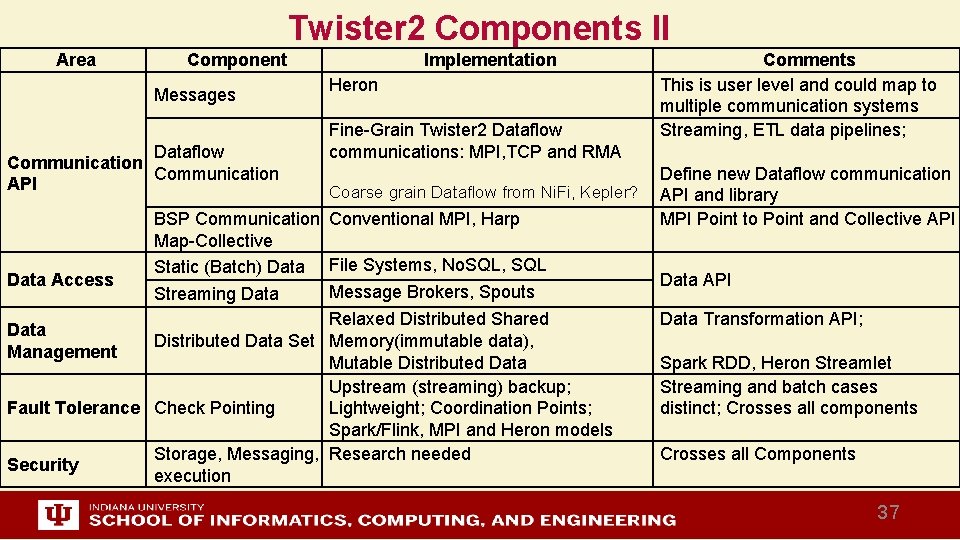
Twister 2 Components II Area Component Messages Dataflow Communication API Data Access Implementation Heron Fine-Grain Twister 2 Dataflow communications: MPI, TCP and RMA Coarse grain Dataflow from Ni. Fi, Kepler? BSP Communication Conventional MPI, Harp Map-Collective Static (Batch) Data File Systems, No. SQL, SQL Message Brokers, Spouts Streaming Data Relaxed Distributed Shared Distributed Data Set Memory(immutable data), Mutable Distributed Data Upstream (streaming) backup; Fault Tolerance Check Pointing Lightweight; Coordination Points; Spark/Flink, MPI and Heron models Storage, Messaging, Research needed Security execution Data Management Comments This is user level and could map to multiple communication systems Streaming, ETL data pipelines; Define new Dataflow communication API and library MPI Point to Point and Collective API Data Transformation API; Spark RDD, Heron Streamlet Streaming and batch cases distinct; Crosses all components Crosses all Components 37
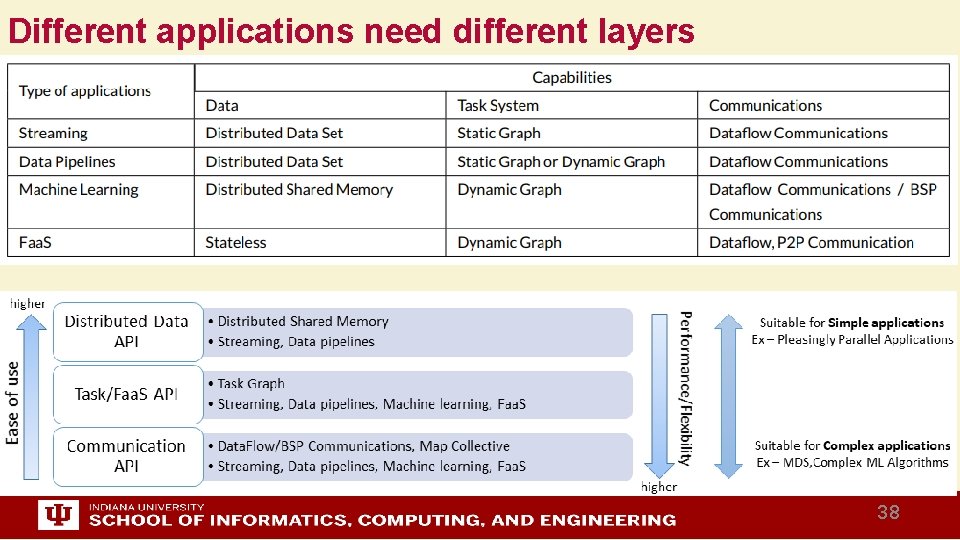
Different applications need different layers 38
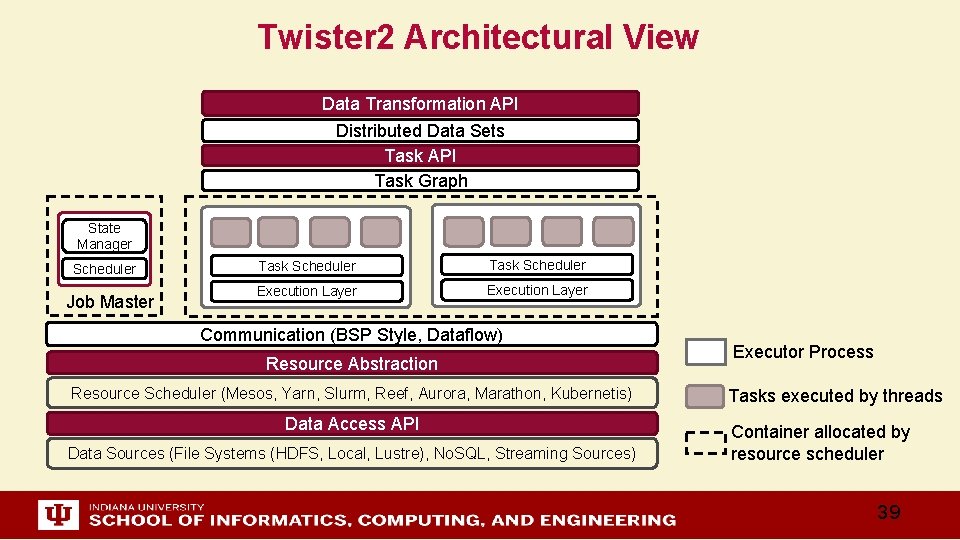
Twister 2 Architectural View Data Transformation API Distributed Data Sets Task API Task Graph State Manager Scheduler Job Master Task Scheduler Execution Layer Communication (BSP Style, Dataflow) Resource Abstraction Resource Scheduler (Mesos, Yarn, Slurm, Reef, Aurora, Marathon, Kubernetis) Data Access API Data Sources (File Systems (HDFS, Local, Lustre), No. SQL, Streaming Sources) Executor Process Tasks executed by threads Container allocated by resource scheduler 39
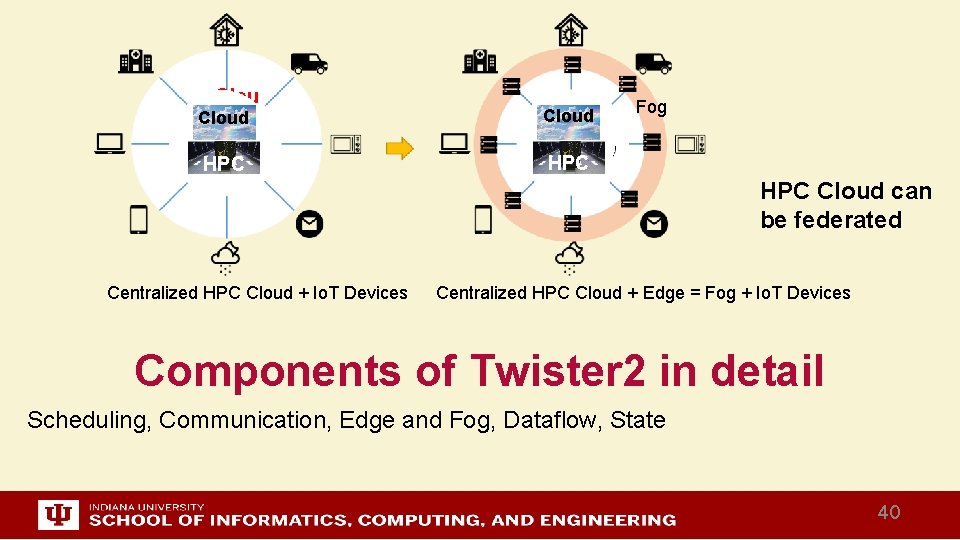
Cloud d Cloud HPC HPC Centralized HPC Cloud + Io. T Devices Fog HPC Cloud can be federated Centralized HPC Cloud + Edge = Fog + Io. T Devices Components of Twister 2 in detail Scheduling, Communication, Edge and Fog, Dataflow, State 40
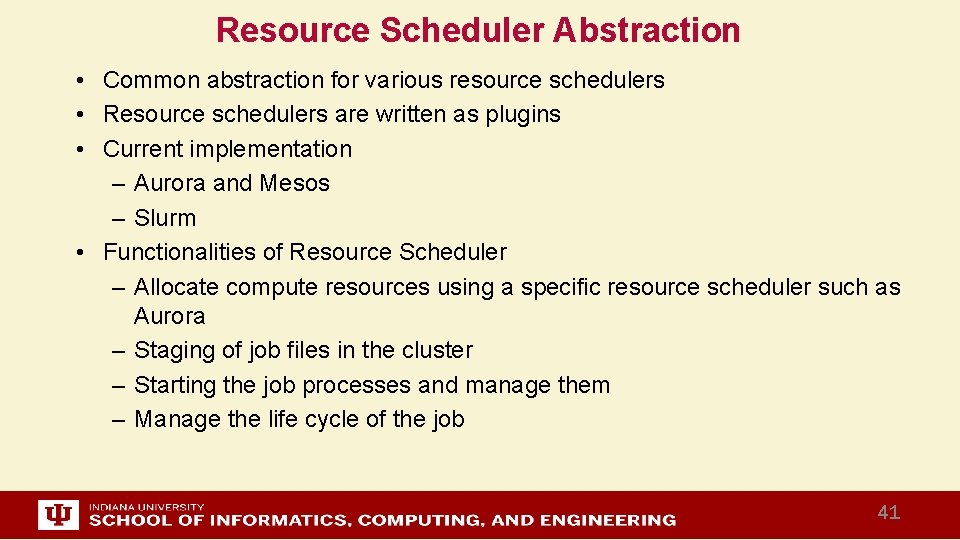
Resource Scheduler Abstraction • Common abstraction for various resource schedulers • Resource schedulers are written as plugins • Current implementation – Aurora and Mesos – Slurm • Functionalities of Resource Scheduler – Allocate compute resources using a specific resource scheduler such as Aurora – Staging of job files in the cluster – Starting the job processes and manage them – Manage the life cycle of the job 41
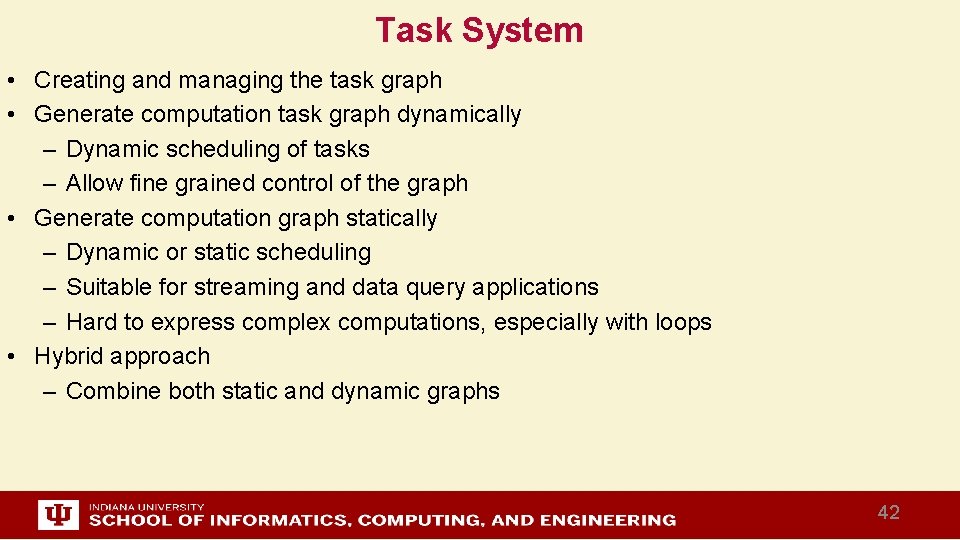
Task System • Creating and managing the task graph • Generate computation task graph dynamically – Dynamic scheduling of tasks – Allow fine grained control of the graph • Generate computation graph statically – Dynamic or static scheduling – Suitable for streaming and data query applications – Hard to express complex computations, especially with loops • Hybrid approach – Combine both static and dynamic graphs 42
Task Scheduler • Schedule for various types of applications – Streaming, Batch, Faa. S • Static Scheduling and Dynamic Scheduling • Central Scheduler for static task graphs • Distributed scheduler for dynamic task graphs 43
Executor • • Execute a task when its data dependencies are satisfied Uses threads and queues Performs task execution optimizations such as Pipelining tasks Can be extended to support custom execution models 44
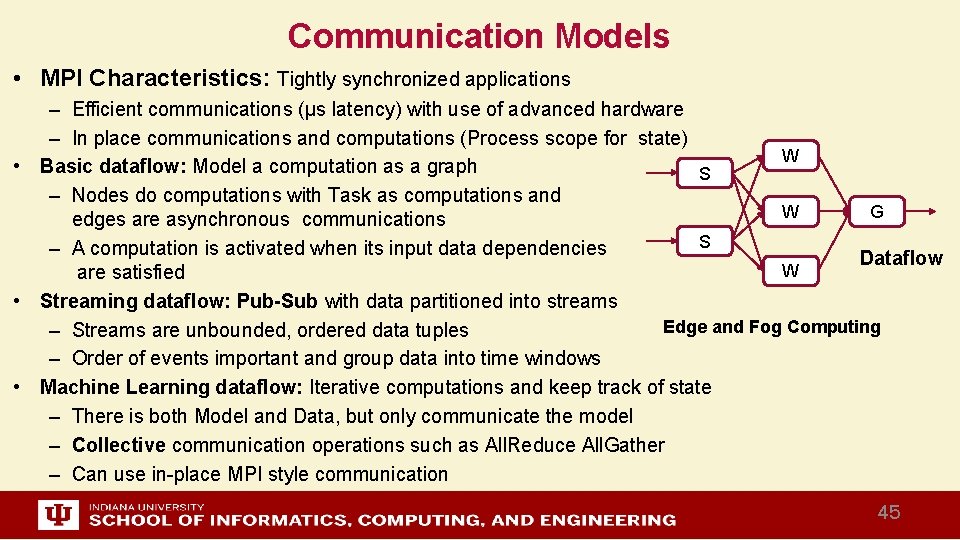
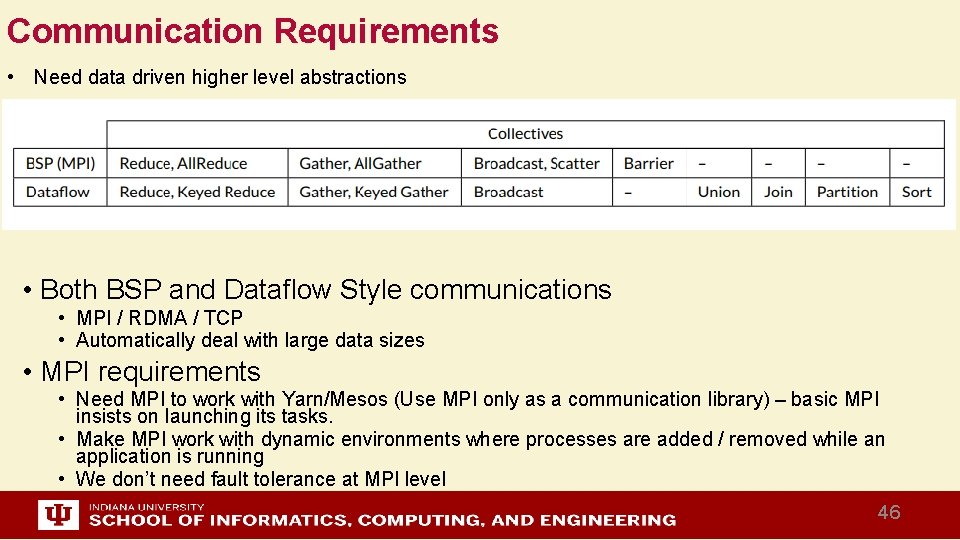
Communication Models • MPI Characteristics: Tightly synchronized applications – Efficient communications (µs latency) with use of advanced hardware – In place communications and computations (Process scope for state) W • Basic dataflow: Model a computation as a graph S – Nodes do computations with Task as computations and W G edges are asynchronous communications S – A computation is activated when its input data dependencies Dataflow W are satisfied • Streaming dataflow: Pub-Sub with data partitioned into streams Edge and Fog Computing – Streams are unbounded, ordered data tuples – Order of events important and group data into time windows • Machine Learning dataflow: Iterative computations and keep track of state – There is both Model and Data, but only communicate the model – Collective communication operations such as All. Reduce All. Gather – Can use in-place MPI style communication 45
Communication Requirements • Need data driven higher level abstractions • Both BSP and Dataflow Style communications • MPI / RDMA / TCP • Automatically deal with large data sizes • MPI requirements • Need MPI to work with Yarn/Mesos (Use MPI only as a communication library) – basic MPI insists on launching its tasks. • Make MPI work with dynamic environments where processes are added / removed while an application is running • We don’t need fault tolerance at MPI level 46
Twister 2 and the Fog • What is the Fog? • In the spirit of yesterday’s Grid computing, the Fog is everything – E. g. cars on a road see a fog as sum of all cars near them – Smart Home can access all the devices and computing resources in their neighborhood – This approach has obviously greatest potential performance and could for example allow road vehicles to self organize and avoid traffic jams – It has the problem that bedeviled yesterday’s Grid; need to manage systems across administrative domains • The simpler scenario is that Fog is restricted to systems that are in same administrative domain as device and cloud – The system can be designed without worrying about conflicting administration issues – The Fog for devices in a car, is in SAME car – The Smart home uses Fog in same home – We address this simpler case • Twister 2 is designed to address second simple view by supporting hierarchical clouds with fog looking like a cloud to the device 47
Data Access Layer • • • Provides a unified interface for accessing raw data Supports multiple file systems such as NFS, HDFS, Lustre, etc. Supports streaming data sources Can be easily extended to support custom data sources Manages data locality information 48
Fault Tolerance and State • State is a key issue and handled differently in systems – CORBA, AMT, MPI and Storm/Heron have long running tasks that preserve state – Spark and Flink preserve datasets across dataflow node using in-memory databases – All systems agree on coarse grain dataflow; only keep state by exchanging data. • Similar form of check-pointing mechanism is used already in HPC and Big Data – although HPC informal as doesn’t typically specify as a dataflow graph – Flink and Spark do better than MPI due to use of database technologies; MPI is a bit harder due to richer state but there is an obvious integrated model using RDD type snapshots of MPI style jobs • Checkpoint after each stage of the dataflow graph – Natural synchronization point – Let’s allows user to choose when to checkpoint (not every stage) – Save state as user specifies; Spark just saves Model state which is insufficient for complex algorithms 49
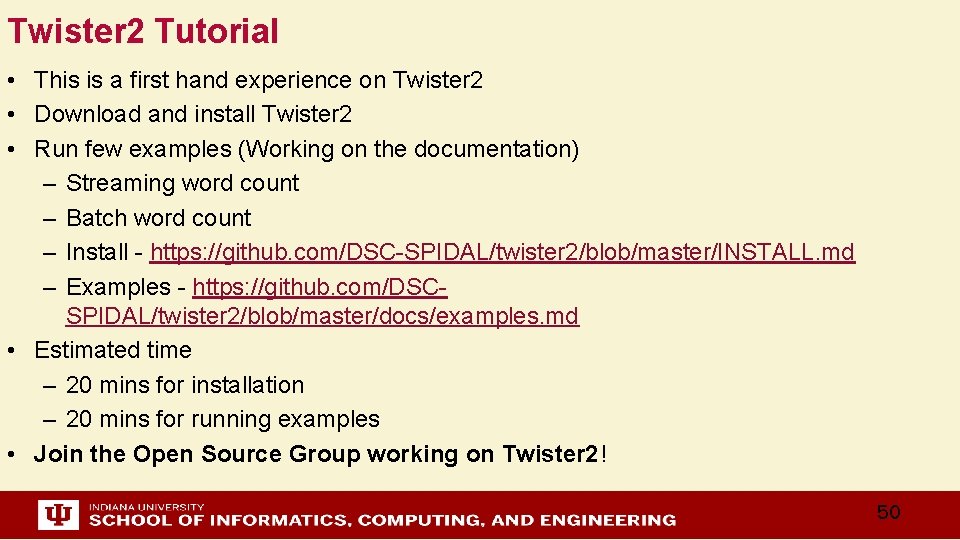
Twister 2 Tutorial • This is a first hand experience on Twister 2 • Download and install Twister 2 • Run few examples (Working on the documentation) – Streaming word count – Batch word count – Install - https: //github. com/DSC-SPIDAL/twister 2/blob/master/INSTALL. md – Examples - https: //github. com/DSCSPIDAL/twister 2/blob/master/docs/examples. md • Estimated time – 20 mins for installation – 20 mins for running examples • Join the Open Source Group working on Twister 2! 50
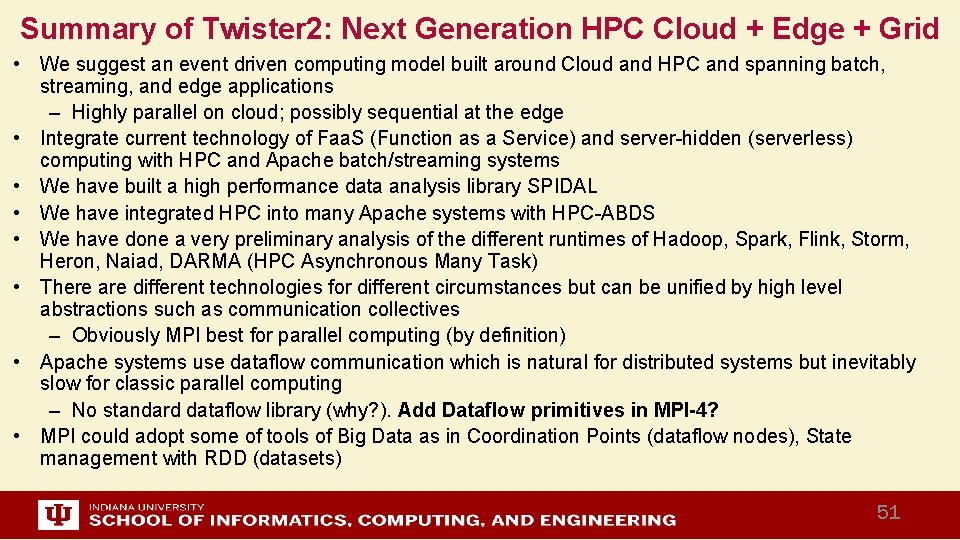
Summary of Twister 2: Next Generation HPC Cloud + Edge + Grid • We suggest an event driven computing model built around Cloud and HPC and spanning batch, streaming, and edge applications – Highly parallel on cloud; possibly sequential at the edge • Integrate current technology of Faa. S (Function as a Service) and server-hidden (serverless) computing with HPC and Apache batch/streaming systems • We have built a high performance data analysis library SPIDAL • We have integrated HPC into many Apache systems with HPC-ABDS • We have done a very preliminary analysis of the different runtimes of Hadoop, Spark, Flink, Storm, Heron, Naiad, DARMA (HPC Asynchronous Many Task) • There are different technologies for different circumstances but can be unified by high level abstractions such as communication collectives – Obviously MPI best for parallel computing (by definition) • Apache systems use dataflow communication which is natural for distributed systems but inevitably slow for classic parallel computing – No standard dataflow library (why? ). Add Dataflow primitives in MPI-4? • MPI could adopt some of tools of Big Data as in Coordination Points (dataflow nodes), State management with RDD (datasets) 51