
Twister 2 A HighPerformance Big Data Programming Environment
Twister 2: A High-Performance Big Data Programming Environment HPBDC 2018: The 4 th IEEE International Workshop on High-Performance Big Data, Deep Learning, and Cloud Computing Geoffrey Fox, May 21, 2018 Judy Qiu, Supun Kamburugamuve Department of Intelligent Systems Engineering gcf@indiana. edu, http: //www. dsc. soic. indiana. edu/, http: //spidal. org/ `, Work with Shantenu Jha, Kannan Govindarajan, Pulasthi Wickramasinghe, Gurhan Gunduz, Ahmet Uyar 3/2/2021 1
Abstract • We analyse the components that are needed in programming environments for Big Data Analysis Systems with scalable HPC performance and the functionality of ABDS – the Apache Big Data Software Stack. • One highlight is Harp-DAAL which is a machine library exploiting the Intel node library DAAL and HPC communication collectives within the Hadoop ecosystem. • Another highlight is Twister 2 which consists of a set of middleware components to support batch or streaming data capabilities familiar from Apache Hadoop, Spark, Heron and Flink but with high performance • Twister 2 covers bulk synchronous and data flow communication; task management as in Mesos, Yarn and Kubernetes; dataflow graph execution models; launching of the Harp-DAAL library; streaming and repository data access interfaces, in-memory databases and fault tolerance at dataflow nodes. • Similar capabilities are available in current Apache systems but as integrated packages which do not allow needed customization for different application scenarios. 3/2/2021 2
Requirements • On general principles parallel and distributed computing have different requirements even if sometimes similar functionalities • Apache stack ABDS typically uses distributed computing concepts • For example, Reduce operation is different in MPI (Harp) and Spark • Large scale simulation requirements are well understood • Big Data requirements are not agreed but there a few key use types 1) Pleasingly parallel processing (including local machine learning LML) as of different tweets from different users with perhaps Map. Reduce style of statistics and visualizations; possibly Streaming 2) Database model with queries again supported by Map. Reduce for horizontal scaling 3) Global Machine Learning GML with single job using multiple nodes as classic parallel computing 4) Deep Learning certainly needs HPC – possibly only multiple small systems • Current workloads stress 1) and 2) and are suited to current clouds and to Apache Big Data Software (with no HPC) • This explains why Spark with poor GML performance can be so successful 3/2/2021 3
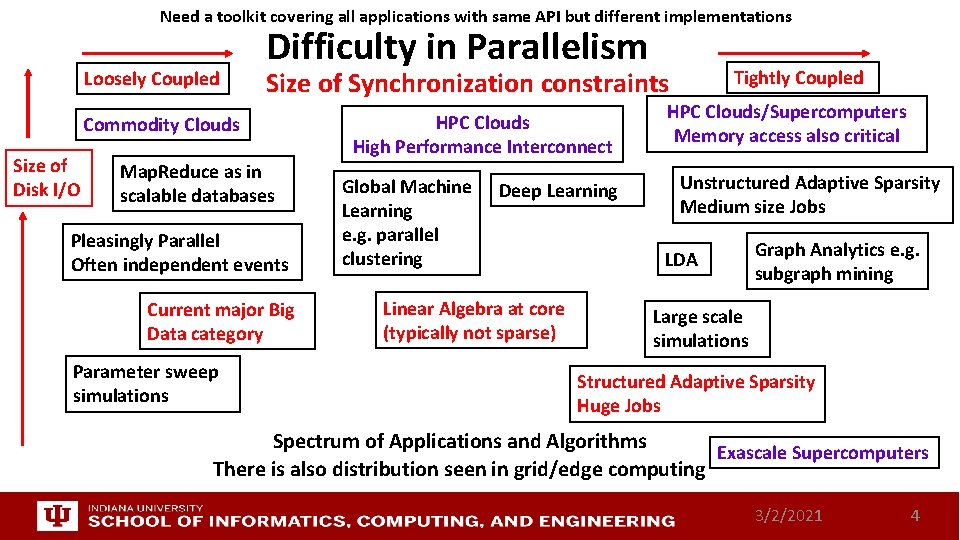
Need a toolkit covering all applications with same API but different implementations Loosely Coupled Difficulty in Parallelism Size of Synchronization constraints Commodity Clouds Size of Disk I/O Map. Reduce as in scalable databases Pleasingly Parallel Often independent events Current major Big Data category Parameter sweep simulations HPC Clouds High Performance Interconnect Global Machine Learning e. g. parallel clustering Deep Learning Linear Algebra at core (typically not sparse) Tightly Coupled HPC Clouds/Supercomputers Memory access also critical Unstructured Adaptive Sparsity Medium size Jobs LDA Graph Analytics e. g. subgraph mining Large scale simulations Structured Adaptive Sparsity Huge Jobs Spectrum of Applications and Algorithms Exascale Supercomputers There is also distribution seen in grid/edge computing 3/2/2021 4
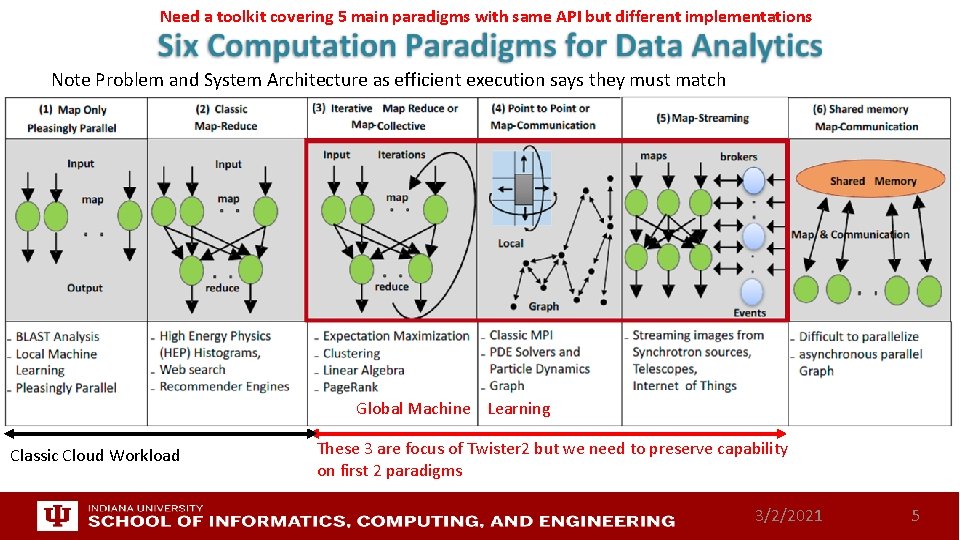
Need a toolkit covering 5 main paradigms with same API but different implementations Note Problem and System Architecture as efficient execution says they must match Global Machine Learning Classic Cloud Workload These 3 are focus of Twister 2 but we need to preserve capability on first 2 paradigms 3/2/2021 5

Comparing Spark, Flink and MPI • On Global Machine Learning GML. 3/2/2021 6

Machine Learning with MPI, Spark and Flink • Three algorithms implemented in three runtimes • Multidimensional Scaling (MDS) • Terasort • K-Means (drop as no time and looked at later) • Implementation in Java • MDS is the most complex algorithm - three nested parallel loops • K-Means - one parallel loop • Terasort - no iterations • With care, Java performance ~ C performance • Without care, Java performance << C performance (details omitted) 3/2/2021 7
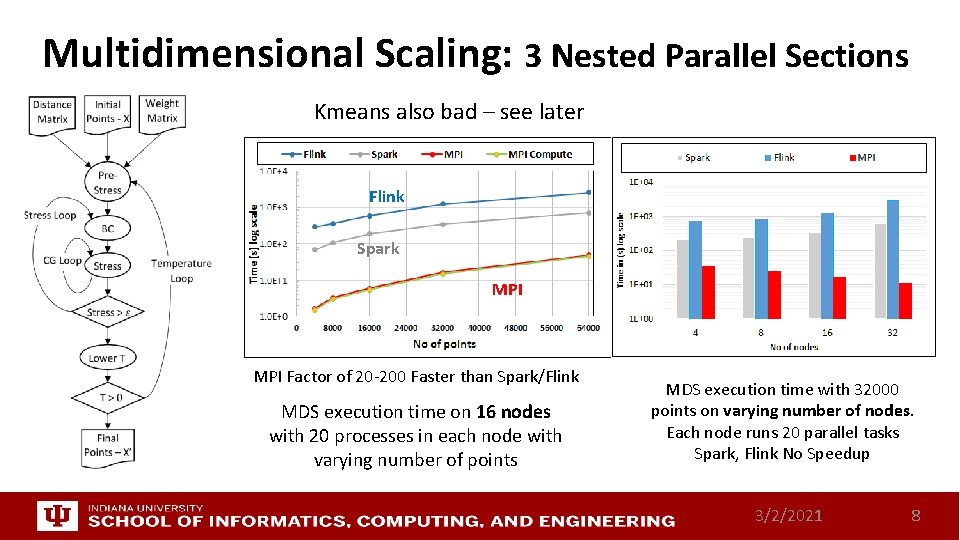
Multidimensional Scaling: 3 Nested Parallel Sections Kmeans also bad – see later Flink Spark MPI Factor of 20 -200 Faster than Spark/Flink MDS execution time on 16 nodes with 20 processes in each node with varying number of points MDS execution time with 32000 points on varying number of nodes. Each node runs 20 parallel tasks Spark, Flink No Speedup 3/2/2021 8
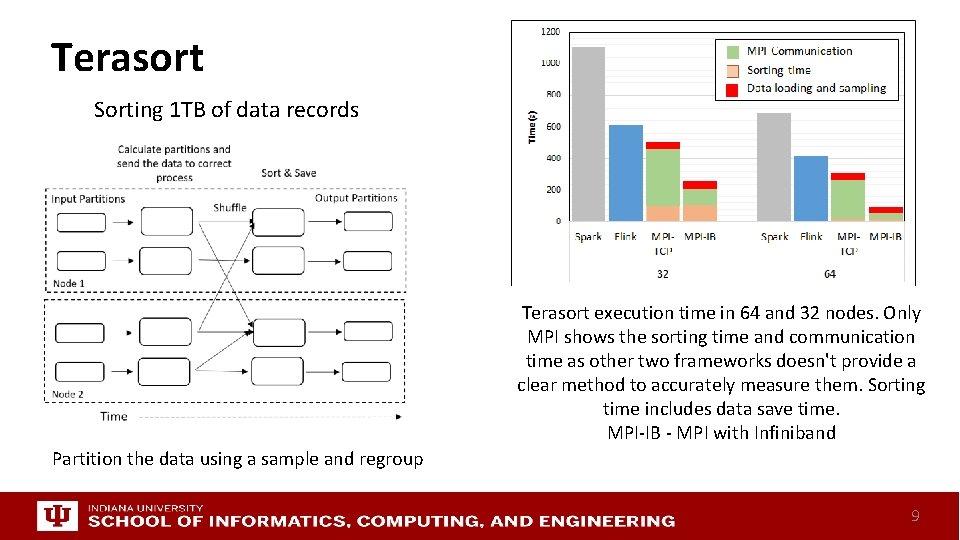
Terasort Sorting 1 TB of data records Terasort execution time in 64 and 32 nodes. Only MPI shows the sorting time and communication time as other two frameworks doesn't provide a clear method to accurately measure them. Sorting time includes data save time. MPI-IB - MPI with Infiniband Partition the data using a sample and regroup 9
Software HPC-ABDS HPC-Faa. S 3/2/2021 10
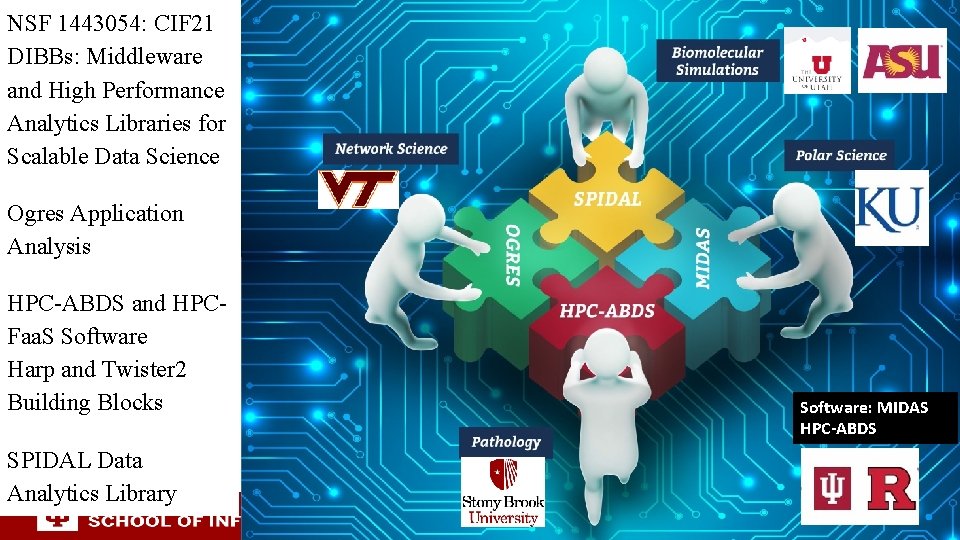
NSF 1443054: CIF 21 DIBBs: Middleware and High Performance Analytics Libraries for Scalable Data Science Ogres Application Analysis HPC-ABDS and HPCFaa. S Software Harp and Twister 2 Building Blocks SPIDAL Data Analytics Library Software: MIDAS HPC-ABDS 3/2/2021 11
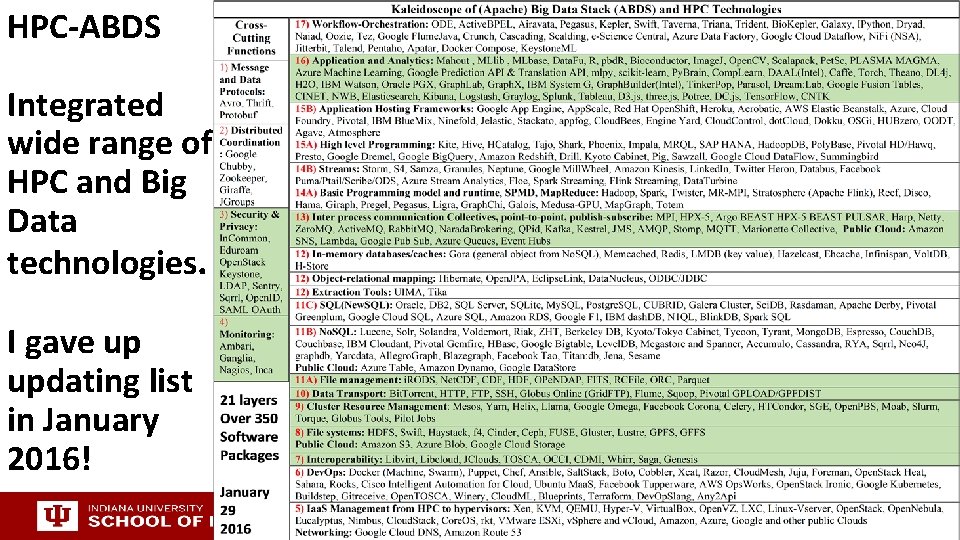
HPC-ABDS Integrated wide range of HPC and Big Data technologies. I gave up updating list in January 2016! 3/2/2021 12
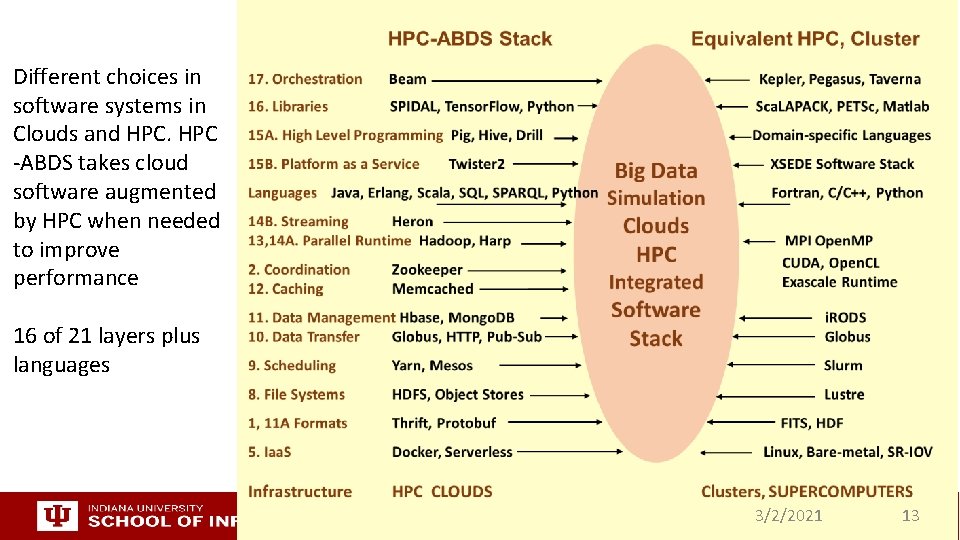
Different choices in software systems in Clouds and HPC -ABDS takes cloud software augmented by HPC when needed to improve performance 16 of 21 layers plus languages 3/2/2021 13
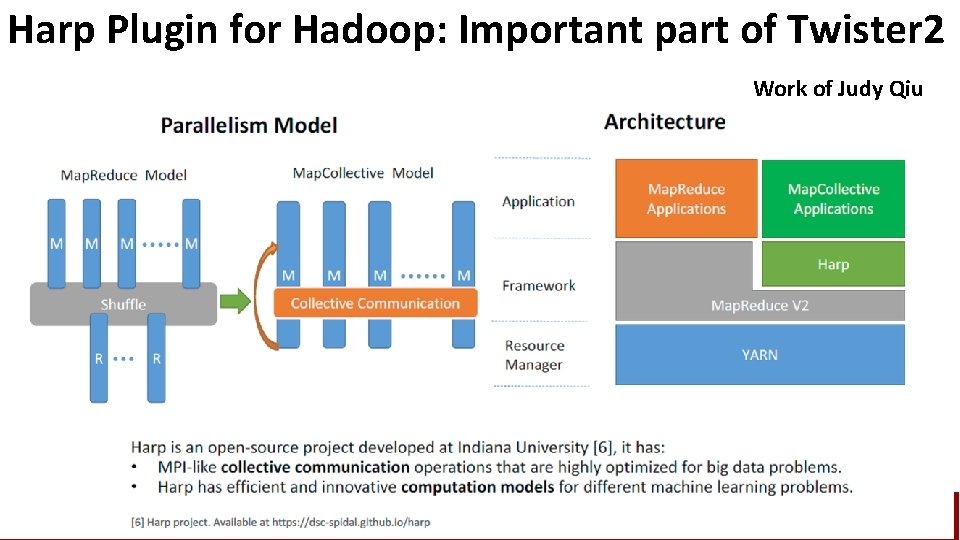
Harp Plugin for Hadoop: Important part of Twister 2 Work of Judy Qiu 14
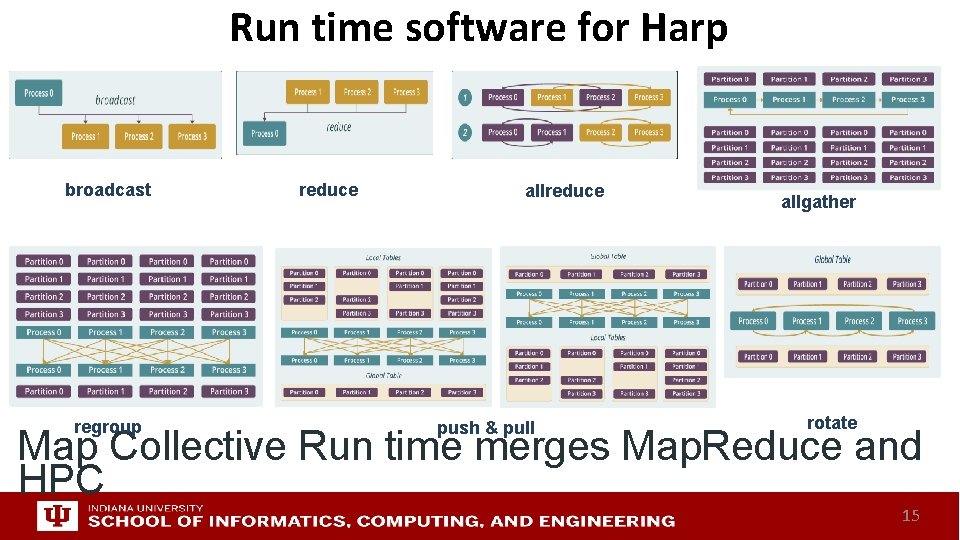
Run time software for Harp broadcast regroup reduce allreduce push & pull allgather rotate Map Collective Run time merges Map. Reduce and HPC 15
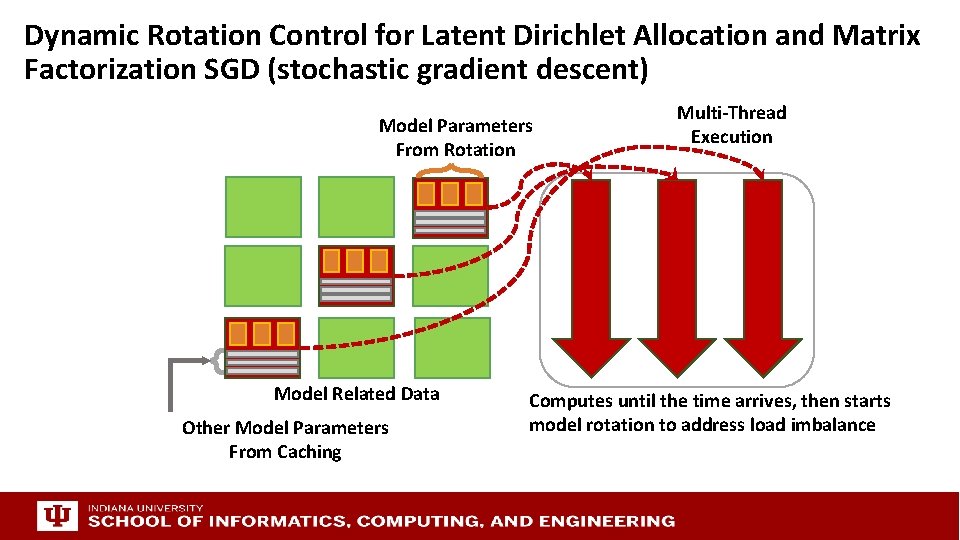
Dynamic Rotation Control for Latent Dirichlet Allocation and Matrix Factorization SGD (stochastic gradient descent) Model Parameters From Rotation Model Related Data Other Model Parameters From Caching Multi-Thread Execution Computes until the time arrives, then starts model rotation to address load imbalance
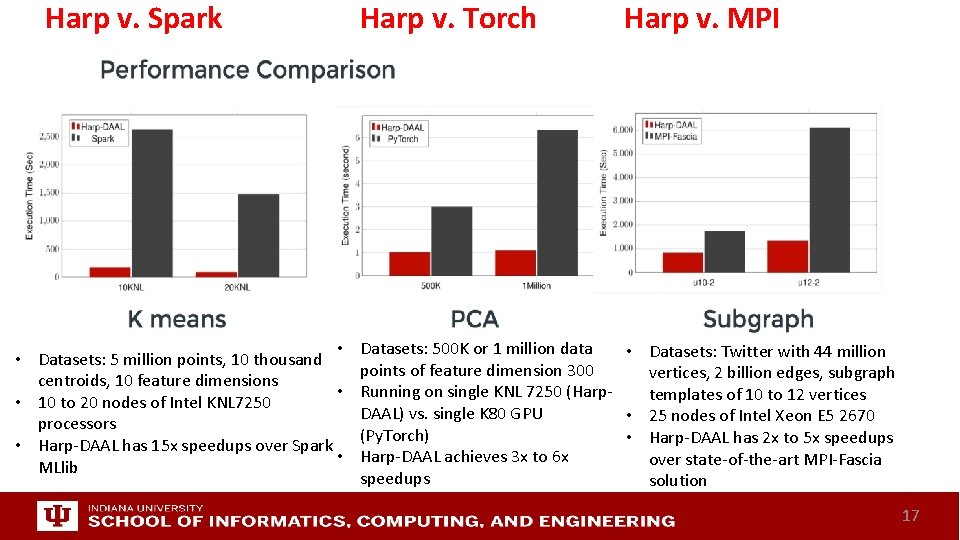
Harp v. Spark • • Datasets: 5 million points, 10 thousand centroids, 10 feature dimensions • • 10 to 20 nodes of Intel KNL 7250 processors • Harp-DAAL has 15 x speedups over Spark • MLlib Harp v. Torch Harp v. MPI Datasets: 500 K or 1 million data • Datasets: Twitter with 44 million points of feature dimension 300 vertices, 2 billion edges, subgraph Running on single KNL 7250 (Harptemplates of 10 to 12 vertices DAAL) vs. single K 80 GPU • 25 nodes of Intel Xeon E 5 2670 (Py. Torch) • Harp-DAAL has 2 x to 5 x speedups Harp-DAAL achieves 3 x to 6 x over state-of-the-art MPI-Fascia speedups solution 17
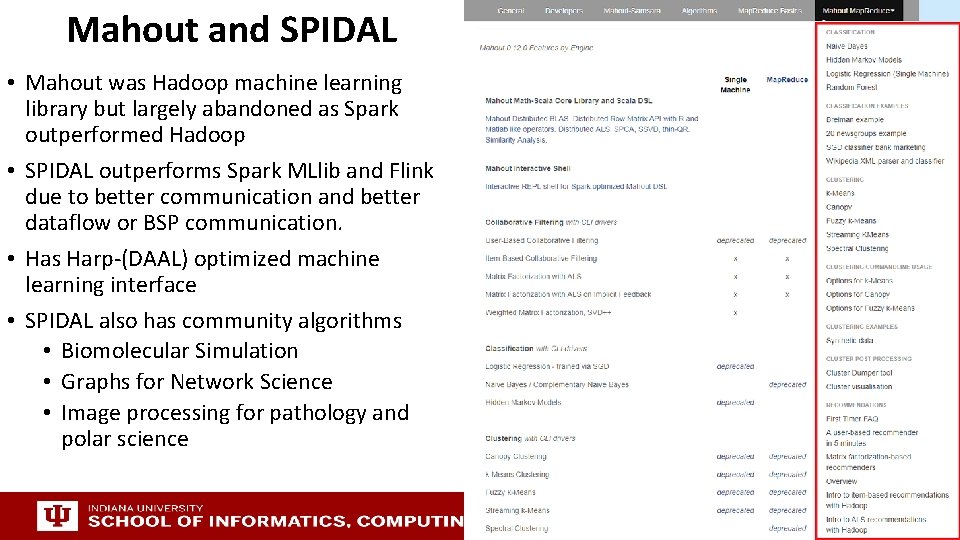
Mahout and SPIDAL • Mahout was Hadoop machine learning library but largely abandoned as Spark outperformed Hadoop • SPIDAL outperforms Spark MLlib and Flink due to better communication and better dataflow or BSP communication. • Has Harp-(DAAL) optimized machine learning interface • SPIDAL also has community algorithms • Biomolecular Simulation • Graphs for Network Science • Image processing for pathology and polar science 18
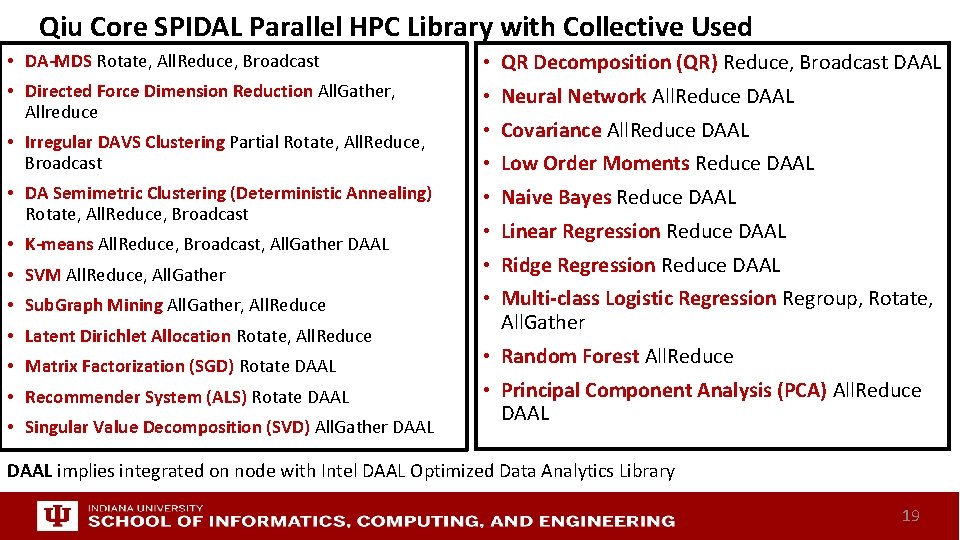
Qiu Core SPIDAL Parallel HPC Library with Collective Used • DA-MDS Rotate, All. Reduce, Broadcast • QR Decomposition (QR) Reduce, Broadcast DAAL • Directed Force Dimension Reduction All. Gather, Allreduce • Neural Network All. Reduce DAAL • Irregular DAVS Clustering Partial Rotate, All. Reduce, Broadcast • DA Semimetric Clustering (Deterministic Annealing) Rotate, All. Reduce, Broadcast • K-means All. Reduce, Broadcast, All. Gather DAAL • SVM All. Reduce, All. Gather • Sub. Graph Mining All. Gather, All. Reduce • Latent Dirichlet Allocation Rotate, All. Reduce • Matrix Factorization (SGD) Rotate DAAL • Recommender System (ALS) Rotate DAAL • Singular Value Decomposition (SVD) All. Gather DAAL • Covariance All. Reduce DAAL • Low Order Moments Reduce DAAL • Naive Bayes Reduce DAAL • Linear Regression Reduce DAAL • Ridge Regression Reduce DAAL • Multi-class Logistic Regression Regroup, Rotate, All. Gather • Random Forest All. Reduce • Principal Component Analysis (PCA) All. Reduce DAAL implies integrated on node with Intel DAAL Optimized Data Analytics Library 19
http: //www. iterativemapreduce. org/ Implementing Twister 2 in detail I This breaks rule from 2012 -2017 of not “competing” with but rather “enhancing” Apache 3/2/2021 20
Twister 2: “Next Generation Grid - Edge – HPC Cloud” Programming Environment • Analyze the runtime of existing systems • Hadoop, Spark, Flink, Pregel Big Data Processing • Open. Whisk and commercial Faa. S • Storm, Heron, Apex Streaming Dataflow • Kepler, Pegasus, Ni. Fi workflow systems • Harp Map-Collective, MPI and HPC AMT runtime like DARMA • And approaches such as Grid. FTP and CORBA/HLA (!) for wide area data links • A lot of confusion coming from different communities (database, distributed, parallel computing, machine learning, computational/ data science) investigating similar ideas with little knowledge exchange and mixed up (unclear) requirements http: //www. iterativemapreduce. org/ 21
Integrating HPC and Apache Programming Environments • Harp-DAAL with a kernel Machine Learning library exploiting the Intel node library DAAL and HPC communication collectives within the Hadoop ecosystem. The broad applicability of Harp. DAAL is supporting all 5 classes of data-intensive computation, from pleasingly parallel to machine learning and simulations. • Twister 2 is a toolkit of components that can be packaged in different ways • Integrated batch or streaming data capabilities familiar from Apache Hadoop, Spark, Heron and Flink but with high performance. • Separate bulk synchronous and data flow communication; • Task management as in Mesos, Yarn and Kubernetes • Dataflow graph execution models • Launching of the Harp-DAAL library • Streaming and repository data access interfaces, • In-memory databases and fault tolerance at dataflow nodes. (use RDD to do classic checkpoint-restart) 22
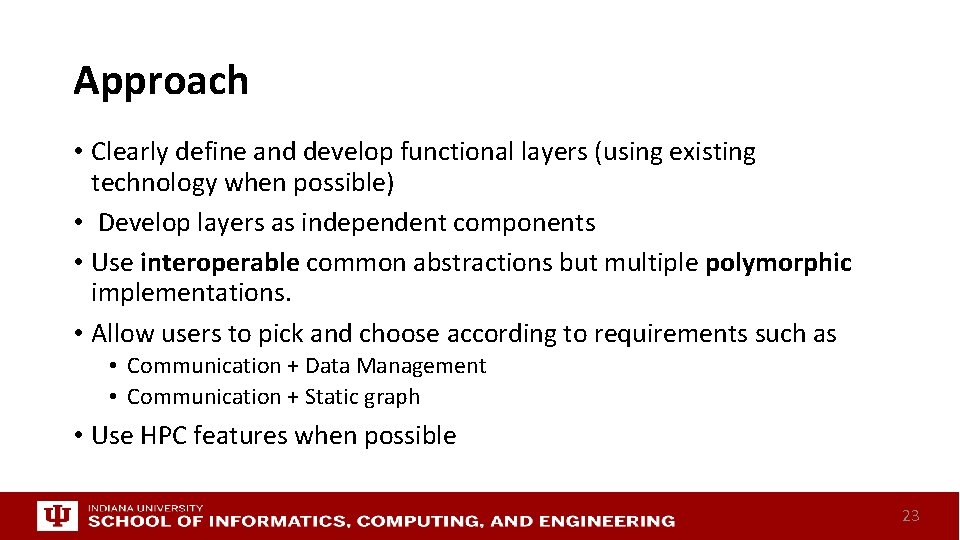
Approach • Clearly define and develop functional layers (using existing technology when possible) • Develop layers as independent components • Use interoperable common abstractions but multiple polymorphic implementations. • Allow users to pick and choose according to requirements such as • Communication + Data Management • Communication + Static graph • Use HPC features when possible 23
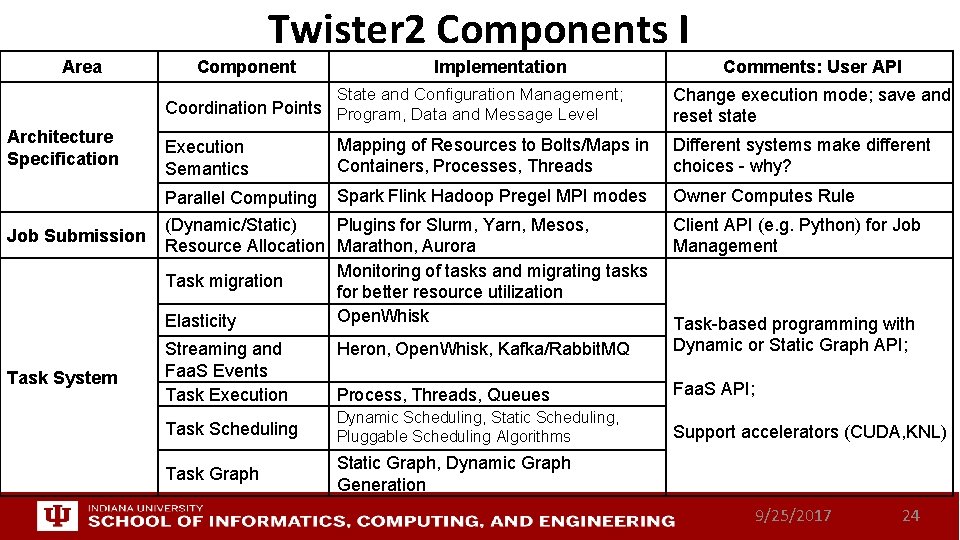
Twister 2 Components I Area Component Implementation State and Configuration Management; Coordination Points Program, Data and Message Level Architecture Specification Job Submission Task System Execution Semantics Mapping of Resources to Bolts/Maps in Containers, Processes, Threads Parallel Computing Spark Flink Hadoop Pregel MPI modes (Dynamic/Static) Plugins for Slurm, Yarn, Mesos, Resource Allocation Marathon, Aurora Monitoring of tasks and migrating tasks Task migration for better resource utilization Open. Whisk Elasticity Comments: User API Change execution mode; save and reset state Different systems make different choices - why? Owner Computes Rule Client API (e. g. Python) for Job Management Heron, Open. Whisk, Kafka/Rabbit. MQ Task-based programming with Dynamic or Static Graph API; Process, Threads, Queues Faa. S API; Task Scheduling Dynamic Scheduling, Static Scheduling, Pluggable Scheduling Algorithms Support accelerators (CUDA, KNL) Task Graph Static Graph, Dynamic Graph Generation Streaming and Faa. S Events Task Execution 9/25/2017 24

Area Twister 2 Components II Component Messages Dataflow Communication API Data Access Implementation Heron Fine-Grain Twister 2 Dataflow communications: MPI, TCP and RMA Coarse grain Dataflow from Ni. Fi, Kepler? BSP Communication Conventional MPI, Harp Map-Collective Static (Batch) Data File Systems, No. SQL, SQL Message Brokers, Spouts Streaming Data Relaxed Distributed Shared Distributed Data Set Memory(immutable data), Mutable Distributed Data Upstream (streaming) backup; Fault Tolerance Check Pointing Lightweight; Coordination Points; Spark/Flink, MPI and Heron models Storage, Messaging, Research needed Security execution Data Management Comments This is user level and could map to multiple communication systems Streaming, ETL data pipelines; Define new Dataflow communication API and library MPI Point to Point and Collective API Data Transformation API; Spark RDD, Heron Streamlet Streaming and batch cases distinct; Crosses all components Crosses all Components 9/25/2017 25
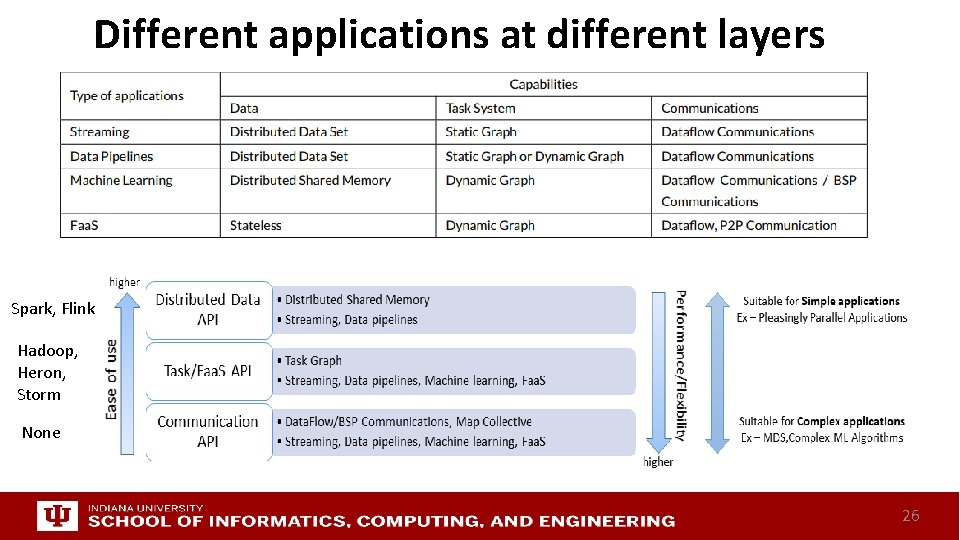
Different applications at different layers Spark, Flink Hadoop, Heron, Storm None 26
http: //www. iterativemapreduce. org/ Implementing Twister 2 in detail II Look at Communication in detail 3/2/2021 27
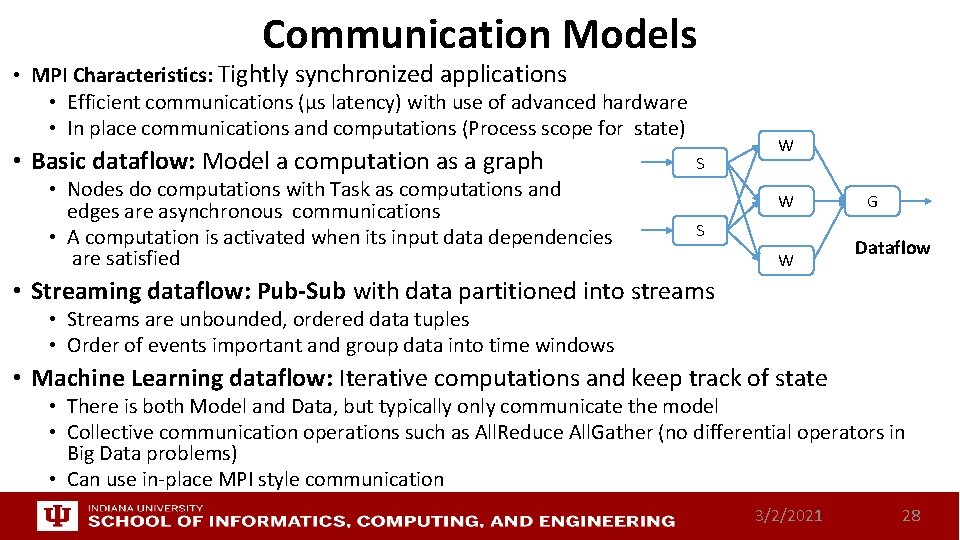
Communication Models • MPI Characteristics: Tightly synchronized applications • Efficient communications (µs latency) with use of advanced hardware • In place communications and computations (Process scope for state) • Basic dataflow: Model a computation as a graph • Nodes do computations with Task as computations and edges are asynchronous communications • A computation is activated when its input data dependencies are satisfied S W W S W G Dataflow • Streaming dataflow: Pub-Sub with data partitioned into streams • Streams are unbounded, ordered data tuples • Order of events important and group data into time windows • Machine Learning dataflow: Iterative computations and keep track of state • There is both Model and Data, but typically only communicate the model • Collective communication operations such as All. Reduce All. Gather (no differential operators in Big Data problems) • Can use in-place MPI style communication 3/2/2021 28
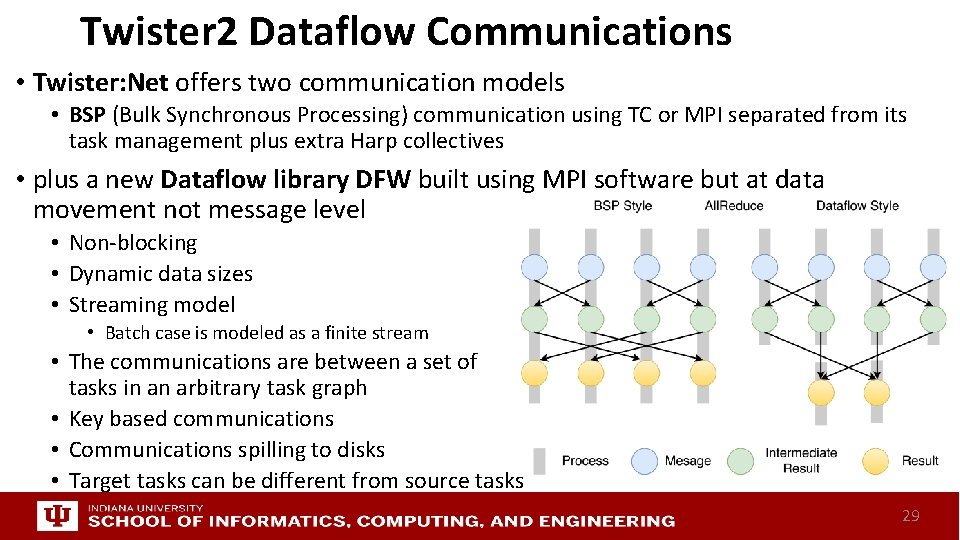
Twister 2 Dataflow Communications • Twister: Net offers two communication models • BSP (Bulk Synchronous Processing) communication using TC or MPI separated from its task management plus extra Harp collectives • plus a new Dataflow library DFW built using MPI software but at data movement not message level • Non-blocking • Dynamic data sizes • Streaming model • Batch case is modeled as a finite stream • The communications are between a set of tasks in an arbitrary task graph • Key based communications • Communications spilling to disks • Target tasks can be different from source tasks 29
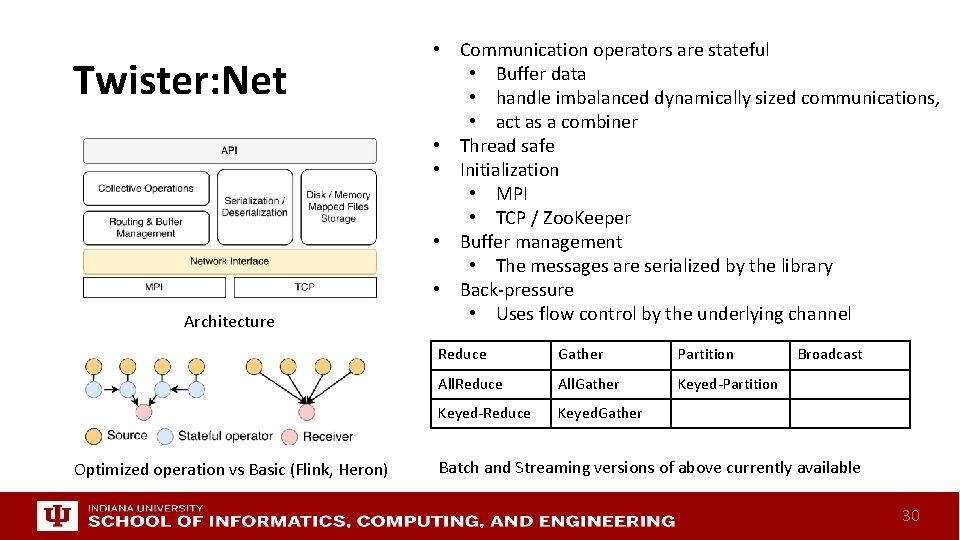
Twister: Net Architecture Optimized operation vs Basic (Flink, Heron) • Communication operators are stateful • Buffer data • handle imbalanced dynamically sized communications, • act as a combiner • Thread safe • Initialization • MPI • TCP / Zoo. Keeper • Buffer management • The messages are serialized by the library • Back-pressure • Uses flow control by the underlying channel Reduce Gather Partition All. Reduce All. Gather Keyed-Partition Keyed-Reduce Keyed. Gather Broadcast Batch and Streaming versions of above currently available 30
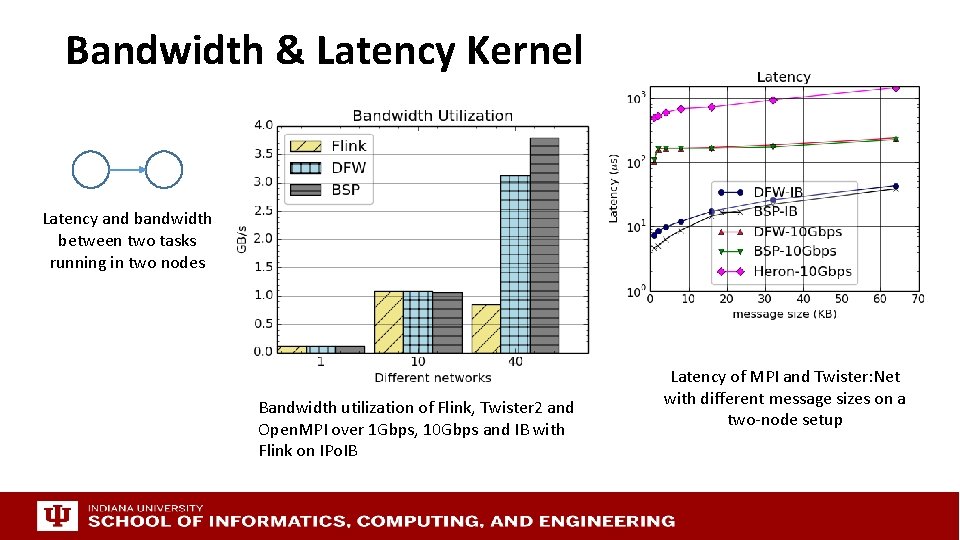
Bandwidth & Latency Kernel Latency and bandwidth between two tasks running in two nodes Bandwidth utilization of Flink, Twister 2 and Open. MPI over 1 Gbps, 10 Gbps and IB with Flink on IPo. IB Latency of MPI and Twister: Net with different message sizes on a two-node setup
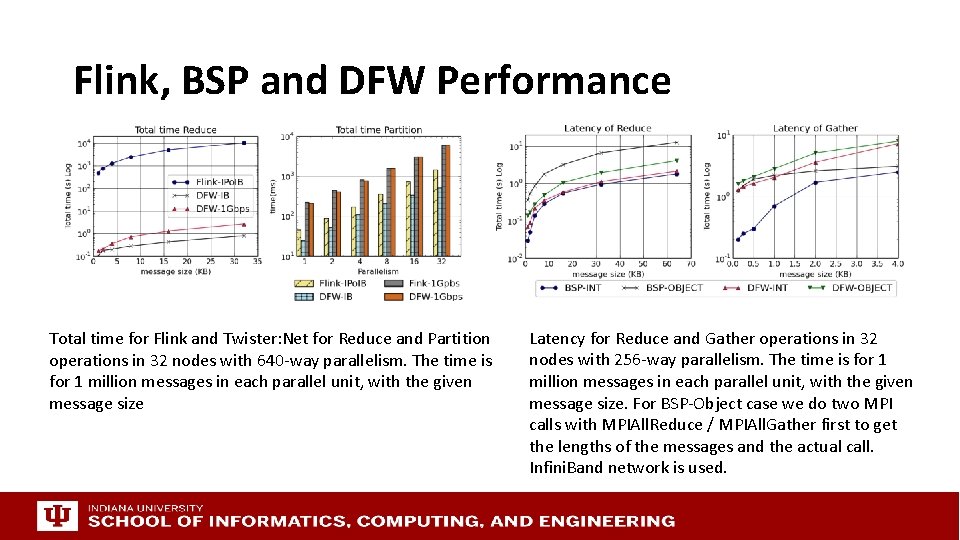
Flink, BSP and DFW Performance Total time for Flink and Twister: Net for Reduce and Partition operations in 32 nodes with 640 -way parallelism. The time is for 1 million messages in each parallel unit, with the given message size Latency for Reduce and Gather operations in 32 nodes with 256 -way parallelism. The time is for 1 million messages in each parallel unit, with the given message size. For BSP-Object case we do two MPI calls with MPIAll. Reduce / MPIAll. Gather first to get the lengths of the messages and the actual call. Infini. Band network is used.
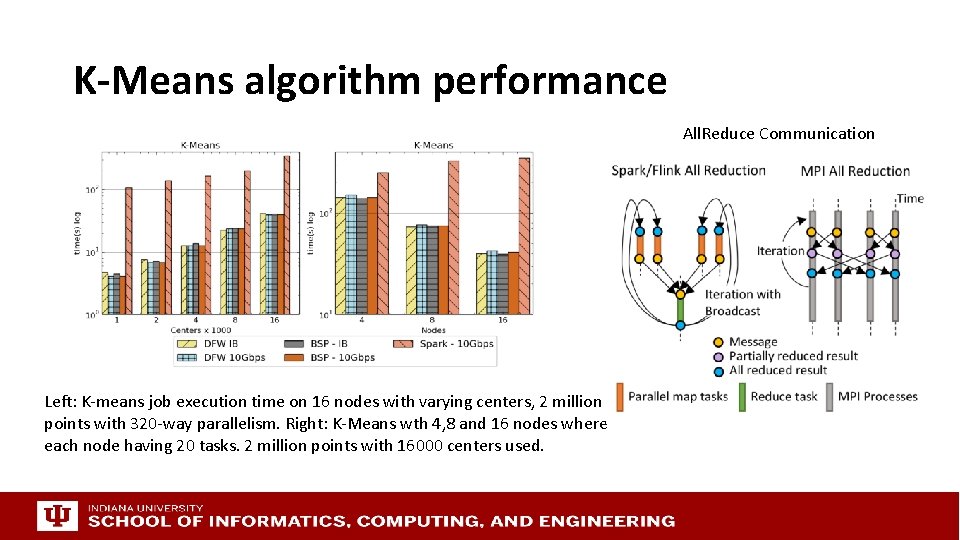
K-Means algorithm performance All. Reduce Communication Left: K-means job execution time on 16 nodes with varying centers, 2 million points with 320 -way parallelism. Right: K-Means wth 4, 8 and 16 nodes where each node having 20 tasks. 2 million points with 16000 centers used.
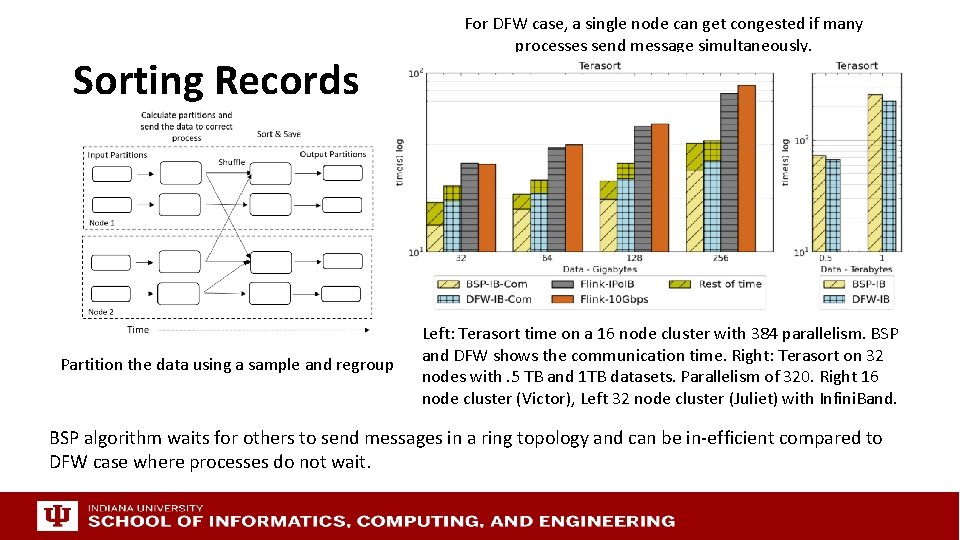
Sorting Records Partition the data using a sample and regroup For DFW case, a single node can get congested if many processes send message simultaneously. Left: Terasort time on a 16 node cluster with 384 parallelism. BSP and DFW shows the communication time. Right: Terasort on 32 nodes with. 5 TB and 1 TB datasets. Parallelism of 320. Right 16 node cluster (Victor), Left 32 node cluster (Juliet) with Infini. Band. BSP algorithm waits for others to send messages in a ring topology and can be in-efficient compared to DFW case where processes do not wait.
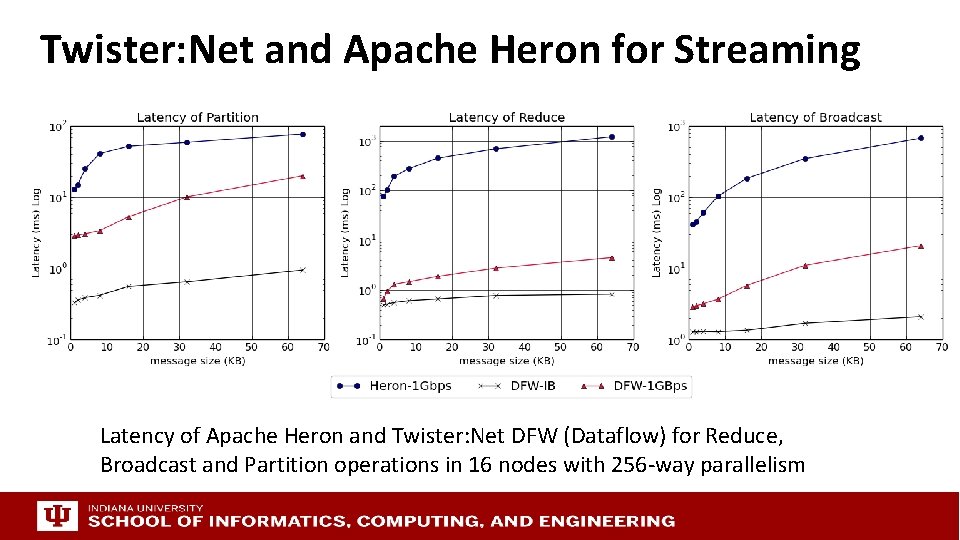
Twister: Net and Apache Heron for Streaming Latency of Apache Heron and Twister: Net DFW (Dataflow) for Reduce, Broadcast and Partition operations in 16 nodes with 256 -way parallelism
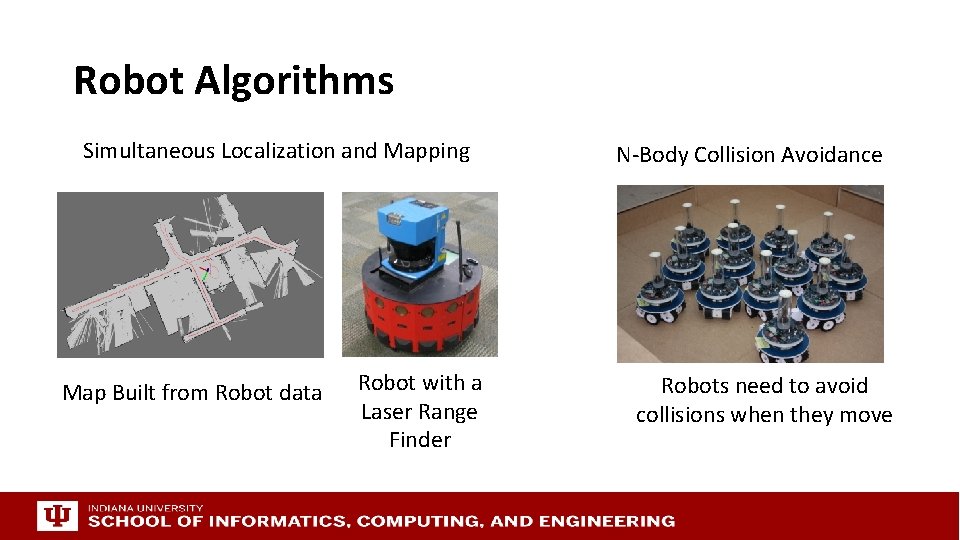
Robot Algorithms Simultaneous Localization and Mapping Map Built from Robot data Robot with a Laser Range Finder N-Body Collision Avoidance Robots need to avoid collisions when they move
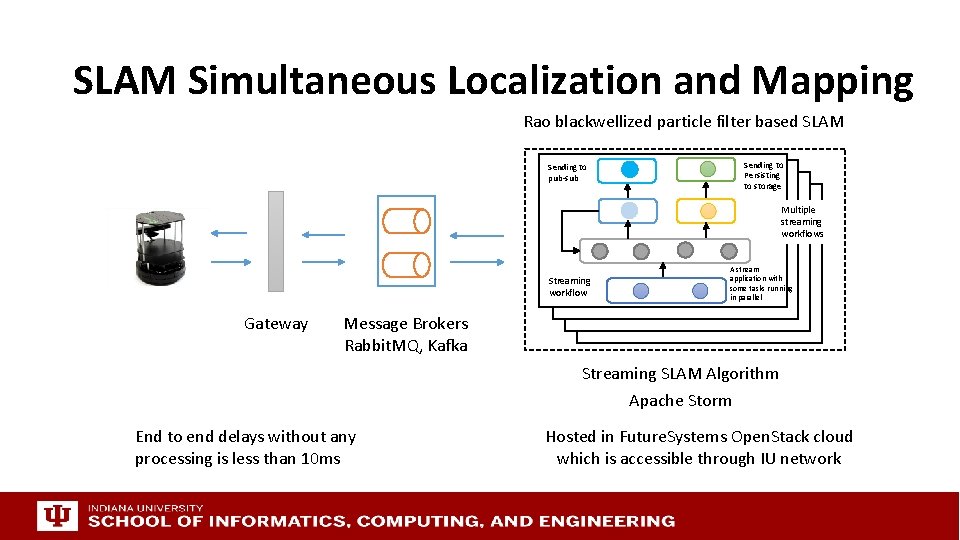
SLAM Simultaneous Localization and Mapping Rao blackwellized particle filter based SLAM Sending to pub-sub Sending to Persisting to storage Multiple streaming workflows Streaming workflow Gateway A stream application with some tasks running in parallel Message Brokers Rabbit. MQ, Kafka Streaming SLAM Algorithm Apache Storm End to end delays without any processing is less than 10 ms Hosted in Future. Systems Open. Stack cloud which is accessible through IU network
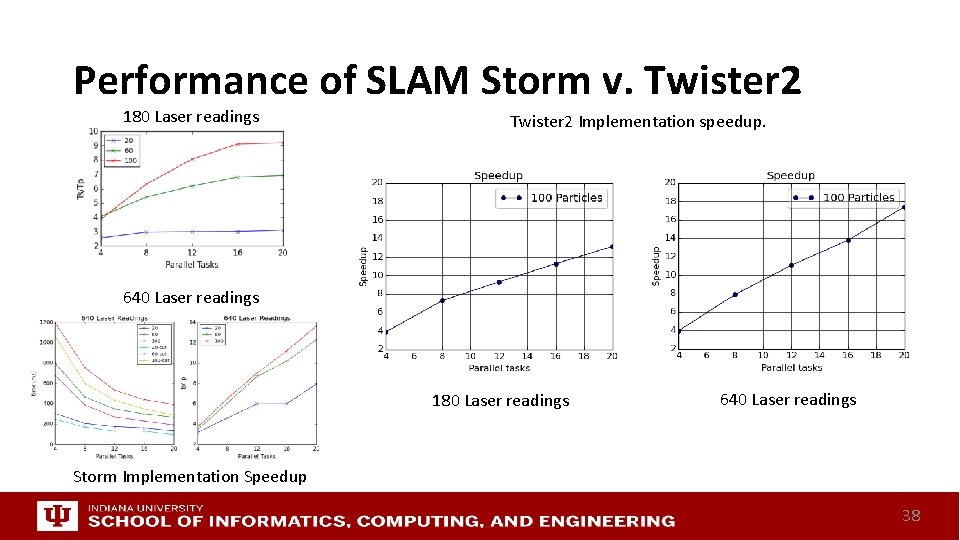
Performance of SLAM Storm v. Twister 2 180 Laser readings Twister 2 Implementation speedup. 640 Laser readings 180 Laser readings 640 Laser readings Storm Implementation Speedup 38
http: //www. iterativemapreduce. org/ Implementing Twister 2 in detail III State 3/2/2021 39
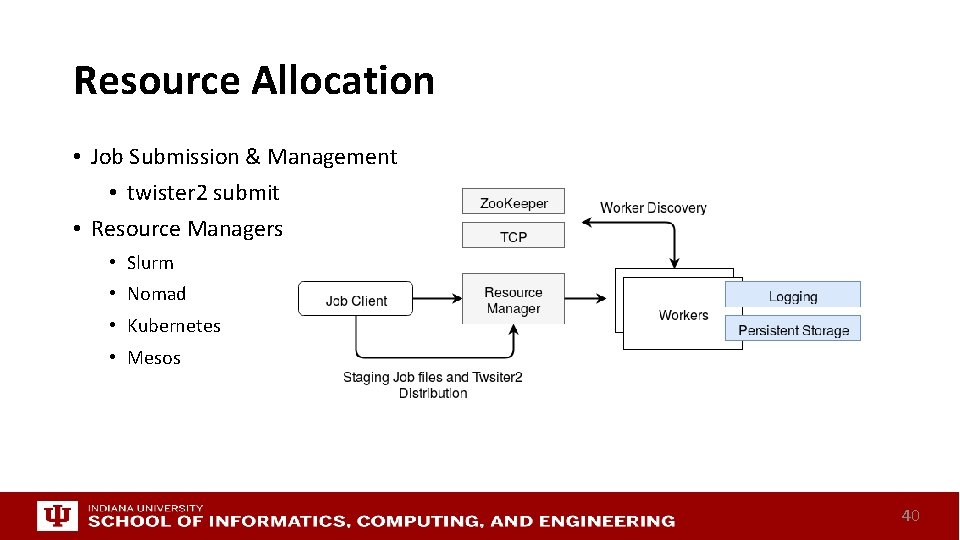
Resource Allocation • Job Submission & Management • twister 2 submit • Resource Managers • Slurm • Nomad • Kubernetes • Mesos 40
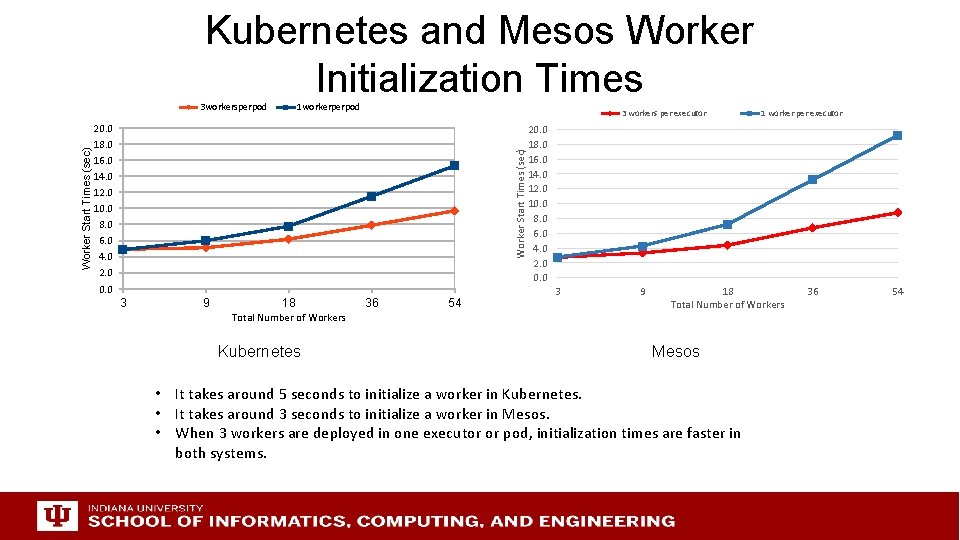
Kubernetes and Mesos Worker Initialization Times 1 workerperpod 3 workers per executor 20. 0 18. 0 16. 0 14. 0 12. 0 10. 0 8. 0 6. 0 4. 0 2. 0 0. 0 Worker Start Times (sec) 3 workersperpod 3 9 18 Total Number of Workers Kubernetes 36 54 1 worker per executor 20. 0 18. 0 16. 0 14. 0 12. 0 10. 0 8. 0 6. 0 4. 0 2. 0 0. 0 3 9 18 Total Number of Workers Mesos • It takes around 5 seconds to initialize a worker in Kubernetes. • It takes around 3 seconds to initialize a worker in Mesos. • When 3 workers are deployed in one executor or pod, initialization times are faster in both systems. 36 54
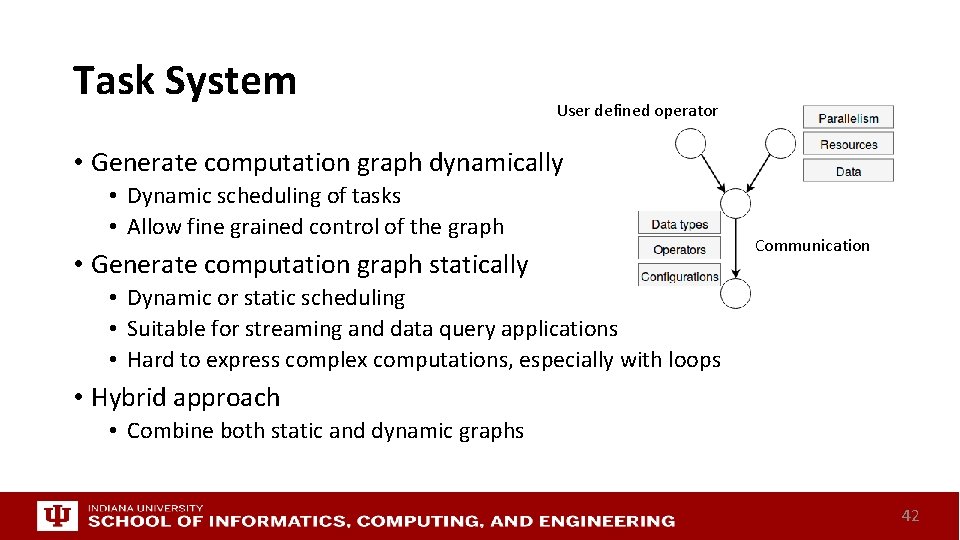
Task System User defined operator • Generate computation graph dynamically • Dynamic scheduling of tasks • Allow fine grained control of the graph • Generate computation graph statically Communication • Dynamic or static scheduling • Suitable for streaming and data query applications • Hard to express complex computations, especially with loops • Hybrid approach • Combine both static and dynamic graphs 42
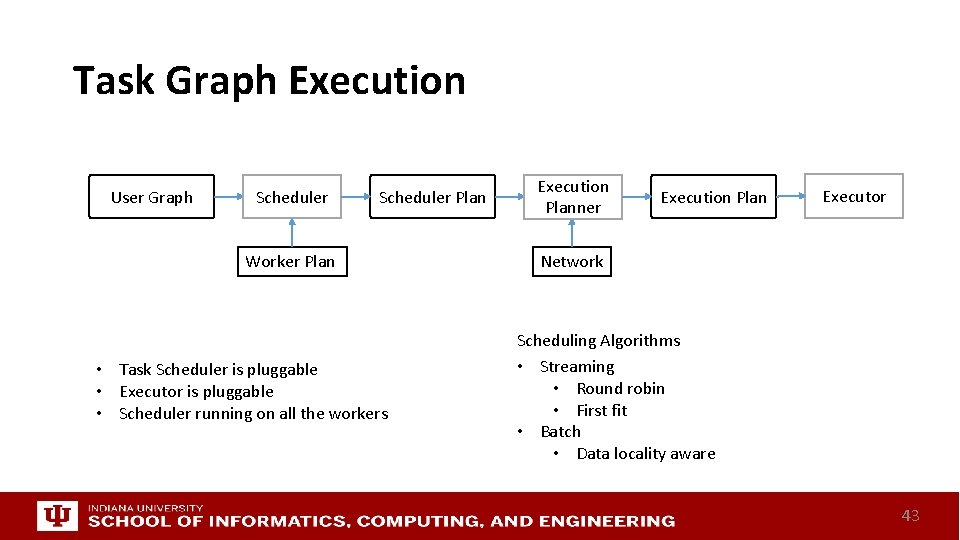
Task Graph Execution User Graph Scheduler Plan Worker Plan • Task Scheduler is pluggable • Executor is pluggable • Scheduler running on all the workers Execution Planner Execution Plan Executor Network Scheduling Algorithms • Streaming • Round robin • First fit • Batch • Data locality aware 43
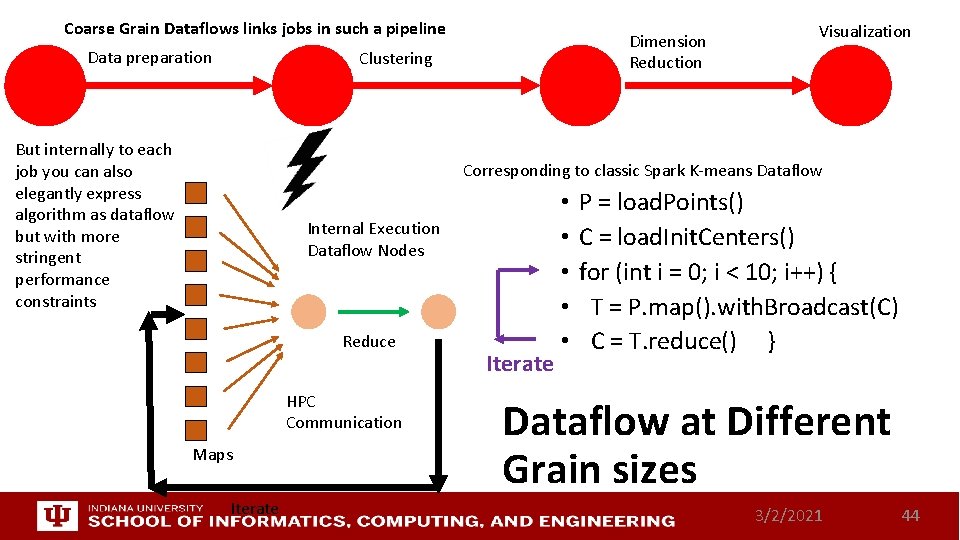
Coarse Grain Dataflows links jobs in such a pipeline Data preparation Dimension Reduction Clustering But internally to each job you can also elegantly express algorithm as dataflow but with more stringent performance constraints Visualization Corresponding to classic Spark K-means Dataflow Internal Execution Dataflow Nodes Reduce HPC Communication Maps Iterate • • • P = load. Points() C = load. Init. Centers() for (int i = 0; i < 10; i++) { T = P. map(). with. Broadcast(C) C = T. reduce() } Dataflow at Different Grain sizes 3/2/2021 44
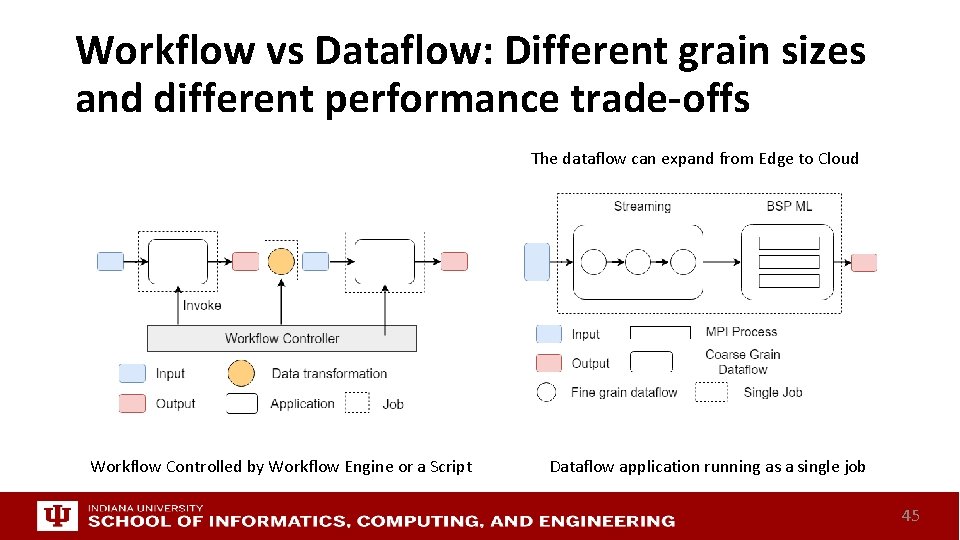
Workflow vs Dataflow: Different grain sizes and different performance trade-offs The dataflow can expand from Edge to Cloud Workflow Controlled by Workflow Engine or a Script Dataflow application running as a single job 45
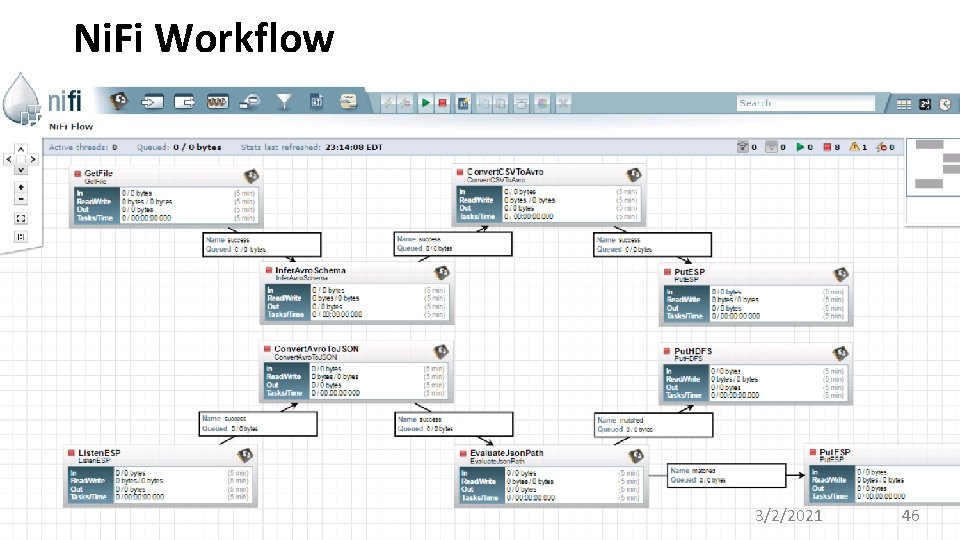
Ni. Fi Workflow 3/2/2021 46
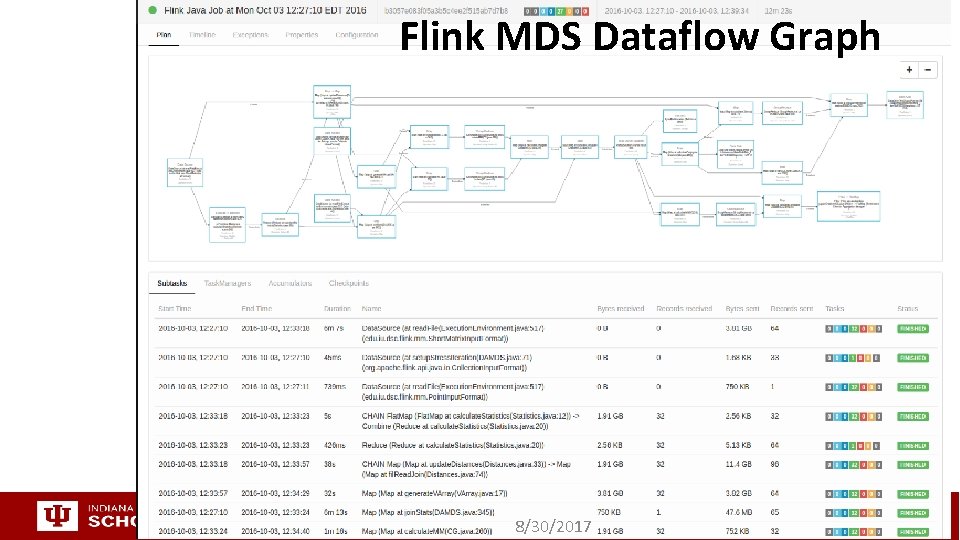
Flink MDS Dataflow Graph 8/30/2017
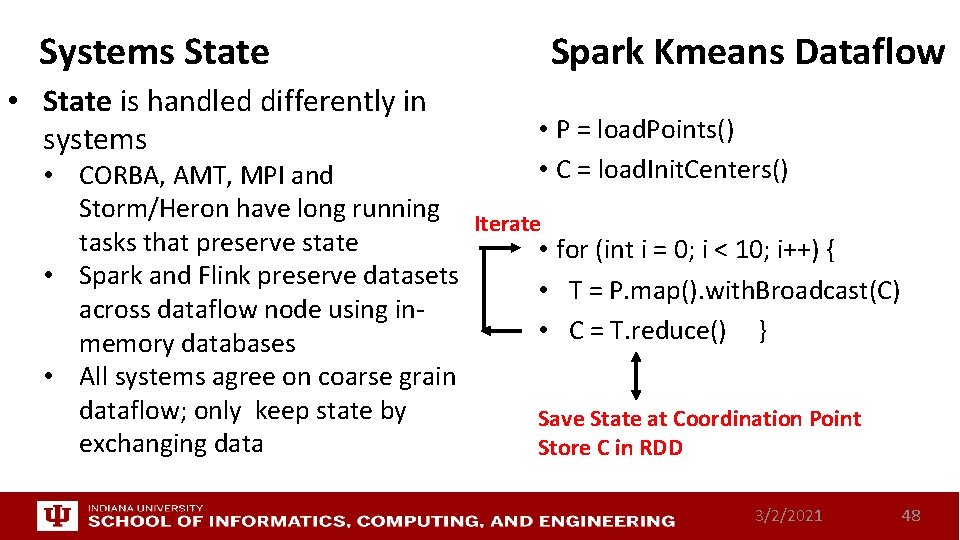
Systems State • State is handled differently in systems Spark Kmeans Dataflow • P = load. Points() • C = load. Init. Centers() • CORBA, AMT, MPI and Storm/Heron have long running Iterate tasks that preserve state • for (int i = 0; i < 10; i++) { • Spark and Flink preserve datasets • T = P. map(). with. Broadcast(C) across dataflow node using in • C = T. reduce() } memory databases • All systems agree on coarse grain dataflow; only keep state by Save State at Coordination Point exchanging data Store C in RDD 3/2/2021 48
Fault Tolerance and State • Similar form of check-pointing mechanism is used already in HPC and Big Data • although HPC informal as doesn’t typically specify as a dataflow graph • Flink and Spark do better than MPI due to use of database technologies; MPI is a bit harder due to richer state but there is an obvious integrated model using RDD type snapshots of MPI style jobs • Checkpoint after each stage of the dataflow graph (at location of intelligent dataflow nodes) • Natural synchronization point • Let’s allows user to choose when to checkpoint (not every stage) • Save state as user specifies; Spark just saves Model state which is insufficient for complex algorithms 3/2/2021 49
http: //www. iterativemapreduce. org/ Implementing Twister 2 Futures 3/2/2021 50
Twister 2 Timeline: End of August 2018 • Twister: Net Dataflow Communication API • Dataflow communications with MPI or TCP • Harp for Machine Learning (Custom BSP Communications) • Rich collectives • Around 30 ML algorithms • HDFS Integration • Task Graph • Streaming - Storm model • Batch analytics - Hadoop • Deployments on Docker, Kubernetes, Mesos (Aurora), Nomad, Slurm 3/2/2021 51
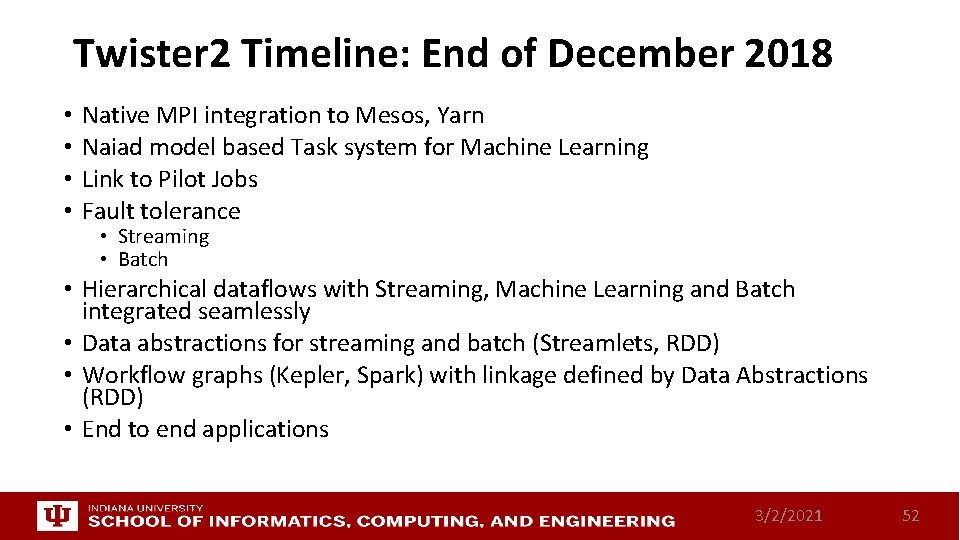
Twister 2 Timeline: End of December 2018 • • Native MPI integration to Mesos, Yarn Naiad model based Task system for Machine Learning Link to Pilot Jobs Fault tolerance • Streaming • Batch • Hierarchical dataflows with Streaming, Machine Learning and Batch integrated seamlessly • Data abstractions for streaming and batch (Streamlets, RDD) • Workflow graphs (Kepler, Spark) with linkage defined by Data Abstractions (RDD) • End to end applications 3/2/2021 52
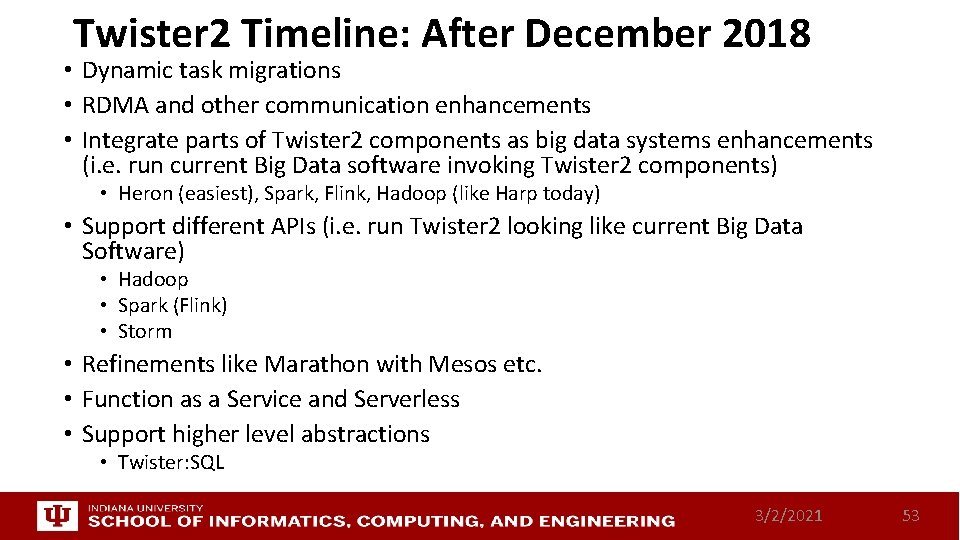
Twister 2 Timeline: After December 2018 • Dynamic task migrations • RDMA and other communication enhancements • Integrate parts of Twister 2 components as big data systems enhancements (i. e. run current Big Data software invoking Twister 2 components) • Heron (easiest), Spark, Flink, Hadoop (like Harp today) • Support different APIs (i. e. run Twister 2 looking like current Big Data Software) • Hadoop • Spark (Flink) • Storm • Refinements like Marathon with Mesos etc. • Function as a Service and Serverless • Support higher level abstractions • Twister: SQL 3/2/2021 53
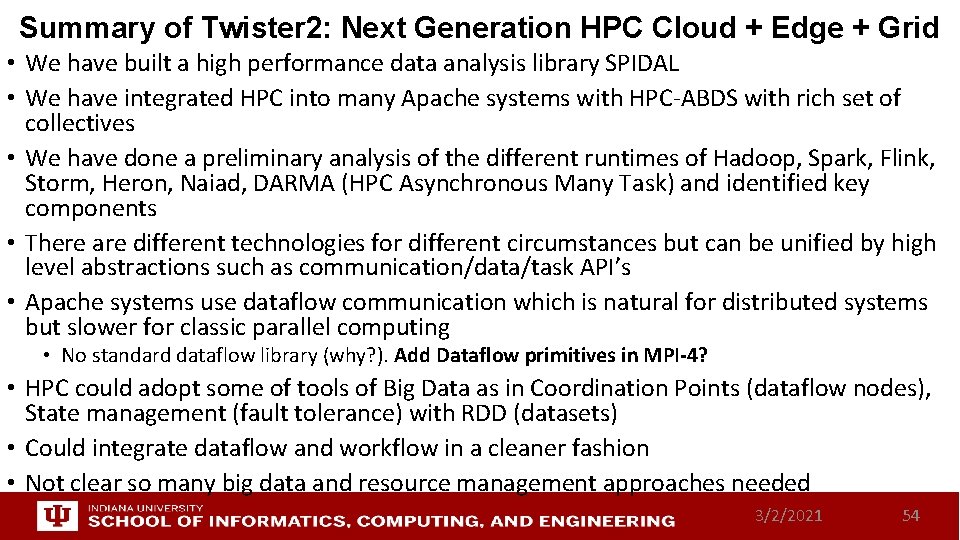
Summary of Twister 2: Next Generation HPC Cloud + Edge + Grid • We have built a high performance data analysis library SPIDAL • We have integrated HPC into many Apache systems with HPC-ABDS with rich set of collectives • We have done a preliminary analysis of the different runtimes of Hadoop, Spark, Flink, Storm, Heron, Naiad, DARMA (HPC Asynchronous Many Task) and identified key components • There are different technologies for different circumstances but can be unified by high level abstractions such as communication/data/task API’s • Apache systems use dataflow communication which is natural for distributed systems but slower for classic parallel computing • No standard dataflow library (why? ). Add Dataflow primitives in MPI-4? • HPC could adopt some of tools of Big Data as in Coordination Points (dataflow nodes), State management (fault tolerance) with RDD (datasets) • Could integrate dataflow and workflow in a cleaner fashion • Not clear so many big data and resource management approaches needed 3/2/2021 54
- Slides: 54