
Twin Studies adoption studies and correlation And how
- Slides: 7
Twin Studies, adoption studies and correlation And how they contribute to our understanding of the learnt/innate debate
Correlation • Correlations show relationships between 2 sets of data. (i. e. how closely they match) • A correlation coefficient is a number between +1 and -1 expressed as a decimal. Eg +0. 86 • The direction of the number ie positive or negative indicates whether the relationship is positive (as one goes up the other goes up) or negative (as one goes up the other goes down) • The nearer to plus or minus one the number is shows how strong the relationship is. • When looking at twin or adoption studies we tend to look for positive relationships as it would be very strange if the closer the biological relationship the more unlike someone we were
Comparing • When we say we compare twins or children with parents we mean on a measurable variable and because we are psychologists this will be something to do with behaviour for example • Intelligence • Aggression • Introversion/extroversion • Sense of humour • Mental illnesses such as depression or schizophrenia Whatever it is you need some kind of test to give both parties that will give a number representing a behaviour
Twin studies With twin studies there are 2 methods 1. comparing concordance rates of Monozygotic twins with Dyzygotic twins (IQ) • Eg • MZ 0. 86 • DZ 0. 46 What does this indicate? . 2. Comparing Monozygotic twins reared together with monozygotic twins reared apart Eg Together 0. 86 Apart 0. 74 What does this indicate?
Adoption studies • With adoption studies we tend to compare the adopted child with the biological mother and the adoptive mother to see which correlation coefficient is highest • E. g. • Child and adoptive mother 0. 42 • Child and biological mother 0. 72
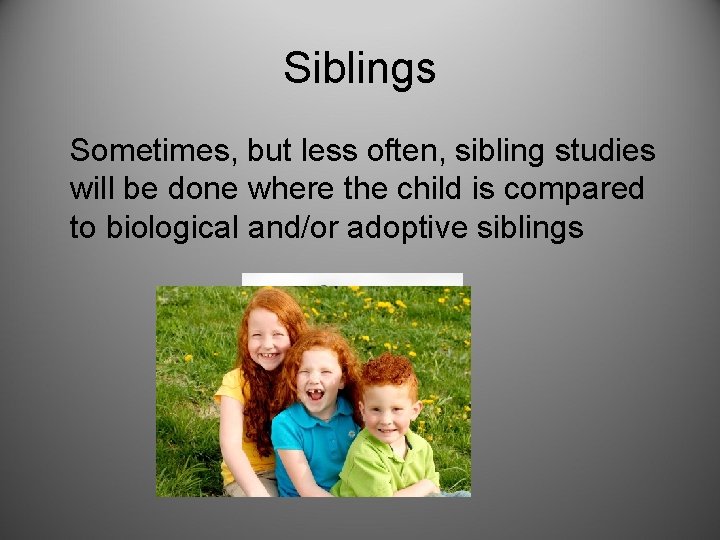
Siblings Sometimes, but less often, sibling studies will be done where the child is compared to biological and/or adoptive siblings
Problems In general the problem is that there are so many variables that come into play when comparing families. This is especially the case when it comes to adoption and reared apart twin studies. There will always be some level of choice in the families chosen by researchers which may create a bias towards what the scientist is trying to show. i. e. support for the learnt or innate debate. Scientists are not meant to favour one outcome when doing research but in this hotly debated topic they sometimes do.