
TWIN PREGNANCY ASSOCIATE PROFESSOR Blidaru IolandaElena MD Ph
TWIN PREGNANCY ASSOCIATE PROFESSOR Blidaru Iolanda-Elena, MD, Ph. D.
TWIN PREGNANCY ♣ a high-risk pregnancy early and excessive distension of the uterus inappropriate uterine contractility sharing the intracavitary space and placental nutrition IUGR abnormal fetal presentation placenta praevia velamentous insertion of the cord prematurity, HTA, caesarian section
TWIN PREGNANCY Incidence multiple gestations → 12% of total conceptions 14% of these survive to term THE “VANISHING TWIN” - before the 2 -nd trimester (20 -60%) no evidence no risk
TWIN PREGNANCY Clasification Monozygotic = identical twins - a single fertilized ovum Dizygotic = fraternal twins - two separate ova - variable rate - 1. 3 (Japan) - 49. 0 (Nigeria)/ 1000 births - Recessive autosomal trait (female line)
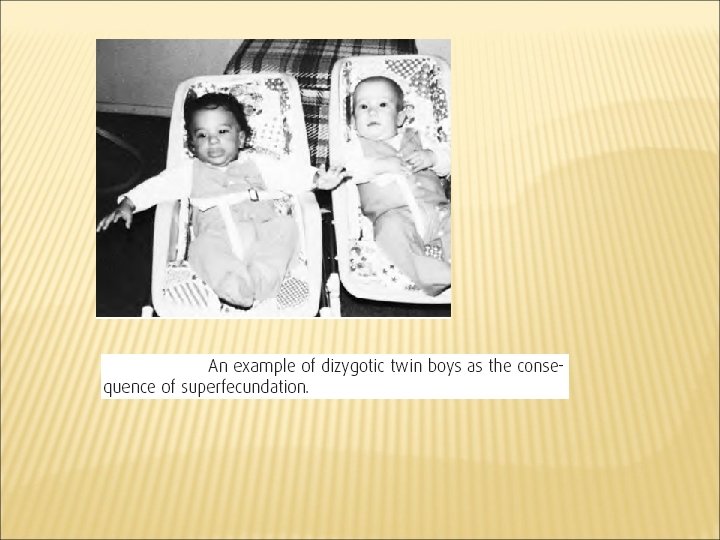
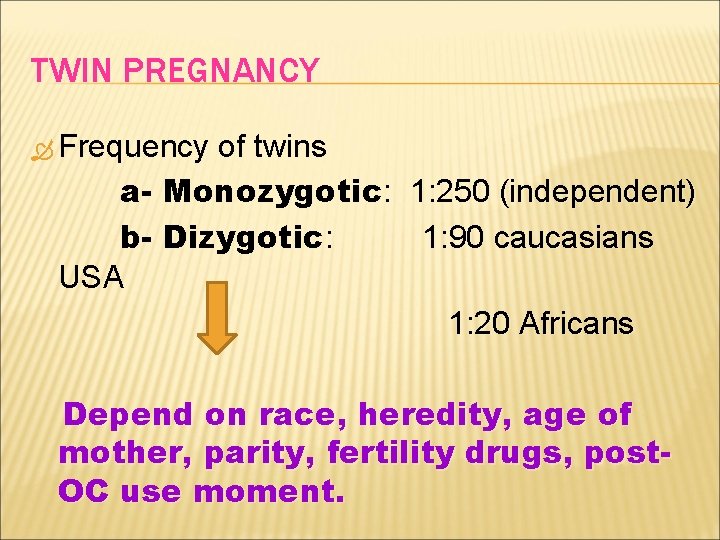
TWIN PREGNANCY Frequency of twins a- Monozygotic: 1: 250 (independent) b- Dizygotic: 1: 90 caucasians USA 1: 20 Africans Depend on race, heredity, age of mother, parity, fertility drugs, post. OC use moment.
TWIN PREGNANCY Etiology – FSH LEVELS 1. 2. 3. 4. 5. 6. Race - high in blacks, less in Asians Heredity - mother more important than father Age - peak incidence → 30 -40 years Parity Drugs - inductors of ovulation Assisted Reproductive Techniques (ART)
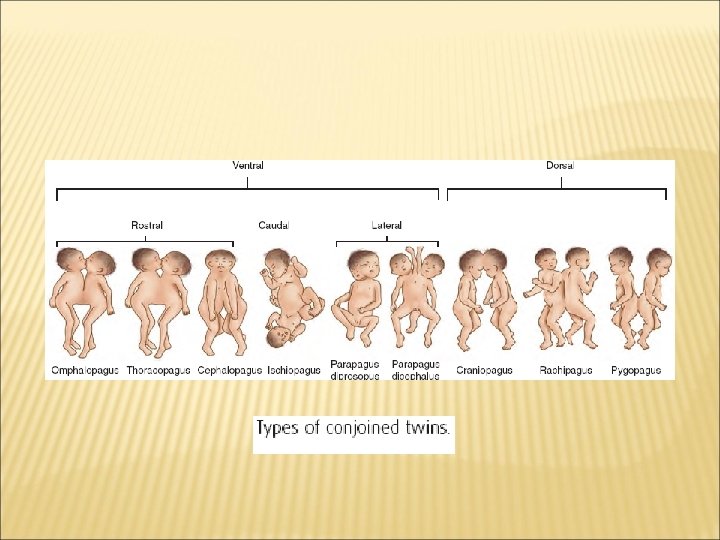
TWIN PREGNANCY DIVISION Ø First 72 hours two embryos, diamniotic, dichorionic. Ø 4 -8 days two embryos, diamniotic, monochorionic. Ø About 8 - 14 days two embryos, monoamniotic, monochorionic. Ø After 14 days cleavage is incomplete, conjoined twins.
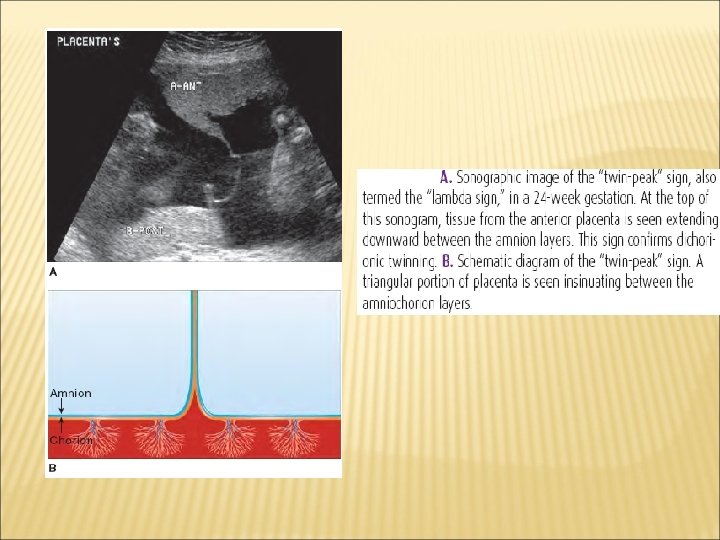
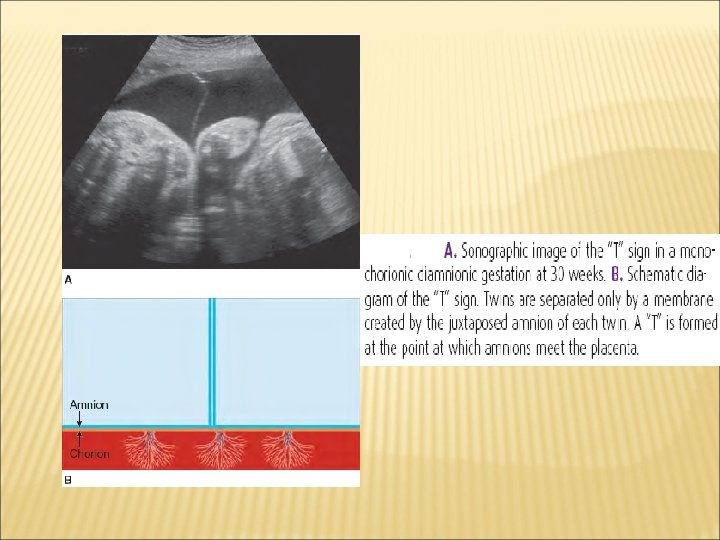
TWIN PREGNANCY Determination of ZYGOSITY and CHORIONICITY US evaluation of chorionicity “twin peak” sign, ”T” sign fetal gender placental examination
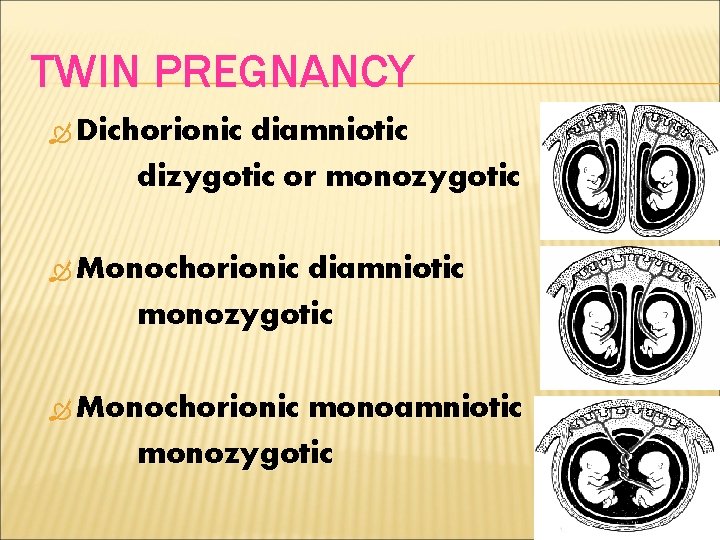
TWIN PREGNANCY Dichorionic diamniotic dizygotic or monozygotic Monochorionic diamniotic monozygotic Monochorionic monoamniotic monozygotic
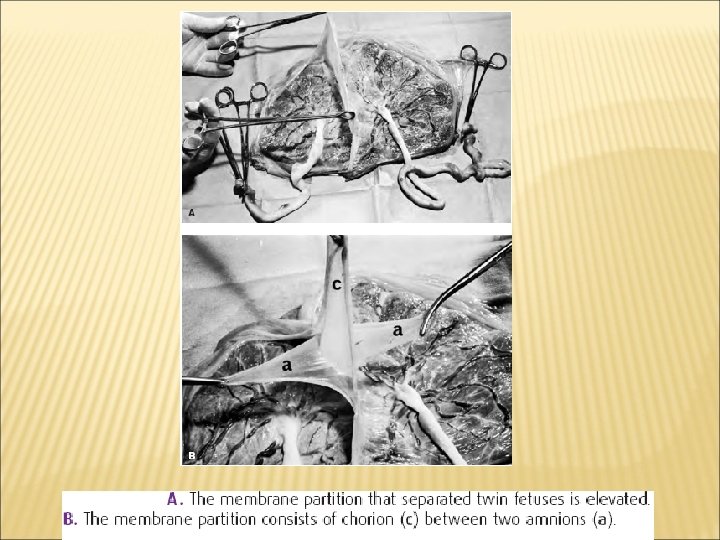
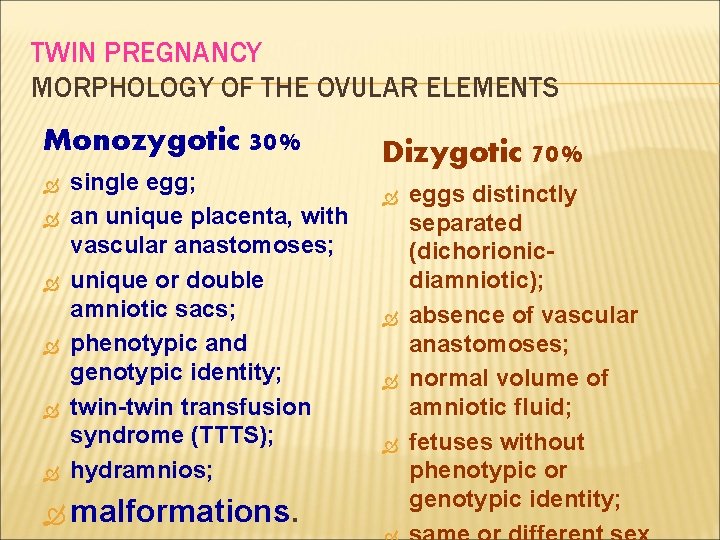
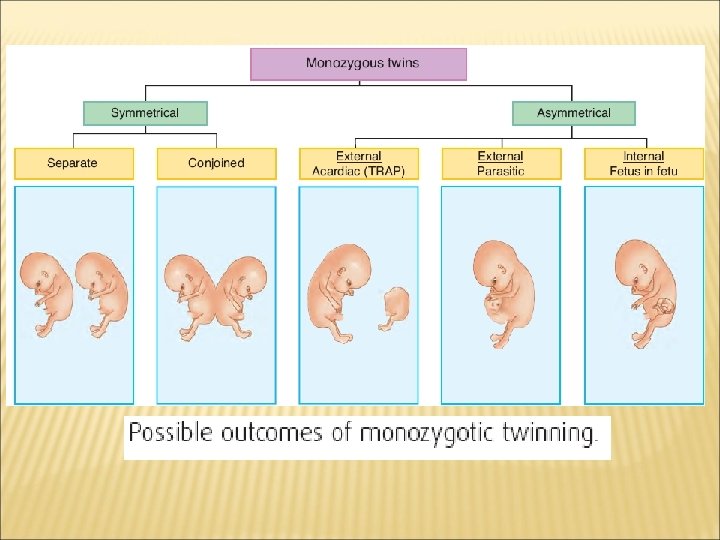
TWIN PREGNANCY MORPHOLOGY OF THE OVULAR ELEMENTS Monozygotic 30% single egg; an unique placenta, with vascular anastomoses; unique or double amniotic sacs; phenotypic and genotypic identity; twin-twin transfusion syndrome (TTTS); hydramnios; malformations. Dizygotic 70% eggs distinctly separated (dichorionicdiamniotic); absence of vascular anastomoses; normal volume of amniotic fluid; fetuses without phenotypic or genotypic identity;
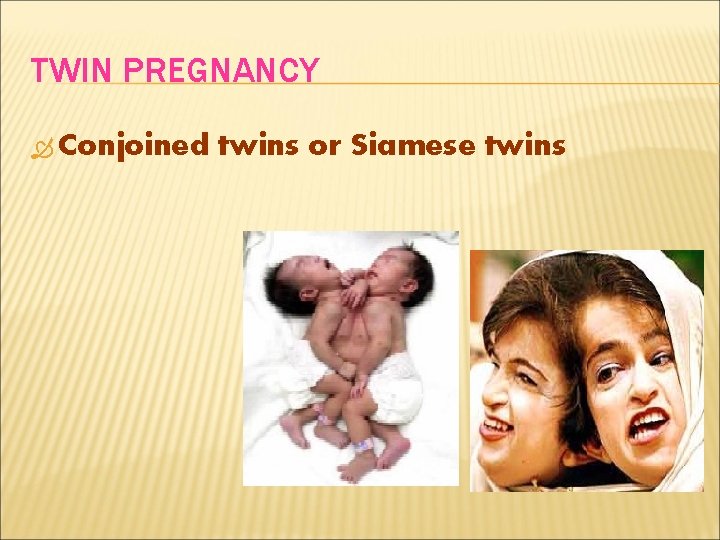
TWIN PREGNANCY Conjoined twins or Siamese twins
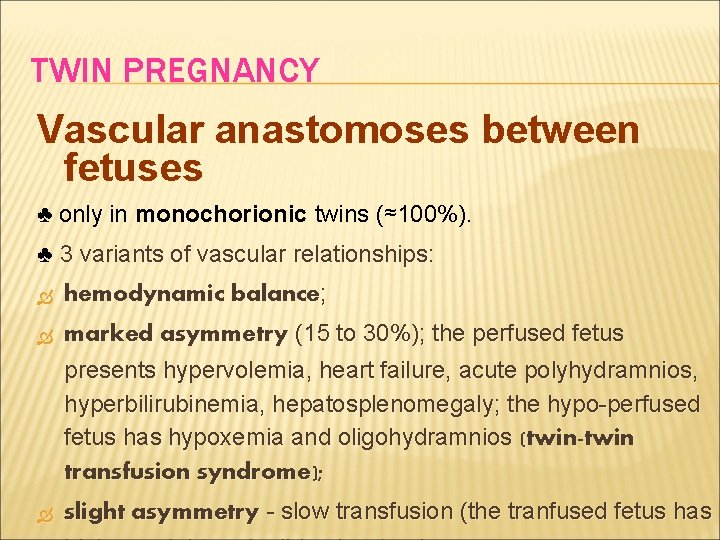
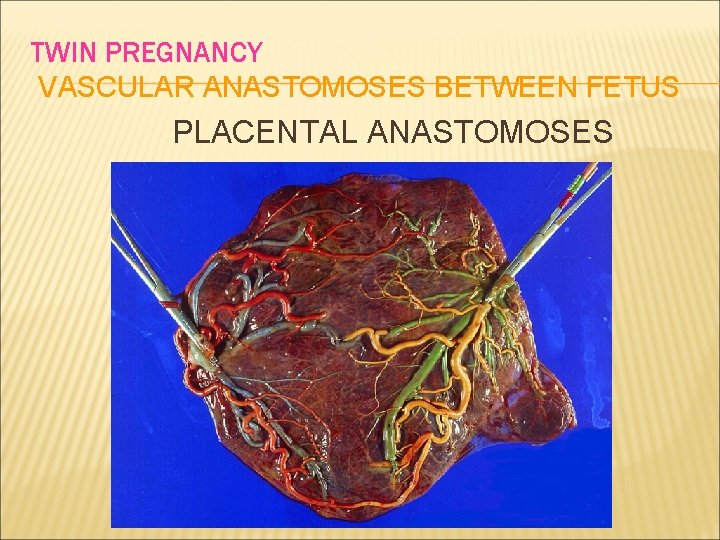
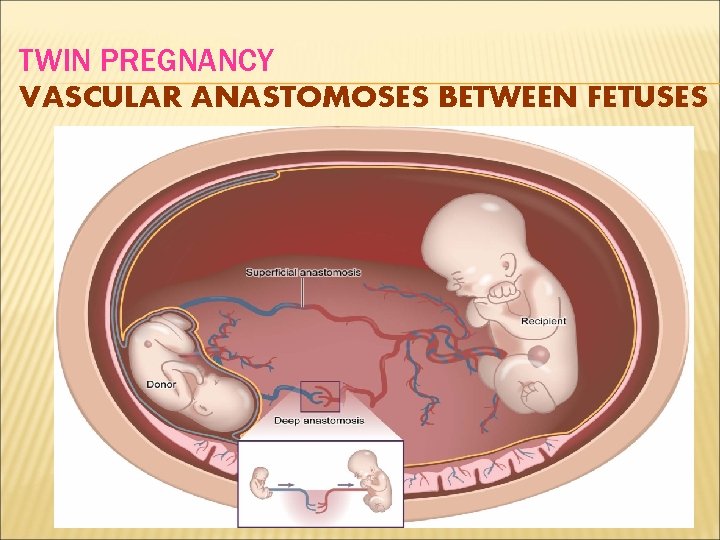
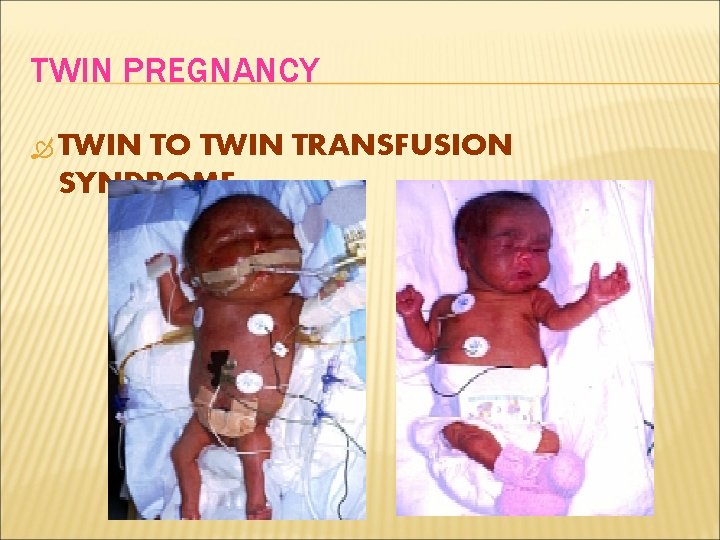
TWIN PREGNANCY Vascular anastomoses between fetuses ♣ only in monochorionic twins (≈100%). ♣ 3 variants of vascular relationships: hemodynamic balance; marked asymmetry (15 to 30%); the perfused fetus presents hypervolemia, heart failure, acute polyhydramnios, hyperbilirubinemia, hepatosplenomegaly; the hypo-perfused fetus has hypoxemia and oligohydramnios (twin-twin transfusion syndrome); slight asymmetry - slow transfusion (the tranfused fetus has
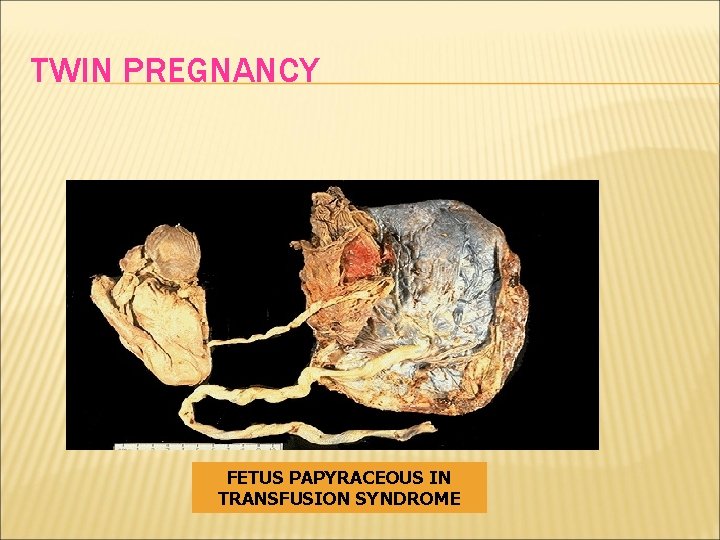
TWIN PREGNANCY TWIN TO TWIN TRANSFUSION SYNDROME (TTTS) Due to the common placental circulation and the anastomosis of the 2 fetal circulations FETUS PAPYRACEOUS One will regress in size, with oligohydramnios in its sac (if 2 sacs), may perish; then becomes dehydrated and mummified.
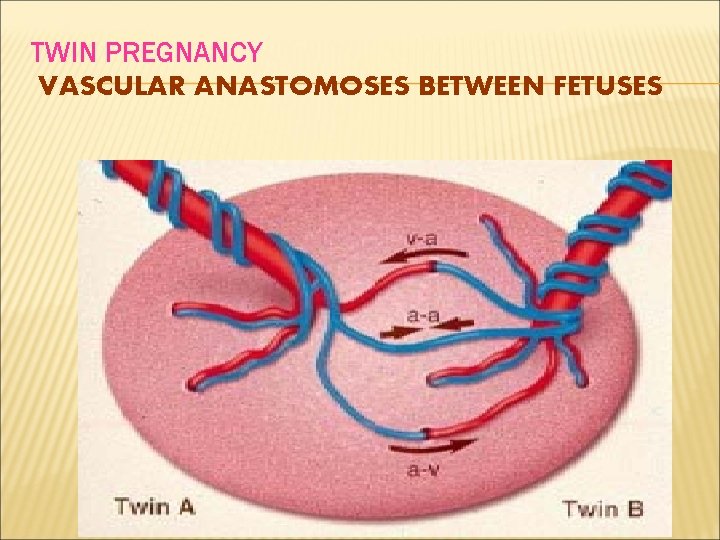
TWIN PREGNANCY VASCULAR ANASTOMOSES BETWEEN FETUSES
TWIN PREGNANCY VASCULAR ANASTOMOSES BETWEEN FETUS PLACENTAL ANASTOMOSES
TWIN PREGNANCY VASCULAR ANASTOMOSES BETWEEN FETUSES
TWIN PREGNANCY FETUS PAPYRACEOUS IN TRANSFUSION SYNDROME
TWIN PREGNANCY TWIN TO TWIN TRANSFUSION SYNDROME
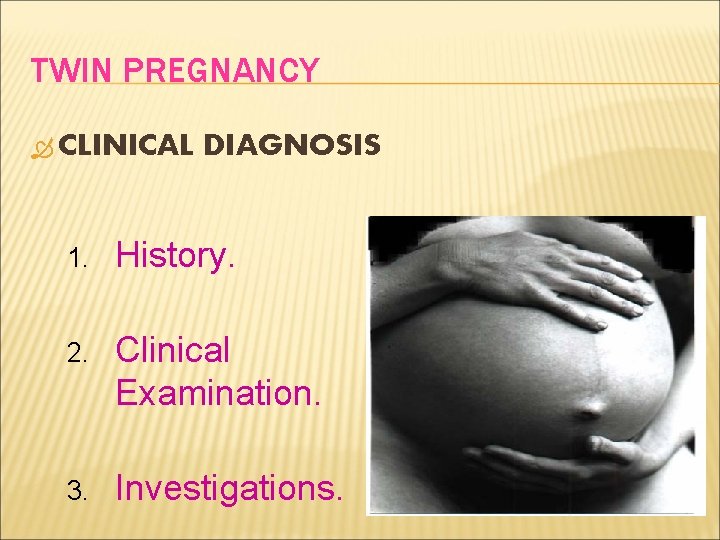
TWIN PREGNANCY CLINICAL DIAGNOSIS 1. History. 2. Clinical Examination. 3. Investigations.
TWIN PREGNANCY HISTORY Family history (maternal side) History of ovulation induction High parity Advanced maternal age Greater weight gain than expected Abdominal size >duration of amenorrhea Pressure symptoms (dyspnea, dyspepsia) Marked edema of lower limb.
TWIN PREGNANCY CLINICAL EXAMINATION ●Uterine size - larger than expected for GA +5 cm (II trim. ) ●Palor, early edema, varicose veins ●Glossy skin, striae, evident colateral circulation. ●Uterine palpation → two fetal heads or multiple similar fetal parts. ●Auscultation of FHS: 2 different sites and different frequency
TWIN PREGNANCY CLINICAL EXAMINATION Bimanual examination a fetal pole, smaller than expected (related to uterine size) sometimes, in hypogastrum the fetal poles can't be detected uterine cervix may be effaced the membranes are under tension.
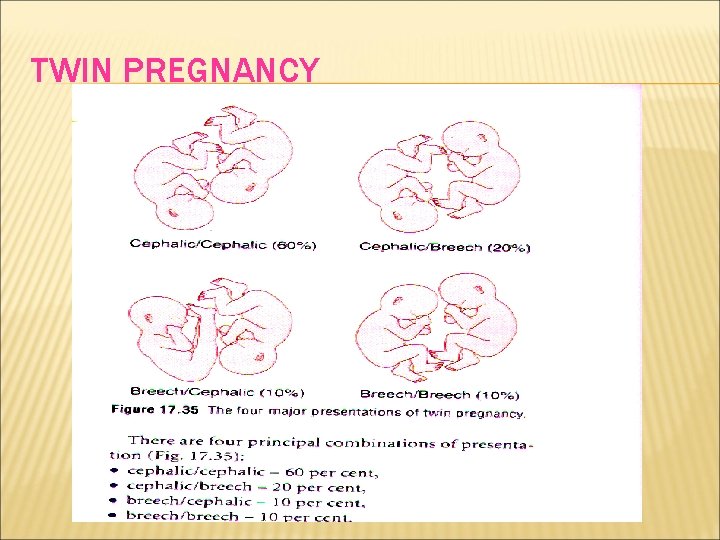
TWIN PREGNANCY
TWIN PREGNANCY INVESTIGATIONS Ultrasound examination → the number of fetuses → type of placentation → fetal size and possible anomalies → presentation, position and relation to each other → fetal well-being and growth pattern for each → guidance to perform some maneuvers: amniocentesis, villous sampling
TWIN PREGNANCY INVESTIGATIONS Biochemical tests 1. h. CG in plasma and in urine 2. AFP level (alone is not diagnostic) 3. estriol 4. HPL
TWIN PREGNANCY Differential diagnosis 1. Hydramnios. 2. Hydatidiform mole. 3. Uterine myomas / ovarian cyst. 4. Fetal macrosomia (single pregnancy) 5. Elevation of the uterus by distended bladder.
TWIN PREGNANCY Maternal responses é é é Cardiac output Plasma volume by 1/3 > singletons Red cell mass 300 ml > singletons Pre-eclampsia 5 -10 times more Postpartum depression ↓Hematocrit and hemoglobin ↓Renal blood flow ↓Iron stores
TWIN PREGNANCY Fetal complications é Spontaneous early pregnancy loss rate é Discordant twins é Twin to twin transfusion syndrome (TTTS) é Intertwining of umbilical cords (monoamniotic twins) é Conjoined twins é Twin-reversed arterial perfusion sequence (TRAP) = acardiac twin é Intrauterine growth restriction (IUGR) é Preterm labour é Cerebral palsy > 3 times > in twins 10 times > in triplets
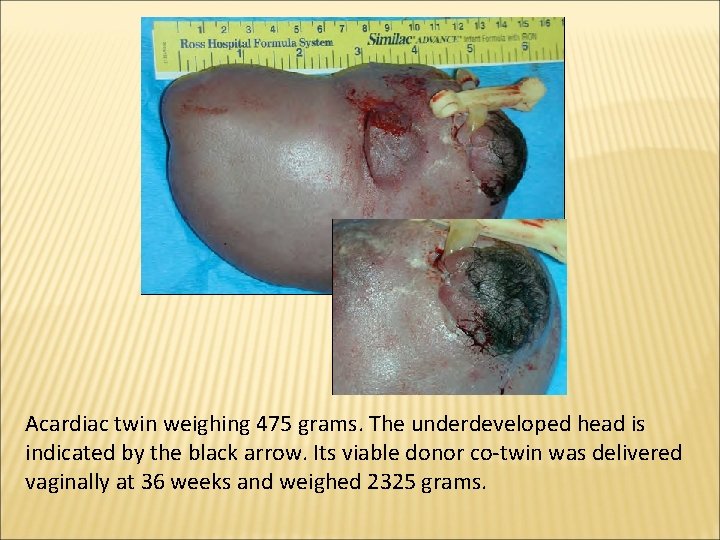
Acardiac twin weighing 475 grams. The underdeveloped head is indicated by the black arrow. Its viable donor co-twin was delivered vaginally at 36 weeks and weighed 2325 grams.
TWIN PREGNANCY The perinatal mortality The principal causes of fetal death - prematurity, - IUGR - prolapsed cord, - infection, - hypoxia during delivery, - malformations, - transfusion syndrome.
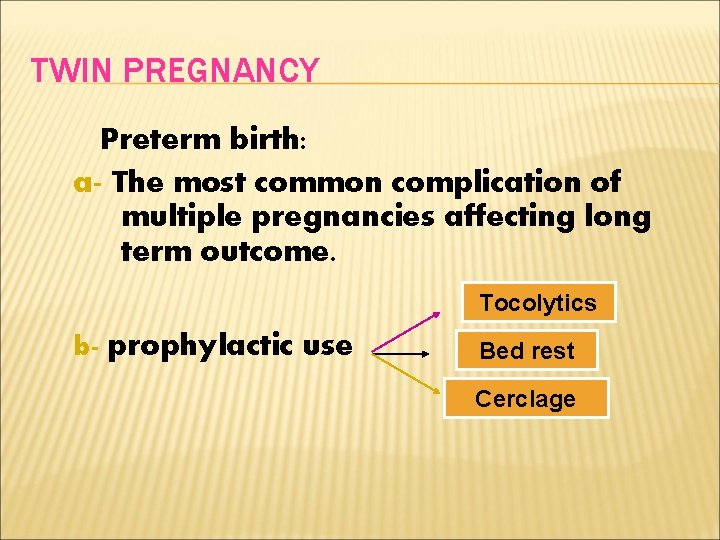
TWIN PREGNANCY Preterm birth: a- The most common complication of multiple pregnancies affecting long term outcome. Tocolytics b- prophylactic use Bed rest Cerclage
TWIN PREGNANCY MANAGEMENT 1. ANTENATAL 2. IN LABOR
TWIN PREGNANCY ANTENATAL MANAGEMENT Early diagnosis (US) Adequate nutrition: 1 - Caloric consumption increased by 300 Kcal per day. 2 - Iron 60 -100 mg per day. 3 - Folic acid 1 mg per day. Frequent prenatal visits - observe maternal and fetal complications 1 - Frequent ultra sound fetal growth, congenital anomalies, amniotic fluid. 2 - Doppler.
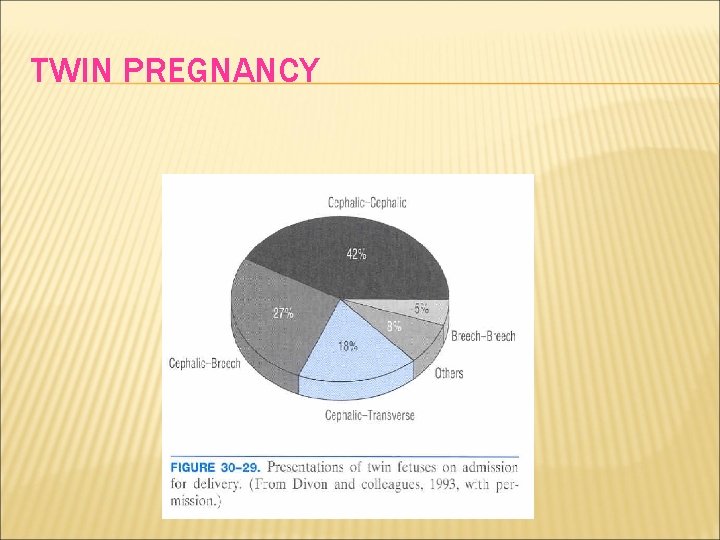
TWIN PREGNANCY IN LABOR MANAGEMENT v Trained obstetrical attendant. v Available blood. v Good access I. V line. v Cardiotocography monitoring. v Anesthetist. v Pediatrician for each fetus. v Mode of delivery - presentation of the first baby.
TWIN PREGNANCY
TWIN PREGNANCY IN LABOR MANAGEMENT 40% of 0 P and 60% of parous women present in labor with a cervix dilated more than 3 cm. The latent phase is shorter. The active phase is longer. Uterine overdistension ▬ hypotonic uterine dysfunction. Increased risk of postpartum hemorrhage (uterine atony).
TWIN PREGNANCY Indications for cesarian section first twin presentation other than vertex hypotonic uterine dysfunction fetal distress prolapsed umbilical cord prematurity placenta praevia hypertension induced or aggravated by pregnancy.
TWIN PREGNANCY The interval between delivery of the first and second twin is commonly cited to be safest if less than 30 minutes. Internal podalic version – for 2 -nd twin If separation of the placenta is delayed or bleeding is brisk, extract the placenta manually after the final delivery. Postpartum hemorrhage is common. Hypotony should be treated promptly with oxytocin by rapid intravenous infusion and massage of the fundus.
- Slides: 44