
Twilight Session 1 Memory and Recall Focus Topics
- Slides: 8
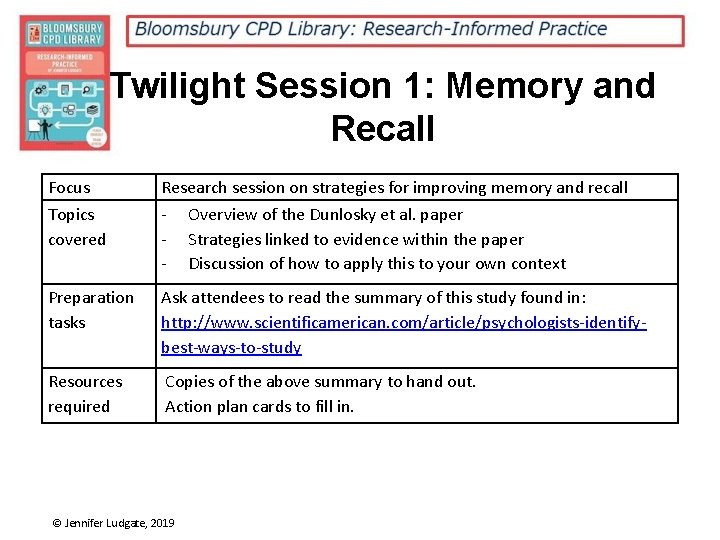
Twilight Session 1: Memory and Recall Focus Topics covered Research session on strategies for improving memory and recall - Overview of the Dunlosky et al. paper - Strategies linked to evidence within the paper - Discussion of how to apply this to your own context Preparation tasks Ask attendees to read the summary of this study found in: http: //www. scientificamerican. com/article/psychologists-identifybest-ways-to-study Resources required Copies of the above summary to hand out. Action plan cards to fill in. © Jennifer Ludgate, 2019
Twilight Session 1: Memory and Recall A session focusing on what to consider and how to apply the findings to your classroom based on Dunlosky’s review of effective learning strategies.
Dunlosky’s findings: • Based on a review of a variety of learning strategies – those that students believe to be most effective and those that are proven to be most effective. Discuss: Should we teach students ‘how’ to revise and study? When do we/should we do this? How do you do this?
Overview of two key findings: Practice-testing: • Low-stakes testing. • Separate from summative assessment. • It can take a number of forms: varying from immediate verbal recall, answering questions in a textbook at the end of a unit or multiple-choice questions. • Includes testing that students are able to organise themselves without a teacher.
Overview of two key findings: Distributed practice • Practice where topics are separated rather than learnt in a single mass before moving on. • This can sometimes be called spaced learning – the researchers suggest that longer gaps can be beneficial. • What type of practice takes place in these sessions is not focused on; however they make clear that combining practice-testing and distributed practice is most effective.
Key questions: Are the suggested approaches to improving memory and recall clear? How do you use practice testing/distributed practice in your classroom? How is this different from previous approaches? What problems do you envisage with using this strategy? How do you see this strategy working practically and logistically? What does it require you to create or know in advance? What might the benefits be considering the format of assessment (formative or summative) for students in your classroom?
Different approaches to distributed practice quizzes: • https: //teachingtoptens. wordpress. com/2018/09/28/ ten-testing-strategies-a-range-of-activities-for-varying -retrieval-practice/ • What strategies do you use to vary how you test students on relevant knowledge? • Are there any resources that you could share with others that might vary retrieval practice and increase motivation and engagement?
Takeaway action plan: • How will you apply these strategies to your everyday teaching? • What do you need to adapt in light of the research findings (for example, the research on the timing of feedback)? • What longer-term implications does this have for your curriculum and schemes of work?