
TwiceExceptional Project Reference Series Gifted Students with Specific















- Slides: 99
Twice-Exceptional Project Reference Series Gifted Students with Specific Learning Disabilities: Reading and Writing Disability Colorado Department of Education Exceptional Student Services Unit Office of Gifted Education
Together we can Vision All students in Colorado will become educated and productive citizens capable of succeeding in a globally competitive workforce. Mission The mission of CDE is to shape, support, and safeguard a statewide education system that prepares students for success in a globally competitive world. 2
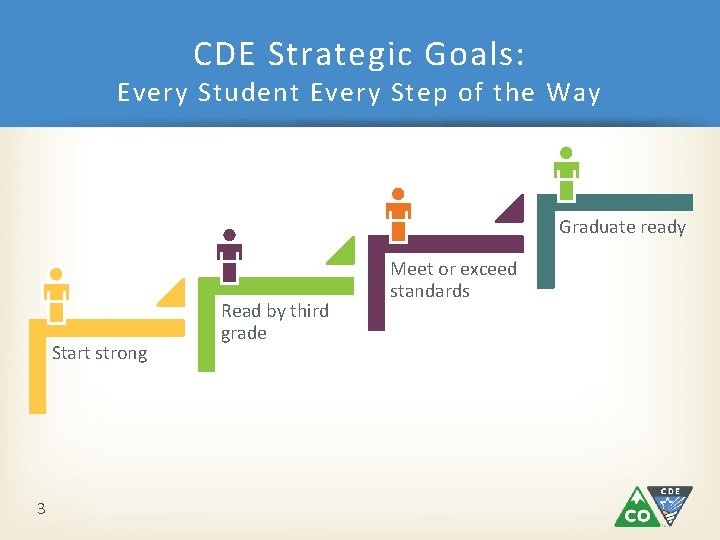
CDE Strategic Goals: Every Student Every Step of the Way Graduate ready Start strong 3 Read by third grade Meet or exceed standards
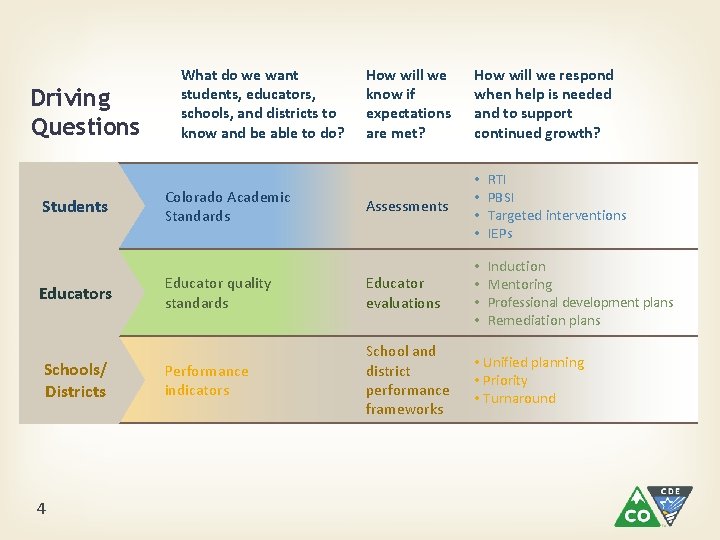
Driving Questions Students Educators Schools/ Districts 4 What do we want students, educators, schools, and districts to know and be able to do? How will we know if expectations are met? How will we respond when help is needed and to support continued growth? Assessments • • RTI PBSI Targeted interventions IEPs Educator quality standards Educator evaluations • • Induction Mentoring Professional development plans Remediation plans Performance indicators School and district performance frameworks • Unified planning • Priority • Turnaround Colorado Academic Standards
Expanding Student Learning When we intentionally integrate… Coherent and rigorous academic standards - - Access to quality learning options - - Supported and effective educators - - Aligned and meaningful assessments - - Statewide and district accountability We can personalize learning and ignite the potential of every student. 5
Training Objectives § Identify characteristics of gifted students with specific learning disabilities (SLD). § Define dyslexia and dysgraphia and understand their relationship to SLD. § Learn about compensatory strategies, strength-based strategies and accommodations for students with reading and writing disabilities. 6
Colorado 2 X Definition Twice Exceptional students are: 1. Students who are identified as gifted and talented in one or more areas of exceptionality § § § 7 specific academics general intellectual ability creativity leadership visual, musical, and performing arts; or psychomotor
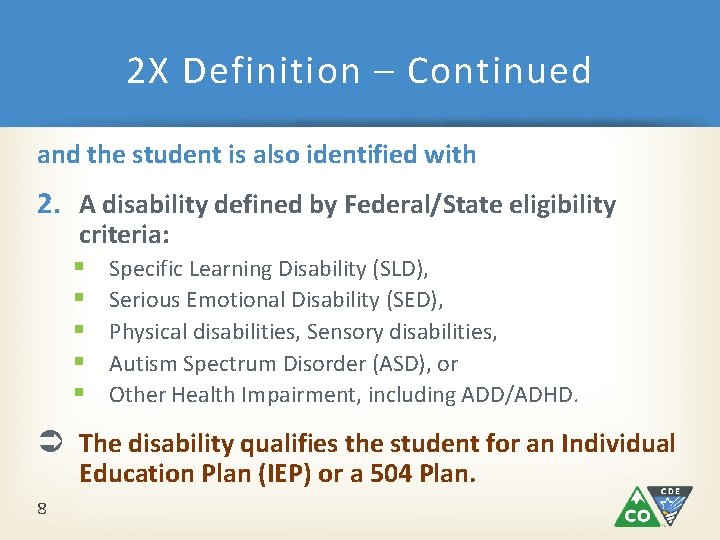
2 X Definition – Continued and the student is also identified with 2. A disability defined by Federal/State eligibility criteria: § Specific Learning Disability (SLD), § Serious Emotional Disability (SED), § Physical disabilities, Sensory disabilities, § Autism Spectrum Disorder (ASD), or § Other Health Impairment, including ADD/ADHD. Ü The disability qualifies the student for an Individual Education Plan (IEP) or a 504 Plan. 8
Activity In groups of 3 -5, create a circle map of all the characteristics you think of for one of the following: § Dyslexia § Dysgraphia § Dyscalculia Put your map on the wall, with all dyslexia together, etc. 9
Film – Individuals with Dyslexia Creative Brains 10
CDE Definition of Specific Learning Disabilities (SLD) Specific Learning Disability means a disorder in one or more of the basic psychological processes involved in understanding or in using language, spoken or written, that may manifest itself in the imperfect ability to listen, think, speak, read, write, spell or do mathematical calculations, including conditions such as perceptual disabilities, brain injury*, minimal brain dysfunction, dyslexia, and developmental aphasia. 11
Definition of Dyslexia The International Dyslexia Association, the National Center for Learning Disabilities, and the National Institute of Child Health and Human Development agree on the following definition: § “Dyslexia is a Specific Learning Disability that is neurological in origin. § “It is characterized by difficulties with accurate and/or fluent word recognition and by poor spelling and decoding abilities. ” 12
Definition of Dyslexia § “These difficulties typically result from a deficit in the phonological component of language that is often unexpected in relation to other cognitive abilities and the provision of effective classroom instruction. ” § “ Secondary consequences may include problems in reading comprehension and reduced reading experience that can impede growth of vocabulary and background knowledge. ” International Dyslexia Association; National Center for Learning Disabilities; CDE 13
Dyslexia and Specific Learning Disability (SLD) § Not all students with dyslexia are eligible under federal criteria as having a Specific Learning Disability. § Federal criteria under IDEA (Individuals with Disabilities Act), strictly state that students must be achieving below grade level to qualify for the SLD label and for an IEP. § Many higher-achieving students with dyslexia or other reading/writing disabilities may qualify for a 504 plan. 14
Is Dyslexia the same thing as a Specific Learning Disability? § No. A student can have dyslexia and not qualify as having an SLD. In order to qualify, the disability must “significantly impact the ability to learn without special supports and services. ” § Both the Federal IDEA Regulations (2006) and Colorado Rules for the Administration of the Exceptional Children’s Educational Act (2007) regarding criteria for the determination of a specific learning disability are clear that the determination of an academic skill deficit in one or more of the identified areas of SLD is to be made in relation to age/grade-level standards, not assessed ability (IQ) or the presence of other learning characteristics. 15
Dyslexia: A Lifelong Challenge § As with other learning disabilities, dyslexia is a lifelong challenge. This language-based processing disorder can hinder reading, writing, spelling and sometimes even speaking. Dyslexia is not a sign of poor intelligence or laziness or the result of impaired hearing or vision. Children and adults with dyslexia have a neurological disorder that causes their brains to process and interpret information differently. National Center for Learning Disabilities (emphasis added) http: //ncld. org 16
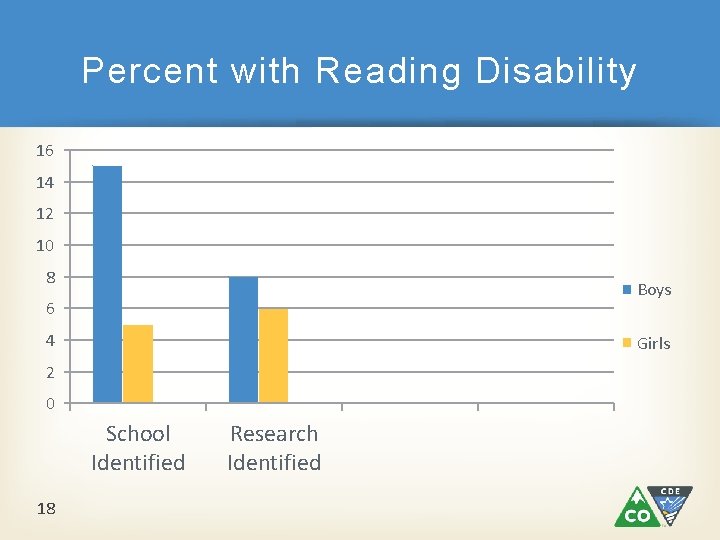
Incidence/Prevalence Rate According to The International Dyslexia Association: § 15 -20% of the population has a language-based learning disability § Of the students with specific learning disabilities receiving special education services, 70 -80% have reading deficits § Dyslexia affects males and females nearly equally as well as people from different ethnic & socio-economic backgrounds 17
Percent with Reading Disability 16 14 12 10 8 Boys 6 4 Girls 2 0 School Identified 18 Research Identified
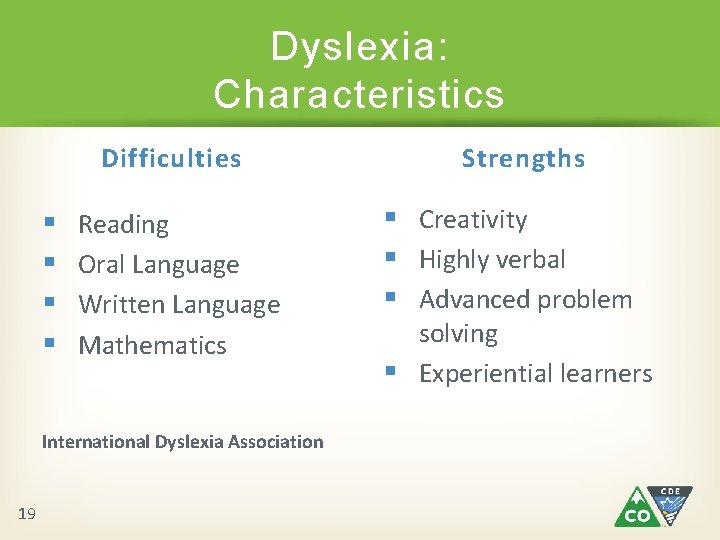
Dyslexia: Characteristics Difficulties § § Reading Oral Language Written Language Mathematics International Dyslexia Association 19 Strengths § Creativity § Highly verbal § Advanced problem solving § Experiential learners
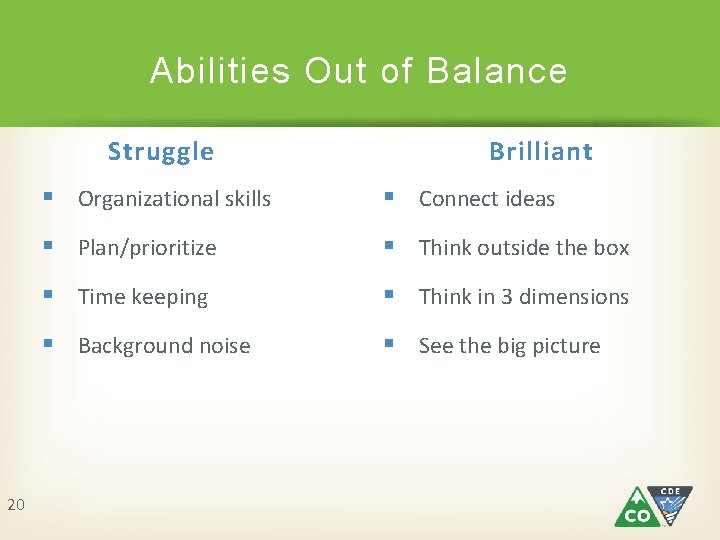
Abilities Out of Balance Struggle 20 Brilliant § Organizational skills § Connect ideas § Plan/prioritize § Think outside the box § Time keeping § Think in 3 dimensions § Background noise § See the big picture
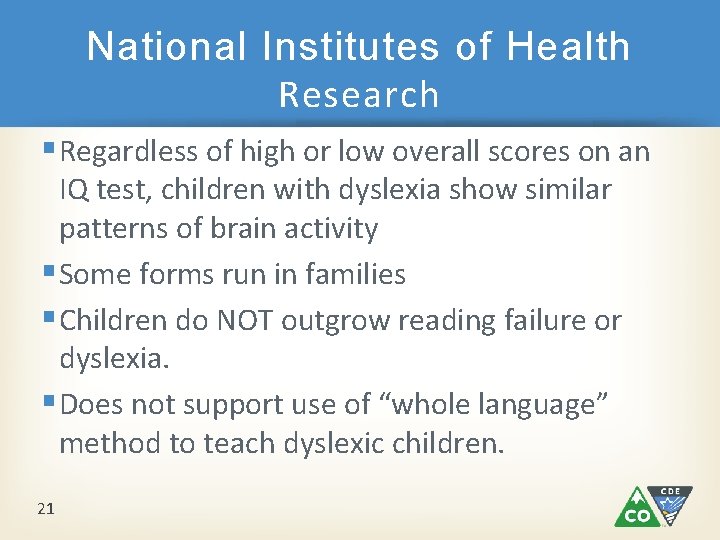
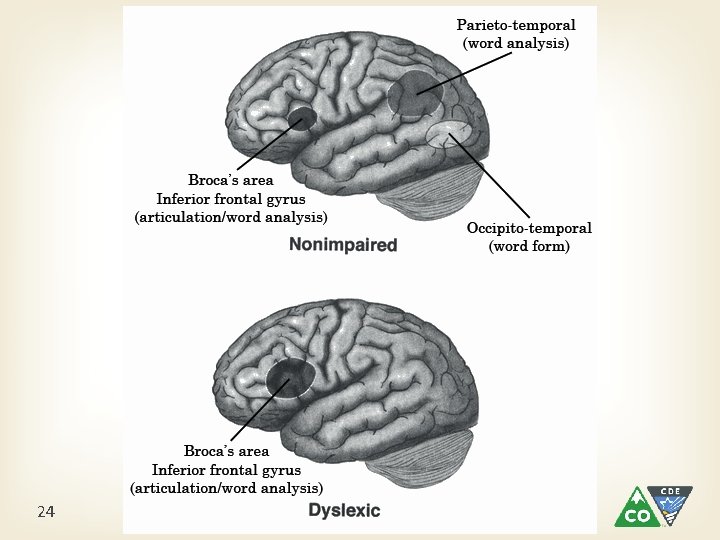
National Institutes of Health Research § Regardless of high or low overall scores on an IQ test, children with dyslexia show similar patterns of brain activity § Some forms run in families § Children do NOT outgrow reading failure or dyslexia. § Does not support use of “whole language” method to teach dyslexic children. 21
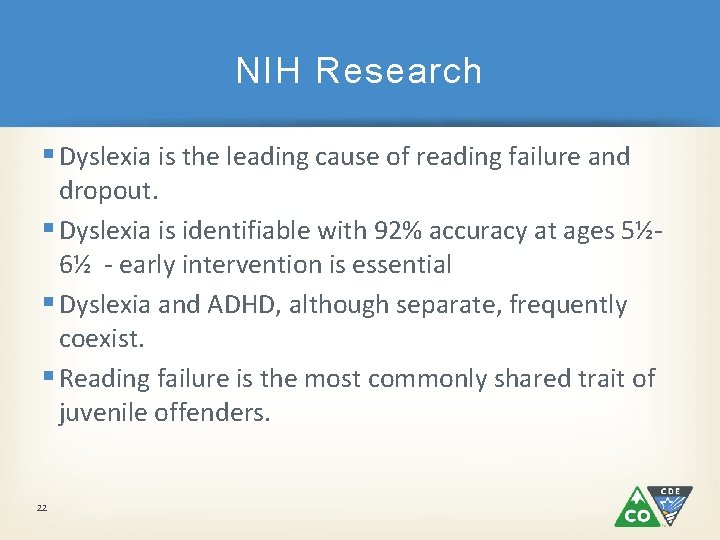
NIH Research § Dyslexia is the leading cause of reading failure and dropout. § Dyslexia is identifiable with 92% accuracy at ages 5½ 6½ - early intervention is essential § Dyslexia and ADHD, although separate, frequently coexist. § Reading failure is the most commonly shared trait of juvenile offenders. 22
Video: Dyslexia and the Brain § What is Dyslexia & Decoding the Dyslexic Brain 23
24
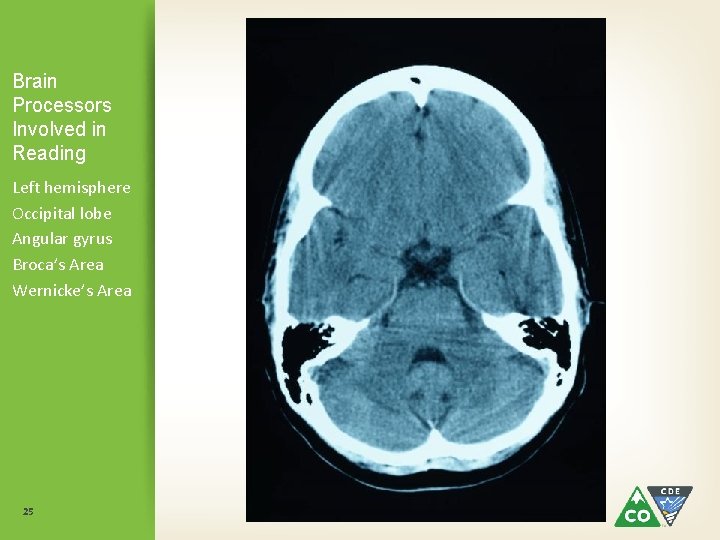
Brain Processors Involved in Reading Left hemisphere Occipital lobe Angular gyrus Broca’s Area Wernicke’s Area 25
Procedural Learning § “At least half the individuals with dyslexia have significant problems with procedural learning, and as a result they’ll be slower to master any rule-based procedural or rote skill that should become automatic through practice. ” § “Because individuals who struggle with procedural learning have difficulty learning t o perform rule-based skills automatically, they must instead perform these skills using conscious compensation, or the combination of focused attention and active working memory. ” Eide & Eide, (2011), The Dyslexic Advantage, pp. 26, 27 26
Jigsaw § At each table group, count off from 1 -5 (to correspond with the sections of the dyslexia article). § All of the individuals with the corresponding numbers (all the #1 s, for example) will get together and read that section and become the “experts” on that information. § Then each group will return to their original table and share their expertise about their section. 27
Dyslexia Myth Busters § Dyslexia is not the result of low intelligence; in fact, gifted students can have dyslexia § People who have dyslexia do not see “backward” § The problem is not behavioral, psychological, motivational, or social § Eye training is not a treatment for dyslexia. International Dyslexia Association; Sally Shaywitz 28
The “Dyslexic Advantage” “For dyslexic brains, excellent function typically means traits like § the ability to see the gist or essence of things or to spot the larger context behind a given situation or idea; § multidimensionality of perspective; § the ability to see new, unusual, or distant connections; § inferential reasoning and ambiguity detection; § the ability to recombine things in novel ways and a general inventiveness; § and greater mindfulness and intentionality during tasks that others take for granted. ” 29 Eide, B. and Eide, F. (2013) The Dyslexic Advantage, p. 42
Gifts and Solutions § http: //www. dys- add. com/videos/dyslexia. Symptoms. Solutions_Part 04. html 30
Reading Simulation Understood. org http: //www. understood. org/en/tools/throughyour-childs-eyes 31
Dysgraphia Definition § National Center for Learning Disabilities defines Dysgraphia as: § “A learning disability that affects writing, which requires a complex set of motor and information processing skills. It can lead to problems with spelling, poor handwriting and putting thoughts on paper. ” § May be due to: § “Visual-spatial difficulties: trouble processing what the eye sees § Language processing difficulty: trouble processing and making sense of what the ear hears” 32
Dysgraphia Simulation http: //www. understood. org/en/tools/through-your-childseyes/player? simq=a 06 af 01 c-0 a 60 -45 c 0 -b 3062 e 8714 d 05 bb 4&standalone=true&simulation=true 33
34
Break 35
Identification Gifted Students with Reading and Writing Problems
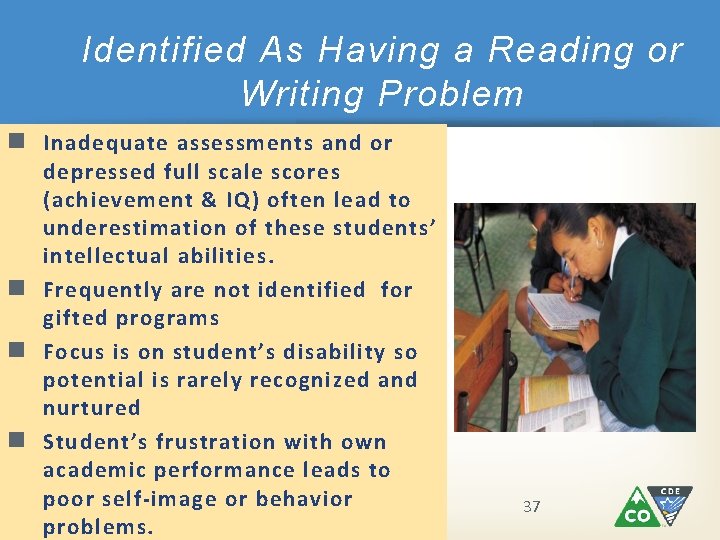
Identified As Having a Reading or Writing Problem n Inadequate assessments and or depressed full scale scores (achievement & IQ) often lead to underestimation of these students’ intellectual abilities. n Frequently are not identified for gifted programs n Focus is on student’s disability so potential is rarely recognized and nurtured n Student’s frustration with own academic performance leads to poor self-image or behavior problems. 37
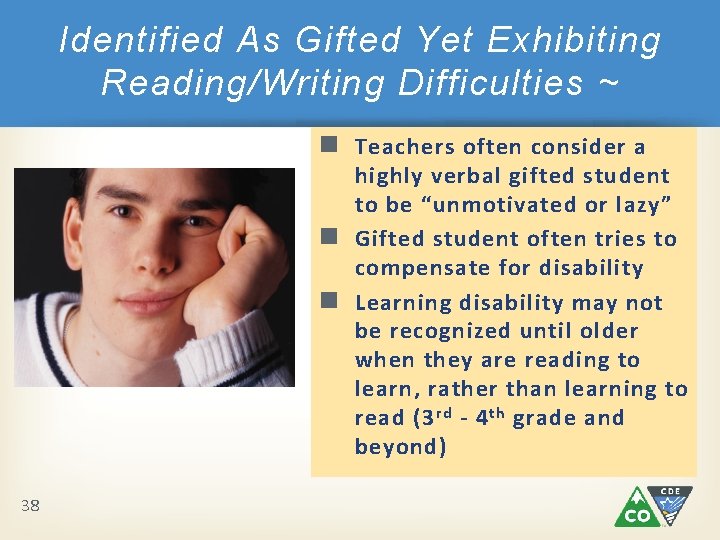
Identified As Gifted Yet Exhibiting Reading/Writing Difficulties ~ n Teachers often consider a highly verbal gifted student to be “unmotivated or lazy” n Gifted student often tries to compensate for disability n Learning disability may not be recognized until older when they are reading to learn, rather than learning to read (3 rd - 4 th grade and beyond) 38
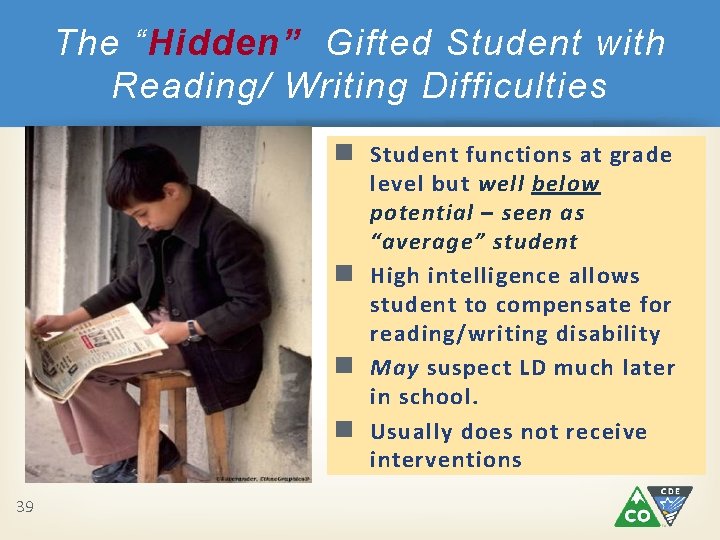
The “Hidden” Gifted Student with Reading/ Writing Difficulties n Student functions at grade level but well below potential – seen as “average” student n High intelligence allows student to compensate for reading/writing disability n May suspect LD much later in school. n Usually does not receive interventions 39
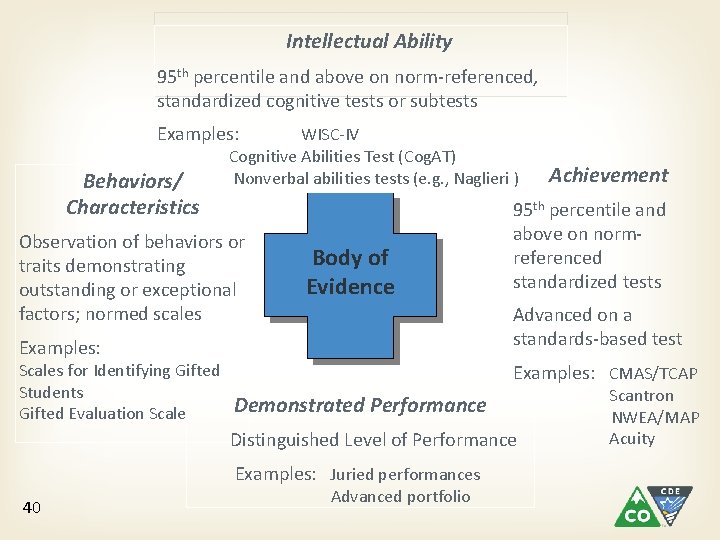
Intellectual Ability 95 th percentile and above on norm-referenced, standardized cognitive tests or subtests Examples: Behaviors/ Characteristics WISC-IV Cognitive Abilities Test (Cog. AT) Nonverbal abilities tests (e. g. , Naglieri ) Observation of behaviors or traits demonstrating outstanding or exceptional factors; normed scales Body of Evidence 95 th percentile and above on normreferenced standardized tests Advanced on a standards-based test Examples: Scales for Identifying Gifted Students Gifted Evaluation Scale Achievement Examples: CMAS/TCAP Scantron NWEA/MAP Acuity Distinguished Level of Performance Demonstrated Performance Examples: Juried performances 40 Advanced portfolio
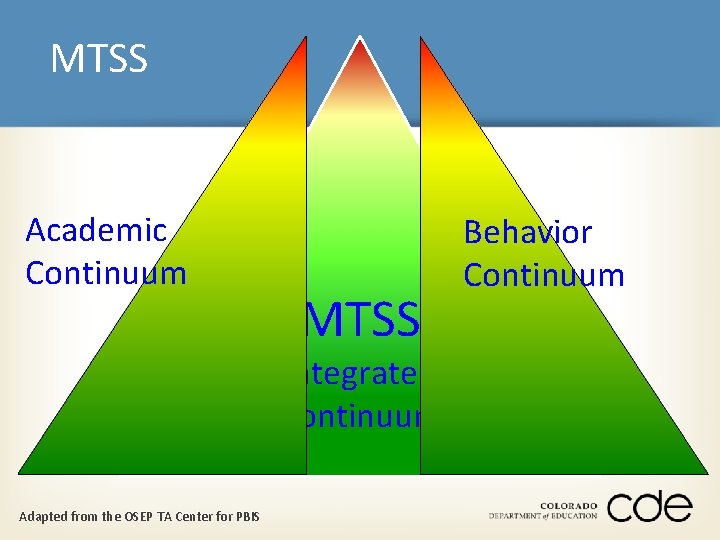
MTSS Academic Continuum MTSS Integrated Continuum Adapted from the OSEP TA Center for PBIS Behavior Continuum
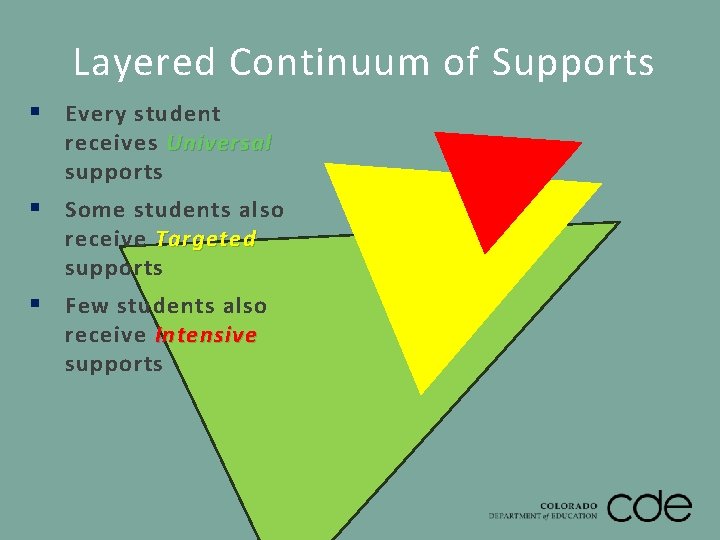
Layered Continuum of Supports § Every student receives Universal supports § Some students also receive Targeted supports § Few students also receive Intensive supports
Benefits of MTSS/Rt. I § Early intervention at the first sign of difficulty without “wait to fail” § Resources can be pooled (e. g. , Reading Recovery, Title I, and SPED funds can be used to provide intense intervention) § Focus will be on student needs - not the disability label Mary Ruth Coleman, 2004 43
Using a Problem-Solving Approach § Indicators of strong verbal ability with poor output § Observational indicators: § Superior vocabulary , particularly in area of interest or strength § Ability to discuss advanced concepts § Sophisticated grammar and sentence structure § Highly developed or unusual sense of humor § Curious, questions the way things are 44
Written Language Disability “Educators of students who appear to have high verbal ability while simultaneously having difficulty completing written assignments – and may even appear to be lazy or unmotivated – have a responsibility to further investigate the students’ strengths and difficulties” pg. 102 Assouline, S. , Foley Nicpon, M. , & Whiteman, C. (2010). Cognitive and Psychosocial Characteristics of Gifted Students with Written Language Disability. Gifted Child Quarterly, 54(2), 102 -115. 45
Assessments of High Verbal Ability § Standardized Assessments §WISC-IV §K-BIT – untimed, no reading 46
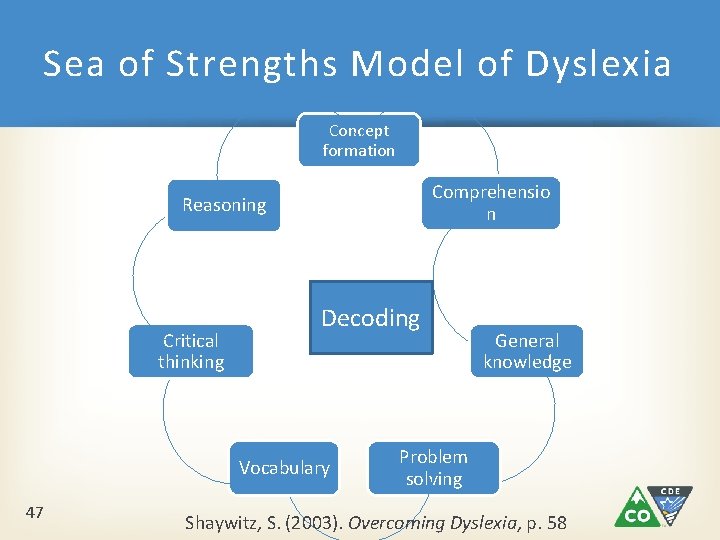
Sea of Strengths Model of Dyslexia Concept formation Comprehensio n Reasoning Critical thinking Decoding Vocabulary 47 General knowledge Problem solving Shaywitz, S. (2003). Overcoming Dyslexia, p. 58
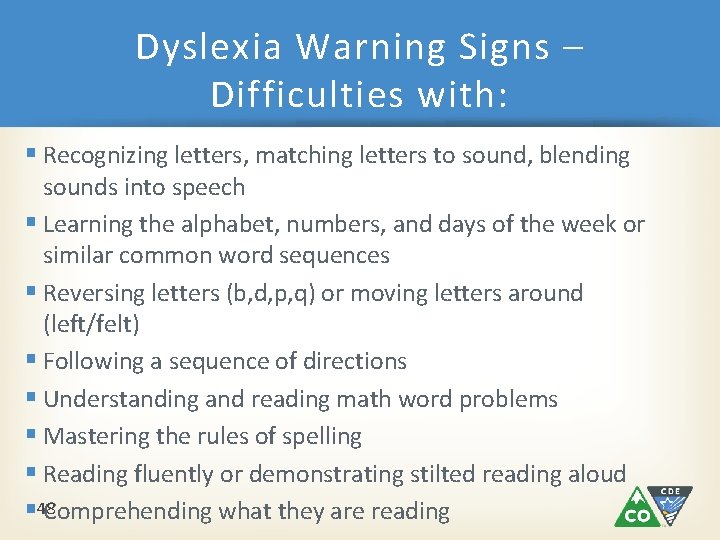
Dyslexia Warning Signs – Difficulties with: § Recognizing letters, matching letters to sound, blending sounds into speech § Learning the alphabet, numbers, and days of the week or similar common word sequences § Reversing letters (b, d, p, q) or moving letters around (left/felt) § Following a sequence of directions § Understanding and reading math word problems § Mastering the rules of spelling § Reading fluently or demonstrating stilted reading aloud § 48 Comprehending what they are reading
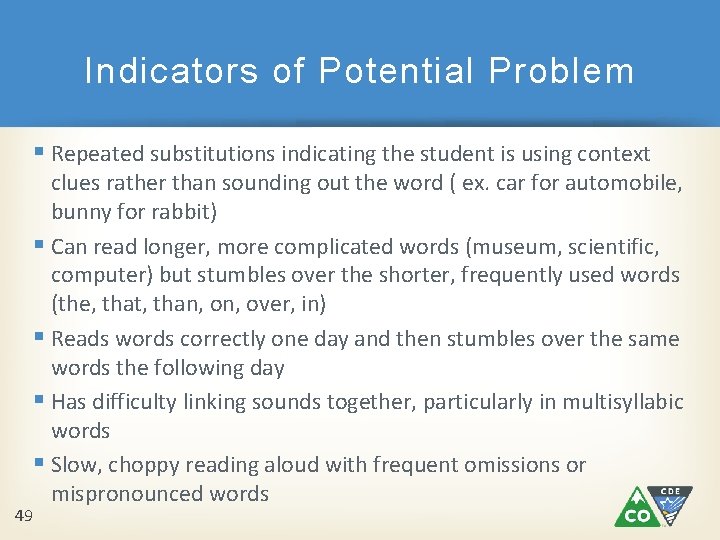
Indicators of Potential Problem § Repeated substitutions indicating the student is using context clues rather than sounding out the word ( ex. car for automobile, bunny for rabbit) § Can read longer, more complicated words (museum, scientific, computer) but stumbles over the shorter, frequently used words (the, that, than, over, in) § Reads words correctly one day and then stumbles over the same words the following day § Has difficulty linking sounds together, particularly in multisyllabic words § Slow, choppy reading aloud with frequent omissions or mispronounced words 49
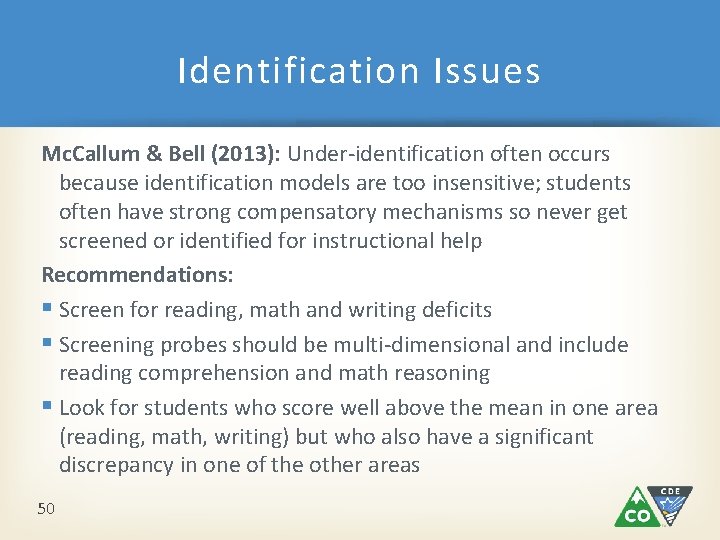
Identification Issues Mc. Callum & Bell (2013): Under-identification often occurs because identification models are too insensitive; students often have strong compensatory mechanisms so never get screened or identified for instructional help Recommendations: § Screen for reading, math and writing deficits § Screening probes should be multi-dimensional and include reading comprehension and math reasoning § Look for students who score well above the mean in one area (reading, math, writing) but who also have a significant discrepancy in one of the other areas 50
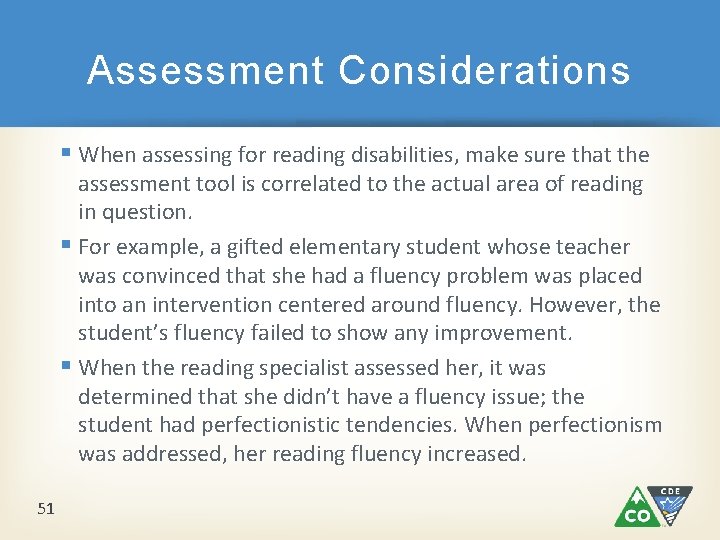
Assessment Considerations § When assessing for reading disabilities, make sure that the assessment tool is correlated to the actual area of reading in question. § For example, a gifted elementary student whose teacher was convinced that she had a fluency problem was placed into an intervention centered around fluency. However, the student’s fluency failed to show any improvement. § When the reading specialist assessed her, it was determined that she didn’t have a fluency issue; the student had perfectionistic tendencies. When perfectionism was addressed, her reading fluency increased. 51
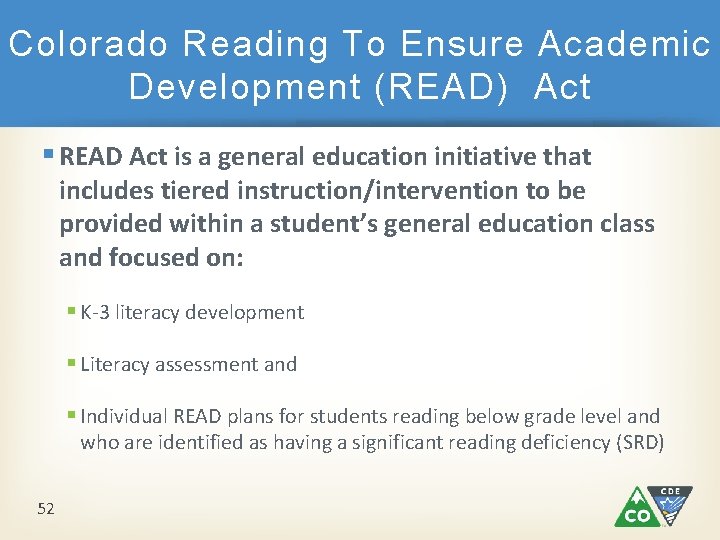
Colorado Reading To Ensure Academic Development (READ) Act § READ Act is a general education initiative that includes tiered instruction/intervention to be provided within a student’s general education class and focused on: § K-3 literacy development § Literacy assessment and § Individual READ plans for students reading below grade level and who are identified as having a significant reading deficiency (SRD) 52
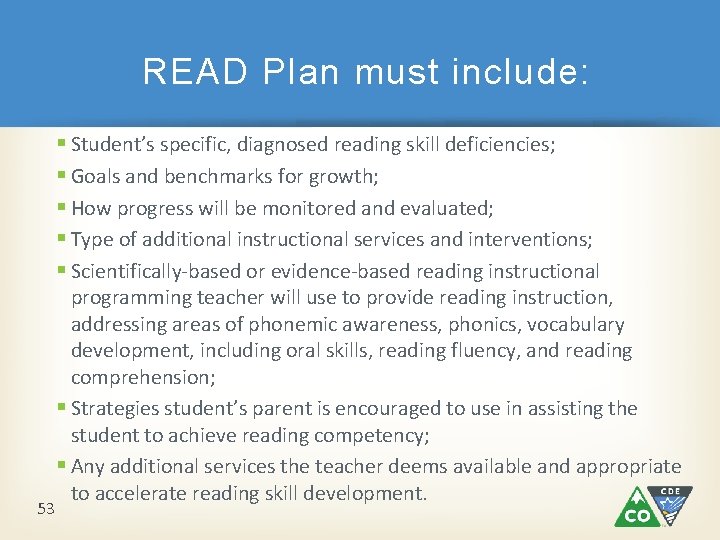
READ Plan must include: § Student’s specific, diagnosed reading skill deficiencies; § Goals and benchmarks for growth; § How progress will be monitored and evaluated; § Type of additional instructional services and interventions; § Scientifically-based or evidence-based reading instructional 53 programming teacher will use to provide reading instruction, addressing areas of phonemic awareness, phonics, vocabulary development, including oral skills, reading fluency, and reading comprehension; § Strategies student’s parent is encouraged to use in assisting the student to achieve reading competency; § Any additional services the teacher deems available and appropriate to accelerate reading skill development.
READ Plan or IEP? § As per the READ Act, “As appropriate, a local education provider may integrate into a student’s Individual Education Plan or Individualized Readiness Plan intervention instruction and strategies to address the student’s reading deficiencies in lieu of a READ plan. ” pg. 2 www. cde. state. co. us: Implementing the Colorado READ Act: Roles and Responsibilities 54
Table Talk 55
Gifted Students with Reading and Writing Difficulties Strength-Based and Compensatory Strategies 56
Dual Emphasis
Acceleration Affective Guidance & Counseling Teach Compensatory Strategies Small Group Direct Instruction Challenges and Remediation Accommodations & Modifications Strengths && Interests Accommodations Higher Order Thinking Skills Content Extension Differentiated Instruction Specific Programs/Tutoring SPED
A “Third Kind” of Strategies § Willard-Holt, et al. (2013) found that twice-exceptional students identified that the most preferred learning strategies “included choice/flexibility in learning, assessment, and pace; using compensatory strategies and strengths to circumvent weaknesses; and collaborating in specific ways. ” p. 258 § In addition, the authors noted, “their learning was unlikely to be optimized using either strategies intended for gifted learners or those for learners with other exceptionalities…. twice-exceptional students require integrated approaches informed by both gifted and special 59 education” p. 259
Simultaneous Focus § Build on student strengths: Develop a life span perspective § Problem solving § Vocabulary § Critical thinking § General knowledge § Reasoning § While focusing on the reading/writing weakness: § Analyze and identify the break-down (phonemics, phonics, vocabulary, comprehension, fluency) § Develop an explicit, structured, multisensory intervention 60
Build on Strengths § Focus on student’s areas of strength, not just his weaknesses § Allow student to participate in high level discussions (may need accommodations such as audio books to gain information) § Have “go-to” projects in area of student’s interest to encourage her to finish essential work; then allow her time to work on those projects as an incentive § Reinforce creativity in process and products § Celebrate the achievement of realistic short-term goals § Ask student to become a “resident expert” in area of interest 61
Continuum of Skills 5 areas of reading: § Phonemic awareness – ability to distinguish sounds, words, rhymes (oral) § Phonics – sound/symbol relationship § Vocabulary § Fluency § Comprehension 62
Specific Reading Strategies § Successful approaches to phonemic and phonics instruction must : § Be explicit and systematic § Teach sound/spelling correspondences directly § Blend previously taught sound/spelling correspondences § Follow a specific sequence from easiest to most difficult § Utilize multisensory techniques 63
Other Intervention Considerations § GT students who are placed in a reading program (i. e. , Wilson Reading) sometimes will languish with the pacing and repetition of this structured program. § One district had a special summer Wilson Reading program for gifted and advanced students to address this concern. They were able to implement the program with fidelity but move at a faster pace due to the high cognitive ability of these students, and the program had positive effects on the students’ reading abilities. 64
Specific Strategies § Berninger & Abbott (2013) identified specific phonemic and phonics strategies that were effective with twice-exceptional students with dyslexia in grades 4 -9: § Clap number of syllables in spoken words and hold up fingers for number of phonemes in each syllable § Find and write letters that come before and after other letters in the alphabet 65
Break 66
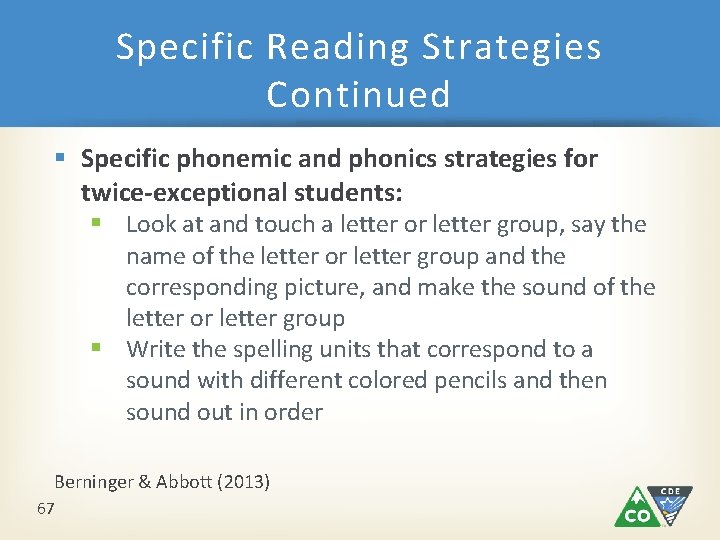
Specific Reading Strategies Continued § Specific phonemic and phonics strategies for twice-exceptional students: § Look at and touch a letter or letter group, say the name of the letter or letter group and the corresponding picture, and make the sound of the letter or letter group § Write the spelling units that correspond to a sound with different colored pencils and then sound out in order Berninger & Abbott (2013) 67
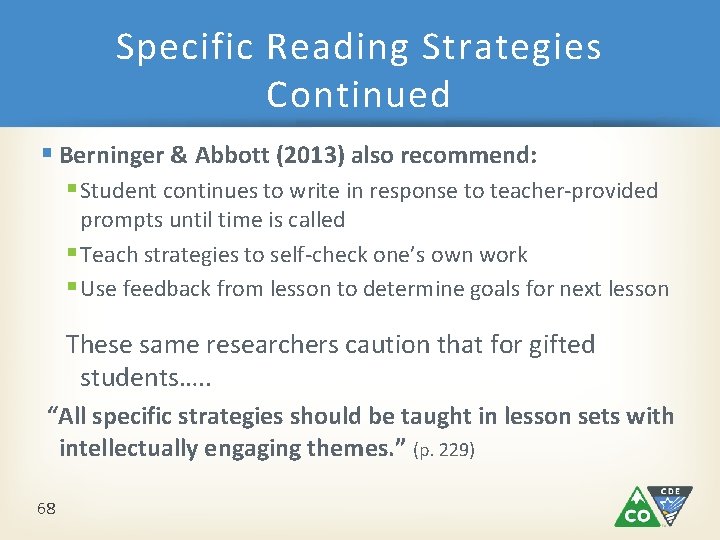
Specific Reading Strategies Continued § Berninger & Abbott (2013) also recommend: § Student continues to write in response to teacher-provided prompts until time is called § Teach strategies to self-check one’s own work § Use feedback from lesson to determine goals for next lesson These same researchers caution that for gifted students…. . “All specific strategies should be taught in lesson sets with intellectually engaging themes. ” (p. 229) 68
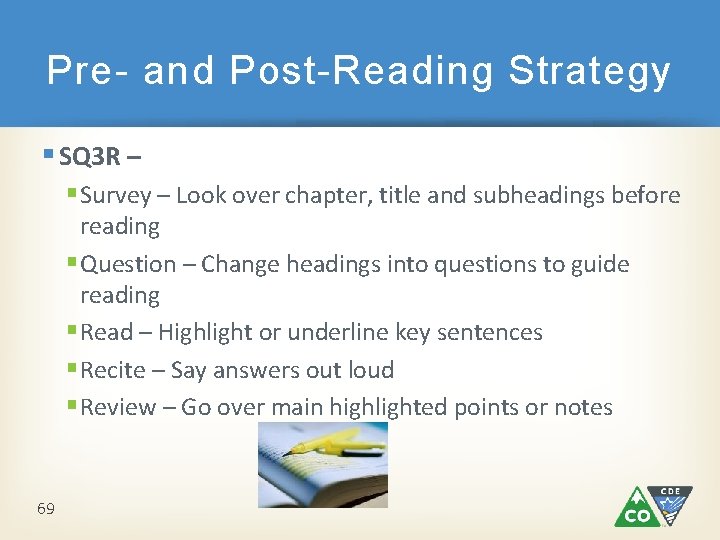
Pre- and Post-Reading Strategy § SQ 3 R – § Survey – Look over chapter, title and subheadings before reading § Question – Change headings into questions to guide reading § Read – Highlight or underline key sentences § Recite – Say answers out loud § Review – Go over main highlighted points or notes 69
What Students Say They Need § Successful gifted students who have reading and writing issues state that they need: § Ownership of their learning § Choice and flexibility of content and process § Higher-order thinking § Analysis skills § Respect them as mature learners § Accommodations for their disabilities 70
Accommodations for Working Memory § Tape record lesson § Provide copy of lesson outline § Have fellow student share notes § Use table of math facts or calculator § Mnemonics § Songs/raps to memorize math facts § Active learning with repetition and practice 71
Explicit Instruction § “Instruction for twice exceptional students who have dyslexia, but are also verbally gifted, should focus not only on oral word reading and written spelling but also on the impaired working memory components within intellectually engaging lesson sets. ” (p. 223) Berninger, V. & Abbott, R. (2013). Differences Between Children With Dyslexia Who Are and Are Not Gifted in Verbal Reasoning. Gifted Child Quarterly, 57(4), 223 -233. 72
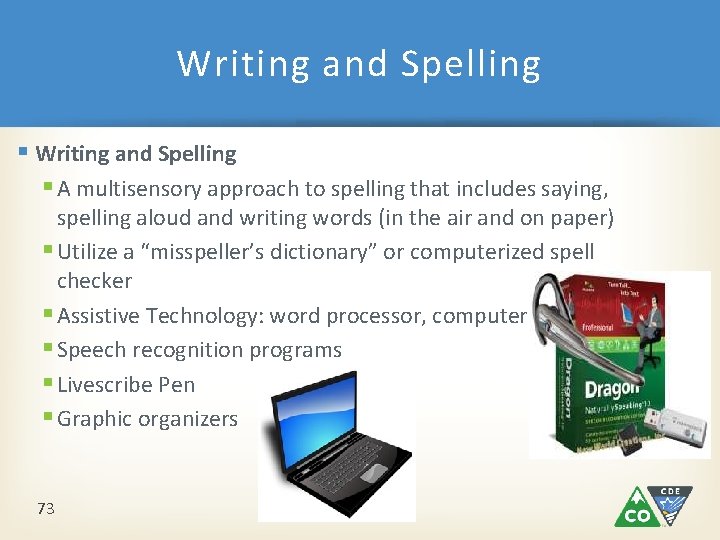
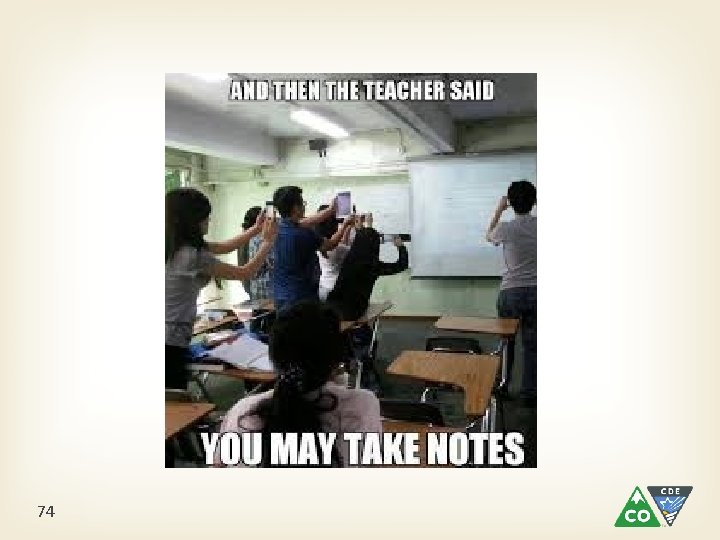
Writing and Spelling § A multisensory approach to spelling that includes saying, spelling aloud and writing words (in the air and on paper) § Utilize a “misspeller’s dictionary” or computerized spell checker § Assistive Technology: word processor, computer § Speech recognition programs § Livescribe Pen § Graphic organizers 73
74
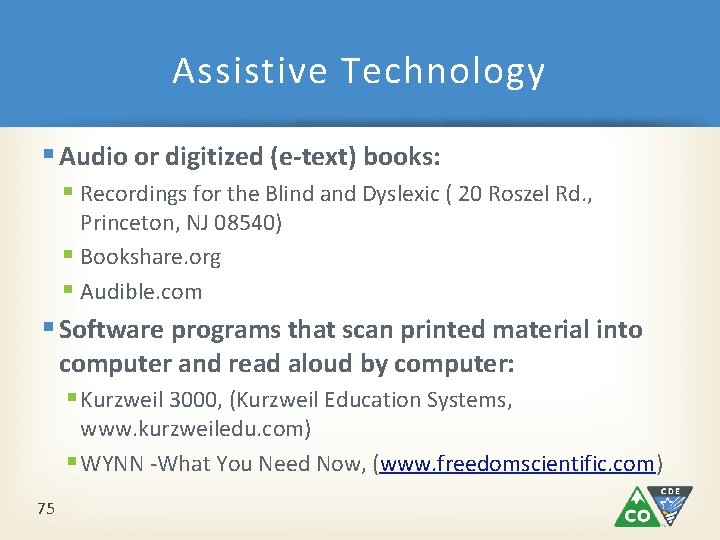
Assistive Technology § Audio or digitized (e-text) books: § Recordings for the Blind and Dyslexic ( 20 Roszel Rd. , Princeton, NJ 08540) § Bookshare. org § Audible. com § Software programs that scan printed material into computer and read aloud by computer: § Kurzweil 3000, (Kurzweil Education Systems, www. kurzweiledu. com) § WYNN -What You Need Now, (www. freedomscientific. com) 75
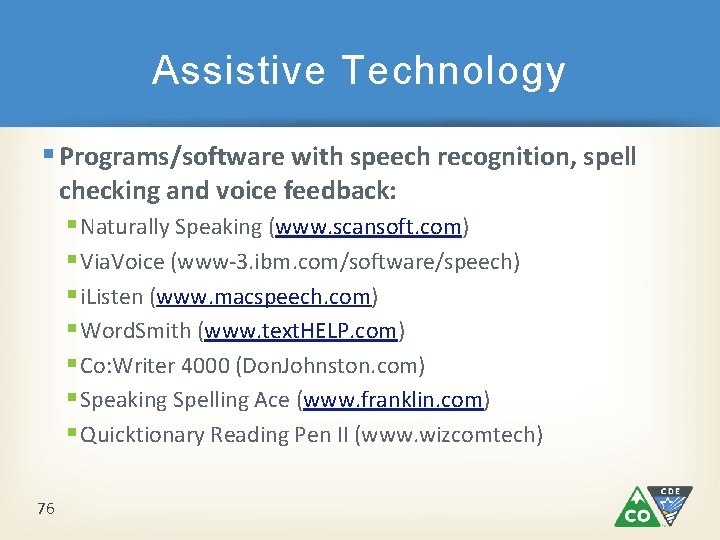
Assistive Technology § Programs/software with speech recognition, spell checking and voice feedback: § Naturally Speaking (www. scansoft. com) § Via. Voice (www-3. ibm. com/software/speech) § i. Listen (www. macspeech. com) § Word. Smith (www. text. HELP. com) § Co: Writer 4000 (Don. Johnston. com) § Speaking Spelling Ace (www. franklin. com) § Quicktionary Reading Pen II (www. wizcomtech) 76
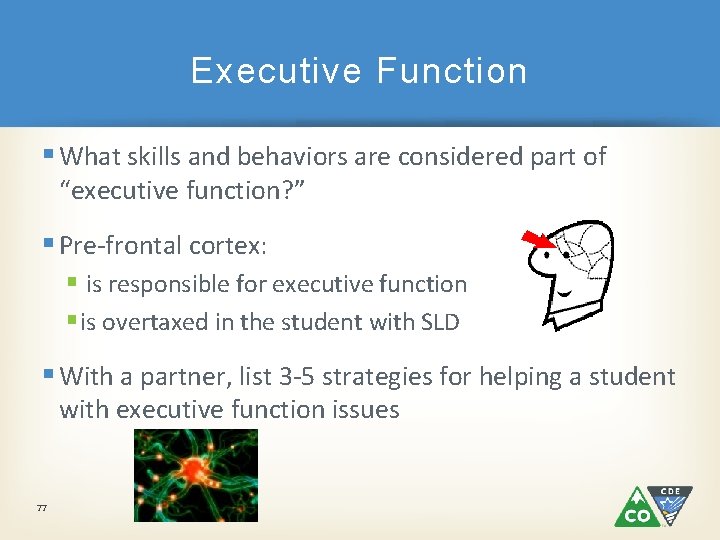
Executive Function § What skills and behaviors are considered part of “executive function? ” § Pre-frontal cortex: § is responsible for executive function § is overtaxed in the student with SLD § With a partner, list 3 -5 strategies for helping a student with executive function issues 77
Organization § Organizational issues with time, materials and information § Quiet, uncluttered homework space § Alarm watch (or on phone) § Texts that can be highlighted § Assignment book that goes between school and home (or is online) § Specific study skills instruction § Personally-developed datebook or scheduler § Graphic organizers § Online organization (Google Docs, calendars) 78 NCLD
Attention and Focus § Extra time § Higher-level thinking skills + context + extra time = meaning (Shaywitz, 2003) § Quiet or freedom from distraction during testing § Preview text before reading aloud § Introduce vocabulary 79
Summary: To Improve Reading § Direct instruction and extra practice on decoding § Multi-sensory methods to improve decoding § Capitalize on cognitive strengths and interests 80 § First read a passage or give a brief summary § Use assistive technology § Build language by engaging children in challenging conversations
Summary: To Improve Writing § Explicit instruction in letter formation, spacing, use of conventions – early grades only § Facilitate expression using oral dictation or keyboarding § Direct instruction in formation of sentences, paragraphs, essays 81 § Engage interests and special abilities § Use assistive technology and the built-in functions of word processors § Use organizational tools for pre-writing: Thinking Maps, Inspiration software, graphic organizers
Stand-up Meeting § Stand up § Find a partner who is NOT on your team § Remain standing with your new partner § Discuss with your partner: § Academic accommodations for a student who struggles with reading § Academic accommodations for a student who struggles with writing 82
Meeting the Social/Emotional Needs of 2 X Students § The frustration felt by twice-exceptional students who have reading or writing concerns is extreme because there is a high social value put on reading and writing by western cultures. § Look for a good fit between student and teacher. § These students need mentors who will help them find their “niche” in society; can be inspirational examples of individuals with dyslexia who have used their talents to be successful in careers. § Bibliotherapy can be an effective way to share these role models. 83
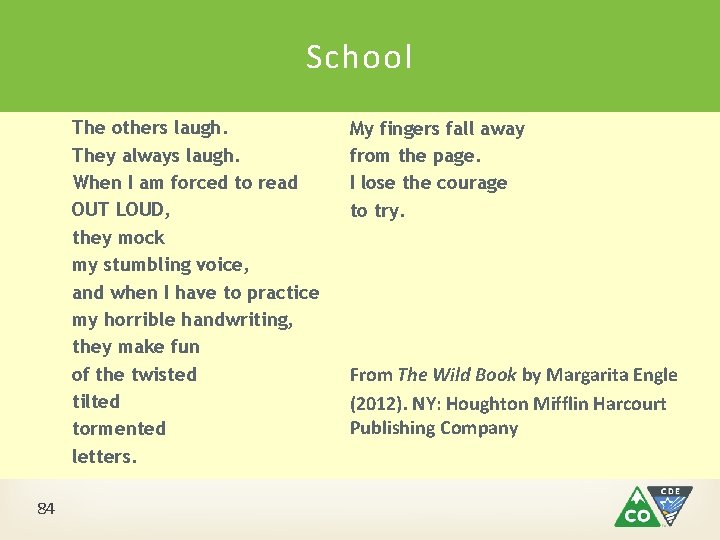
School The others laugh. They always laugh. When I am forced to read OUT LOUD, they mock my stumbling voice, and when I have to practice my horrible handwriting, they make fun of the twisted tilted tormented letters. 84 My fingers fall away from the page. I lose the courage to try. From The Wild Book by Margarita Engle (2012). NY: Houghton Mifflin Harcourt Publishing Company
Bibliotherapy “Bibliotherapy is an attempt to help young people understand themselves and cope with problems by providing literature relevant to their personal situations and developmental needs at appropriate times. Middle and high school teachers using this approach believe that reading can influence a student's thinking and behavior. Moreover, through guided discussions, selected readings can focus on specific needs of gifted students. ” “Nurturing social and emotional development in gifted teenagers through young adult literature. ” Thomas P. Hébert & Richard Kent, (2000). Roeper Review, 22(3), 167 -71. 85
Resources for Bibliotherapy § You. Tube videos listed in this Power. Point § Books § Thank You, Mr. Falker by Patricia Pollacco § Hank Zipzer series by Henry Winkler and Lin Oliver § Learning Outside the Lines and The Short Bus by Jonathan Mooney § The Wild Book by Margarita Engle 86
Case Study: Alicia § “Alicia is a nine-year-old and passionate about her love of horses. She can discuss almost any aspect of her passion in great detail including: characteristics and history of various breeds, history of the domestication, and training and riding methods. Alicia is a talented artist and has a wonderful portfolio of her horse drawings, paintings, and sketches. § “She contributes to many class discussions and frequently relies on her visual memory, advanced vocabulary, and unique sense of humor. Teachers comment on Alicia’s ability to remember so much detail. ” Case studies from Twice-Exceptional Students: Gifted Students with Disabilities, Level 1: An Introductory Resource Book 87
Case Study: Alicia § “Alicia struggles with reading and writing. Her oral reading is not fluent, characterized by word-by-word reading with many decoding errors. She relies on sight words, contextual cues, and her advanced abilities in reasoning skills to comprehend and predict text. Alicia is very self-conscious about her oral reading hates when she is called on to read in class. § “Alicia’s writing is characterized by many wonderful and creative ideas that are very loosely organized. Her writing has many spelling and grammatical errors. § “Alicia has always struggled with the weekly spelling tests. She works hard daily and practices each night, but still only manages to average B- or C on the weekly tests. ” 88
Case Study: David § “David is an 8 th-grader who has been described as insightful, smart, interesting, and charming. His teachers also find him to be polite and respectful. He has demonstrated advanced knowledge in science, particularly in the geology. He can describe different rock formations with the correct vocabulary and concepts. He and his science teacher enjoy conversations about their shared passion. § “David is also a talented music student. He plays 3 instruments and is first chair of his school band. He participates in family musical group that entertains at local senior citizen and community centers on a monthly basis. ” 89
Case Study: David § “Although David is a hard worker and wants to be successful in school, he is very frustrated with how hard school has become for him. He thinks that the teachers give him too much work and he is overwhelmed. He has difficulty with organization which is evident with his messy binder and locker, his inability to locate assignments and to keep track of due dates. Long term assignments are rarely turned in on time. He struggles to understand directions and needs more time to organize his thoughts when trying to explain a concept, even when he knows the information well. § “He has good and creative ideas but his writing is ‘bare-bones’ with little detail or richness. Given his advanced vocabulary, his teachers are surprised by his frequent spelling mistakes. ” 90
Plan for a Student §Using one of the case studies, take one of the reading assignments and create a lesson plan for your selected student. 91
References § Berninger, V. & Abbott, R. (2013). Differences between children with dyslexia who are and are not gifted in verbal reasoning. Gifted Child Quarterly, 57, 223 -233. § Eide, B. & Eide, F. (2012). The Dyslexic Advantage: Unlocking the Hidden Potential of the Dyslexic Brain. New York, Hay House. § Foley Nicpon, M. , Allmon, A. , Sieck, R. , & Stinson, R. D. (2011). Empirical investigation of twiceexceptionality: Where have we been and where are we are going? Gifted Child Quarterly, 55, 3 -17. 92
References – Continued § Mc. Callum, S. R. , Bell, S. M. , Coles, J. T. , Miller, K. C. , Hopkins, M. B. , & Hilton-Prillhart, A. (2013). Screening of twiceexceptional students (gifted with learning disabilities) within a Response to Intervention (Rt. I) model. Gifted Child Quarterly, 57, 209 -222. § Shaywitz, S. (2003). Overcoming Dyslexia: A New and Complete Science-Based Program for Reading Problems at Any Level. New York: Vintage Books. 93
References – Continued § Spiers Neumeister, K. , Yssel, N. , & Burney, V. H. (2013). The influence of primary caregivers in fostering success in twice -exceptional children. Gifted Child Quarterly, 57, 263 -274 § Willard-Holt, C. , Weber, J. , Morrison, K. L. , & Horgan, J. (2013). Twice-exceptional learners’ perspectives on effective learning strategies. Gifted Child Quarterly, 57, 247 -262. 94
Web Resources § http: //www. cde. state. co. us/coloradoliteracy/Re § § § 95 ad. Act/index. asp http: //www. ncld. org/types-learningdisabilities/dysgraphia/what-is-dysgraphia http: //www. wrightslaw. com/info/read. dysgraphi a. facts. htm http: //www. ldaamerica. us http: //nih. gov/ http: //LDonline. org
Web Resources § http: //greatbooks. org § http: //cfge. wm. edu § http: //www. davidsongifted. org/db/Articles_id_10707. as px § http: //www. ncld. org/types-learning- disabilities/dysgraphia/seven-important-facts-aboutsupporting-students-with-writing-learning-disability § http: //www. understood. org 96
Video: Disability and Success 97
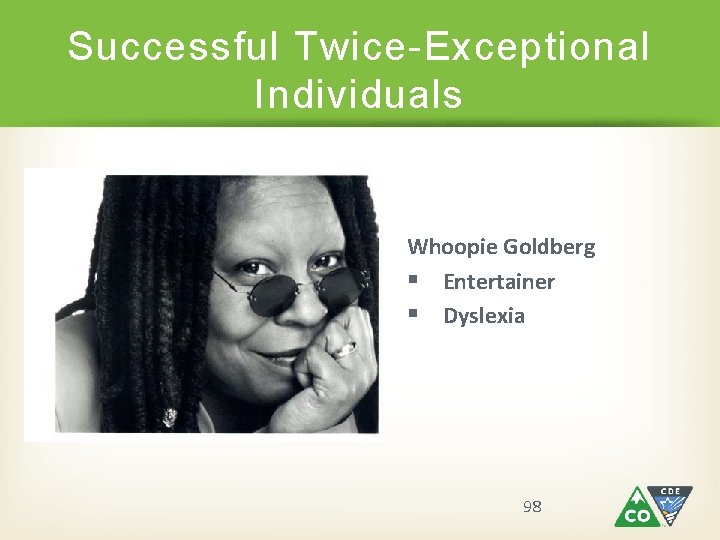
Successful Twice-Exceptional Individuals Whoopie Goldberg § Entertainer § Dyslexia 98
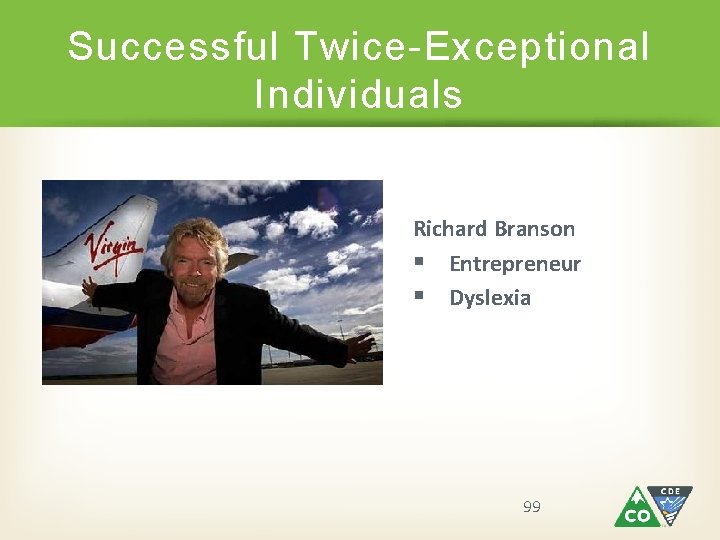
Successful Twice-Exceptional Individuals Richard Branson § Entrepreneur § Dyslexia 99