
Twenty Questions Chapter 8 Review Twenty Questions 1

- Slides: 22
Twenty Questions Chapter 8 Review
Twenty Questions 1 2 3 4 5 6 7 8 9 10 11 12 13 14 15 16 17 18 19 20
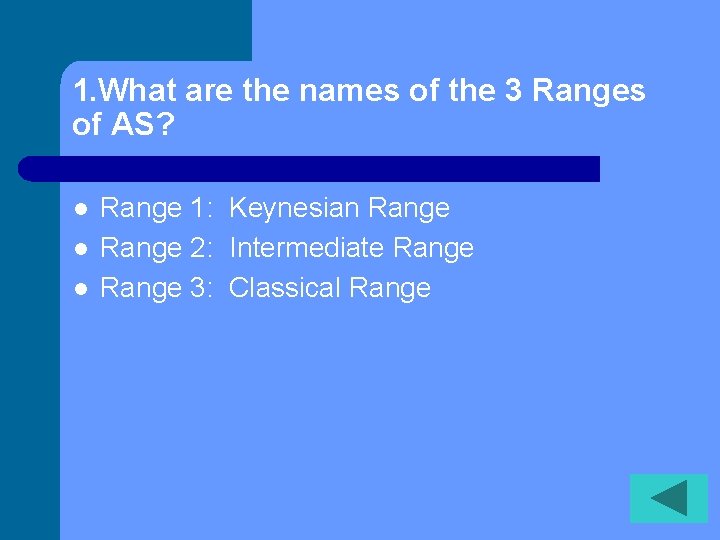
1. What are the names of the 3 Ranges of AS? l l l Range 1: Keynesian Range 2: Intermediate Range 3: Classical Range
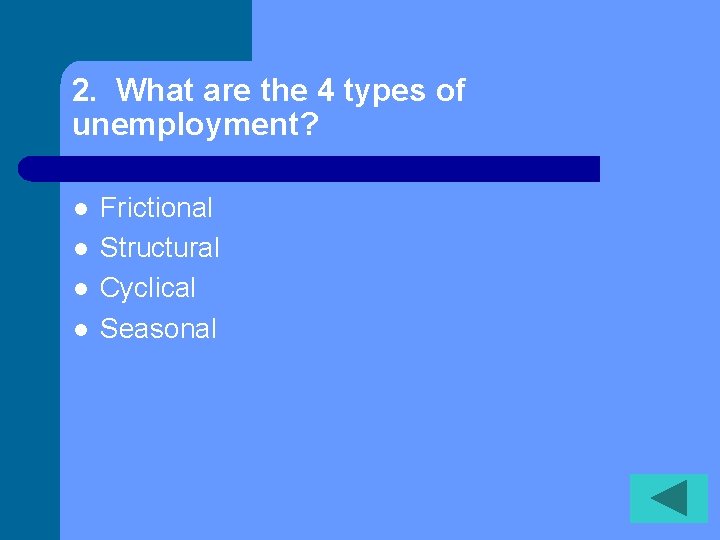
2. What are the 4 types of unemployment? l l Frictional Structural Cyclical Seasonal
3. What is the difference between demand-pull inflation and cost-push inflation? l Demand-Pull Inflation: Caused by consumers due to excessive demand for goods and services. l Cost-Push Inflation: Caused by producers due to the rising cost of production.
4. How do you calculate the misery index? l ALWAYS add the unemployment rate and the inflation rate
5. How is the inflation rate measured? l By the Consumer Price Index
6. What are the 2 criterias needed to be counted as part of the labor force? l l Needs to be 16 years or older Has to be actively looking for a job
7. What is hyperinflation? l A very rapid rise in prices
8. What does COLA stand for and how does this protect workers from inflation? l l COLA=Cost of Living Adjustment This is a clause in worker’s contracts that promises an increase in wages to match any unanticipated inflation that can occur
9. What is the most serious type of unemployment? l Structural
10. What are the highest and lowest points in the business cycle called? l l Highest Point=Peak Lowest Point=Trough
11. What does the unemployment rate have to be if the nation wants to be at full employment? l 5% or Less
12. When there is unanticipated inflation in the economy, who gains and gets hurt respectively? l l GAINS=debtors LOSES=creditors
13. At what range is there full employment? l Classical Range
14. What is the difference between nominal value and real value? l Nominal value does not take inflation into account whereas the real value does
15. What are the 4 determinants of AS? l l Resource Prices Productivity Technology Government Taxes and Regulations
16. What is stagflation? l Inflation and low economic growth-2 bad things happening at the same time
17. What happens to PL and O/E when AD increases in the Classical Range? l l Price Level=Increases Output/Employment=Stays the same
18. What does the economy look like under the Keynesian Range? l Recession/Depression and High Unemployment
19. What is deflation? l A decrease in price level (opposite of inflation)
20. Which direction should you shift your AS curve if it increases? l Right