
Twentieth Century China PART 1 Republican China 1912
Twentieth Century China PART 1: Republican China 1912 -1949 PART 2: Communist China 1949 -1997 D. Smith/History 12
PART 2 POST REVOLUTION CHINA 1949 -1997
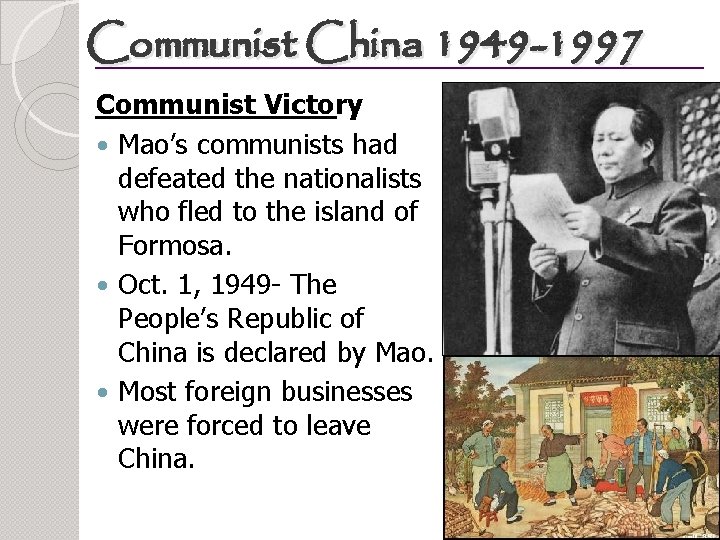
Communist China 1949 -1997 Communist Victory Mao’s communists had defeated the nationalists who fled to the island of Formosa. Oct. 1, 1949 - The People’s Republic of China is declared by Mao. Most foreign businesses were forced to leave China.
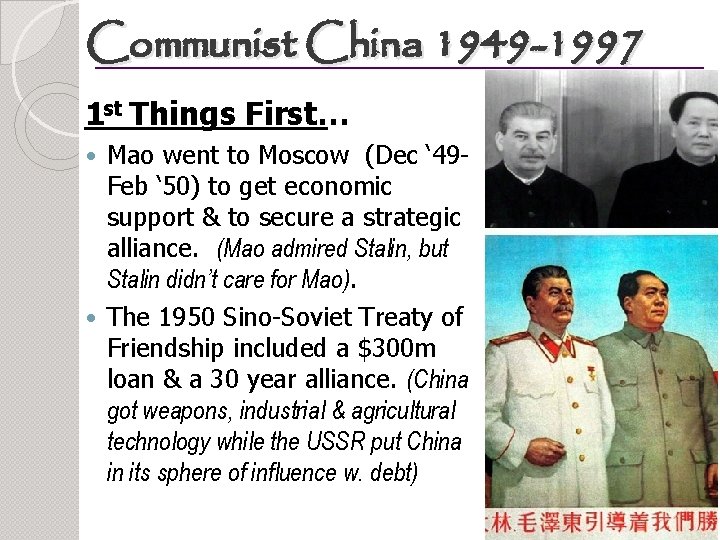
Communist China 1949 -1997 1 st Things First… Mao went to Moscow (Dec ‘ 49 Feb ‘ 50) to get economic support & to secure a strategic alliance. (Mao admired Stalin, but Stalin didn’t care for Mao). The 1950 Sino-Soviet Treaty of Friendship included a $300 m loan & a 30 year alliance. (China got weapons, industrial & agricultural technology while the USSR put China in its sphere of influence w. debt)
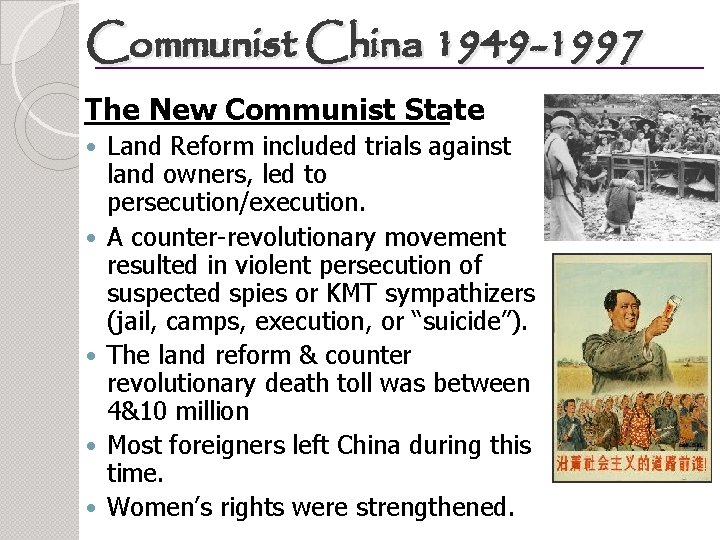
Communist China 1949 -1997 The New Communist State Land Reform included trials against land owners, led to persecution/execution. A counter-revolutionary movement resulted in violent persecution of suspected spies or KMT sympathizers (jail, camps, execution, or “suicide”). The land reform & counter revolutionary death toll was between 4&10 million Most foreigners left China during this time. Women’s rights were strengthened.
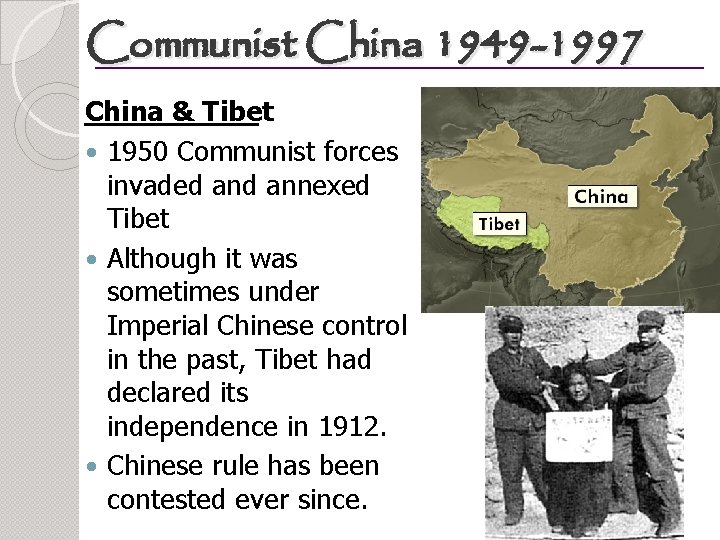
Communist China 1949 -1997 China & Tibet 1950 Communist forces invaded annexed Tibet Although it was sometimes under Imperial Chinese control in the past, Tibet had declared its independence in 1912. Chinese rule has been contested ever since.
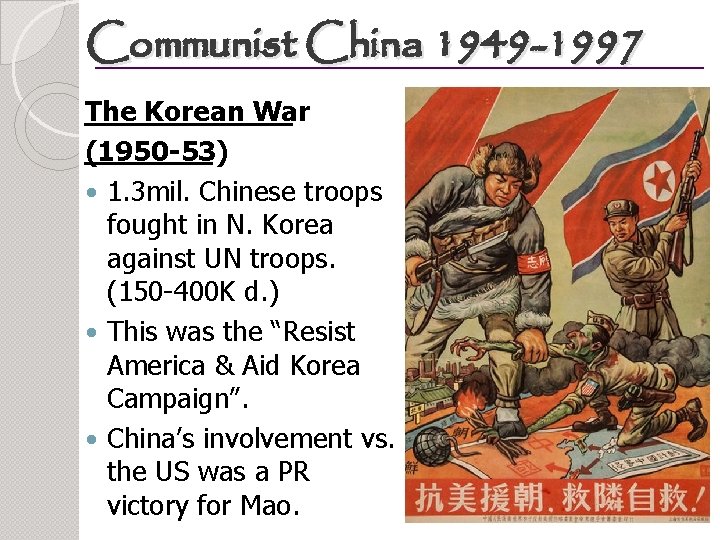
Communist China 1949 -1997 The Korean War (1950 -53) 1. 3 mil. Chinese troops fought in N. Korea against UN troops. (150 -400 K d. ) This was the “Resist America & Aid Korea Campaign”. China’s involvement vs. the US was a PR victory for Mao.
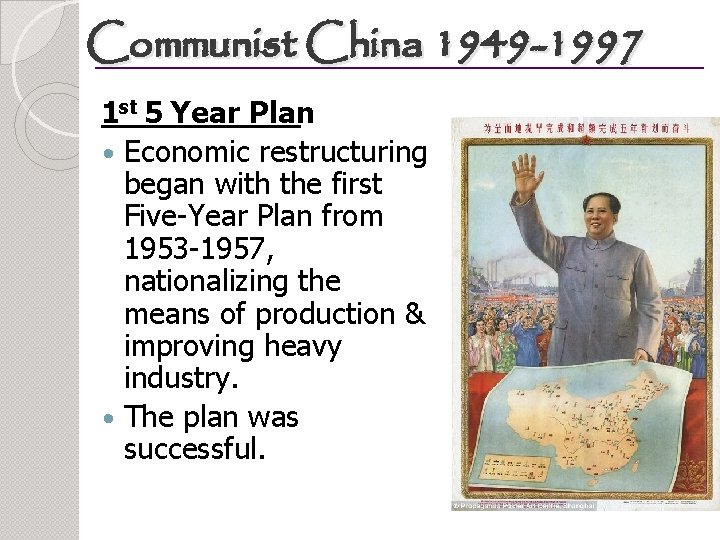
Communist China 1949 -1997 1 st 5 Year Plan Economic restructuring began with the first Five-Year Plan from 1953 -1957, nationalizing the means of production & improving heavy industry. The plan was successful.
Communist China 1949 -1997 1956 -7 Hundred Flowers Campaign Mao felt the revolution needed the support of the intellectual class. Inspired by Khrushchev’s more liberal approach, Mao relaxed restrictions on public criticism of the party. “Let a hundred flowers bloom, and a hundred schools of thought contend. ” By ‘ 57, the flood of criticism was too much. Those who complained were declared “Rightists”& were discredited or imprisoned.
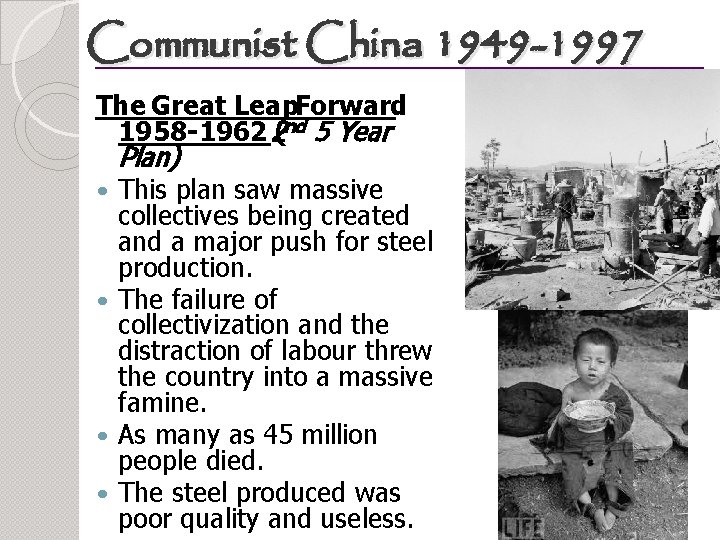
Communist China 1949 -1997 The Great Leap. Forward 1958 -1962 2(nd 5 Year Plan) This plan saw massive collectives being created and a major push for steel production. The failure of collectivization and the distraction of labour threw the country into a massive famine. As many as 45 million people died. The steel produced was poor quality and useless.
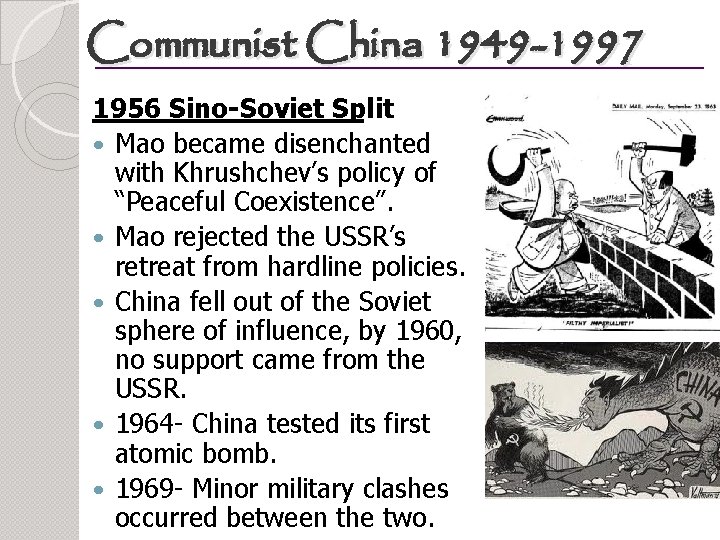
Communist China 1949 -1997 1956 Sino-Soviet Split Mao became disenchanted with Khrushchev’s policy of “Peaceful Coexistence”. Mao rejected the USSR’s retreat from hardline policies. China fell out of the Soviet sphere of influence, by 1960, no support came from the USSR. 1964 - China tested its first atomic bomb. 1969 - Minor military clashes occurred between the two.
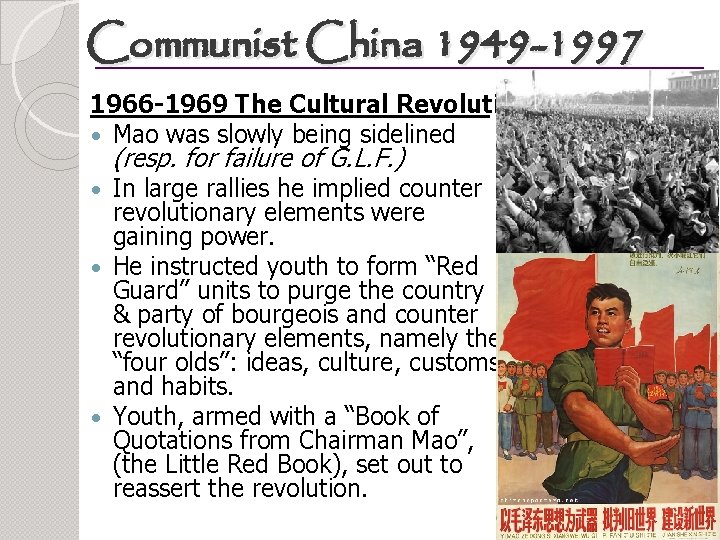
Communist China 1949 -1997 1966 -1969 The Cultural Revolution Mao was slowly being sidelined (resp. for failure of G. L. F. ) In large rallies he implied counter revolutionary elements were gaining power. He instructed youth to form “Red Guard” units to purge the country & party of bourgeois and counter revolutionary elements, namely the “four olds”: ideas, culture, customs, and habits. Youth, armed with a “Book of Quotations from Chairman Mao”, (the Little Red Book), set out to reassert the revolution.
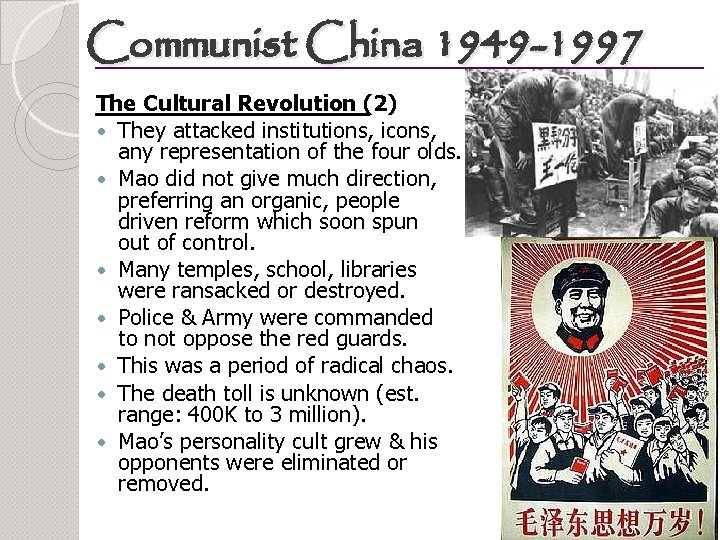
Communist China 1949 -1997 The Cultural Revolution (2) They attacked institutions, icons, any representation of the four olds. Mao did not give much direction, preferring an organic, people driven reform which soon spun out of control. Many temples, school, libraries were ransacked or destroyed. Police & Army were commanded to not oppose the red guards. This was a period of radical chaos. The death toll is unknown (est. range: 400 K to 3 million). Mao’s personality cult grew & his opponents were eliminated or removed.
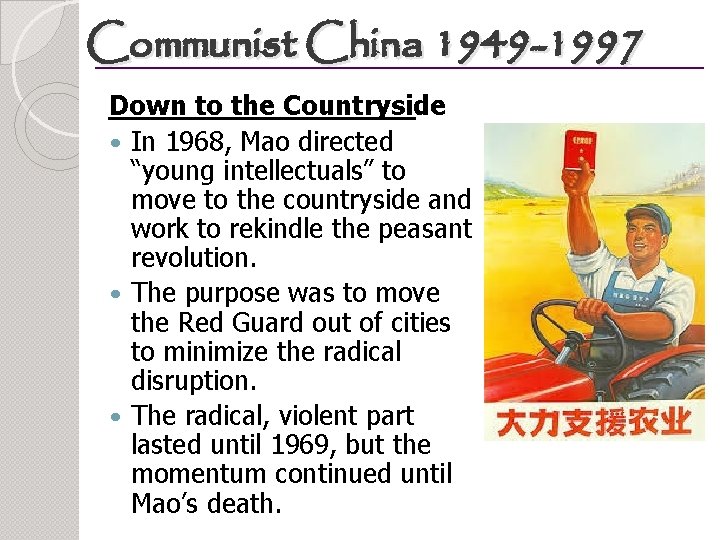
Communist China 1949 -1997 Down to the Countryside In 1968, Mao directed “young intellectuals” to move to the countryside and work to rekindle the peasant revolution. The purpose was to move the Red Guard out of cities to minimize the radical disruption. The radical, violent part lasted until 1969, but the momentum continued until Mao’s death.
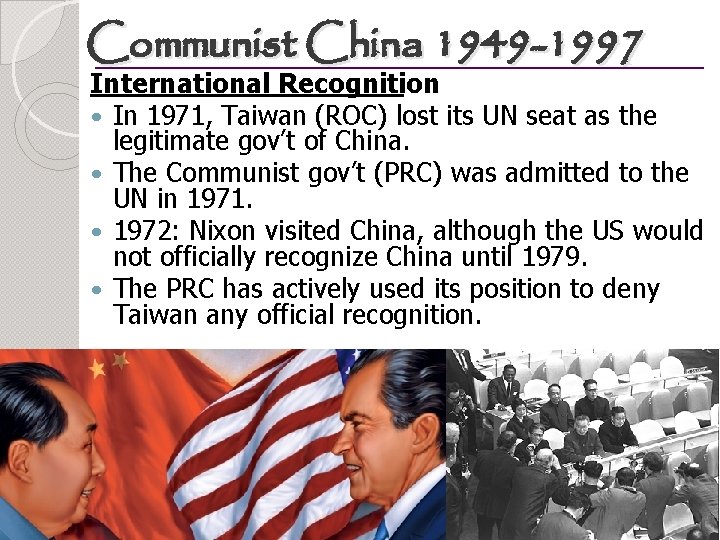
Communist China 1949 -1997 International Recognition In 1971, Taiwan (ROC) lost its UN seat as the legitimate gov’t of China. The Communist gov’t (PRC) was admitted to the UN in 1971. 1972: Nixon visited China, although the US would not officially recognize China until 1979. The PRC has actively used its position to deny Taiwan any official recognition.
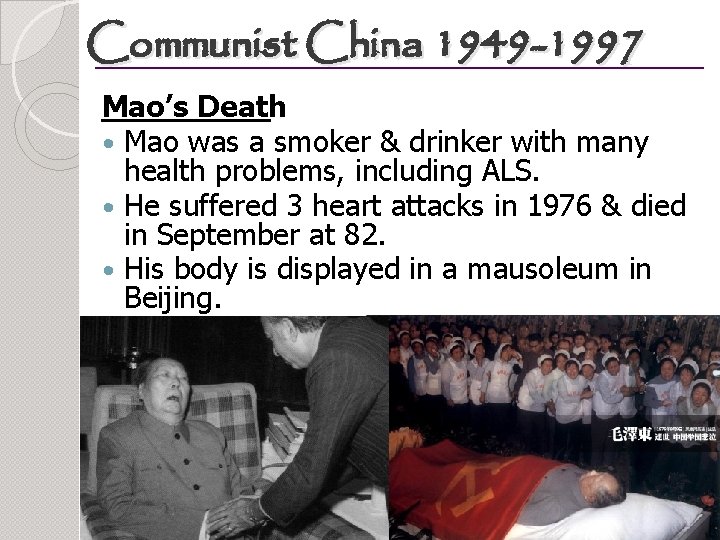
Communist China 1949 -1997 Mao’s Death Mao was a smoker & drinker with many health problems, including ALS. He suffered 3 heart attacks in 1976 & died in September at 82. His body is displayed in a mausoleum in Beijing.
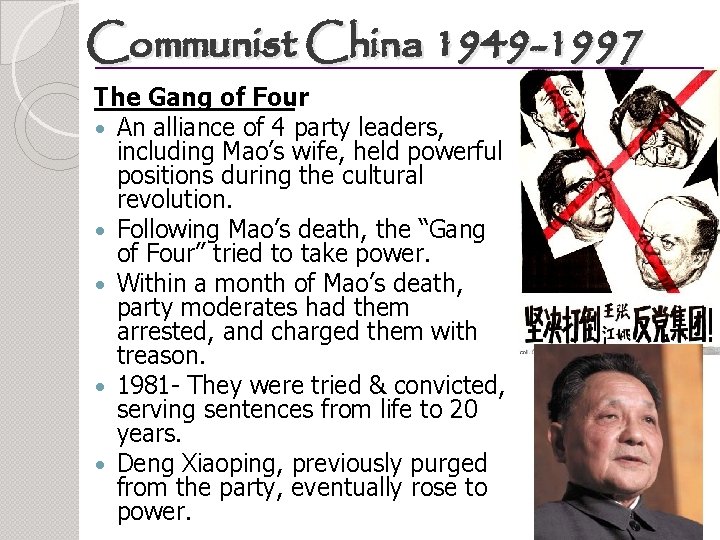
Communist China 1949 -1997 The Gang of Four An alliance of 4 party leaders, including Mao’s wife, held powerful positions during the cultural revolution. Following Mao’s death, the “Gang of Four” tried to take power. Within a month of Mao’s death, party moderates had them arrested, and charged them with treason. 1981 - They were tried & convicted, serving sentences from life to 20 years. Deng Xiaoping, previously purged from the party, eventually rose to power.
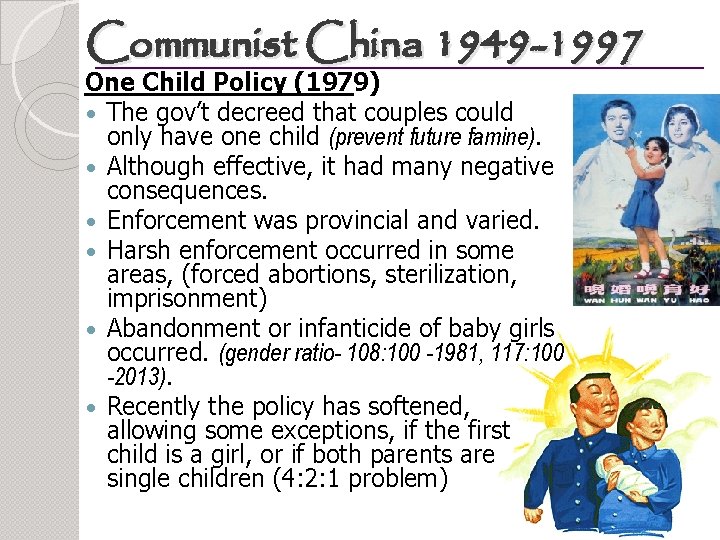
Communist China 1949 -1997 One Child Policy (1979) The gov’t decreed that couples could only have one child (prevent future famine). Although effective, it had many negative consequences. Enforcement was provincial and varied. Harsh enforcement occurred in some areas, (forced abortions, sterilization, imprisonment) Abandonment or infanticide of baby girls occurred. (gender ratio- 108: 100 -1981, 117: 100 -2013). Recently the policy has softened, allowing some exceptions, if the first child is a girl, or if both parents are single children (4: 2: 1 problem)
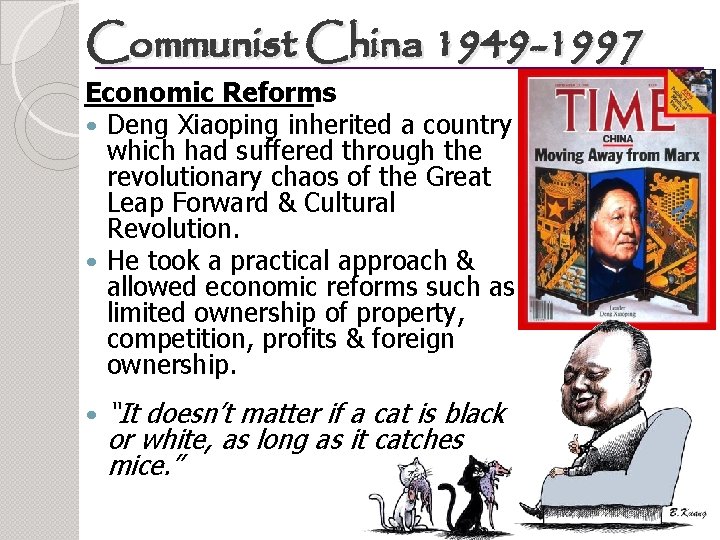
Communist China 1949 -1997 Economic Reforms Deng Xiaoping inherited a country which had suffered through the revolutionary chaos of the Great Leap Forward & Cultural Revolution. He took a practical approach & allowed economic reforms such as limited ownership of property, competition, profits & foreign ownership. “It doesn’t matter if a cat is black or white, as long as it catches mice. ”
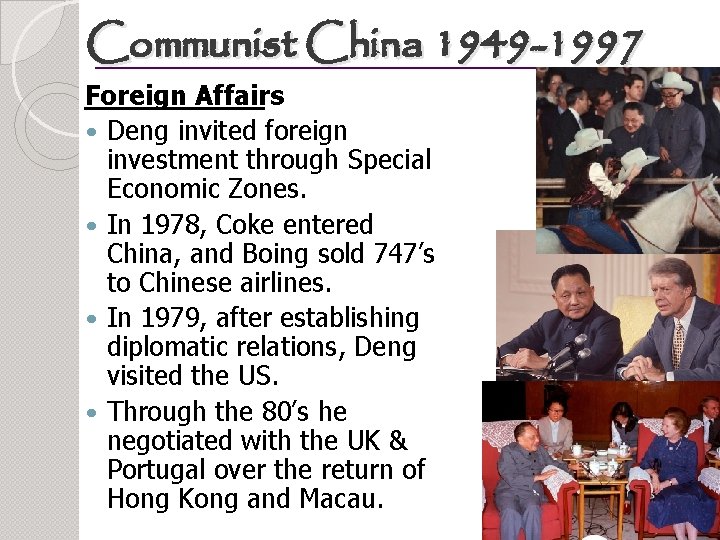
Communist China 1949 -1997 Foreign Affairs Deng invited foreign investment through Special Economic Zones. In 1978, Coke entered China, and Boing sold 747’s to Chinese airlines. In 1979, after establishing diplomatic relations, Deng visited the US. Through the 80’s he negotiated with the UK & Portugal over the return of Hong Kong and Macau.
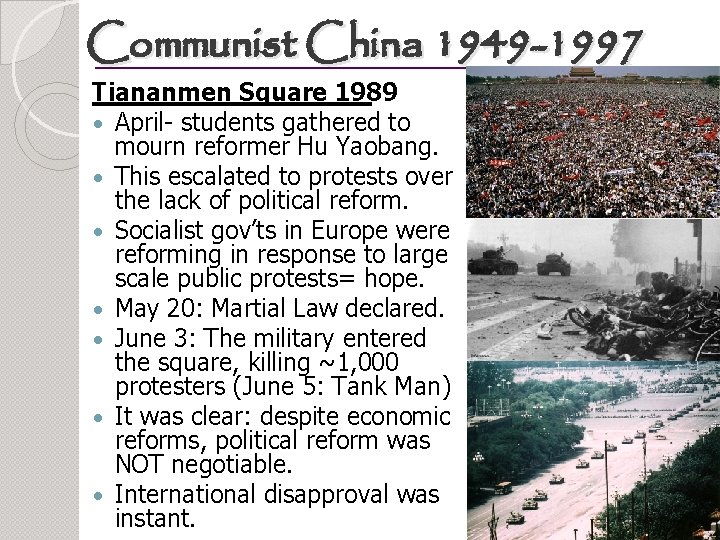
Communist China 1949 -1997 Tiananmen Square 1989 April- students gathered to mourn reformer Hu Yaobang. This escalated to protests over the lack of political reform. Socialist gov’ts in Europe were reforming in response to large scale public protests= hope. May 20: Martial Law declared. June 3: The military entered the square, killing ~1, 000 protesters (June 5: Tank Man) It was clear: despite economic reforms, political reform was NOT negotiable. International disapproval was instant.
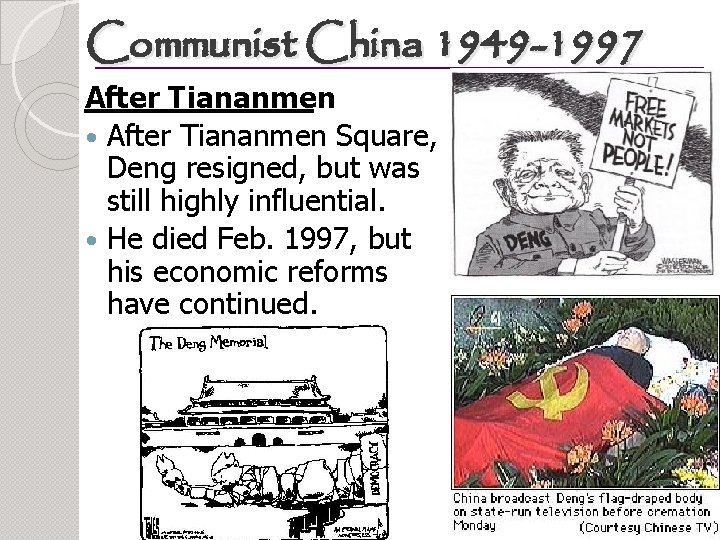
Communist China 1949 -1997 After Tiananmen Square, Deng resigned, but was still highly influential. He died Feb. 1997, but his economic reforms have continued.
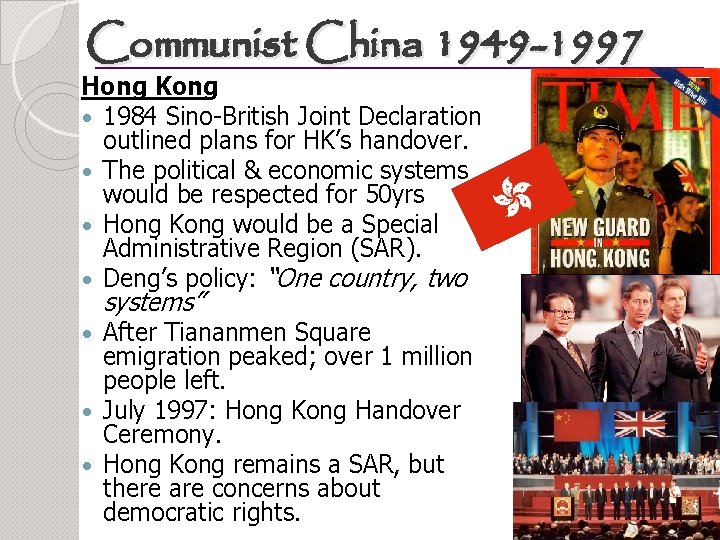
Communist China 1949 -1997 Hong Kong 1984 Sino-British Joint Declaration outlined plans for HK’s handover. The political & economic systems would be respected for 50 yrs Hong Kong would be a Special Administrative Region (SAR). Deng’s policy: “One country, two systems” After Tiananmen Square emigration peaked; over 1 million people left. July 1997: Hong Kong Handover Ceremony. Hong Kong remains a SAR, but there are concerns about democratic rights.
- Slides: 23