
Twelve Ways to Defeat TwoFactor Authentication Roger Grimes

- Slides: 55
Twelve Ways to Defeat Two-Factor Authentication Roger Grimes Data-Driven Defense Evangelist, Know. Be 4, Inc. rogerg@knowbe 4. com
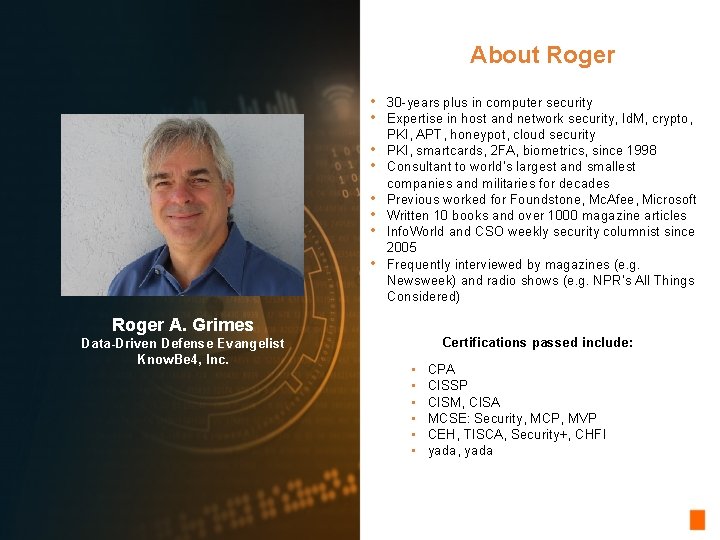
About Roger • • 30 -years plus in computer security Expertise in host and network security, Id. M, crypto, PKI, APT, honeypot, cloud security PKI, smartcards, 2 FA, biometrics, since 1998 Consultant to world’s largest and smallest companies and militaries for decades Previous worked for Foundstone, Mc. Afee, Microsoft Written 10 books and over 1000 magazine articles Info. World and CSO weekly security columnist since 2005 Frequently interviewed by magazines (e. g. Newsweek) and radio shows (e. g. NPR’s All Things Considered) Roger A. Grimes Data-Driven Defense Evangelist Know. Be 4, Inc. Certifications passed include: • • • CPA CISSP CISM, CISA MCSE: Security, MCP, MVP CEH, TISCA, Security+, CHFI yada, yada
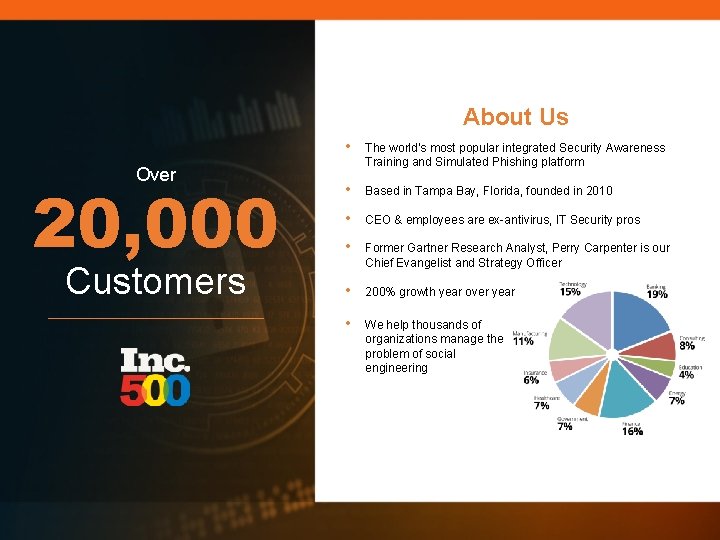
About Us Over 20, 000 Customers • The world’s most popular integrated Security Awareness Training and Simulated Phishing platform • Based in Tampa Bay, Florida, founded in 2010 • CEO & employees are ex-antivirus, IT Security pros • Former Gartner Research Analyst, Perry Carpenter is our Chief Evangelist and Strategy Officer • 200% growth year over year • We help thousands of organizations manage the problem of social engineering
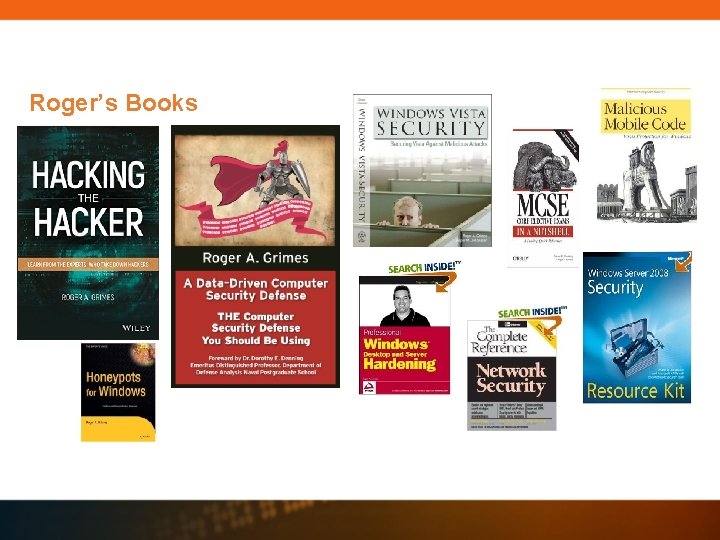
Roger’s Books
Today’s Presentation • Two-Factor Authentication Intro • Hacking 2 FA • Defending Against 2 FA Attacks
Two-Factor Authentication Intro
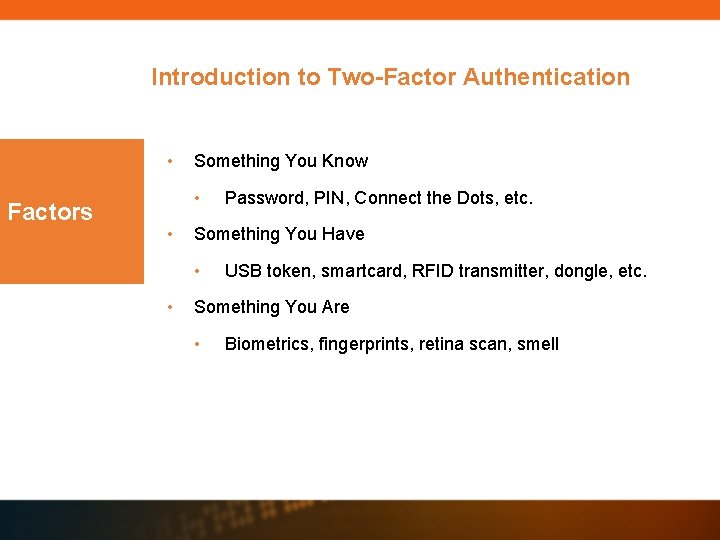
Introduction to Two-Factor Authentication • Factors Something You Know • • Something You Have • • Password, PIN, Connect the Dots, etc. USB token, smartcard, RFID transmitter, dongle, etc. Something You Are • Biometrics, fingerprints, retina scan, smell
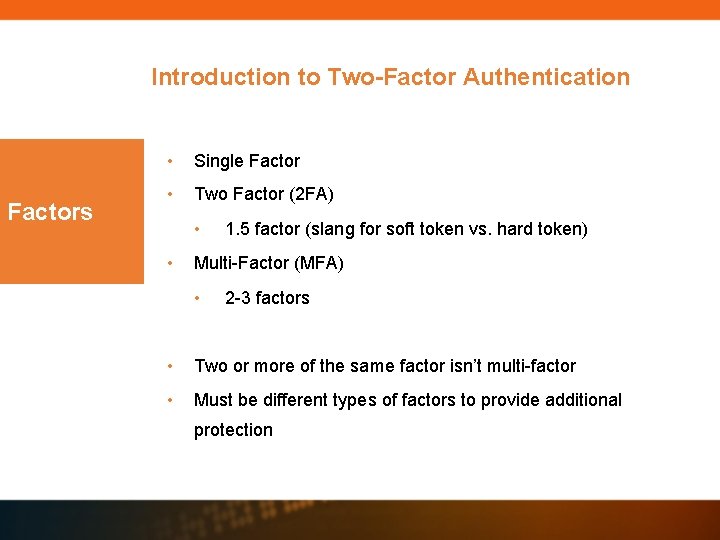
Introduction to Two-Factor Authentication Factors • Single Factor • Two Factor (2 FA) • • 1. 5 factor (slang for soft token vs. hard token) Multi-Factor (MFA) • 2 -3 factors • Two or more of the same factor isn’t multi-factor • Must be different types of factors to provide additional protection
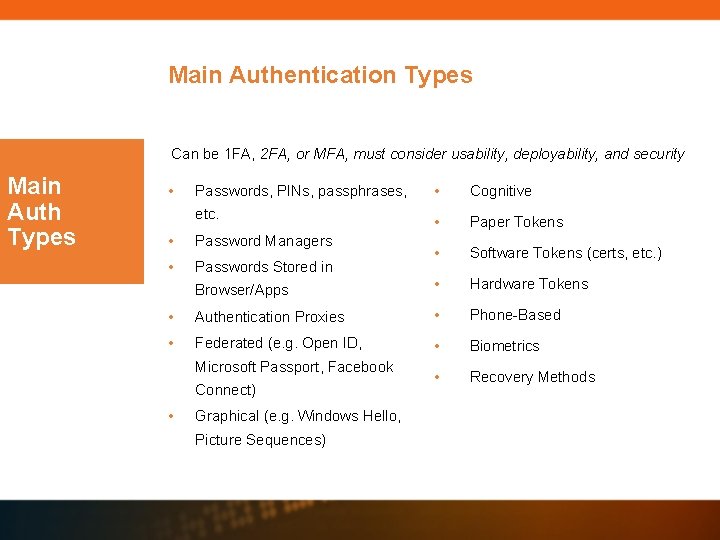
Main Authentication Types Can be 1 FA, 2 FA, or MFA, must consider usability, deployability, and security Main Auth Types • Passwords, PINs, passphrases, • Cognitive etc. • Paper Tokens • Software Tokens (certs, etc. ) Browser/Apps • Hardware Tokens • Authentication Proxies • Phone-Based • Federated (e. g. Open ID, • Biometrics • Recovery Methods • Password Managers • Passwords Stored in Microsoft Passport, Facebook Connect) • Graphical (e. g. Windows Hello, Picture Sequences)
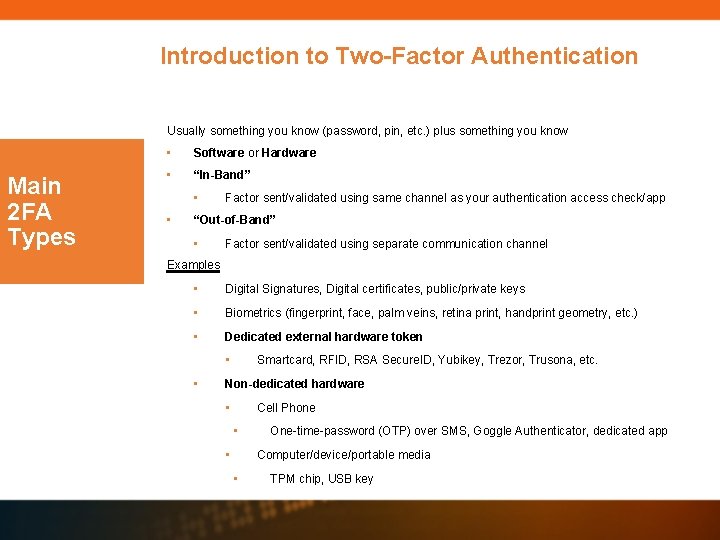
Introduction to Two-Factor Authentication Usually something you know (password, pin, etc. ) plus something you know Main 2 FA Types • Software or Hardware • “In-Band” • • Factor sent/validated using same channel as your authentication access check/app “Out-of-Band” • Factor sent/validated using separate communication channel Examples • Digital Signatures, Digital certificates, public/private keys • Biometrics (fingerprint, face, palm veins, retina print, handprint geometry, etc. ) • Dedicated external hardware token • • Smartcard, RFID, RSA Secure. ID, Yubikey, Trezor, Trusona, etc. Non-dedicated hardware • Cell Phone • • One-time-password (OTP) over SMS, Goggle Authenticator, dedicated app Computer/device/portable media • TPM chip, USB key
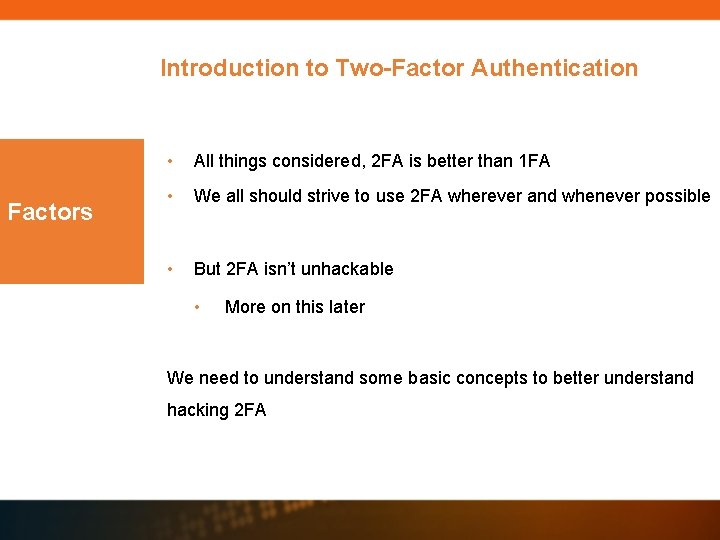
Introduction to Two-Factor Authentication Factors • All things considered, 2 FA is better than 1 FA • We all should strive to use 2 FA wherever and whenever possible • But 2 FA isn’t unhackable • More on this later We need to understand some basic concepts to better understand hacking 2 FA
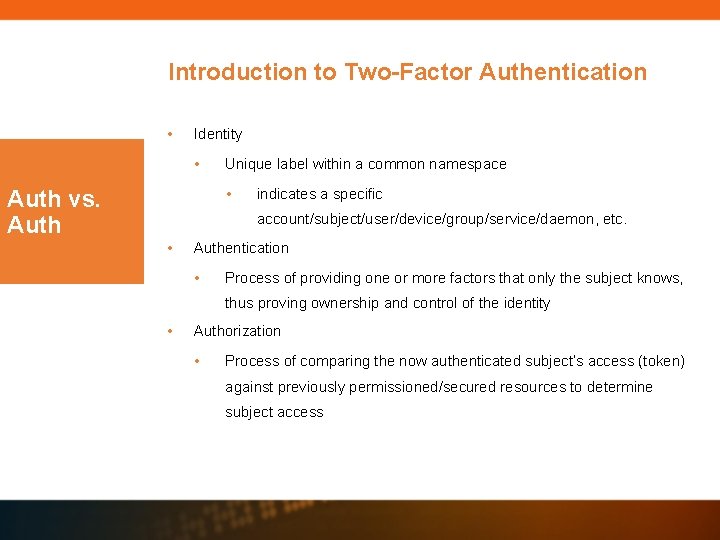
Introduction to Two-Factor Authentication • Identity • Auth vs. Auth Unique label within a common namespace • indicates a specific account/subject/user/device/group/service/daemon, etc. • Authentication • Process of providing one or more factors that only the subject knows, thus proving ownership and control of the identity • Authorization • Process of comparing the now authenticated subject’s access (token) against previously permissioned/secured resources to determine subject access
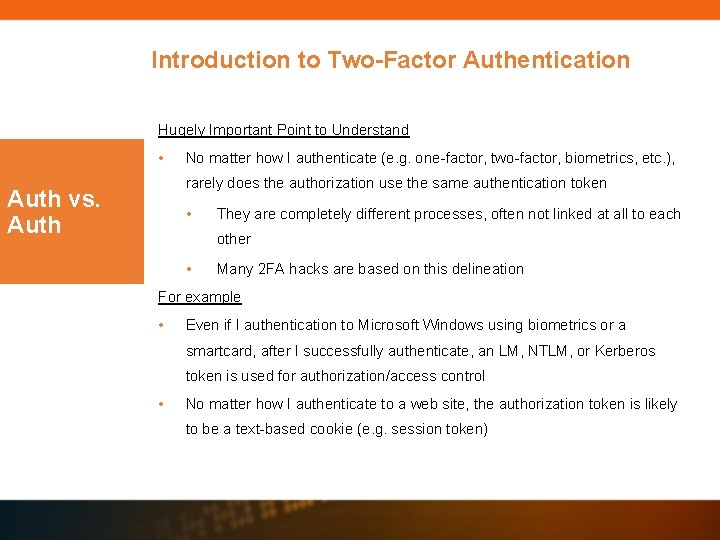
Introduction to Two-Factor Authentication Hugely Important Point to Understand • No matter how I authenticate (e. g. one-factor, two-factor, biometrics, etc. ), rarely does the authorization use the same authentication token Auth vs. Auth • They are completely different processes, often not linked at all to each other • Many 2 FA hacks are based on this delineation For example • Even if I authentication to Microsoft Windows using biometrics or a smartcard, after I successfully authenticate, an LM, NTLM, or Kerberos token is used for authorization/access control • No matter how I authenticate to a web site, the authorization token is likely to be a text-based cookie (e. g. session token)
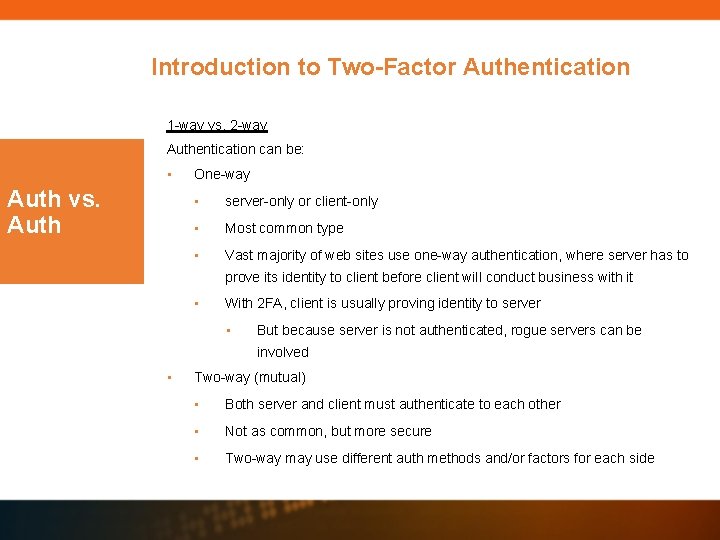
Introduction to Two-Factor Authentication 1 -way vs. 2 -way Authentication can be: • Auth vs. Auth One-way • server-only or client-only • Most common type • Vast majority of web sites use one-way authentication, where server has to prove its identity to client before client will conduct business with it • With 2 FA, client is usually proving identity to server • But because server is not authenticated, rogue servers can be involved • Two-way (mutual) • Both server and client must authenticate to each other • Not as common, but more secure • Two-way may use different auth methods and/or factors for each side
Hacking 2 FA
2 FA Hacks Main Hacking Methods General • Social Engineering • Technical Attack against underlying technology • Some of the attacks are both Some 2 FA/MFA solutions are better than others, but there is no such thing as “unhackable”
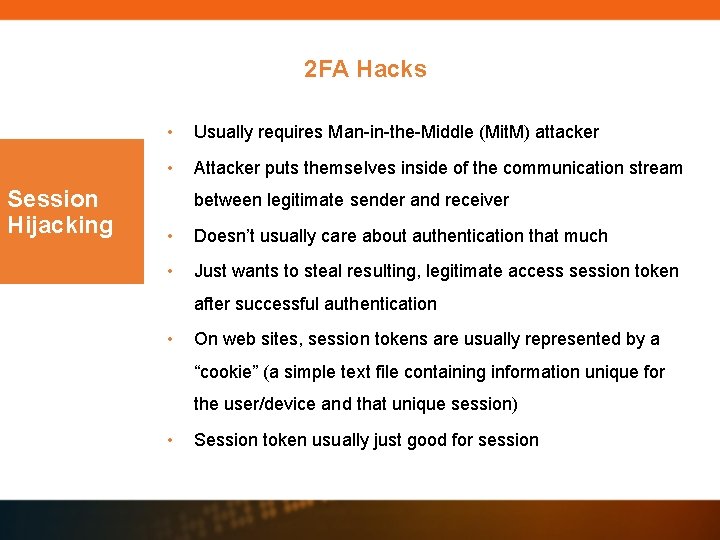
2 FA Hacks Session Hijacking • Usually requires Man-in-the-Middle (Mit. M) attacker • Attacker puts themselves inside of the communication stream between legitimate sender and receiver • Doesn’t usually care about authentication that much • Just wants to steal resulting, legitimate access session token after successful authentication • On web sites, session tokens are usually represented by a “cookie” (a simple text file containing information unique for the user/device and that unique session) • Session token usually just good for session
2 FA Hacks • Session Hijacking has been around since computers have been networked Session Hijacking • ARP spoofing, cookie stealing, URL tampering, etc. • Bancos trojans did it in the early 2000’s • Firesheep made it super popular and easy in 2010 • Defense against web-based session hijacking was for vendors to use unpredictable cookie contents and to use HTTPS (SSL/TLS) • • Hackers got around Better defense was to use 2 FA • Hackers got around
2 FA Hacks Common Session Hijacking Methods Session Hijacking Rogue Proxy/Server used to: • Replay and Steal Credentials • Steal Session Cookie
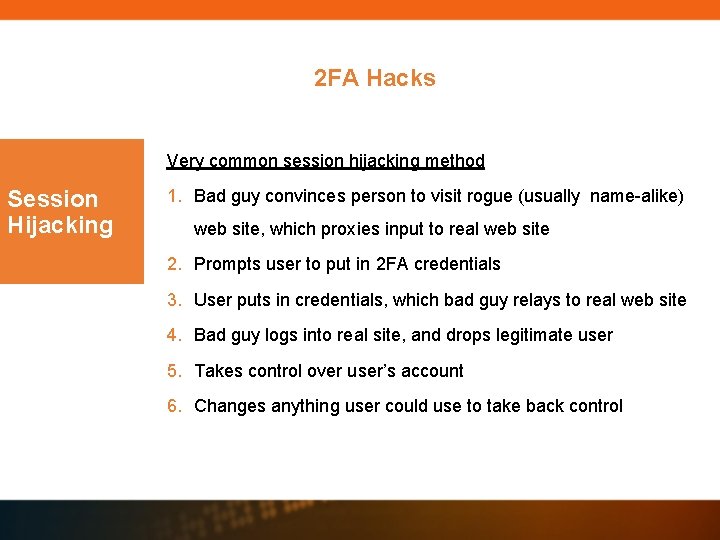
2 FA Hacks Very common session hijacking method Session Hijacking 1. Bad guy convinces person to visit rogue (usually name-alike) web site, which proxies input to real web site 2. Prompts user to put in 2 FA credentials 3. User puts in credentials, which bad guy relays to real web site 4. Bad guy logs into real site, and drops legitimate user 5. Takes control over user’s account 6. Changes anything user could use to take back control
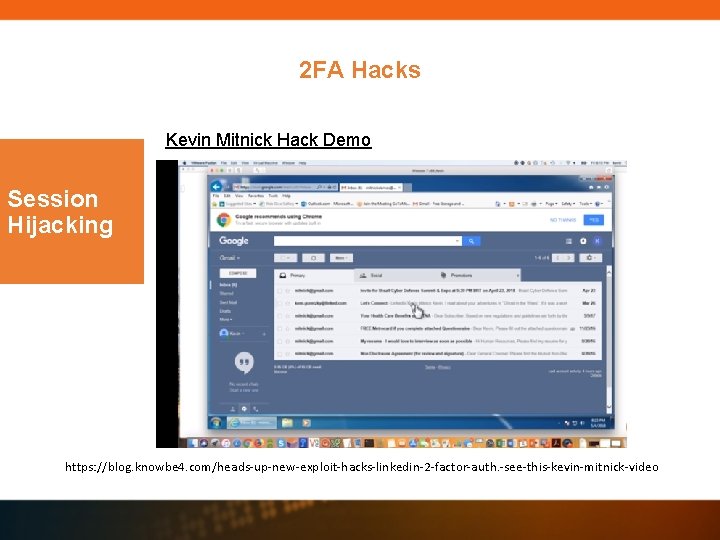
2 FA Hacks Kevin Mitnick Hack Demo Session Hijacking https: //blog. knowbe 4. com/heads-up-new-exploit-hacks-linkedin-2 -factor-auth. -see-this-kevin-mitnick-video
2 FA Hacks Kevin Mitnick Hack Demo 1. Kevin set up fake look-alike/sound-alike web site that was really Session Hijacking an evil proxy 2. Tricked user into visiting evil proxy web site 3. User typed in credentials, which proxy, now pretending to be the legitimate customer, presented to legitimate web site 4. Legitimate web site sent back legitimate session token, which Kevin then stole and replayed to take over user’s session • Kevin used Evilginx (https: //breakdev. org/evilginx-advancedphishing-with-two-factor-authentication-bypass/) • One example hack out of the dozens, if not hundreds of ways to do session hijacking, even if 2 FA is involved
2 FA Hacks Man-in-the-Endpoint Attacks • If endpoint gets compromised, 2 FA isn’t going to help you • Attacker can just do everything they want that the user is allowed to do after successful authentication • Steal session cookies • Attacker can modify 2 FA software to even steal 2 FA secrets • Smartcards and rogue CSPs
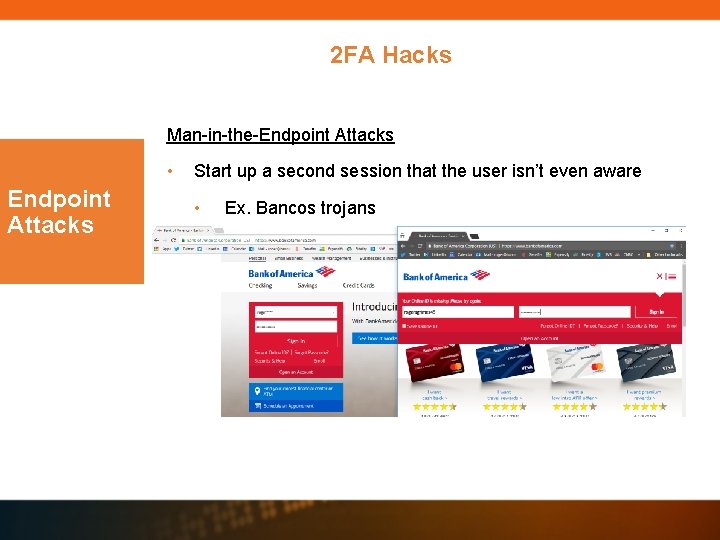
2 FA Hacks Man-in-the-Endpoint Attacks • Endpoint Attacks Start up a second session that the user isn’t even aware • Ex. Bancos trojans
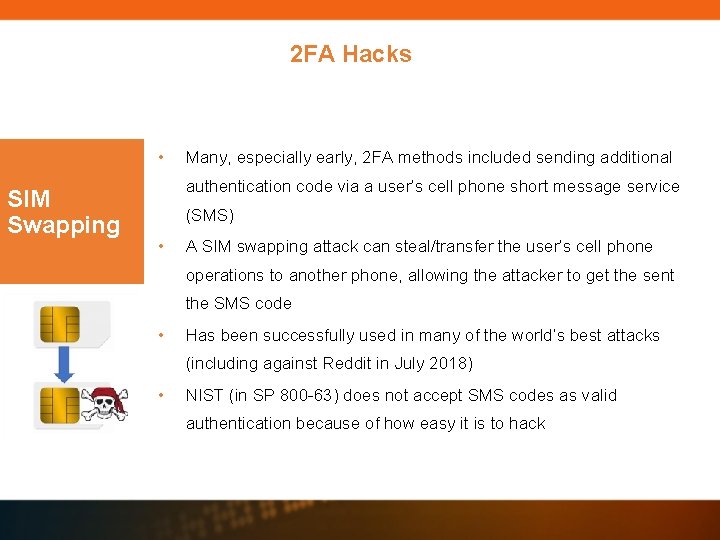
2 FA Hacks • SIM Swapping Many, especially early, 2 FA methods included sending additional authentication code via a user’s cell phone short message service (SMS) • A SIM swapping attack can steal/transfer the user’s cell phone operations to another phone, allowing the attacker to get the sent the SMS code • Has been successfully used in many of the world’s best attacks (including against Reddit in July 2018) • NIST (in SP 800 -63) does not accept SMS codes as valid authentication because of how easy it is to hack
2 FA Hacks SIM Basics SIM Swapping • SIM stands for Subscriber Identity Module • Most cell phone SIM cards store the cell phone network’s information and the subscriber’s (user/owner) information, plus can store app data • If you move the SIM card to another cell phone, it transfers your phone number and other info to that other cell phone • Once done, “old” usually phone stops working
2 FA Hacks SIM Swapping Attack SIM Swapping • Attackers (using different methods) successfully transfer your SIM information to their cell phone • Often done by using social engineering: • To your cell phone network provider’s tech support • At local phone store or over phone • May start with successful vishing/phishing to victim to retrieve necessary cell phone account info • Information may be collected by reviewing victim’s social media accounts
2 FA Hacks SIM Swapping Attack (con’t) SIM Swapping • Once SIM criminals have gathered enough info on victim, they call/visit the victim’s cellphone provider and claim that the SIM card has been lost or damaged or buy new phones using your identity • They activate another SIM card/number using your info • Most vendors ask for additional information, that usually the thief has learned, such as account pin/password, address, last four of ssn, and/or answers to password reset questions • Once transferred, thief has control of phone and SMS
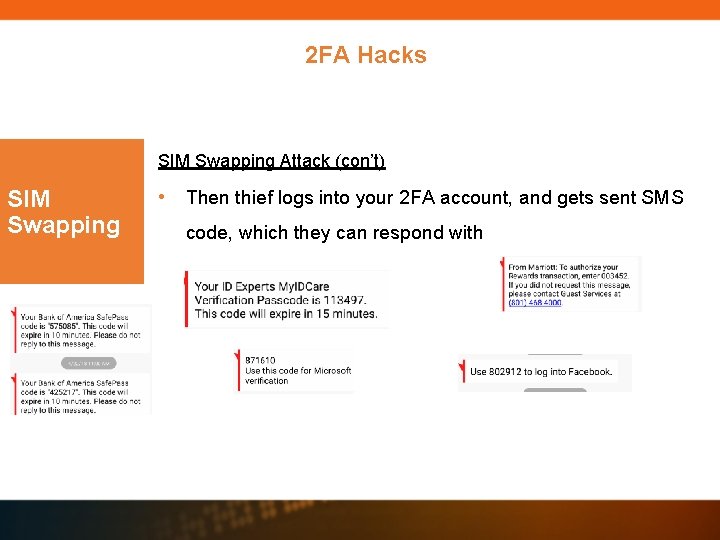
2 FA Hacks SIM Swapping Attack (con’t) SIM Swapping • Then thief logs into your 2 FA account, and gets sent SMS code, which they can respond with
2 FA Hacks SIM Swapping Attack (con’t) SIM Swapping • Defense: Use non-SMS-based apps • App travels with authenticated user, not phone number or SIM • Can’t be as easily transferred by 3 rd party without your knowledge or participation • Not perfect, but stops easy SIM-swapping attacks
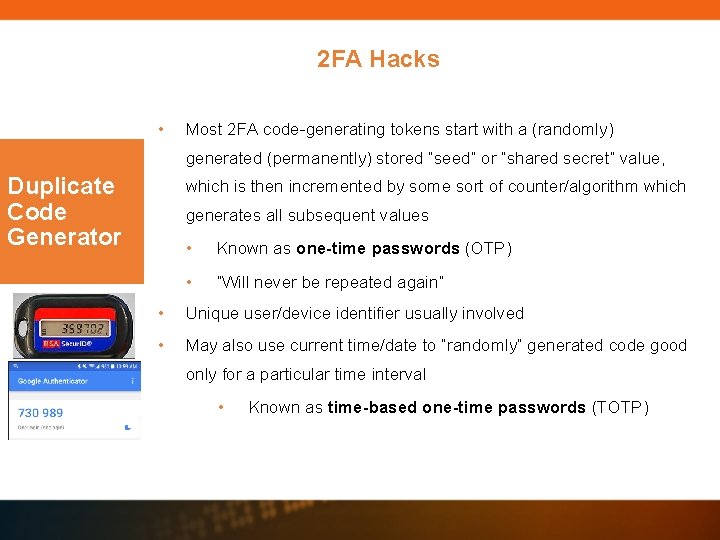
2 FA Hacks • Most 2 FA code-generating tokens start with a (randomly) generated (permanently) stored “seed” or “shared secret” value, Duplicate Code Generator which is then incremented by some sort of counter/algorithm which generates all subsequent values • Known as one-time passwords (OTP) • “Will never be repeated again” • Unique user/device identifier usually involved • May also use current time/date to “randomly” generated code good only for a particular time interval • Known as time-based one-time passwords (TOTP)
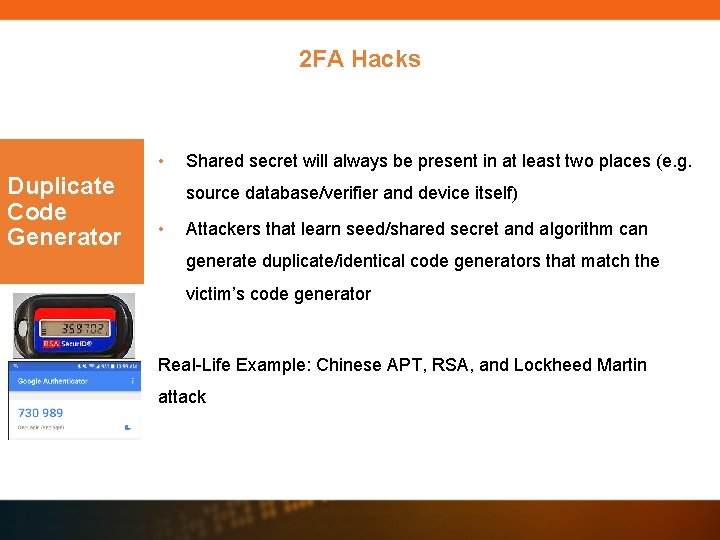
2 FA Hacks • Duplicate Code Generator Shared secret will always be present in at least two places (e. g. source database/verifier and device itself) • Attackers that learn seed/shared secret and algorithm can generate duplicate/identical code generators that match the victim’s code generator Real-Life Example: Chinese APT, RSA, and Lockheed Martin attack
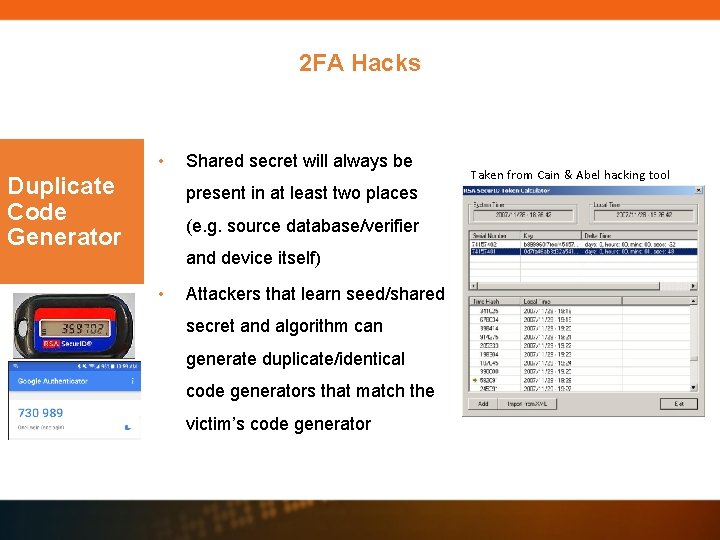
2 FA Hacks • Duplicate Code Generator Shared secret will always be present in at least two places (e. g. source database/verifier and device itself) • Attackers that learn seed/shared secret and algorithm can generate duplicate/identical code generators that match the victim’s code generator Taken from Cain & Abel hacking tool
2 FA Hacks Not Required/ Downgrade Attacks • If you still have a 1 FA solution for a site or service, and it can still be used, then it’s like you don’t really have 2 FA • Many sites and services that allow 2 FA, don’t require it • Which means attacker can use non-2 FA credential to access • May allow both more secure and less secure 2 FA methods, but you likely can’t force only one method
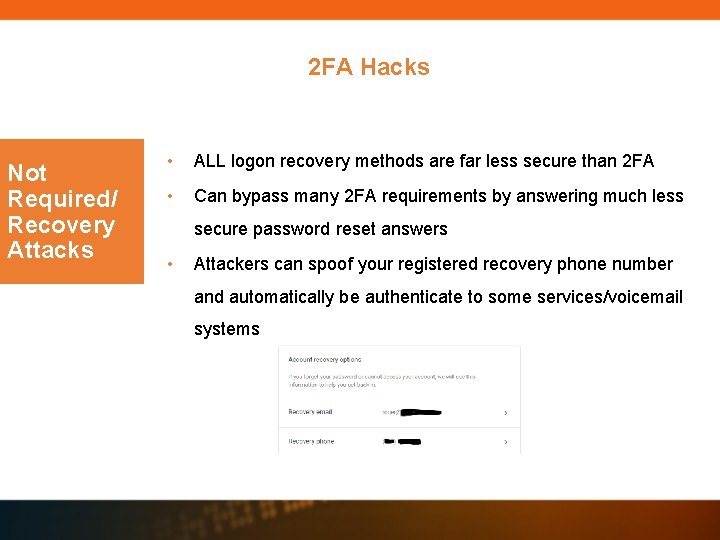
2 FA Hacks Not Required/ Recovery Attacks • ALL logon recovery methods are far less secure than 2 FA • Can bypass many 2 FA requirements by answering much less secure password reset answers • Attackers can spoof your registered recovery phone number and automatically be authenticate to some services/voicemail systems
2 FA Hacks Social Engineer Tech Support • There have been many real-world instances where the user had 2 FA to a particular web site or service, maybe even required that it be used; • And hackers socially engineered tech support into disabling it and resetting password, using other information they had learned
2 FA Hacks Social Engineer Tech Support • “Hi, I lost my 2 FA token or it is broken, what can I do to get a new one? ” • “Hi, my laptop crashed and I had to reinstall Google Authenticator. Can you resend me a new QR code to my temporary email address so I can access my corp email? ”
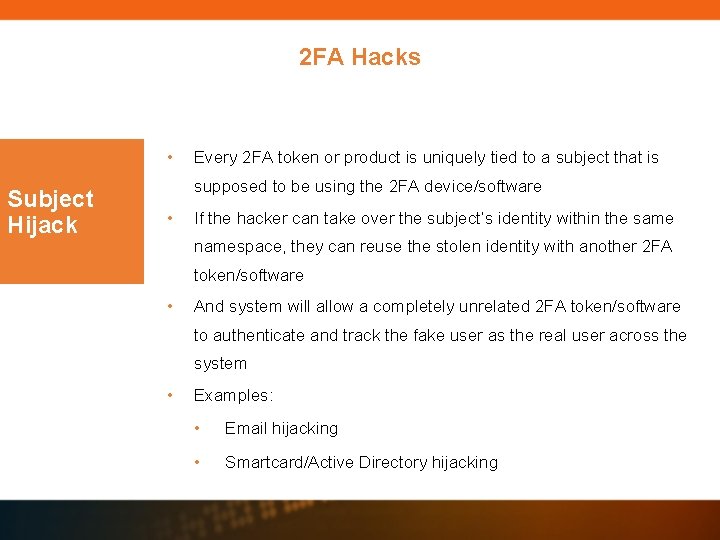
2 FA Hacks • Subject Hijack Every 2 FA token or product is uniquely tied to a subject that is supposed to be using the 2 FA device/software • If the hacker can take over the subject’s identity within the same namespace, they can reuse the stolen identity with another 2 FA token/software • And system will allow a completely unrelated 2 FA token/software to authenticate and track the fake user as the real user across the system • Examples: • Email hijacking • Smartcard/Active Directory hijacking
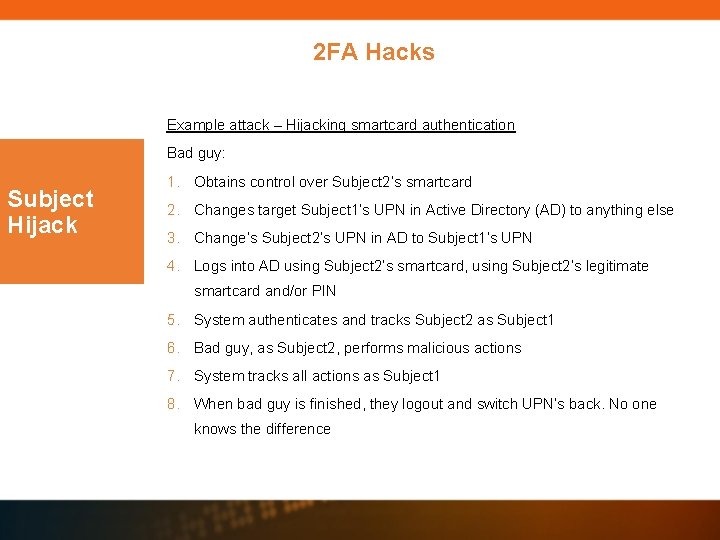
2 FA Hacks Example attack – Hijacking smartcard authentication Bad guy: Subject Hijack 1. Obtains control over Subject 2’s smartcard 2. Changes target Subject 1’s UPN in Active Directory (AD) to anything else 3. Change’s Subject 2’s UPN in AD to Subject 1’s UPN 4. Logs into AD using Subject 2’s smartcard, using Subject 2’s legitimate smartcard and/or PIN 5. System authenticates and tracks Subject 2 as Subject 1 6. Bad guy, as Subject 2, performs malicious actions 7. System tracks all actions as Subject 1 8. When bad guy is finished, they logout and switch UPN’s back. No one knows the difference
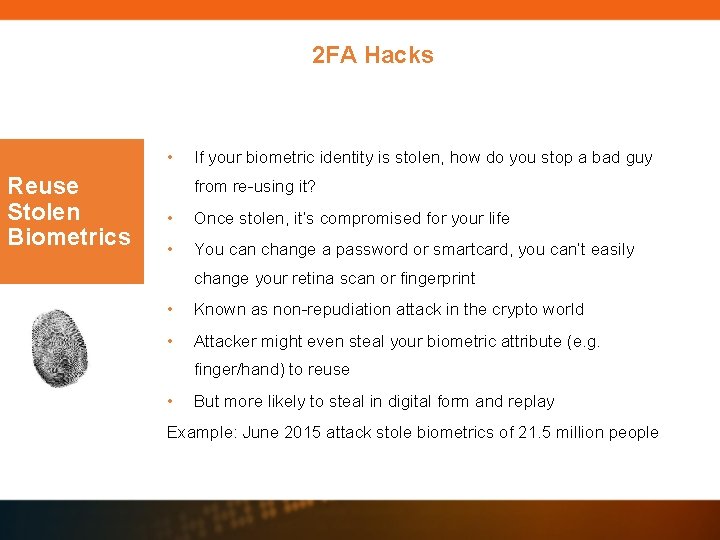
2 FA Hacks • Reuse Stolen Biometrics If your biometric identity is stolen, how do you stop a bad guy from re-using it? • Once stolen, it’s compromised for your life • You can change a password or smartcard, you can’t easily change your retina scan or fingerprint • Known as non-repudiation attack in the crypto world • Attacker might even steal your biometric attribute (e. g. finger/hand) to reuse • But more likely to steal in digital form and replay Example: June 2015 attack stole biometrics of 21. 5 million people
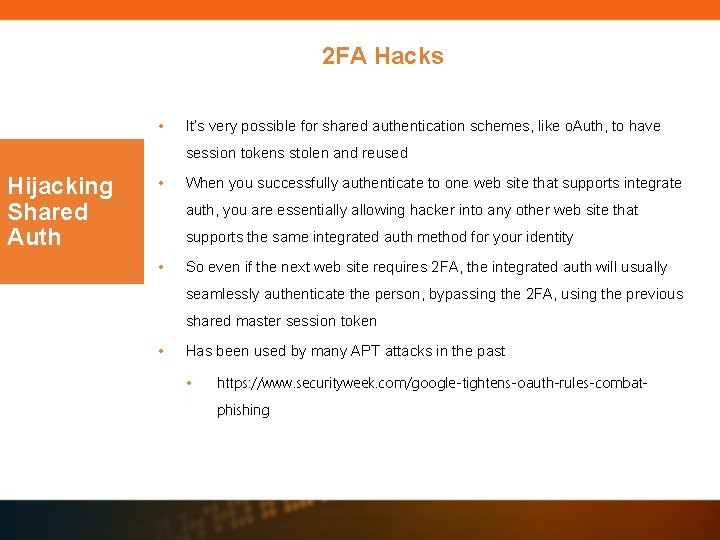
2 FA Hacks • It’s very possible for shared authentication schemes, like o. Auth, to have session tokens stolen and reused Hijacking Shared Auth • When you successfully authenticate to one web site that supports integrate auth, you are essentially allowing hacker into any other web site that supports the same integrated auth method for your identity • So even if the next web site requires 2 FA, the integrated auth will usually seamlessly authenticate the person, bypassing the 2 FA, using the previous shared master session token • Has been used by many APT attacks in the past • https: //www. securityweek. com/google-tightens-oauth-rules-combatphishing
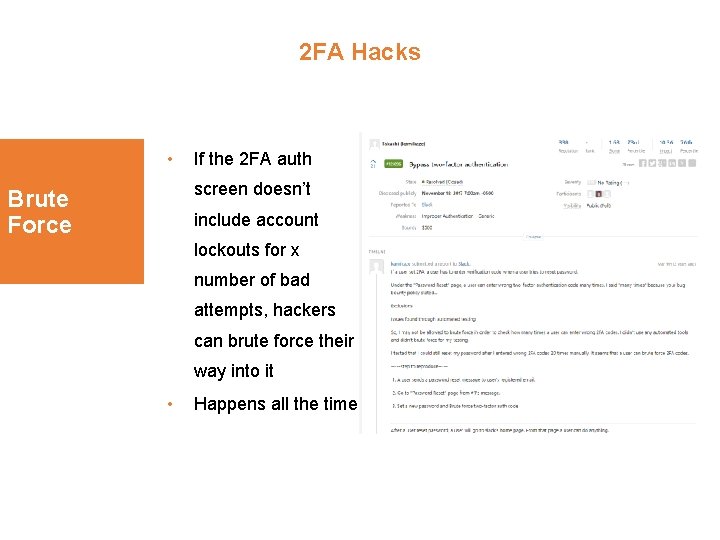
2 FA Hacks • If the 2 FA auth screen doesn’t Brute Force include account lockouts for x number of bad attempts, hackers can brute force their way into it • Happens all the time
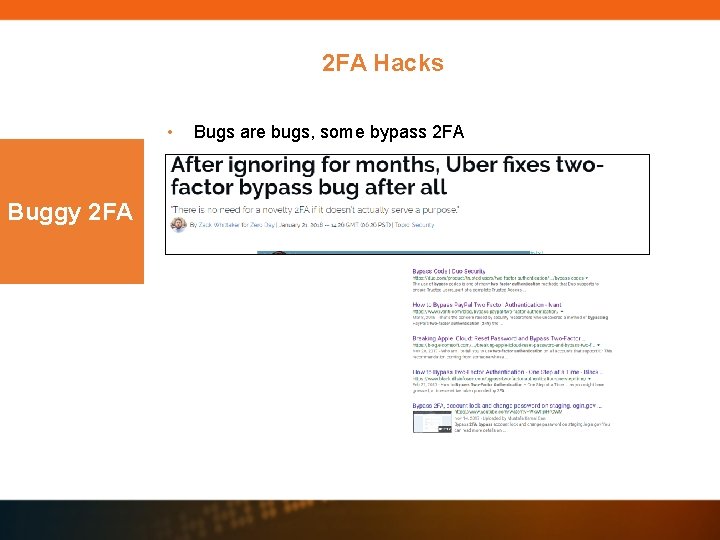
2 FA Hacks • Buggy 2 FA Bugs are bugs, some bypass 2 FA
2 FA Hacks 2017 ROCA vulnerability Buggy 2 FA • Sometimes a single bug impacts hundreds of millions of otherwise unrelated 2 FA devices • Huge bug making any 2 FA product (smartcards, TPM chips, Yubikeys, etc. ) with Infineon-generated RSA key lengths of 2048 or smaller (which is most of them), easy to extract the PRIVATE key from public key. • Still tens to hundreds of millions of devices impacted
2 FA Hacks Biometric Physical Attacks • Fake fingerprints, fake faces, etc. • Biometric vendors try to prevent fakes, but hackers just get around • Stolen and replayed
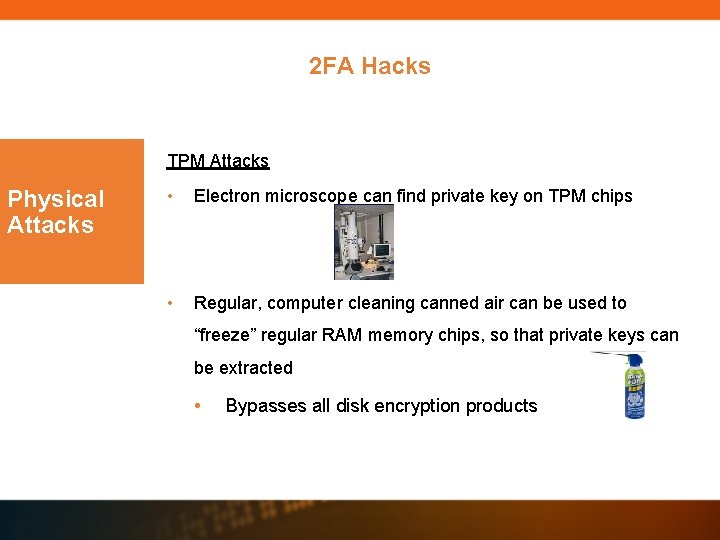
2 FA Hacks TPM Attacks Physical Attacks • Electron microscope can find private key on TPM chips • Regular, computer cleaning canned air can be used to “freeze” regular RAM memory chips, so that private keys can be extracted • Bypasses all disk encryption products
Defending Against 2 FA Attacks
Defending Against 2 FA Attacks Social Defenses • Realize nothing is unhackable • Include 2 FA hacking awareness into your security awareness training • Share this slide deck with co-workers and mgmt. • Don’t get tricked into clicking on rogue links • Block rogue links as much as possible • Make sure URL is legitimate
Defending Against 2 FA Attacks Technical Defenses • Enable REQUIRED 2 FA whenever possible • Don’t use SMS-based 2 FA whenever possible • Use/require 2 -way, mutual, authentication whenever possible • • Ex. FIDO U 2 F’s Channel or Token Binding Does your 2 FA solution specifically fight session token theft and/or malicious replays (i. e. replay resistant) • Can your 2 FA vendor’s support help be socially engineered? • Make sure 2 FA vendors use secure development lifecycle (SDL) in their programming • Make sure 2 FA has “bad attempt throttling” or “account lockout” enabled
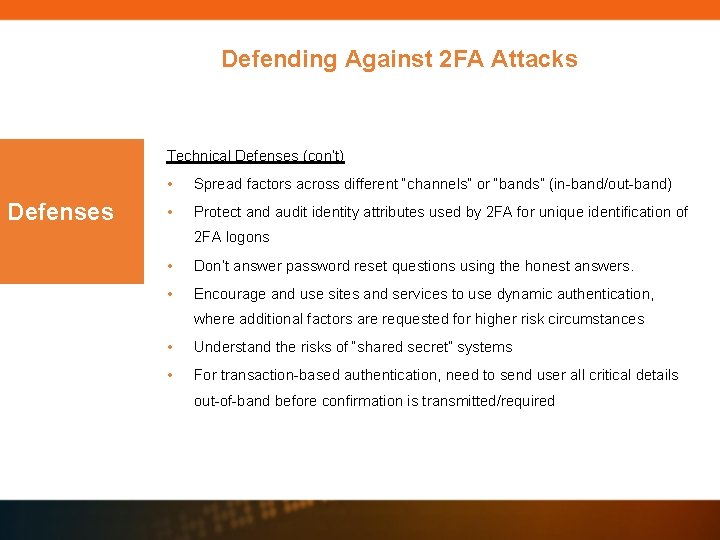
Defending Against 2 FA Attacks Technical Defenses (con’t) Defenses • Spread factors across different “channels” or “bands” (in-band/out-band) • Protect and audit identity attributes used by 2 FA for unique identification of 2 FA logons • Don’t answer password reset questions using the honest answers. • Encourage and use sites and services to use dynamic authentication, where additional factors are requested for higher risk circumstances • Understand the risks of “shared secret” systems • For transaction-based authentication, need to send user all critical details out-of-band before confirmation is transmitted/required
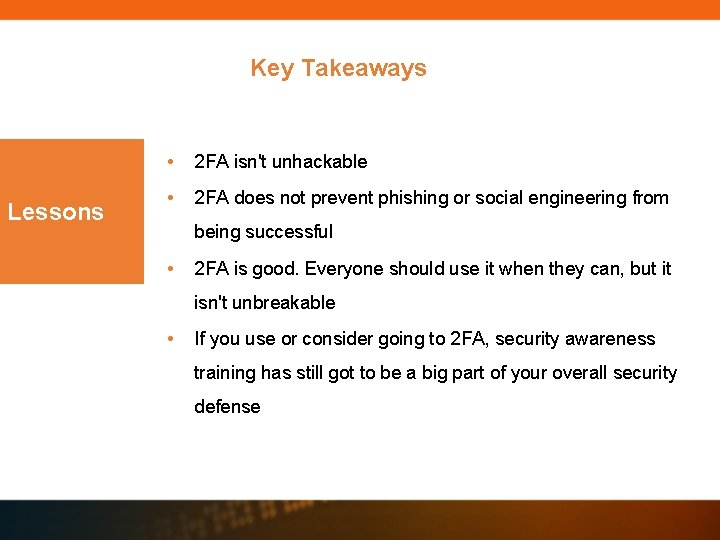
Key Takeaways Lessons • 2 FA isn't unhackable • 2 FA does not prevent phishing or social engineering from being successful • 2 FA is good. Everyone should use it when they can, but it isn't unbreakable • If you use or consider going to 2 FA, security awareness training has still got to be a big part of your overall security defense
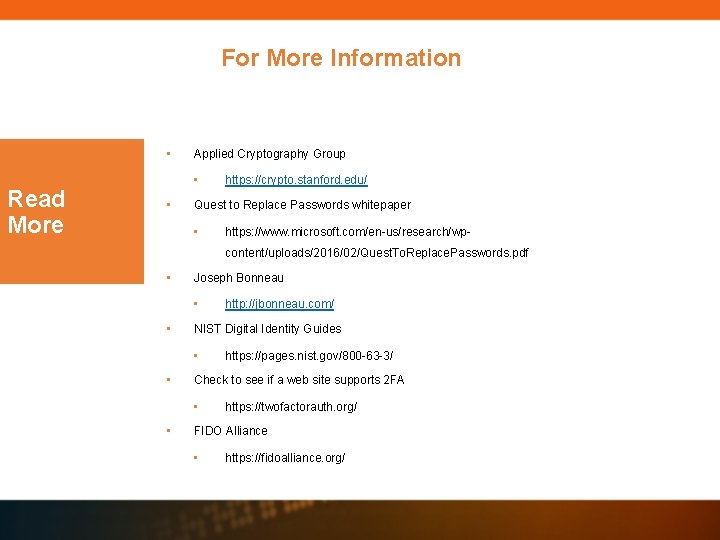
For More Information • Read More Applied Cryptography Group • • https: //crypto. stanford. edu/ Quest to Replace Passwords whitepaper • https: //www. microsoft. com/en-us/research/wpcontent/uploads/2016/02/Quest. To. Replace. Passwords. pdf • Joseph Bonneau • • NIST Digital Identity Guides • • https: //pages. nist. gov/800 -63 -3/ Check to see if a web site supports 2 FA • • http: //jbonneau. com/ https: //twofactorauth. org/ FIDO Alliance • https: //fidoalliance. org/
Resources Free Phishing Security Test Find out what percentage of your users are Phishprone Free Domain Spoof Test Find out now if hackers can spoof an email address of your own domain. » Learn More at « www. Know. Be 4. com/Resources 19
Questions? Tel: 855 -KNOWBE 4 (566 -9234) | www. Know. Be 4. com | Sales@Know. Be 4. com
Thank You! Roger A. Grimes– Data-Driven Defense Evangelist, Know. Be 4 rogerg@knowbe 4. com Twitter: @rogeragrimes Tel: 855 -KNOWBE 4 (566 -9234) | www. Know. Be 4. com | Sales@Know. Be 4. com