
TVS Teaching and Learning Session 3 Questioning Rosenshines
- Slides: 7
TVS Teaching and Learning Session 3: Questioning Rosenshine’s Principles in Action by Tom Sherrington ‘One of the strongest implications from Rosenshine’s ‘Principles of Instruction’ is that effective questioning lies at the heart of great instructional teaching… it’s clear this needs to be a highly interactive, dynamic, responsive process. ’ Welcome to the third in a series of five sessions exploring Rosenshine’s Principles in Action by Tom Sherrington (@teacherhead). We will be using this reflection booklet alongside Tom’s videos in which he delivers in depth training on the principles and how they can support us all to be more effective teachers in the classroom. Whilst it is recommended to complete each session in one sitting, you can of course stop the video at any relevant point and break the session into smaller parts to fit in with your responsibilities. Simply follow the instructions in this booklet that will provide you with relevant links, tasks and reflection points. Prior Knowledge Quiz Answer the following question to see how much you can remember from the previous sessions. 1. What is a schema? 2. Why is it important to revisit prior knowledge? 3. Summarise your learning about Worked Examples. 4. What is the effect of aligning experience with knowledge? 5. What is Cognitive Load Theory?
Go to the following link and play the third in the series of videos: Rosenshine Masterclass III- Questioning Watch the video until 2. 07. The beginning of the session discusses teachers’ confidence in asking questions and their success in involving the whole class. Tom explains that a common situation involves the teacher focusing on one student or a few students whilst the rest of the class sit passively. Activity 1: 15 minutes Take some time to think about one of your classes where you recognise the situation described by Tom. You are going to reflect on this class specifically. Thinking about this group of students, which students do you think receive more of your attention during questioning? What might possible reasons for this be? Which students, on reflection, do you question the least? What might possible reasons for this be?
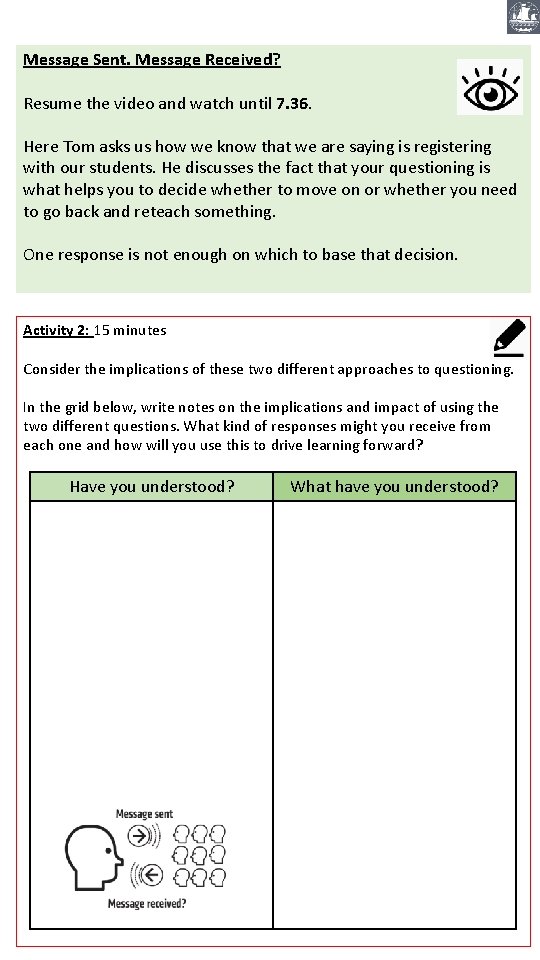
Message Sent. Message Received? Resume the video and watch until 7. 36. Here Tom asks us how we know that we are saying is registering with our students. He discusses the fact that your questioning is what helps you to decide whether to move on or whether you need to go back and reteach something. One response is not enough on which to base that decision. Activity 2: 15 minutes Consider the implications of these two different approaches to questioning. In the grid below, write notes on the implications and impact of using the two different questions. What kind of responses might you receive from each one and how will you use this to drive learning forward? Have you understood? What have you understood?
A Repertoire of Questioning Techniques Resume the video and watch until 19. 00 This section gives some really effective examples of practical questioning techniques that can be applied to the classroom. Tom’s table below outlines these techniques. Activity 3: 30 minutes Under each of the questioning techniques, make notes on the explanations Tom gives in the video. Cold Call No hands up or calling out. Ask everyone select who answers. No Opt Out If students get an answer wrong or don’t know, go back to them to check that they now know the answer. Check for Understanding Ask a selection of students to relay back what they have understood about the question under discussion.
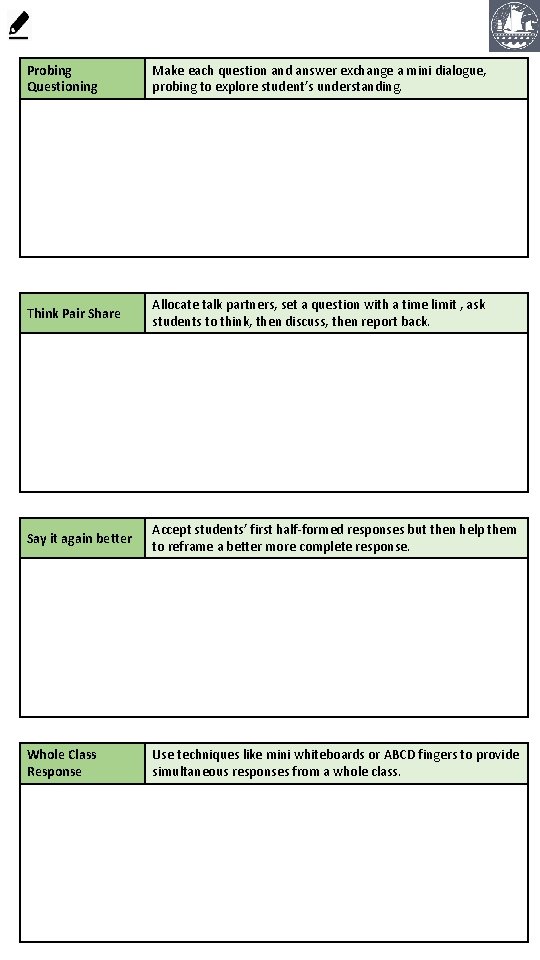
Probing Questioning Make each question and answer exchange a mini dialogue, probing to explore student’s understanding. Think Pair Share Allocate talk partners, set a question with a time limit , ask students to think, then discuss, then report back. Say it again better Accept students’ first half-formed responses but then help them to reframe a better more complete response. Whole Class Response Use techniques like mini whiteboards or ABCD fingers to provide simultaneous responses from a whole class.
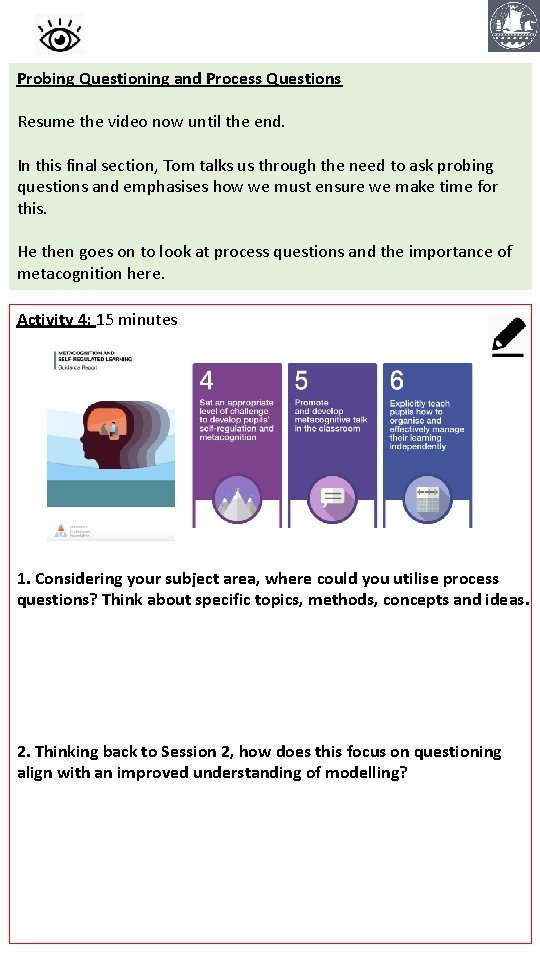
Probing Questioning and Process Questions Resume the video now until the end. In this final section, Tom talks us through the need to ask probing questions and emphasises how we must ensure we make time for this. He then goes on to look at process questions and the importance of metacognition here. Activity 4: 15 minutes 1. Considering your subject area, where could you utilise process questions? Think about specific topics, methods, concepts and ideas. 2. Thinking back to Session 2, how does this focus on questioning align with an improved understanding of modelling?
Final Reflections Activity 6: 20 -30 minutes Take some time to reflect on the video and your learning and make some notes on the following prompts: Key takeaways from the session are… • • Thinking about the students you reflected on in Activity 1, some key actions moving forward could be… ü ü I would still like to know more about or need some additional support with… o o