
TVPS3 Test of Perceptual Skills 3 rd Edition

- Slides: 8
TVPS-3 Test of Perceptual Skills 3 rd Edition, 2006
Introduction of TVPS-3
TVPS-3 • Anthor: Nancy A. Martin, Ph. D. • Assess visual perceptual abilities without requiring motor involvement when making response
Characteristics • Not language-relevant (by saying, pointing. or other method upon agreement): – Available for people with impairments of: motor, speech, hearing, neurological, or cognitive functions. • Black & white colors: – Available for color-blindness
Purpose of TVPS-3 • For OT, school psychologist, optometrists et al. , : – To provide a reliable measure of perceptual abilities – Help to figure out what problem is – Used to monitor progress of intervention.
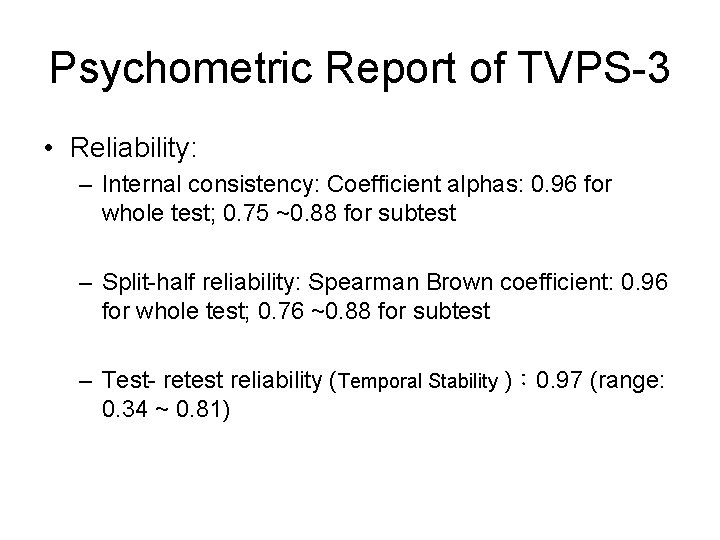
Psychometric Report of TVPS-3 • Reliability: – Internal consistency: Coefficient alphas: 0. 96 for whole test; 0. 75 ~0. 88 for subtest – Split-half reliability: Spearman Brown coefficient: 0. 96 for whole test; 0. 76 ~0. 88 for subtest – Test- retest reliability (Temporal Stability ): 0. 97 (range: 0. 34 ~ 0. 81)
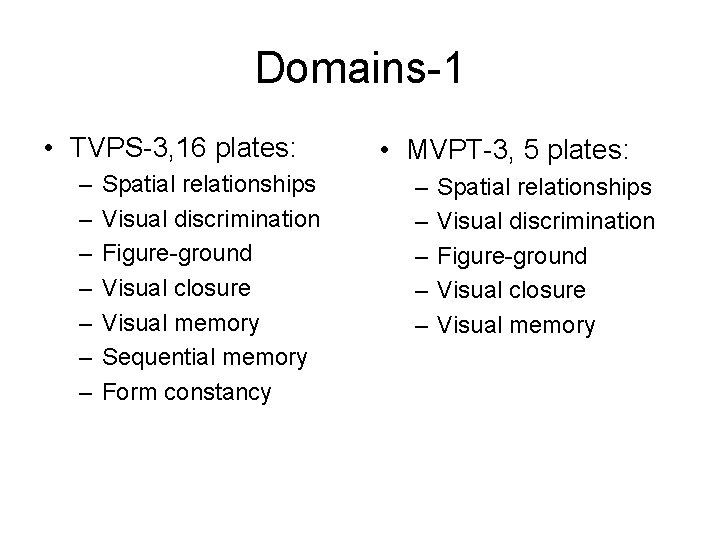
Domains-1 • TVPS-3, 16 plates: – – – – Spatial relationships Visual discrimination Figure-ground Visual closure Visual memory Sequential memory Form constancy • MVPT-3, 5 plates: – – – Spatial relationships Visual discrimination Figure-ground Visual closure Visual memory
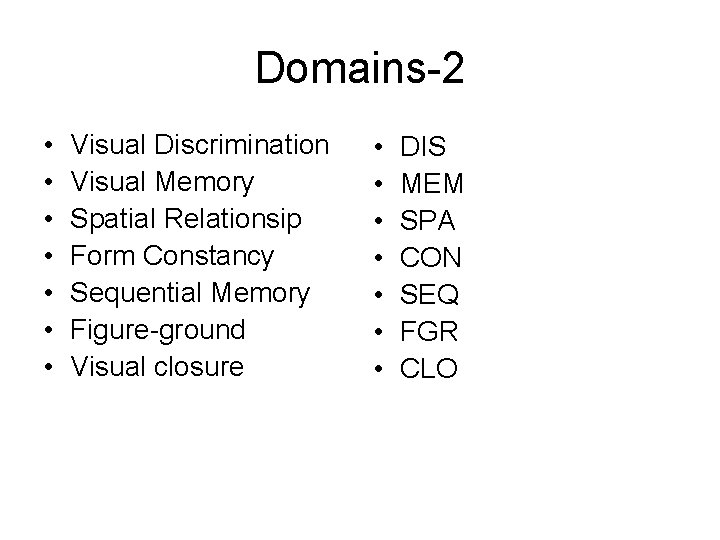
Domains-2 • • Visual Discrimination Visual Memory Spatial Relationsip Form Constancy Sequential Memory Figure-ground Visual closure • • DIS MEM SPA CON SEQ FGR CLO