
TVET CURRICULUM DEVELOPMENT ASESSMENT AND CERTIFICATION COUNCIL OVERVIEW

- Slides: 16
TVET CURRICULUM DEVELOPMENT, ASESSMENT AND CERTIFICATION COUNCIL OVERVIEW OF COMPETENCY BASED EDUCATION AND TRAINING (CBET) APPROACH Presented by TVET CDACC Secretariat
• CBET (Competency Based Education and Training) is a mode or approach of training where the emphasis is placed on the acquisition of competence (Knowledge, Skills and Worker Behaviours (Attitudes))
Competence is the ability to perform tasks or do work according to set standards. • It is designed to meet the demands of industry and business. • It involves training individuals to be able to perform to the standards required in work place. •
“COMPETENCY BASED EDUCATION AND TRAINING (CBET) FOCUSES ONOUTCOMES OF LEARNING. CBET FOCUSSES ON WHAT THE TRAINEES ARE EXPECTED TO DO RATHER THAN ON WHAT THEY ARE EXPECTED TOLEARN ABOUT OR KNOW. ” CBET IS ALSO KNOWN ASOUTCOME BASED TRAINING.
CBET IS BASED ON A SET OF OUTCOMES THAT ARE DERIVED FROM AN ANALYSIS OF TASKS THAT A WORKER IN A PARTICULAR JOB PERFORM. A NEEDS ANALYSIS IS PERFORMED BEFORE CURRICULUM IS DESIGNED.
• CBET entails training trainees such that they develop competencies (knowledge, skills and attitudes (worker behaviors) that are demanded at the workplace while in training institution. • The demands of industry therefore shapes the curriculum. • The participation of industry is therefore of high importance
WHY CBET? • The strength of CBET lies in its ability to develop the necessary competencies for people to be successful in the workplace. • If training institutions are able to produce graduates that are ready to work as per standards set by industry upon graduation, then the overall economic health of a country is improved.
CBET is a mode of training which is: 1. outcome based 2. demand driven 3. industry centered and 4. flexible
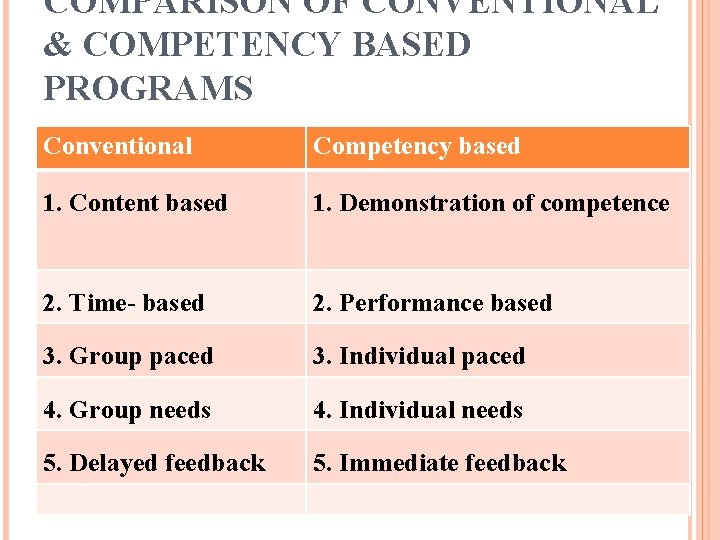
COMPARISON OF CONVENTIONAL & COMPETENCY BASED PROGRAMS Conventional Competency based 1. Content based 1. Demonstration of competence 2. Time- based 2. Performance based 3. Group paced 3. Individual paced 4. Group needs 4. Individual needs 5. Delayed feedback 5. Immediate feedback
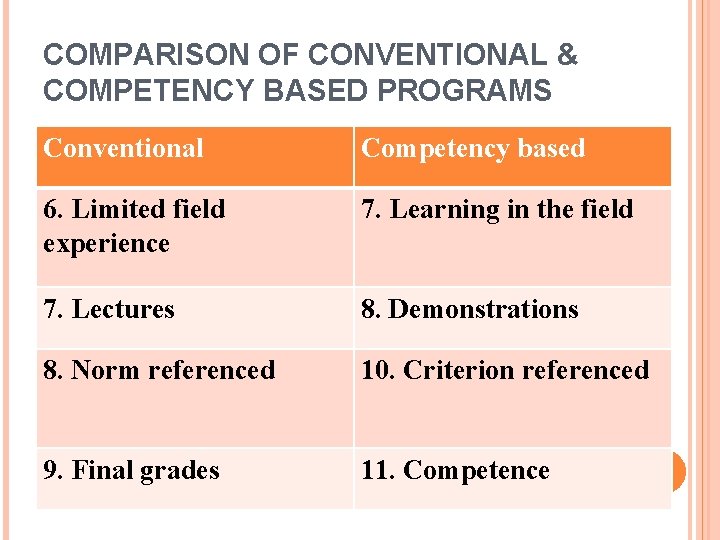
COMPARISON OF CONVENTIONAL & COMPETENCY BASED PROGRAMS Conventional Competency based 6. Limited field experience 7. Learning in the field 7. Lectures 8. Demonstrations 8. Norm referenced 10. Criterion referenced 9. Final grades 11. Competence
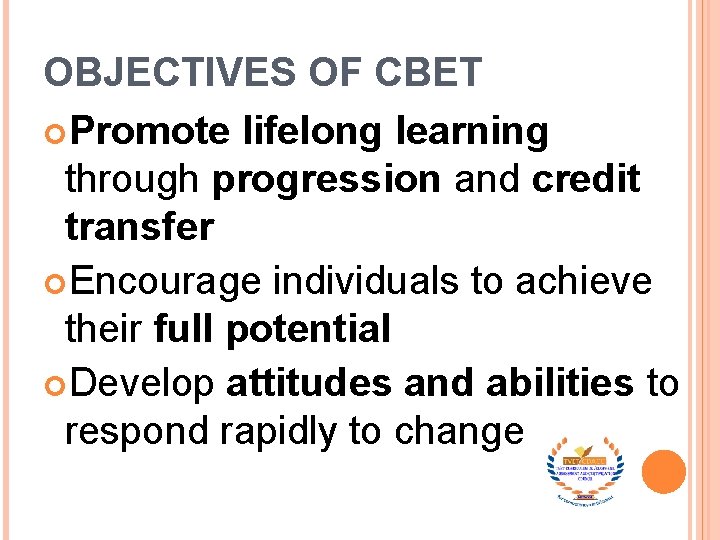
OBJECTIVES OF CBET Promote lifelong learning through progression and credit transfer Encourage individuals to achieve their full potential Develop attitudes and abilities to respond rapidly to change
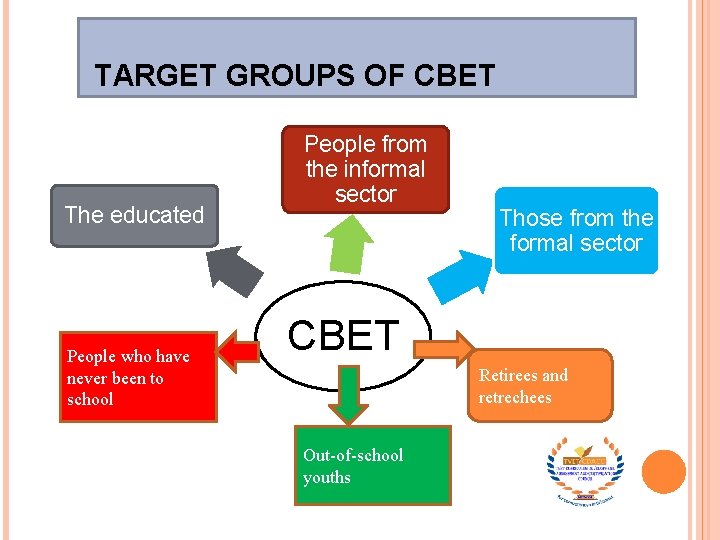
TARGET GROUPS OF CBET The educated People who have never been to school People from the informal sector Those from the formal sector CBET Retirees and retrechees Out-of-school youths
TARGET GROUPS OF CBET CONT’D • Those currently educated and trained who need to update their competences • Individuals from the informal sector • The unemployed population
TARGET GROUPS OF CBET CNTD Out of school youth Those with little or no education Those individuals who are made redundant so that they can learn new competences Those who have retired but would like to develop new competences
CONCLUSION Implementation of competency based curriculum will: ØImprove employability of TVET graduates ØIncrease self employment of TVET graduates ØProvide competent TVET graduates for social economic development ØContribute towards attainment of BIG 4 agenda and Vision 2030
THANK YOU