
TVET Colleges Strategic Annual Performance Operational Planning Process






- Slides: 32
TVET Colleges Strategic, Annual Performance & Operational Planning Process Limpopo and Mpumalanga TVET Colleges 31 July 2015
Presentation Outline • • • Purpose DHET Strategic Priorities 2014/15 APP Challenges TVET Colleges’ Priorities Enrolments Planning process 2
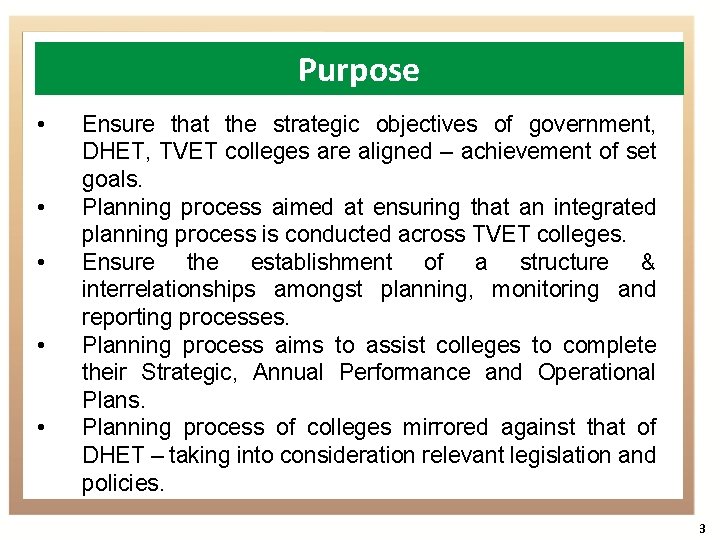
Purpose • • • Ensure that the strategic objectives of government, DHET, TVET colleges are aligned – achievement of set goals. Planning process aimed at ensuring that an integrated planning process is conducted across TVET colleges. Ensure the establishment of a structure & interrelationships amongst planning, monitoring and reporting processes. Planning process aims to assist colleges to complete their Strategic, Annual Performance and Operational Plans. Planning process of colleges mirrored against that of DHET – taking into consideration relevant legislation and policies. 3
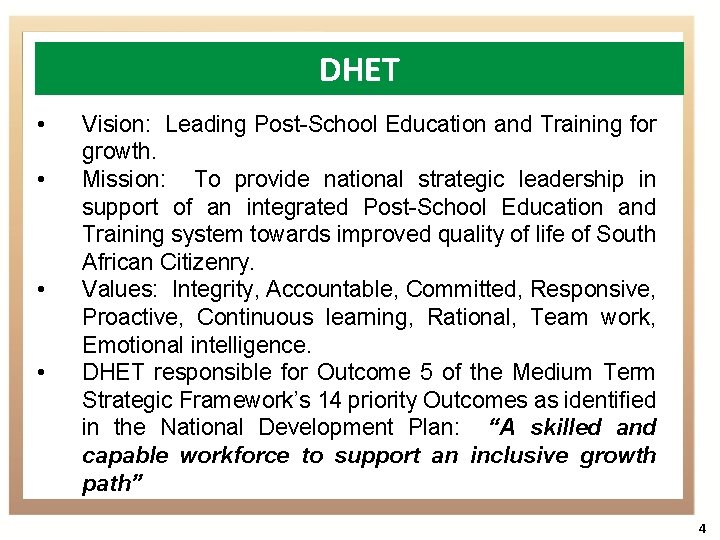
DHET • • Vision: Leading Post-School Education and Training for growth. Mission: To provide national strategic leadership in support of an integrated Post-School Education and Training system towards improved quality of life of South African Citizenry. Values: Integrity, Accountable, Committed, Responsive, Proactive, Continuous learning, Rational, Team work, Emotional intelligence. DHET responsible for Outcome 5 of the Medium Term Strategic Framework’s 14 priority Outcomes as identified in the National Development Plan: “A skilled and capable workforce to support an inclusive growth path” 4
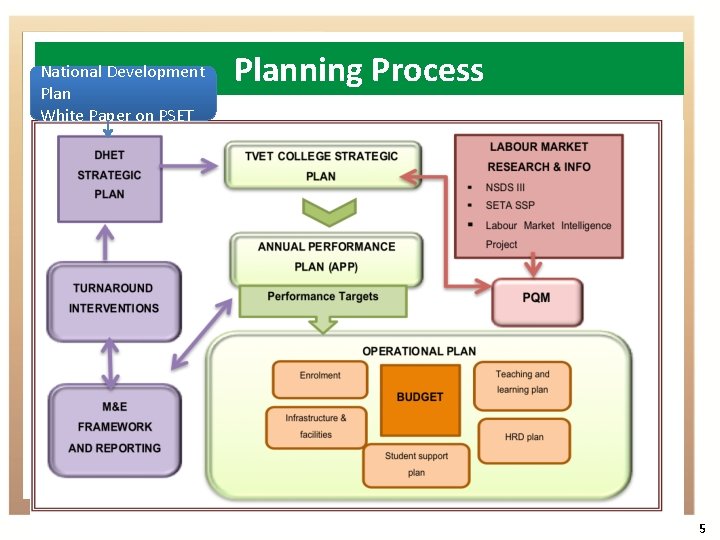
National Development Plan White Paper on PSET Planning Process 5
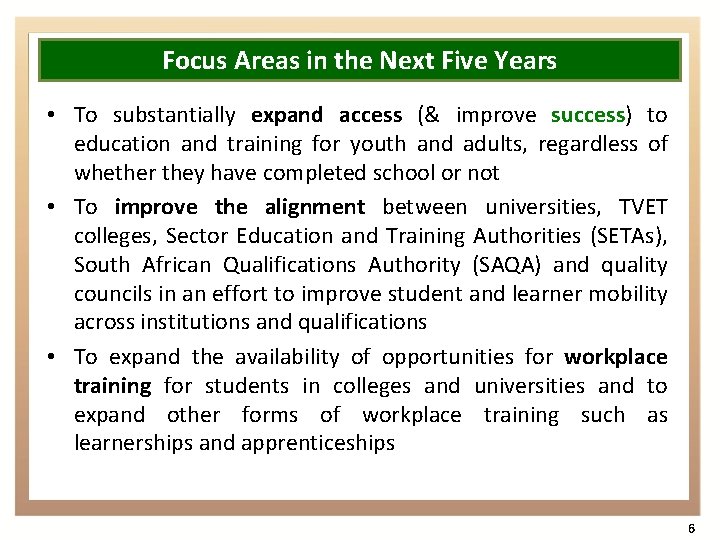
Focus Areas in the Next Five Years • To substantially expand access (& improve success) to education and training for youth and adults, regardless of whether they have completed school or not • To improve the alignment between universities, TVET colleges, Sector Education and Training Authorities (SETAs), South African Qualifications Authority (SAQA) and quality councils in an effort to improve student and learner mobility across institutions and qualifications • To expand the availability of opportunities for workplace training for students in colleges and universities and to expand other forms of workplace training such as learnerships and apprenticeships 6
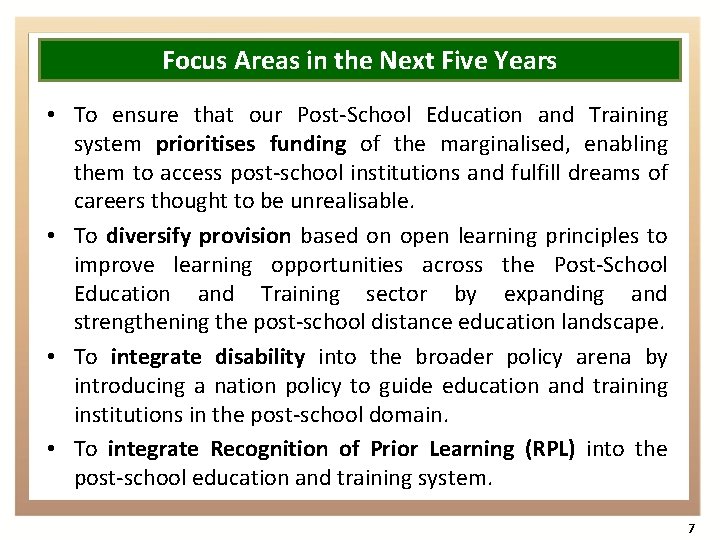
Focus Areas in the Next Five Years • To ensure that our Post-School Education and Training system prioritises funding of the marginalised, enabling them to access post-school institutions and fulfill dreams of careers thought to be unrealisable. • To diversify provision based on open learning principles to improve learning opportunities across the Post-School Education and Training sector by expanding and strengthening the post-school distance education landscape. • To integrate disability into the broader policy arena by introducing a nation policy to guide education and training institutions in the post-school domain. • To integrate Recognition of Prior Learning (RPL) into the post-school education and training system. 7
TVET Colleges’ Strategic & Priority Areas
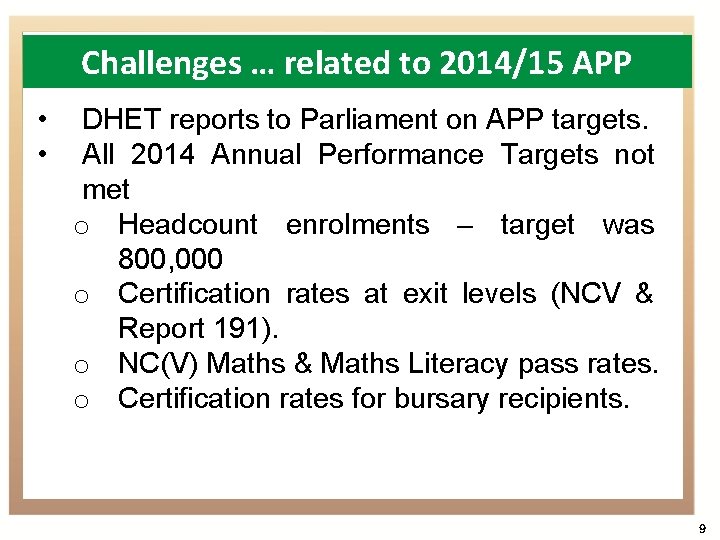
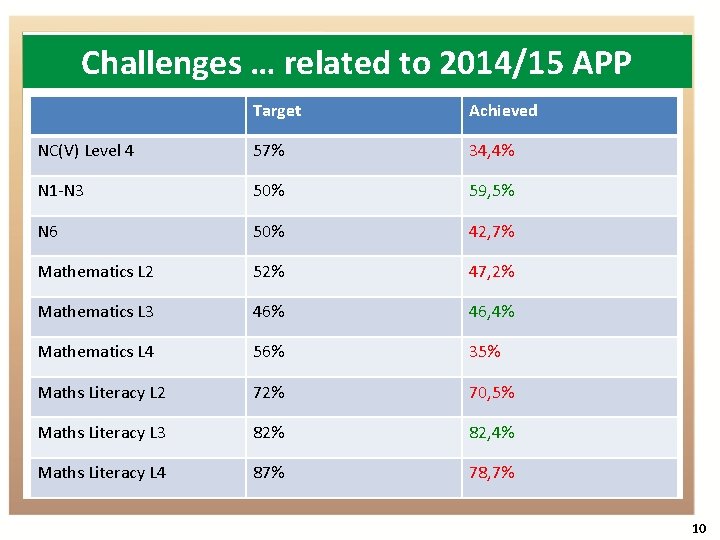
Challenges … related to 2014/15 APP • • DHET reports to Parliament on APP targets. All 2014 Annual Performance Targets not met o Headcount enrolments – target was 800, 000 o Certification rates at exit levels (NCV & Report 191). o NC(V) Maths & Maths Literacy pass rates. o Certification rates for bursary recipients. 9
Challenges … related to 2014/15 APP Target Achieved NC(V) Level 4 57% 34, 4% N 1 -N 3 50% 59, 5% N 6 50% 42, 7% Mathematics L 2 52% 47, 2% Mathematics L 3 46% 46, 4% Mathematics L 4 56% 35% Maths Literacy L 2 72% 70, 5% Maths Literacy L 3 82% 82, 4% Maths Literacy L 4 87% 78, 7% 10
2015/16 APP • • • Headcount enrolment of 725, 000. Certification rates in TVET Colleges ( NC(V) Level 4 = 59%, N 3 = 53%, N 6 = 53%. Lead time to issue certificates to qualifying candidates – 9 months. Percentage of public TVET College examination centres conducting national examinations in compliance with national policy, 100%. TVET Colleges throughput rate, 10% increase from current baseline. Students accommodated in TVET colleges (n? ), need to determine from each college’s baseline. 11
2015/16 APP • • • Qualifying students obtaining financial assistance (200, 000 annually). Funded NC(V) L 4 students obtaining qualification within stipulated time (%). TVET Colleges compliant to governance standards, and increasing every year thereafter (100%). TVET college lecturers undergoing specified hours of work in their industry for specified periods every two years. Conducting monitoring and evaluation of college processes and reporting quarterly to DHET. 12
Colleges’ Strategic Goals • • Provision of PSET by increasing quality and success in terms of academic achievements of students. Provision of PSET capacity, by having adequate infrastructure & systems in place to increase access & provide effective services to students. To develop partnerships & maintain stakeholder relations in support of increasing number of students who are adequately prepared for the labour market and/or further & higher education. To ensure continuous business excellence, good corporate governance, resource management (human resource, infrastructure, facilities etc) and information management and credible data reporting. 13
TVET Colleges’ Priorities • Improved governance and strengthened management. • Improved quality of teaching & learning. • Sound financial management systems, including standardised policies across colleges. • Implementation of policy directives for TVET College Information Management and reporting. • Credible, accurate and reliable student data information management. o Unit record system to be implemented from 2016. • Implementation of the process of verification of student enrolments. 14
TVET Colleges’ Priorities • TVET College lecturers exposed to the work place. • Artisan development. • Annual teaching and learning plans developed, implemented, supported & monitored. • Annual student support services plans developed, implemented, supported & monitored. • Monitoring and Evaluation Framework implemented and reported on. • Colleges to identify “flagship programmes”. Differentiation. • Student academic support programmes. • SRC leadership development programmes – college responsibility. • Student wellness programmes. 15
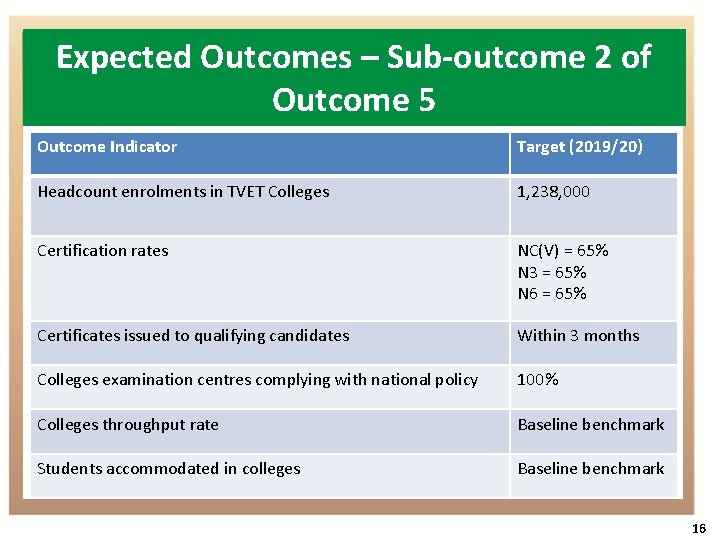
Expected Outcomes – Sub-outcome 2 of Outcome 5 Outcome Indicator Target (2019/20) Headcount enrolments in TVET Colleges 1, 238, 000 Certification rates NC(V) = 65% N 3 = 65% N 6 = 65% Certificates issued to qualifying candidates Within 3 months Colleges examination centres complying with national policy 100% Colleges throughput rate Baseline benchmark Students accommodated in colleges Baseline benchmark 16
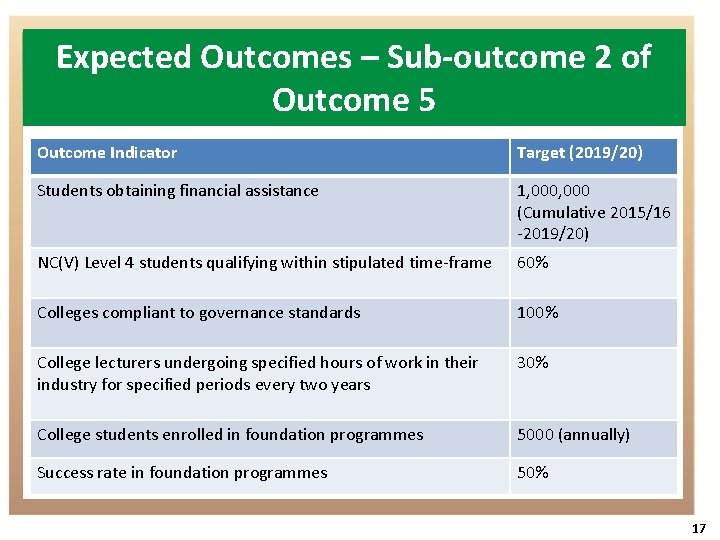
Expected Outcomes – Sub-outcome 2 of Outcome 5 Outcome Indicator Target (2019/20) Students obtaining financial assistance 1, 000 (Cumulative 2015/16 -2019/20) NC(V) Level 4 students qualifying within stipulated time-frame 60% Colleges compliant to governance standards 100% College lecturers undergoing specified hours of work in their industry for specified periods every two years 30% College students enrolled in foundation programmes 5000 (annually) Success rate in foundation programmes 50% 17
• • Enrolments - Current Status Colleges use various systems for data collection: o Coltech (27 TVET Colleges) o ITS/Adapt. IT (21 TVET Colleges) o Thusanang (2 TVET Colleges) Weekly enrolments through Excel templates. Data from Excel templates integrated at the Department. Manual and labour intensive process. Process susceptible to errors. All colleges have connectivity. Not all college campuses have (adequate) connectivity. 18
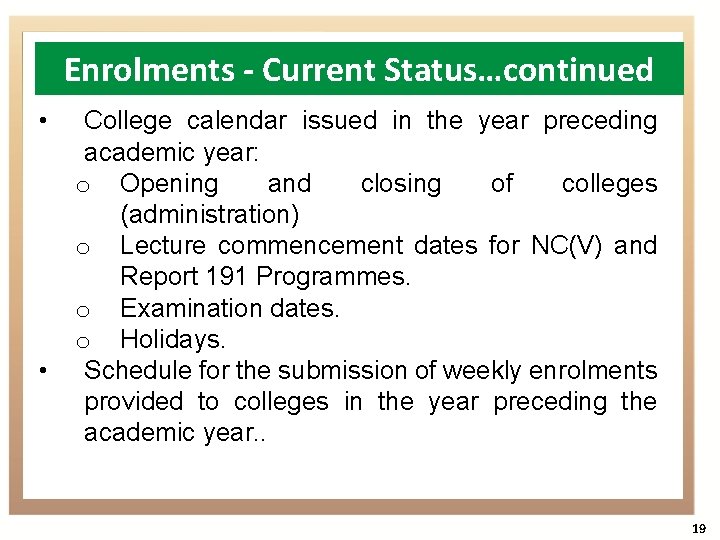
Enrolments - Current Status…continued • • College calendar issued in the year preceding academic year: o Opening and closing of colleges (administration) o Lecture commencement dates for NC(V) and Report 191 Programmes. o Examination dates. o Holidays. Schedule for the submission of weekly enrolments provided to colleges in the year preceding the academic year. . 19
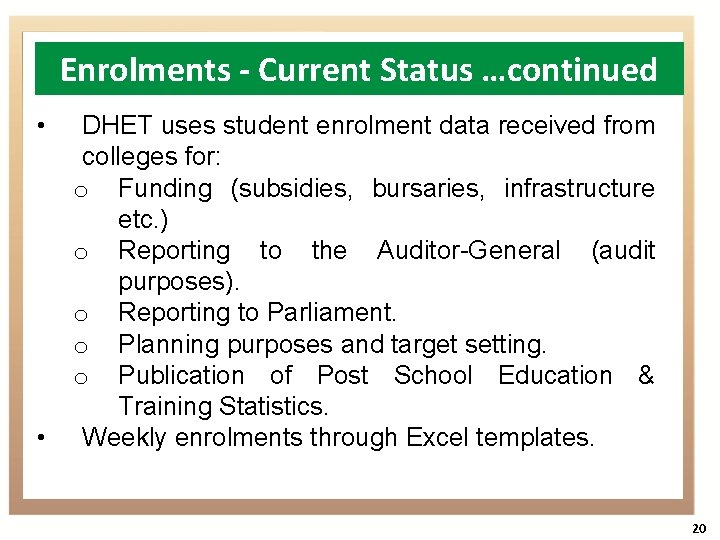
Enrolments - Current Status …continued • • DHET uses student enrolment data received from colleges for: o Funding (subsidies, bursaries, infrastructure etc. ) o Reporting to the Auditor-General (audit purposes). o Reporting to Parliament. o Planning purposes and target setting. o Publication of Post School Education & Training Statistics. Weekly enrolments through Excel templates. 20
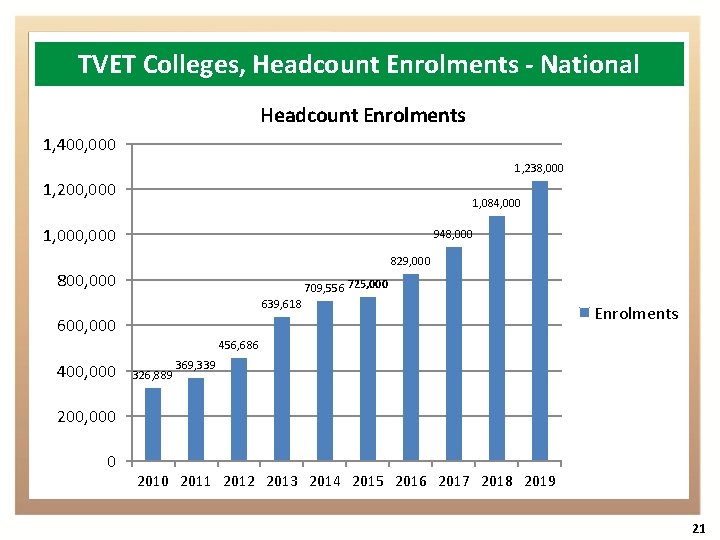
TVET Colleges, Headcount Enrolments - National Headcount Enrolments 1, 400, 000 1, 238, 000 1, 200, 000 1, 084, 000 1, 000 948, 000 829, 000 800, 000 709, 556 725, 000 639, 618 600, 000 Enrolments 456, 686 400, 000 326, 889 369, 339 200, 000 0 2011 2012 2013 2014 2015 2016 2017 2018 2019 21
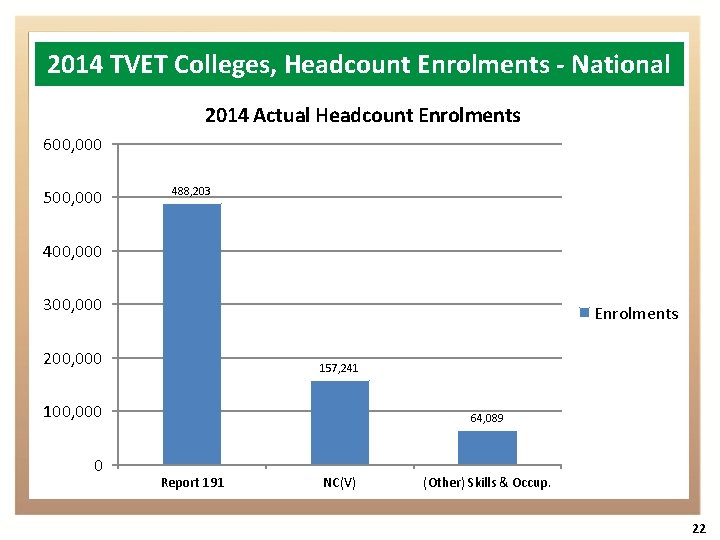
2014 TVET Colleges, Headcount Enrolments - National 2014 Actual Headcount Enrolments 600, 000 500, 000 488, 203 400, 000 300, 000 Enrolments 200, 000 157, 241 100, 000 0 64, 089 Report 191 NC(V) (Other) Skills & Occup. 22
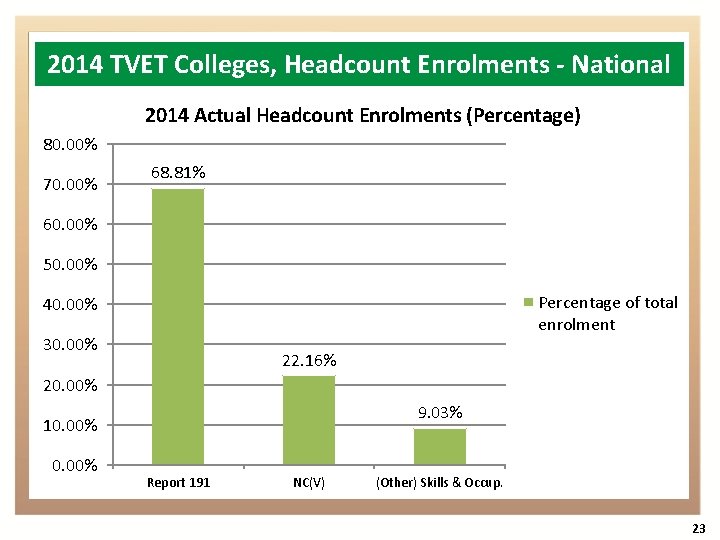
2014 TVET Colleges, Headcount Enrolments - National 2014 Actual Headcount Enrolments (Percentage) 80. 00% 70. 00% 68. 81% 60. 00% 50. 00% Percentage of total enrolment 40. 00% 30. 00% 22. 16% 20. 00% 9. 03% 10. 00% Report 191 NC(V) (Other) Skills & Occup. 23
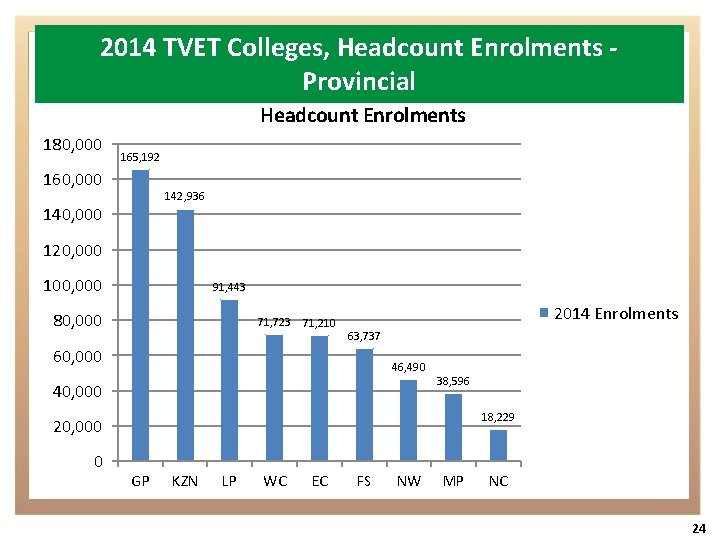
2014 TVET Colleges, Headcount Enrolments Provincial Headcount Enrolments 180, 000 165, 192 160, 000 142, 936 140, 000 120, 000 100, 000 91, 443 80, 000 71, 723 71, 210 2014 Enrolments 63, 737 60, 000 46, 490 40, 000 38, 596 18, 229 20, 000 0 GP KZN LP WC EC FS NW MP NC 24
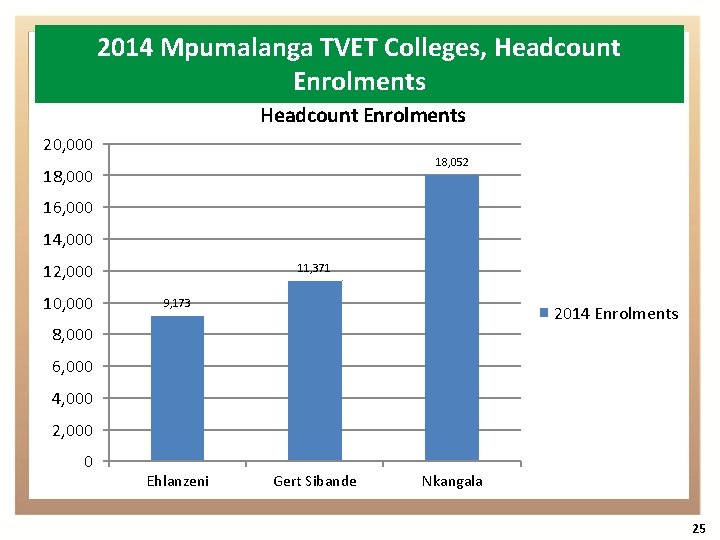
2014 Mpumalanga TVET Colleges, Headcount Enrolments 20, 000 18, 052 18, 000 16, 000 14, 000 12, 000 10, 000 11, 371 9, 173 2014 Enrolments 8, 000 6, 000 4, 000 2, 000 0 Ehlanzeni Gert Sibande Nkangala 25
2014 Limpopo TVET Colleges, Headcount Enrolments 30, 000 26, 578 25, 728 25, 000 20, 000 15, 000 11, 256 2014 Enrolments 9, 293 10, 000 7, 634 6, 166 4, 788 5, 000 W at er be rg be em Vh uk kh Se an op M hu n i. S e E ba ta Le al ph Le Ca p ric or n al e 0 26
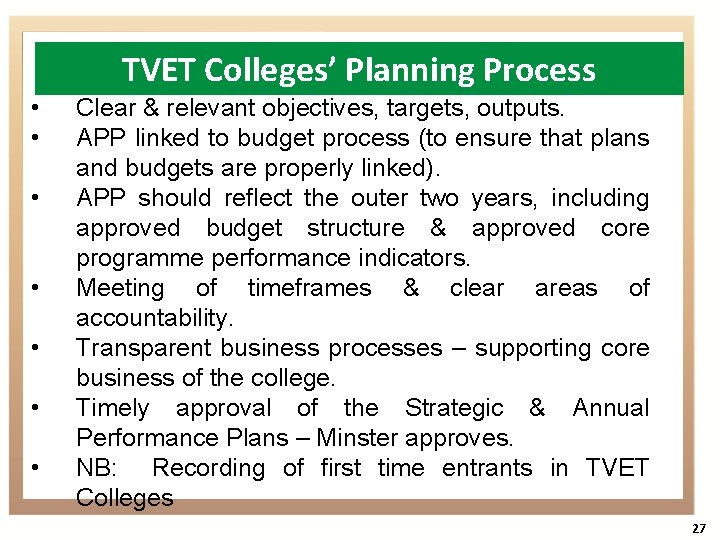
TVET Colleges’ Planning Process • • Clear & relevant objectives, targets, outputs. APP linked to budget process (to ensure that plans and budgets are properly linked). APP should reflect the outer two years, including approved budget structure & approved core programme performance indicators. Meeting of timeframes & clear areas of accountability. Transparent business processes – supporting core business of the college. Timely approval of the Strategic & Annual Performance Plans – Minster approves. NB: Recording of first time entrants in TVET Colleges 27
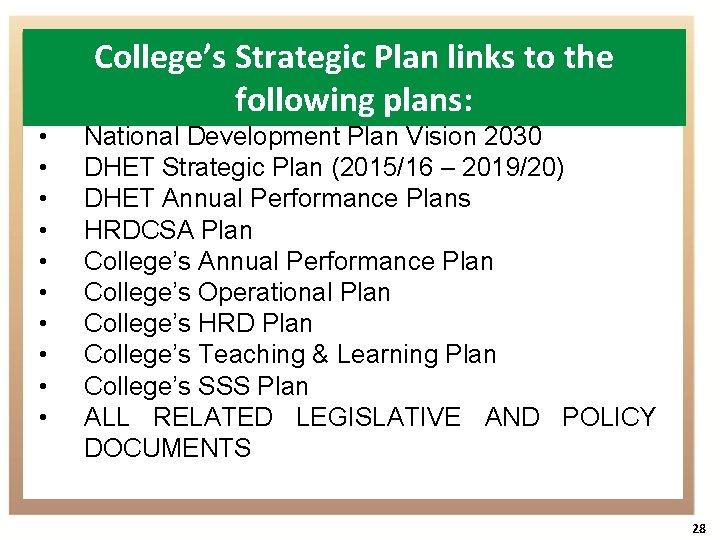
College’s Strategic Plan links to the following plans: • • • National Development Plan Vision 2030 DHET Strategic Plan (2015/16 – 2019/20) DHET Annual Performance Plans HRDCSA Plan College’s Annual Performance Plan College’s Operational Plan College’s HRD Plan College’s Teaching & Learning Plan College’s SSS Plan ALL RELATED LEGISLATIVE AND POLICY DOCUMENTS 28
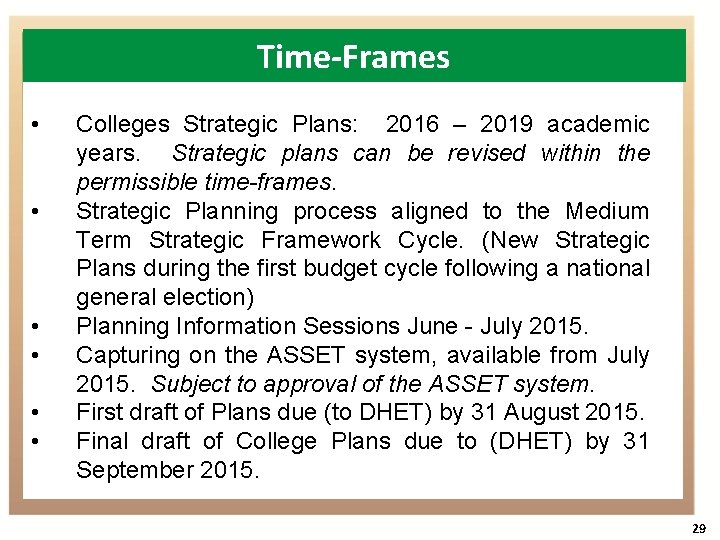
Time-Frames • • • Colleges Strategic Plans: 2016 – 2019 academic years. Strategic plans can be revised within the permissible time-frames. Strategic Planning process aligned to the Medium Term Strategic Framework Cycle. (New Strategic Plans during the first budget cycle following a national general election) Planning Information Sessions June - July 2015. Capturing on the ASSET system, available from July 2015. Subject to approval of the ASSET system. First draft of Plans due (to DHET) by 31 August 2015. Final draft of College Plans due to (DHET) by 31 September 2015. 29
Support • • • DHET Officials – National and Regional. Source documents: o National Development Plan o White Paper on Post School Education & Training o Provincial Development Plans Planning templates will be provided o Strategic Plan o Annual Performance Plan o Operational Plan ASSET system. TVET Colleges. 30
Conclusion • • While the CET Act of 2006 (as amended) assigns the responsibility of developing and submitting the Strategic Plans to the Minister for approval, it is the responsibility of the management at operational level to draft the Strategic, Annual Performance & Operational Plans, recommend improvements to management and table the Plans to Council for adoption and approval. The role of Council and its committees is oversight over the operational activities of management. 31
Thank You