
Tutorial The Sigma Cognitive ArchitectureSystem Paul S Rosenbloom
Σ Tutorial The Sigma Cognitive Architecture/System Paul S. Rosenbloom [Abram Demski & Volkan Ustun also here] 8. 1. 2014 The work depicted here was sponsored by the U. S. Army, the Air Force Office of Scientific Research and the Office of Naval Research. Statements and opinions expressed do not necessarily reflect the position or the policy of the United States Government, and no official endorsement should be inferred.
Goal of this Tutorial § Not an introduction to programming in Sigma § Also not a hands on tutorial § Goal is instead to provide a deeper insight into Sigma: § What it is about § How it works § What it is capable of First public tutorial on Sigma Feel free to ask questions at any time § Will mix lecture, live demonstration and Q&A § Sigma 34 on fairly slow machine (old Mac. Book Air) § Sigma 35 on more appropriate machine runs 2 -3 times faster
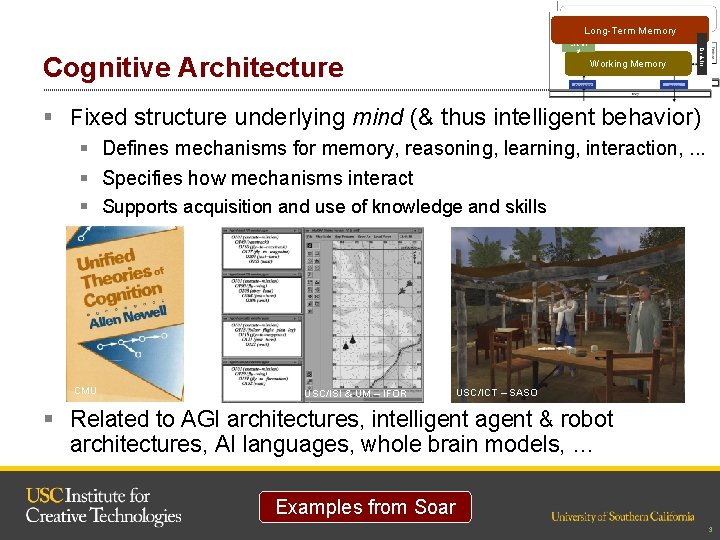
Long-Term Memory Cognitive Architecture Working Memory Decision Learnin g § Fixed structure underlying mind (& thus intelligent behavior) § Defines mechanisms for memory, reasoning, learning, interaction, . . . § Specifies how mechanisms interact § Supports acquisition and use of knowledge and skills CMU USC/ISI & UM – IFOR USC/ICT – SASO § Related to AGI architectures, intelligent agent & robot architectures, AI languages, whole brain models, … Examples from Soar 3
Overall Desiderata for the Sigma (�� ) Architecture § A new breed of cognitive architecture that is § Grand unified § Cognitive + key non-cognitive (perceptuomotor, affective, …) § Functionally elegant § Broadly capable yet simple and theoretically elegant § Sufficiently efficient § Fast enough for anticipated applications § For virtual humans (& intelligent agents/robots) that are § Broadly, deeply and robustly cognitive § Interactive with their physical and social worlds § Adaptive given their interactions and experience § For integrated models of natural minds Hybrid: Discrete + Continuous Mixed: Symbolic/Relational + Probabilistic/Statistical
More on Functional Elegance § Can the diversity of intelligent behavior arise from the interactions among a small general set of mechanisms? § Cognitive Newton’s laws § Elementary cognitive particles Periodic table of behaviors § Cognitive axioms “Proofs” of behavioral theorems Akin to Universal AI (Hutter) in spirit, but not necessarily as minimal § Given a small set of general mechanisms how many requisite behaviors can be produced? § Discovering “proofs” of intelligent behaviors § Deconstructing intelligent behaviors in terms of cognitive mechanisms § Towards deeper theories with greater explanatory reach § Discovering a sufficient small general set of cognitive mechanisms § Discovering how they can yield the breadth of intelligent behavior 5
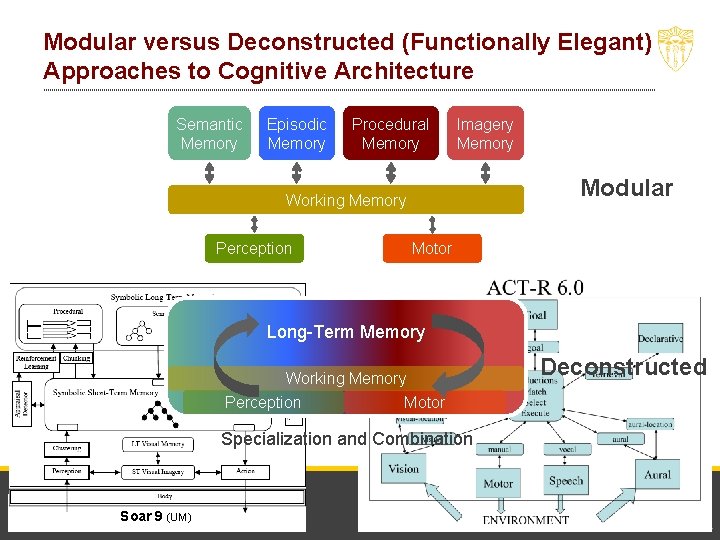
Modular versus Deconstructed (Functionally Elegant) Approaches to Cognitive Architecture Semantic Memory Episodic Memory Procedural Memory Imagery Memory Modular Working Memory Perception Motor Procedural Semantic Episodic Imagery Long-Term Memory Working Memory Perception Motor Deconstructed Specialization and Combination Soar 9 (UM) 6
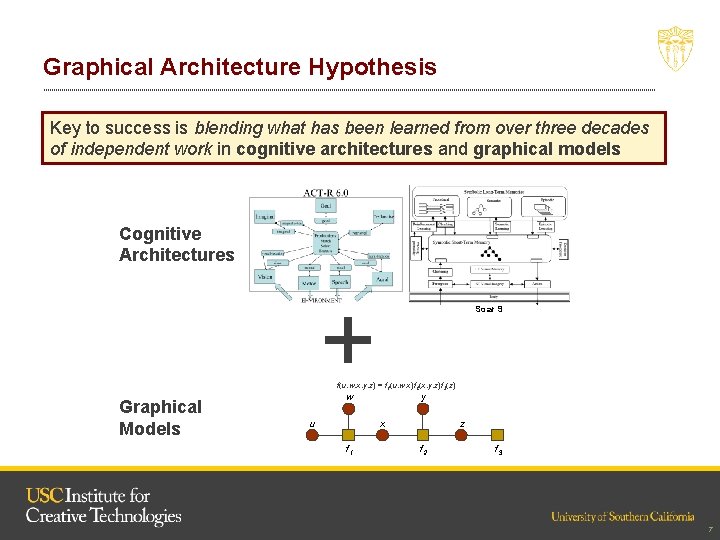
Graphical Architecture Hypothesis Key to success is blending what has been learned from over three decades of independent work in cognitive architectures and graphical models Cognitive Architectures + Soar 9 f(u, w, x, y, z) = f 1(u, w, x)f 2(x, y, z)f 3(z) Graphical Models w u y x f 1 z f 2 f 3 7
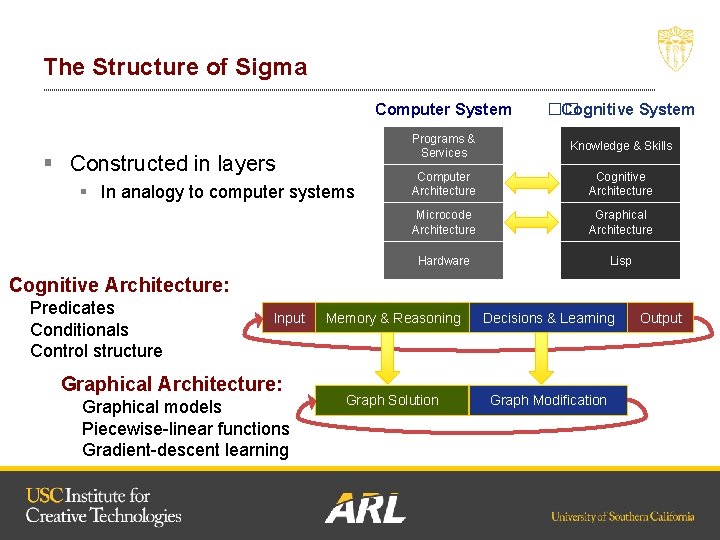
The Structure of Sigma § Constructed in layers § In analogy to computer systems Computer System �� Cognitive System Programs & Services Knowledge & Skills Computer Architecture Cognitive Architecture Microcode Architecture Graphical Architecture Hardware Lisp Cognitive Architecture: Predicates Conditionals Control structure Input Graphical Architecture: Graphical models Piecewise-linear functions Gradient-descent learning Memory & Reasoning Decisions & Learning Graph Solution Graph Modification Output
Predicates Conditionals Control Structure COGNITIVE ARCHITECTURE 9
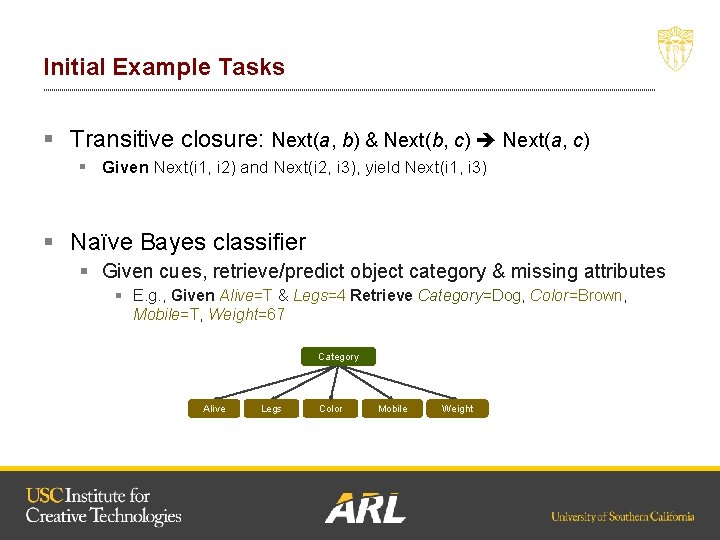
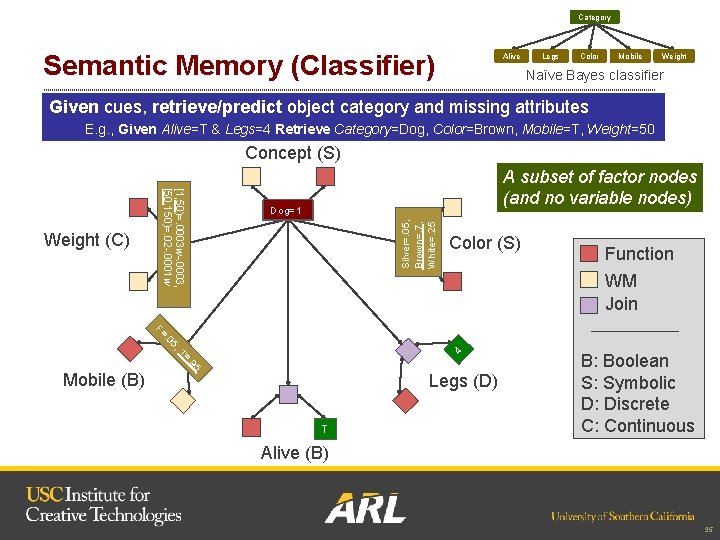
Initial Example Tasks § Transitive closure: Next(a, b) & Next(b, c) Next(a, c) § Given Next(i 1, i 2) and Next(i 2, i 3), yield Next(i 1, i 3) § Naïve Bayes classifier § Given cues, retrieve/predict object category & missing attributes § E. g. , Given Alive=T & Legs=4 Retrieve Category=Dog, Color=Brown, Mobile=T, Weight=67 Category Alive Legs Color Mobile Weight
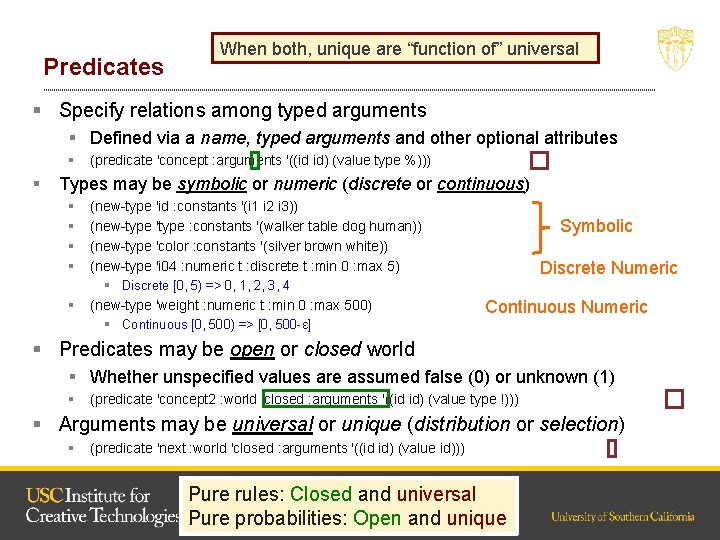
Predicates When both, unique are “function of” universal § Specify relations among typed arguments § Defined via a name, typed arguments and other optional attributes § § (predicate 'concept : arguments '((id id) (value type %))) Types may be symbolic or numeric (discrete or continuous) § § § (new-type 'id : constants '(i 1 i 2 i 3)) (new-type 'type : constants '(walker table dog human)) (new-type 'color : constants '(silver brown white)) (new-type 'i 04 : numeric t : discrete t : min 0 : max 5) § Discrete [0, 5) => 0, 1, 2, 3, 4 (new-type 'weight : numeric t : min 0 : max 500) § Continuous [0, 500) => [0, 500 -ε] Symbolic Discrete Numeric Continuous Numeric § Predicates may be open or closed world § Whether unspecified values are assumed false (0) or unknown (1) § (predicate 'concept 2 : world 'closed : arguments '((id id) (value type !))) § Arguments may be universal or unique (distribution or selection) § (predicate 'next : world 'closed : arguments '((id id) (value id))) Pure rules: Closed and universal Pure probabilities: Open and unique
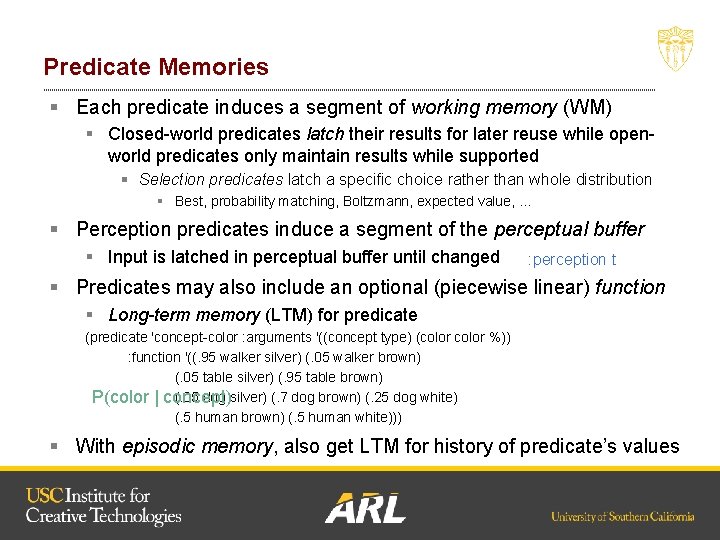
Predicate Memories § Each predicate induces a segment of working memory (WM) § Closed-world predicates latch their results for later reuse while openworld predicates only maintain results while supported § Selection predicates latch a specific choice rather than whole distribution § Best, probability matching, Boltzmann, expected value, … § Perception predicates induce a segment of the perceptual buffer § Input is latched in perceptual buffer until changed : perception t § Predicates may also include an optional (piecewise linear) function § Long-term memory (LTM) for predicate (predicate 'concept-color : arguments '((concept type) (color %)) : function '((. 95 walker silver) (. 05 walker brown) (. 05 table silver) (. 95 table brown) (. 05 dog silver) (. 7 dog brown) (. 25 dog white) P(color | concept) (. 5 human brown) (. 5 human white))) § With episodic memory, also get LTM for history of predicate’s values
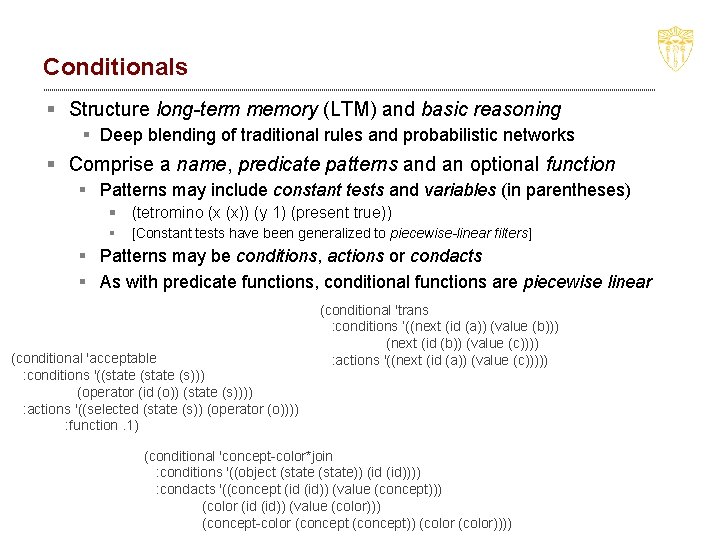
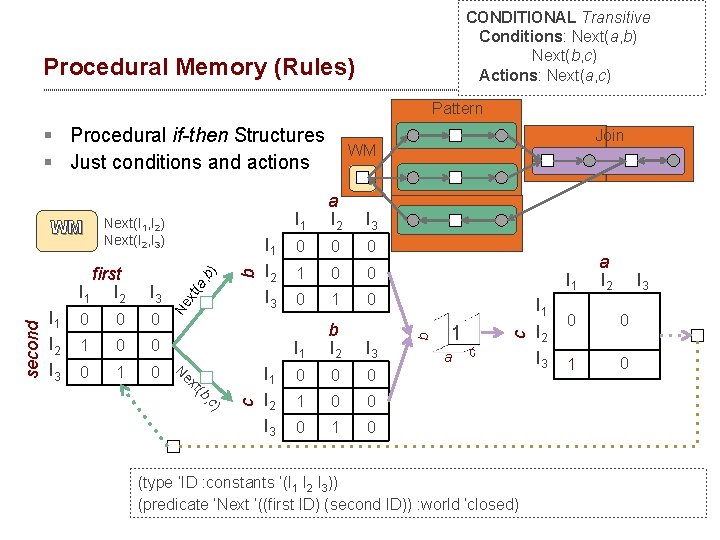
Conditionals § Structure long-term memory (LTM) and basic reasoning § Deep blending of traditional rules and probabilistic networks § Comprise a name, predicate patterns and an optional function § Patterns may include constant tests and variables (in parentheses) § (tetromino (x (x)) (y 1) (present true)) § [Constant tests have been generalized to piecewise-linear filters] § Patterns may be conditions, actions or condacts § As with predicate functions, conditional functions are piecewise linear (conditional 'acceptable : conditions '((state (s))) (operator (id (o)) (state (s)))) : actions '((selected (state (s)) (operator (o)))) : function. 1) (conditional 'trans : conditions ’((next (id (a)) (value (b))) (next (id (b)) (value (c)))) : actions '((next (id (a)) (value (c))))) (conditional 'concept-color*join : conditions '((object (state)) (id)))) : condacts '((concept (id)) (value (concept))) (color (id)) (value (color))) (concept-color (concept)) (color))))
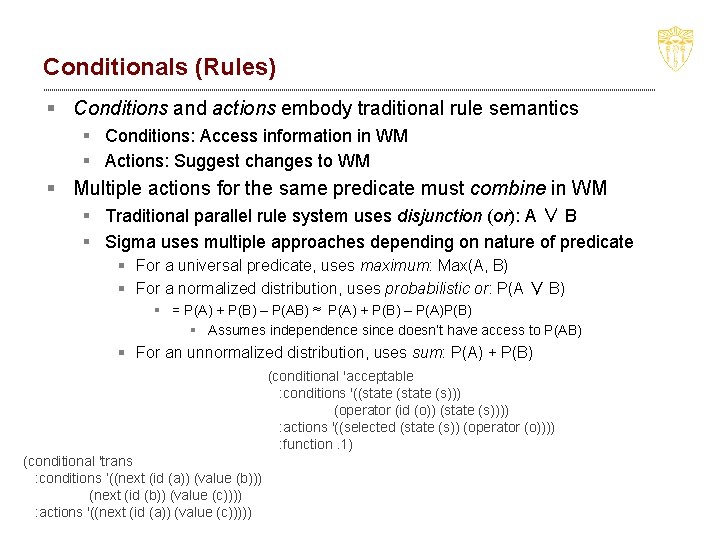
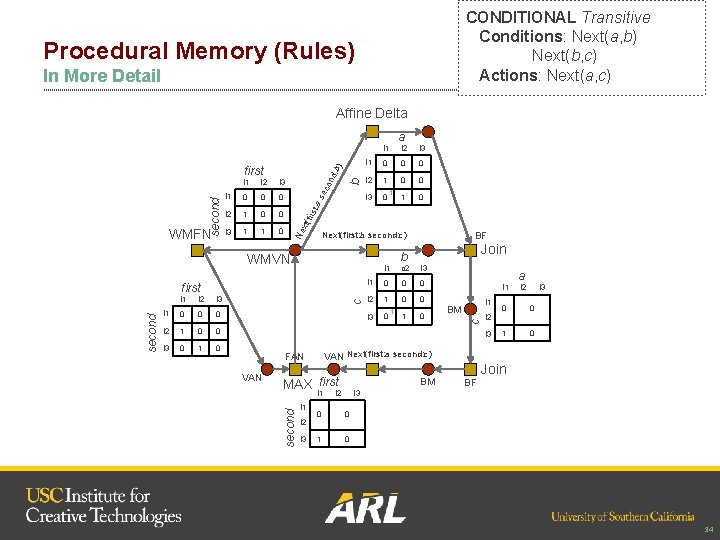
Conditionals (Rules) § Conditions and actions embody traditional rule semantics § Conditions: Access information in WM § Actions: Suggest changes to WM § Multiple actions for the same predicate must combine in WM § Traditional parallel rule system uses disjunction (or): A ∨ B § Sigma uses multiple approaches depending on nature of predicate § For a universal predicate, uses maximum: Max(A, B) § For a normalized distribution, uses probabilistic or: P(A ∨ B) § = P(A) + P(B) – P(AB) ≈ P(A) + P(B) – P(A)P(B) § Assumes independence since doesn’t have access to P(AB) § For an unnormalized distribution, uses sum: P(A) + P(B) (conditional 'acceptable : conditions '((state (s))) (operator (id (o)) (state (s)))) : actions '((selected (state (s)) (operator (o)))) : function. 1) (conditional 'trans : conditions ’((next (id (a)) (value (b))) (next (id (b)) (value (c)))) : actions '((next (id (a)) (value (c)))))
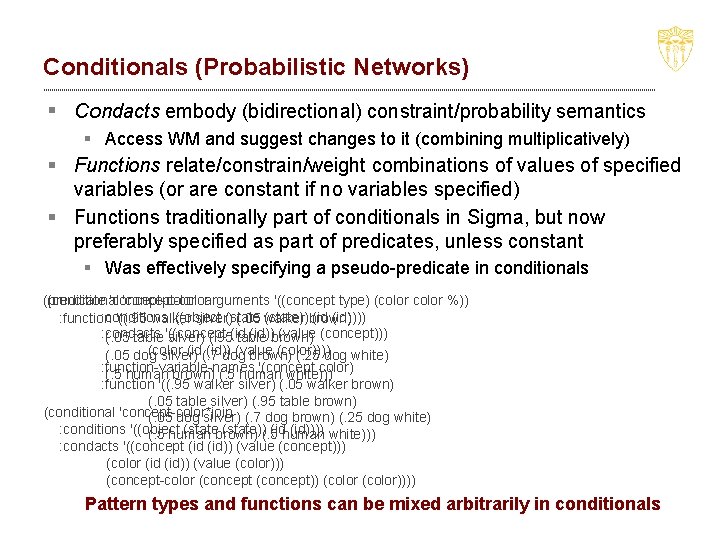
Conditionals (Probabilistic Networks) § Condacts embody (bidirectional) constraint/probability semantics § Access WM and suggest changes to it (combining multiplicatively) § Functions relate/constrain/weight combinations of values of specified variables (or are constant if no variables specified) § Functions traditionally part of conditionals in Sigma, but now preferably specified as part of predicates, unless constant § Was effectively specifying a pseudo-predicate in conditionals (conditional 'concept-color (predicate 'concept-color : arguments '((concept type) (color %)) : conditions '((object (state (id)))) : function '((. 95 walker silver) (. 05 (state)) walker brown) : condacts (id))brown) (value (concept))) (. 05 table '((concept silver) (. 95(id table (color (id(. 7 (id)) (value (color)))) (. 05 dog silver) dog brown) (. 25 dog white) : function-variable-names '(concept color) (. 5 human brown) (. 5 human white))) : function '((. 95 walker silver) (. 05 walker brown) (. 05 table silver) (. 95 table brown) (conditional 'concept-color*join (. 05 dog silver) (. 7 dog brown) (. 25 dog white) : conditions '((object (statebrown) (state))(. 5 (idhuman (id)))) white))) (. 5 human : condacts '((concept (id)) (value (concept))) (color (id)) (value (color))) (concept-color (concept)) (color)))) Pattern types and functions can be mixed arbitrarily in conditionals
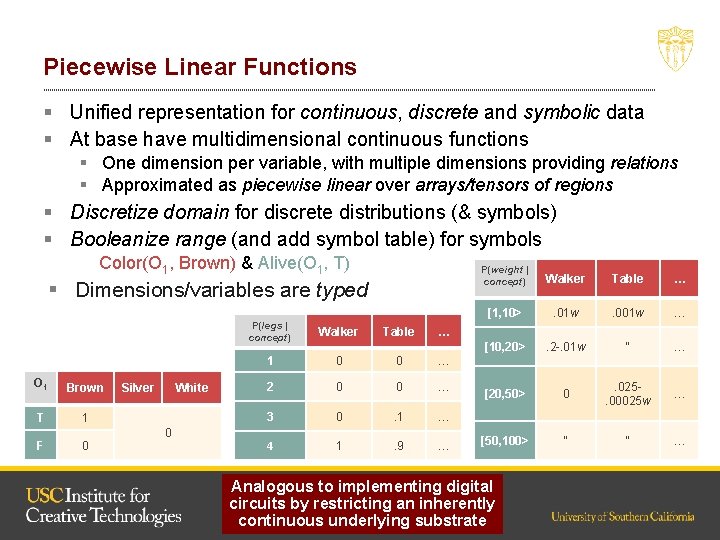
Piecewise Linear Functions § Unified representation for continuous, discrete and symbolic data § At base have multidimensional continuous functions § One dimension per variable, with multiple dimensions providing relations § Approximated as piecewise linear over arrays/tensors of regions § Discretize domain for discrete distributions (& symbols) § Booleanize range (and add symbol table) for symbols Color(O 1, Brown) & Alive(O 1, T) § Dimensions/variables are typed O 1 Brown T 1 F 0 Silver White P(legs | concept) Walker 1 0 0 … 2 0 0 … 3 0 . 1 … 4 1 . 9 … 0 Table P(weight | concept) Walker Table … [1, 10> . 01 w . 001 w … [10, 20> . 2 -. 01 w “ … [20, 50> 0 . 025. 00025 w … [50, 100> “ “ … … Analogous to implementing digital circuits by restricting an inherently continuous underlying substrate
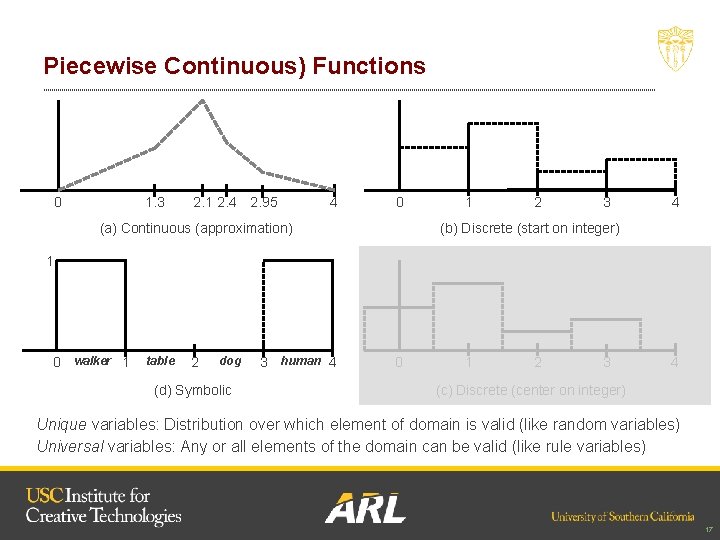
Piecewise Continuous) Functions 0 1. 3 2. 1 2. 4 2. 95 4 0 (a) Continuous (approximation) 1 2 3 4 (b) Discrete (start on integer) 1 0 walker 1 table 2 dog (d) Symbolic 3 human 4 0 1 2 3 4 (c) Discrete (center on integer) Unique variables: Distribution over which element of domain is valid (like random variables) Universal variables: Any or all elements of the domain can be valid (like rule variables) 17
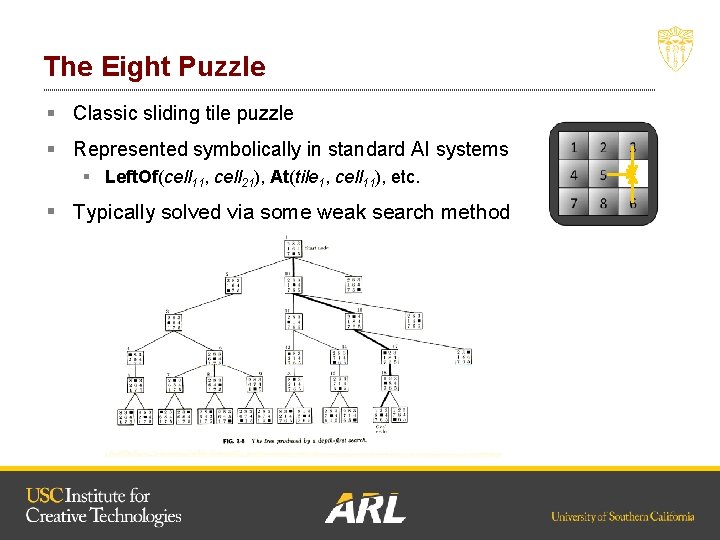
The Eight Puzzle § Classic sliding tile puzzle § Represented symbolically in standard AI systems § Left. Of(cell 11, cell 21), At(tile 1, cell 11), etc. § Typically solved via some weak search method
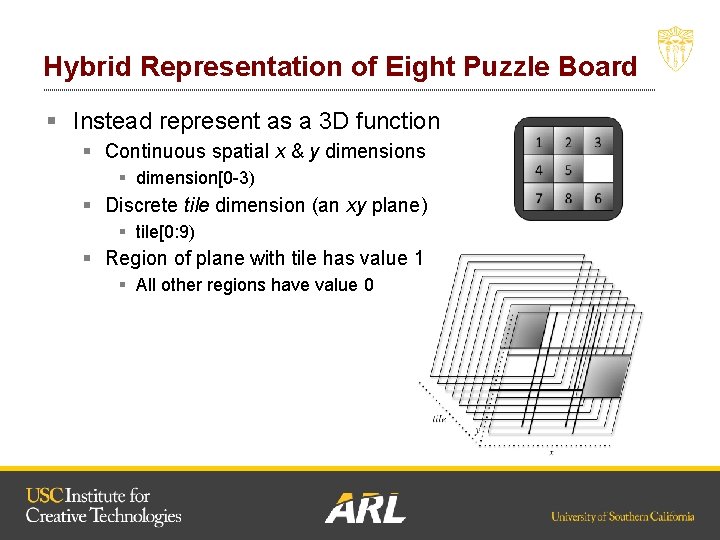
Hybrid Representation of Eight Puzzle Board § Instead represent as a 3 D function § Continuous spatial x & y dimensions § dimension[0 -3) § Discrete tile dimension (an xy plane) § tile[0: 9) § Region of plane with tile has value 1 § All other regions have value 0
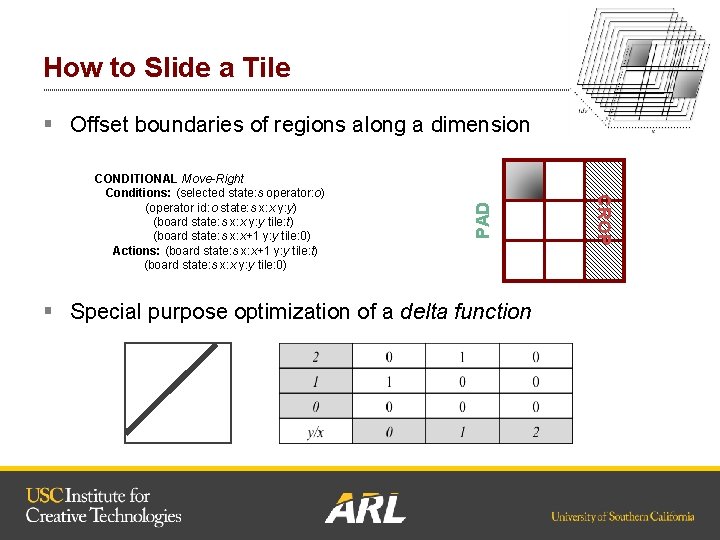
How to Slide a Tile § Special purpose optimization of a delta function CROP CONDITIONAL Move-Right Conditions: (selected state: s operator: o) (operator id: o state: s x: x y: y) (board state: s x: x y: y tile: t) (board state: s x: x+1 y: y tile: 0) Actions: (board state: s x: x+1 y: y tile: t) (board state: s x: x y: y tile: 0) PAD § Offset boundaries of regions along a dimension
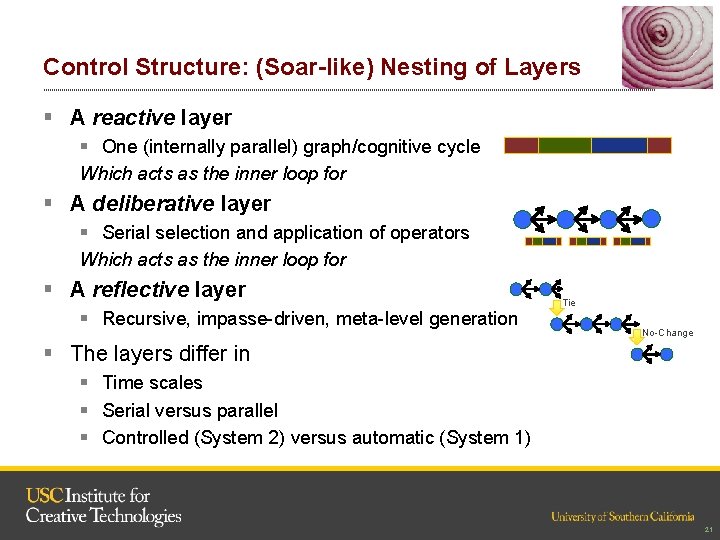
Control Structure: (Soar-like) Nesting of Layers § A reactive layer § One (internally parallel) graph/cognitive cycle Which acts as the inner loop for § A deliberative layer § Serial selection and application of operators Which acts as the inner loop for § A reflective layer § Recursive, impasse-driven, meta-level generation Tie No-Change § The layers differ in § Time scales § Serial versus parallel § Controlled (System 2) versus automatic (System 1) 21
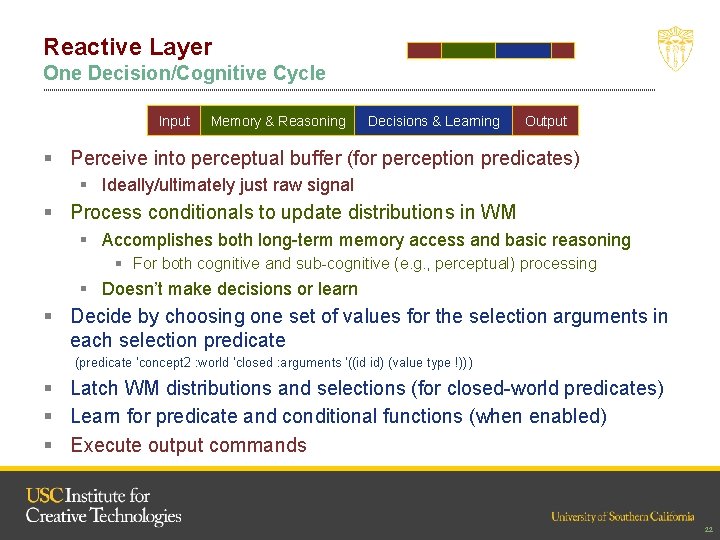
Reactive Layer One Decision/Cognitive Cycle Input Memory & Reasoning Decisions & Learning Output § Perceive into perceptual buffer (for perception predicates) § Ideally/ultimately just raw signal § Process conditionals to update distributions in WM § Accomplishes both long-term memory access and basic reasoning § For both cognitive and sub-cognitive (e. g. , perceptual) processing § Doesn’t make decisions or learn § Decide by choosing one set of values for the selection arguments in each selection predicate (predicate 'concept 2 : world 'closed : arguments '((id id) (value type !)) ) § Latch WM distributions and selections (for closed-world predicates) § Learn for predicate and conditional functions (when enabled) § Execute output commands 22
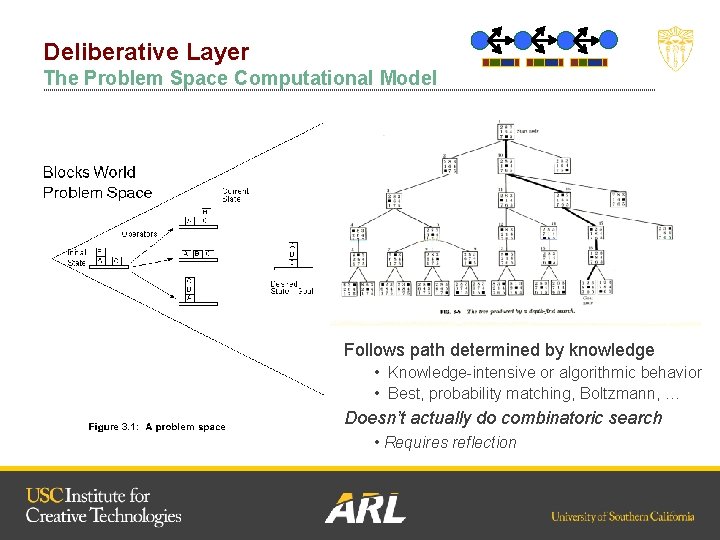
Deliberative Layer The Problem Space Computational Model Follows path determined by knowledge • Knowledge-intensive or algorithmic behavior • Best, probability matching, Boltzmann, … Doesn’t actually do combinatoric search • Requires reflection
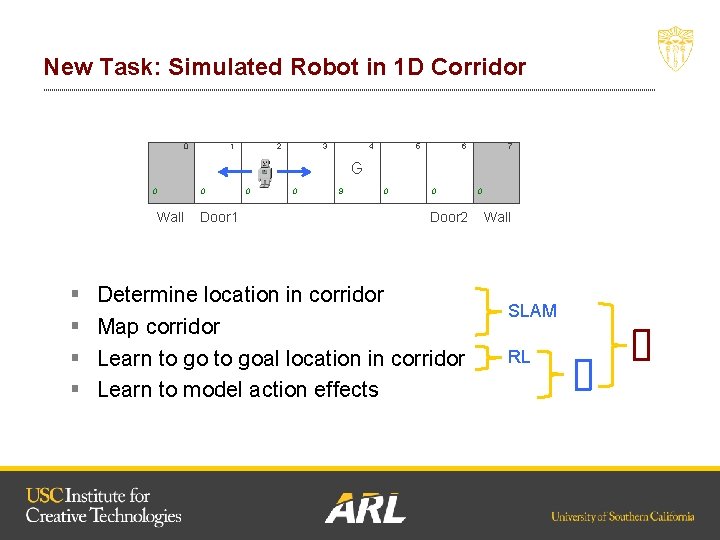
New Task: Simulated Robot in 1 D Corridor 0 1 2 3 4 5 6 7 G 0 0 Wall § § Door 1 0 0 9 0 0 Door 2 Determine location in corridor Map corridor Learn to goal location in corridor Learn to model action effects 0 Wall SLAM RL
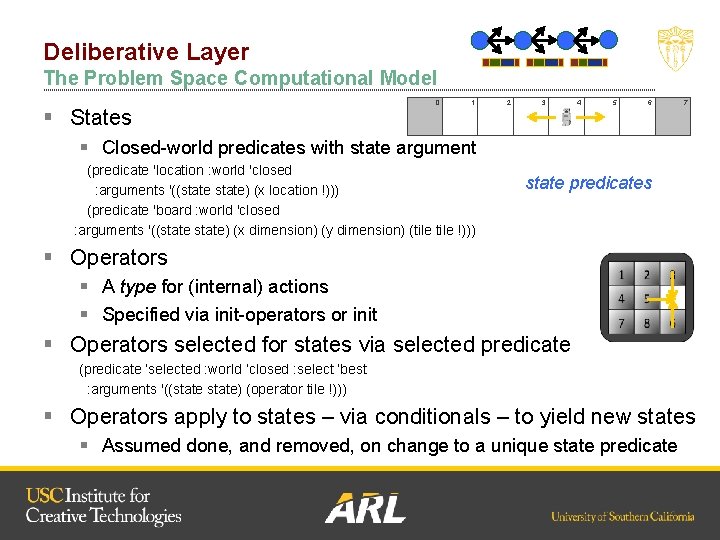
Deliberative Layer The Problem Space Computational Model § States 0 1 2 3 4 5 6 7 § Closed-world predicates with state argument (predicate 'location : world 'closed : arguments '((state) (x location !))) (predicate 'board : world 'closed : arguments '((state) (x dimension) (y dimension) (tile !))) state predicates § Operators § A type for (internal) actions § Specified via init-operators or init § Operators selected for states via selected predicate (predicate ’selected : world ’closed : select ’best : arguments '((state) (operator tile !))) § Operators apply to states – via conditionals – to yield new states § Assumed done, and removed, on change to a unique state predicate
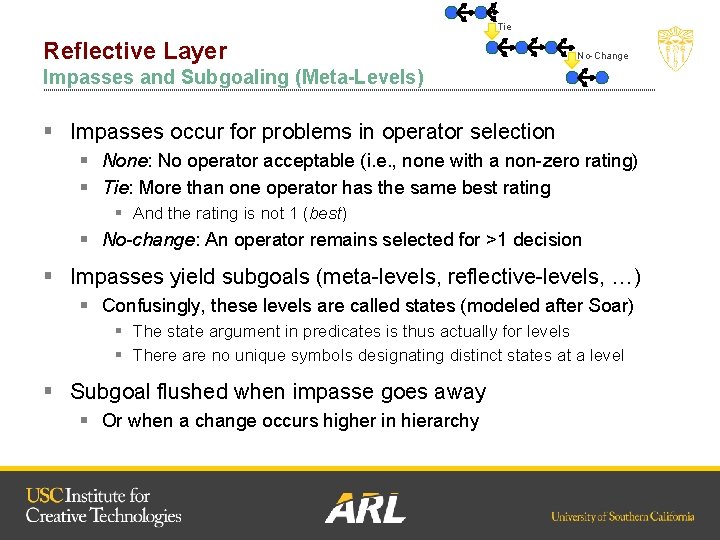
Tie Reflective Layer No-Change Impasses and Subgoaling (Meta-Levels) § Impasses occur for problems in operator selection § None: No operator acceptable (i. e. , none with a non-zero rating) § Tie: More than one operator has the same best rating § And the rating is not 1 (best) § No-change: An operator remains selected for >1 decision § Impasses yield subgoals (meta-levels, reflective-levels, …) § Confusingly, these levels are called states (modeled after Soar) § The state argument in predicates is thus actually for levels § There are no unique symbols designating distinct states at a level § Subgoal flushed when impasse goes away § Or when a change occurs higher in hierarchy
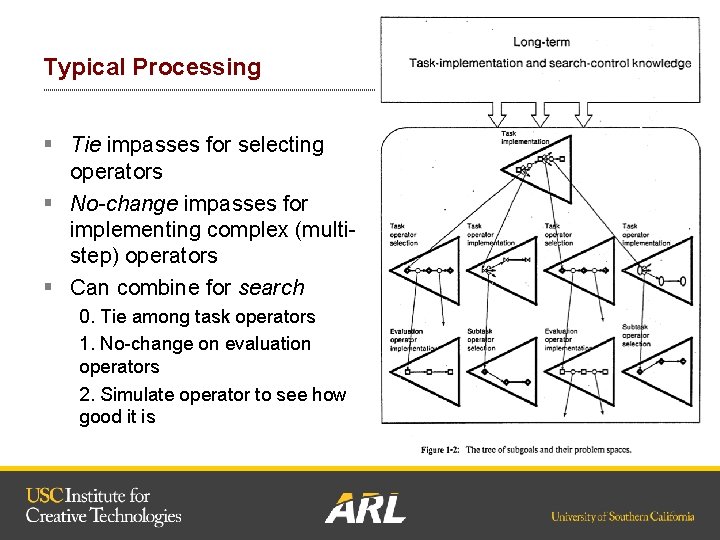
Typical Processing § Tie impasses for selecting operators § No-change impasses for implementing complex (multistep) operators § Can combine for search 0. Tie among task operators 1. No-change on evaluation operators 2. Simulate operator to see how good it is
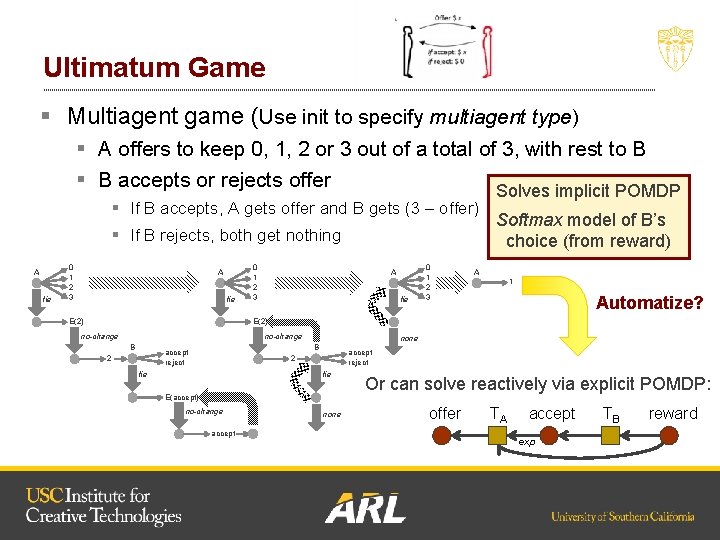
Ultimatum Game § Multiagent game (Use init to specify multiagent type) § A offers to keep 0, 1, 2 or 3 out of a total of 3, with rest to B § B accepts or rejects offer Solves implicit POMDP § If B accepts, A gets offer and B gets (3 – offer) § If B rejects, both get nothing A tie 0 1 2 3 A tie E(2) 0 1 2 3 A tie 0 1 2 3 Softmax model of B’s choice (from reward) A 1 Automatize? E(2) no-change B 2 none B accept reject 2 tie E(accept) no-change accept none Or can solve reactively via explicit POMDP: offer TA accept exp TB reward
Graphical models Piecewise-linear functions Gradient-descent learning GRAPHICAL ARCHITECTURE 29
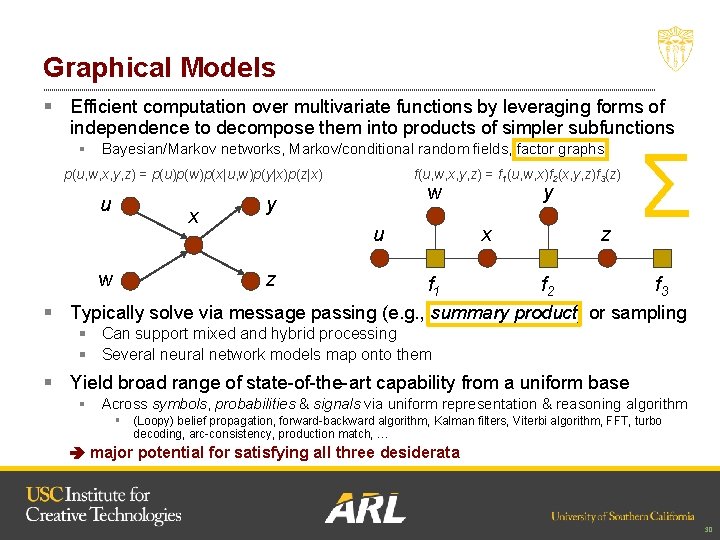
Graphical Models § Efficient computation over multivariate functions by leveraging forms of independence to decompose them into products of simpler subfunctions § Bayesian/Markov networks, Markov/conditional random fields, factor graphs f(u, w, x, y, z) = f 1(u, w, x)f 2(x, y, z)f 3(z) p(u, w, x, y, z) = p(u)p(w)p(x|u, w)p(y|x)p(z|x) u w x w y u z y x f 1 z f 2 Σ f 3 § Typically solve via message passing (e. g. , summary product) or sampling § Can support mixed and hybrid processing § Several neural network models map onto them § Yield broad range of state-of-the-art capability from a uniform base § Across symbols, probabilities & signals via uniform representation & reasoning algorithm § (Loopy) belief propagation, forward-backward algorithm, Kalman filters, Viterbi algorithm, FFT, turbo decoding, arc-consistency, production match, … major potential for satisfying all three desiderata 30
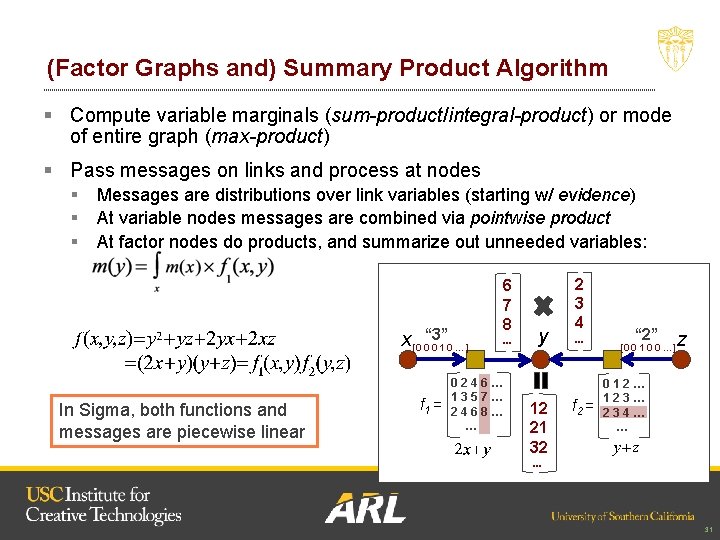
(Factor Graphs and) Summary Product Algorithm § Compute variable marginals (sum-product/integral-product) or mode of entire graph (max-product) § Pass messages on links and process at nodes § § § Messages are distributions over link variables (starting w/ evidence) At variable nodes messages are combined via pointwise product At factor nodes do products, and summarize out unneeded variables: x [0 0“ 3” 0 1 0 …] In Sigma, both functions and messages are piecewise linear f 1 = 6 7 8. . . 0246… 1357… 2468… … y 12 21 32 2 3 4. . . f 2 = “ 2” [0 0 1 0 0 …] z 012… 123… 234… … . . . 31
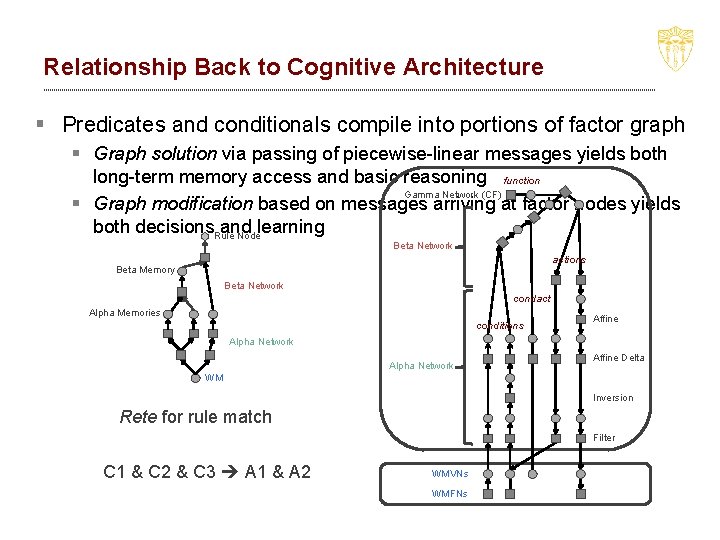
Relationship Back to Cognitive Architecture § Predicates and conditionals compile into portions of factor graph § Graph solution via passing of piecewise-linear messages yields both long-term memory access and basic reasoning function Gamma Network (CF) § Graph modification based on messages arriving at factor nodes yields both decisions. Rule and learning Node Beta Network actions Beta Memory Beta Network condact Alpha Memories conditions Affine Alpha Network Affine Delta WM Inversion Rete for rule match Filter C 1 & C 2 & C 3 A 1 & A 2 WMVNs WMFNs
CONDITIONAL Transitive Conditions: Next(a, b) Next(b, c) Actions: Next(a, c) Procedural Memory (Rules) Pattern § Procedural if-then Structures § Just conditions and actions 0 1 0 0 0 1 0 , b t(a N ex t(b , c ) I 1 I 2 I 3 I 1 a I 2 I 3 0 0 0 1 0 I 1 b I 2 I 3 0 0 0 1 0 I 1 1 a c 0 I 1 I 2 I 3 WM b 0 b I 3 ) first I 1 I 2 Ne x I 1 I 2 I 3 Next(I 1, I 2) Next(I 2, I 3) c second WM Join c (type ’ID : constants ‘(I 1 I 2 I 3)) (predicate ‘Next ‘((first ID) (second ID)) : world ‘closed) I 1 I 2 I 3 a I 2 I 3 0 0 1 0
CONDITIONAL Transitive Conditions: Next(a, b) Next(b, c) Actions: Next(a, c) Procedural Memory (Rules) In More Detail Affine Delta a 0 0 I 2 1 0 0 I 3 1 1 0 b I 1 0 0 0 I 2 1 0 0 1 0 I 3 Next(first: b second: c) I 1 0 0 0 I 2 1 0 0 I 3 0 1 0 c I 3 Join I 1 o 2 I 3 I 1 0 0 0 I 2 1 0 0 I 3 0 1 a I 1 BM VAN Next(first: a second: c) FAN VAN MAX first I 1 I 2 I 3 BM I 2 BF I 2 I 3 0 0 1 0 I 2 I 3 second first I 2 BF b WMVN I 1 0 1 t: a 0 I 3 firs I 1 se co n I 3 I 2 c WMFN I 2 Ne xt( second I 1 d: b ) first I 1 Join I 3 0 0 1 0 34
Category Semantic Memory (Classifier) Alive Legs Color Mobile Weight Naïve Bayes classifier Given cues, retrieve/predict object category and missing attributes E. g. , Given Alive=T & Legs=4 Retrieve Category=Dog, Color=Brown, Mobile=T, Weight=50 Concept (S) Dog=1 Silver=. 05, Brown=. 7, White=. 25 [1, 50)=. 0003 w-. 0003, [50, 150)=. 02 -. 0001 w Weight (C) A subset of factor nodes (and no variable nodes) Color (S) Function WM Join 4 , T 5. 0 F= 95 =. Mobile (B) Legs (D) T B: Boolean S: Symbolic D: Discrete C: Continuous Alive (B) 35
Imagery Memory (Mental Imagery) § How is spatial information represented and processed in minds? § § Add and delete objects from images Aggregate combinations into new objects Translate, scale and rotate objects Extract implied properties for further reasoning § In a symbolic architecture either need to § Represent and reason about images symbolically § Connect to an imagery component (as in Soar 9) § In Sigma, use its standard mechanisms § Continuous, discrete and hybrid representations § Affine transform nodes that are special purpose optimizations of general factor nodes 36
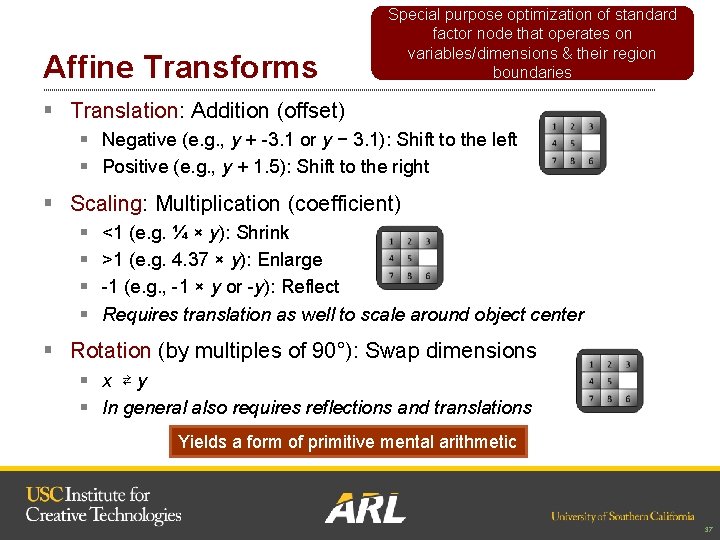
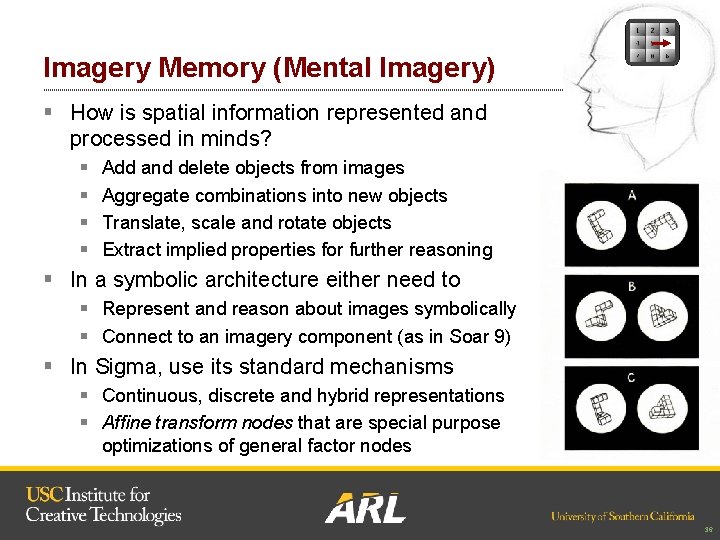
Affine Transforms Special purpose optimization of standard factor node that operates on variables/dimensions & their region boundaries § Translation: Addition (offset) § Negative (e. g. , y + -3. 1 or y − 3. 1): Shift to the left § Positive (e. g. , y + 1. 5): Shift to the right § Scaling: Multiplication (coefficient) § § <1 (e. g. ¼ × y): Shrink >1 (e. g. 4. 37 × y): Enlarge -1 (e. g. , -1 × y or -y): Reflect Requires translation as well to scale around object center § Rotation (by multiples of 90°): Swap dimensions § x ⇄y § In general also requires reflections and translations Yields a form of primitive mental arithmetic 37
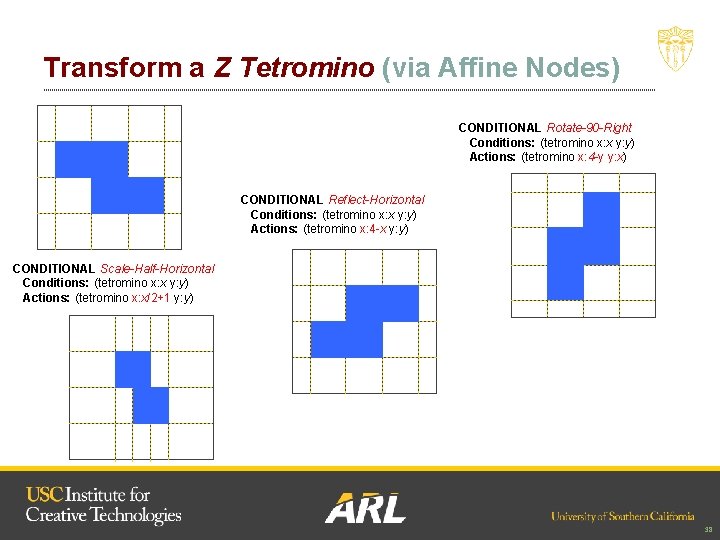
Transform a Z Tetromino (via Affine Nodes) CONDITIONAL Rotate-90 -Right Conditions: (tetromino x: x y: y) Actions: (tetromino x: 4 -y y: x) CONDITIONAL Reflect-Horizontal Conditions: (tetromino x: x y: y) Actions: (tetromino x: 4 -x y: y) CONDITIONAL Scale-Half-Horizontal Conditions: (tetromino x: x y: y) Actions: (tetromino x: x/2+1 y: y) 38
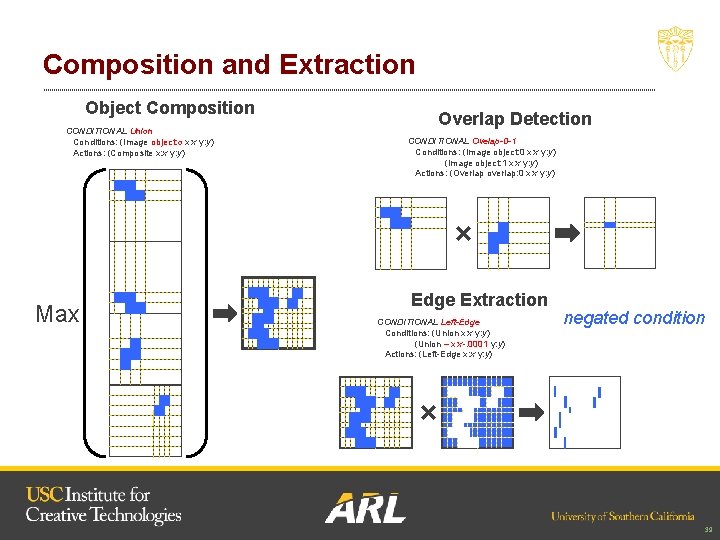
Composition and Extraction Object Composition CONDITIONAL Union Conditions: (Image object: o x: x y: y) Actions: (Composite x: x y: y) Overlap Detection CONDITIONAL Ovelap-0 -1 Conditions: (Image object: 0 x: x y: y) (image object: 1 x: x y: y) Actions: (Overlap overlap: 0 x: x y: y) × Max Edge Extraction CONDITIONAL Left-Edge Conditions: (Union x: x y: y) (Union – x: x-. 0001 y: y) Actions: (Left-Edge x: x y: y) negated condition × 39

DECISIONS & LEARNING 40
Decisions at Working Memory Factor Nodes (WMFNs) § Choice of best alternative at the cognitive level is computed as a side effect of MAX summarization over messages arriving at WMFN nodes § As MAX is computed, maximal (sub)regions are tracked for argmax § Choice of expected value involves EV summarization § Choice by probability matching involves a variant of INTEGRAL summarization § Can also transform function before summarization to yield variations such as Boltzmann/softmax selection
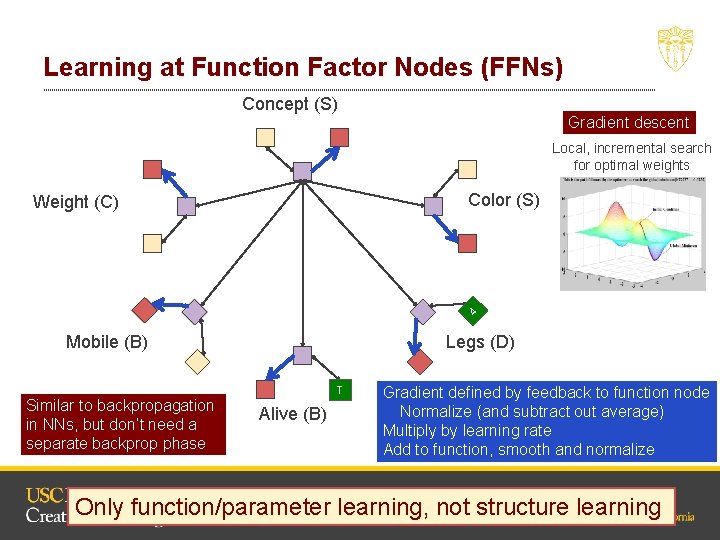
Learning at Function Factor Nodes (FFNs) Concept (S) Gradient descent Local, incremental search for optimal weights Color (S) 4 Weight (C) Mobile (B) Similar to backpropagation in NNs, but don’t need a separate backprop phase Legs (D) T Alive (B) Gradient defined by feedback to function node Normalize (and subtract out average) Multiply by learning rate Add to function, smooth and normalize Only function/parameter learning, not structure learning
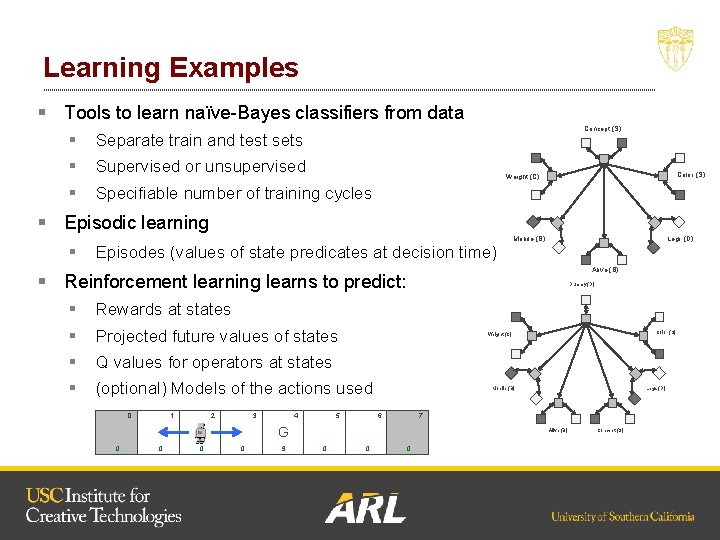
Learning Examples § Tools to learn naïve-Bayes classifiers from data Concept (S) § Separate train and test sets § Supervised or unsupervised § Specifiable number of training cycles Color (S) Weight (C) § Episodic learning Mobile (B) § Legs (D) Episodes (values of state predicates at decision time) Alive (B) § Reinforcement learning learns to predict: § Rewards at states § Projected future values of states § Q values for operators at states § (optional) Models of the actions used 0 1 2 3 4 Dummy (D) 5 Mobile (B) 6 0 0 0 9 Legs (D) 7 G 0 Color (S) Weight (C) Alive (B) 0 0 0 Concept (S)
Episodic Memory § A core competency in cognition § Back at least to Tulving (1983) in psychology § Back at least to Vere & Bickmore (1990) in AI § Spans ability to § Store history of what has been experienced § Autobiographical and temporal § Selectively retrieve and reuse information from past episodes § Replay fragments of past history § Not yet pervasive in cognitive architectures § But see work in Soar, Icarus, ACT-R, . . § General relationship to CBR and IBL
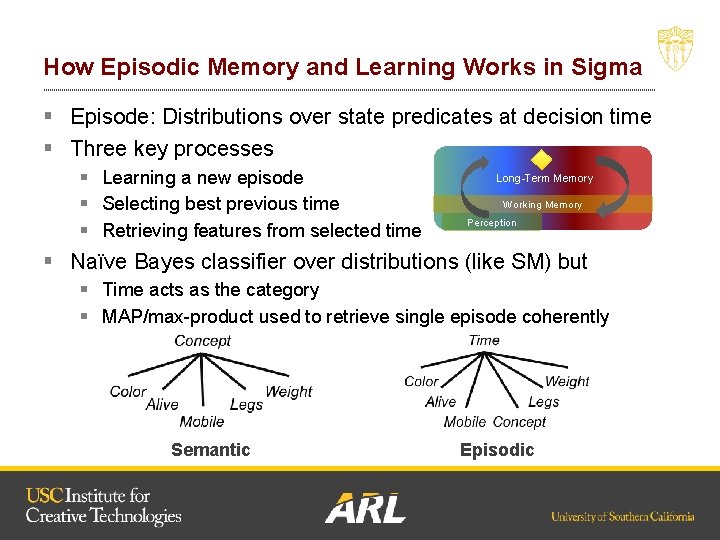
How Episodic Memory and Learning Works in Sigma § Episode: Distributions over state predicates at decision time Seman Image Episo § Three key processes Procedur dic tic ry § Learning a new episode § Selecting best previous time § Retrieving features from selected time al Memor Memo Long-Term Memory ry y Working Memory Perception § Naïve Bayes classifier over distributions (like SM) but § Time acts as the category § MAP/max-product used to retrieve single episode coherently Semantic Episodic
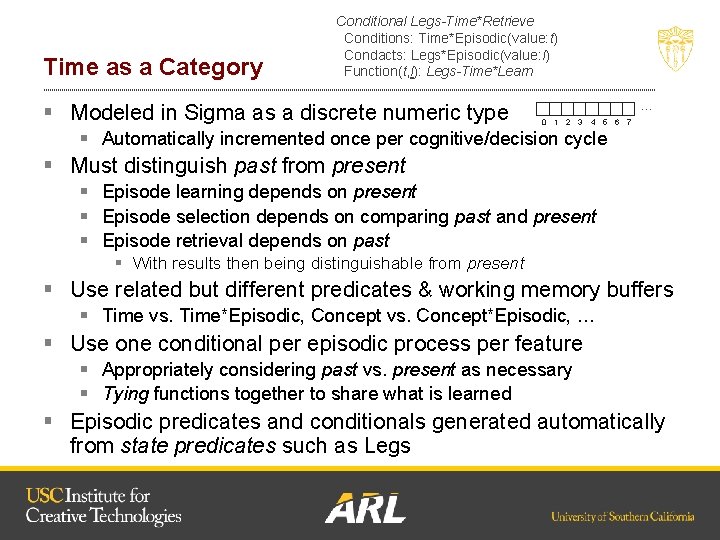
Time as a Category Conditional Legs-Time*Retrieve Conditions: Time*Episodic(value: t) Condacts: Legs*Episodic(value: l) Function(t, l): Legs-Time*Learn § Modeled in Sigma as a discrete numeric type … 0 1 2 3 4 5 6 7 § Automatically incremented once per cognitive/decision cycle § Must distinguish past from present § Episode learning depends on present § Episode selection depends on comparing past and present § Episode retrieval depends on past § With results then being distinguishable from present § Use related but different predicates & working memory buffers § Time vs. Time*Episodic, Concept vs. Concept*Episodic, … § Use one conditional per episodic process per feature § Appropriately considering past vs. present as necessary § Tying functions together to share what is learned § Episodic predicates and conditionals generated automatically from state predicates such as Legs
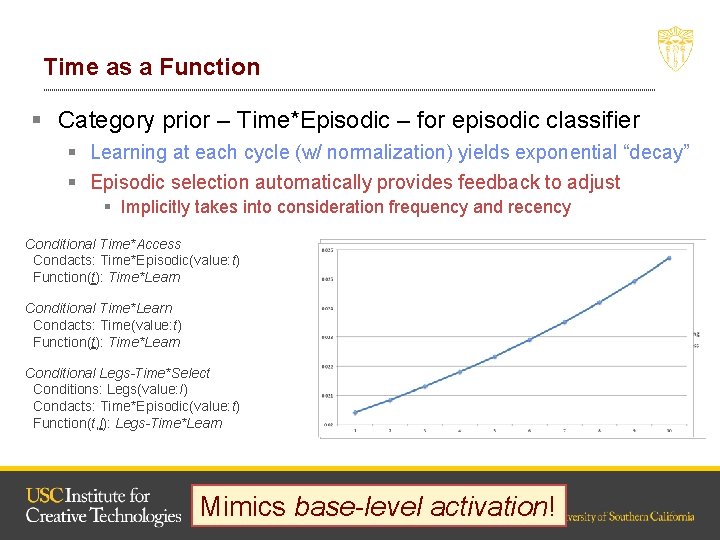
Time as a Function § Category prior – Time*Episodic – for episodic classifier § Learning at each cycle (w/ normalization) yields exponential “decay” § Episodic selection automatically provides feedback to adjust § Implicitly takes into consideration frequency and recency Conditional Time*Access Condacts: Time*Episodic(value: t) Function(t): Time*Learn Conditional Time*Learn Condacts: Time(value: t) Function(t): Time*Learn Conditional Legs-Time*Select Conditions: Legs(value: l) Condacts: Time*Episodic(value: t) Function(t, l): Legs-Time*Learn Mimics base-level activation!
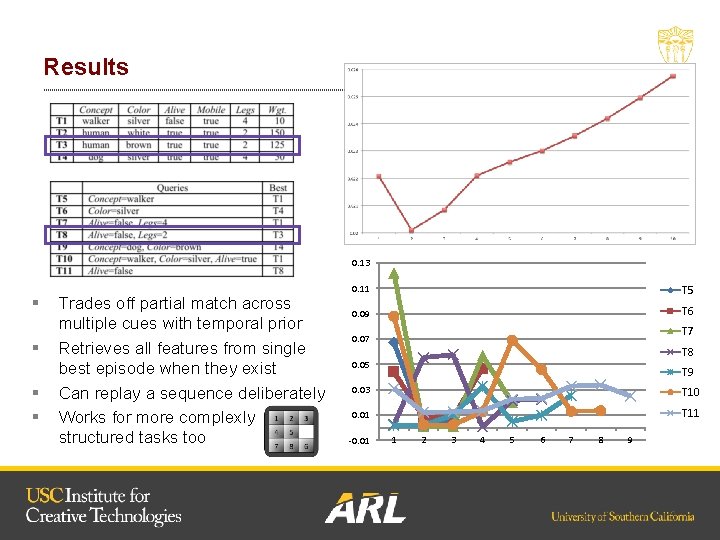
Results 0. 13 § § Trades off partial match across multiple cues with temporal prior Retrieves all features from single best episode when they exist Can replay a sequence deliberately Works for more complexly structured tasks too 0. 11 T 5 0. 09 T 6 T 7 0. 07 T 8 0. 05 T 9 0. 03 T 10 0. 01 T 11 -0. 01 1 2 3 4 5 6 7 8 9
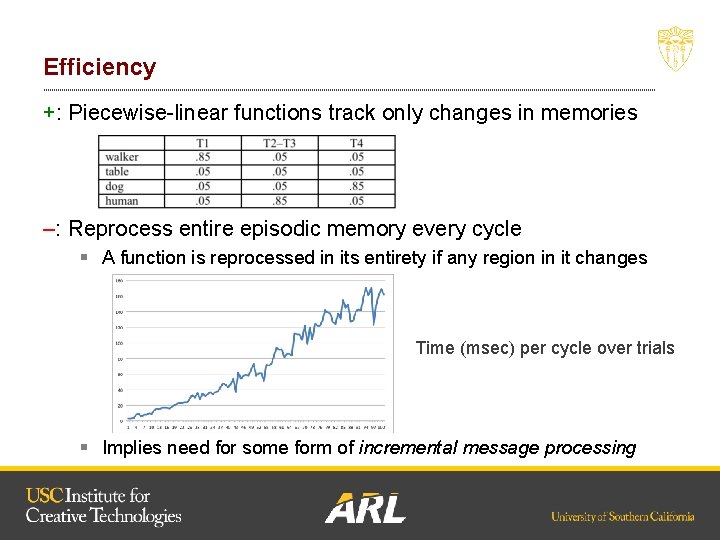
Efficiency +: Piecewise-linear functions track only changes in memories –: Reprocess entire episodic memory every cycle § A function is reprocessed in its entirety if any region in it changes Time (msec) per cycle over trials § Implies need for some form of incremental message processing
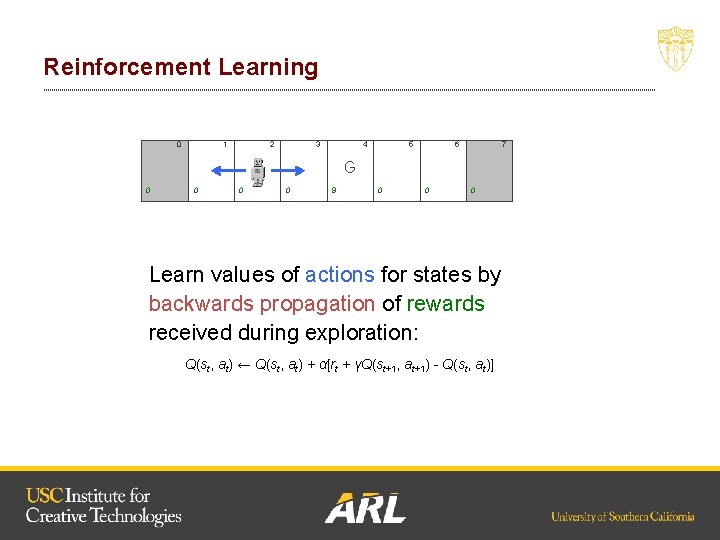
Reinforcement Learning 0 1 2 3 4 5 6 7 G 0 0 9 0 0 0 Learn values of actions for states by backwards propagation of rewards received during exploration: Q(st, at) ← Q(st, at) + α[rt + γQ(st+1, at+1) - Q(st, at)]
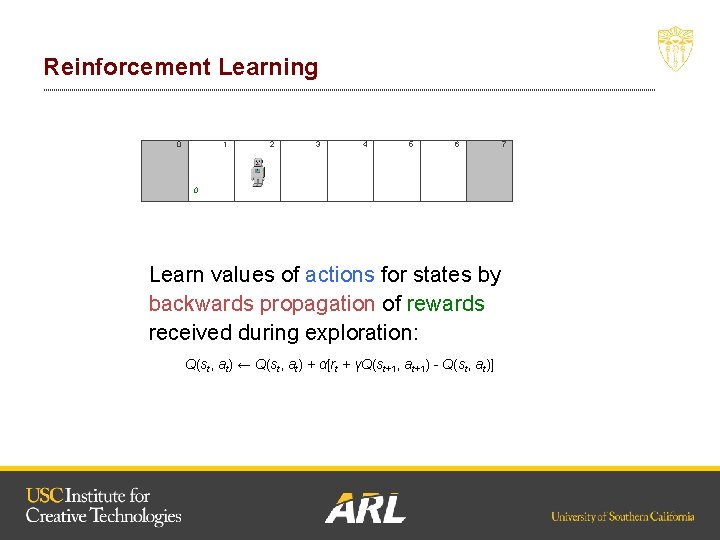
Reinforcement Learning 0 1 2 3 4 5 6 0 Learn values of actions for states by backwards propagation of rewards received during exploration: Q(st, at) ← Q(st, at) + α[rt + γQ(st+1, at+1) - Q(st, at)] 7
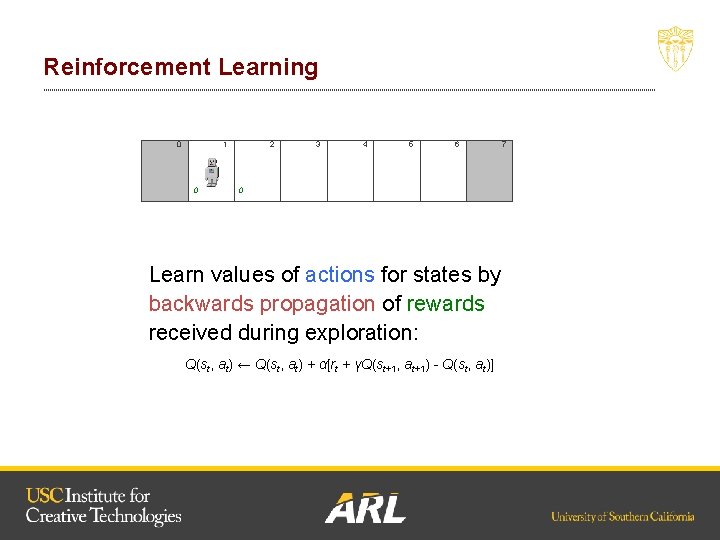
Reinforcement Learning 0 1 0 2 3 4 5 6 0 Learn values of actions for states by backwards propagation of rewards received during exploration: Q(st, at) ← Q(st, at) + α[rt + γQ(st+1, at+1) - Q(st, at)] 7
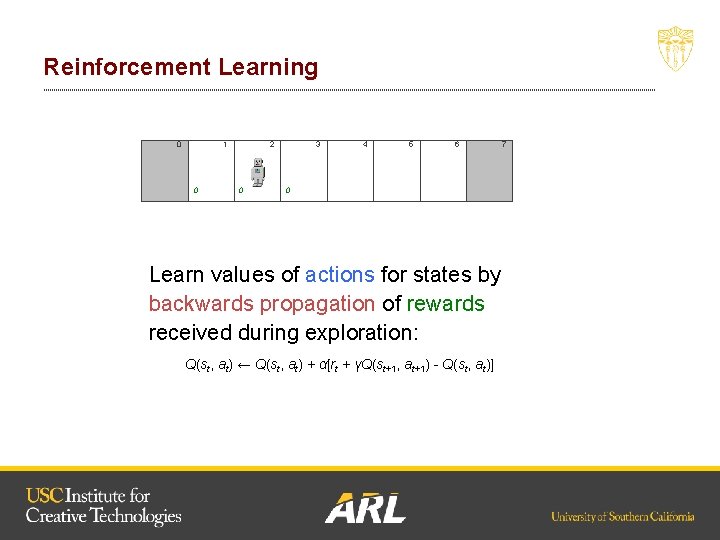
Reinforcement Learning 0 1 0 2 0 3 4 5 6 0 Learn values of actions for states by backwards propagation of rewards received during exploration: Q(st, at) ← Q(st, at) + α[rt + γQ(st+1, at+1) - Q(st, at)] 7
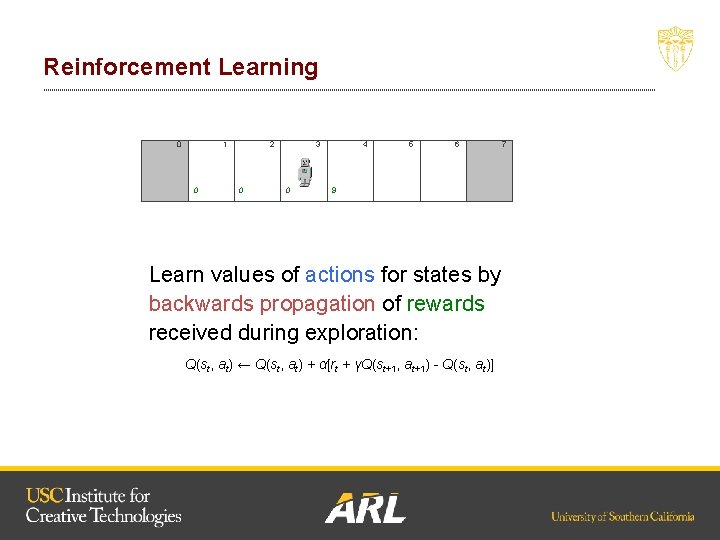
Reinforcement Learning 0 1 0 2 0 3 0 4 5 6 9 Learn values of actions for states by backwards propagation of rewards received during exploration: Q(st, at) ← Q(st, at) + α[rt + γQ(st+1, at+1) - Q(st, at)] 7
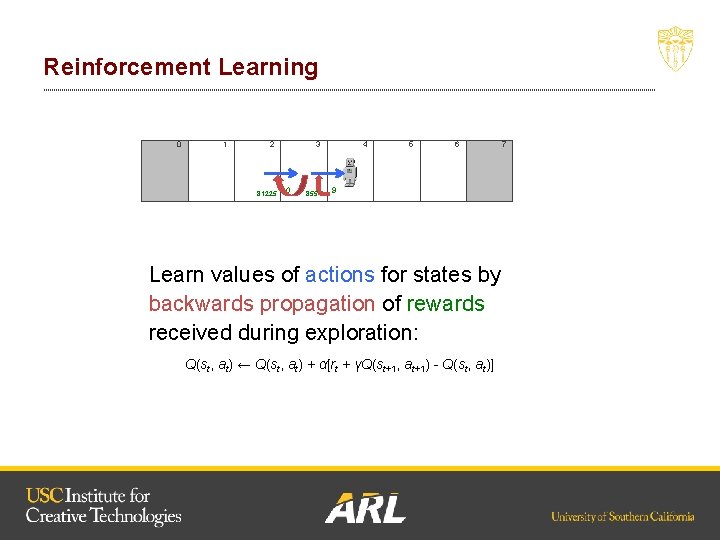
Reinforcement Learning 0 1 2 . 81225 3 0 . 855 4 5 6 9 Learn values of actions for states by backwards propagation of rewards received during exploration: Q(st, at) ← Q(st, at) + α[rt + γQ(st+1, at+1) - Q(st, at)] 7
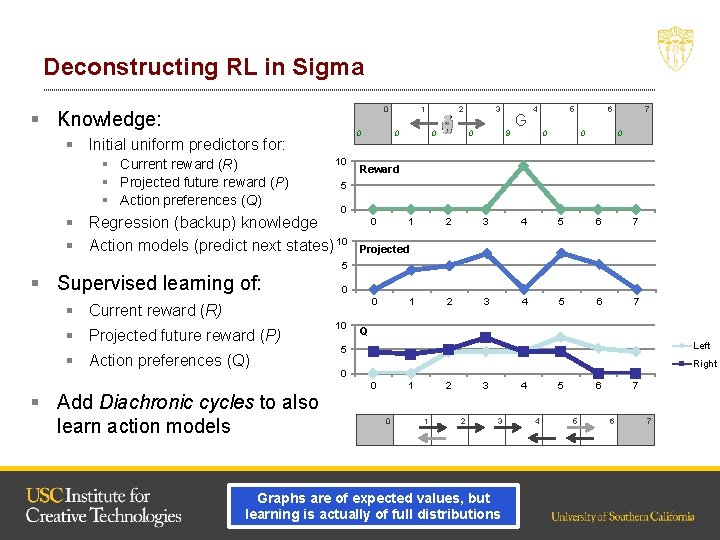
Deconstructing RL in Sigma 0 § Knowledge: 0 § Initial uniform predictors for: § Current reward (R) § Projected future reward (P) § Action preferences (Q) 10 1 0 2 0 3 0 9 G 4 5 0 6 0 7 0 Reward 5 0 § Regression (backup) knowledge § Action models (predict next states) 10 0 1 2 3 4 5 6 7 Projected 5 § Supervised learning of: 0 0 § Current reward (R) § Projected future reward (P) § Action preferences (Q) § Add Diachronic cycles to also learn action models 10 1 Q Left 5 Right 0 0 1 0 2 1 3 2 4 3 Graphs are of expected values, but learning is actually of full distributions 5 4 6 5 7 6 7
Template-Based Structure Creation § From specifications of core state predicates automatically generate additional types, predicates and conditionals as needed for various forms of learning § Synchronic prediction § Map learning in SLAM § Acoustic function learning in speech HMM § Diachronic prediction § Learning action models in RL § Transition function learning in speech HMM § Episodic learning § Reinforcement learning
SUMMARY 58
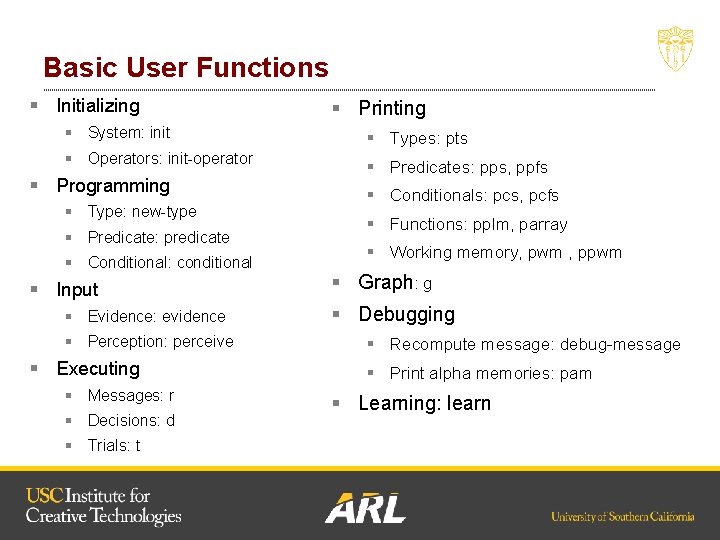
Basic User Functions § Initializing § Printing § System: init § Types: pts § Operators: init-operator § Predicates: pps, ppfs § Programming § Type: new-type § Predicate: predicate § Conditional: conditional § Input § Evidence: evidence § Perception: perceive § Executing § Messages: r § Decisions: d § Trials: t § Conditionals: pcs, pcfs § Functions: pplm, parray § Working memory, pwm , ppwm § Graph: g § Debugging § Recompute message: debug-message § Print alpha memories: pam § Learning: learn
![Overall Progress on Sigma § Mental imagery [BICA 11 a; AGI 12 b] §](http://slidetodoc.com/presentation_image/66daf249add0925edcf774636cdc8143/image-60.jpg "Overall Progress on Sigma § Mental imagery [BICA 11 a; AGI 12 b] §")
Overall Progress on Sigma § Mental imagery [BICA 11 a; AGI 12 b] § Memory [ICCM 10] § § Procedural (rule) Declarative (semantic/episodic) [Cog. Sci 14] Constraint Distributed vectors [AGI 14 a] § § Problem solving § § Preference based decisions [AGI 11] Impasse-driven reflection [AGI 13] Decision-theoretic (POMDP) [BICA 11 b] Theory of Mind [AGI 13, AGI 14 b] Perception § Object recognition (CRFs) [BICA 11 b] § Isolated word recognition (HMMs) § Localization [BICA 11 b] § Natural language § Learning [ICCM 13] § § § § 1 -3 D continuous imagery buffer § Object transformation § Feature & relationship detection Concept (supervised/unsupervised) Episodic [Cog. Sci 14] § Reinforcement [AGI 12 a, AGI 14 b] Action/transition models [AGI 12 a] § Models of other agents [AGI 14 b] Perceptual (including maps in SLAM) § Question answering (selection) § Word sense disambiguation [ICCM 13] § Part of speech tagging [ICCM 13] Graph integration [BICA 11 b] § CRF + Localization + POMDP Optimization [ICCM 12] Some of these are still just beginnings
Current and Near Future Topics § Scaling up knowledge and learning § Continuous speech understanding, and its integration with language and cognition § Distributed vector representations and their role in (integrating) speech, language and cognition § Emotion/affect and its relationship to the architecture § Learning of models of others § Lower architectural levels § Adaptive virtual humans
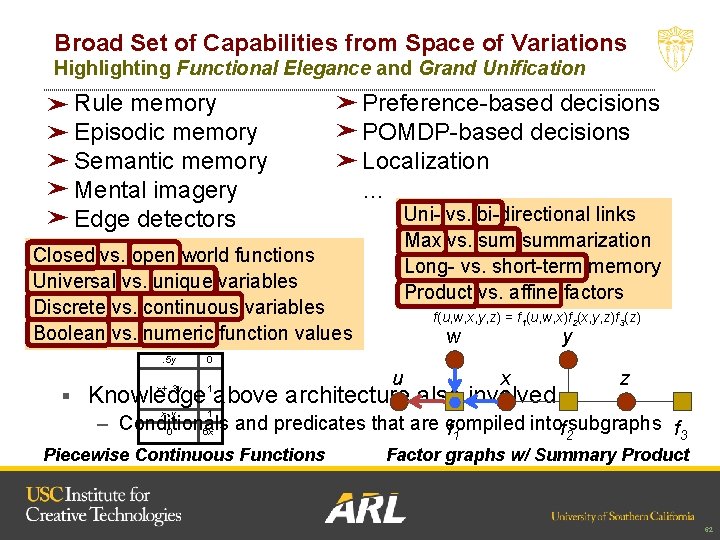
Broad Set of Capabilities from Space of Variations Highlighting Functional Elegance and Grand Unification ➤ Rule memory ➤ Episodic memory ➤ Semantic memory ➤ Mental imagery ➤ Edge detectors ➤ Preference-based decisions ➤ POMDP-based decisions ➤ Localization … Uni- vs. bi-directional links Max vs. summarization Long- vs. short-term memory Product vs. affine factors Closed vs. open world functions Universal vs. unique variables Discrete vs. continuous variables Boolean vs. numeric function values. 5 y § f(u, w, x, y, z) = f 1(u, w, x)f 2(x, y, z)f 3(z) w y 0 u x Knowledge above architecture also involved x+. 3 y 1 x-y 1 z – Conditionals and predicates that are compiled intof 2 subgraphs f 3 f 1 0 6 x Piecewise Continuous Functions Factor graphs w/ Summary Product 62
Fundamental Questions about Sigma § Can full range of capabilities be provided in this manner? § Can it all be sufficiently efficient for real time behavior? § What are the functional gains? § Can the human mind (and brain) be modeled? 63
Wrapping Up § Sigma website is http: //cogarch. ict. usc. edu § Most papers on Sigma can be found through there § New papers on which I’m an author usually appear online sooner at http: //cs. usc. edu/~rosenblo/pubs. html § Full use of Sigma requires a non-free version of Lisp. Works § The free version imposes heap-size limits that are problematic for anything other than small programs § We will soon have a version without the graph, regression and parallel processing interfaces that should run in any version of Lisp § Sigma is open source (simplified BSD license) § We are not yet distributing it openly because of a lack of appropriate documentation, but we are beginning to make progress on this § We will consider special requests in the interim
- Slides: 64