
TUTORIAL Spatial Disorientation and Optical Illusions Threat and
- Slides: 34
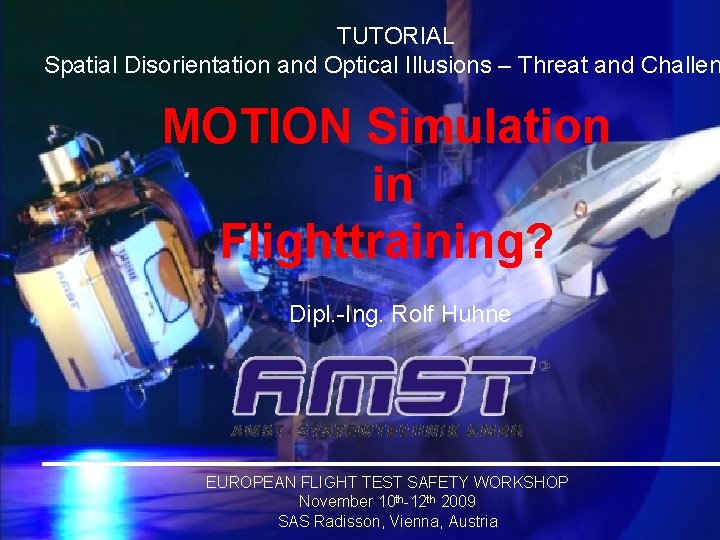
TUTORIAL Spatial Disorientation and Optical Illusions – Threat and Challen MOTION Simulation in Flighttraining? Dipl. -Ing. Rolf Huhne EUROPEAN FLIGHT TEST SAFETY WORKSHOP November 10 th-12 th 2009 SAS Radisson, Vienna, Austria
Do we need MOTION in Flight SIMULATION?
Quality motion in training – a controversial discussion Arguments against motion: Ø Motion does not transfer in training Ø Large variation between how simulators feel (wash-out filters/motion algorithms) Ø Experienced pilots know how to fly and do not need motion Arguments in favor of motion: Ø Motion contributes positively to pilot‘s performance because of faster vestibular perception (quick reaction skills) Ø Simulators must represent reality as good as possible Ø Vestibular-vision dynamics need vestibular stimulation for activation
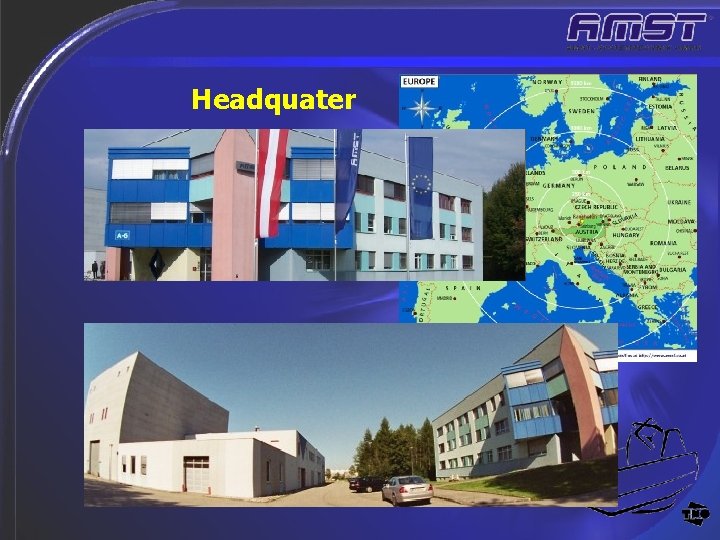
Headquater
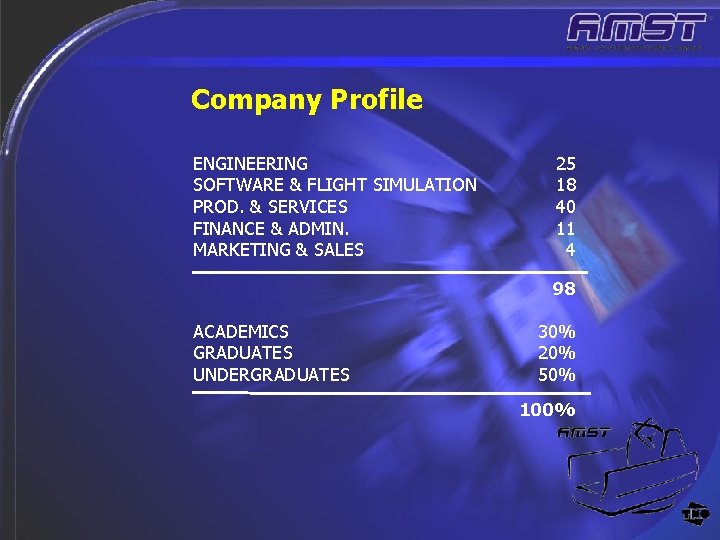
Company Profile ENGINEERING SOFTWARE & FLIGHT SIMULATION PROD. & SERVICES FINANCE & ADMIN. MARKETING & SALES 25 18 40 11 4 98 ACADEMICS GRADUATES UNDERGRADUATES 30% 20% 50% 100%
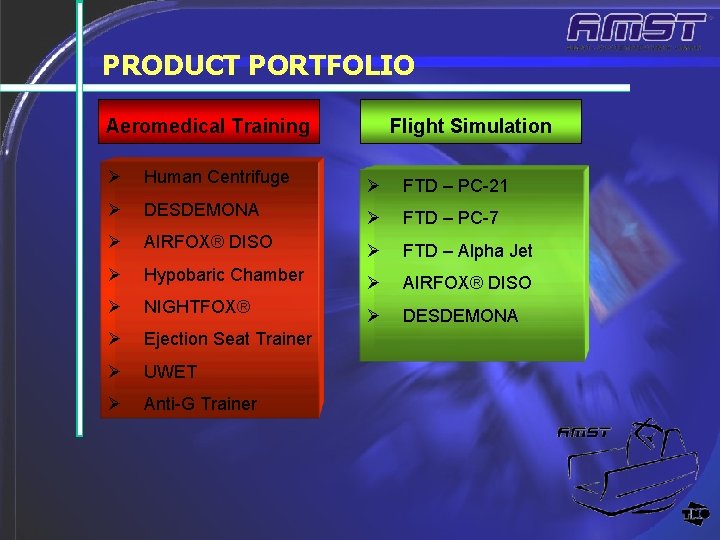
PRODUCT PORTFOLIO Aeromedical Training Flight Simulation Ø Human Centrifuge Ø FTD – PC-21 Ø DESDEMONA Ø FTD – PC-7 Ø AIRFOX® DISO Ø FTD – Alpha Jet Ø Hypobaric Chamber Ø AIRFOX® DISO Ø NIGHTFOX® Ø DESDEMONA Ø Ejection Seat Trainer Ø UWET Ø Anti-G Trainer
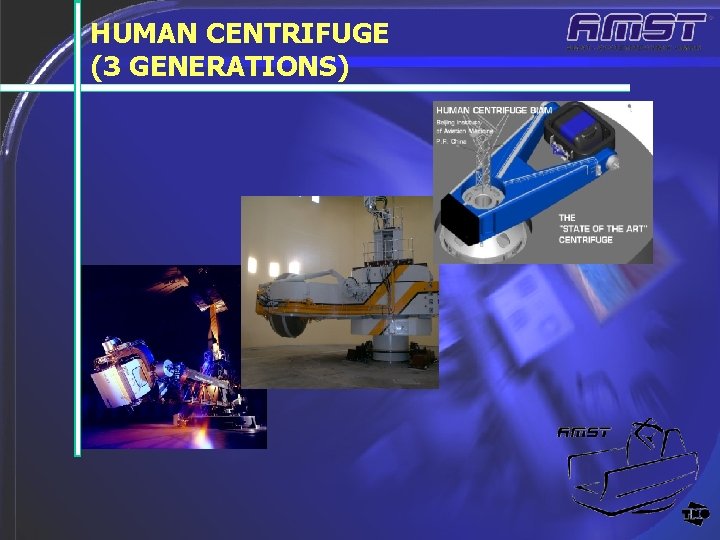
HUMAN CENTRIFUGE (3 GENERATIONS) +
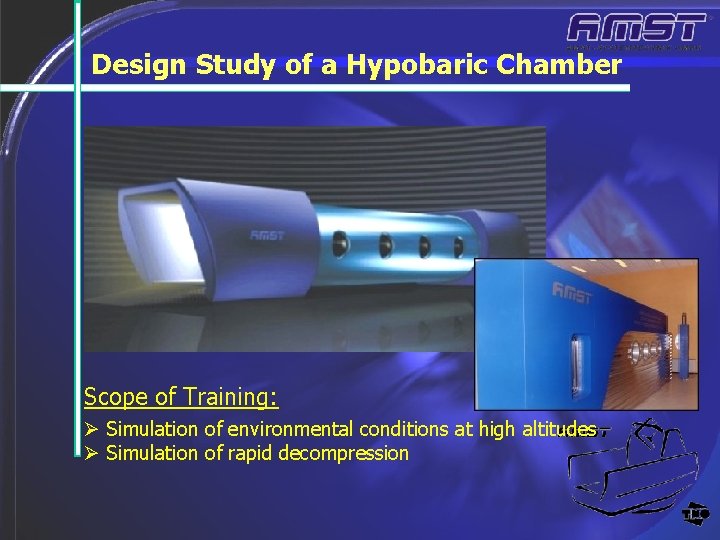
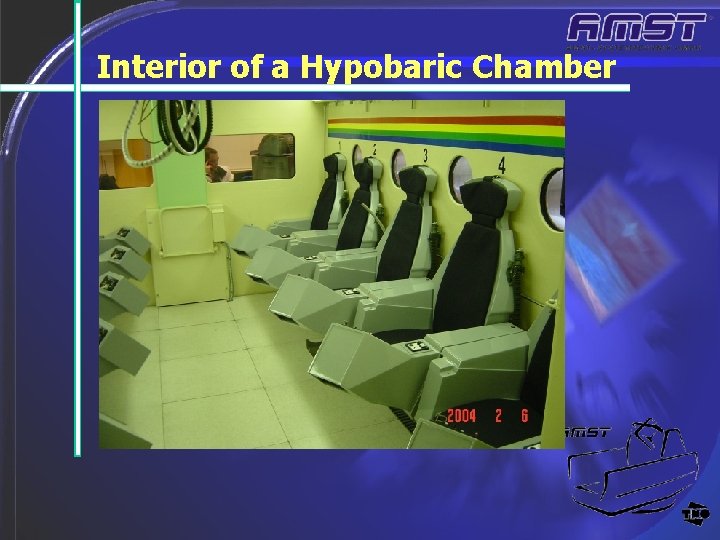
Design Study of a Hypobaric Chamber Scope of Training: Ø Simulation of environmental conditions at high altitudes Ø Simulation of rapid decompression
Interior of a Hypobaric Chamber
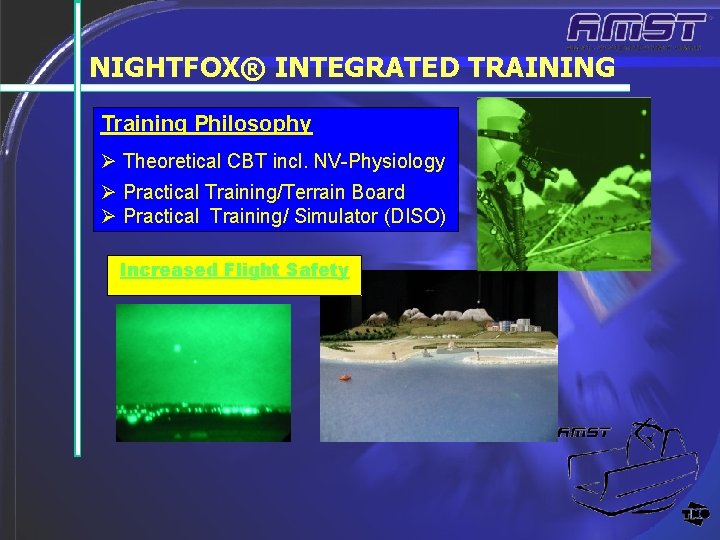
NIGHTFOX® INTEGRATED TRAINING Training Philosophy Ø Theoretical CBT incl. NV-Physiology Ø Practical Training/Terrain Board Ø Practical Training/ Simulator (DISO) + Increased Flight Safety
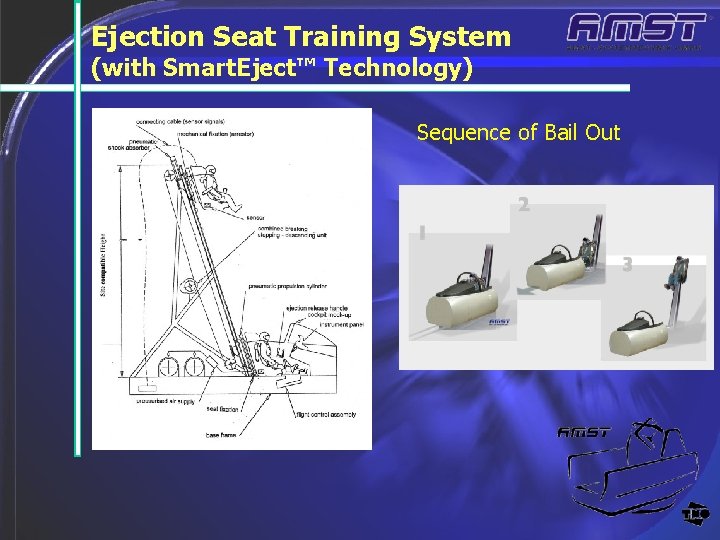
Ejection Seat Training System (with Smart. Eject™ Technology) Sequence of Bail Out
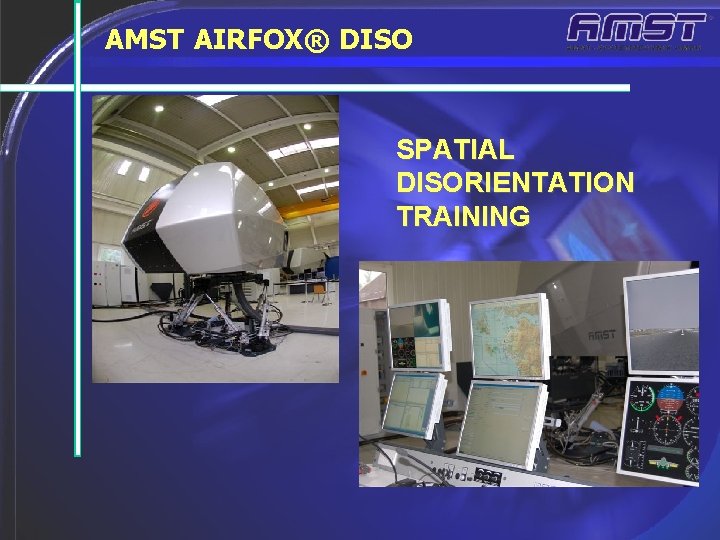
AMST AIRFOX® DISO SPATIAL DISORIENTATION TRAINING
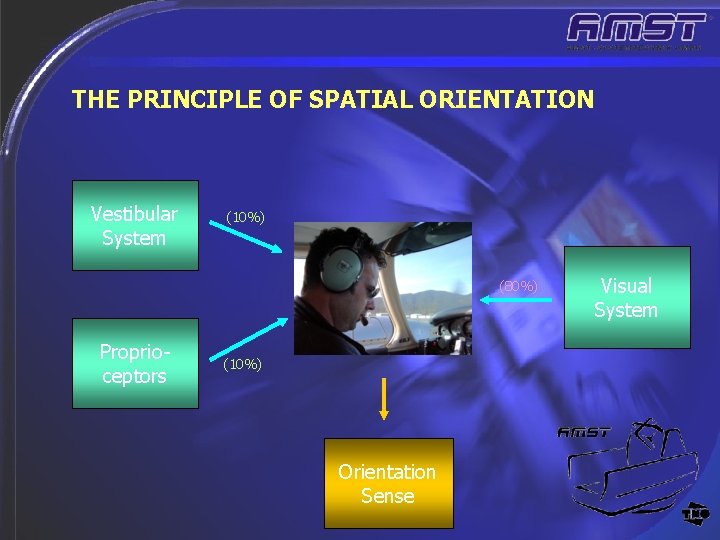
THE PRINCIPLE OF SPATIAL ORIENTATION Vestibular System (10%) (80%) Proprioceptors (10%) Orientation Sense Visual System
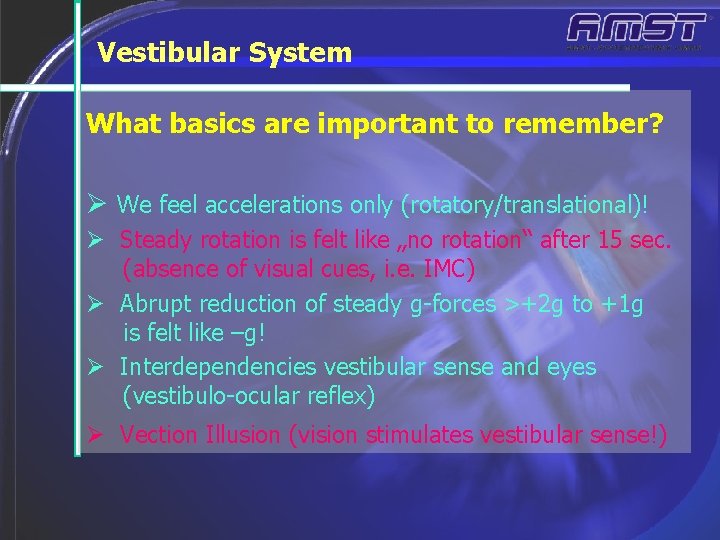
Vestibular System What basics are important to remember? Ø We feel accelerations only (rotatory/translational)! Ø Steady rotation is felt like „no rotation“ after 15 sec. (absence of visual cues, i. e. IMC) Ø Abrupt reduction of steady g-forces >+2 g to +1 g is felt like –g! Ø Interdependencies vestibular sense and eyes (vestibulo-ocular reflex) Ø Vection Illusion (vision stimulates vestibular sense!)
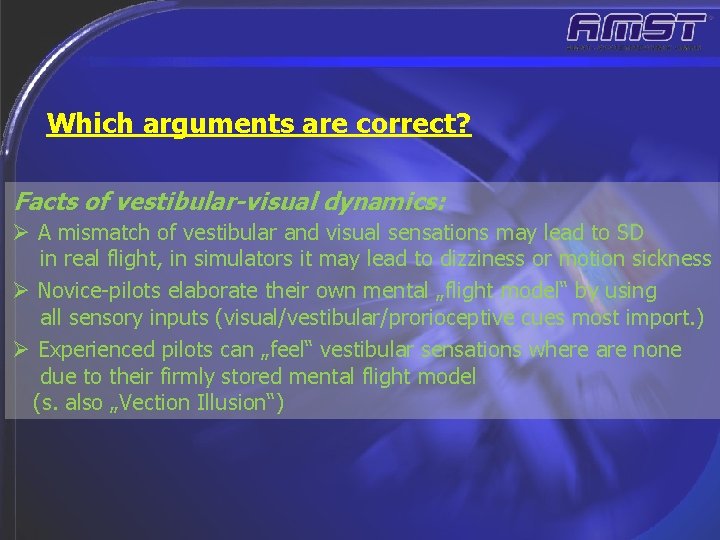
Which arguments are correct? Facts of vestibular-visual dynamics: Ø A mismatch of vestibular and visual sensations may lead to SD in real flight, in simulators it may lead to dizziness or motion sickness Ø Novice-pilots elaborate their own mental „flight model“ by using all sensory inputs (visual/vestibular/prorioceptive cues most import. ) Ø Experienced pilots can „feel“ vestibular sensations where are none due to their firmly stored mental flight model (s. also „Vection Illusion“)
Do we need MOTION in SIMULATION?
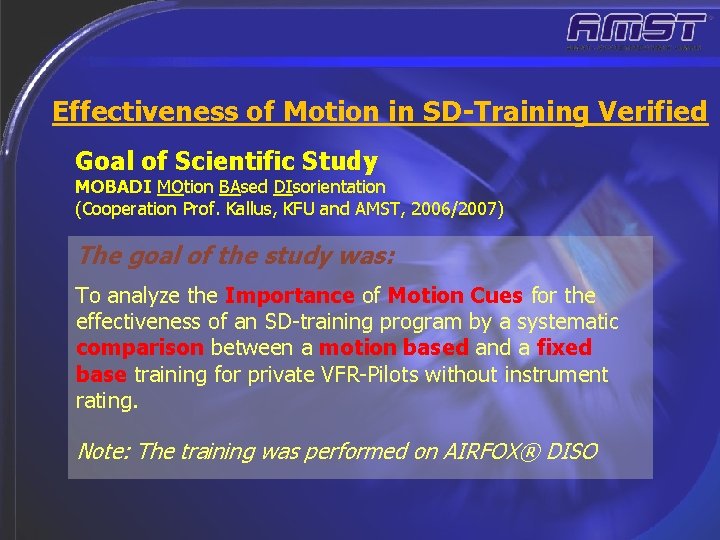
Effectiveness of Motion in SD-Training Verified Goal of Scientific Study MOBADI MOtion BAsed DIsorientation (Cooperation Prof. Kallus, KFU and AMST, 2006/2007) The goal of the study was: To analyze the Importance of Motion Cues for the effectiveness of an SD-training program by a systematic comparison between a motion based and a fixed base training for private VFR-Pilots without instrument rating. Note: The training was performed on AIRFOX® DISO
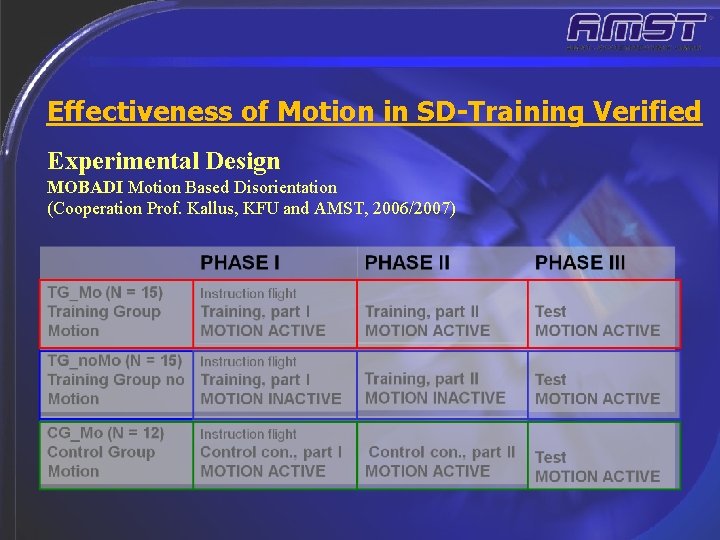
Effectiveness of Motion in SD-Training Verified Experimental Design MOBADI Motion Based Disorientation (Cooperation Prof. Kallus, KFU and AMST, 2006/2007)
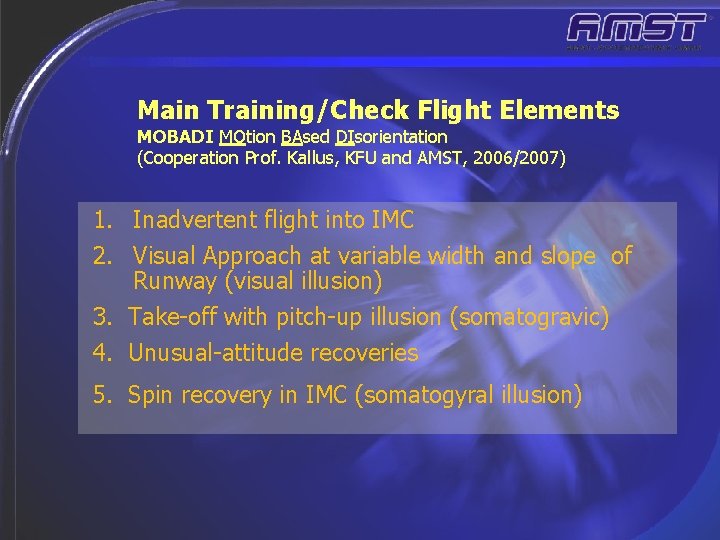
Main Training/Check Flight Elements MOBADI MOtion BAsed DIsorientation (Cooperation Prof. Kallus, KFU and AMST, 2006/2007) 1. Inadvertent flight into IMC 2. Visual Approach at variable width and slope of Runway (visual illusion) 3. Take-off with pitch-up illusion (somatogravic) 4. Unusual-attitude recoveries 5. Spin recovery in IMC (somatogyral illusion)
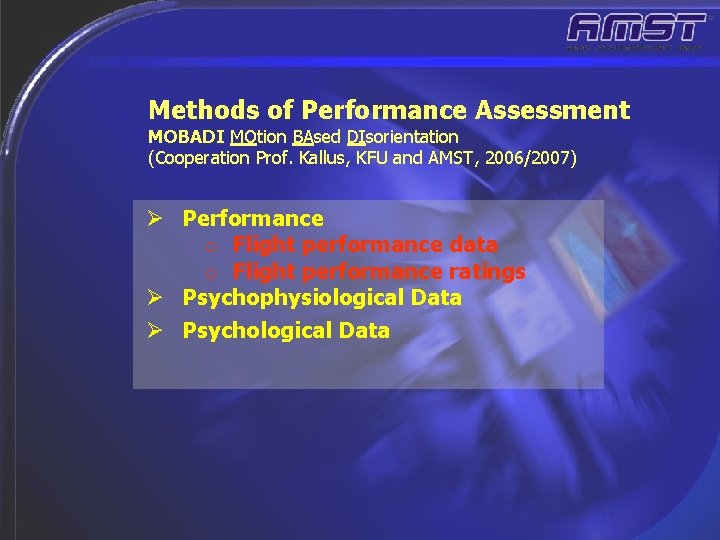
Methods of Performance Assessment MOBADI MOtion BAsed DIsorientation (Cooperation Prof. Kallus, KFU and AMST, 2006/2007) Ø Performance o Flight performance data o Flight performance ratings Ø Psychophysiological Data Ø Psychological Data
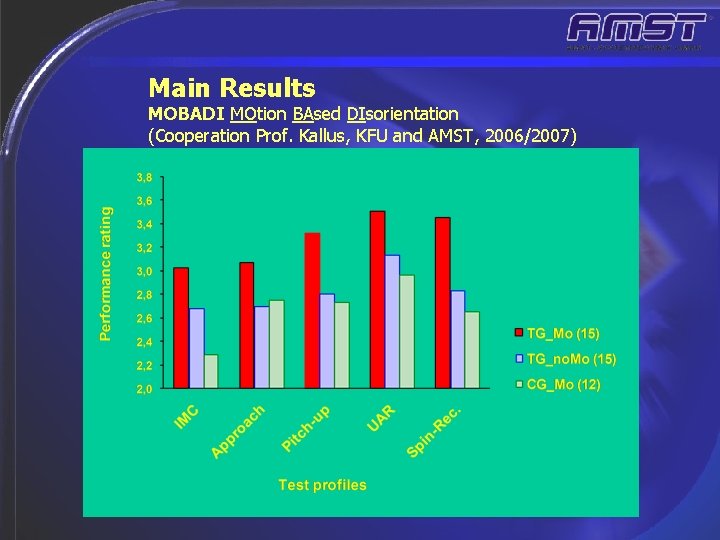
Main Results MOBADI MOtion BAsed DIsorientation (Cooperation Prof. Kallus, KFU and AMST, 2006/2007)
Effectiveness of Motion in SD-Training Verified Conclusion MOBADI MOtion BAsed DIsorientation (Cooperation Prof. Kallus, KFU and AMST, 2006/2007) Ø Motion based SD-training results in significantly better flight performance than fixed base training Ø Quality motion transfers in the case of SD-training for VFR-pilots Ø No-motion training does not transfer in SD-training Ø JAR-FCL gives credits for 5 FH in fixed base simulators (FNPT) in basic flight training (might be questioned)
Effectiveness of Motion in Hover Training? Results of MOBADI and our own experience in SD/HPL Training encouraged us to formulate following Thesis: Thesis Ø Motion is important for novice pilots for elaboration and storage of individual flight model (procedural memory) Ø Motion is important for flight maneuvres accompanied by certain linear and/or angular accelerations Ø Motion is indispensable for SD and HPL Training Ø Motion in basic flight training might transfer
Effectiveness of Motion in Hover Training? The idea was developed to train ab-initio student pilots in hovering a helicopter and compare their „simulator“ performance with their „real helicopter“ performance. (Hovering is one of the most demanding basic flight maneuvres in terms of required coordinated inputs of cyclic stick, pedals and collective ). Discussions with training experts resultet in as controversial statements as the present discussions about quality motion in flight simulators. There was no way but try it!
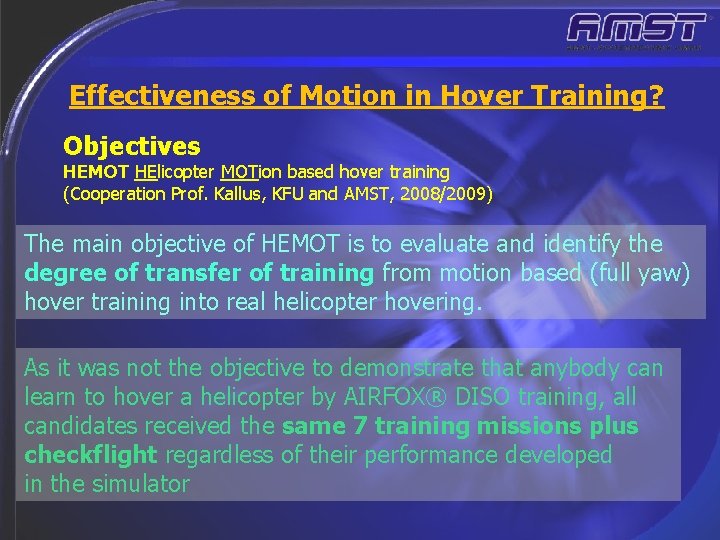
Effectiveness of Motion in Hover Training? Objectives HEMOT HElicopter MOTion based hover training (Cooperation Prof. Kallus, KFU and AMST, 2008/2009) The main objective of HEMOT is to evaluate and identify the degree of transfer of training from motion based (full yaw) hover training into real helicopter hovering. As it was not the objective to demonstrate that anybody can learn to hover a helicopter by AIRFOX® DISO training, all candidates received the same 7 training missions plus checkflight regardless of their performance developed in the simulator
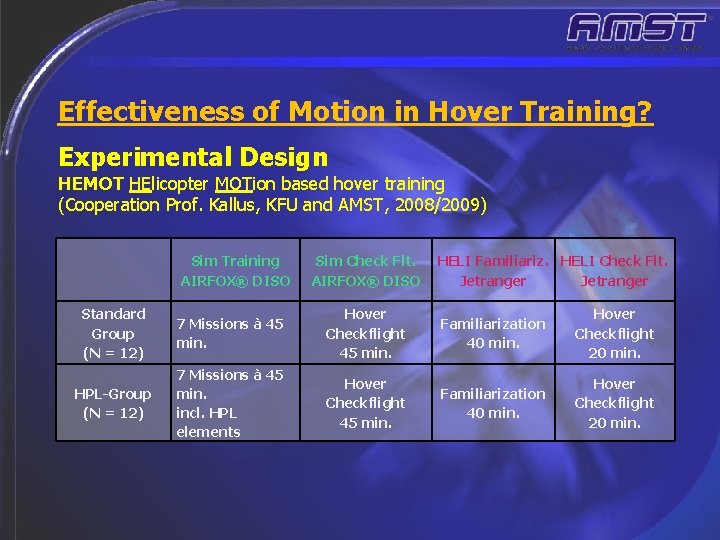
Effectiveness of Motion in Hover Training? Experimental Design HEMOT HElicopter MOTion based hover training (Cooperation Prof. Kallus, KFU and AMST, 2008/2009) Sim Training AIRFOX® DISO Sim Check Flt. AIRFOX® DISO HELI Familiariz. HELI Check Flt. Jetranger Standard Group (N = 12) 7 Missions à 45 min. Hover Checkflight 45 min. Familiarization 40 min. Hover Checkflight 20 min. HPL-Group (N = 12) 7 Missions à 45 min. incl. HPL elements Hover Checkflight 45 min. Familiarization 40 min. Hover Checkflight 20 min.
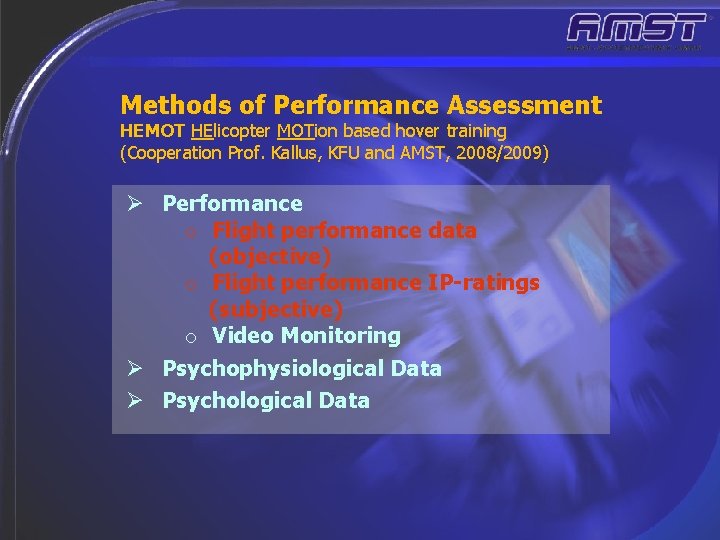
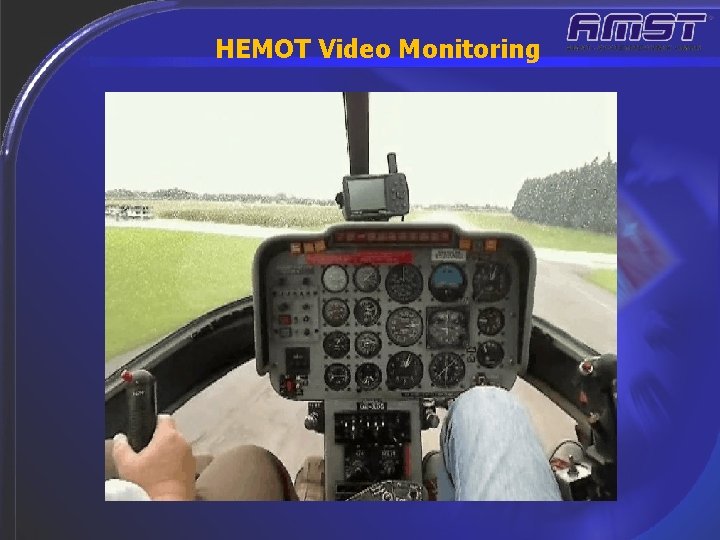
Methods of Performance Assessment HEMOT HElicopter MOTion based hover training (Cooperation Prof. Kallus, KFU and AMST, 2008/2009) Ø Performance o Flight performance data (objective) o Flight performance IP-ratings (subjective) o Video Monitoring Ø Psychophysiological Data Ø Psychological Data
HEMOT Video Monitoring
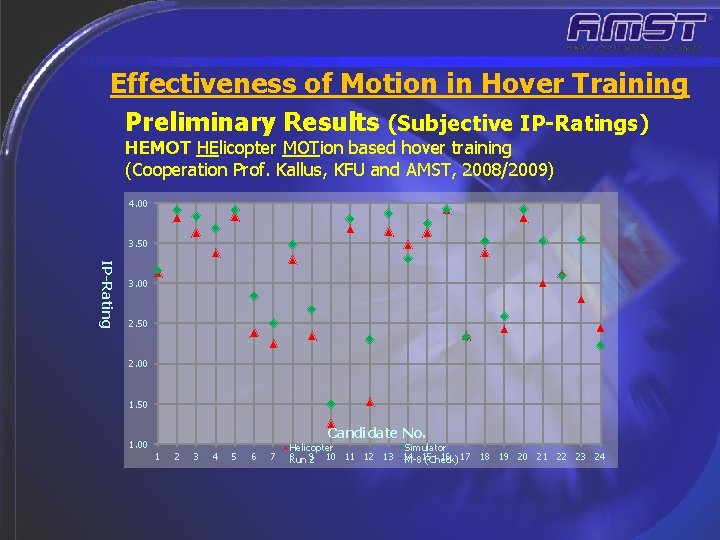
Effectiveness of Motion in Hover Training Preliminary Results (Subjective IP-Ratings) HEMOT HElicopter MOTion based hover training (Cooperation Prof. Kallus, KFU and AMST, 2008/2009) 4. 00 3. 50 IP-Rating 3. 00 2. 50 2. 00 1. 50 Candidate No. 1. 00 1 2 3 4 5 6 7 Helicopter Simulator 8 92 10 11 12 13 14 16 17 18 19 20 21 22 23 24 Run M-815 (Check)
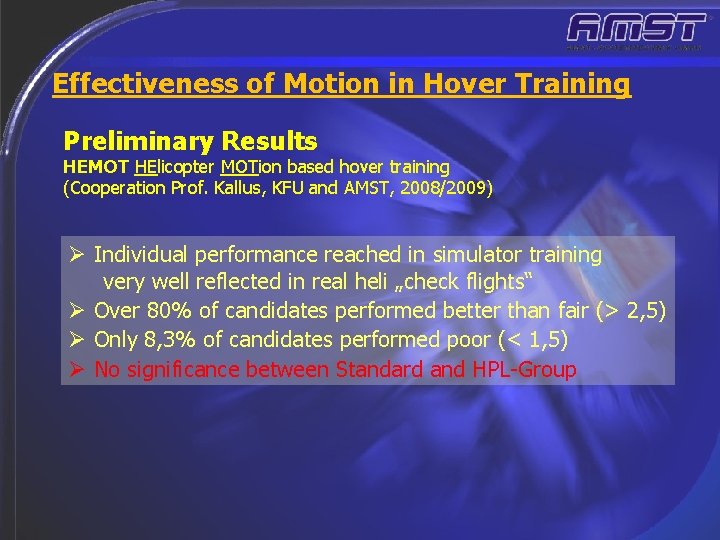
Effectiveness of Motion in Hover Training Preliminary Results HEMOT HElicopter MOTion based hover training (Cooperation Prof. Kallus, KFU and AMST, 2008/2009) Ø Individual performance reached in simulator training very well reflected in real heli „check flights“ Ø Over 80% of candidates performed better than fair (> 2, 5) Ø Only 8, 3% of candidates performed poor (< 1, 5) Ø No significance between Standard and HPL-Group
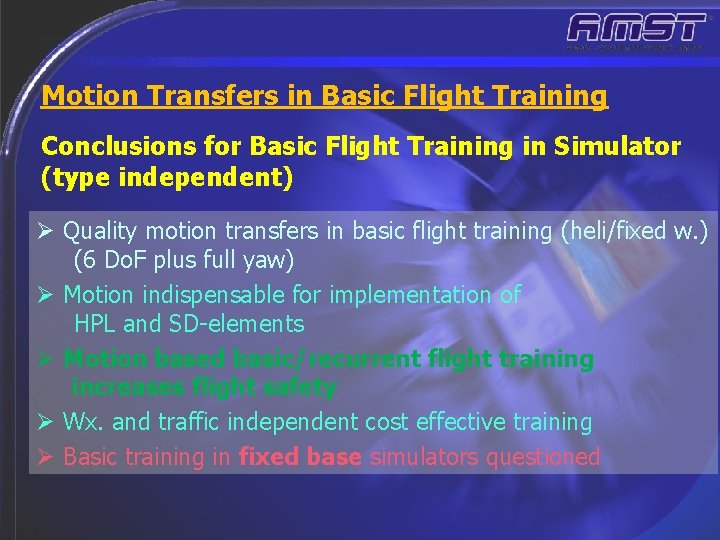
Motion Transfers in Basic Flight Training Conclusions for Basic Flight Training in Simulator (type independent) Ø Quality motion transfers in basic flight training (heli/fixed w. ) (6 Do. F plus full yaw) Ø Motion indispensable for implementation of HPL and SD-elements Ø Motion based basic/recurrent flight training increases flight safety Ø Wx. and traffic independent cost effective training Ø Basic training in fixed base simulators questioned
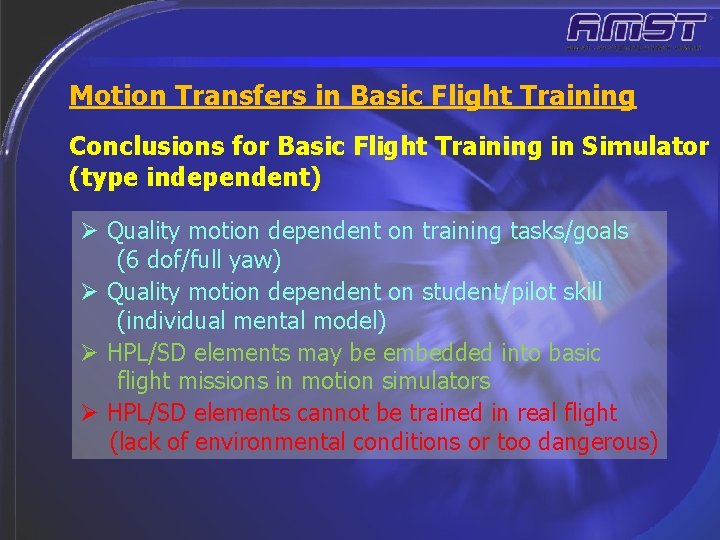
Motion Transfers in Basic Flight Training Conclusions for Basic Flight Training in Simulator (type independent) Ø Quality motion dependent on training tasks/goals (6 dof/full yaw) Ø Quality motion dependent on student/pilot skill (individual mental model) Ø HPL/SD elements may be embedded into basic flight missions in motion simulators Ø HPL/SD elements cannot be trained in real flight (lack of environmental conditions or too dangerous)
Motion Transfers in Basic Flight Training What to do now? Ø Development of new class motion based part task trainers (PTT) (high fidelity motion, generic cockpit, generic flight performance) Ø PTTs represent class of a/c or helicopter Ø Training Tasks: o Initial and recurrent basic flight training (VFR/IFR) o o HPL/SD training including upset-recoveries and spins Special heli effects (white out, brown out, watering, moving pads) Night vision goggles training (NVT) Hypoxia training (simulation of high cabin altitudes) Ø Convince regulators to certify PTTs and grant credits
Many thanks for listening! Questions? BE AWARE OF!