
Tutorial Presentation AUDIT RISK MATERIALITY AND AUDIT EVIDENCE



- Slides: 28
Tutorial Presentation AUDIT RISK , MATERIALITY AND AUDIT EVIDENCE Audit Risk CPA 9 -1
What is meant by ‘‘Materiality’’ in Auditing? Materiality is the threshold above which missing or incorrect information in financial statements is considered to have an impact on the decision making of users. 9 -2
What are the factors are important for deciding materiality? n n n n Whether the item is recurring or non-recurring Statutory requirement Degree of estimation Trend Related amounts Critical points Transaction of unexpected values Transaction Showing Small Value After Set off Audit Risk 9 -3
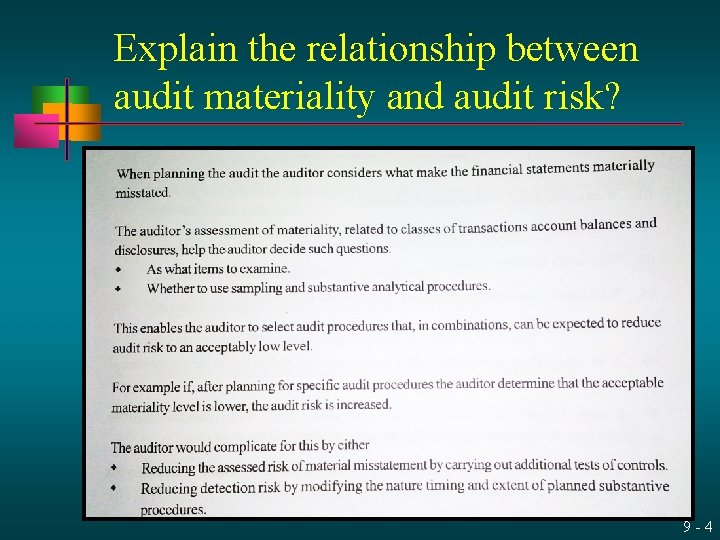
Explain the relationship between audit materiality and audit risk? 9 -4
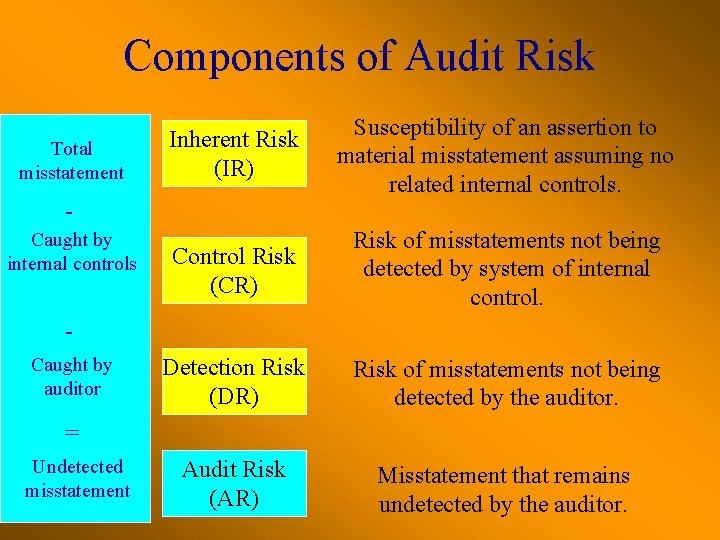
Briefly describe the components of audit risk and evaluate the relationship among them? Audit Risk When planning the audit, the auditor considers what would make the financial statements materially misstated. The auditor's assessment of materiality related to specific account balances and classes of transactions helps the auditor decide such questions as what items to examine and whether to use sampling and analytical procedures. This is enabling to the auditor to select audit procedures that in combination can be expected to reduce audit risk to an acceptably lower level. There is an inverse relationship between materiality and the level of audit risk. Higher the materiality level; lower the audit risk and vice versa. 9 -5
Components of Audit Risk Total misstatement Inherent Risk (IR) Susceptibility of an assertion to material misstatement assuming no related internal controls. Control Risk (CR) Risk of misstatements not being detected by system of internal control. Detection Risk (DR) Risk of misstatements not being detected by the auditor. Audit Risk (AR) Misstatement that remains undetected by the auditor. Caught by internal controls Caught by auditor = Undetected misstatement
Evaluating Results A. Audit Risk Model for Evaluating Results B. Reducing Achieved Audit Risk C. Revising Risks and Evidence 9 -7
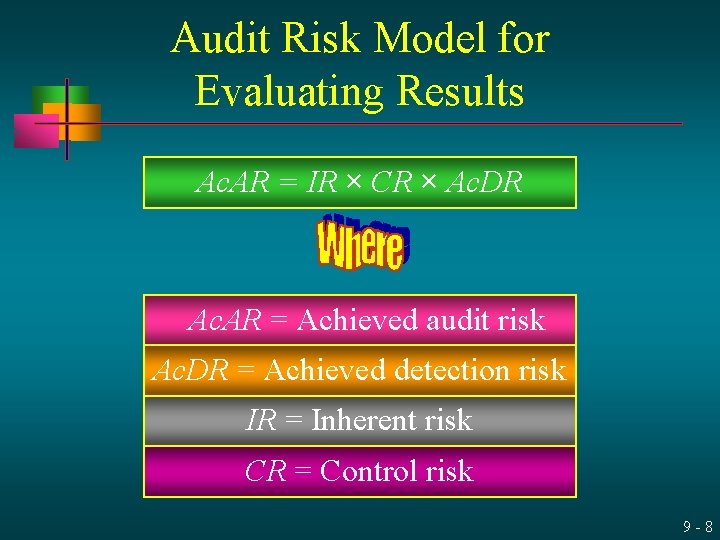
Audit Risk Model for Evaluating Results Ac. AR = IR × CR × Ac. DR Ac. AR = Achieved audit risk Ac. DR = Achieved detection risk IR = Inherent risk CR = Control risk 9 -8
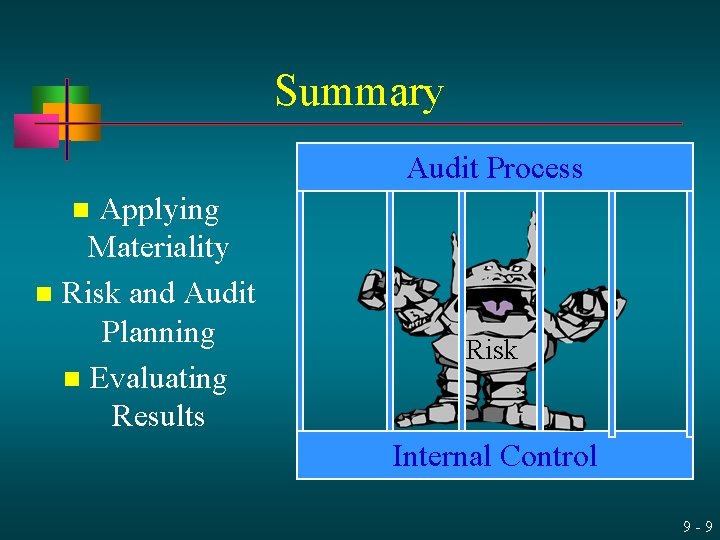
Summary Audit Process Applying Materiality n Risk and Audit Planning n Evaluating Results n Risk Internal Control 9 -9
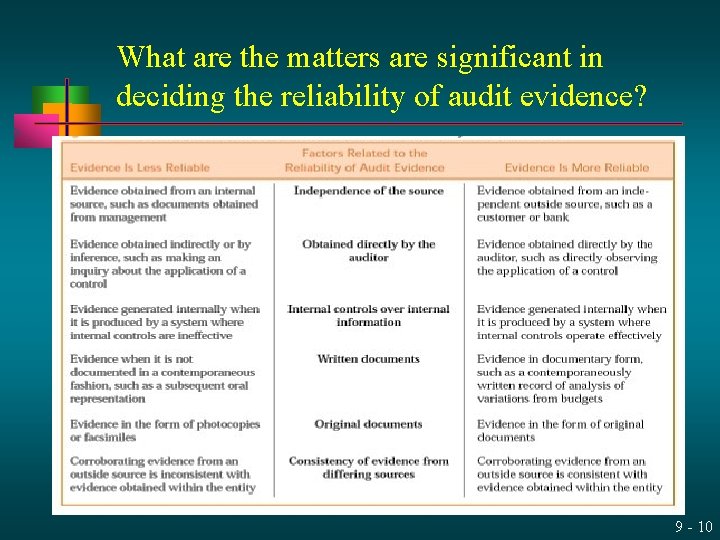
What are the matters are significant in deciding the reliability of audit evidence? 9 - 10
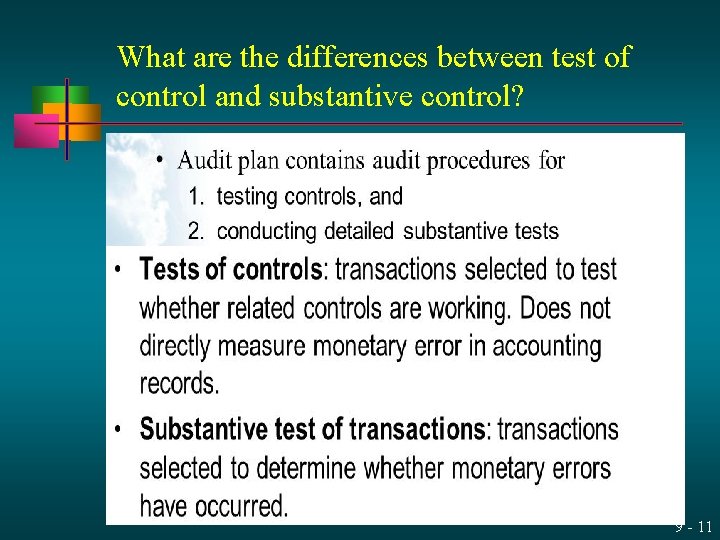
What are the differences between test of control and substantive control? 9 - 11
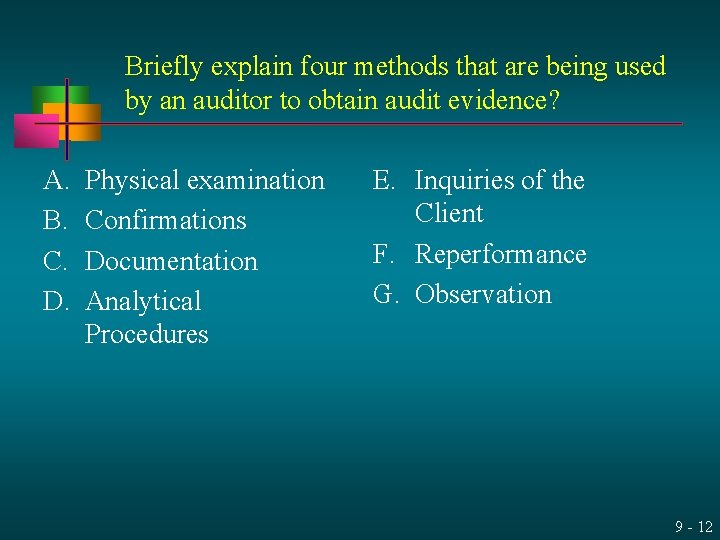
Briefly explain four methods that are being used by an auditor to obtain audit evidence? A. B. C. D. Physical examination Confirmations Documentation Analytical Procedures E. Inquiries of the Client F. Reperformance G. Observation 9 - 12
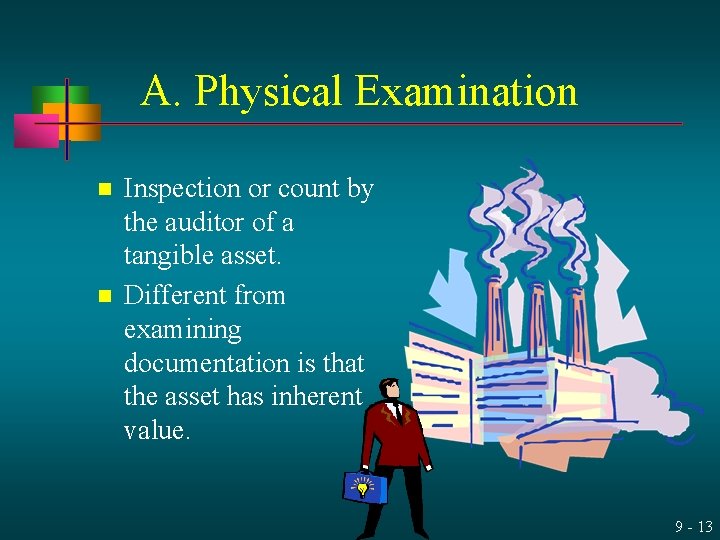
A. Physical Examination n n Inspection or count by the auditor of a tangible asset. Different from examining documentation is that the asset has inherent value. 9 - 13
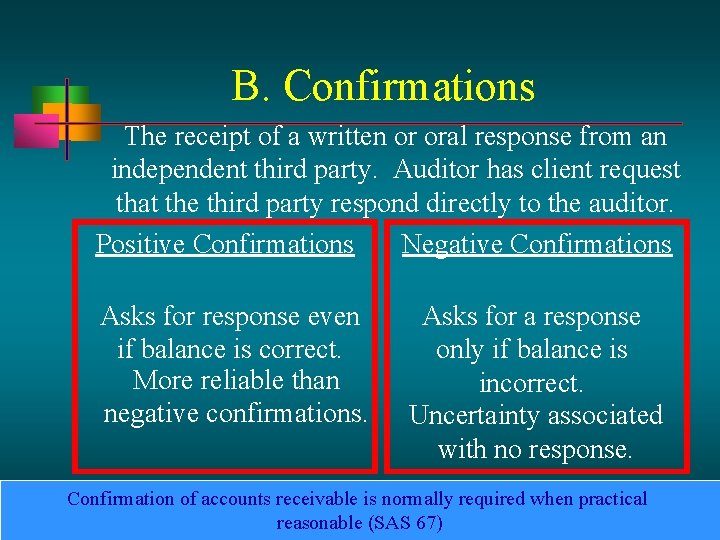
B. Confirmations The receipt of a written or oral response from an independent third party. Auditor has client request that the third party respond directly to the auditor. Positive Confirmations Negative Confirmations Asks for response even if balance is correct. More reliable than negative confirmations. Asks for a response only if balance is incorrect. Uncertainty associated with no response. Confirmation of accounts receivable is normally required when practical reasonable (SAS 67) 9 - 14
B. Confirmations (Continued) 1. Customers – Confirm A/R balances 2. Vendors – Confirm A/P balances 3. Banks – Confirm checking account and loan balances 4. Attorneys – Confirm contingent liabilities 5. Inventory Agents – Confirm consignments 9 - 15
C. Documentation 1. Types of Documents 2. Document Vouching 3. Document Tracing 9 - 16
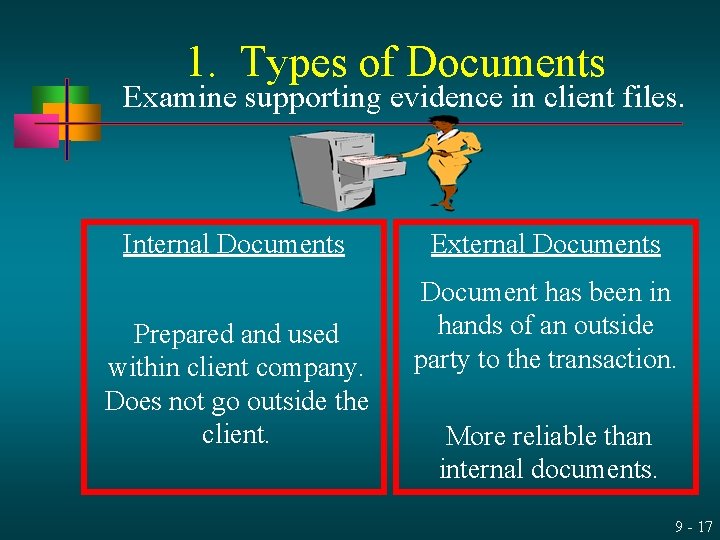
1. Types of Documents Examine supporting evidence in client files. Internal Documents Prepared and used within client company. Does not go outside the client. External Documents Document has been in hands of an outside party to the transaction. More reliable than internal documents. 9 - 17
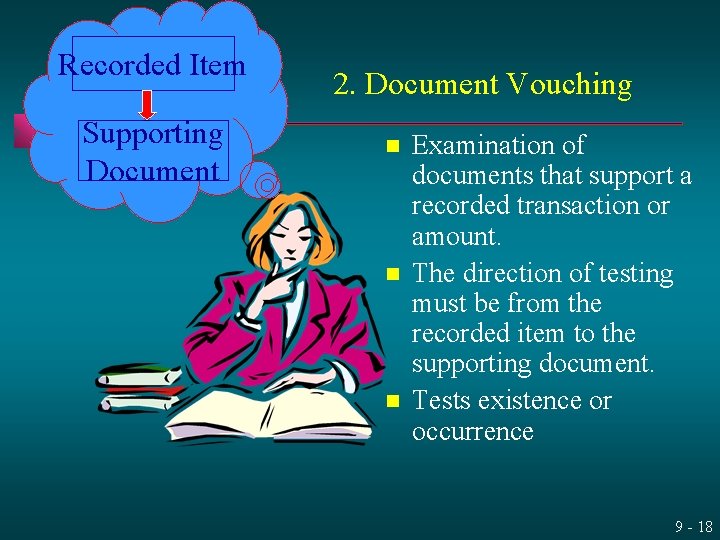
Recorded Item Supporting Document 2. Document Vouching n n n Examination of documents that support a recorded transaction or amount. The direction of testing must be from the recorded item to the supporting document. Tests existence or occurrence 9 - 18
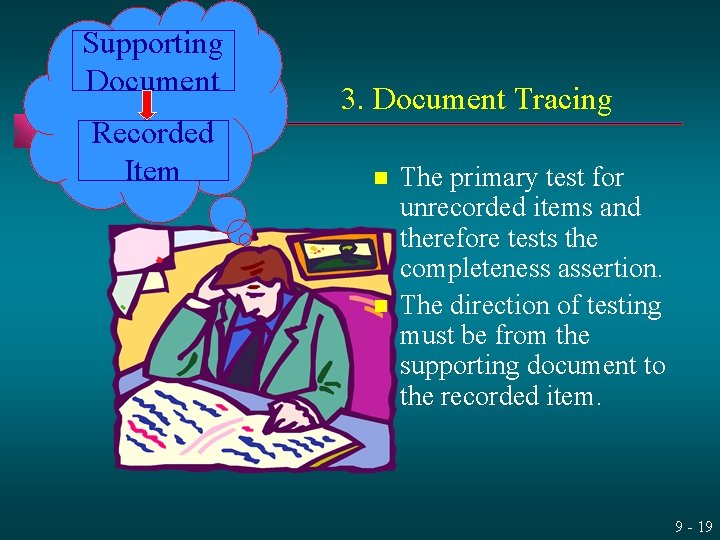
Supporting Document Recorded Item 3. Document Tracing n n The primary test for unrecorded items and therefore tests the completeness assertion. The direction of testing must be from the supporting document to the recorded item. 9 - 19
D. Analytical Procedures Audits studies relationships among data. Unusual fluctuations occur when significant difference are not expected but do exist or when significant differences are expected but do not exist. Required during the planning and completion phases on all audits. 9 - 20
E. Inquiries of the Client n n Auditor obtains information from the client in response to questions. Although much evidence is obtained through inquiry, it can not be regarded as conclusive and may be biased in the client’s favor. 9 - 21
F. Re performance Reperformance involves rechecking a sample of the computations and transfers of information. Rechecking of computations consists of testing mathematical accuracy. Rechecking of transfers of information involves seeing if information is recorded consistently in the accounting records. I don’t think this is what they meant by performance! 9 - 22
What do you mean by sufficient and appropriateness of audit evidence? It is the responsibility of the auditor to obtain reasonable assurance by conducting audit engagement and expressing his opinion in the audit report. This expression of opinion results in reasonable assurance which is conveyed to users of financial statements via audit report. However, to form audit opinion, auditor is required to stay objective and he cannot express an opinion on his own and by his own free will rather his opinion must be based upon evidence i. e. audit evidence (as it is collected as a result of application of audit procedures during audit engagement thus called audit evidence) and it should be that sufficient and appropriate that a reasonable assurance can be drawn on the basis of such evidence by the auditor. 9 - 23
What do you mean by sufficient and appropriateness of audit evidence? n The information obtained by the auditor in arriving at the conclusions on which the audit opinion is based. n It comprise source documents and accounting records underlying the financial statements and corroborating information from other sources. 9 - 24
OBJECTIVE n The auditor should obtain Sufficient and Appropriate Audit Evidence to be able to draw reasonable conclusions on which to base the audit opinion. 9 - 25
Sufficient and Appropriate Audit Evidence n Sufficiency is the measure of quantity of audit evidence. n Appropriateness is the measure the quality of audit evidence and its relevance to a particular assertion and reliability. 9 - 26
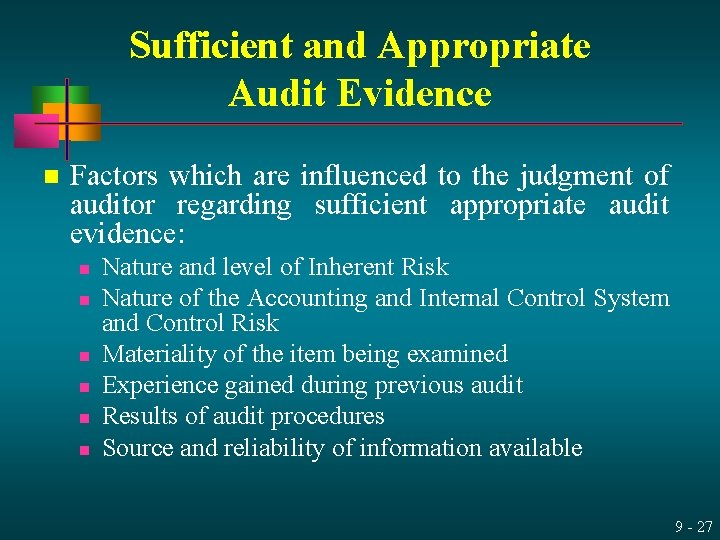
Sufficient and Appropriate Audit Evidence n Factors which are influenced to the judgment of auditor regarding sufficient appropriate audit evidence: n n n Nature and level of Inherent Risk Nature of the Accounting and Internal Control System and Control Risk Materiality of the item being examined Experience gained during previous audit Results of audit procedures Source and reliability of information available 9 - 27
9 - 28