
Tutorial on Greens Theorem and Forward Modeling SRME






![Reciprocity Eqn. of Convolution Type 1. Helmholtz Eqns: 2 + k 2 ]G(A|x) =-](https://slidetodoc.com/presentation_image_h/fb3958243d0f3d3d859abce611d39d88/image-17.jpg "Reciprocity Eqn. of Convolution Type 1. Helmholtz Eqns: 2 + k 2 ]G(A|x) =-")

- Slides: 21
Tutorial on Green’s Theorem and Forward Modeling, SRME, Interferometry, and. . Migration
Outline • • Green’s Functions Forward Modeling
What is a Green’s Function? Answer: Point Src. Response of Medium Impulse-Point Src. Response of Medium Listening & source coords. G(x, t|x s , t s)= Listening time (t-|r|/c) = |r| { 1 t=|r|/c 0 ottherwise Geometrical Spreading t=1 t=2 t=3 T 4 t=4 r 2 2 Propagation time = |r| = x + y + z c c 2
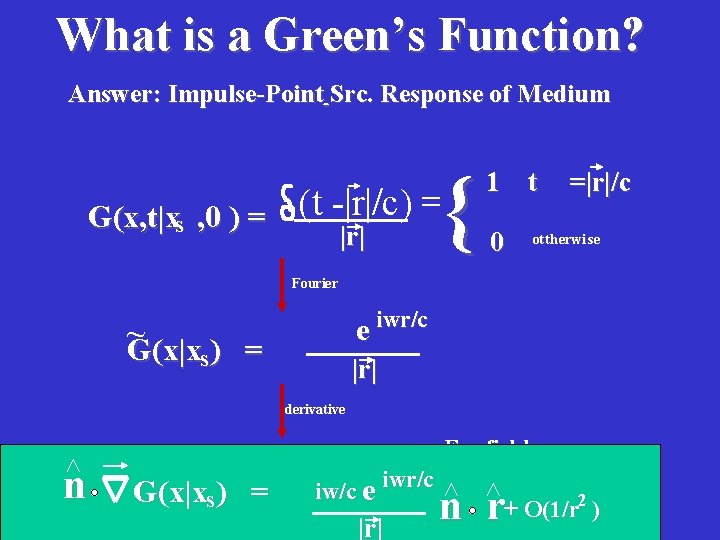
What is a Green’s Function? Answer: Point Src. Response of Medium Impulse-Point Src. Response of Medium { G(x, t|xs , 0 ) = (t -|r|/c) = |r| 1 t-ts =|r|/c 0 ottherwise Fourier e iwr/c ~ G(x|xs ) = |r| derivative Far field approx ~ iwr/c e iwr/c G(x|xs ) = iw/c d k + O(1/r 2 ) 2 n G(x|xs) = iw/c e |r| n r+ O(1/r ) dr |r| n r
Wave in Heterogeneous Medium i(wt - wt) G = Ae (2) satisfies Geometrical speading . . G = c except at origin i 2 2 G w kri = (kci ) r /c = wt i i r Time taken along ray segment 1 2 Valid at high w and smooth media 3 4
Outline • • • Green’s Functions Forward Modeling SRME Acausal GF, Stationarity, Reciprocity Interferometry Migration
What is Huygen’s Principle? Answer: Every pt. on a wavefront is a secondary src. pt. Common tangent kinematically defines next wavefront. P(x, T 5 ) T 4 T 5
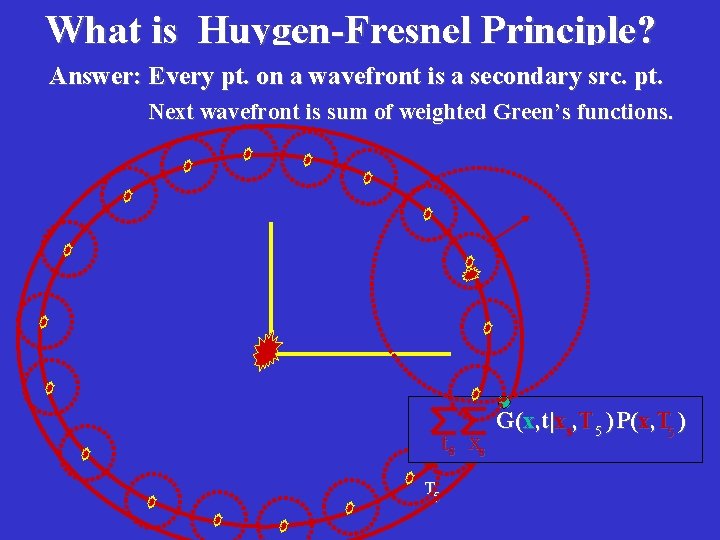
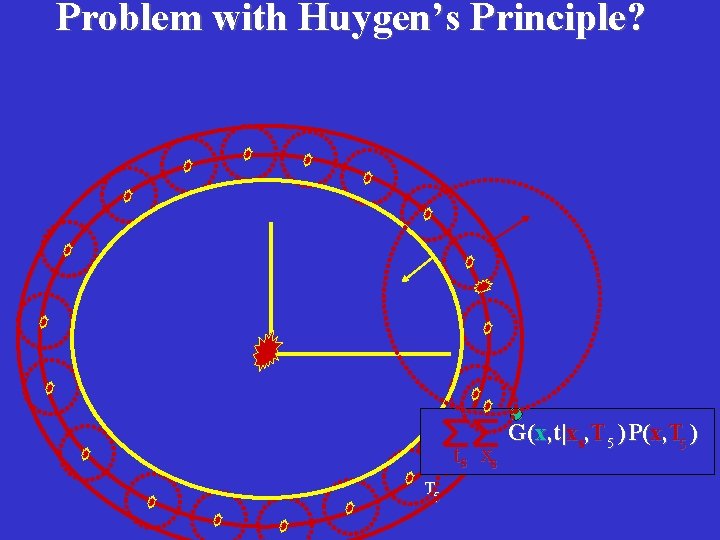
What is Huygen-Fresnel Principle? Answer: Every pt. on a wavefront is a secondary src. pt. Next wavefront is sum of weighted Green’s functions. G(x, t|x’s , T 5 )P(x’s, T 5) G(x, t|xs, T 5 ) P(xs, T 5 ) T 5
What is Huygen-Fresnel Principle? Answer: Every pt. on a wavefront is a secondary src. pt. Next wavefront is sum of weighted Green’s functions. ts xs T 5 G(x, t|xs, T 5 ) P(x, T 5 )
Problem with Huygen’s Principle? ts xs T 5 G(x, t|xs, T 5 ) P(x, T 5 )
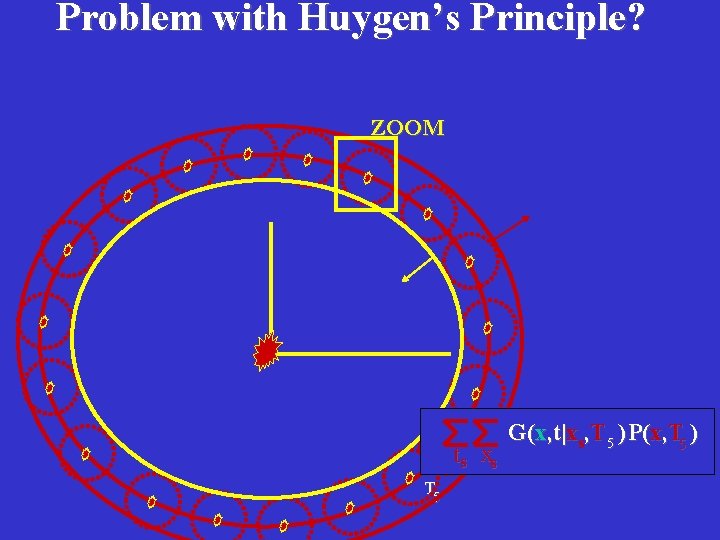
Problem with Huygen’s Principle? ZOOM ts xs T 5 G(x, t|xs, T 5 ) P(x, T 5 )
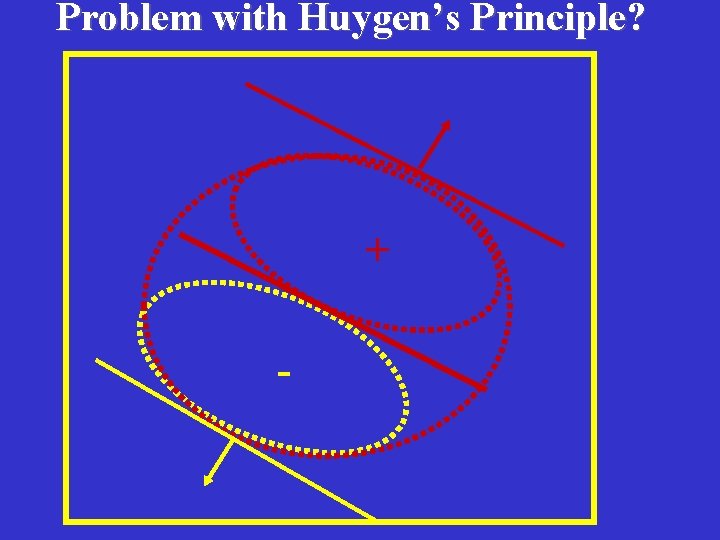
Problem with Huygen’s Principle? ZOOM + -
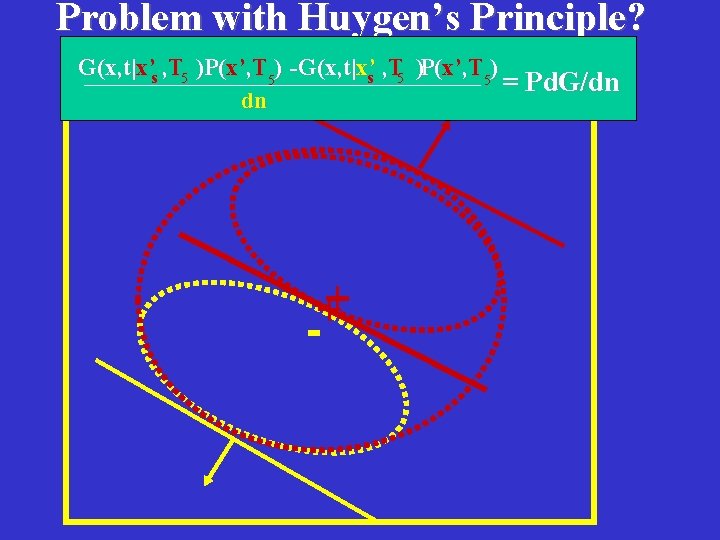
Problem with Huygen’s Principle? G(x, t|x’s , T 5 )P(x’, T 5) -G(x, t|xs’ , T 5 )P(x’, T 5) = Pd. G/dn dn ZOOM + + -
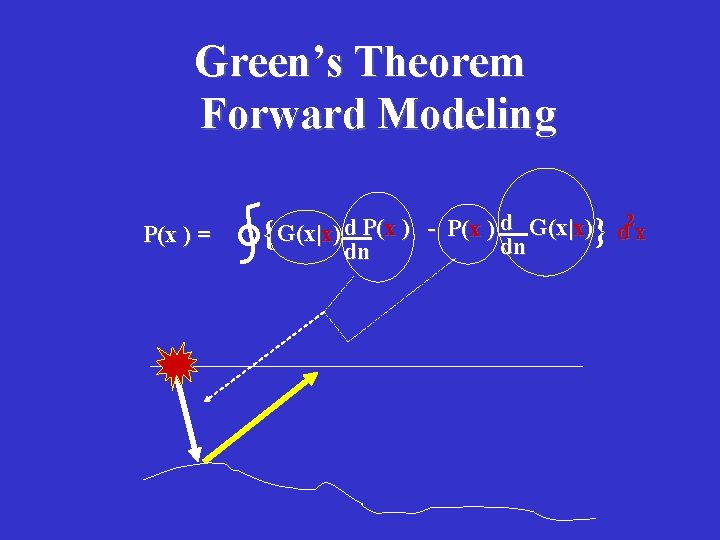
Green’s Theorem Forward Modeling } P(x ) = 2 d d P( x ) G(x| x ) P( x ) d x } G(x|x) dn dn
Outline • • • Green’s Functions Forward Modeling SRME Acausal GF, Stationarity, Reciprocity Interferometry Migration
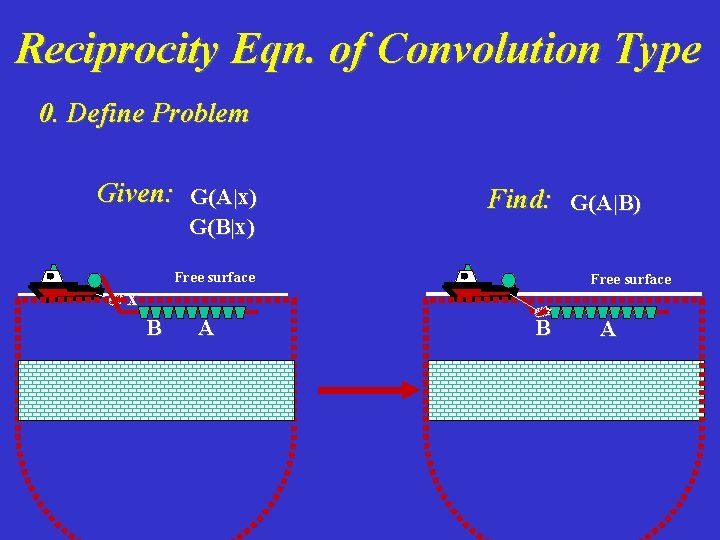
Reciprocity Eqn. of Convolution Type 0. Define Problem Given: G(A|x) G(B|x) Find: G(A|B) Free surface x B A Free surface B A
Reciprocity Eqn. of Convolution Type 1. Helmholtz Eqns: 2 + k 2 ]G(A|x) =- (x-A); 2 + k 2 ] P(B|x)* =- (x-B) [ [ 2. Multiply by G(A|x) and P(B|x)* and subtract P(B|x)* [ G(A|x) [ P(B|x)* 2 2 + k 2 ]G(A|x) =- (x-A) P(B|x)* 2 + k ]P(B|x)*=- (x-B) G(A|x)* G(A|x) - G(A|x) 2 P(B|x)* = (B-x)G(A|x) - * { P(B|x) * * G(A|x) ) =- G(A|x) { P(B|x)* P(B|x) G(A|x})} -= P(B|x) 2 P(B|x)*= G(A|x) [G(A|x) P(B|x)*] - (A-x)P(B|x)* * (B-x)G(A|x) - (A-x)P(B|x) * G(A|x ) P(B|x) G(A|x) P(B|x)*
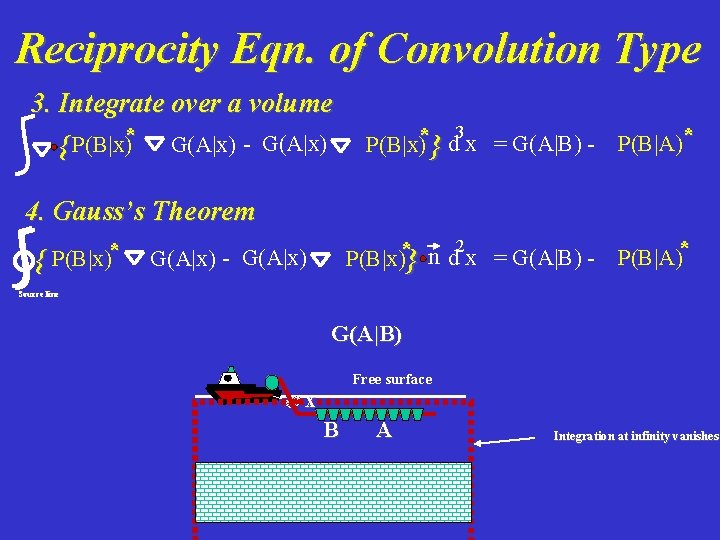
Reciprocity Eqn. of Convolution Type 3. Integrate over a volume { P(B|x)* G(A|x) - G(A|x) 3 P(B|x)* } d x = G(A|B) - P(B|A)* 2 * n P(B|x) } d x = G(A|B) - P(B|A)* 4. Gauss’s Theorem { P(B|x)* G(A|x) - G(A|x) Source line G(A|B) Free surface x B A Integration at infinity vanishes
Reciprocity Eqn. of Convolution Type 3. Integrate over a volume { P(B|x) G(A|x) - G(A|x) P(B|A) Hence, the two integrands above are opposite and equal in far-field hi-freq. approximation 4. Gauss’s Theorem { P(B|x) 3 P(B|x) } d x = G(A|B) - 2 P(B|x) } n d x = G(A|B) - G(A|x) P(B|A) Layer interface A B If boundary is far away the major contribution is specular reflection (B-x) n = - (A-x) n |B-x| |A-x| x n
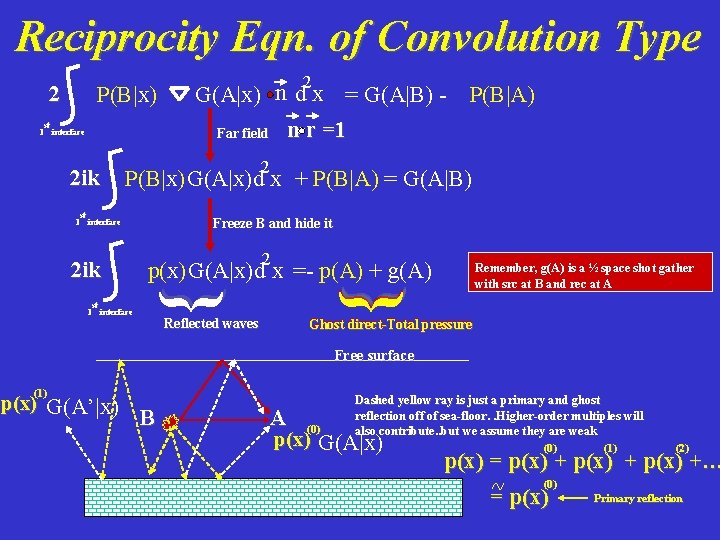
Reciprocity Eqn. of Convolution Type P(B|x) st 1 interface 2 ik P(B|A) 2 P(B|x) G(A|x) d x + P(B|A) = G(A|B) st 1 interface 2 p(x) G(A|x) d x =- p(A) + g(A) { 2 ik Freeze B and hide it { 2 2 G(A|x) n d x = G(A|B) Far field n r =1 Reflected waves Remember, g(A) is a ½ space shot gather with src at B and rec at A Ghost direct-Total pressure Free surface (1) p(x) G(A’|x) B A (0) Dashed yellow ray is just a primary and ghost reflection off of sea-floor. . Higher-order multiples will also contribute. . but we assume they are weak p(x) G(A|x) (0) (1) (2) p(x) = p(x) +… (0) = p(x) Primary reflection
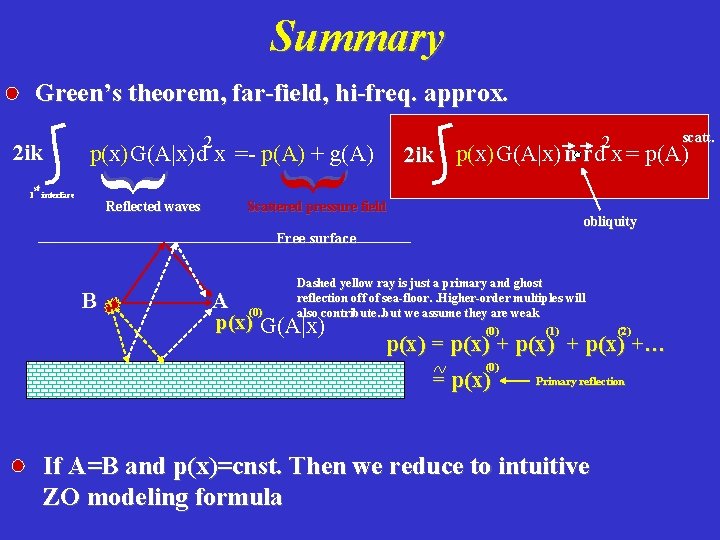
Summary Green’s theorem, far-field, hi-freq. approx. 2 ik p(x) G(A|x) n r d x = p(A) { st 1 interface Reflected waves Scattered pressure field obliquity Free surface B scatt. 2 p(x) G(A|x) d x =- p(A) + g(A) { 2 ik 2 A (0) Dashed yellow ray is just a primary and ghost reflection off of sea-floor. . Higher-order multiples will also contribute. . but we assume they are weak p(x) G(A|x) (0) (1) (2) p(x) = p(x) +… (0) = p(x) Primary reflection If A=B and p(x)=cnst. Then we reduce to intuitive ZO modeling formula