
TUTORIAL ON ADHESIVES AND HOW TO USE THEM
- Slides: 10
TUTORIAL ON ADHESIVES AND HOW TO USE THEM FOR MOUNTING Jared Talbot 12/9/2016
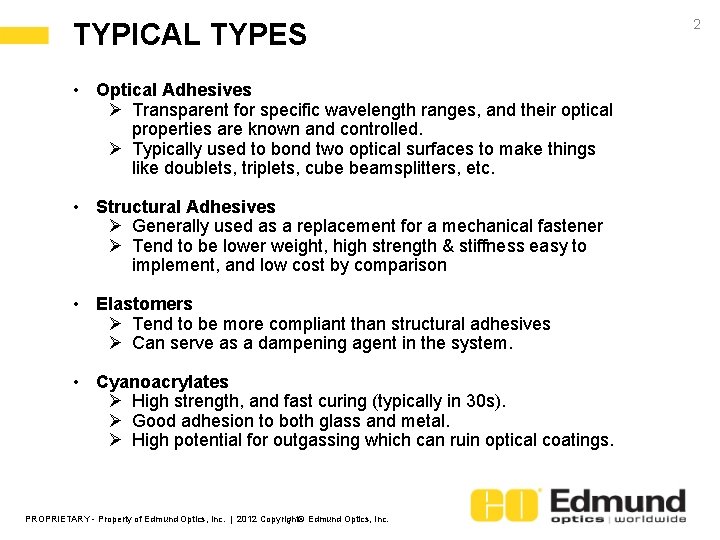
TYPICAL TYPES • Optical Adhesives Ø Transparent for specific wavelength ranges, and their optical properties are known and controlled. Ø Typically used to bond two optical surfaces to make things like doublets, triplets, cube beamsplitters, etc. • Structural Adhesives Ø Generally used as a replacement for a mechanical fastener Ø Tend to be lower weight, high strength & stiffness easy to implement, and low cost by comparison • Elastomers Ø Tend to be more compliant than structural adhesives Ø Can serve as a dampening agent in the system. • Cyanoacrylates Ø High strength, and fast curing (typically in 30 s). Ø Good adhesion to both glass and metal. Ø High potential for outgassing which can ruin optical coatings. PROPRIETARY - Property of Edmund Optics, Inc. | 2012 Copyright© Edmund Optics, Inc. 2
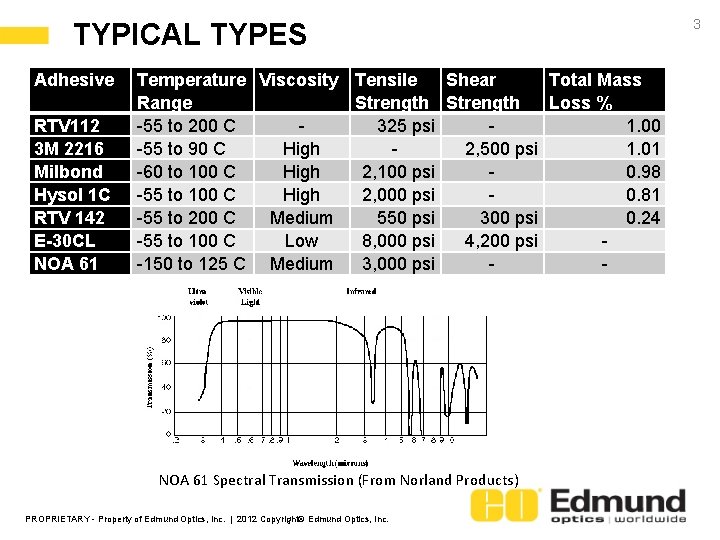
TYPICAL TYPES Adhesive RTV 112 3 M 2216 Milbond Hysol 1 C RTV 142 E-30 CL NOA 61 Temperature Viscosity Tensile Shear Total Mass Range Strength Loss % -55 to 200 C 325 psi 1. 00 -55 to 90 C High 2, 500 psi 1. 01 -60 to 100 C High 2, 100 psi 0. 98 -55 to 100 C High 2, 000 psi 0. 81 -55 to 200 C Medium 550 psi 300 psi 0. 24 -55 to 100 C Low 8, 000 psi 4, 200 psi -150 to 125 C Medium 3, 000 psi - NOA 61 Spectral Transmission (From Norland Products) PROPRIETARY - Property of Edmund Optics, Inc. | 2012 Copyright© Edmund Optics, Inc. 3
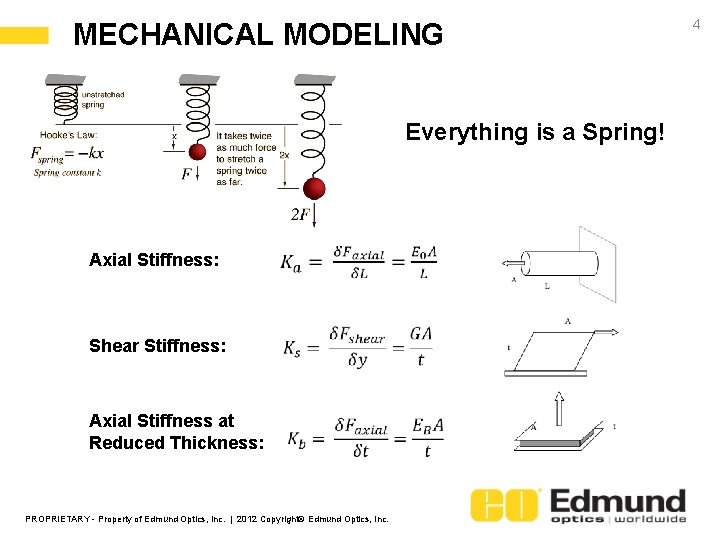
MECHANICAL MODELING Everything is a Spring! Axial Stiffness: Shear Stiffness: Axial Stiffness at Reduced Thickness: PROPRIETARY - Property of Edmund Optics, Inc. | 2012 Copyright© Edmund Optics, Inc. 4
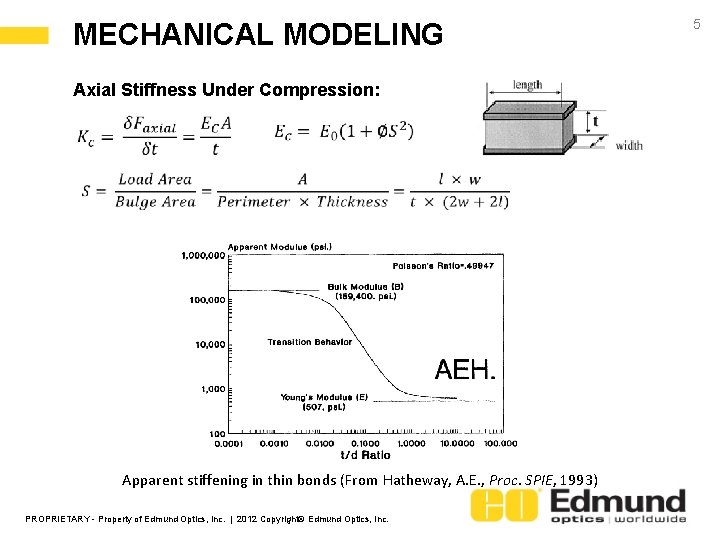
MECHANICAL MODELING Axial Stiffness Under Compression: Apparent stiffening in thin bonds (From Hatheway, A. E. , Proc. SPIE, 1993) PROPRIETARY - Property of Edmund Optics, Inc. | 2012 Copyright© Edmund Optics, Inc. 5
MOUNTING OPTICS BY ADHESIVE BONDING • Advantages to mounting via bonding Ø Can help reduce size and weight Ø Tend to reduce complexity of the mechanics Ø Still able to provide high strength and rigidity Ø For components like prisms which can be a little heavier this can be an ideal way to keep weight down. • The key to successful implementation is choosing the correct adhesive, and ensuring adequate control of the area and thickness of the bond. • Control of the thickness is key to maximizing the bond strength, which can typically done of two ways: 1) Using shims and spaces to control the gap between parts. 2) Mix small glass or plastic beads into the adhesive, where the diameters of these beads should match the desired bond thickness. PROPRIETARY - Property of Edmund Optics, Inc. | 2012 Copyright© Edmund Optics, Inc. 6
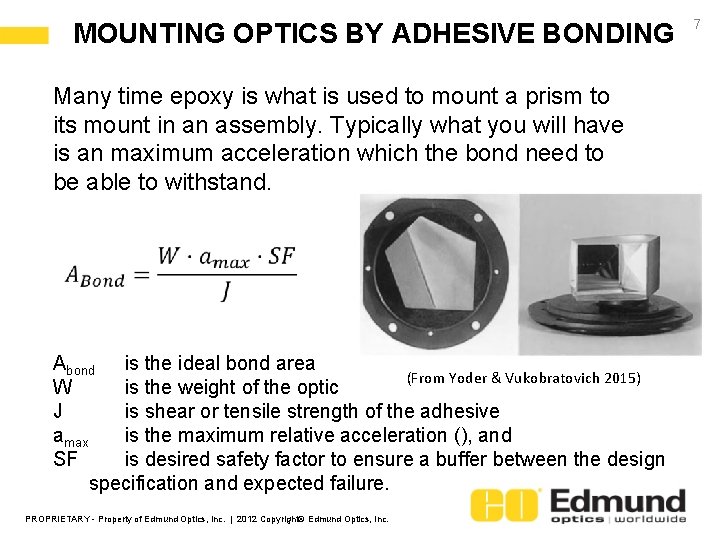
MOUNTING OPTICS BY ADHESIVE BONDING Many time epoxy is what is used to mount a prism to its mount in an assembly. Typically what you will have is an maximum acceleration which the bond need to be able to withstand. Abond is the ideal bond area (From Yoder & Vukobratovich 2015) W is the weight of the optic J is shear or tensile strength of the adhesive amax is the maximum relative acceleration (), and SF is desired safety factor to ensure a buffer between the design specification and expected failure. PROPRIETARY - Property of Edmund Optics, Inc. | 2012 Copyright© Edmund Optics, Inc. 7
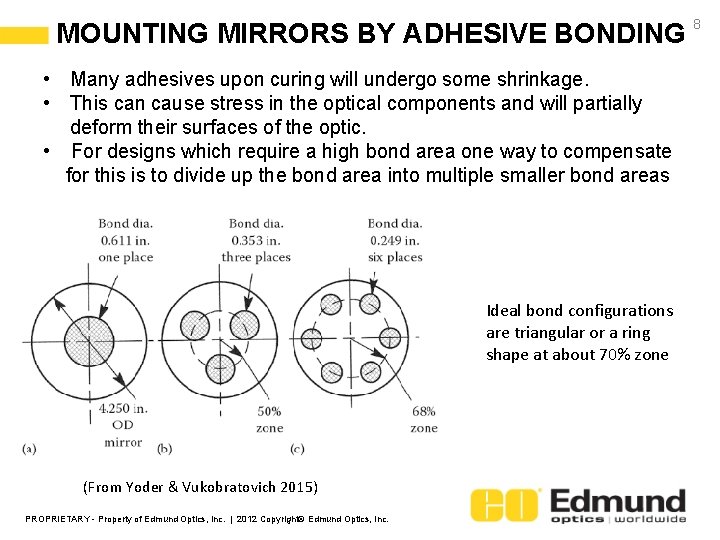
MOUNTING MIRRORS BY ADHESIVE BONDING 8 • Many adhesives upon curing will undergo some shrinkage. • This can cause stress in the optical components and will partially deform their surfaces of the optic. • For designs which require a high bond area one way to compensate for this is to divide up the bond area into multiple smaller bond areas Ideal bond configurations are triangular or a ring shape at about 70% zone (From Yoder & Vukobratovich 2015) PROPRIETARY - Property of Edmund Optics, Inc. | 2012 Copyright© Edmund Optics, Inc.
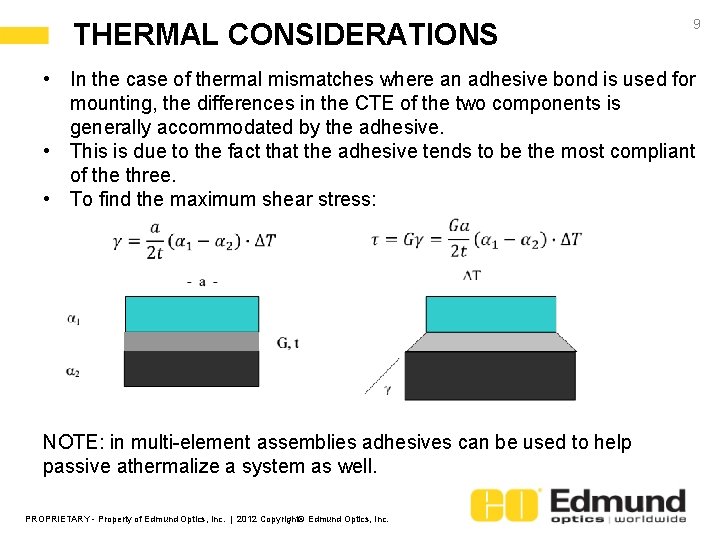
THERMAL CONSIDERATIONS 9 • In the case of thermal mismatches where an adhesive bond is used for mounting, the differences in the CTE of the two components is generally accommodated by the adhesive. • This is due to the fact that the adhesive tends to be the most compliant of the three. • To find the maximum shear stress: NOTE: in multi-element assemblies adhesives can be used to help passive athermalize a system as well. PROPRIETARY - Property of Edmund Optics, Inc. | 2012 Copyright© Edmund Optics, Inc.
REFERENCES 1) 2) 3) 4) 5) 6) 7) 10 J. Burge, “Intro to Opto-Mechanical Engineering” Notes, University of Arizona, 2016. K. Schwertz, J. Burge, “Field Guide to Optomechanical Design and Analysis”, SPIE, 2012. P. Yoder, D. Vukobratovich, “Opto-Mechanical Systems Design”, Volume 4, 2015. A. E. Hatheway, “Analysis of adhesive bonds in optics”, Proc. SPIE, 1993. E. Norland, “Techniques in using UV adhesives for optomechanical designs”, Proc. SPIE, 1995. B. G. Yacobi, S. Martin, K. Davis, A. Hudson, and M. Hubert, “Adhesive bonding in microelectronics and photonics”, Journal of Applied Physics, 2002. https: //www. norlandprod. com/adhesives/NOA%2061. html PROPRIETARY - Property of Edmund Optics, Inc. | 2012 Copyright© Edmund Optics, Inc.