
Tutorial of Practice 4 Supercell Defect formation energy
- Slides: 8
Tutorial of Practice #4 - Supercell & Defect formation energy - Qn. MSG Jae-Hyeon Ko Yong-Hyun Kim
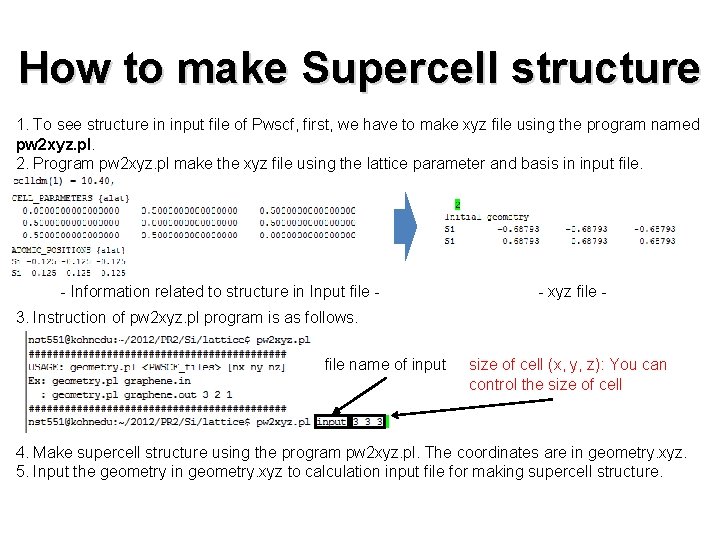
How to make Supercell structure 1. To see structure in input file of Pwscf, first, we have to make xyz file using the program named pw 2 xyz. pl. 2. Program pw 2 xyz. pl make the xyz file using the lattice parameter and basis in input file. - Information related to structure in Input file - - xyz file - 3. Instruction of pw 2 xyz. pl program is as follows. file name of input size of cell (x, y, z): You can control the size of cell 4. Make supercell structure using the program pw 2 xyz. pl. The coordinates are in geometry. xyz. 5. Input the geometry in geometry. xyz to calculation input file for making supercell structure.
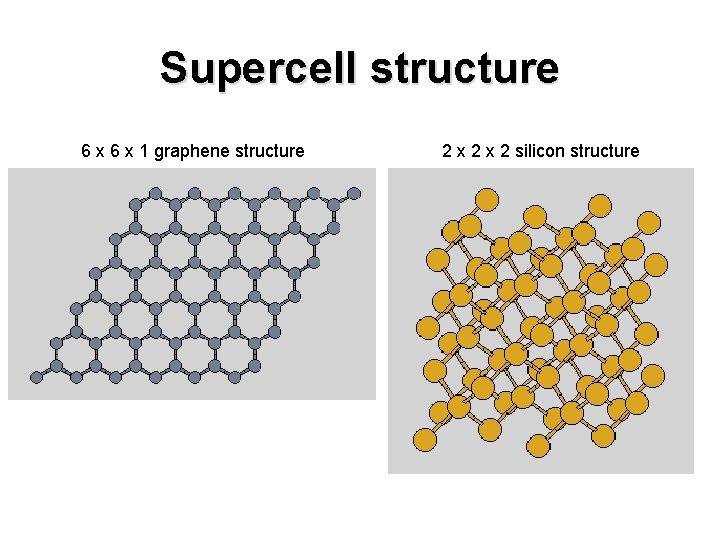
Supercell structure 6 x 1 graphene structure 2 x 2 silicon structure
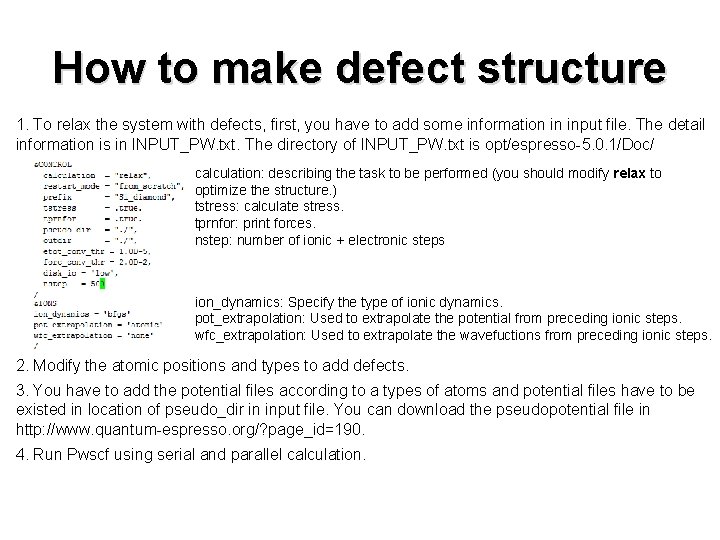
How to make defect structure 1. To relax the system with defects, first, you have to add some information in input file. The detail information is in INPUT_PW. txt. The directory of INPUT_PW. txt is opt/espresso-5. 0. 1/Doc/ calculation: describing the task to be performed (you should modify relax to optimize the structure. ) tstress: calculate stress. tprnfor: print forces. nstep: number of ionic + electronic steps ion_dynamics: Specify the type of ionic dynamics. pot_extrapolation: Used to extrapolate the potential from preceding ionic steps. wfc_extrapolation: Used to extrapolate the wavefuctions from preceding ionic steps. 2. Modify the atomic positions and types to add defects. 3. You have to add the potential files according to a types of atoms and potential files have to be existed in location of pseudo_dir in input file. You can download the pseudopotential file in http: //www. quantum-espresso. org/? page_id=190. 4. Run Pwscf using serial and parallel calculation.
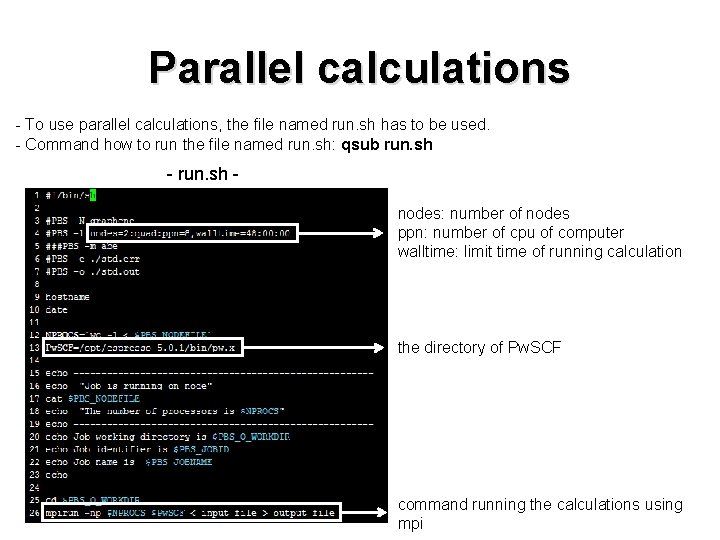
Parallel calculations - To use parallel calculations, the file named run. sh has to be used. - Command how to run the file named run. sh: qsub run. sh - run. sh nodes: number of nodes ppn: number of cpu of computer walltime: limit time of running calculation the directory of Pw. SCF command running the calculations using mpi
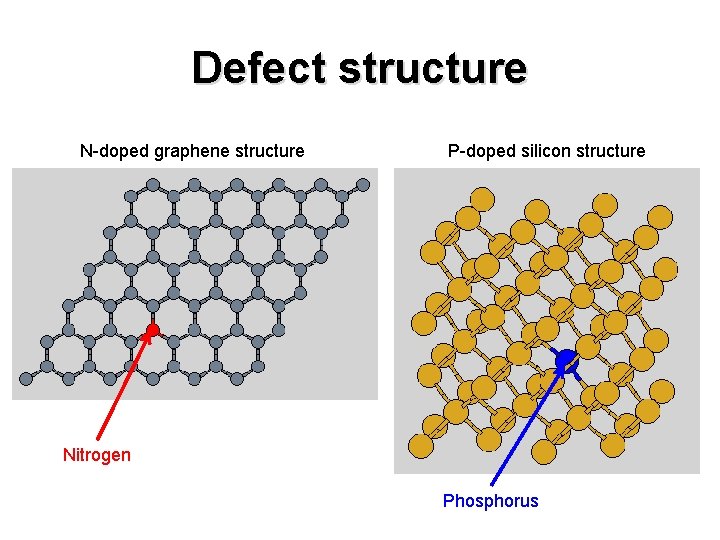
Defect structure N-doped graphene structure P-doped silicon structure Nitrogen Phosphorus
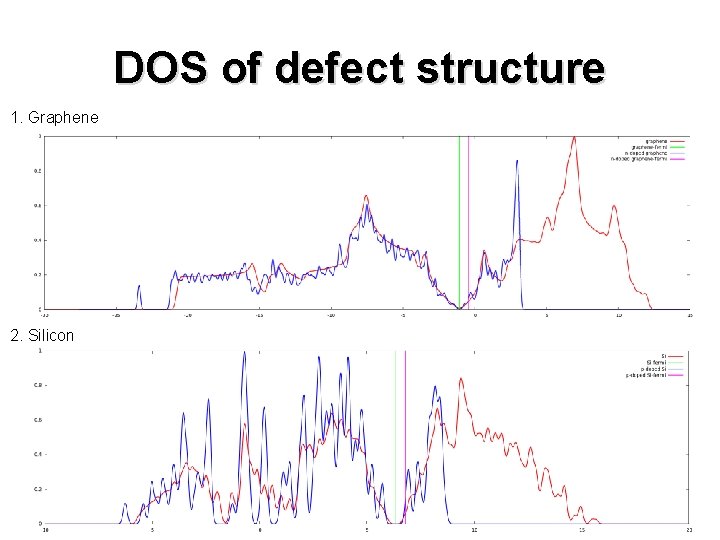
DOS of defect structure 1. Graphene 2. Silicon
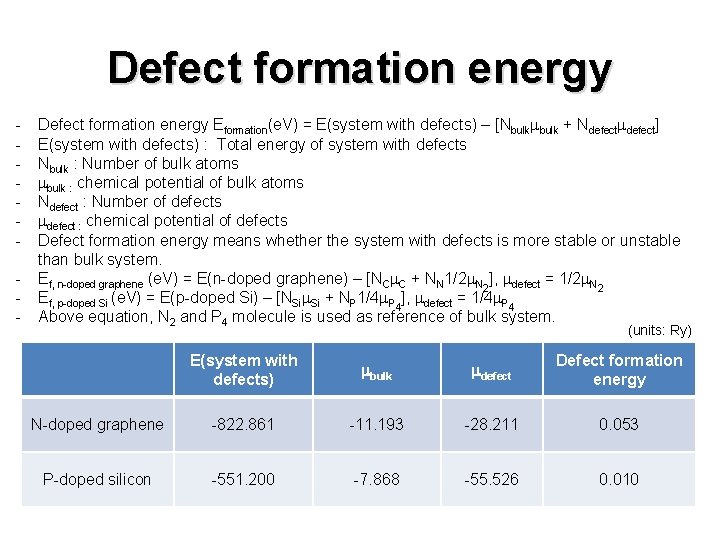
Defect formation energy - Defect formation energy Eformation(e. V) = E(system with defects) – [Nbulk + Ndefect] E(system with defects) : Total energy of system with defects Nbulk : Number of bulk atoms bulk : chemical potential of bulk atoms Ndefect : Number of defects defect : chemical potential of defects Defect formation energy means whether the system with defects is more stable or unstable than bulk system. Ef, n-doped graphene (e. V) = E(n-doped graphene) – [NC C + NN 1/2 N 2], defect = 1/2 N 2 Ef, p-doped Si (e. V) = E(p-doped Si) – [NSi Si + NP 1/4 P 4], defect = 1/4 P 4 Above equation, N 2 and P 4 molecule is used as reference of bulk system. (units: Ry) E(system with defects) bulk defect Defect formation energy N-doped graphene -822. 861 -11. 193 -28. 211 0. 053 P-doped silicon -551. 200 -7. 868 -55. 526 0. 010