
Tutorial Lecture Semiconductor Photoelectrochemistry and Solar Water Splitting


- Slides: 58
Tutorial Lecture: Semiconductor Photoelectrochemistry and Solar Water Splitting Shannon W. Boettcher Asst. Prof. of Chemistry University of Oregon Eugene, USA Mt. Hood Oregon Shannon Boettcher – ICMR Tutorial PEC Water Splitting 1
Motivation: Powering the Planet Global power consumption: ~18 TW 3 TW Worldwide potential*: Wind < 4 TW Biomass < 5 TW Hydro < 1. 5 TW Geothermal < 1 TW Solar ~ 120, 000 TW *Lewis, MRS Bulletin, (32) 808 2007. Solar is the only renewable source capable of providing 20 -50 TW of power worldwide. Shannon Boettcher – ICMR Tutorial PEC Water Splitting 2
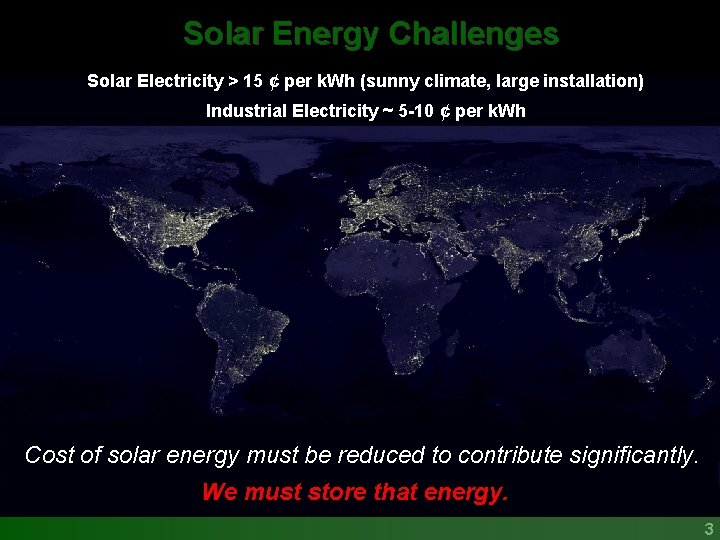
Solar Energy Challenges Solar Electricity > 15 ¢ per k. Wh (sunny climate, large installation) Industrial Electricity ~ 5 -10 ¢ per k. Wh Cost of solar energy must be reduced to contribute significantly. We must store that energy. Shannon Boettcher – ICMR Tutorial PEC Water Splitting 3
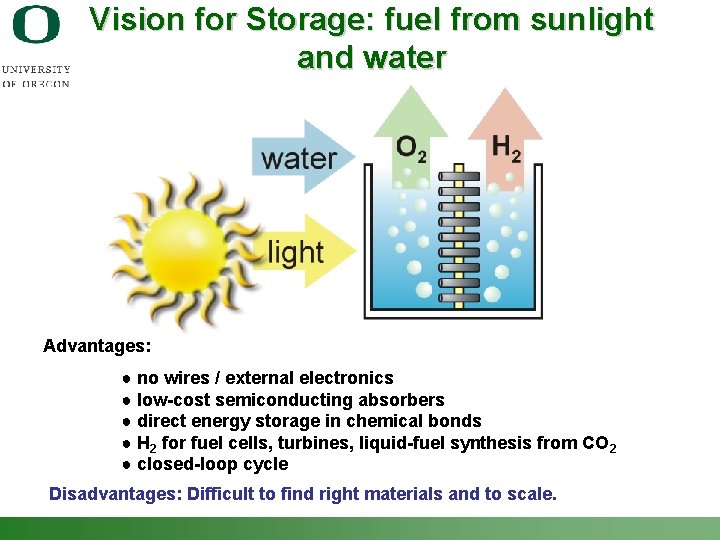
Vision for Storage: fuel from sunlight and water Advantages: ● no wires / external electronics ● low-cost semiconducting absorbers ● direct energy storage in chemical bonds ● H 2 for fuel cells, turbines, liquid-fuel synthesis from CO 2 ● closed-loop cycle Disadvantages: Difficult to find right materials and to scale. Shannon Boettcher – ICMR Tutorial PEC Water Splitting 4
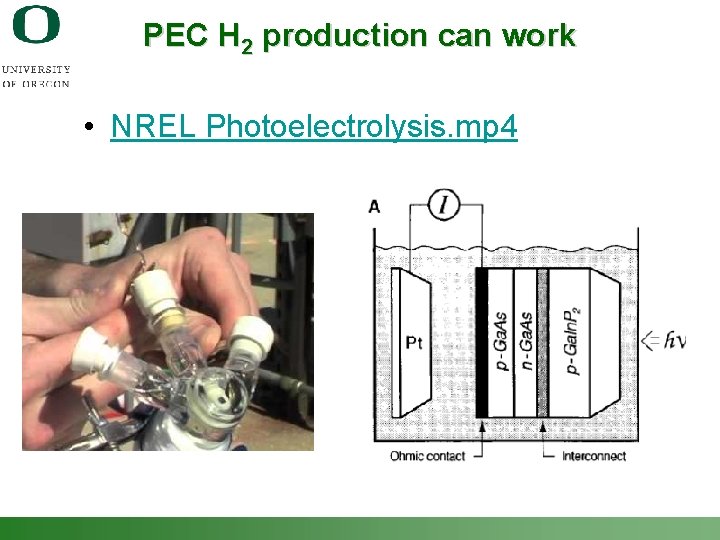
PEC H 2 production can work • NREL Photoelectrolysis. mp 4 Shannon Boettcher – ICMR Tutorial PEC Water Splitting 5
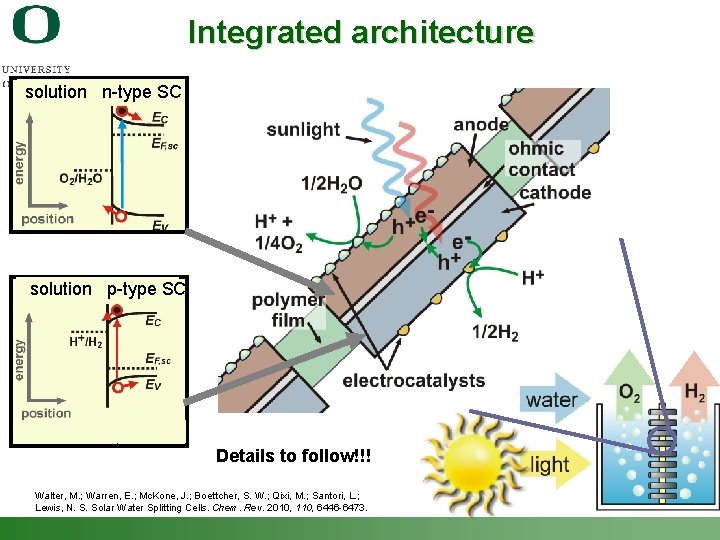
Integrated architecture solution n-type SC solution p-type SC Details to follow!!! Walter, M. ; Warren, E. ; Mc. Kone, J. ; Boettcher, S. W. ; Qixi, M. ; Santori, L. ; Lewis, N. S. Solar Water Splitting Cells. Chem. Rev. 2010, 110, 6446 -6473. Shannon Boettcher – ICMR Tutorial PEC Water Splitting 6
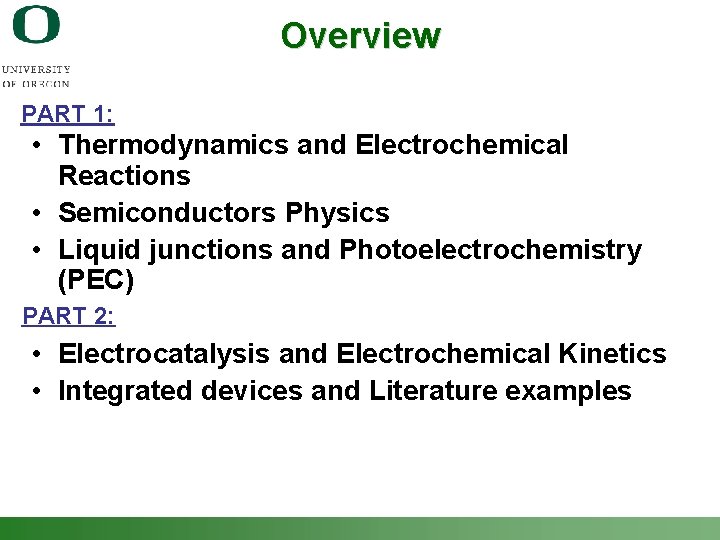
Overview PART 1: • Thermodynamics and Electrochemical Reactions • Semiconductors Physics • Liquid junctions and Photoelectrochemistry (PEC) PART 2: • Electrocatalysis and Electrochemical Kinetics • Integrated devices and Literature examples Shannon Boettcher – ICMR Tutorial PEC Water Splitting 7
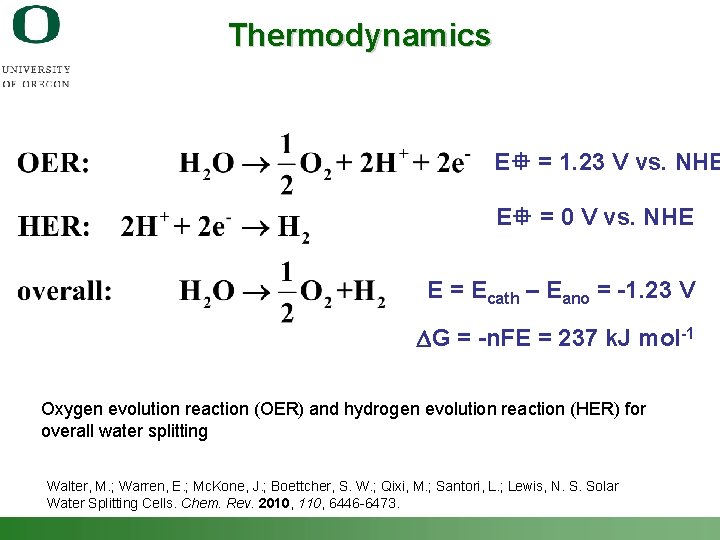
Thermodynamics E = 1. 23 V vs. NHE E = 0 V vs. NHE E = Ecath – Eano = -1. 23 V DG = -n. FE = 237 k. J mol-1 Oxygen evolution reaction (OER) and hydrogen evolution reaction (HER) for overall water splitting Walter, M. ; Warren, E. ; Mc. Kone, J. ; Boettcher, S. W. ; Qixi, M. ; Santori, L. ; Lewis, N. S. Solar Water Splitting Cells. Chem. Rev. 2010, 110, 6446 -6473. Shannon Boettcher – ICMR Tutorial PEC Water Splitting 8
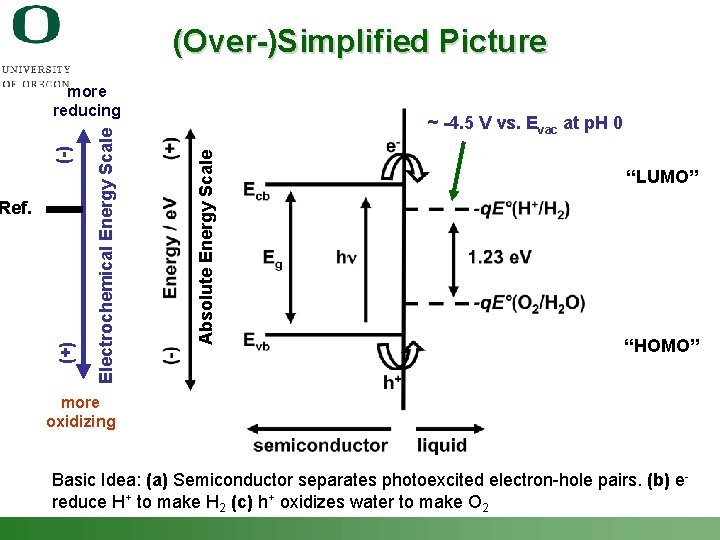
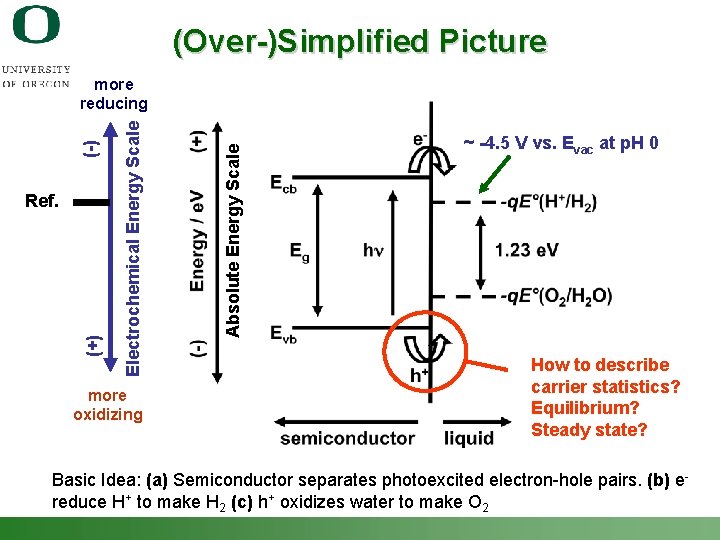
(Over-)Simplified Picture ~ -4. 5 V vs. Evac at p. H 0 Absolute Energy Scale (+) Ref. Electrochemical Energy Scale (-) more reducing “LUMO” “HOMO” more oxidizing Basic Idea: (a) Semiconductor separates photoexcited electron-hole pairs. (b) e- reduce H+ to make H 2 (c) h+ oxidizes water to make O 2 Shannon Boettcher – ICMR Tutorial PEC Water Splitting 9
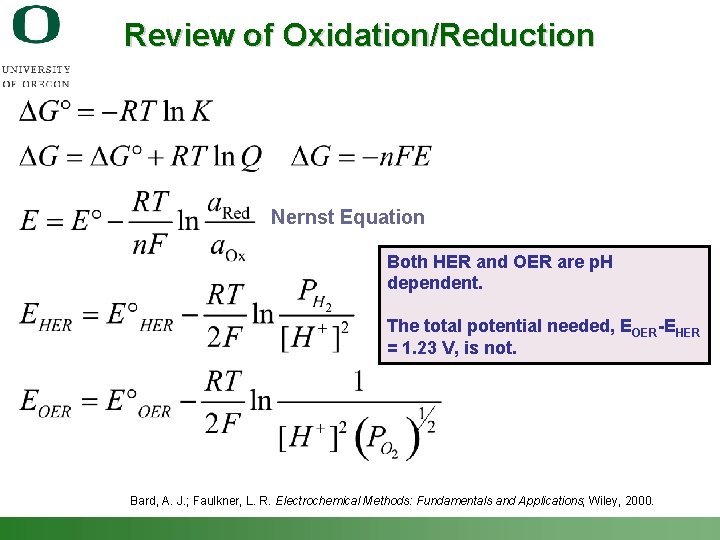
Review of Oxidation/Reduction Nernst Equation Both HER and OER are p. H dependent. The total potential needed, EOER-EHER = 1. 23 V, is not. Bard, A. J. ; Faulkner, L. R. Electrochemical Methods: Fundamentals and Applications; Wiley, 2000. Shannon Boettcher – ICMR Tutorial PEC Water Splitting 10
(Over-)Simplified Picture Absolute Energy Scale (+) Ref. Electrochemical Energy Scale (-) more reducing more oxidizing ~ -4. 5 V vs. Evac at p. H 0 How to describe carrier statistics? Equilibrium? Steady state? Basic Idea: (a) Semiconductor separates photoexcited electron-hole pairs. (b) e- reduce H+ to make H 2 (c) h+ oxidizes water to make O 2 Shannon Boettcher – ICMR Tutorial PEC Water Splitting 11
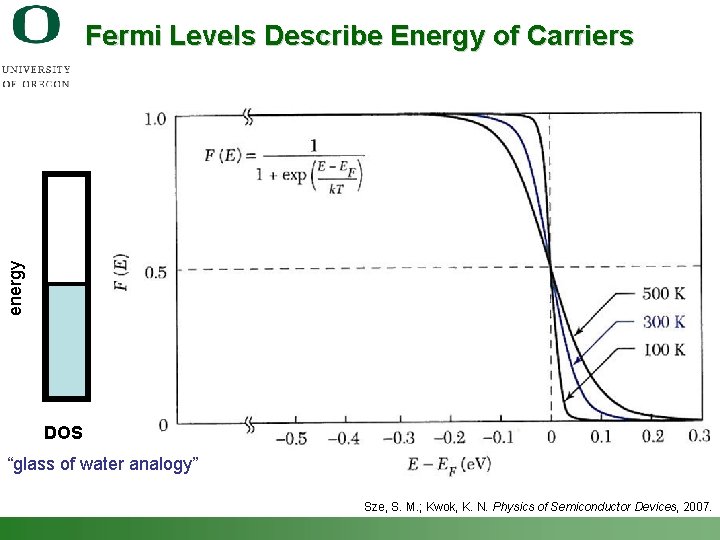
energy Fermi Levels Describe Energy of Carriers DOS “glass of water analogy” Sze, S. M. ; Kwok, K. N. Physics of Semiconductor Devices, 2007. Shannon Boettcher – ICMR Tutorial PEC Water Splitting 12
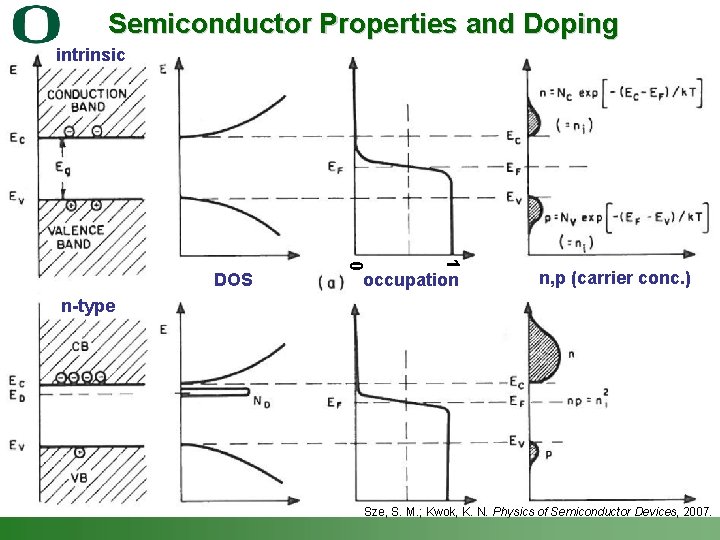
Semiconductor Properties and Doping intrinsic 1 0 DOS occupation n, p (carrier conc. ) n-type Sze, S. M. ; Kwok, K. N. Physics of Semiconductor Devices, 2007. Shannon Boettcher – ICMR Tutorial PEC Water Splitting 13
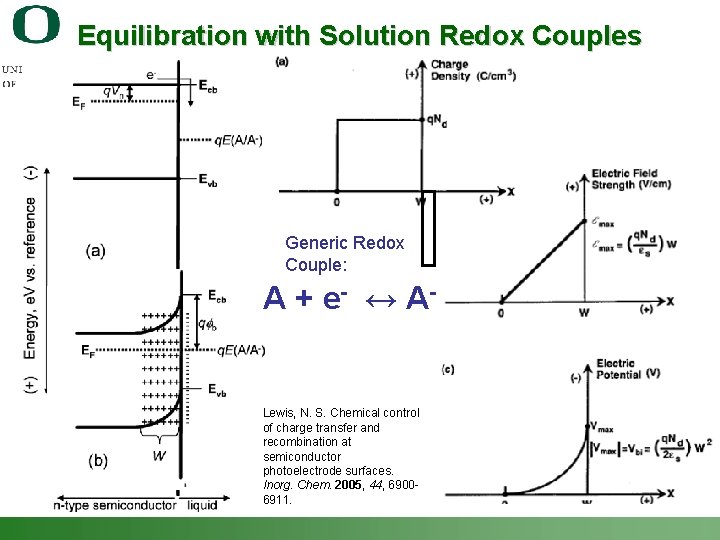
Equilibration with Solution Redox Couples Generic Redox Couple: A + e - ↔ A- Lewis, N. S. Chemical control of charge transfer and recombination at semiconductor photoelectrode surfaces. Inorg. Chem. 2005, 44, 69006911. Shannon Boettcher – ICMR Tutorial PEC Water Splitting 14
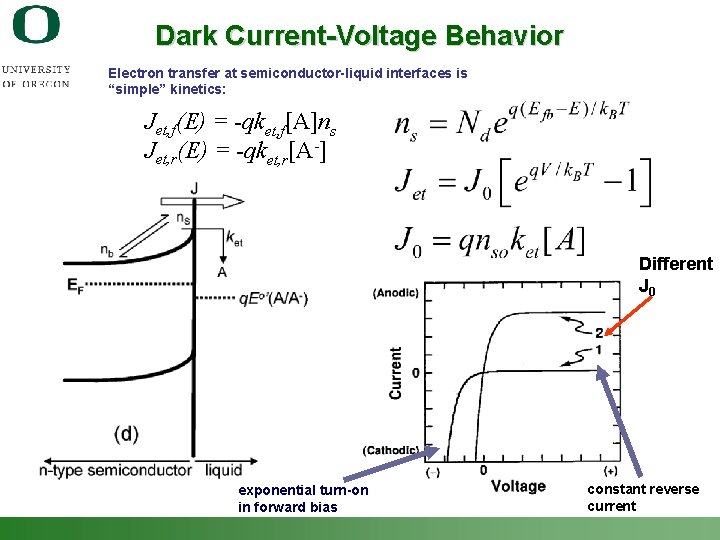
Dark Current-Voltage Behavior Electron transfer at semiconductor-liquid interfaces is “simple” kinetics: Jet, f(E) = -qket, f[A]ns Jet, r(E) = -qket, r[A-] Different J 0 exponential turn-on in forward bias Shannon Boettcher – ICMR Tutorial PEC Water Splitting constant reverse current 15
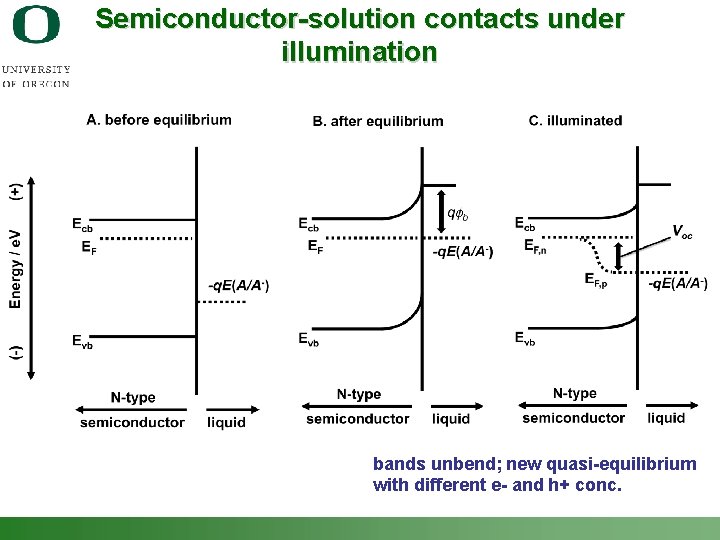
Semiconductor-solution contacts under illumination bands unbend; new quasi-equilibrium with different e- and h+ conc. Shannon Boettcher – ICMR Tutorial PEC Water Splitting 16
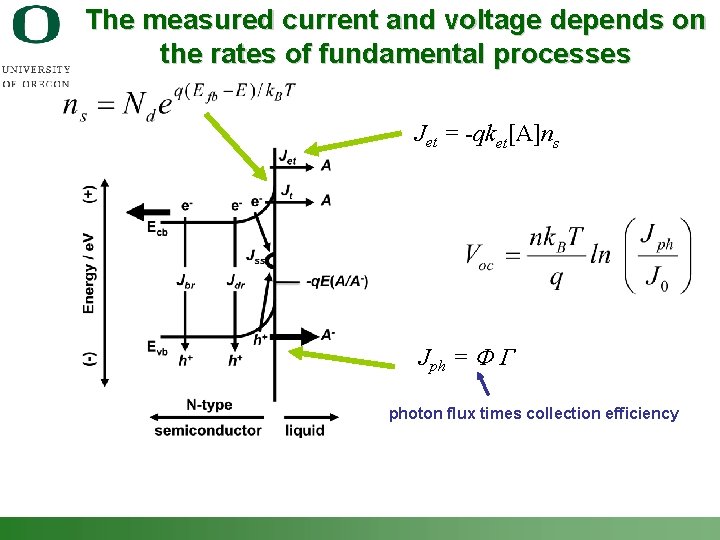
The measured current and voltage depends on the rates of fundamental processes Jet = -qket[A]ns Jph = F G photon flux times collection efficiency Shannon Boettcher – ICMR Tutorial PEC Water Splitting 17
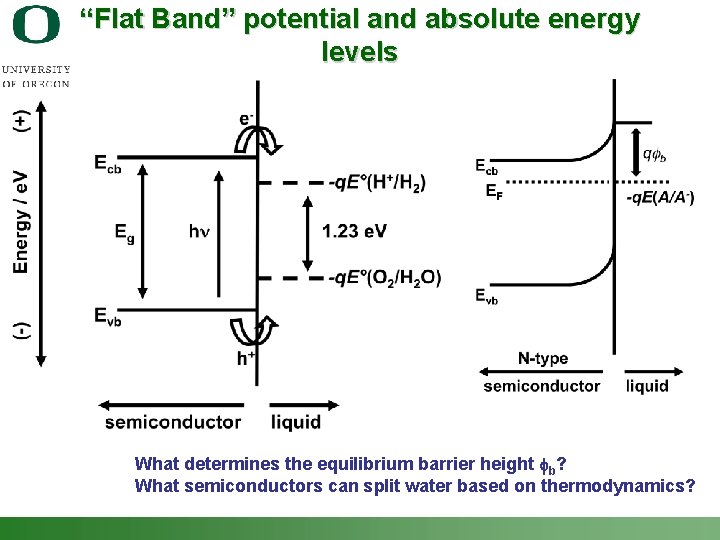
“Flat Band” potential and absolute energy levels What determines the equilibrium barrier height fb? What semiconductors can split water based on thermodynamics? Shannon Boettcher – ICMR Tutorial PEC Water Splitting 18
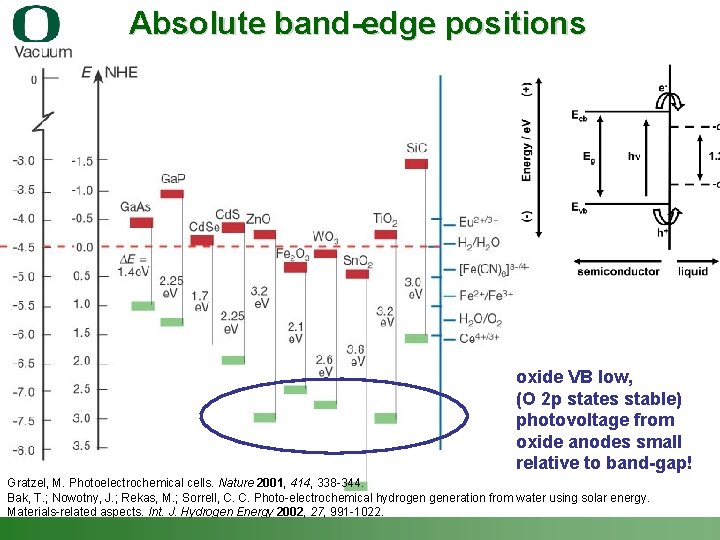
Absolute band-edge positions oxide VB low, (O 2 p states stable) photovoltage from oxide anodes small relative to band-gap! Gratzel, M. Photoelectrochemical cells. Nature 2001, 414, 338 -344. Bak, T. ; Nowotny, J. ; Rekas, M. ; Sorrell, C. C. Photo-electrochemical hydrogen generation from water using solar energy. Materials-related aspects. Int. J. Hydrogen Energy 2002, 27, 991 -1022. Shannon Boettcher – ICMR Tutorial PEC Water Splitting 19
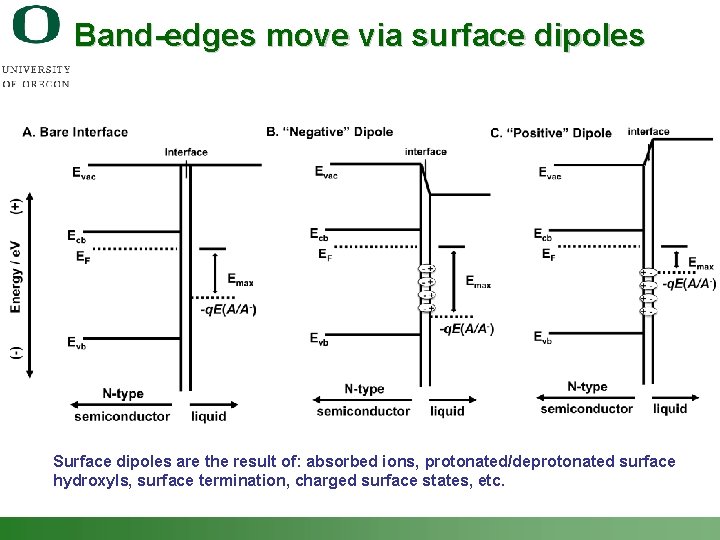
Band-edges move via surface dipoles Surface dipoles are the result of: absorbed ions, protonated/deprotonated surface hydroxyls, surface termination, charged surface states, etc. Shannon Boettcher – ICMR Tutorial PEC Water Splitting 20
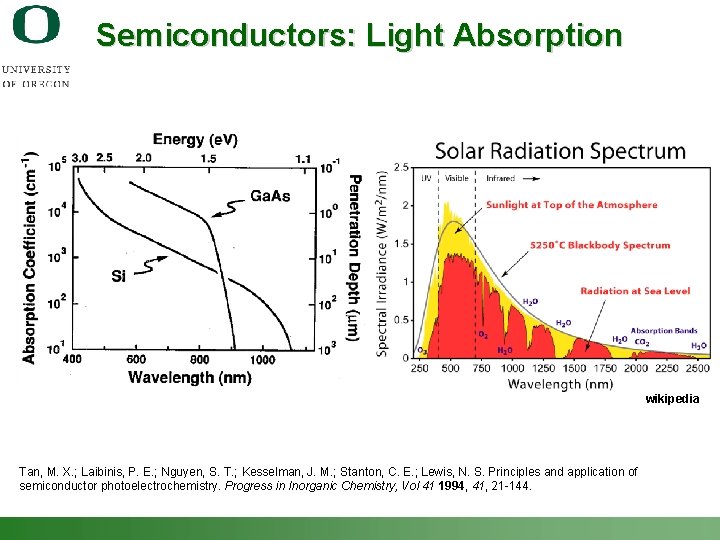
Semiconductors: Light Absorption wikipedia Tan, M. X. ; Laibinis, P. E. ; Nguyen, S. T. ; Kesselman, J. M. ; Stanton, C. E. ; Lewis, N. S. Principles and application of semiconductor photoelectrochemistry. Progress in Inorganic Chemistry, Vol 41 1994, 41, 21 -144. Shannon Boettcher – ICMR Tutorial PEC Water Splitting 21
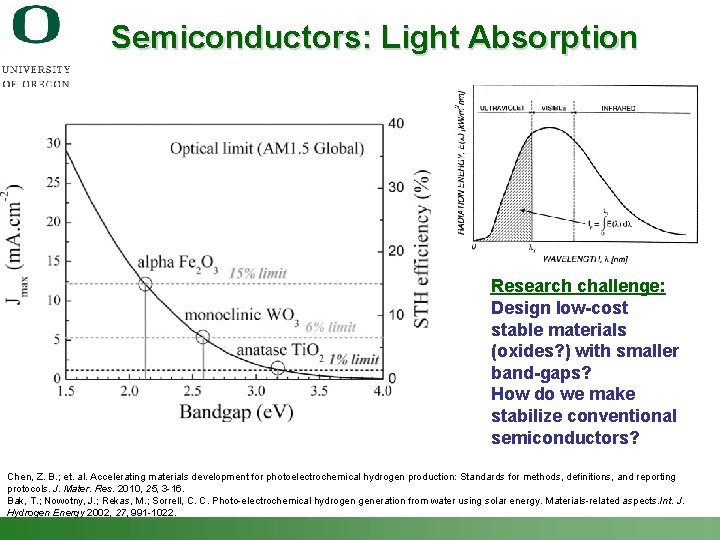
Semiconductors: Light Absorption Research challenge: Design low-cost stable materials (oxides? ) with smaller band-gaps? How do we make stabilize conventional semiconductors? Chen, Z. B. ; et. al. Accelerating materials development for photoelectrochemical hydrogen production: Standards for methods, definitions, and reporting protocols. J. Mater. Res. 2010, 25, 3 -16. Bak, T. ; Nowotny, J. ; Rekas, M. ; Sorrell, C. C. Photo-electrochemical hydrogen generation from water using solar energy. Materials-related aspects. Int. J. Hydrogen Energy 2002, 27, 991 -1022. Shannon Boettcher – ICMR Tutorial PEC Water Splitting 22
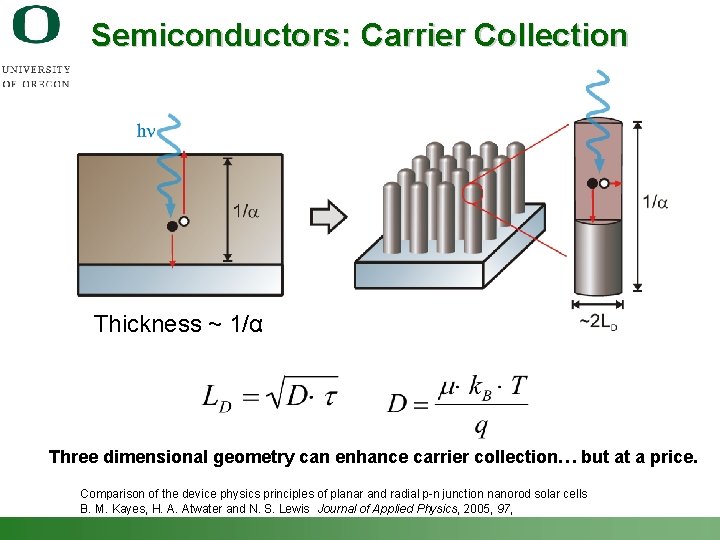
Semiconductors: Carrier Collection Thickness ~ 1/α Three dimensional geometry can enhance carrier collection… but at a price. Comparison of the device physics principles of planar and radial p-n junction nanorod solar cells B. M. Kayes, H. A. Atwater and N. S. Lewis Journal of Applied Physics, 2005, 97, Shannon Boettcher – ICMR Tutorial PEC Water Splitting 23
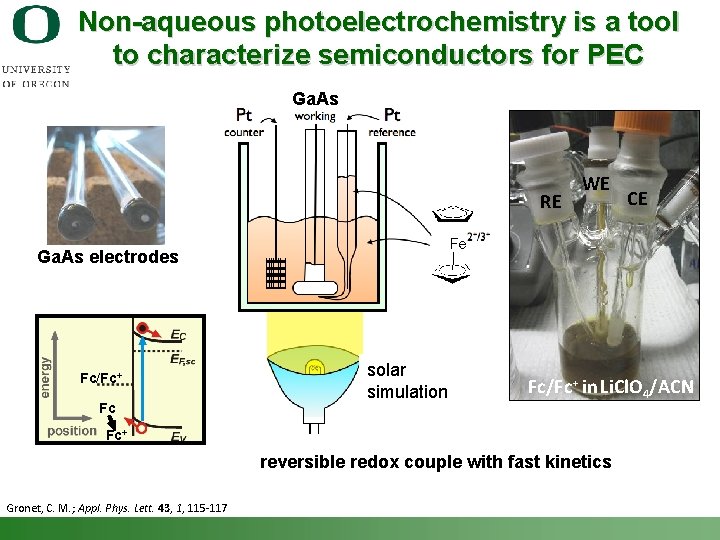
Non-aqueous photoelectrochemistry is a tool to characterize semiconductors for PEC Ga. As RE WE CE Ga. As electrodes Fc/Fc+ Fc solar simulation Fc/Fc+ in Li. Cl. O 4/ACN Fc+ reversible redox couple with fast kinetics Gronet, C. M. ; Appl. Phys. Lett. 43, 1, 115 -117 Shannon Boettcher – ICMR Tutorial PEC Water Splitting 24
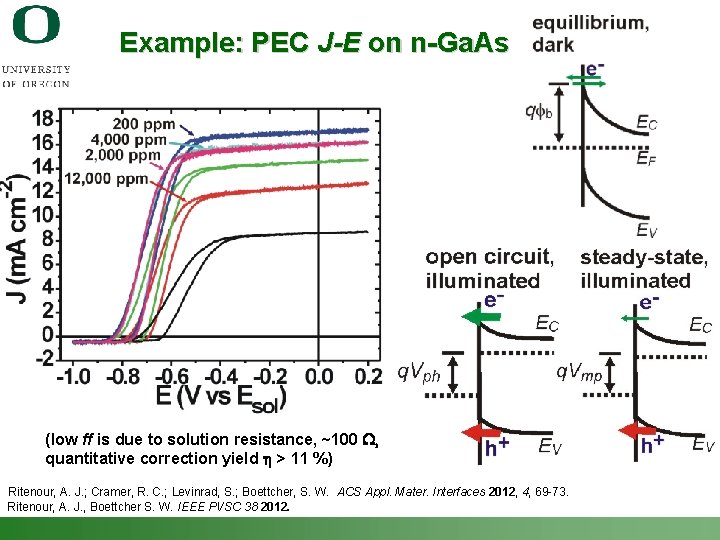
Example: PEC J-E on n-Ga. As (low ff is due to solution resistance, ~100 W, quantitative correction yield h > 11 %) Ritenour, A. J. ; Cramer, R. C. ; Levinrad, S. ; Boettcher, S. W. ACS Appl. Mater. Interfaces 2012, 4, 69 -73. Ritenour, A. J. , Boettcher S. W. IEEE PVSC 38 2012. Shannon Boettcher – ICMR Tutorial PEC Water Splitting 25
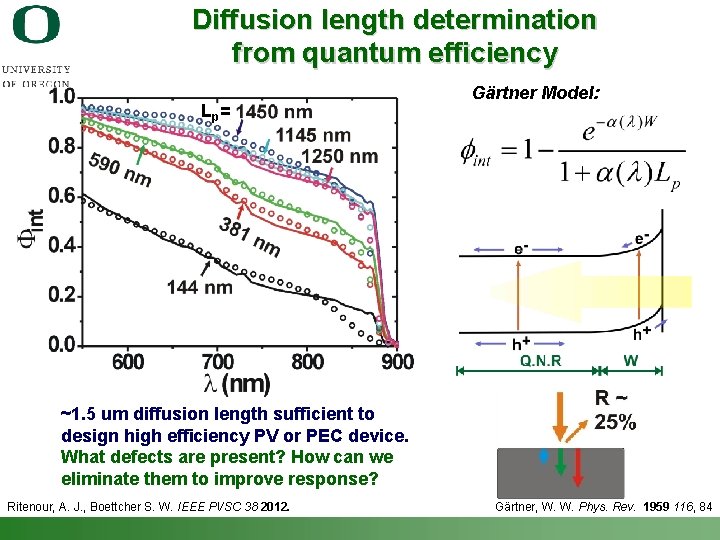
Diffusion length determination from quantum efficiency L p= Gӓrtner Model: ~1. 5 um diffusion length sufficient to design high efficiency PV or PEC device. What defects are present? How can we eliminate them to improve response? Ritenour, A. J. , Boettcher S. W. IEEE PVSC 38 2012. Shannon Boettcher – ICMR Tutorial PEC Water Splitting Gӓrtner, W. W. Phys. Rev. 1959 116, 84 26
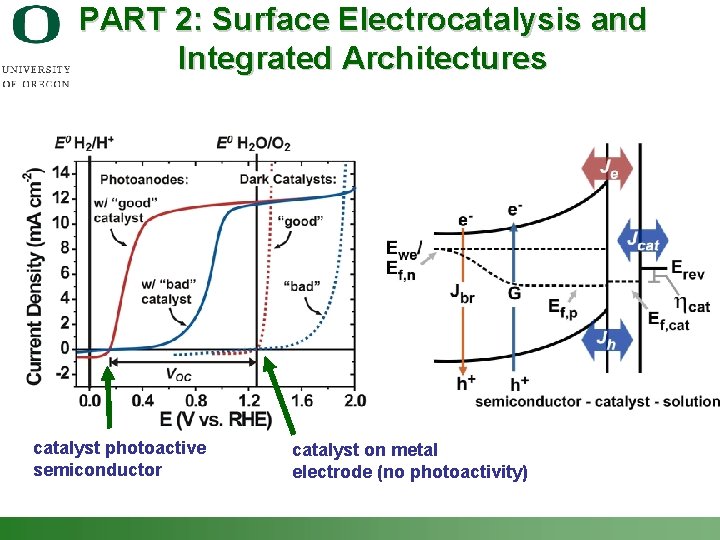
PART 2: Surface Electrocatalysis and Integrated Architectures catalyst photoactive semiconductor catalyst on metal electrode (no photoactivity) Shannon Boettcher – ICMR Tutorial PEC Water Splitting 27
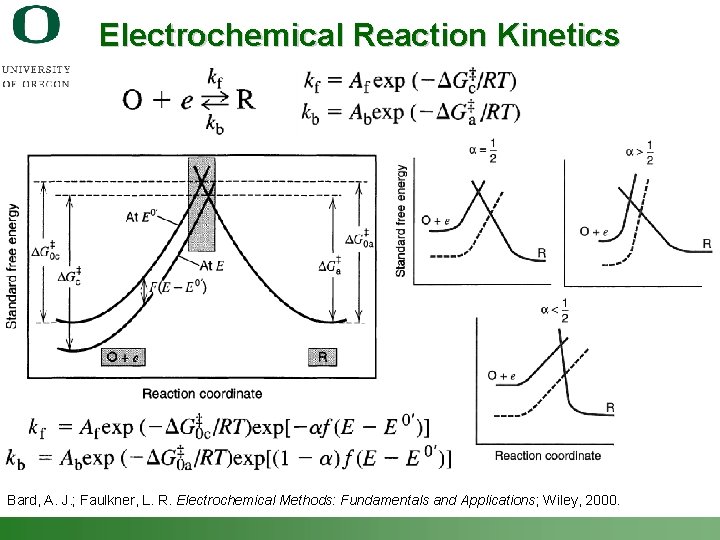
Electrochemical Reaction Kinetics Bard, A. J. ; Faulkner, L. R. Electrochemical Methods: Fundamentals and Applications; Wiley, 2000. Shannon Boettcher – ICMR Tutorial PEC Water Splitting 28
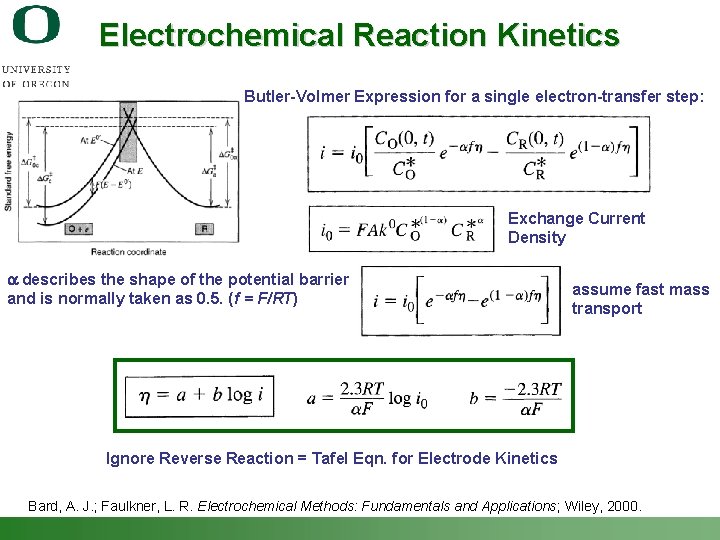
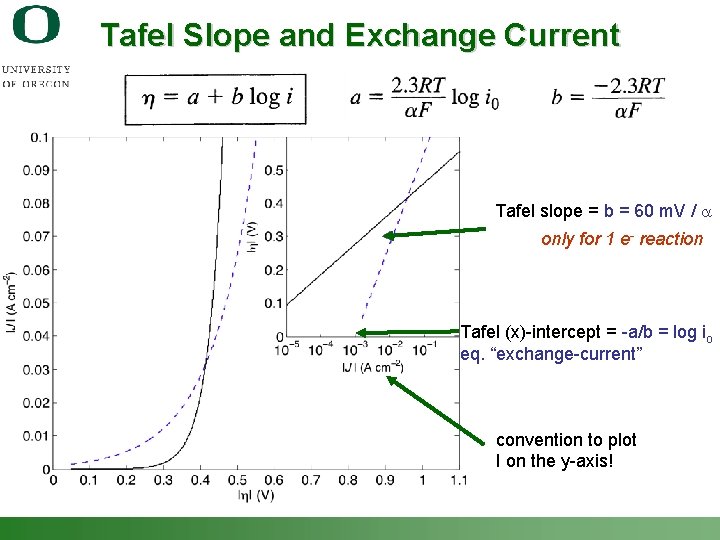
Electrochemical Reaction Kinetics Butler-Volmer Expression for a single electron-transfer step: Exchange Current Density a describes the shape of the potential barrier and is normally taken as 0. 5. (f = F/RT) assume fast mass transport Ignore Reverse Reaction = Tafel Eqn. for Electrode Kinetics Bard, A. J. ; Faulkner, L. R. Electrochemical Methods: Fundamentals and Applications; Wiley, 2000. Shannon Boettcher – ICMR Tutorial PEC Water Splitting 29
Tafel Slope and Exchange Current Tafel slope = b = 60 m. V / a only for 1 e- reaction Tafel (x)-intercept = -a/b = log io eq. “exchange-current” convention to plot I on the y-axis! Shannon Boettcher – ICMR Tutorial PEC Water Splitting 30
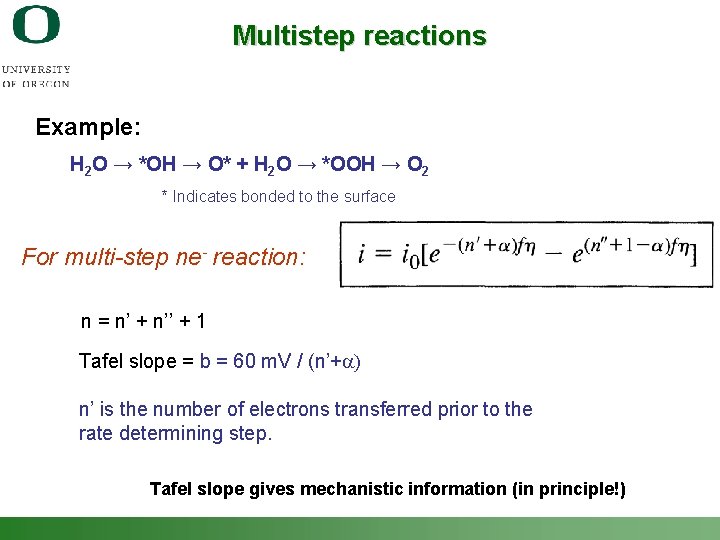
Multistep reactions Example: H 2 O → *OH → O* + H 2 O → *OOH → O 2 * Indicates bonded to the surface For multi-step ne- reaction: n = n’ + n’’ + 1 Tafel slope = b = 60 m. V / (n’+a) n’ is the number of electrons transferred prior to the rate determining step. Tafel slope gives mechanistic information (in principle!) Shannon Boettcher – ICMR Tutorial PEC Water Splitting 31
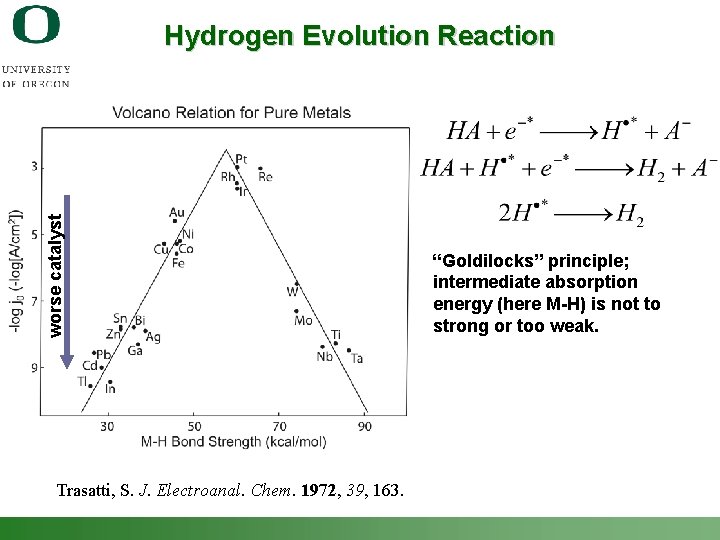
worse catalyst Hydrogen Evolution Reaction “Goldilocks” principle; intermediate absorption energy (here M-H) is not to strong or too weak. Trasatti, S. J. Electroanal. Chem. 1972, 39, 163. Shannon Boettcher – ICMR Tutorial PEC Water Splitting 32
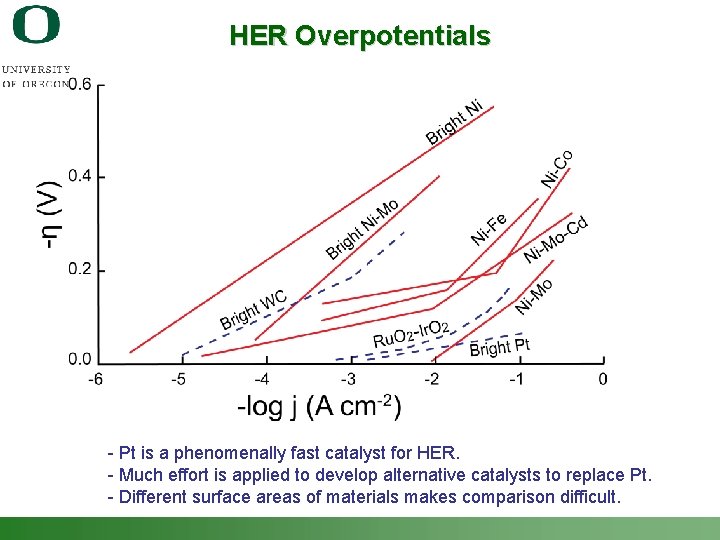
HER Overpotentials - Pt is a phenomenally fast catalyst for HER. - Much effort is applied to develop alternative catalysts to replace Pt. - Different surface areas of materials makes comparison difficult. Shannon Boettcher – ICMR Tutorial PEC Water Splitting 33
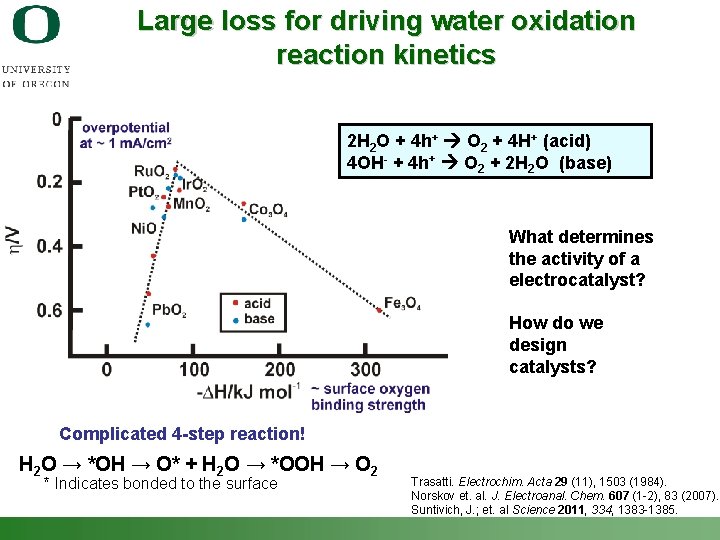
Large loss for driving water oxidation reaction kinetics 2 H 2 O + 4 h+ O 2 + 4 H+ (acid) 4 OH- + 4 h+ O 2 + 2 H 2 O (base) What determines the activity of a electrocatalyst? How do we design catalysts? Complicated 4 -step reaction! H 2 O → *OH → O* + H 2 O → *OOH → O 2 * Indicates bonded to the surface Shannon Boettcher – ICMR Tutorial PEC Water Splitting Trasatti. Electrochim. Acta 29 (11), 1503 (1984). Norskov et. al. J. Electroanal. Chem. 607 (1 -2), 83 (2007). Suntivich, J. ; et. al Science 2011, 334, 1383 -1385. 34
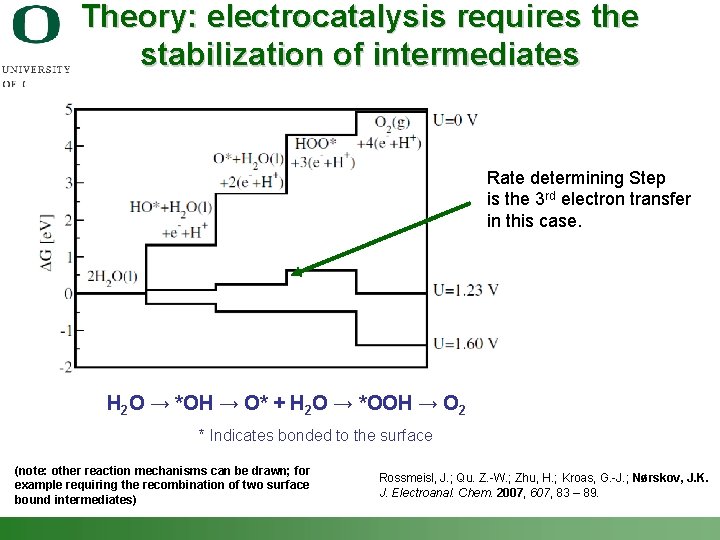
Theory: electrocatalysis requires the stabilization of intermediates Rate determining Step is the 3 rd electron transfer in this case. H 2 O → *OH → O* + H 2 O → *OOH → O 2 * Indicates bonded to the surface (note: other reaction mechanisms can be drawn; for example requiring the recombination of two surface bound intermediates) Shannon Boettcher – ICMR Tutorial PEC Water Splitting Rossmeisl, J. ; Qu. Z. -W. ; Zhu, H. ; Kroas, G. -J. ; Nørskov, J. K. J. Electroanal. Chem. 2007, 607, 83 – 89. 35
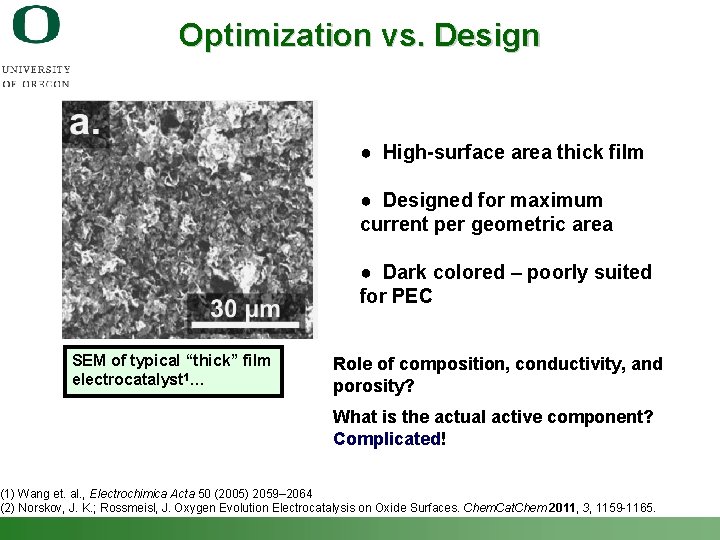
Optimization vs. Design ● High-surface area thick film ● Designed for maximum current per geometric area ● Dark colored – poorly suited for PEC SEM of typical “thick” film electrocatalyst 1… Role of composition, conductivity, and porosity? What is the actual active component? Complicated! (1) Wang et. al. , Electrochimica Acta 50 (2005) 2059– 2064 (2) Norskov, J. K. ; Rossmeisl, J. Oxygen Evolution Electrocatalysis on Oxide Surfaces. Chem. Cat. Chem 2011, 3, 1159 -1165. Shannon Boettcher – ICMR Tutorial PEC Water Splitting 36
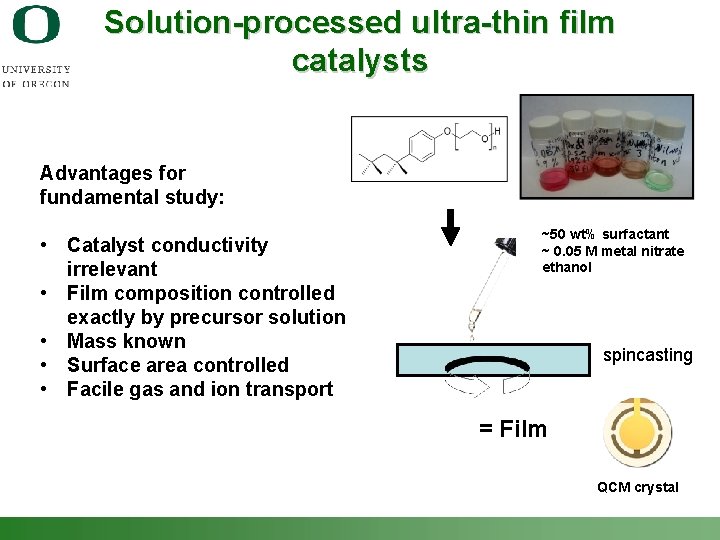
Solution-processed ultra-thin film catalysts Advantages for fundamental study: • Catalyst conductivity irrelevant • Film composition controlled exactly by precursor solution • Mass known • Surface area controlled • Facile gas and ion transport ~50 wt% surfactant ~ 0. 05 M metal nitrate ethanol spincasting = Film QCM crystal Shannon Boettcher – ICMR Tutorial PEC Water Splitting 37
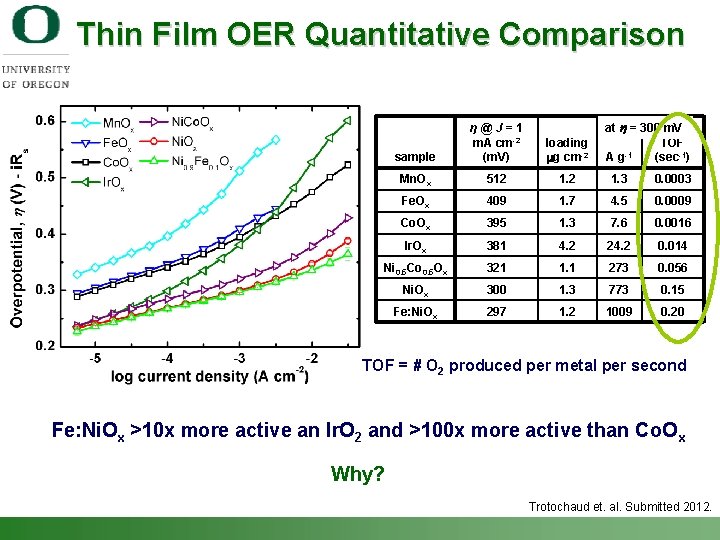
Thin Film OER Quantitative Comparison at h = 300 m. V TOF -1 Ag (sec-1) sample η@J=1 m. A cm-2 (m. V) loading mg cm-2 Mn. Ox 512 1. 3 0. 0003 Fe. Ox 409 1. 7 4. 5 0. 0009 Co. Ox 395 1. 3 7. 6 0. 0016 Ir. Ox 381 4. 2 24. 2 0. 014 Ni 0. 5 Co 0. 5 Ox 321 1. 1 273 0. 056 Ni. Ox 300 1. 3 773 0. 15 Fe: Ni. Ox 297 1. 2 1009 0. 20 TOF = # O 2 produced per metal per second Fe: Ni. Ox >10 x more active an Ir. O 2 and >100 x more active than Co. Ox Why? Trotochaud et. al. Submitted 2012. Shannon Boettcher – ICMR Tutorial PEC Water Splitting 38
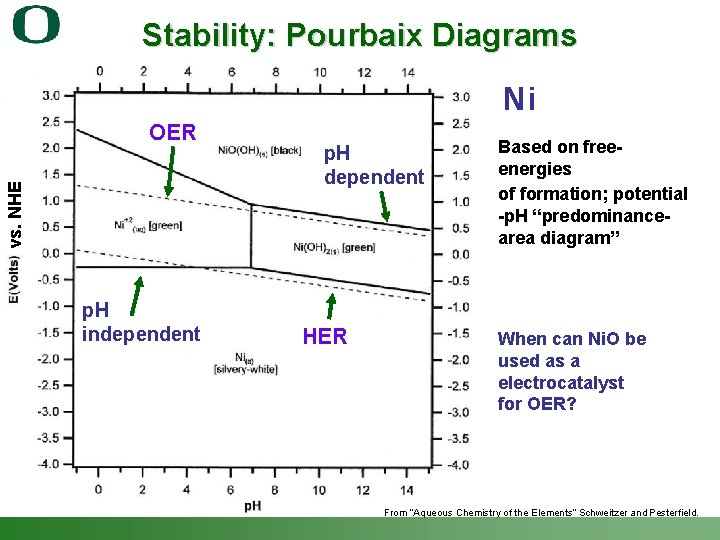
Stability: Pourbaix Diagrams Ni vs. NHE OER p. H independent p. H dependent HER Based on freeenergies of formation; potential -p. H “predominancearea diagram” When can Ni. O be used as a electrocatalyst for OER? From “Aqueous Chemistry of the Elements” Schweitzer and Pesterfield. Shannon Boettcher – ICMR Tutorial PEC Water Splitting 39
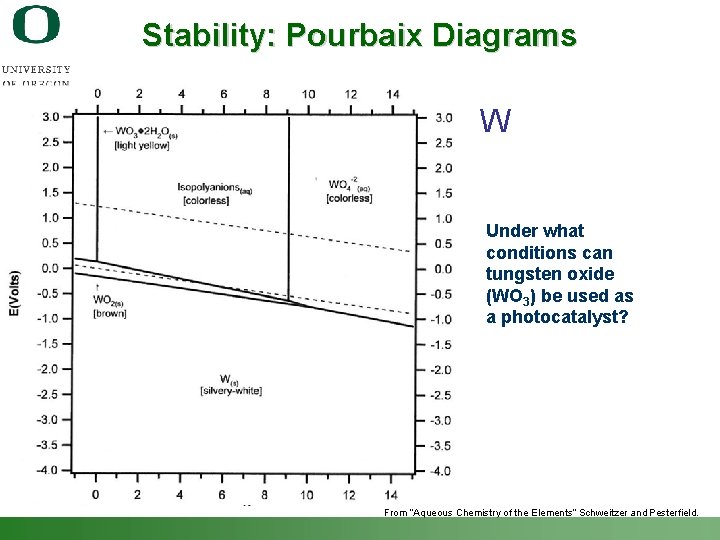
Stability: Pourbaix Diagrams W Under what conditions can tungsten oxide (WO 3) be used as a photocatalyst? From “Aqueous Chemistry of the Elements” Schweitzer and Pesterfield. Shannon Boettcher – ICMR Tutorial PEC Water Splitting 40
Part III : Examples of integrated devices and some literature examples. Shannon Boettcher – ICMR Tutorial PEC Water Splitting 41
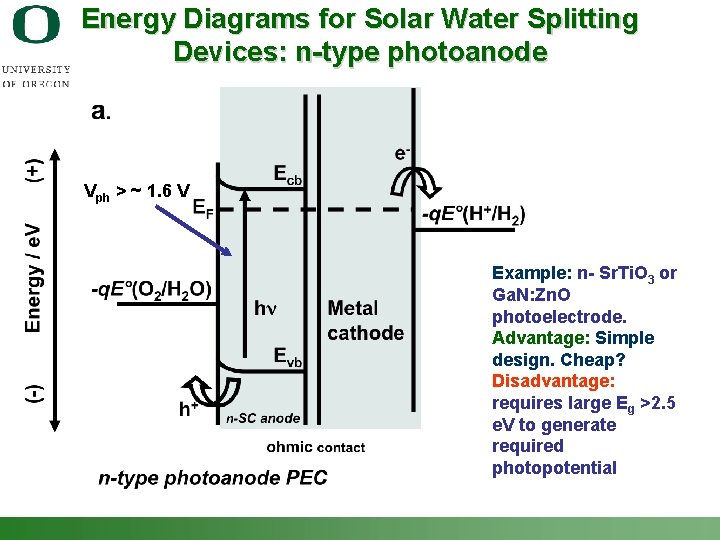
Energy Diagrams for Solar Water Splitting Devices: n-type photoanode Vph > ~ 1. 6 V Example: n- Sr. Ti. O 3 or Ga. N: Zn. O photoelectrode. Advantage: Simple design. Cheap? Disadvantage: requires large Eg >2. 5 e. V to generate required photopotential Shannon Boettcher – ICMR Tutorial PEC Water Splitting 42
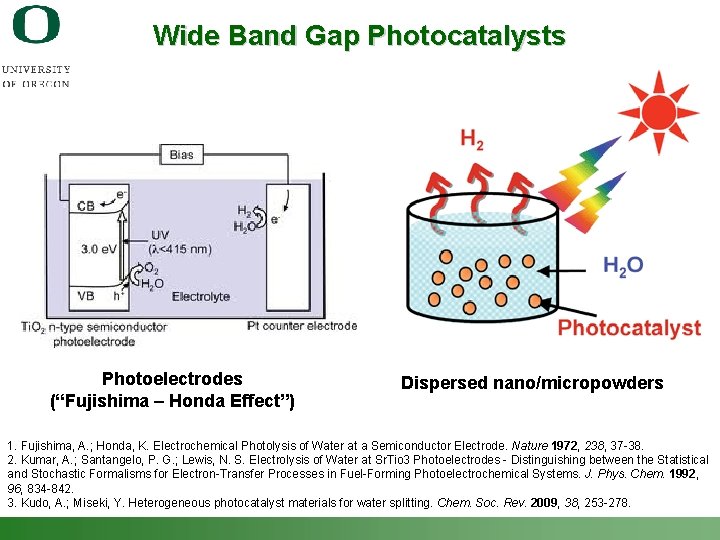
Wide Band Gap Photocatalysts Photoelectrodes (“Fujishima – Honda Effect”) Dispersed nano/micropowders 1. Fujishima, A. ; Honda, K. Electrochemical Photolysis of Water at a Semiconductor Electrode. Nature 1972, 238, 37 -38. 2. Kumar, A. ; Santangelo, P. G. ; Lewis, N. S. Electrolysis of Water at Sr. Tio 3 Photoelectrodes - Distinguishing between the Statistical and Stochastic Formalisms for Electron-Transfer Processes in Fuel-Forming Photoelectrochemical Systems. J. Phys. Chem. 1992, 96, 834 -842. 3. Kudo, A. ; Miseki, Y. Heterogeneous photocatalyst materials for water splitting. Chem. Soc. Rev. 2009, 38, 253 -278. Shannon Boettcher – ICMR Tutorial PEC Water Splitting 43
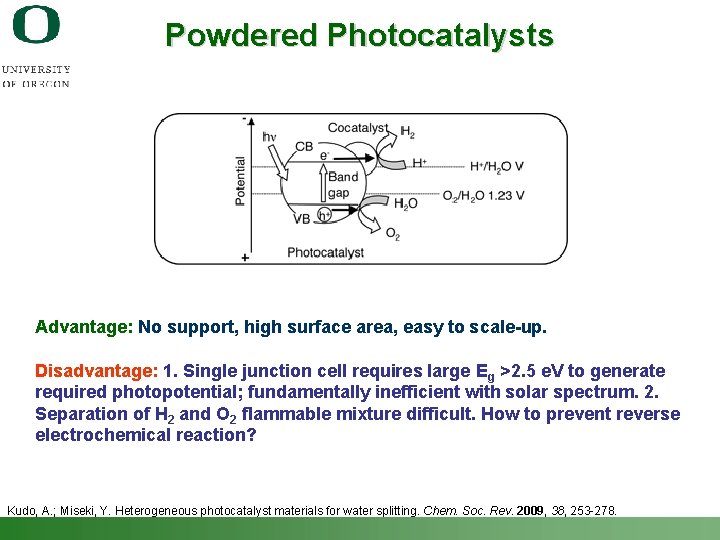
Powdered Photocatalysts Advantage: No support, high surface area, easy to scale-up. Disadvantage: 1. Single junction cell requires large Eg >2. 5 e. V to generate required photopotential; fundamentally inefficient with solar spectrum. 2. Separation of H 2 and O 2 flammable mixture difficult. How to prevent reverse electrochemical reaction? Kudo, A. ; Miseki, Y. Heterogeneous photocatalyst materials for water splitting. Chem. Soc. Rev. 2009, 38, 253 -278. Shannon Boettcher – ICMR Tutorial PEC Water Splitting 44
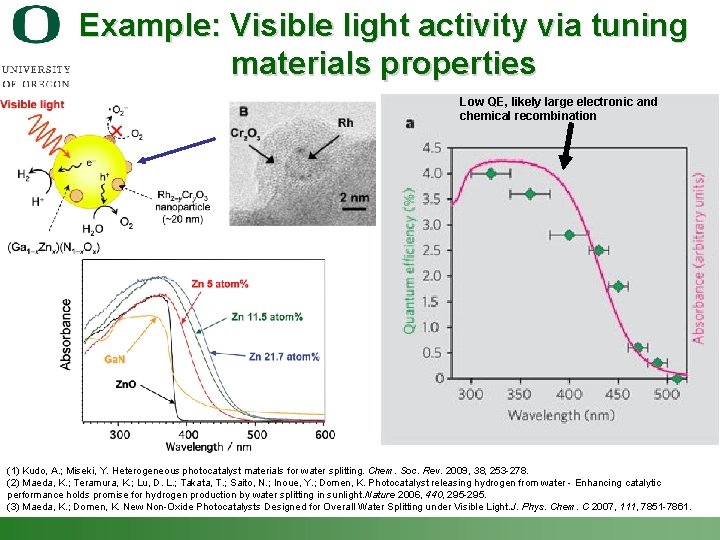
Example: Visible light activity via tuning materials properties Low QE, likely large electronic and chemical recombination (1) Kudo, A. ; Miseki, Y. Heterogeneous photocatalyst materials for water splitting. Chem. Soc. Rev. 2009, 38, 253 -278. (2) Maeda, K. ; Teramura, K. ; Lu, D. L. ; Takata, T. ; Saito, N. ; Inoue, Y. ; Domen, K. Photocatalyst releasing hydrogen from water - Enhancing catalytic performance holds promise for hydrogen production by water splitting in sunlight. Nature 2006, 440, 295 -295. (3) Maeda, K. ; Domen, K. New Non-Oxide Photocatalysts Designed for Overall Water Splitting under Visible Light. J. Phys. Chem. C 2007, 111, 7851 -7861. Shannon Boettcher – ICMR Tutorial PEC Water Splitting 45
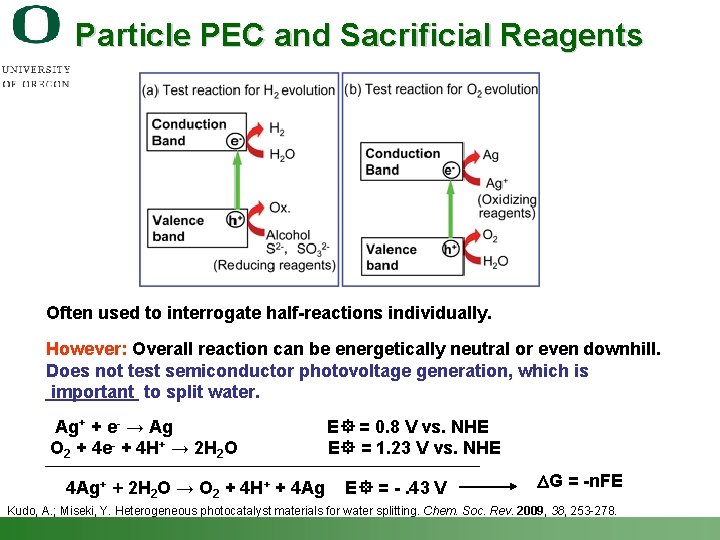
Particle PEC and Sacrificial Reagents Often used to interrogate half-reactions individually. However: Overall reaction can be energetically neutral or even downhill. Does not test semiconductor photovoltage generation, which is important to split water. Ag+ + e- → Ag E = 0. 8 V vs. NHE O 2 + 4 e- + 4 H+ → 2 H 2 O E = 1. 23 V vs. NHE 4 Ag+ + 2 H 2 O → O 2 + 4 H+ + 4 Ag E = -. 43 V DG = -n. FE Kudo, A. ; Miseki, Y. Heterogeneous photocatalyst materials for water splitting. Chem. Soc. Rev. 2009, 38, 253 -278. Shannon Boettcher – ICMR Tutorial PEC Water Splitting 46
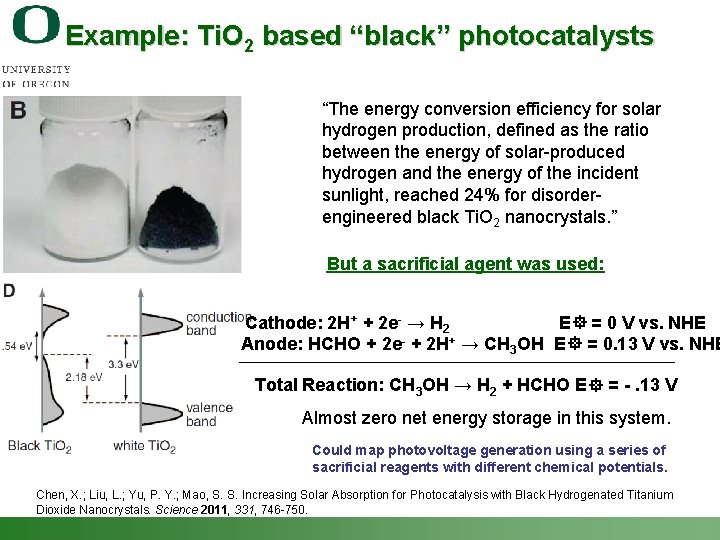
Example: Ti. O 2 based “black” photocatalysts “The energy conversion efficiency for solar hydrogen production, defined as the ratio between the energy of solar-produced hydrogen and the energy of the incident sunlight, reached 24% for disorderengineered black Ti. O 2 nanocrystals. ” But a sacrificial agent was used: Cathode: 2 H+ + 2 e- → H 2 E = 0 V vs. NHE Anode: HCHO + 2 e- + 2 H+ → CH 3 OH E = 0. 13 V vs. NHE Total Reaction: CH 3 OH → H 2 + HCHO E = -. 13 V Almost zero net energy storage in this system. Could map photovoltage generation using a series of sacrificial reagents with different chemical potentials. Chen, X. ; Liu, L. ; Yu, P. Y. ; Mao, S. S. Increasing Solar Absorption for Photocatalysis with Black Hydrogenated Titanium Dioxide Nanocrystals. Science 2011, 331, 746 -750. Shannon Boettcher – ICMR Tutorial PEC Water Splitting 47
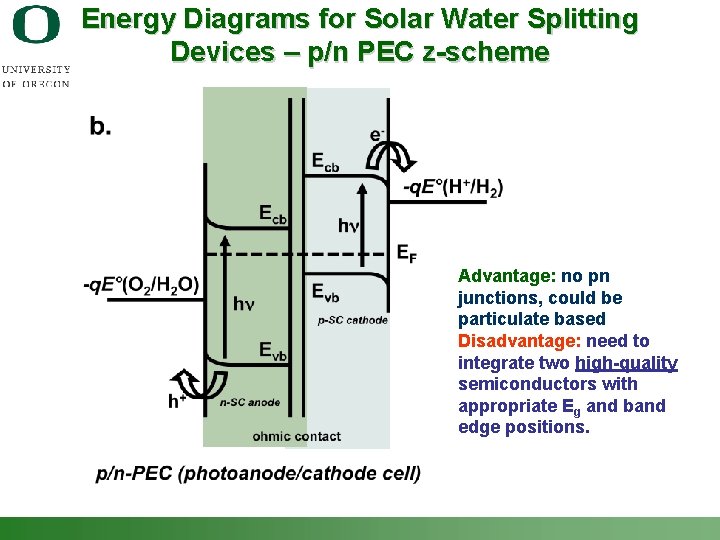
Energy Diagrams for Solar Water Splitting Devices – p/n PEC z-scheme Advantage: no pn junctions, could be particulate based Disadvantage: need to integrate two high-quality semiconductors with appropriate Eg and band edge positions. Shannon Boettcher – ICMR Tutorial PEC Water Splitting 48
Individual component testing using a 3 electrode potentiostat Reference electrode (RE) used to measure applied voltage versus absolute reference. Typically bubble O 2 or H 2 through solution to maintain well-defined Nernstian potential Counter electrode (CE) used to complete circuit, potential required to pass current at CE usually not measured. Semiconductor working electrode (WE) control majority carrier Fermi level versus the reference electrode and measure current. Chen, Z. B. ; Jaramillo, T. F. ; et. al. J. Mater. Res. 2010, 25, 3 -16. Shannon Boettcher – ICMR Tutorial PEC Water Splitting 49
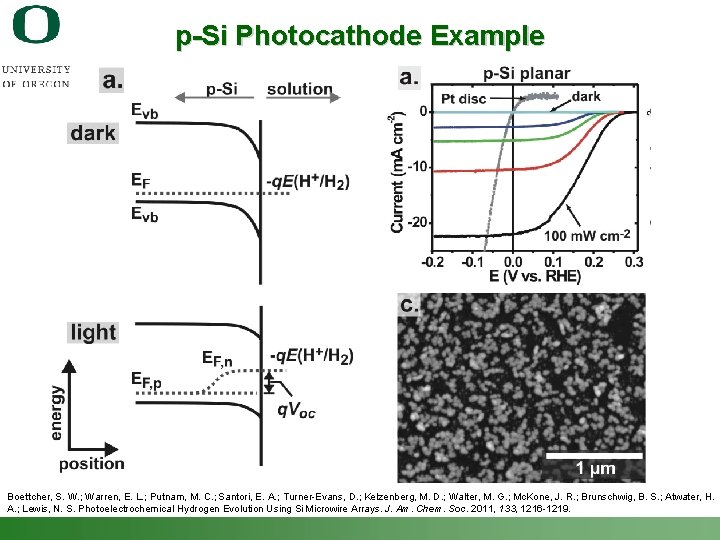
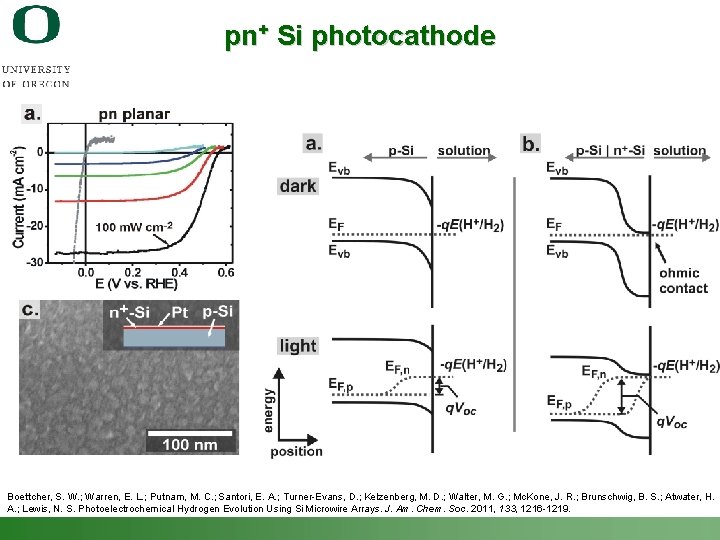
p-Si Photocathode Example Boettcher, S. W. ; Warren, E. L. ; Putnam, M. C. ; Santori, E. A. ; Turner-Evans, D. ; Kelzenberg, M. D. ; Walter, M. G. ; Mc. Kone, J. R. ; Brunschwig, B. S. ; Atwater, H. A. ; Lewis, N. S. Photoelectrochemical Hydrogen Evolution Using Si Microwire Arrays. J. Am. Chem. Soc. 2011, 133, 1216 -1219. Shannon Boettcher – ICMR Tutorial PEC Water Splitting 50
pn+ Si photocathode Boettcher, S. W. ; Warren, E. L. ; Putnam, M. C. ; Santori, E. A. ; Turner-Evans, D. ; Kelzenberg, M. D. ; Walter, M. G. ; Mc. Kone, J. R. ; Brunschwig, B. S. ; Atwater, H. A. ; Lewis, N. S. Photoelectrochemical Hydrogen Evolution Using Si Microwire Arrays. J. Am. Chem. Soc. 2011, 133, 1216 -1219. Shannon Boettcher – ICMR Tutorial PEC Water Splitting 51
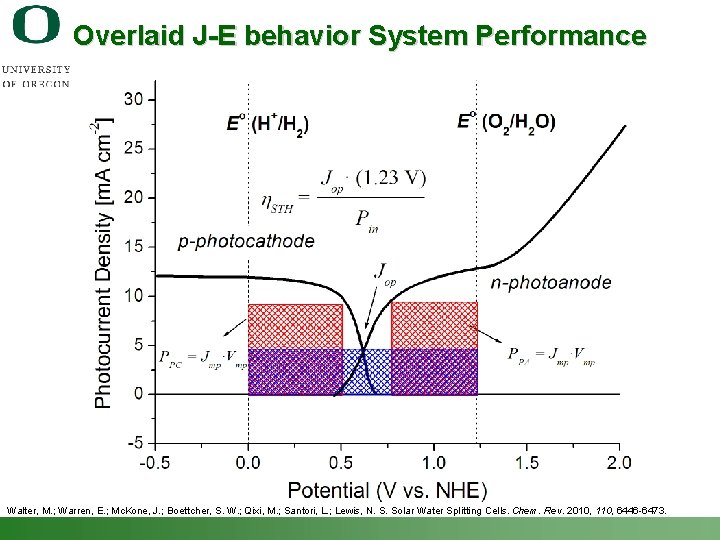
Overlaid J-E behavior System Performance Walter, M. ; Warren, E. ; Mc. Kone, J. ; Boettcher, S. W. ; Qixi, M. ; Santori, L. ; Lewis, N. S. Solar Water Splitting Cells. Chem. Rev. 2010, 110, 6446 -6473. Shannon Boettcher – ICMR Tutorial PEC Water Splitting 52
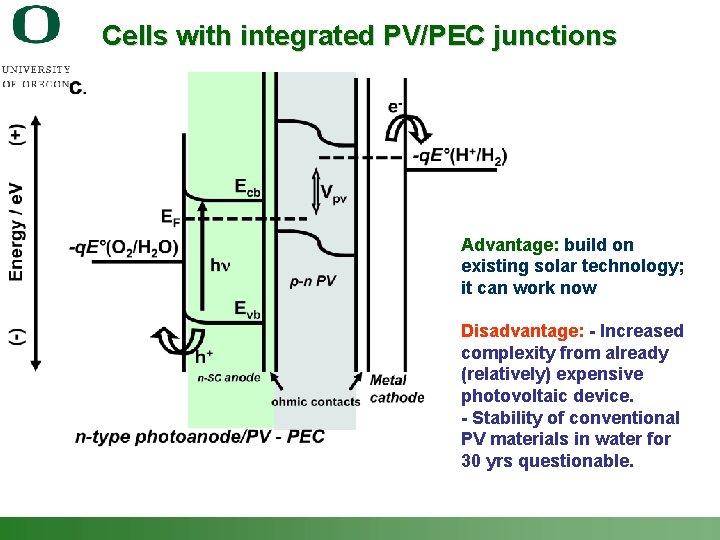
Cells with integrated PV/PEC junctions Advantage: build on existing solar technology; it can work now Disadvantage: - Increased complexity from already (relatively) expensive photovoltaic device. - Stability of conventional PV materials in water for 30 yrs questionable. Shannon Boettcher – ICMR Tutorial PEC Water Splitting 53
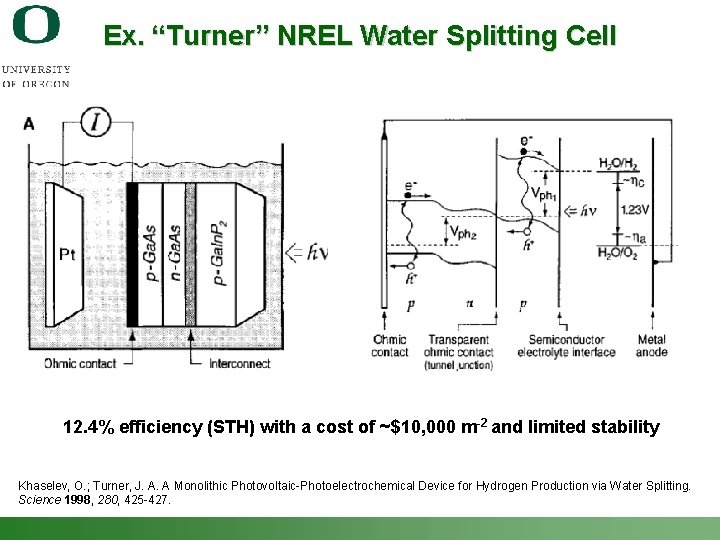
Ex. “Turner” NREL Water Splitting Cell 12. 4% efficiency (STH) with a cost of ~$10, 000 m-2 and limited stability Khaselev, O. ; Turner, J. A. A Monolithic Photovoltaic-Photoelectrochemical Device for Hydrogen Production via Water Splitting. Science 1998, 280, 425 -427. Shannon Boettcher – ICMR Tutorial PEC Water Splitting 54
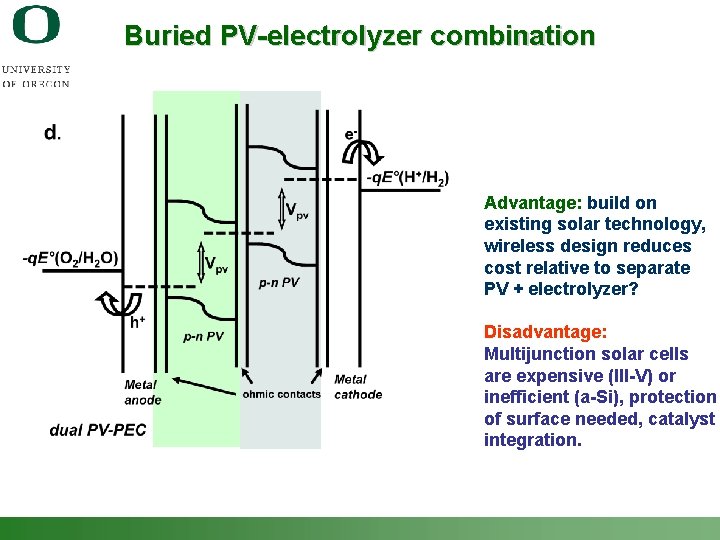
Buried PV-electrolyzer combination Advantage: build on existing solar technology, wireless design reduces cost relative to separate PV + electrolyzer? Disadvantage: Multijunction solar cells are expensive (III-V) or inefficient (a-Si), protection of surface needed, catalyst integration. Shannon Boettcher – ICMR Tutorial PEC Water Splitting 55
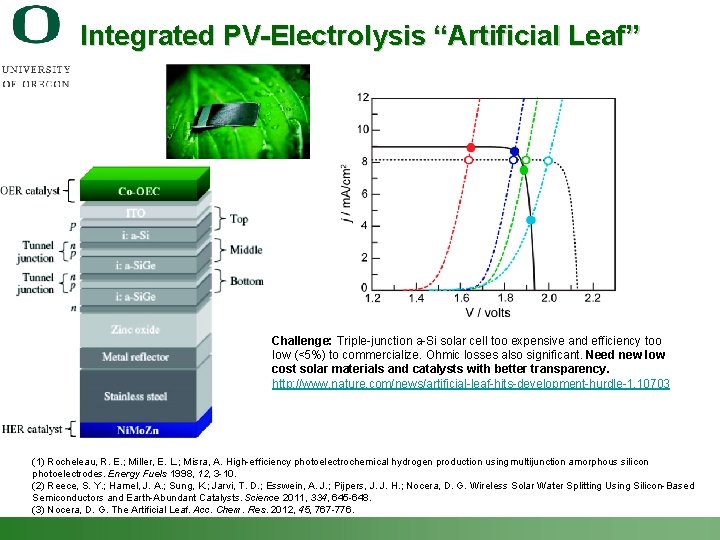
Integrated PV-Electrolysis “Artificial Leaf” Challenge: Triple-junction a-Si solar cell too expensive and efficiency too low (<5%) to commercialize. Ohmic losses also significant. Need new low cost solar materials and catalysts with better transparency. http: //www. nature. com/news/artificial-leaf-hits-development-hurdle-1. 10703 (1) Rocheleau, R. E. ; Miller, E. L. ; Misra, A. High-efficiency photoelectrochemical hydrogen production using multijunction amorphous silicon photoelectrodes. Energy Fuels 1998, 12, 3 -10. (2) Reece, S. Y. ; Hamel, J. A. ; Sung, K. ; Jarvi, T. D. ; Esswein, A. J. ; Pijpers, J. J. H. ; Nocera, D. G. Wireless Solar Water Splitting Using Silicon-Based Semiconductors and Earth-Abundant Catalysts. Science 2011, 334, 645 -648. (3) Nocera, D. G. The Artificial Leaf. Acc. Chem. Res. 2012, 45, 767 -776. Shannon Boettcher – ICMR Tutorial PEC Water Splitting 56
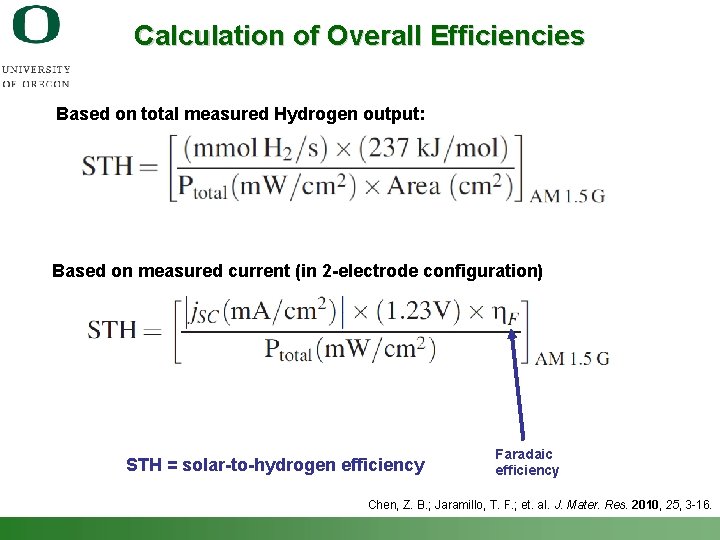
Calculation of Overall Efficiencies Based on total measured Hydrogen output: Based on measured current (in 2 -electrode configuration) STH = solar-to-hydrogen efficiency Faradaic efficiency Chen, Z. B. ; Jaramillo, T. F. ; et. al. J. Mater. Res. 2010, 25, 3 -16. Shannon Boettcher – ICMR Tutorial PEC Water Splitting 57
Acknowledgements Boettcher Group Summer 2012 Fuding Lin To all the mentors and co-workers. "If I have seen further, it is by standing on the shoulders of giants” - Isaac Newton. Andy Ritenour T. J. Mills Basic Energy Science Solar Photochemistry Lena Trotochaud Young Professor Program Shannon Boettcher – ICMR Tutorial PEC Water Splitting 58