
Tutorial Based Learning vs FreePlay in Competitive Video
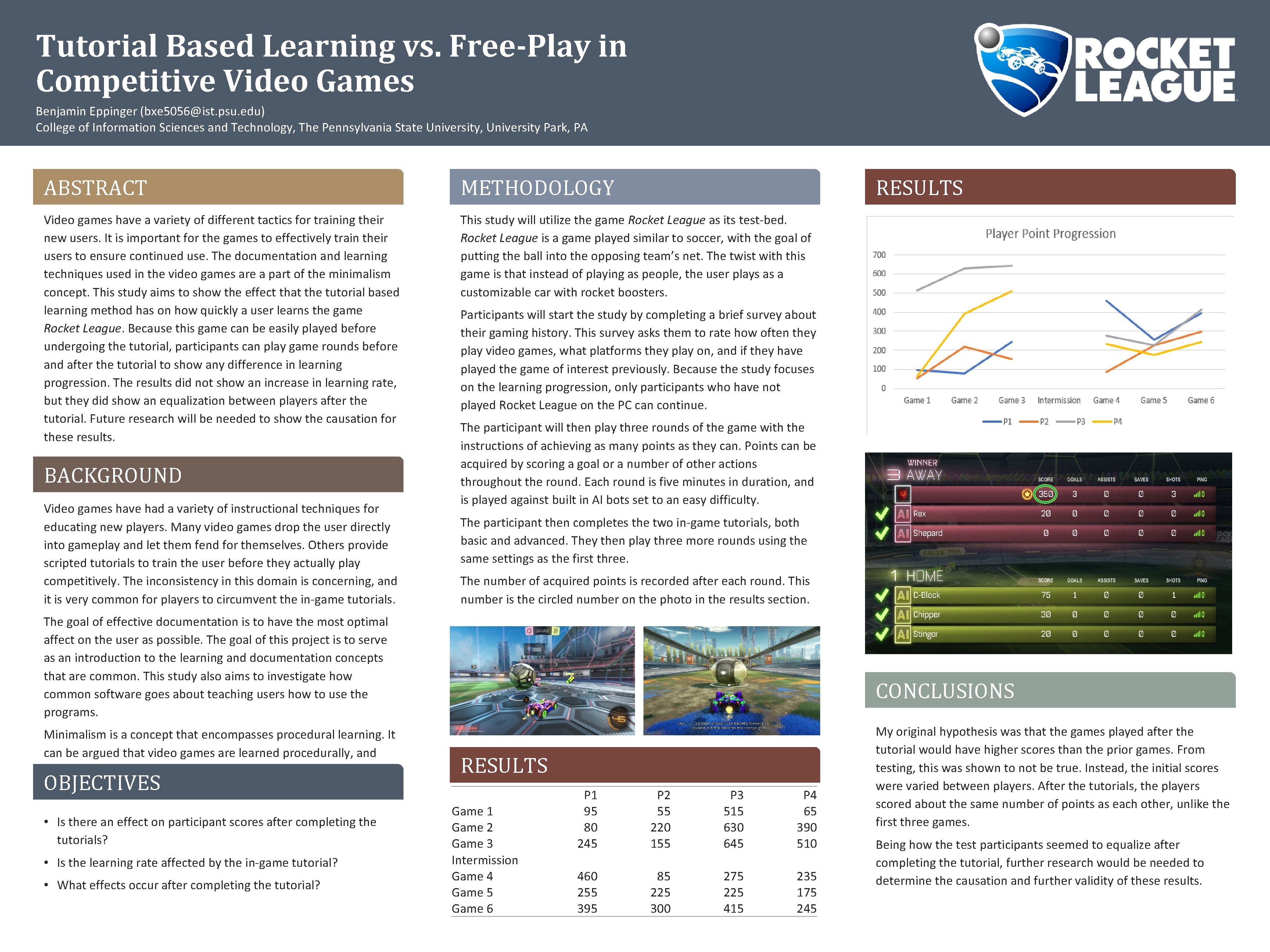
Tutorial Based Learning vs. Free-Play in Competitive Video Games Benjamin Eppinger (bxe 5056@ist. psu. edu) College of Information Sciences and Technology, The Pennsylvania State University, University Park, PA ABSTRACT METHODOLOGY Video games have a variety of different tactics for training their new users. It is important for the games to effectively train their users to ensure continued use. The documentation and learning techniques used in the video games are a part of the minimalism concept. This study aims to show the effect that the tutorial based learning method has on how quickly a user learns the game Rocket League. Because this game can be easily played before undergoing the tutorial, participants can play game rounds before and after the tutorial to show any difference in learning progression. The results did not show an increase in learning rate, but they did show an equalization between players after the tutorial. Future research will be needed to show the causation for these results. This study will utilize the game Rocket League as its test-bed. Rocket League is a game played similar to soccer, with the goal of putting the ball into the opposing team’s net. The twist with this game is that instead of playing as people, the user plays as a customizable car with rocket boosters. BACKGROUND Video games have had a variety of instructional techniques for educating new players. Many video games drop the user directly into gameplay and let them fend for themselves. Others provide scripted tutorials to train the user before they actually play competitively. The inconsistency in this domain is concerning, and it is very common for players to circumvent the in-game tutorials. RESULTS Participants will start the study by completing a brief survey about their gaming history. This survey asks them to rate how often they play video games, what platforms they play on, and if they have played the game of interest previously. Because the study focuses on the learning progression, only participants who have not played Rocket League on the PC can continue. The participant will then play three rounds of the game with the instructions of achieving as many points as they can. Points can be acquired by scoring a goal or a number of other actions throughout the round. Each round is five minutes in duration, and is played against built in AI bots set to an easy difficulty. The participant then completes the two in-game tutorials, both basic and advanced. They then play three more rounds using the same settings as the first three. The number of acquired points is recorded after each round. This number is the circled number on the photo in the results section. The goal of effective documentation is to have the most optimal affect on the user as possible. The goal of this project is to serve as an introduction to the learning and documentation concepts that are common. This study also aims to investigate how common software goes about teaching users how to use the programs. Minimalism is a concept that encompasses procedural learning. It can be argued that video games are learned procedurally, and there are minimalistic aspects to the learning patterns. OBJECTIVES • Is there an effect on participant scores after completing the tutorials? • Is the learning rate affected by the in-game tutorial? • What effects occur after completing the tutorial? CONCLUSIONS RESULTS Game 1 Game 2 Game 3 Intermission Game 4 Game 5 Game 6 P 1 95 80 245 P 2 55 220 155 P 3 515 630 645 P 4 65 390 510 460 255 395 85 225 300 275 225 415 235 175 245 My original hypothesis was that the games played after the tutorial would have higher scores than the prior games. From testing, this was shown to not be true. Instead, the initial scores were varied between players. After the tutorials, the players scored about the same number of points as each other, unlike the first three games. Being how the test participants seemed to equalize after completing the tutorial, further research would be needed to determine the causation and further validity of these results.
- Slides: 1