
Tutorial 4 Review question 1 p 184 Review
- Slides: 11
Tutorial 4 • Review question 1, p. 184 • Review question 5, p. 184 • Review question 7, p. 184 Copyright 2008 Mc. Graw-Hill Australia Pty Ltd PPTs t/a Macroeconomics 2 e by Bernanke Olekalns and Frank Slides prepared by Anne Gleeson, Flinders University 6 -1
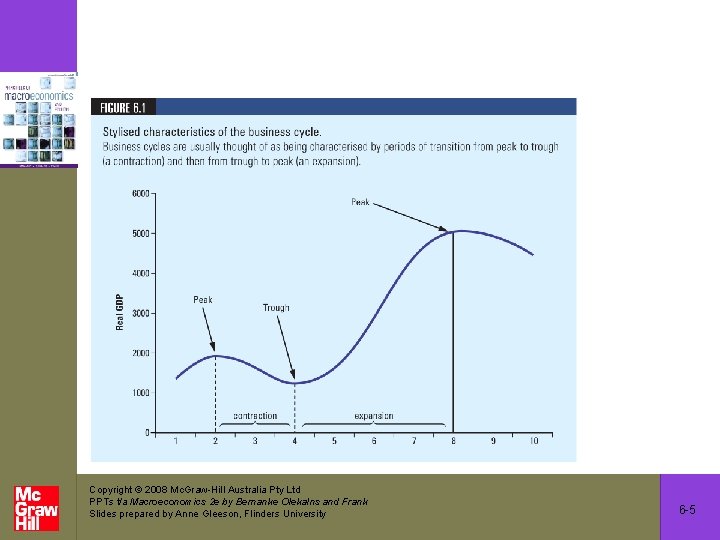
Review question 1, p. 184 • Define contraction and expansion. What are the beginning and ending points of a recession called? In post-war Australia, which have been longer on average—contraction or expansion? Copyright 2008 Mc. Graw-Hill Australia Pty Ltd PPTs t/a Macroeconomics 2 e by Bernanke Olekalns and Frank Slides prepared by Anne Gleeson, Flinders University 6 -2
Copyright 2008 Mc. Graw-Hill Australia Pty Ltd PPTs t/a Macroeconomics 2 e by Bernanke Olekalns and Frank Slides prepared by Anne Gleeson, Flinders University 6 -3
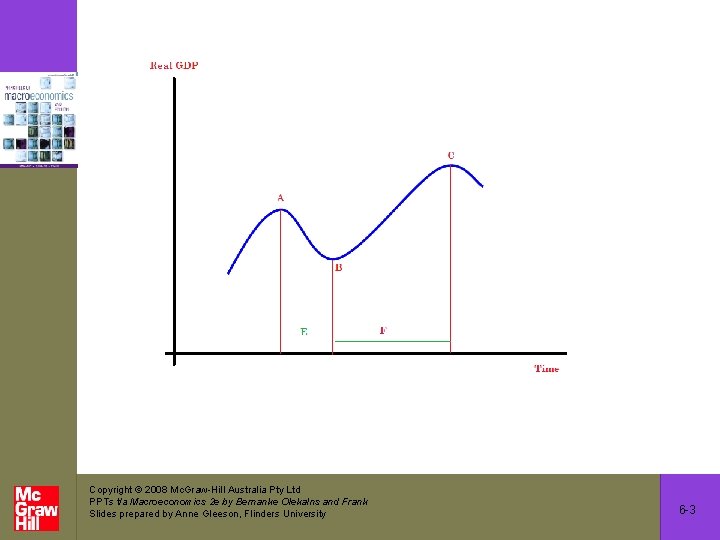
• Contraction: A period in which the economy is moving from a peak to a trough. • Expansion: A period in which the economy is moving from a trough to a peak. • The beginning of a contraction is called the peak (the point at which economic activity reaches its highest point and begins to decline) • The end point of a contraction (and the beginning of the expansion) is called a trough. • In post-war Australia, expansions have been considerably longer than recessions on average. Copyright 2008 Mc. Graw-Hill Australia Pty Ltd PPTs t/a Macroeconomics 2 e by Bernanke Olekalns and Frank Slides prepared by Anne Gleeson, Flinders University 6 -4
Copyright 2008 Mc. Graw-Hill Australia Pty Ltd PPTs t/a Macroeconomics 2 e by Bernanke Olekalns and Frank Slides prepared by Anne Gleeson, Flinders University 6 -5
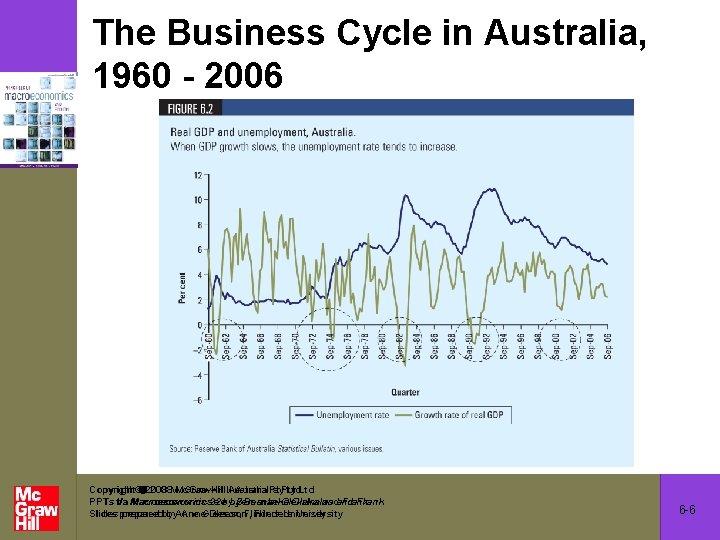
The Business Cycle in Australia, 1960 - 2006 Copyright 2008 Mc. Graw-Hill Australia Pty Ltd PPTs t/a Macroeconomics 2 e 2 ebyby Bernanke Olekalns andand Frank Slides preparedby by. Anne. Gleeson, Flinders University 6 -6
Review question 5, p. 184 • Define potential output. Is it possible for an economy to produce an amount greater than potential output? Explain. Copyright 2008 Mc. Graw-Hill Australia Pty Ltd PPTs t/a Macroeconomics 2 e by Bernanke Olekalns and Frank Slides prepared by Anne Gleeson, Flinders University 6 -7
• Potential output, or potential GDP, is the amount of output the economy can produce when it is using its inputs, such as capital and labour, at normal rates. • Inputs can be used at greater than normal rates for a time (for example, workers can work overtime and machines can be used at night or on weekends), • Therefore, it is possible for the economy to produce an amount exceeding potential output. Copyright 2008 Mc. Graw-Hill Australia Pty Ltd PPTs t/a Macroeconomics 2 e by Bernanke Olekalns and Frank Slides prepared by Anne Gleeson, Flinders University 6 -8
Review question 7, p. 184 • True or false: When output equals potential output, the unemployment rate is zero. Explain. Copyright 2008 Mc. Graw-Hill Australia Pty Ltd PPTs t/a Macroeconomics 2 e by Bernanke Olekalns and Frank Slides prepared by Anne Gleeson, Flinders University 6 -9
• False. • When output = potential output, the unemployment rate = the natural unemployment rate. • Cyclical unemployment is zero when output equals potential output, but frictional and structural unemployment still exist. Copyright 2008 Mc. Graw-Hill Australia Pty Ltd PPTs t/a Macroeconomics 2 e by Bernanke Olekalns and Frank Slides prepared by Anne Gleeson, Flinders University 6 -10
• Natural unemployment rate = frictional plus structural unemployment. – Frictional unemployment related to job search – Structural unemployment related to mismatch • Natural unemployment exists independently of whether the economy is in expansion or contraction. • Cyclical unemployment is the extra unemployment that occurs during a recession. Copyright 2008 Mc. Graw-Hill Australia Pty Ltd PPTs t/a Macroeconomics 2 e by Bernanke Olekalns and Frank Slides prepared by Anne Gleeson, Flinders University 6 -11