
TUTORIAL 3 Question 1 A packed bed is
TUTORIAL 3

Question 1 A packed bed is composed of cylinders having a diameter D = 0. 02 m and a length h = D. The bulk density of the overall packed bed is 962 kg/m 3 and the density of the solid cylinders is 1600 kg/m 3. a) Calculate the void fraction, ε. b) Calculate the effective diameter Dp of the particles. c) Calculate the value of a.
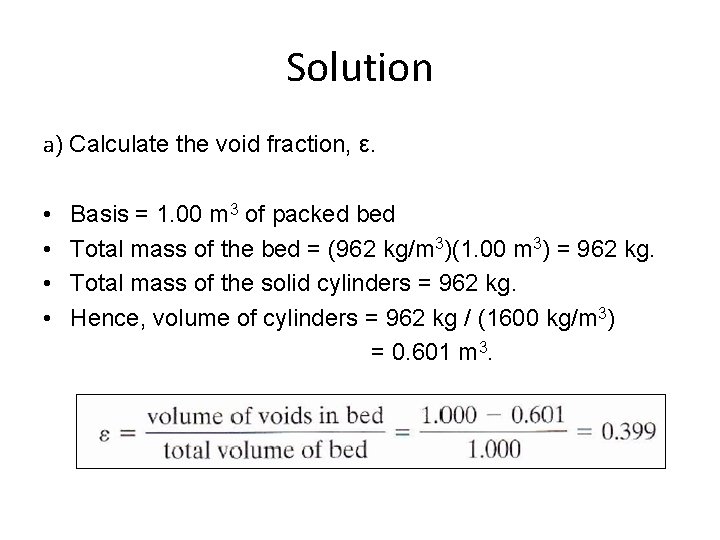
Solution a) Calculate the void fraction, ε. • • Basis = 1. 00 m 3 of packed bed Total mass of the bed = (962 kg/m 3)(1. 00 m 3) = 962 kg. Total mass of the solid cylinders = 962 kg. Hence, volume of cylinders = 962 kg / (1600 kg/m 3) = 0. 601 m 3.

b) Calculate the effective diameter Dp of the particles. • For a cylinder where h = D, the surface area of a particle is: • The volume of the particle:
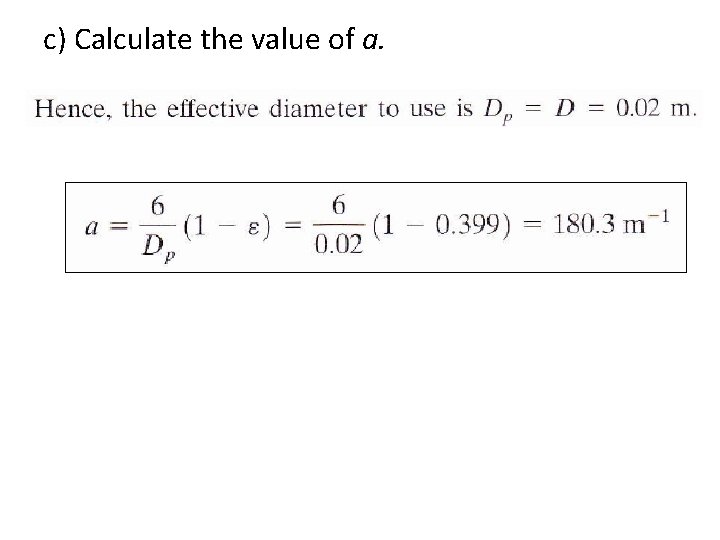
c) Calculate the value of a.
Question 2 Settling Velocity of Oil Droplets Oil droplets having diameter of 20 μm are to be settled from air with a density of 1. 137 kg/m 3 and viscosity of 1. 9 x 10 -5 Pa. s. Meanwhile, the density of the oil is 900 kg/m 3. The droplet will be assumed to be a rigid sphere. a) Determine the drag coefficient, CD for the oil droplets as a function of terminal settling velocity, ut. b) Calculate the terminal velocity of the droplets if the Reynolds number is 0. 012.
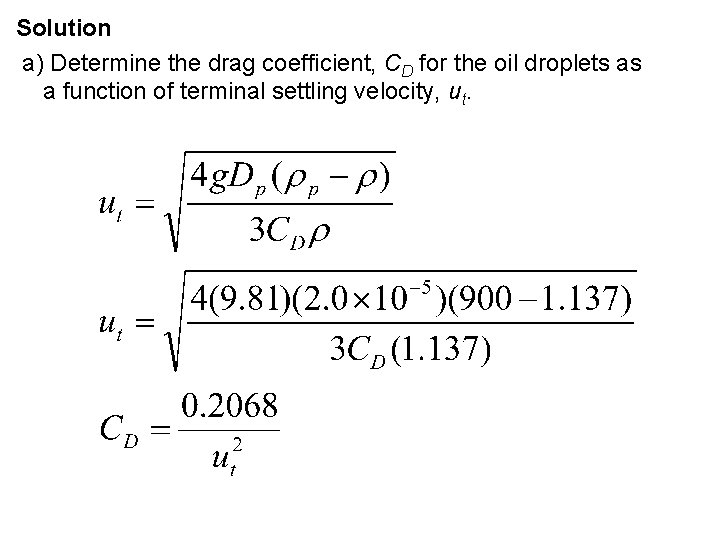
Solution a) Determine the drag coefficient, CD for the oil droplets as a function of terminal settling velocity, ut.

b) Calculate the terminal velocity of the droplets if the Reynolds number is 0. 012. • For Re < 1 (Stokes Law applied - laminar flow)
Question 3 Hindered Settling of Glass Spheres Calculate the settling velocity of glass spheres having a diameter of 1. 554 x 10 -4 m in water at 20ºC. The slurry contains 60 wt % solids. The density of the glass sphere and water is 2467 kg/m 3 and 998 kg/m 3, respectively. The viscosity of water is 1. 005 x 10 -3 Pa. s.
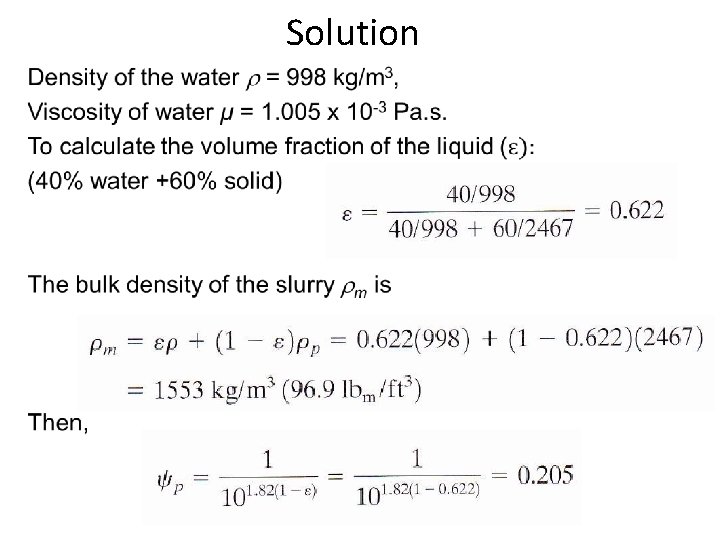
Solution •

The terminal velocity for hindered settling is: The Reynolds number can be calculated as follows: NRe Since the NRe < 1. 0, therefore the settling is in the Stoke’s law range.
Question 4 Fluidization A bed of ion exchange beads 8 ft deep is to be backwashed with water to remove dirt. The particles have a density of 1. 24 g/cm 3 and an average size of 1. 1 mm. The beads are assumed to be spherical (Φ =1) and is taken as 0. 4. a) What is the minimum fluidization velocity using water at 20ºC with density of 1. 00 g/cm 3? the viscosity of water is 0. 01 g/cm. s. b) Calculate the particle Reynolds number.

Solution 2
- Slides: 13