
Turning your Prewriting into a Draft English 99101
- Slides: 11
Turning your Prewriting into a Draft English 99/101
Purpose of Prewriting l Generating Ideas l Developing as Many Options as Possible l Reviewing/Selecting Ideas to Find the Most Applicable Ones l Finding Connections with and Information about the Topic (What do I have to Say about a Topic? )
Purpose of Drafting
Transitions l Because the purposes are significantly different, prewriting & drafting are two separate & distinct processes l You can move back & forth between the processes if necessary
Tip #1: Developing Ideas listed in your outlines/other methods usually have little “meat” to them l Your final paper should have fully developed examples with lots of specific details and information l Focus on developing ideas within the specific examples, concepts or topics that you decide to work with
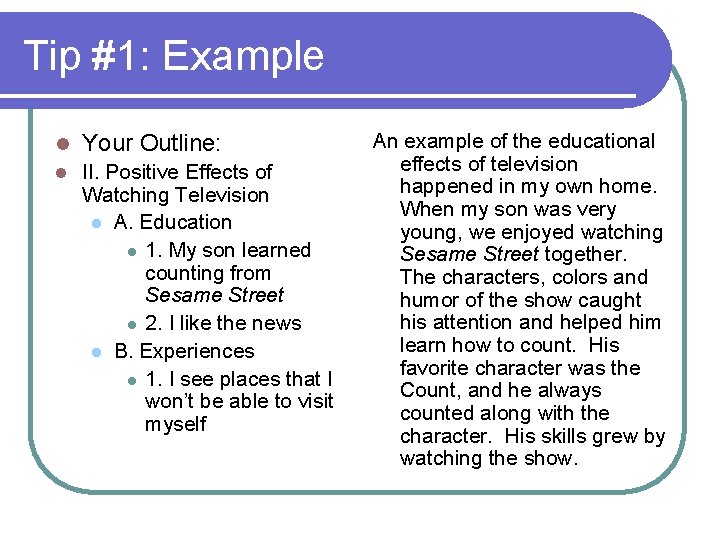
Tip #1: Example l Your Outline: l II. Positive Effects of Watching Television l A. Education l 1. My son learned counting from Sesame Street l 2. I like the news l B. Experiences l 1. I see places that I won’t be able to visit myself An example of the educational effects of television happened in my own home. When my son was very young, we enjoyed watching Sesame Street together. The characters, colors and humor of the show caught his attention and helped him learn how to count. His favorite character was the Count, and he always counted along with the character. His skills grew by watching the show.
Tip #2: Don’t Expect Perfection l Make sure that you know drafting is not the last step in the process l If you get stuck on selecting a word or finding the right example or quote, simply use a space saver [a * or ? or the next best word] and move on l Remember this: “A draft is something the wind blows through”
Tip # 3: Know the Final Format Make sure that you have a good idea about the final format of the essay that you are working with, including the total number of paragraphs and the final length l Use your understanding of the parameters of the assignment to help you focus your energy on the most important aspects of the paper. In other words, don’t do too much or too little for the final product l
Tip #3: Example l If you have a three-page paper on a historical figure, consider these questions: l l How much research or reading is required to complete this assignment? What amount of information is possible to include in a three-page paper? What are the most important aspects of the person’s life? How many body paragraphs will the final essay have?
Tip #4: Working Out of Order l The best process does not always include starting at line one, page one and writing to the end l Moving around from paragraph to paragraph when you are struggling to complete a draft can help you continue to work even when you feel “blocked”
Final Thoughts l Drafting is only the second step in the process, but it is a significant one l See your book, Chapters 2 & 3 l Make sure to “work smart, not just hard”