
Turning national guidance into local reality Julie Windsor


- Slides: 28
Turning national guidance into local reality Julie Windsor Patient Safety Clinical Lead – Medical Specialties/ Older People 13 th October 2016
What I’m going to cover. v Links between national audit data and other drivers to enhance improvement work v Engaging with patients to ensure data improves services important to them v Linking data with CQC inspection v NHS Improvement Falls Collaborative
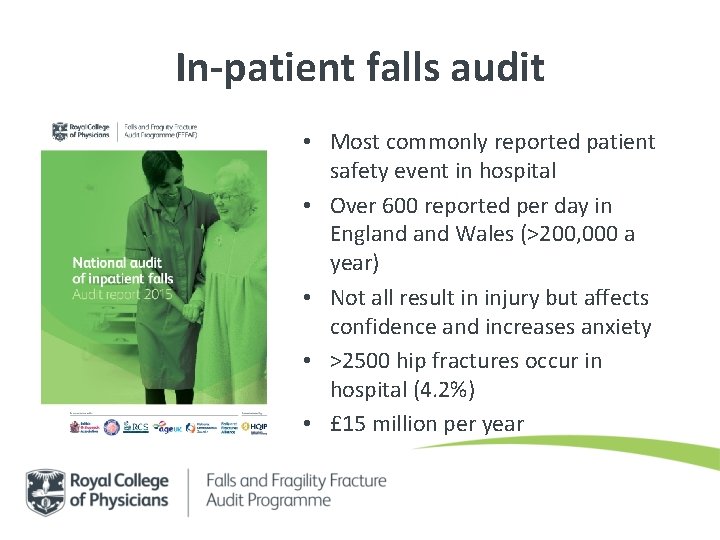
In-patient falls audit • Most commonly reported patient safety event in hospital • Over 600 reported per day in England Wales (>200, 000 a year) • Not all result in injury but affects confidence and increases anxiety • >2500 hip fractures occur in hospital (4. 2%) • £ 15 million per year
How do we prevent falls in hospital? • No easy answer • Multiple interventions performed by MDT reduces falls by 20 -30% • Patients with dementia and delirium at particular risk • NICE CG 161 and NPSA guidance • Audited all hospitals in England Wales (and Northern Ireland)
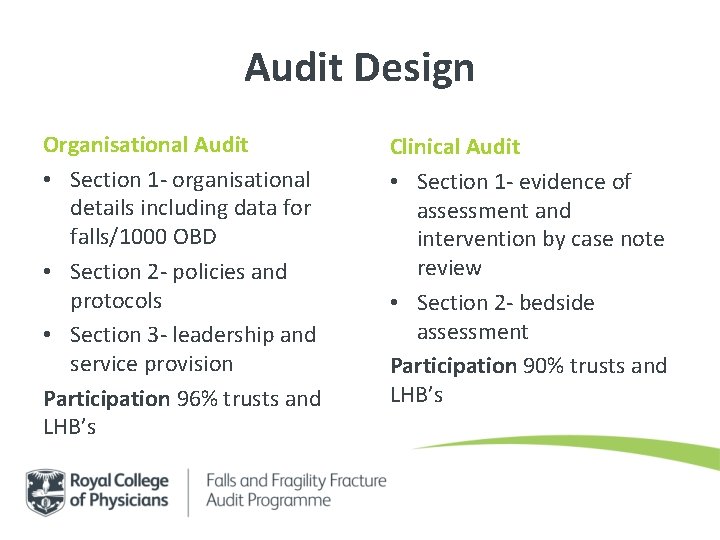
Audit Design Organisational Audit • Section 1 - organisational details including data for falls/1000 OBD • Section 2 - policies and protocols • Section 3 - leadership and service provision Participation 96% trusts and LHB’s Clinical Audit • Section 1 - evidence of assessment and intervention by case note review • Section 2 - bedside assessment Participation 90% trusts and LHB’s
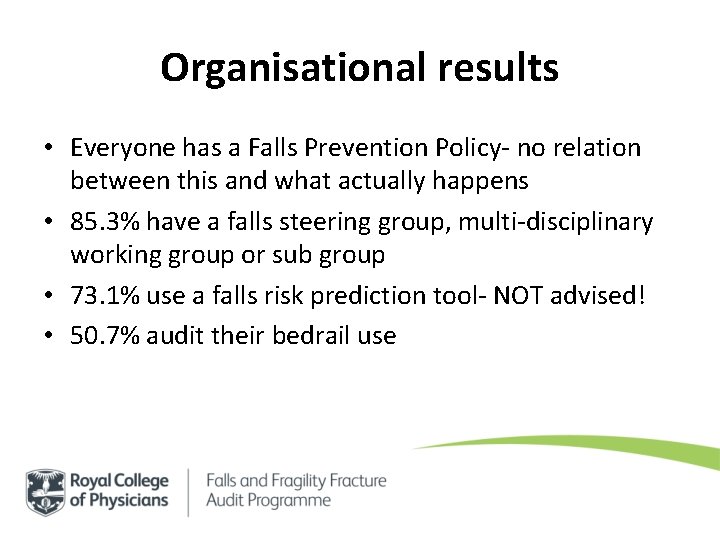
Organisational results • Everyone has a Falls Prevention Policy- no relation between this and what actually happens • 85. 3% have a falls steering group, multi-disciplinary working group or sub group • 73. 1% use a falls risk prediction tool- NOT advised! • 50. 7% audit their bedrail use
Key recommendations for Trusts and LHB’s 1 Falls steering group –board-level falls steering group that has representation from and reports to the board. Review trends in falls/1000 OBD’s 2 Falls multidisciplinary working group –that meets regularly, and that they reviews the activities of the falls service. This group should monitor interventions to improve prevention of falls in hospital and use proven methods to embed these changes.
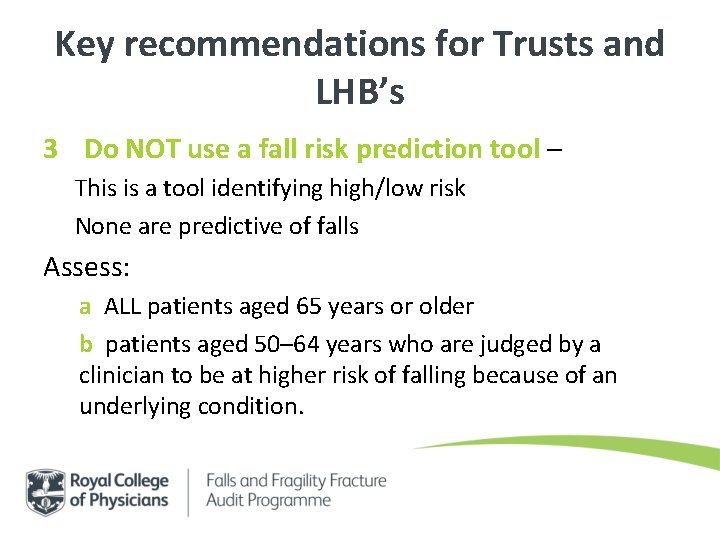
Key recommendations for Trusts and LHB’s 3 Do NOT use a fall risk prediction tool – This is a tool identifying high/low risk None are predictive of falls Assess: a ALL patients aged 65 years or older b patients aged 50– 64 years who are judged by a clinician to be at higher risk of falling because of an underlying condition.
Key recommendations for Trusts and LHB’s 4 Audit bed rail use –regularly audit the use of bed rails against their policy and embed changes to ensure appropriate use. 5 Review multifactorial falls risk assessments (MFRAs) – review their MFRA and associated interventions to include all the domains in this audit.
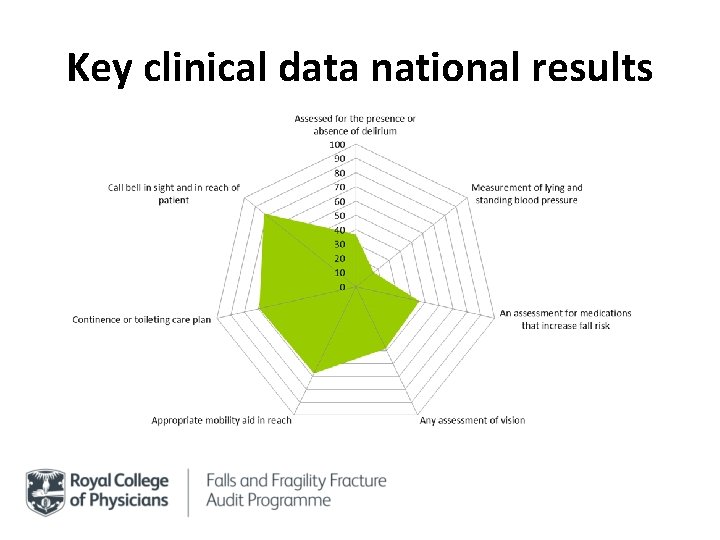
Key clinical data national results
Or put another way… • • 6/7 patients didn’t have a l and s BP Half didn’t have a clear medication review 2/3 didn’t have a delirium assessment Half didn’t have a vision assessment 1/3 couldn’t reach their mobility aid 1/5 couldn’t reach their call bell So there is a lot of room for improvement!
Key indicator recommendations 6 Dementia and delirium –review their dementia and delirium policies to embed the use of standardised tools and documented relevant care plans. Falls teams should work closely with dementia and delirium teams (if present) to ensure team working for these high-risk patients.
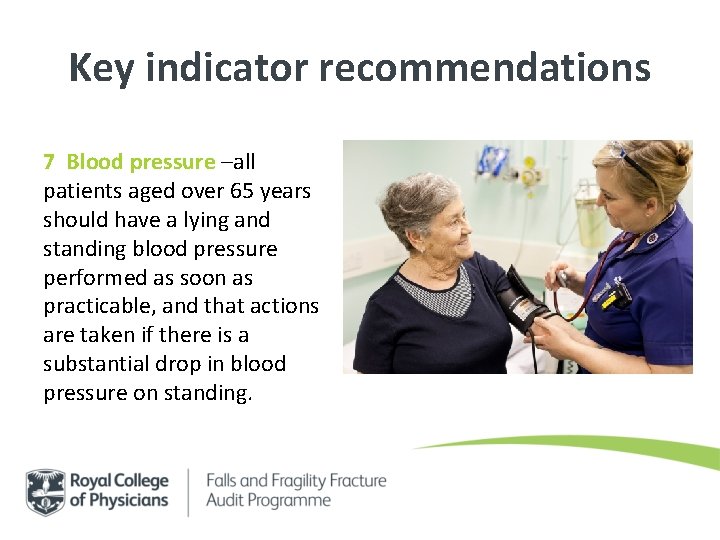
Key indicator recommendations 7 Blood pressure –all patients aged over 65 years should have a lying and standing blood pressure performed as soon as practicable, and that actions are taken if there is a substantial drop in blood pressure on standing.
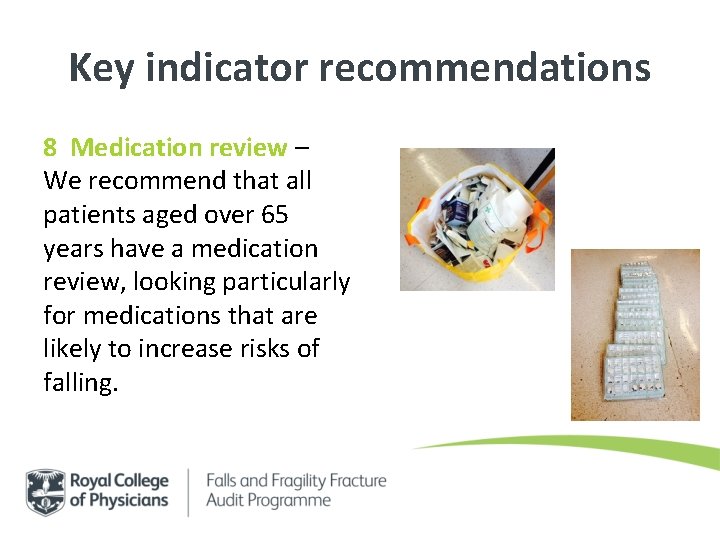
Key indicator recommendations 8 Medication review – We recommend that all patients aged over 65 years have a medication review, looking particularly for medications that are likely to increase risks of falling.
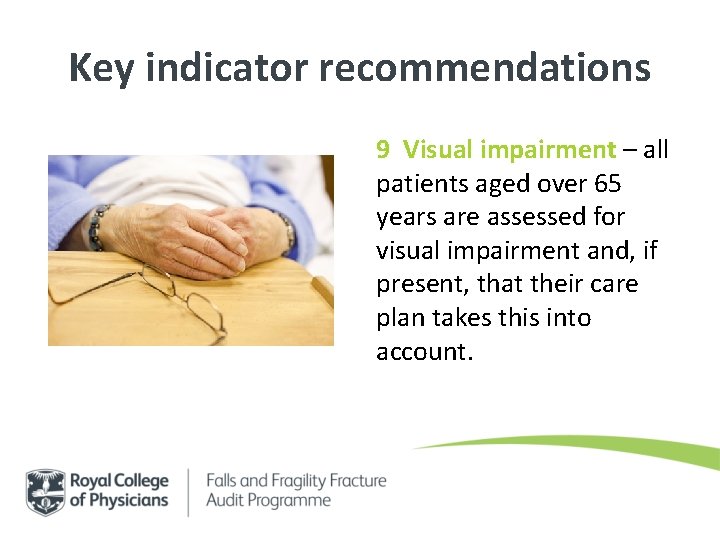
Key indicator recommendations 9 Visual impairment – all patients aged over 65 years are assessed for visual impairment and, if present, that their care plan takes this into account.
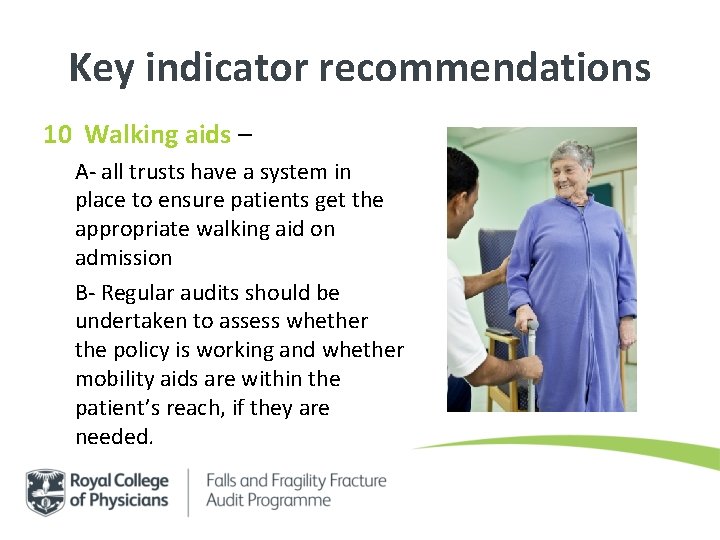
Key indicator recommendations 10 Walking aids – A- all trusts have a system in place to ensure patients get the appropriate walking aid on admission B- Regular audits should be undertaken to assess whether the policy is working and whether mobility aids are within the patient’s reach, if they are needed.
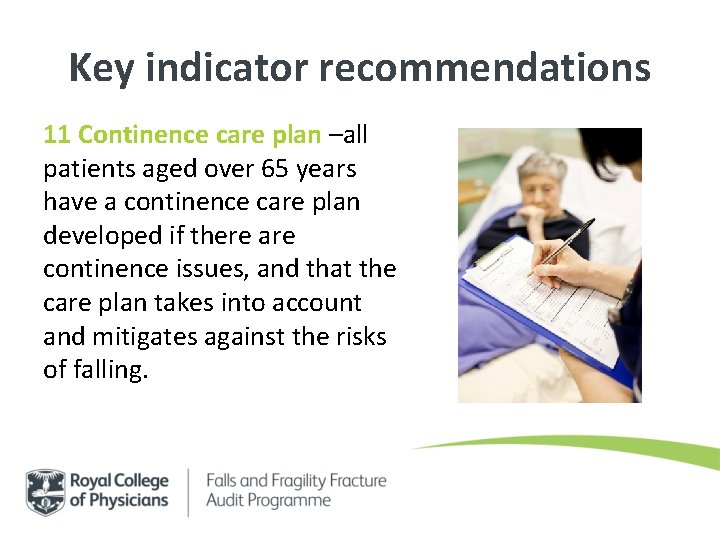
Key indicator recommendations 11 Continence care plan –all patients aged over 65 years have a continence care plan developed if there are continence issues, and that the care plan takes into account and mitigates against the risks of falling.
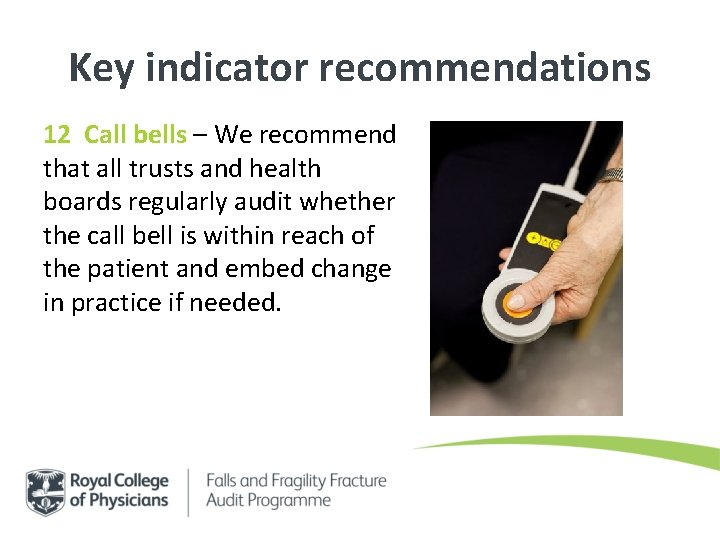
Key indicator recommendations 12 Call bells – We recommend that all trusts and health boards regularly audit whether the call bell is within reach of the patient and embed change in practice if needed.
CQC Inspection – a driver for improvement 20
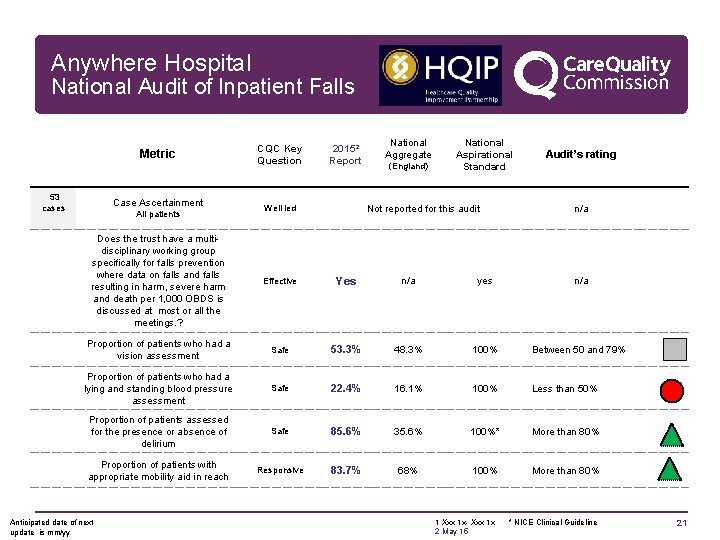
Anywhere Hospital National Audit of Inpatient Falls Metric 53 cases Case Ascertainment All patients CQC Key Question 2015² Report National Aggregate (England) National Aspirational Standard Not reported for this audit Well led Audit’s rating n/a Does the trust have a multidisciplinary working group specifically for falls prevention where data on falls and falls resulting in harm, severe harm and death per 1, 000 OBDS is discussed at most or all the meetings. ? Effective Yes n/a yes n/a Proportion of patients who had a vision assessment Safe 53. 3% 48. 3% 100% Between 50 and 79% Proportion of patients who had a lying and standing blood pressure assessment Safe 22. 4% 16. 1% 100% Less than 50% Proportion of patients assessed for the presence or absence of delirium Safe 85. 6% 35. 6% 100%* More than 80% Proportion of patients with appropriate mobility aid in reach Responsive 83. 7% 68% 100% More than 80% Anticipated date of next update is mm/yy 1 Xxx 1 x- Xxx 1 x 2 May 15 * NICE Clinical Guideline 21
NHS Improvement – support for improvement 22
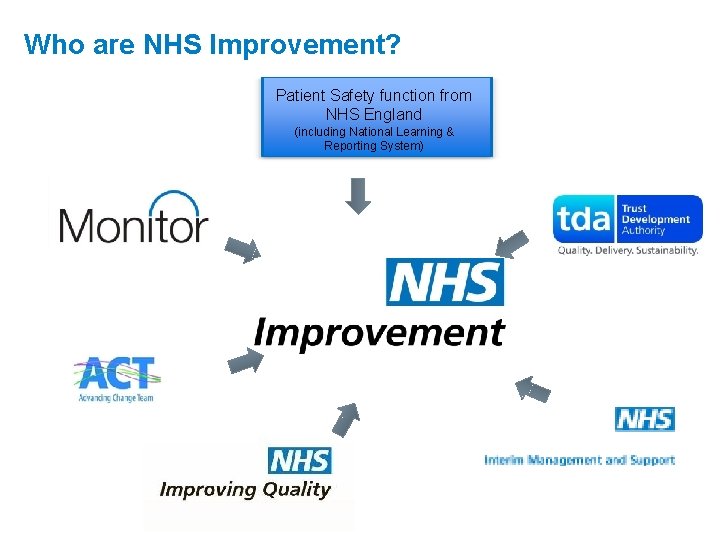
Who are NHS Improvement? Patient Safety function from NHS England (including National Learning & Reporting System)
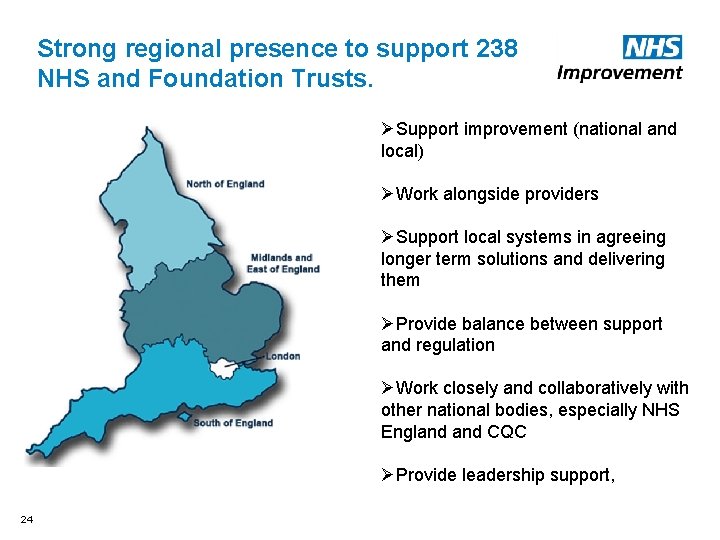
Strong regional presence to support 238 NHS and Foundation Trusts. ØSupport improvement (national and local) ØWork alongside providers ØSupport local systems in agreeing longer term solutions and delivering them ØProvide balance between support and regulation ØWork closely and collaboratively with other national bodies, especially NHS England CQC ØProvide leadership support, 24
Key role to share best practice and reduce variation Ø Develop a national approach to improvement that supports local capability, aspiration and energy. Ø Ensure focus is on the quality of patient care. Ø Create a culture of continuous improvement. Ø Current nurse led improvement programmes include: o o 25 Pressure Ulcers 1: 1 Nurse care Infection, Prevention & Control Collaborative Falls Collaborative launches on 19 th October.
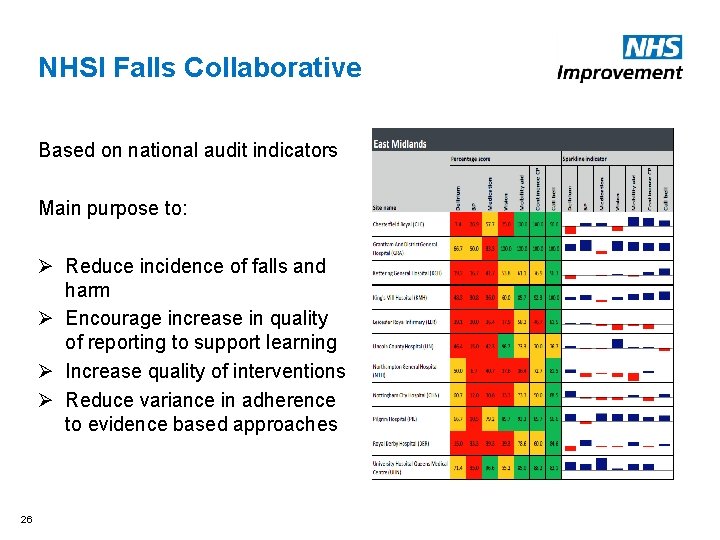
NHSI Falls Collaborative Based on national audit indicators Main purpose to: Ø Reduce incidence of falls and harm Ø Encourage increase in quality of reporting to support learning Ø Increase quality of interventions Ø Reduce variance in adherence to evidence based approaches 26
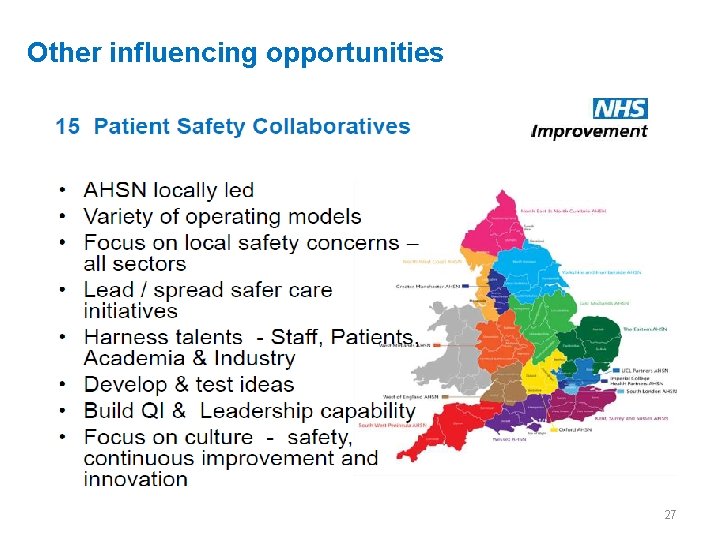
Other influencing opportunities 27
Summing up Ø National audit extremely well taken up Ø Provided high quality data Ø Focussed provider and national body attention Ø Provided a ‘road map’ for improvement Thanks for listening …Any questions? jwindsor@nhs. net 28