
Turning Math Attractive to Computer Science Students An
- Slides: 17
Turning Math Attractive to Computer Science Students: An Applicationto-Model Approach Aleardo Manacero Jr. Norian Marranghello DCCE/UNESP/Brazil DCCE/Ibilce/UNESP - 1999 1
The problem: n n CS students doesn´t expect math Math instructors are not familiar; with math applications on CS; or Are not trusted by the students; The lack of interest in math at freshman time implies in a poor learning of the complex computing subjects at senior time. DCCE/Ibilce/UNESP - 1999 2
Why math is a trouble n n Computers are more attractive; Students can´t devise applications for its theoretical subjects; Math instructors do not have time and knowledge to find such apps; It is naturally a hard subject. DCCE/Ibilce/UNESP - 1999 3
Usual solutions n Leave the problem to the math instructors OR n Insert a design course in the freshman year (as coalition colleges do) DCCE/Ibilce/UNESP - 1999 4
Our solution n Insert a “computer applications” course where: u Math subjects are explained after an application has demanded for them; u Feeling about complexity precedes theoric models. DCCE/Ibilce/UNESP - 1999 5
Its development n n For a given math subject find an application that uses it as a model; Spend some time teaching the application; Explain theoretical model for such application; Show this model is developed from a certain math subject. DCCE/Ibilce/UNESP - 1999 6
Difficulties n What application should be taught? u. A familiar one; u An attractive one. n What level of complexity should be given? u Not to deep, not to superficial; u Varies from class to class. DCCE/Ibilce/UNESP - 1999 7
Typical applications n n Graphical applications, either in computer graphics or image processing; Network applications (as demand projections, traffic control, etc. ). DCCE/Ibilce/UNESP - 1999 8
Things to avoid n n n Concentrate applications on a certain field; Make the subject looks too easy or too complex; Forget that the students are freshman and do not know most of the math involved. DCCE/Ibilce/UNESP - 1999 9
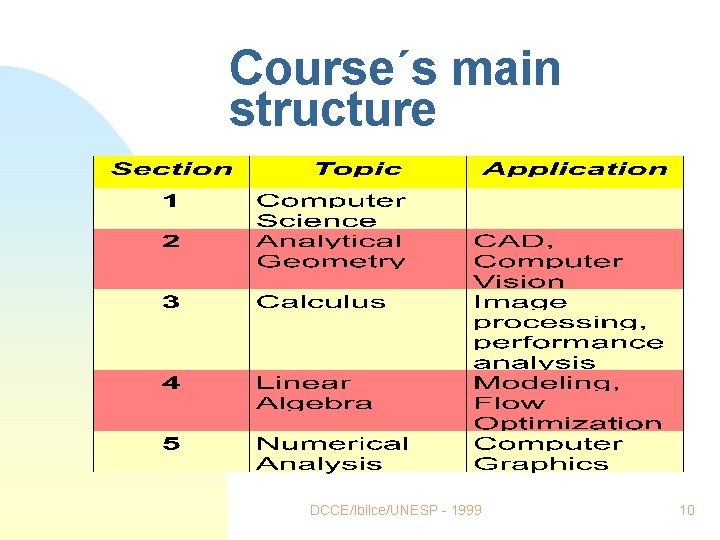
Course´s main structure DCCE/Ibilce/UNESP - 1999 10
Examples n Geometry u Demonstrate a CAD session u Describe its functional components u Compare pixel and geometrical representations u Show its interaction with analytical geometry DCCE/Ibilce/UNESP - 1999 11
Examples n Computer vision u Recognizing geometrical entities u Using Hough transforms to recognize geometrical forms DCCE/Ibilce/UNESP - 1999 12
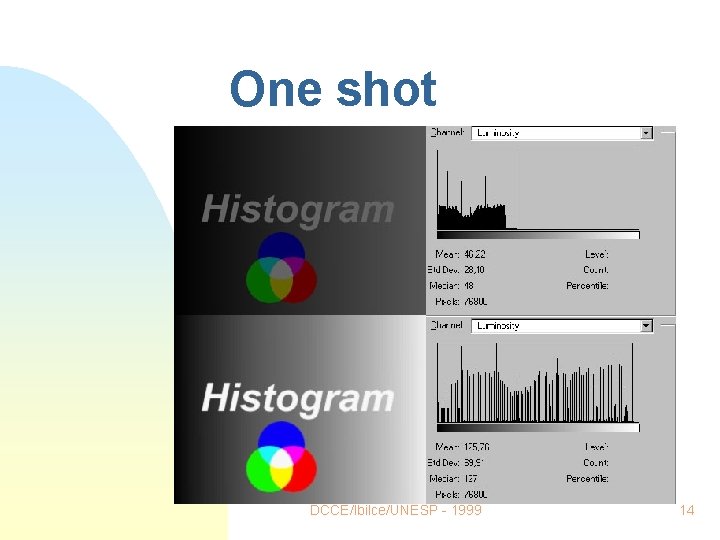
Examples n Calculus u Image filtering is shown to enhance image quality u Students see the filtering with histogram equalization u Histogram equalization is explained, starting from calculus up to theory of probabilities DCCE/Ibilce/UNESP - 1999 13
One shot DCCE/Ibilce/UNESP - 1999 14
Examples n Network demand u Explain why a future demand is important u Explain how it may be predicted u Show the link between queueing theory - probabilities - calculus DCCE/Ibilce/UNESP - 1999 15
Conclusions n n Abandoning rates dropped from 23% to 6% in just three years Reproval rates dropped from 18% to 8% in the same period Understanding of more complex subjects is rising Some adjustments still have to be done DCCE/Ibilce/UNESP - 1999 16
Contacts: n E-mails to: u aleardo@dcce. ibilce. unesp. br u norian@dcce. ibilce. unesp. br DCCE/Ibilce/UNESP - 1999 17