
TURNING MACHINE 2 axis xz Machining operations of
- Slides: 32
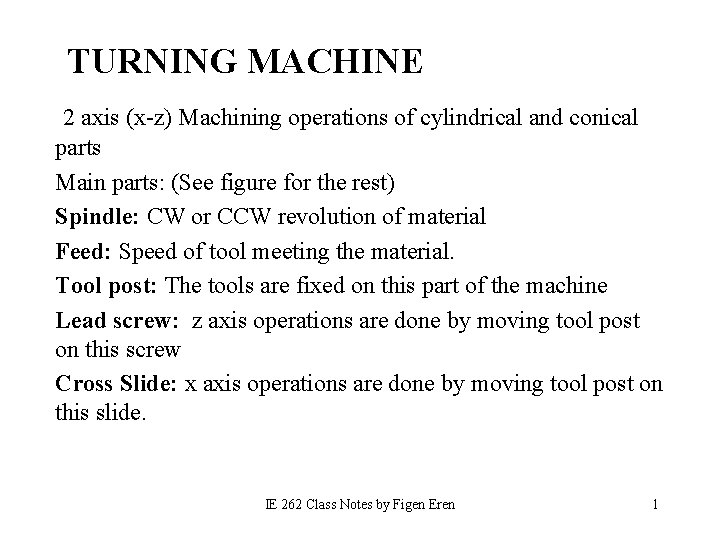
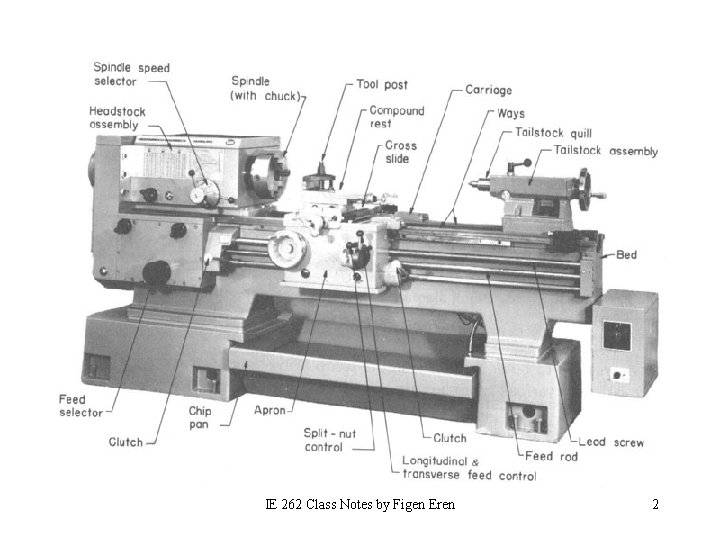
TURNING MACHINE 2 axis (x-z) Machining operations of cylindrical and conical parts Main parts: (See figure for the rest) Spindle: CW or CCW revolution of material Feed: Speed of tool meeting the material. Tool post: The tools are fixed on this part of the machine Lead screw: z axis operations are done by moving tool post on this screw Cross Slide: x axis operations are done by moving tool post on this slide. IE 262 Class Notes by Figen Eren 1
IE 262 Class Notes by Figen Eren 2
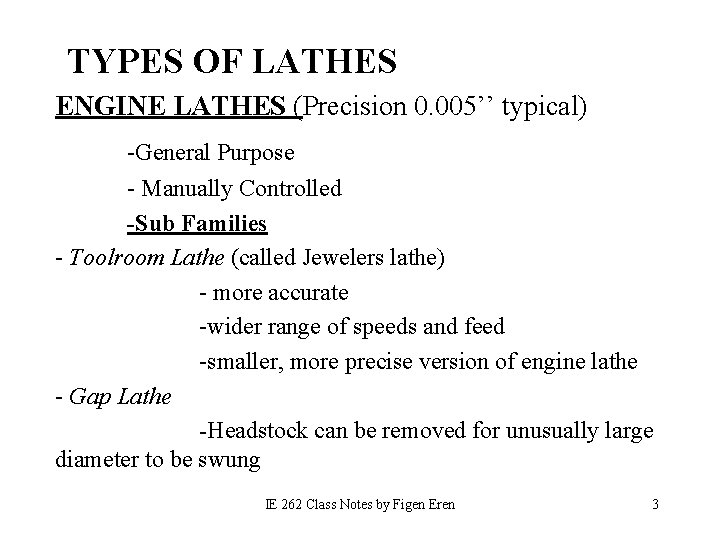
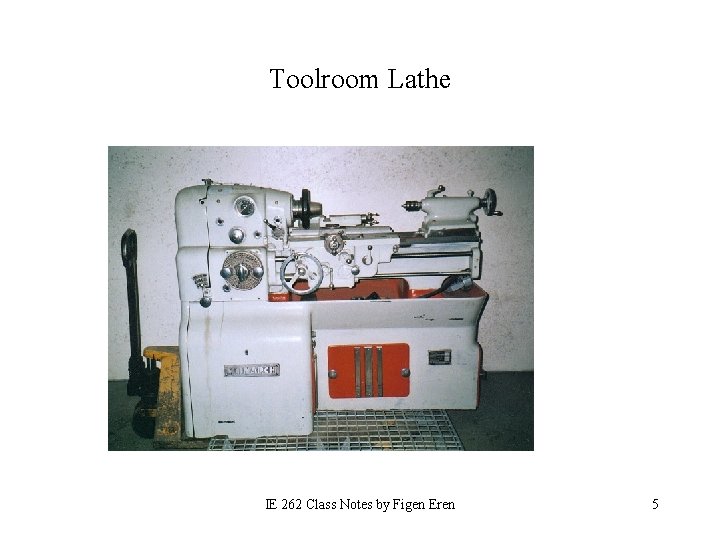
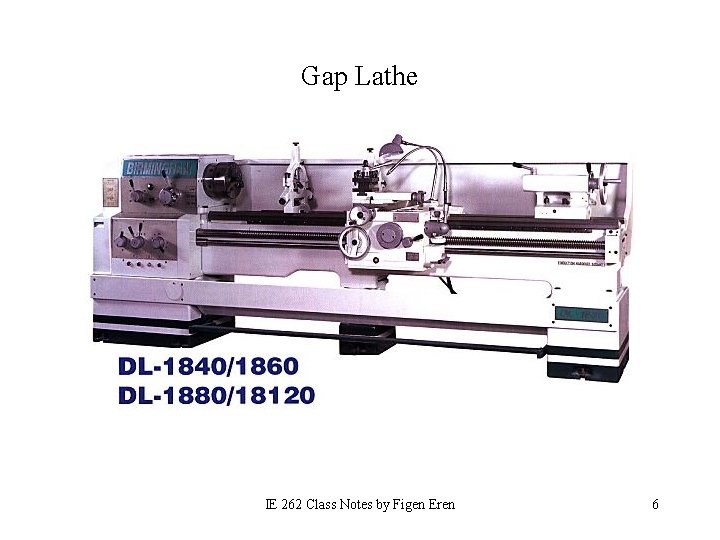
TYPES OF LATHES ENGINE LATHES (Precision 0. 005’’ typical) -General Purpose - Manually Controlled -Sub Families - Toolroom Lathe (called Jewelers lathe) - more accurate -wider range of speeds and feed -smaller, more precise version of engine lathe - Gap Lathe -Headstock can be removed for unusually large diameter to be swung IE 262 Class Notes by Figen Eren 3
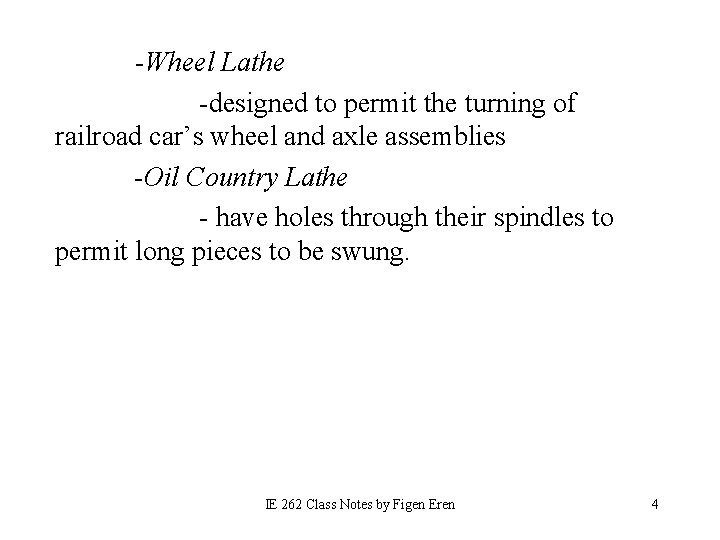
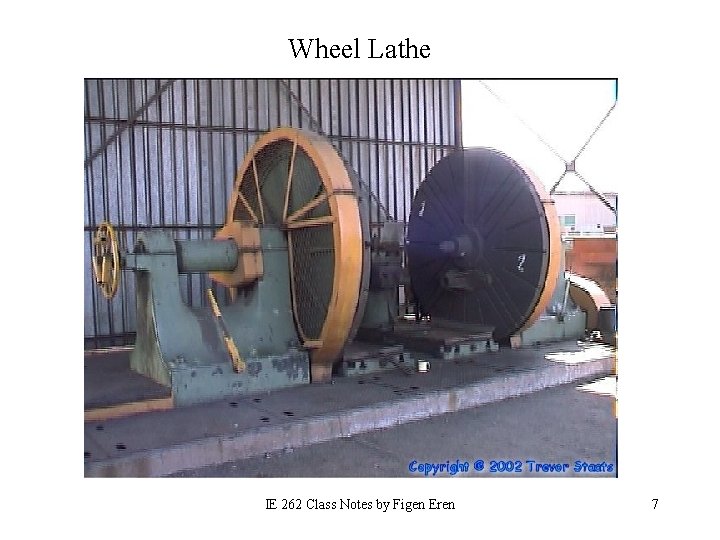
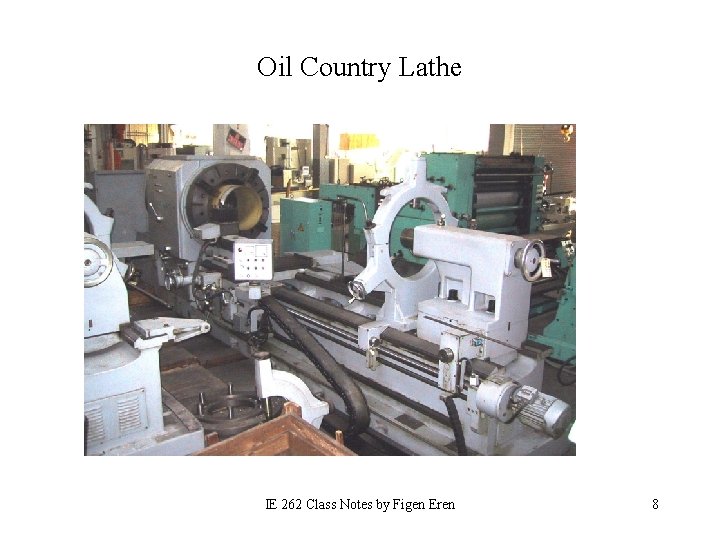
-Wheel Lathe -designed to permit the turning of railroad car’s wheel and axle assemblies -Oil Country Lathe - have holes through their spindles to permit long pieces to be swung. IE 262 Class Notes by Figen Eren 4
Toolroom Lathe IE 262 Class Notes by Figen Eren 5
Gap Lathe IE 262 Class Notes by Figen Eren 6
Wheel Lathe IE 262 Class Notes by Figen Eren 7
Oil Country Lathe IE 262 Class Notes by Figen Eren 8
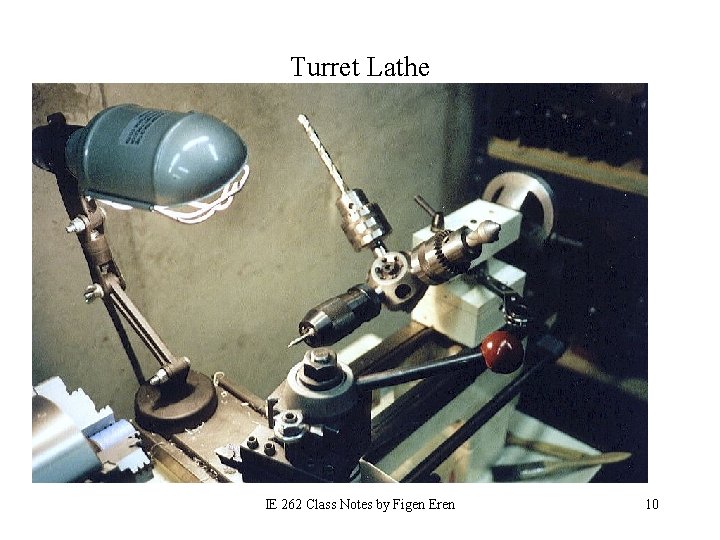
TURRET LATHES ( Precision: 0. 003” typical) -Semi-automatic -Have multiple tool(usually 6) turret -Several things may be happening to the part at the same line. IE 262 Class Notes by Figen Eren 9
Turret Lathe IE 262 Class Notes by Figen Eren 10
CHUCKING MACHINES OR CHUCKERS -Automatic - Usually vertical - Do not have tail stock -Used for individual pieces - Work-part hold by a chuck AUTOMATIC BAR MACHINE(AUTOMATIC SCREW MACHINES) ( Precision: 0. 003”) - Similar to CHUCKERS but workpart hold by a collet -This way long pieces can be fed through headstock. IE 262 Class Notes by Figen Eren 11
- Automatic -Used mostly in screw production that is why it is most frequently called automatic screw machines. - Has two types -Single - spindle screw machines (1 tool cuts at each time) - multiple -spindle screw machines (4 -6 tools cuts at the same time) CNC LATHE - Programmable, computer controlled IE 262 Class Notes by Figen Eren 12
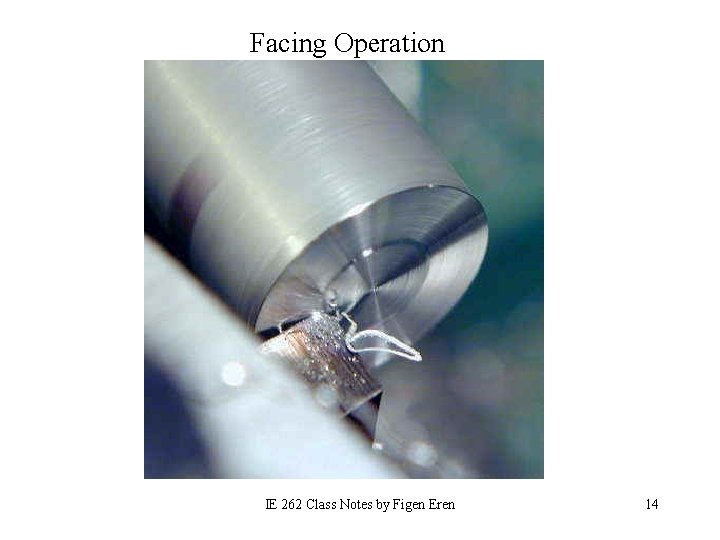
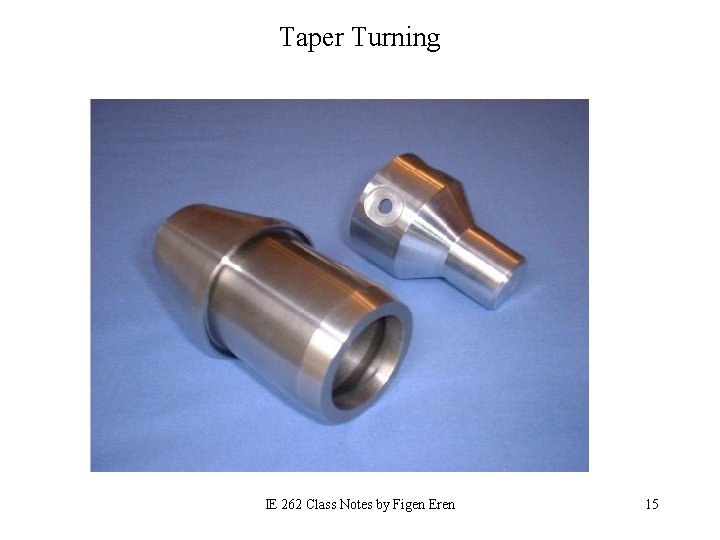
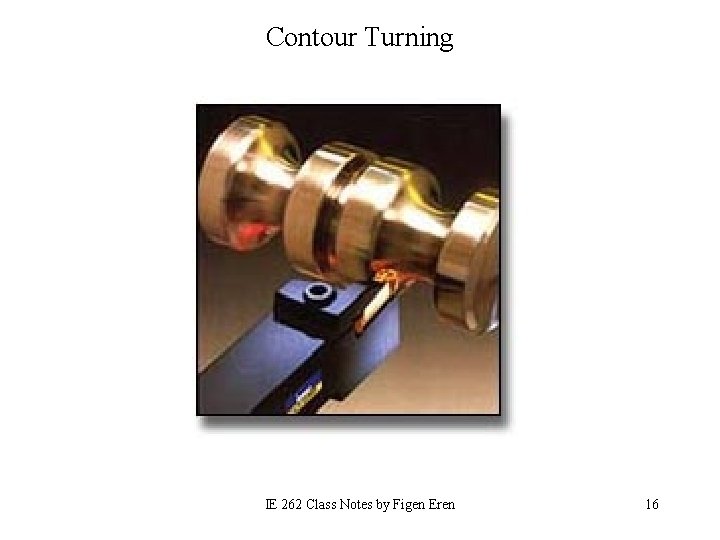
Operations Related To Turning Facing: Tool is fed along x axis creates a flat surface at the end. Taper turning: Tool is fed at an angle create a conical geometry Contour turning Instead of feeding the tool along a straight line, the tool follows a contour. IE 262 Class Notes by Figen Eren 13
Facing Operation IE 262 Class Notes by Figen Eren 14
Taper Turning IE 262 Class Notes by Figen Eren 15
Contour Turning IE 262 Class Notes by Figen Eren 16
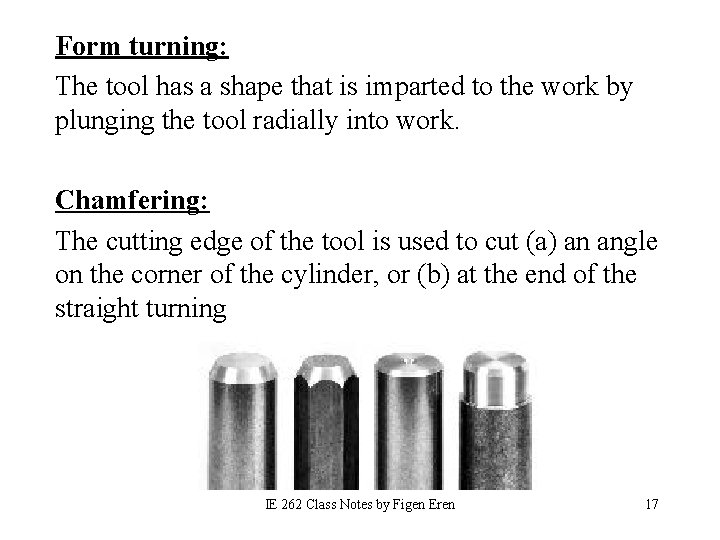
Form turning: The tool has a shape that is imparted to the work by plunging the tool radially into work. Chamfering: The cutting edge of the tool is used to cut (a) an angle on the corner of the cylinder, or (b) at the end of the straight turning IE 262 Class Notes by Figen Eren 17
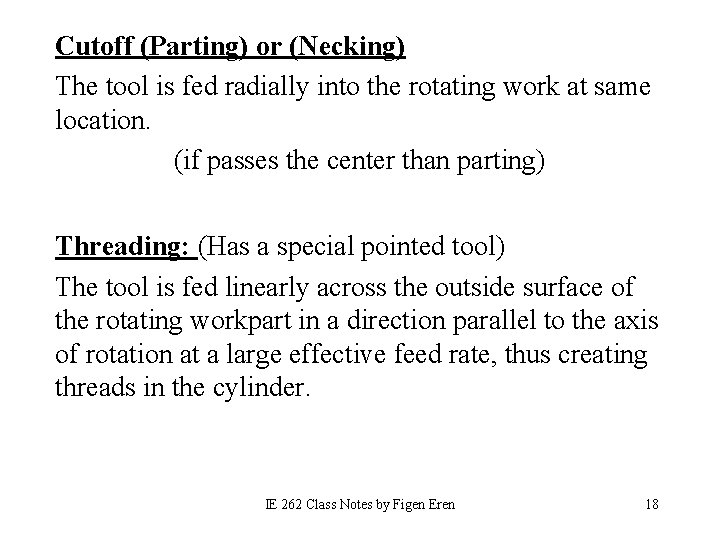
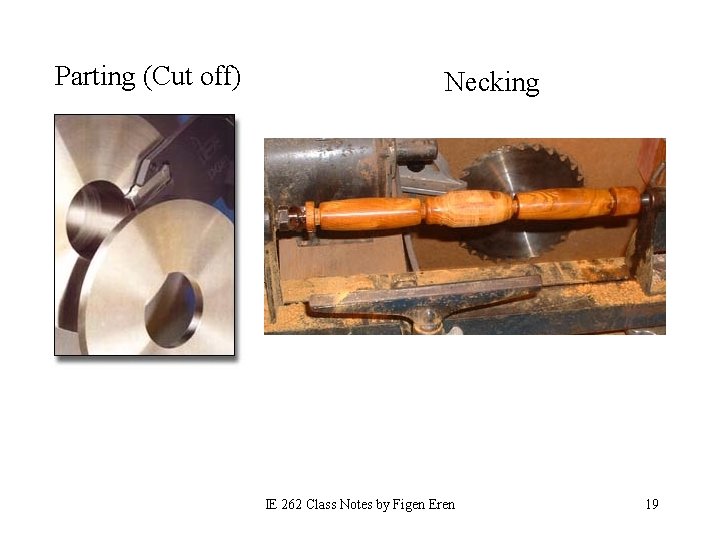
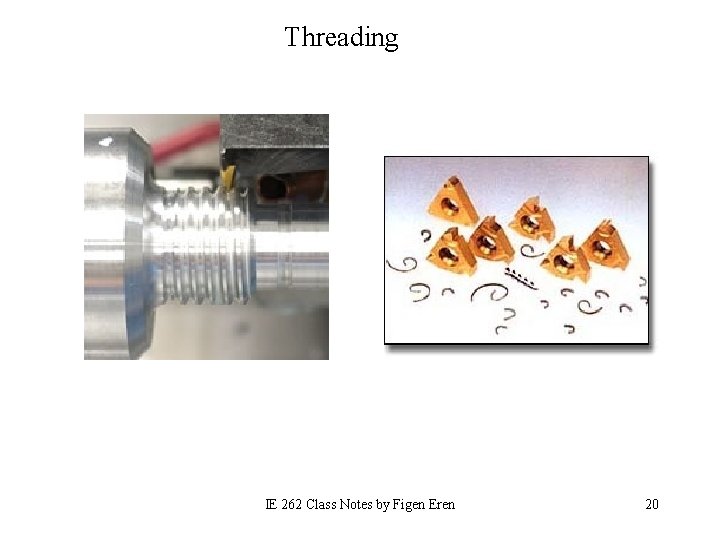
Cutoff (Parting) or (Necking) The tool is fed radially into the rotating work at same location. (if passes the center than parting) Threading: (Has a special pointed tool) The tool is fed linearly across the outside surface of the rotating workpart in a direction parallel to the axis of rotation at a large effective feed rate, thus creating threads in the cylinder. IE 262 Class Notes by Figen Eren 18
Parting (Cut off) Necking IE 262 Class Notes by Figen Eren 19
Threading IE 262 Class Notes by Figen Eren 20
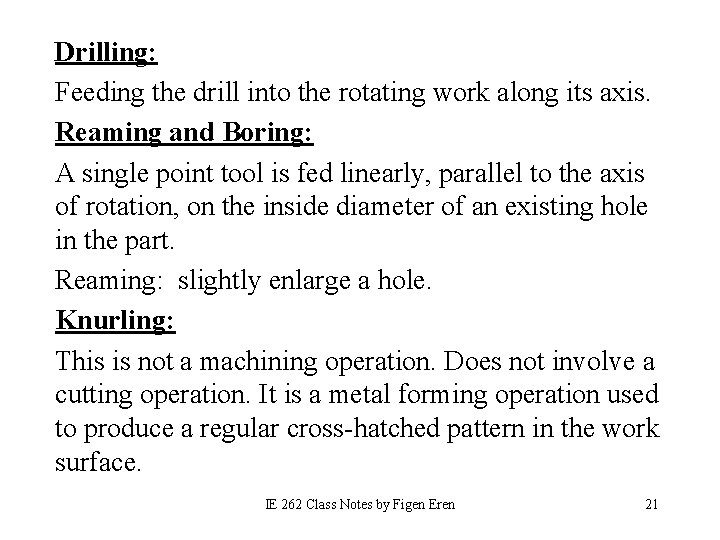
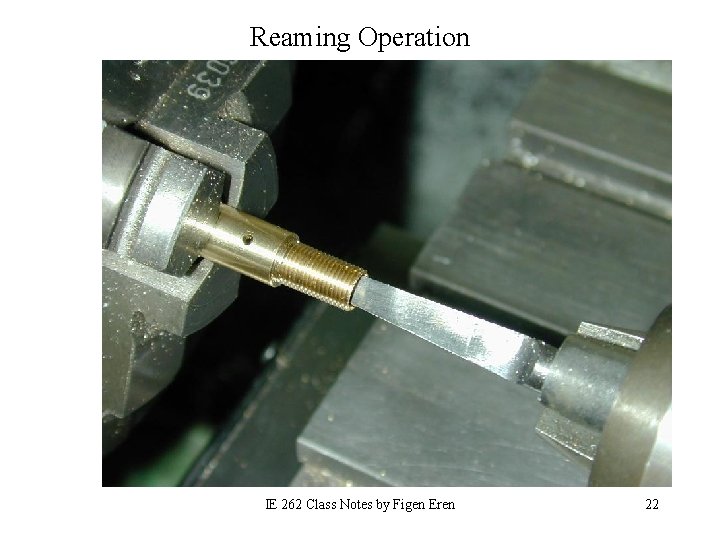
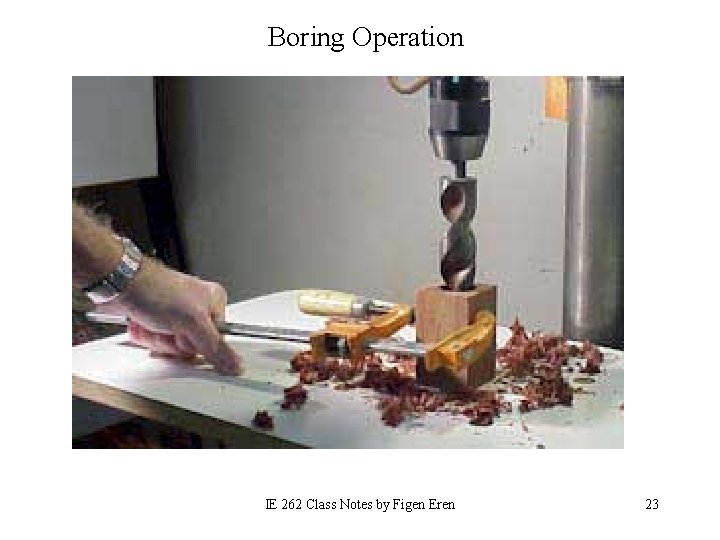
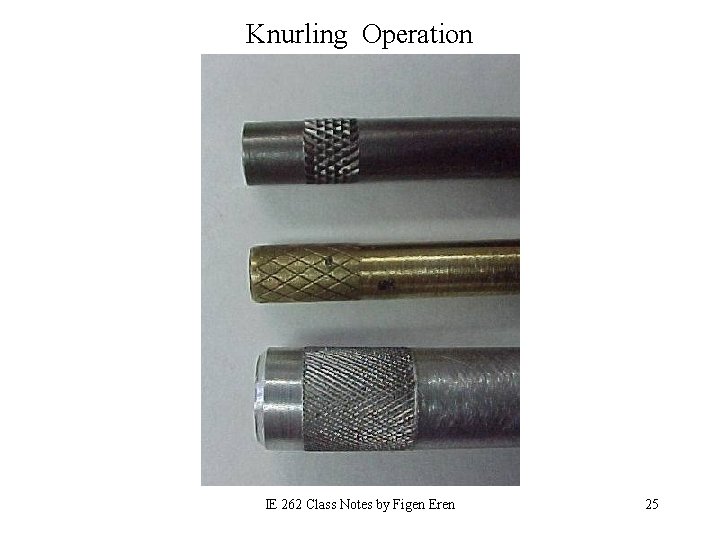
Drilling: Feeding the drill into the rotating work along its axis. Reaming and Boring: A single point tool is fed linearly, parallel to the axis of rotation, on the inside diameter of an existing hole in the part. Reaming: slightly enlarge a hole. Knurling: This is not a machining operation. Does not involve a cutting operation. It is a metal forming operation used to produce a regular cross-hatched pattern in the work surface. IE 262 Class Notes by Figen Eren 21
Reaming Operation IE 262 Class Notes by Figen Eren 22
Boring Operation IE 262 Class Notes by Figen Eren 23
Drilling Operation IE 262 Class Notes by Figen Eren 24
Knurling Operation IE 262 Class Notes by Figen Eren 25
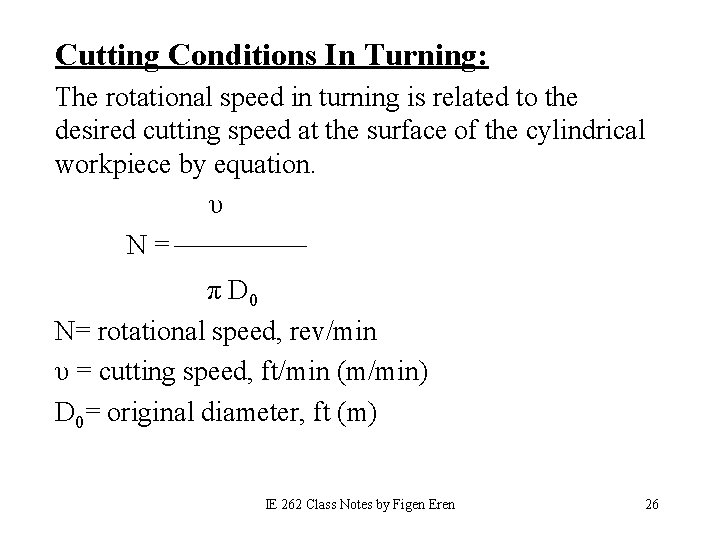
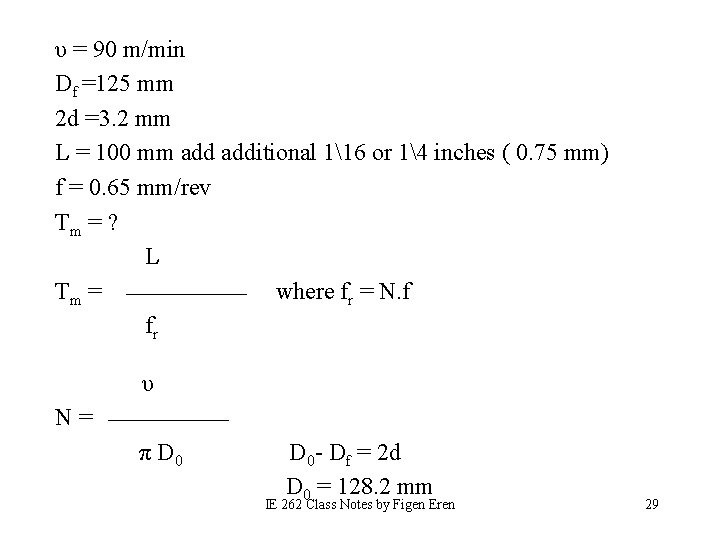
Cutting Conditions In Turning: The rotational speed in turning is related to the desired cutting speed at the surface of the cylindrical workpiece by equation. υ N= π D 0 N= rotational speed, rev/min υ = cutting speed, ft/min (m/min) D 0= original diameter, ft (m) IE 262 Class Notes by Figen Eren 26
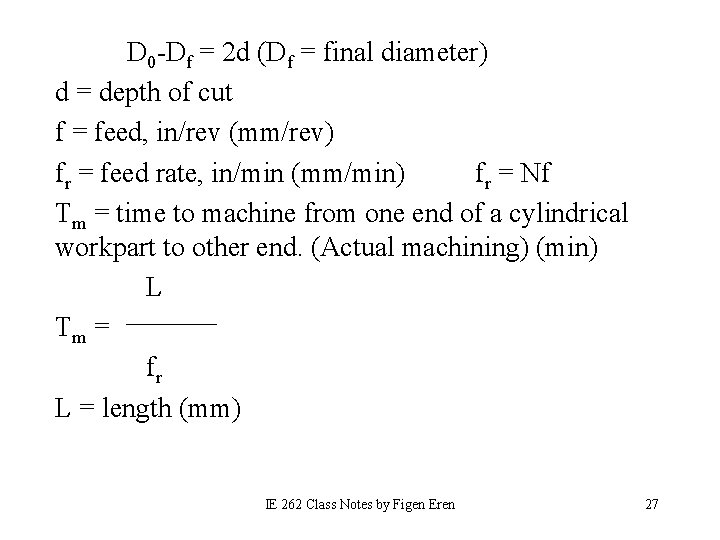
D 0 -Df = 2 d (Df = final diameter) d = depth of cut f = feed, in/rev (mm/rev) fr = feed rate, in/min (mm/min) fr = Nf Tm = time to machine from one end of a cylindrical workpart to other end. (Actual machining) (min) L Tm = fr L = length (mm) IE 262 Class Notes by Figen Eren 27
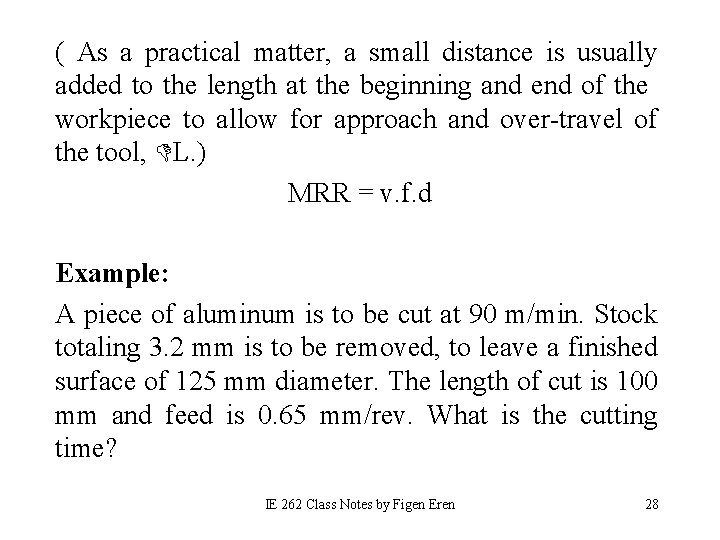
( As a practical matter, a small distance is usually added to the length at the beginning and end of the workpiece to allow for approach and over-travel of the tool, L. ) MRR = v. f. d Example: A piece of aluminum is to be cut at 90 m/min. Stock totaling 3. 2 mm is to be removed, to leave a finished surface of 125 mm diameter. The length of cut is 100 mm and feed is 0. 65 mm/rev. What is the cutting time? IE 262 Class Notes by Figen Eren 28
υ = 90 m/min Df =125 mm 2 d =3. 2 mm L = 100 mm additional 116 or 14 inches ( 0. 75 mm) f = 0. 65 mm/rev Tm = ? L Tm = where fr = N. f fr υ N= π D 0 - Df = 2 d D 0 = 128. 2 mm IE 262 Class Notes by Figen Eren 29
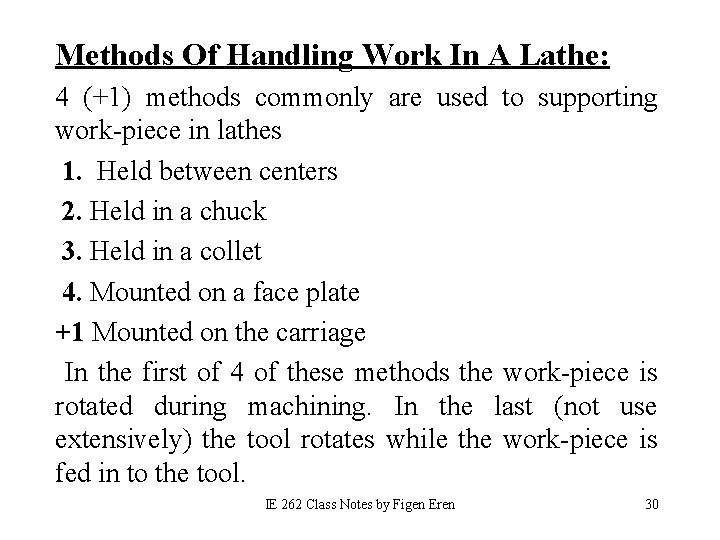
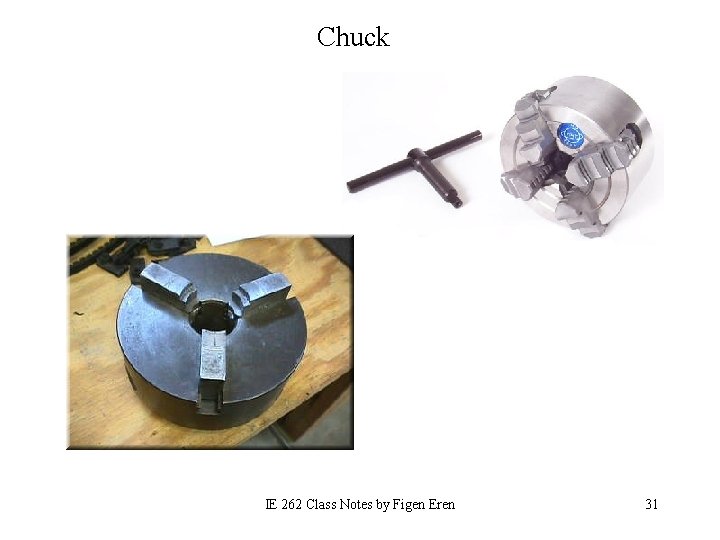
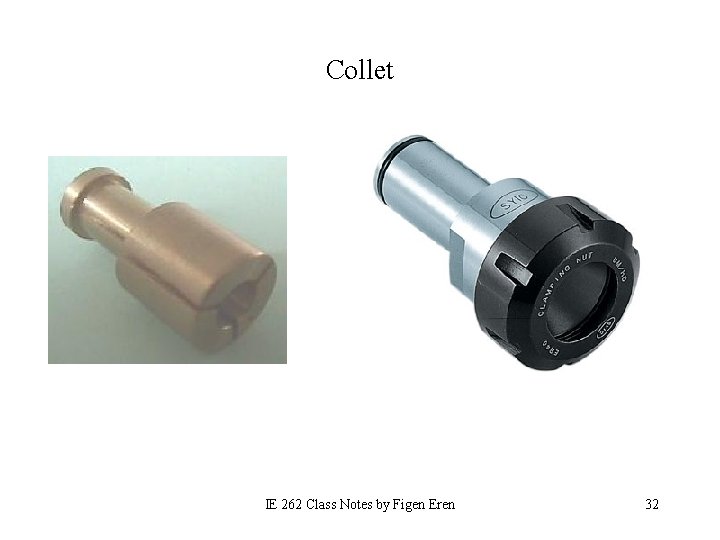
Methods Of Handling Work In A Lathe: 4 (+1) methods commonly are used to supporting work-piece in lathes 1. Held between centers 2. Held in a chuck 3. Held in a collet 4. Mounted on a face plate +1 Mounted on the carriage In the first of 4 of these methods the work-piece is rotated during machining. In the last (not use extensively) the tool rotates while the work-piece is fed in to the tool. IE 262 Class Notes by Figen Eren 30
Chuck IE 262 Class Notes by Figen Eren 31
Collet IE 262 Class Notes by Figen Eren 32