
Turning Level Design Concepts into Adaptive Plans Bob
Turning Level Design Concepts into Adaptive Plans Bob Wray, Charles Newton, Victor Hung, Norb Timpko 7 Jun 2017 Copyright © 2017 Soar Technology, Inc.

Challenge Level Design Adaptive Plans • Implementing a “level” in a game (or training environment) is difficult 2 – Tedious (lots of details that need to be specified) – Uncertain (players will end doing things you did not expect) – Limited expressivity for conditional events • Initial conditions (scenario/level specification) • Simple “scripts” for on-going management of events • How can we improve the level design and implementation process to mitigate these difficulties?
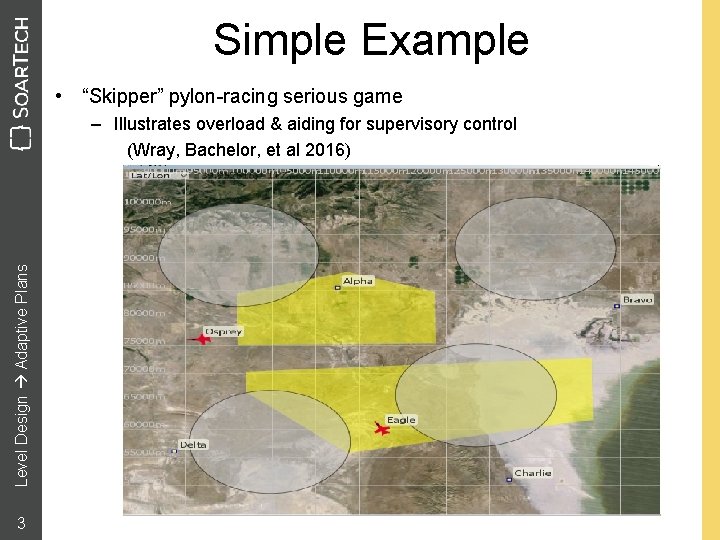
Simple Example • “Skipper” pylon-racing serious game Level Design Adaptive Plans – Illustrates overload & aiding for supervisory control (Wray, Bachelor, et al 2016) 3
Simple Example • Example level/scenario (desired events) Level Design Adaptive Plans – At least one routing that requires simultaneous speed and maneuver interventions – Simultaneous pylon goals on one side of maneuver area – Simultaneous pylon goals on opposite sides – Start obstacles moving if player is >> average score after 2 m 4 • Easy to create a plan that satisfies these constraints if player is predictable • Much harder to create a plan that satisfies these constraints if player is not (altogether) predictable • Even harder when additional semi-autonomous actors can react to player actions within the scenario
Relevant Background • Guided (constricted) player navigation – Restrict player choices in a seemingly unrestricted world – “String of pearls” (limit branching) Level Design Adaptive Plans • Interactive narrative / story direction (emphasis: UX) 5 – Planning and plan execution that helps ensure the game constructs a compelling narrative / experience • Riedl and Young (2004); Magerko (2007) • Scenario adaptation (emphasis: designer) – Plan execution that adapts game events to satisfy the goals of the designer (often an instructor in simulation-based training) • Wray & Woods (2013); Wray, Bachelor, et al (2015) • Scenario authoring – Toolsets that allow the designer to specify scenario execution requirements • Medler and Magerko (2006); Folsom-Kovarik et al (2016)
Application Requirements • Player decisions can be limited a little, but not a lot Level Design Adaptive Plans – “Open world” – Lax/forgiving player timeline – Non-episodic levels: Player choices must impact later events and options within the level/scenario 6 • Designers are not programmers (or AI developers) – Level-design primitives need to be familiar concepts (game events) – Must limit / encapsulate programming details • Designers will have high-level scenario requirements and low-level event requirements – Event 1 Event 2 (Event 3, Event 4) – The actors in Event 2 must include at least 2 actors from Event 1
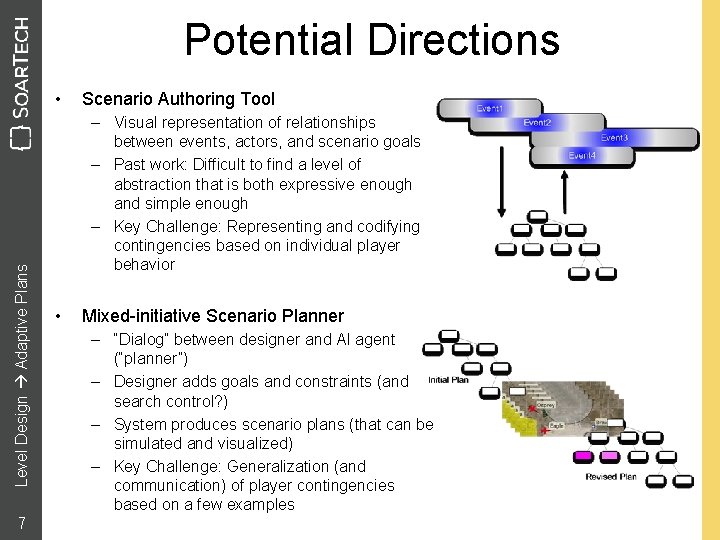
Potential Directions Level Design Adaptive Plans • 7 Scenario Authoring Tool – Visual representation of relationships between events, actors, and scenario goals – Past work: Difficult to find a level of abstraction that is both expressive enough and simple enough – Key Challenge: Representing and codifying contingencies based on individual player behavior • Mixed-initiative Scenario Planner – “Dialog” between designer and AI agent (“planner”) – Designer adds goals and constraints (and search control? ) – System produces scenario plans (that can be simulated and visualized) – Key Challenge: Generalization (and communication) of player contingencies based on a few examples
Conclusions • Questions – Does “listening to the architecture” inform potential approaches to the challenge? Level Design Adaptive Plans • Nuggets 8 – Interesting and challenging problem with potential real-world impacts – Opportunity for integrative research (planning, plan execution, dialog, user modeling, agent/world modeling, etc. ) • Coal – Many past attempts with marginal success. What’s different now?
References • • • Level Design Adaptive Plans • 9 • • • Folsom-Kovarik, J. T. , Woods, A. , & Wray, R. E. (2016). Designing an Authorable Scenario Representation for Instructor Control over Computationally Tailored Narrative in Training Proceedings of the 29 th International FLAIRS Conference. Key Largo: AAAI Press. Magerko, B. (2007). Evaluating Preemptive Story Direction in the Interactive Drama Architecture. Journal of Game Development, 3. Medler, B. , & Magerko, B. (2006). Scribe: A General Tool for Authoring Interactive Drama. Paper presented at the 3 rd International Conference on Technologies for Interactive Digital Storytelling and Entertainment, Darmstadt, Germany. Wray, R. E. , & Woods, A. (2013). A Cognitive Systems Approach to Tailoring Learner Practice. In J. Laird & M. Klenk (Eds. ), Proceedings of the Second Advances in Cognitive Systems Conference. Baltimore, MD. Wray, R. E. , Bachelor, B. , Jones, R. M. , & Newton, C. (2015). Bracketing human performance to support automation for workload reduction: A case study Lecture Notes in Computer Science: Proceedings of the Human Computer Interaction International (HCII) Conference. Los Angeles: Springer-Verlag. Wray, R. E. , Bachelor, B. , Newton, C. , Aron, K. , & Jones, R. M. (2016). Using a Serious Game to Illustrate Supervisory Control Technology Lecture Notes in Computer Science: Proceedings of the 2016 Human Computer Interaction International (HCII) Conference. Toronto: Springer-Verlag. Young, R. M. , Riedl, M. O. , Branly, M. , Jhala, A. , Martin, R. J. , & Saretto, C. J. (2004). An architecture for integrating plan-based behavior generation with interactive game environments. Journal of Game Development, 1(1).
- Slides: 9