
Turn in your Do Now to the front


- Slides: 52
Turn in your Do Now to the front Turn in your annotated food diary Do Now— 11. 16. 15 l What is your first quarter grade? Is this grade what you expected? Why? l Biuret solution is the indicator for which substance? What is the positive color?
Objectives l SWBAT describe and diagram how brain processing differs in reflex and voluntary responses
Objectives l SWBAT set-up for their lab. differentiate nutrient indicators.
2. 2. 1: Food Testing
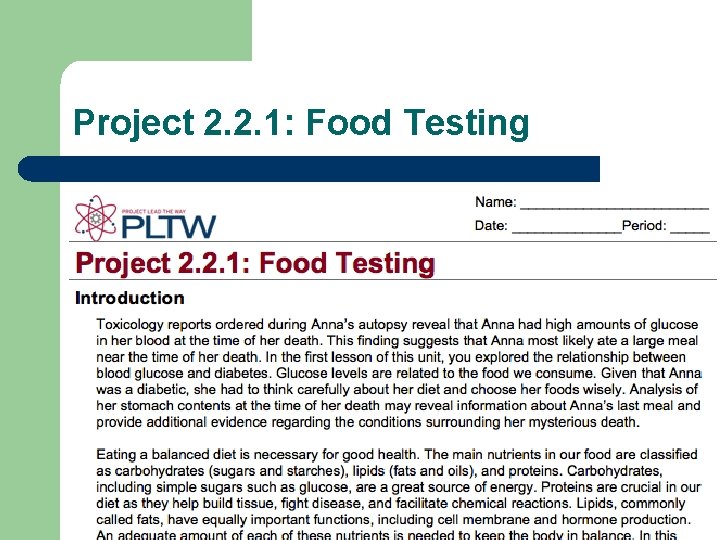
Project 2. 2. 1: Food Testing
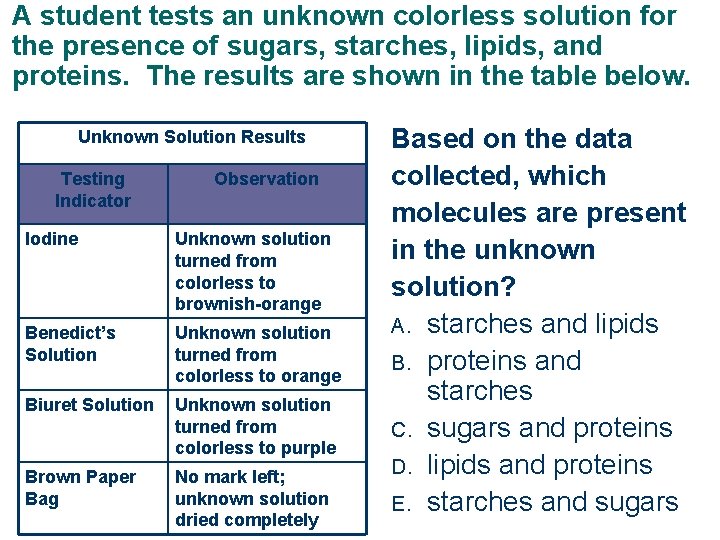
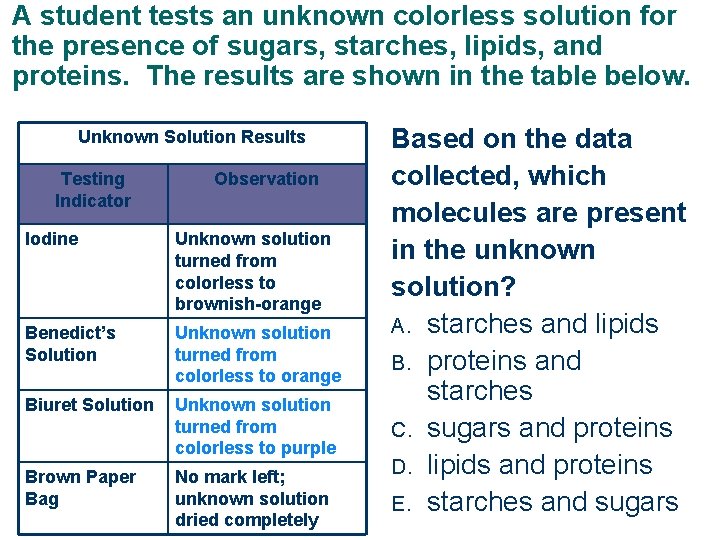
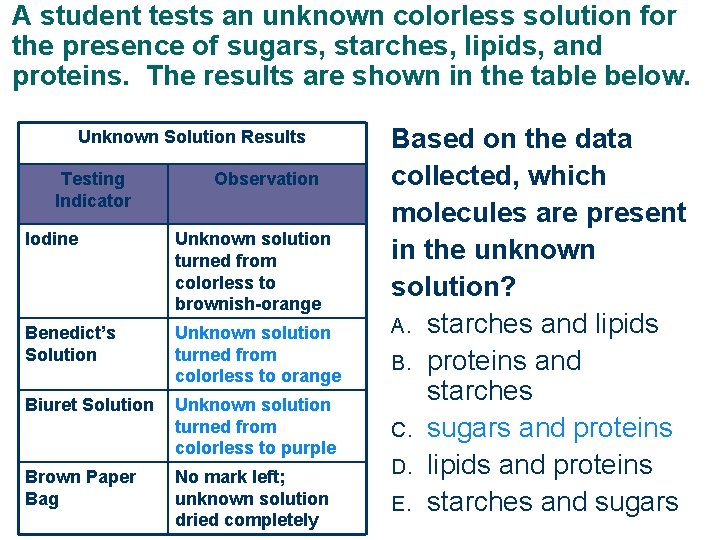
A student tests an unknown colorless solution for the presence of sugars, starches, lipids, and proteins. The results are shown in the table below. Unknown Solution Results Testing Indicator Observation Iodine Unknown solution turned from colorless to brownish-orange Benedict’s Solution Unknown solution turned from colorless to orange Biuret Solution Unknown solution turned from colorless to purple Brown Paper Bag No mark left; unknown solution dried completely Based on the data collected, which molecules are present in the unknown solution? A. starches and lipids B. proteins and starches C. sugars and proteins D. lipids and proteins E. starches and sugars
A student tests an unknown colorless solution for the presence of sugars, starches, lipids, and proteins. The results are shown in the table below. Unknown Solution Results Testing Indicator Observation Iodine Unknown solution turned from colorless to brownish-orange Benedict’s Solution Unknown solution turned from colorless to orange Biuret Solution Unknown solution turned from colorless to purple Brown Paper Bag No mark left; unknown solution dried completely Based on the data collected, which molecules are present in the unknown solution? A. starches and lipids B. proteins and starches C. sugars and proteins D. lipids and proteins E. starches and sugars
A student tests an unknown colorless solution for the presence of sugars, starches, lipids, and proteins. The results are shown in the table below. Unknown Solution Results Testing Indicator Observation Iodine Unknown solution turned from colorless to brownish-orange Benedict’s Solution Unknown solution turned from colorless to orange Biuret Solution Unknown solution turned from colorless to purple Brown Paper Bag No mark left; unknown solution dried completely Based on the data collected, which molecules are present in the unknown solution? A. starches and lipids B. proteins and starches C. sugars and proteins D. lipids and proteins E. starches and sugars
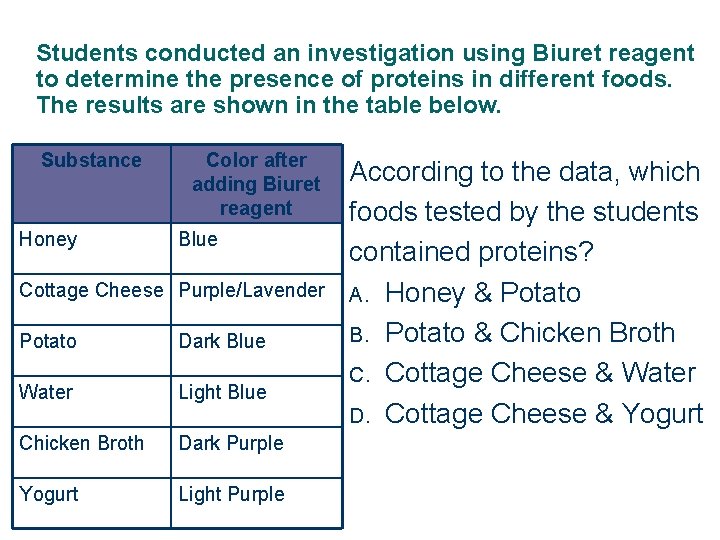
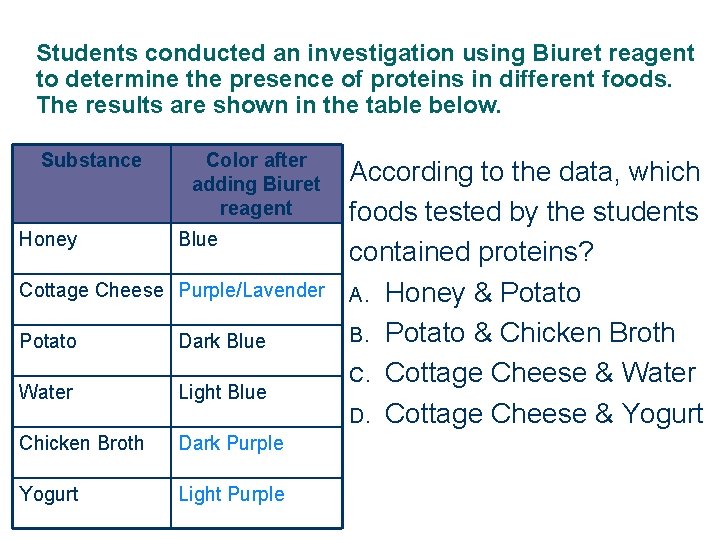
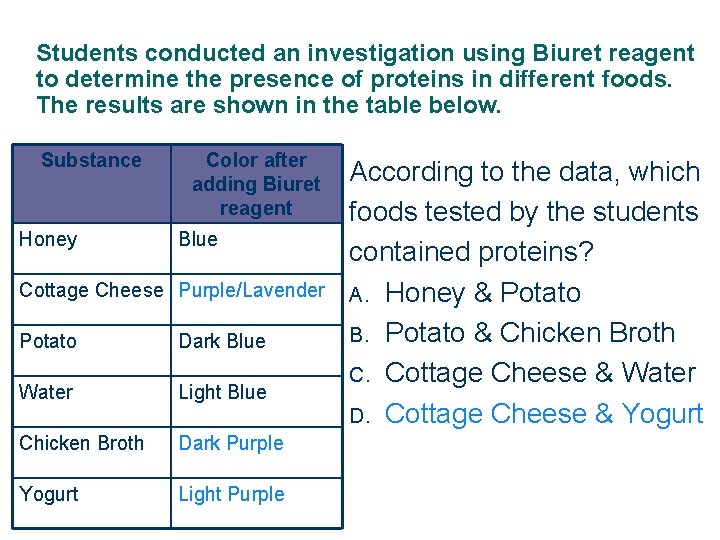
Students conducted an investigation using Biuret reagent to determine the presence of proteins in different foods. The results are shown in the table below. Substance Honey Color after adding Biuret reagent Blue Cottage Cheese Purple/Lavender Potato Dark Blue Water Light Blue Chicken Broth Dark Purple Yogurt Light Purple According to the data, which foods tested by the students contained proteins? A. Honey & Potato B. Potato & Chicken Broth C. Cottage Cheese & Water D. Cottage Cheese & Yogurt
Students conducted an investigation using Biuret reagent to determine the presence of proteins in different foods. The results are shown in the table below. Substance Honey Color after adding Biuret reagent Blue Cottage Cheese Purple/Lavender Potato Dark Blue Water Light Blue Chicken Broth Dark Purple Yogurt Light Purple According to the data, which foods tested by the students contained proteins? A. Honey & Potato B. Potato & Chicken Broth C. Cottage Cheese & Water D. Cottage Cheese & Yogurt
Students conducted an investigation using Biuret reagent to determine the presence of proteins in different foods. The results are shown in the table below. Substance Honey Color after adding Biuret reagent Blue Cottage Cheese Purple/Lavender Potato Dark Blue Water Light Blue Chicken Broth Dark Purple Yogurt Light Purple According to the data, which foods tested by the students contained proteins? A. Honey & Potato B. Potato & Chicken Broth C. Cottage Cheese & Water D. Cottage Cheese & Yogurt
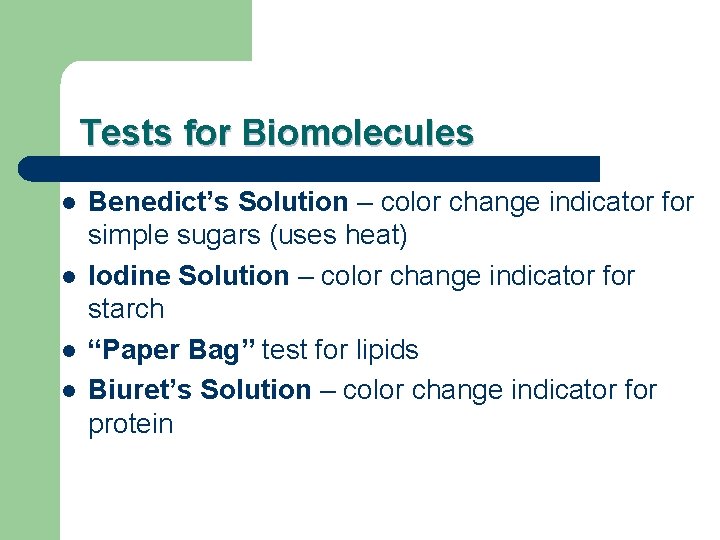
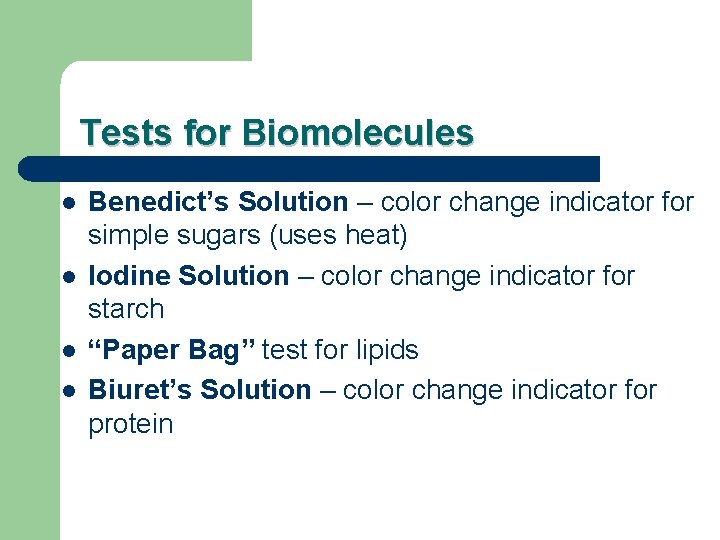
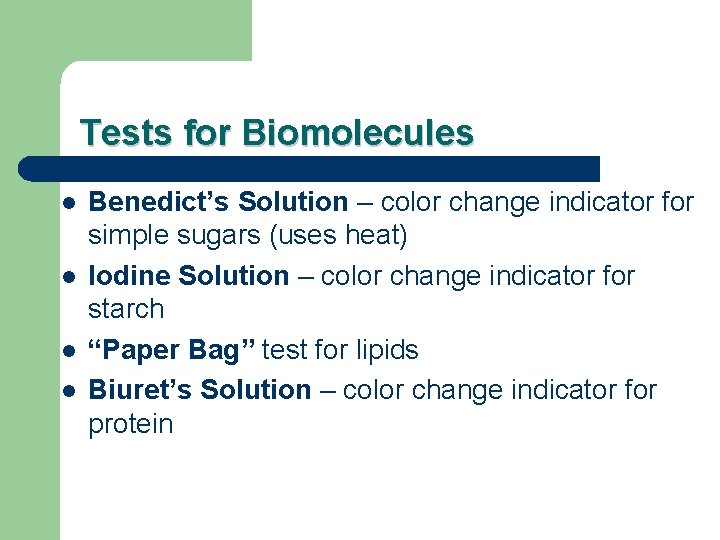
Tests for Biomolecules l l Benedict’s Solution – color change indicator for simple sugars (uses heat) Iodine Solution – color change indicator for starch “Paper Bag” test for lipids Biuret’s Solution – color change indicator for protein
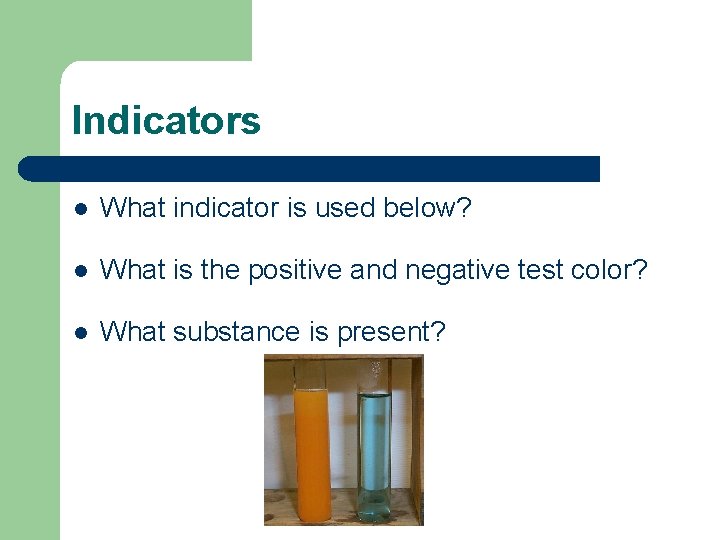
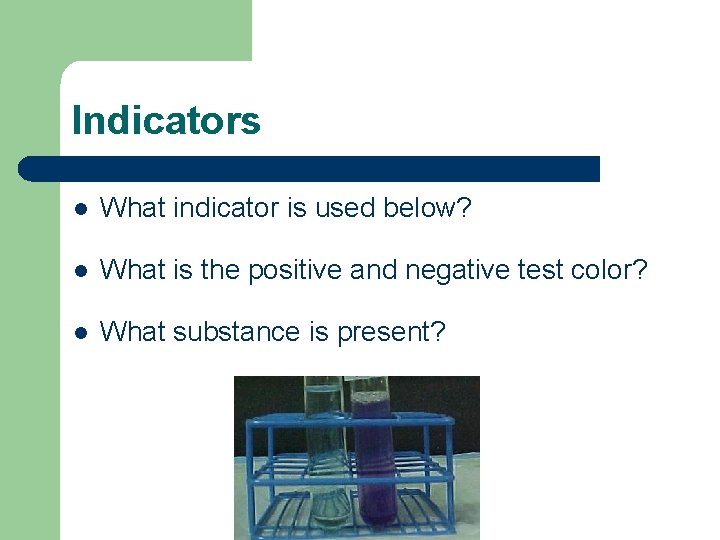
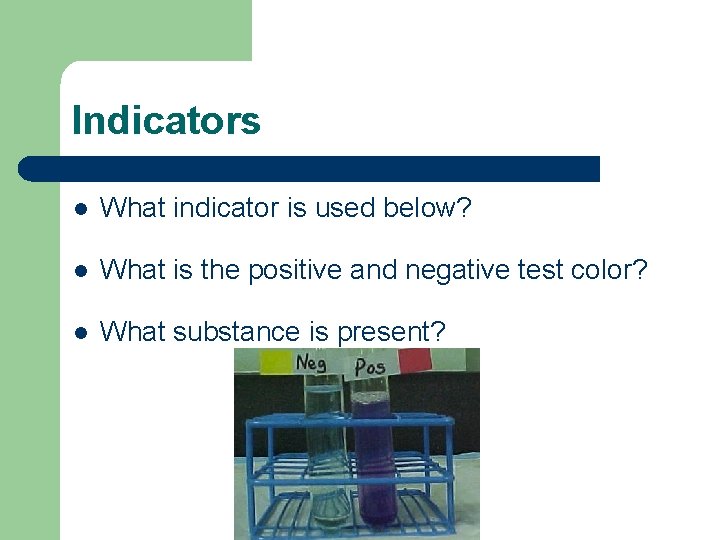
Indicators l What indicator is used below? l What is the positive and negative test color? l What substance is present?
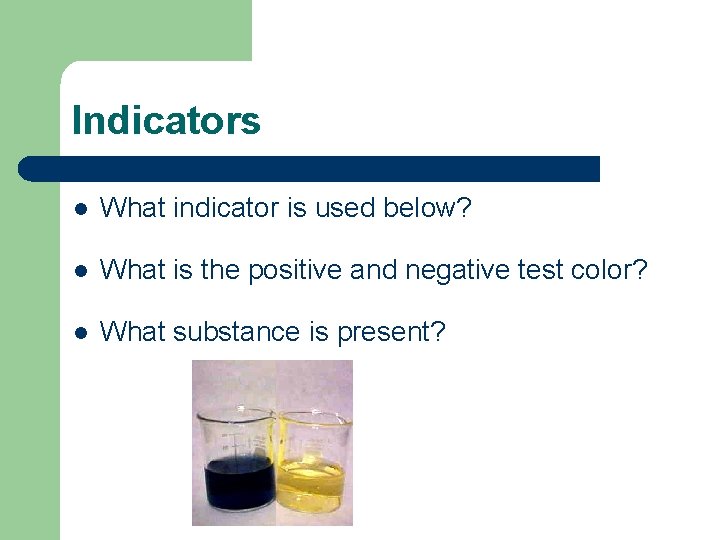
Indicators l What indicator is used below? l What is the positive and negative test color? l What substance is present?
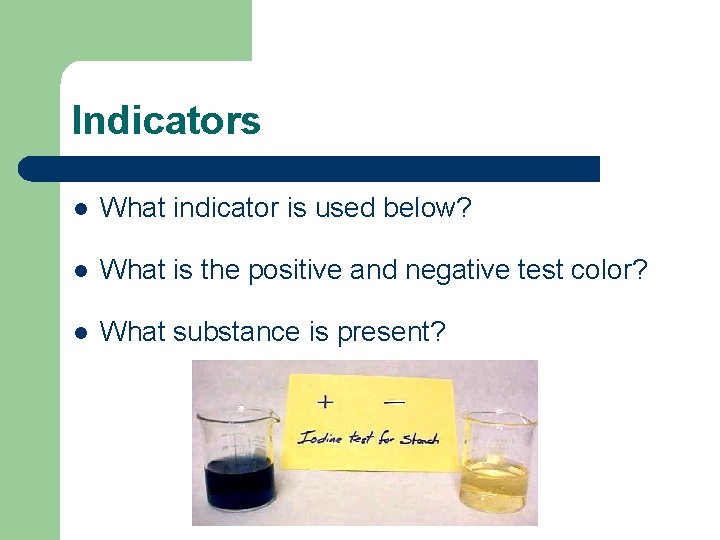
Indicators l What indicator is used below? l What is the positive and negative test color? l What substance is present?
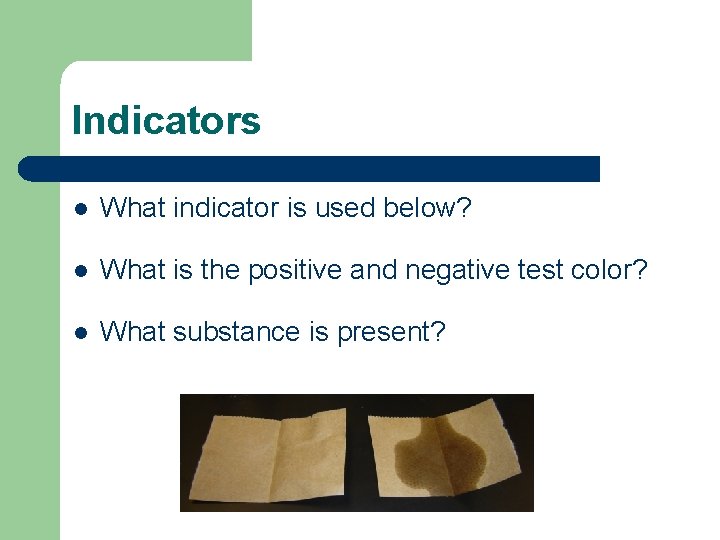
Indicators l What indicator is used below? l What is the positive and negative test color? l What substance is present?
Indicators l What indicator is used below? l What is the positive and negative test color? l What substance is present?
Indicators l What indicator is used below? l What is the positive and negative test color? l What substance is present?
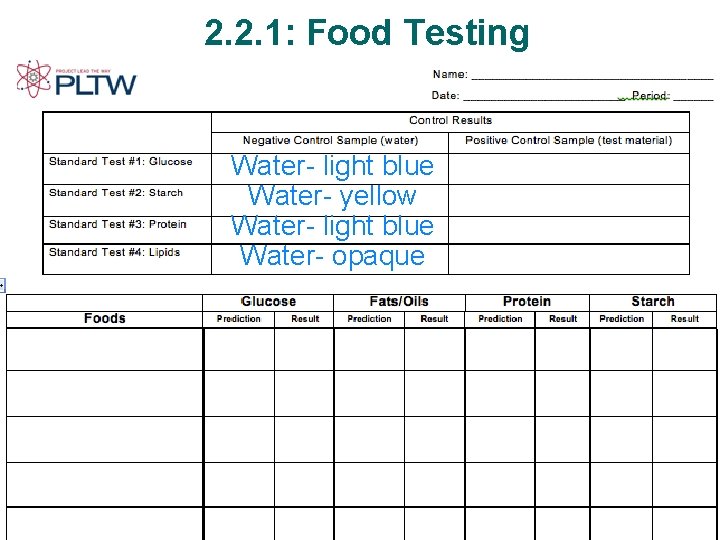
2. 2. 1: Food Testing l What would be a good negative control for lipids, simple sugars, complex sugars, and proteins?
2. 2. 1: Food Testing l What would be a good negative control for lipids, simple sugars, complex sugars, and proteins? WATER
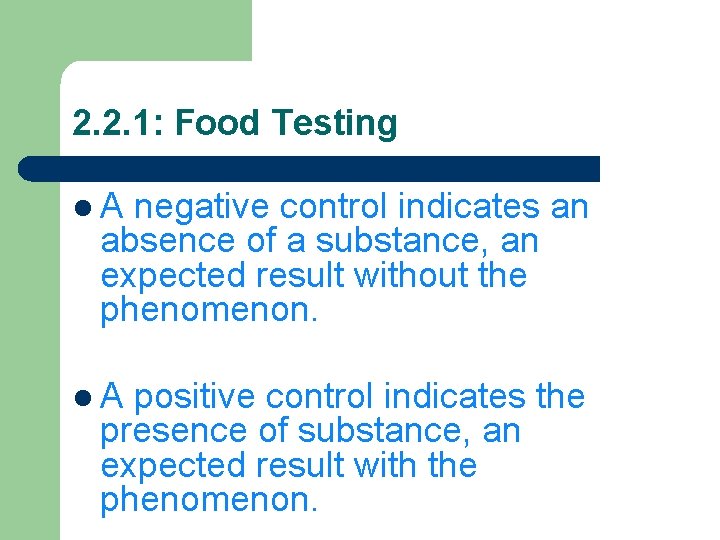
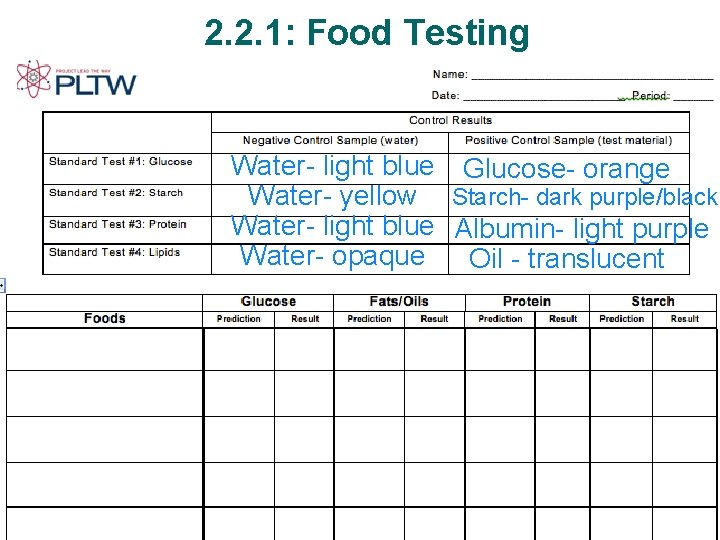
2. 2. 1: Food Testing l. A negative control indicates an absence of a substance, an expected result without the phenomenon. l. A positive control indicates the presence of substance, an expected result with the phenomenon.
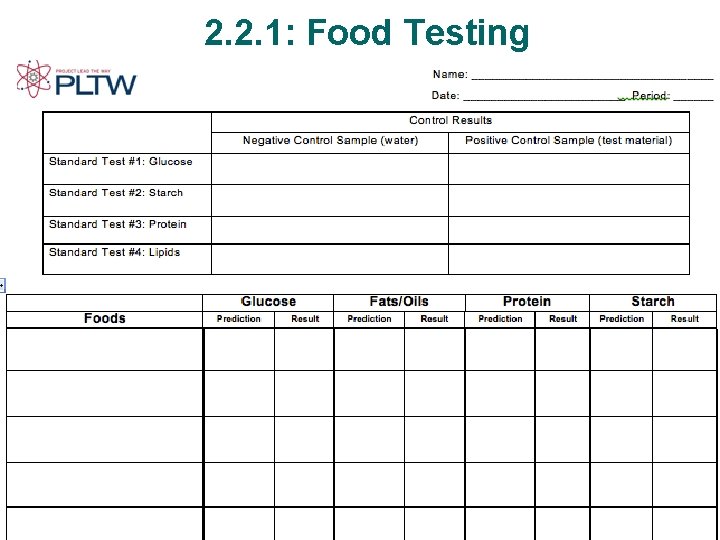
2. 2. 1: Food Testing
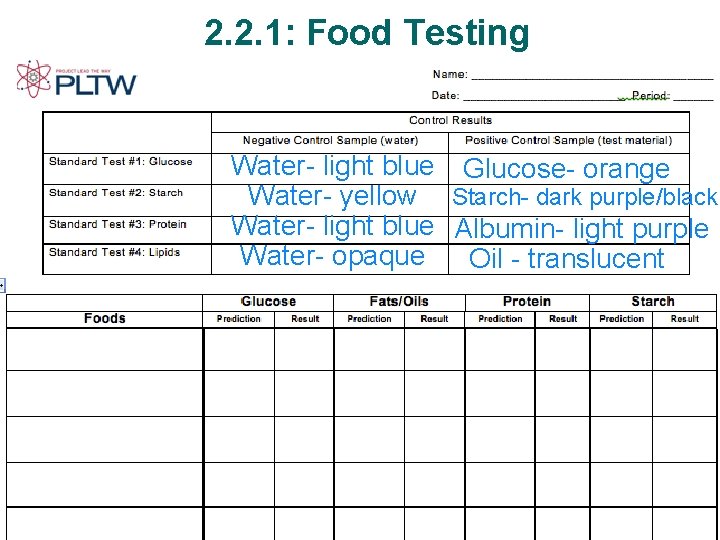
2. 2. 1: Food Testing Water- light blue Water- yellow Water- light blue Water- opaque
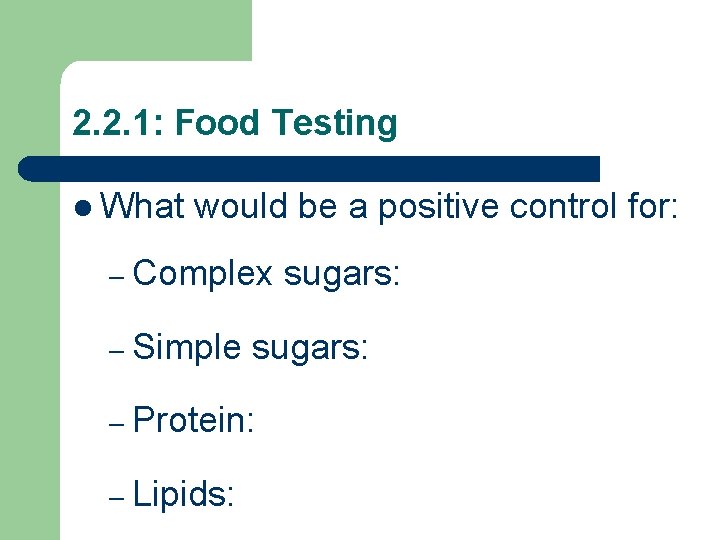
2. 2. 1: Food Testing l What would be a positive control for: – Complex – Simple sugars: – Protein: – Lipids: sugars:
2. 2. 1: Food Testing Water- light blue Glucose- orange Water- yellow Starch- dark purple/black Water- light blue Albumin- light purple Water- opaque Oil - translucent
Procedure l We already have the positive and negative controls for all of the foods, so if you need to compare your food sample, look back at the positive and negative controls.
Procedure l Form l Test groups of four food items of your choice and Anna’s stomach contents. How many test tubes do you need?
Procedure l Testing for sugars (benedicts), proteins (biuret) and starch (iodine) will use a test tube, three test tubes per food, so 15 test tubes. You will have 5, and you will have to clean them.
Procedure l Testing for sugars (benedicts), proteins (biuret) and starch (iodine) will use a test tube, three test tubes per food, so 15 test tubes. You will have 5, and you will have to clean them. l Also need 5 pieces of brown paper bag
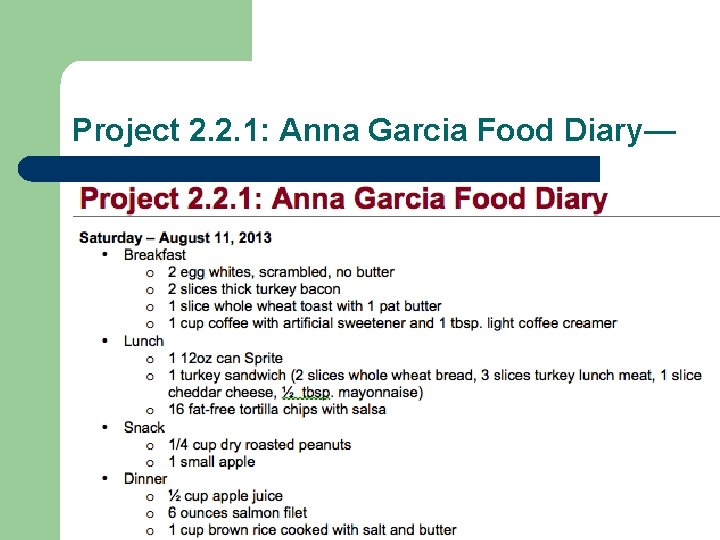
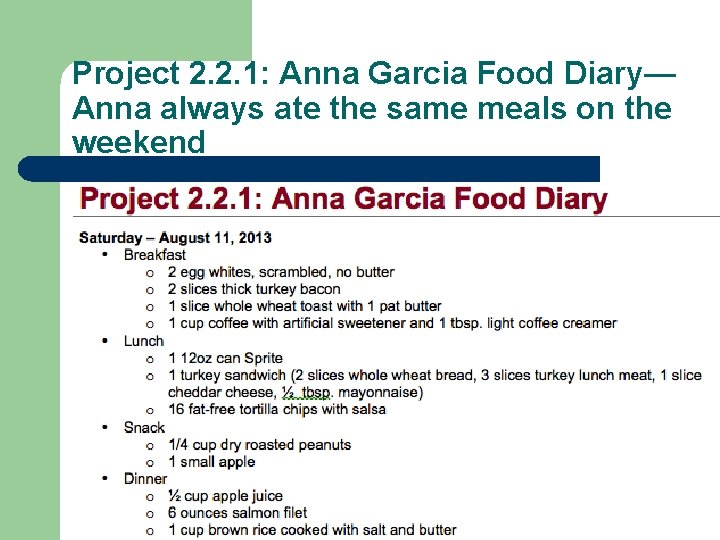
Project 2. 2. 1: Anna Garcia Food Diary—
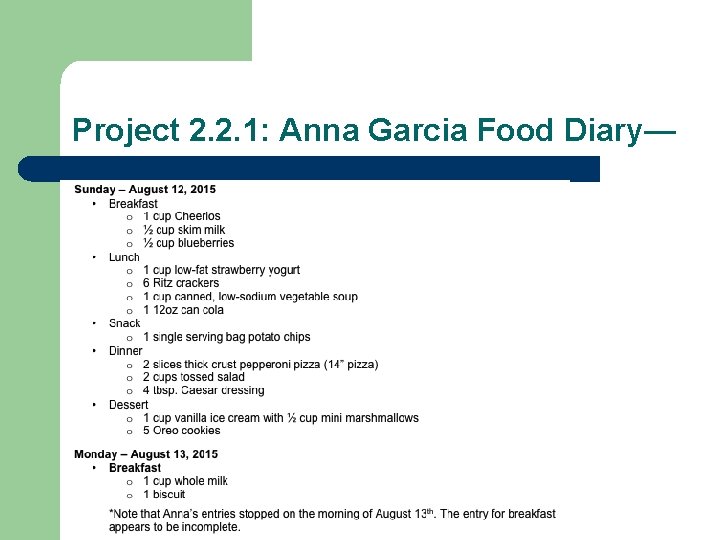
Project 2. 2. 1: Anna Garcia Food Diary—
2. 2. 1: Food Testing Water- light blue Glucose- orange Water- yellow Starch- dark purple/black Water- light blue Albumin- light purple Water- opaque Oil - translucent
Exit Slip You want to test the different parts of a cheeseburger. You are going to test the meat, cheese, and bun. Which indicator(s) would you use for the meat? Cheese? Bun? WHY?
Homework l Read through the procedure listed in 2. 2. 1: Food Testing for testing the controls, you will use this same procedure tomorrow to test the foods. l You must heat the sample with the Benedict’s solution, don’t heat anything else!
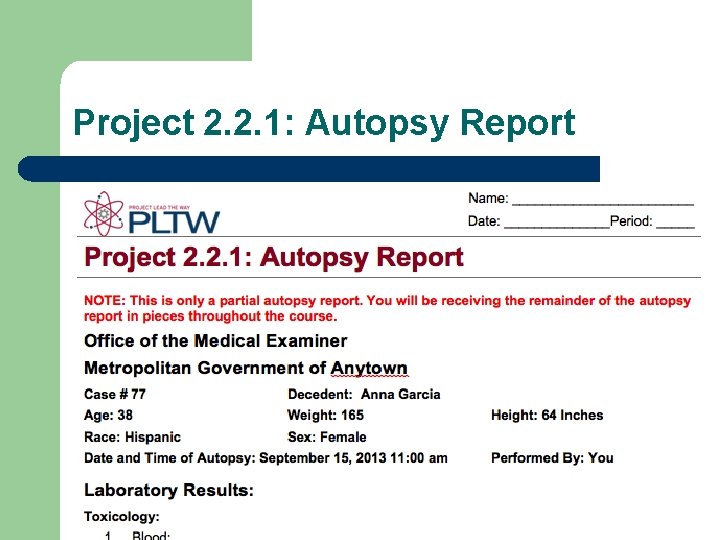
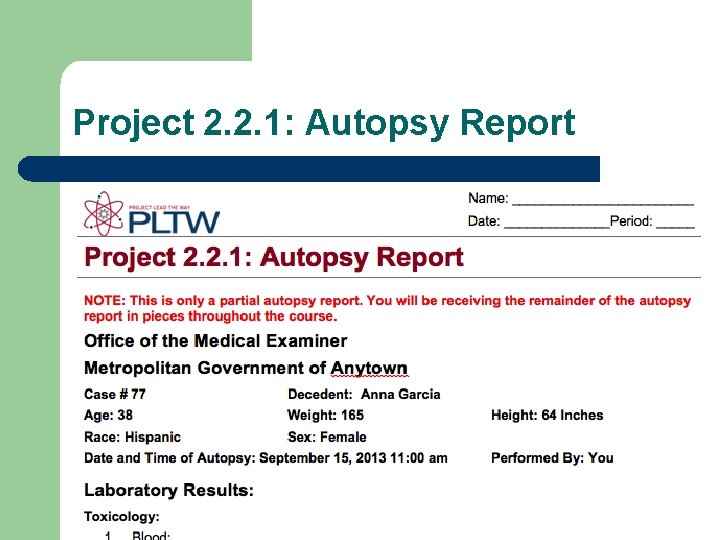
Project 2. 2. 1: Autopsy Report
Homework l 5 th and 6 th period we are meeting in the Little Theatre – If you are not attending the presentation for 6 th period please remind me before you leave l Late work is due by 4: 45 pm tomorrow!
Homework l Finish 2. 2. 1: Food Testing – Answer Part II: Testing Food Samples #5, use this to complete Project 2. 2. 1: Autopsy Report – Answer all the conclusion questions l#4 must be answered on looseleaf paper and must be five to eight sentences.
Homework l 2. 2. 1: Food Testing – You will turn in a completed 2. 2. 1: Food Testing packet, data table, 2. 2. 1: Autopsy Report, and Conclusion Question #4 on looseleaf paper
Please sit your new assigned seat Iyana Tim Maya Rudi Tayah Teri Tayla Noelle Mykah Nia Nyla Cat Imani Monika Anayah Destini Thalia Laila Aaliyah Summer Megan Jazmine Chico Projector Door
Project 2. 2. 1: Autopsy Report
Tests for Biomolecules l l Benedict’s Solution – color change indicator for simple sugars (uses heat) Iodine Solution – color change indicator for starch “Paper Bag” test for lipids Biuret’s Solution – color change indicator for protein
Project 2. 2. 1: Food Testing
Project 2. 2. 1: Anna Garcia Food Diary— Anna always ate the same meals on the weekend
Tests for Biomolecules l l Benedict’s Solution – color change indicator for simple sugars (uses heat) Iodine Solution – color change indicator for starch “Paper Bag” test for lipids Biuret’s Solution – color change indicator for protein
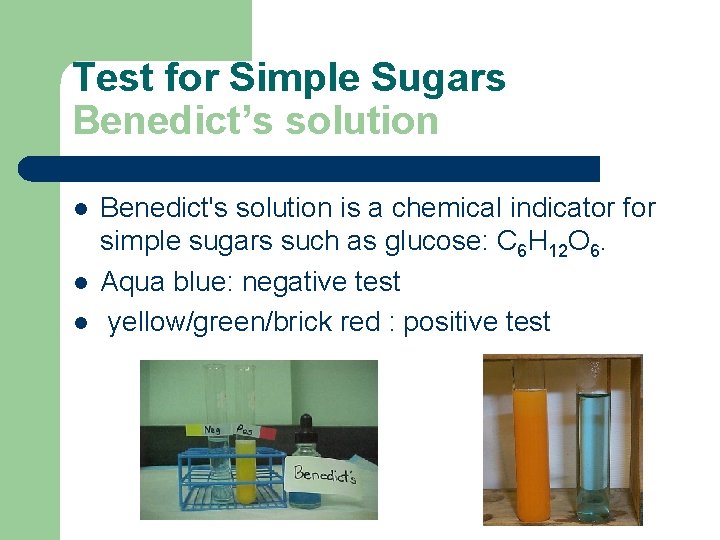
Test for Simple Sugars Benedict’s solution l l l Benedict's solution is a chemical indicator for simple sugars such as glucose: C 6 H 12 O 6. Aqua blue: negative test yellow/green/brick red : positive test
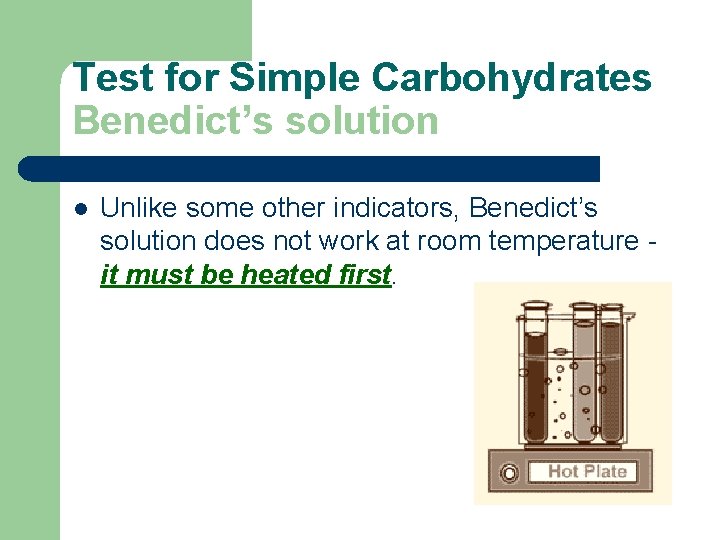
Test for Simple Carbohydrates Benedict’s solution l Unlike some other indicators, Benedict’s solution does not work at room temperature it must be heated first.
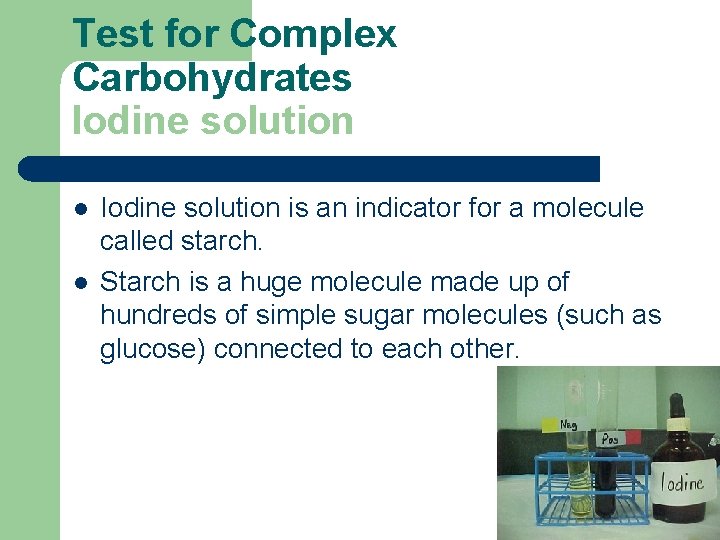
Test for Complex Carbohydrates Iodine solution l l Iodine solution is an indicator for a molecule called starch. Starch is a huge molecule made up of hundreds of simple sugar molecules (such as glucose) connected to each other.
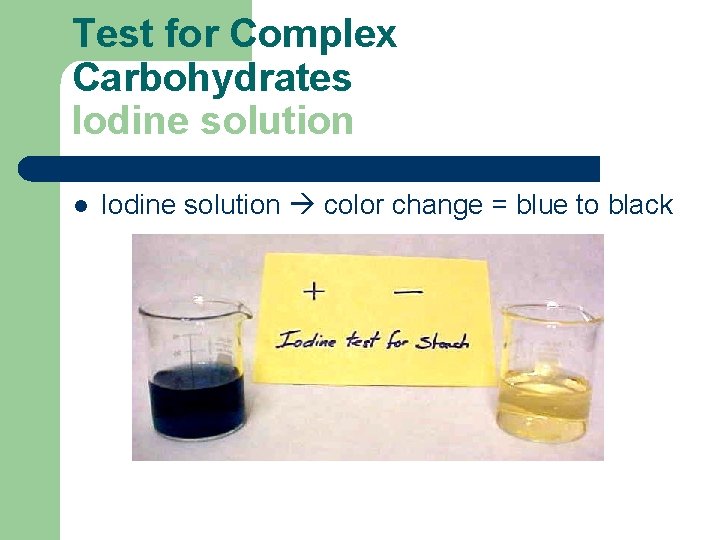
Test for Complex Carbohydrates Iodine solution l Iodine solution color change = blue to black
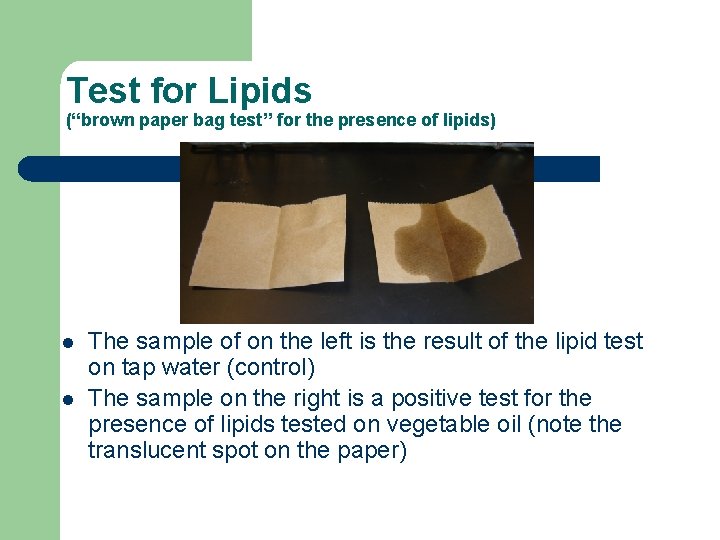
Test for Lipids (“brown paper bag test” for the presence of lipids) l l The sample of on the left is the result of the lipid test on tap water (control) The sample on the right is a positive test for the presence of lipids tested on vegetable oil (note the translucent spot on the paper)
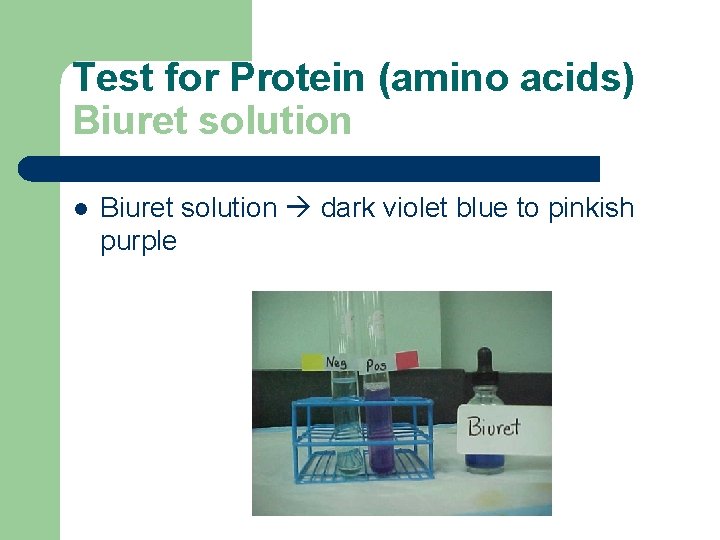
Test for Protein (amino acids) Biuret solution l Biuret solution dark violet blue to pinkish purple
Procedure l We already have the positive and negative controls for all of the foods, so if you need to compare your food sample, look back at the positive and negative controls.
Procedure l Test one food of your choice and Anna’s stomach contents. How many test tubes do you need?