
Turn in Nothing IB Psychology 11 2 18
➢Turn in: ➢ Nothing IB Psychology 11. 2. 18 ➢Take out: ➢A PIECE OF PAPER… ➢Notes, Notes ➢Today’s Learning Objectives: I can [insert CT] • – – – Theories of one cognitive process. Schema theory. Reconstructive memory Today’s Agenda: ➢Memory: the MSM ➢Schema and other ideas… HW: ➢NONE
Your Task(s) I will be reading a list of words…Your task is to listen to the words… Now, recall as many of those words that you can…write them down…order does not matter…you will have 60 seconds. We’ll graph the results.
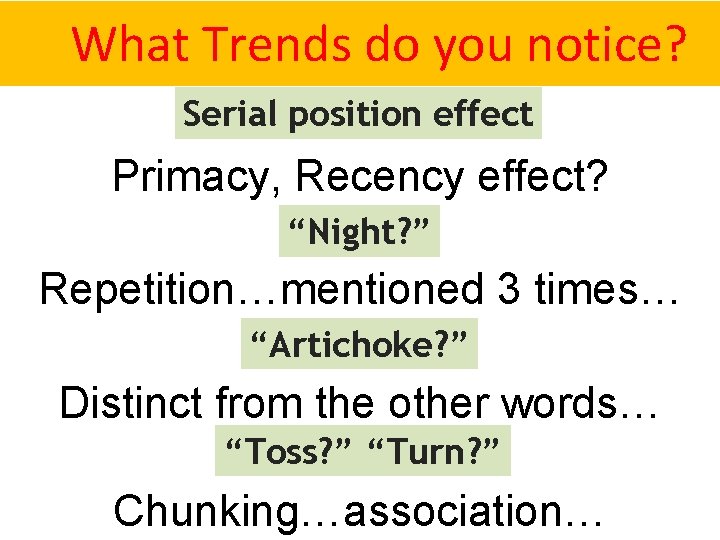
What Trends do you notice? Serial position effect Primacy, Recency effect? “Night? ” Repetition…mentioned 3 times… “Artichoke? ” Distinct from the other words… “Toss? ” “Turn? ” Chunking…association…
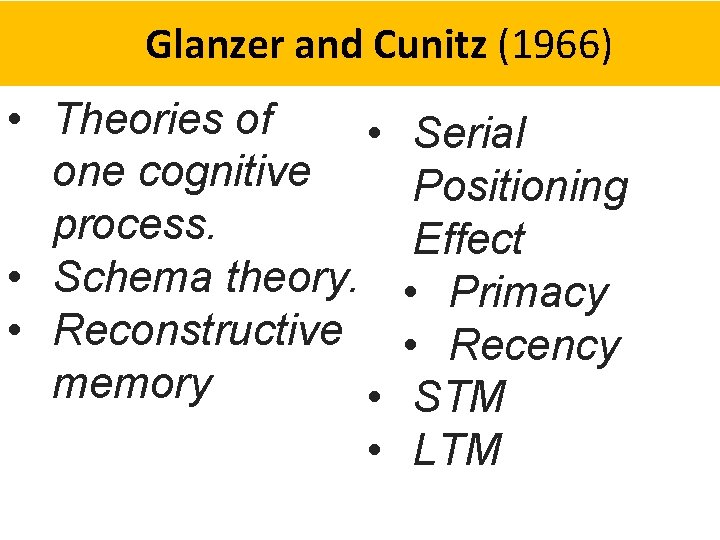
Glanzer and Cunitz (1966) • Theories of • one cognitive process. • Schema theory. • Reconstructive memory • Serial Positioning Effect • Primacy • Recency STM • LTM

Bransford and Johnson (1972) If the balloons popped, the sound wouldn’t be able to carry since everything would be too far away from the correct floor. A closed window would also prevent the sound from carrying, since most buildings tend to be well insulated. Since the whole operation depends on a steady flow of electricity, a break in the middle of the wire would also cause problems. Of course, the fellow could shout, but the human voice is not loud enough to carry that far. An additional problem is that a string could break on the instrument. Then there could be no accompaniment to the message. It is clear that the best situation would involve less distance. Then there would be fewer potential problems. With face to face contact, the least number of things could go wrong.
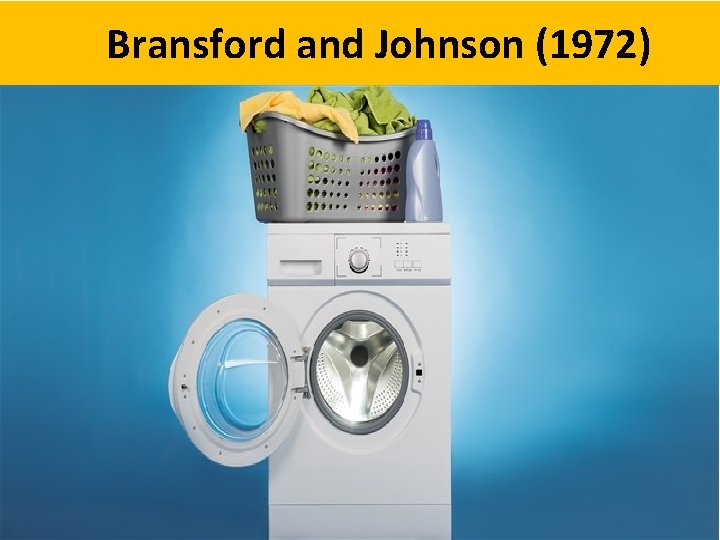
Bransford and Johnson (1972) The procedure is actually quite simple. First you arrange things into different groups. Of course, one pile may be sufficient depending on how much there is to do. If you have to go somewhere else due to lack of facilities that is the next step, otherwise you are pretty well set. It is important not to overdo things. That is, it is better to do too few things at once than too many. In the short run this may not seem important but complications can easily arise. A mistake can be expensive as well. At first the whole procedure will seem complicated. Soon, however, it will become just another facet of life. It is difficult to foresee any end to the necessity for this task in the immediate future, but then one never can tell, After the procedure is completed one arranges the materials into different groups again. Then they can be put into their appropriate places. Eventually they will be used once more and the whole cycle will then have to be repeated. However, that is part of life.
- Slides: 6