
Turing Machines Chapter 17 1 Languages and Machines
- Slides: 45
Turing Machines Chapter 17 1
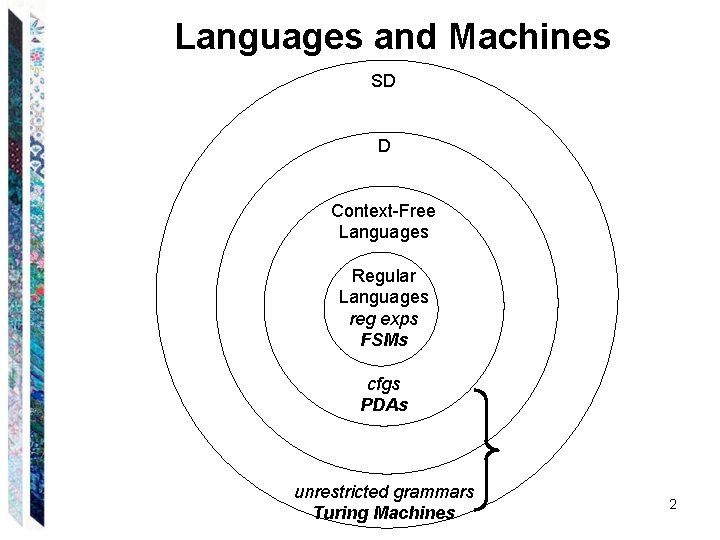
Languages and Machines SD D Context-Free Languages Regular Languages reg exps FSMs cfgs PDAs unrestricted grammars Turing Machines 2
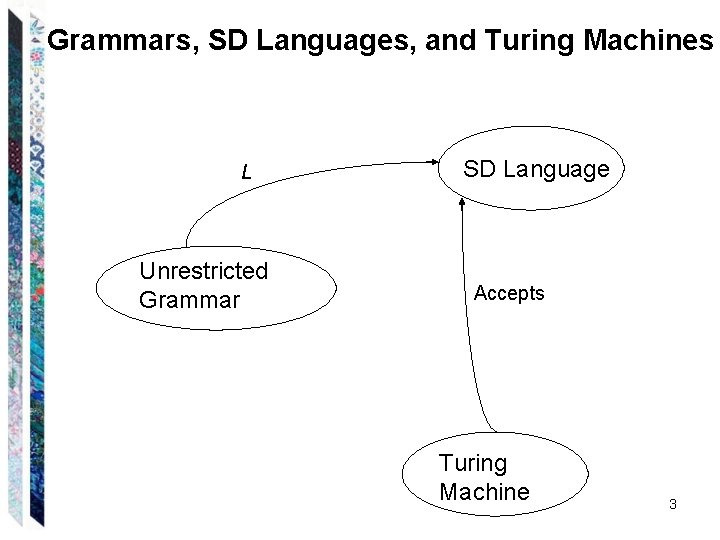
Grammars, SD Languages, and Turing Machines L Unrestricted Grammar SD Language Accepts Turing Machine 3
Turing Machines Can we come up with a new kind of automaton that has two properties: ● powerful enough to describe all computable things unlike FSMs and PDAs. ● simple enough that we can reason formally about it like FSMs and PDAs, unlike real computers. 4
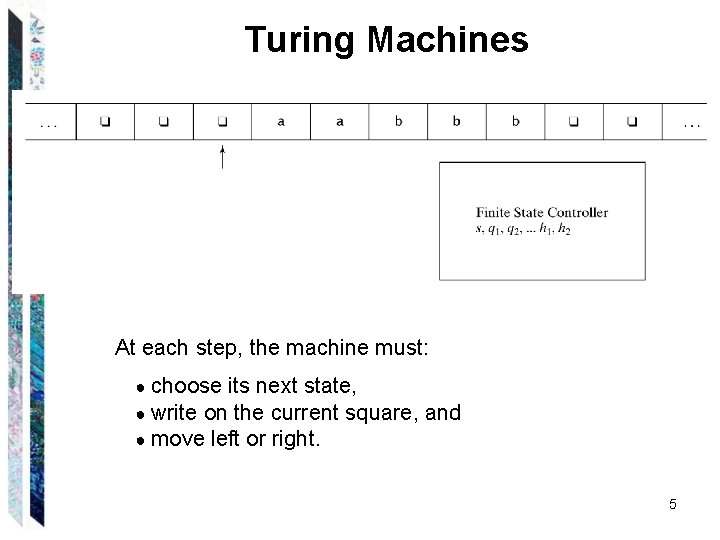
Turing Machines At each step, the machine must: ● choose its next state, ● write on the current square, ● move left or right. and 5
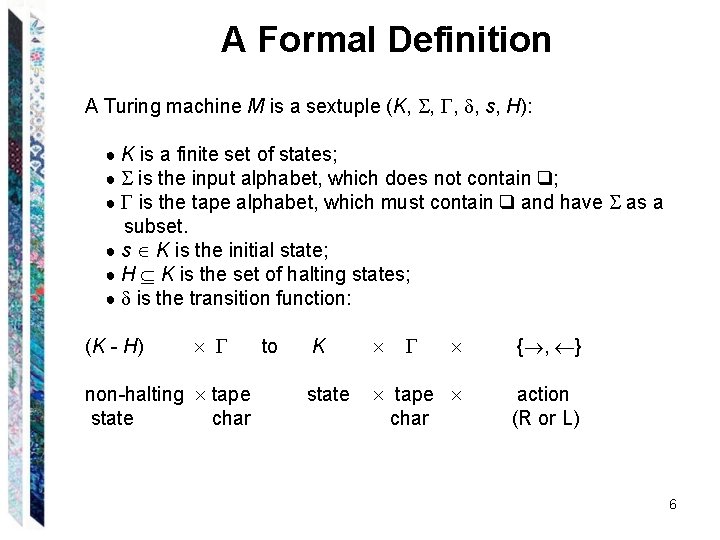
A Formal Definition A Turing machine M is a sextuple (K, , s, H): ● K is a finite set of states; ● is the input alphabet, which does not contain q; ● is the tape alphabet, which must contain q and have as a subset. ● s K is the initial state; ● H K is the set of halting states; ● is the transition function: (K - H) non-halting tape state char to K { , } state tape char action (R or L) 6
Notes on the Definition 1. The input tape is infinite in both directions. 2. is a function, not a relation. So this is a definition for deterministic Turing machines. 3. must be defined for all state, input pairs unless the state is a halting state. 4. Turing machines do not necessarily halt (unlike FSM's and PDAs). Why? To halt, they must enter a halting state. Otherwise they loop. 5. Turing machines generate output so they can compute functions. 7
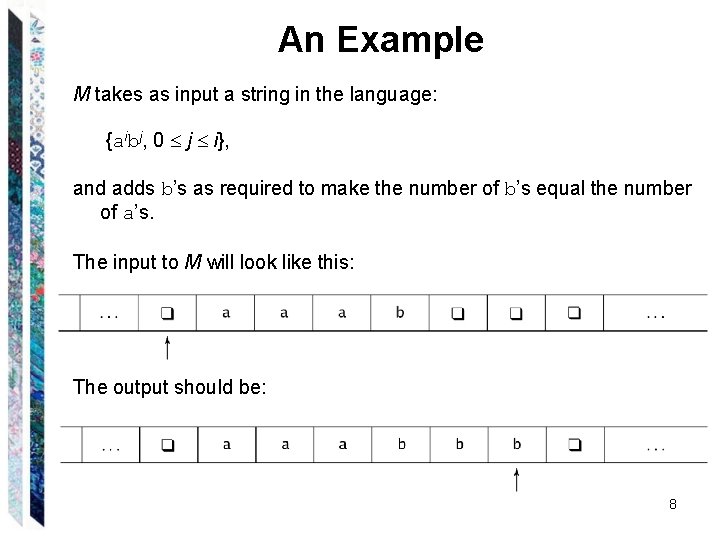
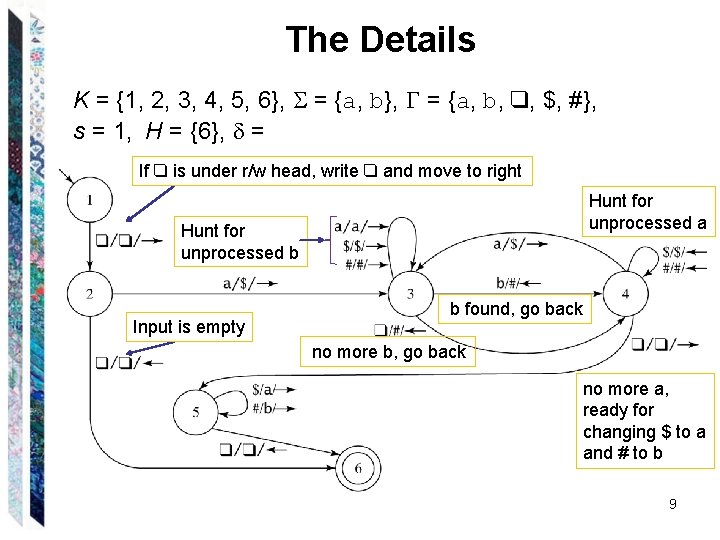
An Example M takes as input a string in the language: {aibj, 0 j i}, and adds b’s as required to make the number of b’s equal the number of a’s. The input to M will look like this: The output should be: 8
The Details K = {1, 2, 3, 4, 5, 6}, = {a, b, q, $, #}, s = 1, H = {6}, = If q is under r/w head, write q and move to right Hunt for unprocessed a Hunt for unprocessed b Input is empty b found, go back no more b, go back no more a, ready for changing $ to a and # to b 9
Notes on Programming The machine has a strong procedural feel, with one phase coming after another. There are common idioms, like scan left until you find a blank There are two common ways to scan back and forth marking things off. Often there is a final phase to fix up the output. Even a very simple machine is a nuisance to write. 10
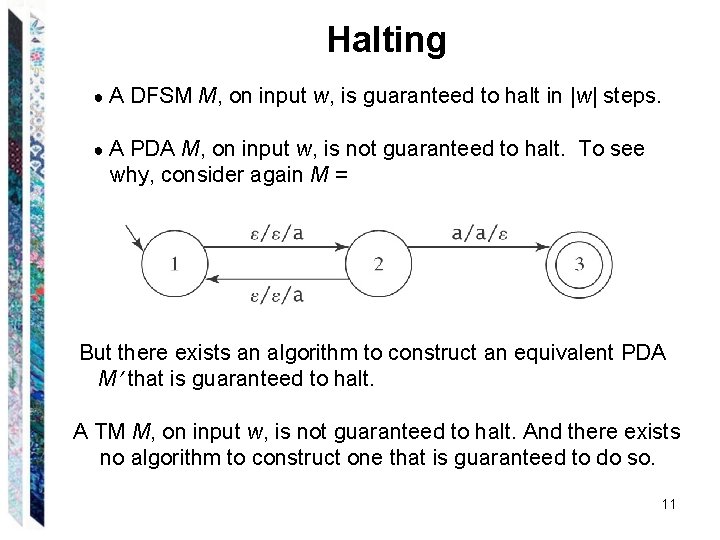
Halting ●A DFSM M, on input w, is guaranteed to halt in |w| steps. ●A PDA M, on input w, is not guaranteed to halt. To see why, consider again M = But there exists an algorithm to construct an equivalent PDA M that is guaranteed to halt. A TM M, on input w, is not guaranteed to halt. And there exists no algorithm to construct one that is guaranteed to do so. 11
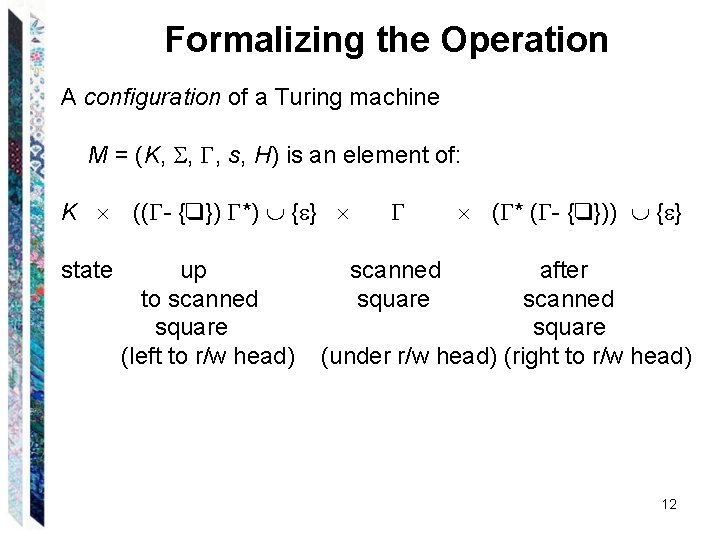
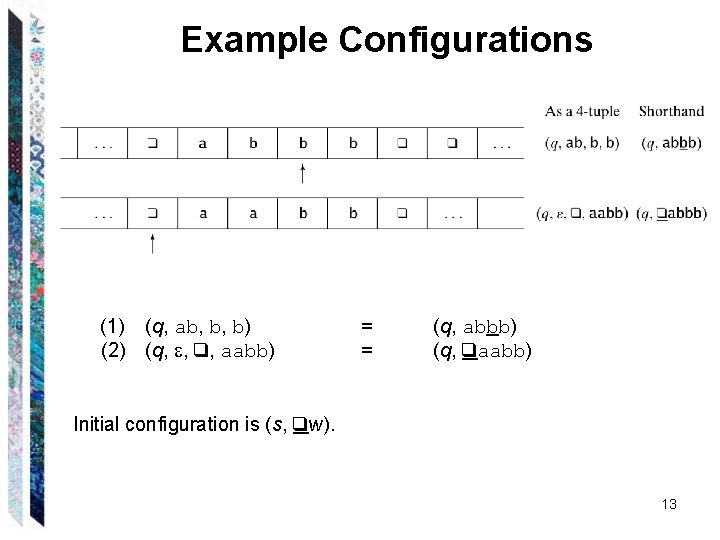
Formalizing the Operation A configuration of a Turing machine M = (K, , , s, H) is an element of: K (( - {q}) *) { } state up to scanned square (left to r/w head) ( * ( - {q})) { } scanned square after scanned square (under r/w head) (right to r/w head) 12
Example Configurations (1) (q, ab, b, b) (2) (q, , q, aabb) = = (q, abbb) (q, qaabb) Initial configuration is (s, qw). 13
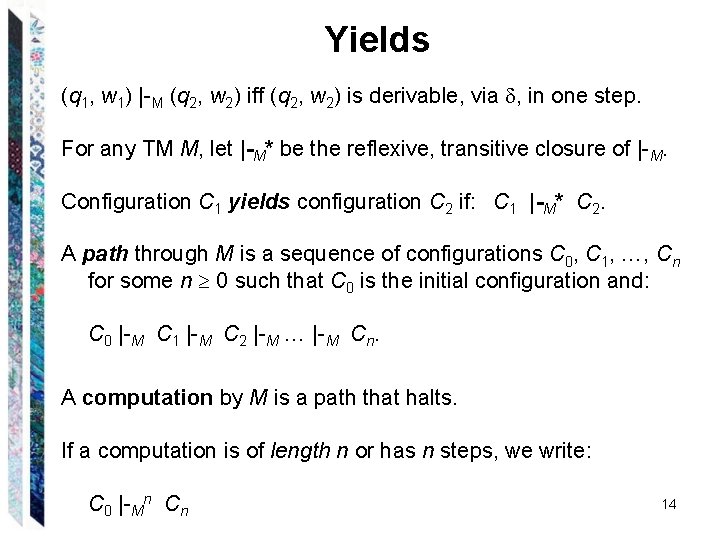
Yields (q 1, w 1) |-M (q 2, w 2) iff (q 2, w 2) is derivable, via , in one step. For any TM M, let |-M* be the reflexive, transitive closure of |-M. Configuration C 1 yields configuration C 2 if: C 1 |-M* C 2. A path through M is a sequence of configurations C 0, C 1, …, Cn for some n 0 such that C 0 is the initial configuration and: C 0 |-M C 1 |-M C 2 |-M … |-M Cn. A computation by M is a path that halts. If a computation is of length n or has n steps, we write: C 0 |-Mn Cn 14
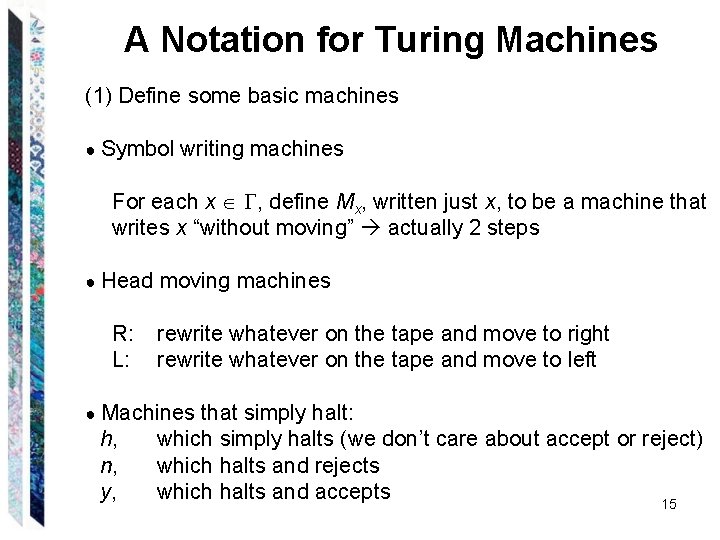
A Notation for Turing Machines (1) Define some basic machines ● Symbol writing machines For each x , define Mx, written just x, to be a machine that writes x “without moving” actually 2 steps ● Head R: L: moving machines rewrite whatever on the tape and move to right rewrite whatever on the tape and move to left ● Machines h, n, y, that simply halt: which simply halts (we don’t care about accept or reject) which halts and rejects which halts and accepts 15
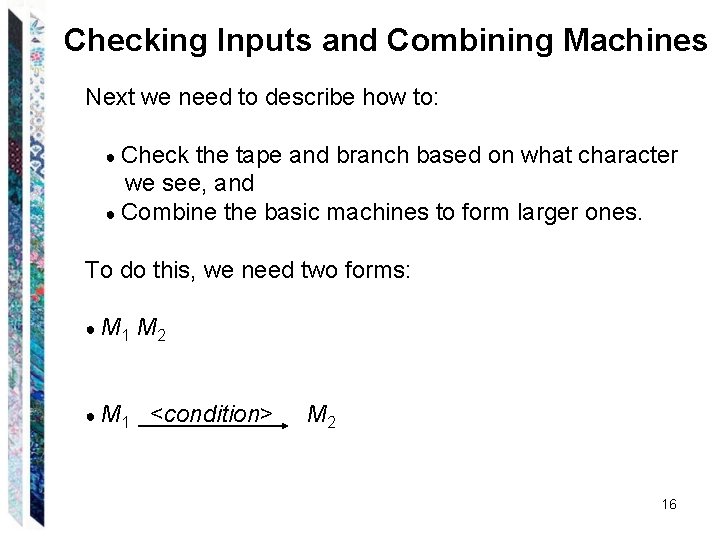
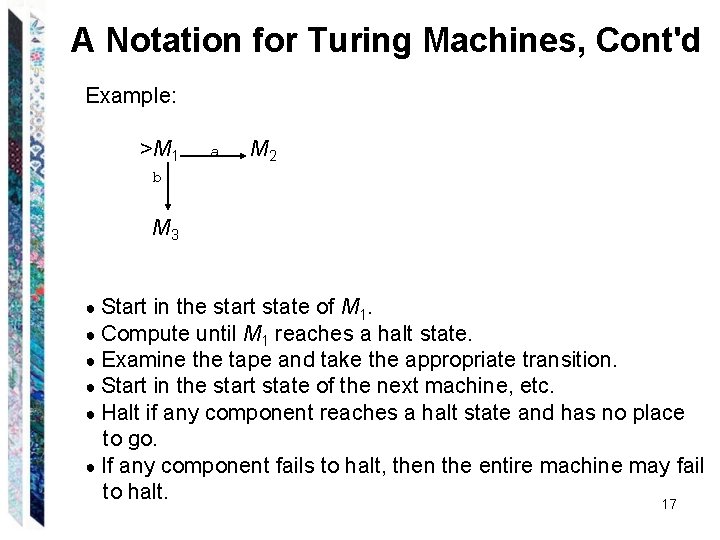
Checking Inputs and Combining Machines Next we need to describe how to: ● Check the tape and branch based on what character we see, and ● Combine the basic machines to form larger ones. To do this, we need two forms: ● M 1 M 2 <condition> M 2 16
A Notation for Turing Machines, Cont'd Example: >M 1 a M 2 b M 3 ● Start in the start state of M 1. ● Compute until M 1 reaches a halt state. ● Examine the tape and take the appropriate transition. ● Start in the start state of the next machine, etc. ● Halt if any component reaches a halt state and has no place to go. ● If any component fails to halt, then the entire machine may fail to halt. 17
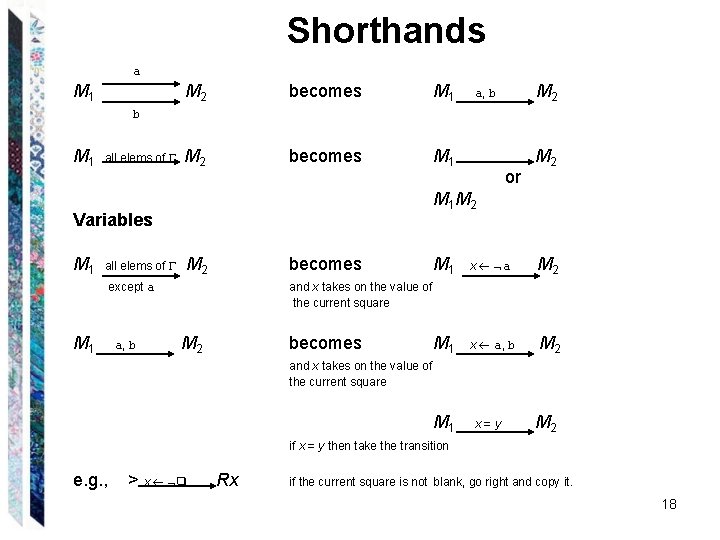
Shorthands a M 1 M 2 becomes M 1 M 2 a, b b M 1 all elems of M 1 M 2 Variables M 1 M 2 all elems of becomes except a M 1 a, b or M 2 M 1 x a, b M 2 and x takes on the value of the current square M 2 becomes and x takes on the value of the current square M 1 x=y M 2 if x = y then take the transition e. g. , > x q Rx if the current square is not blank, go right and copy it. 18
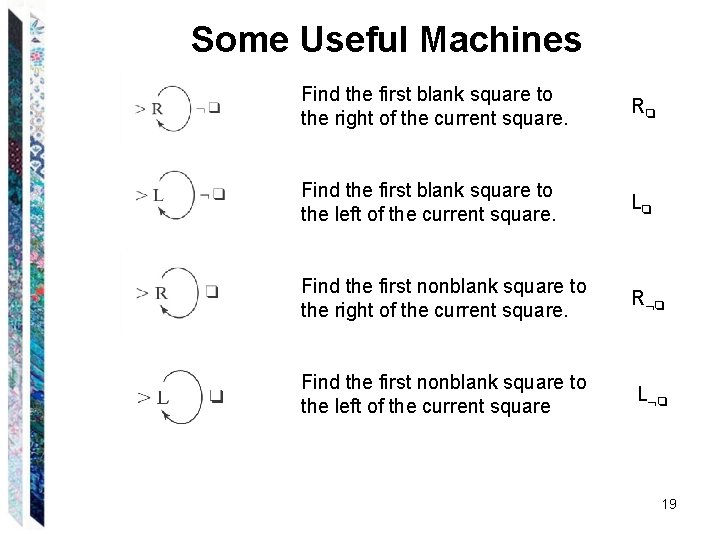
Some Useful Machines Find the first blank square to the right of the current square. Rq Find the first blank square to the left of the current square. Lq Find the first nonblank square to the right of the current square. R q Find the first nonblank square to the left of the current square L q 19
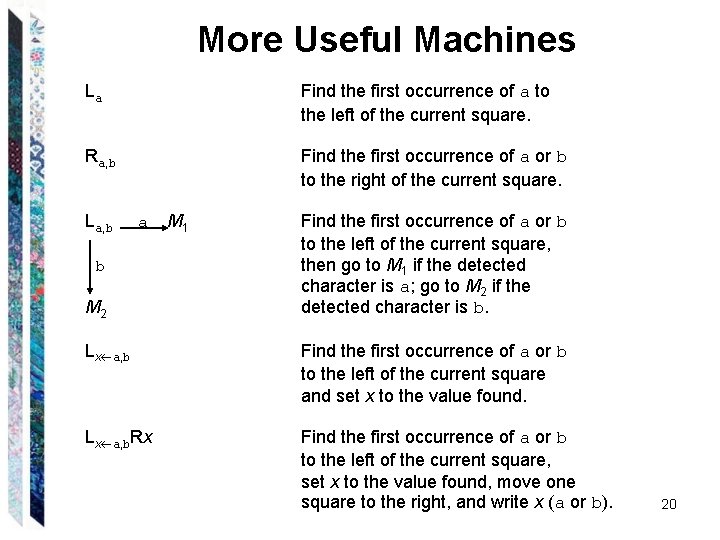
More Useful Machines La Find the first occurrence of a to the left of the current square. Ra, b Find the first occurrence of a or b to the right of the current square. La, b a b M 2 M 1 Find the first occurrence of a or b to the left of the current square, then go to M 1 if the detected character is a; go to M 2 if the detected character is b. Lx a, b Find the first occurrence of a or b to the left of the current square and set x to the value found. Lx a, b. Rx Find the first occurrence of a or b to the left of the current square, set x to the value found, move one square to the right, and write x (a or b). 20
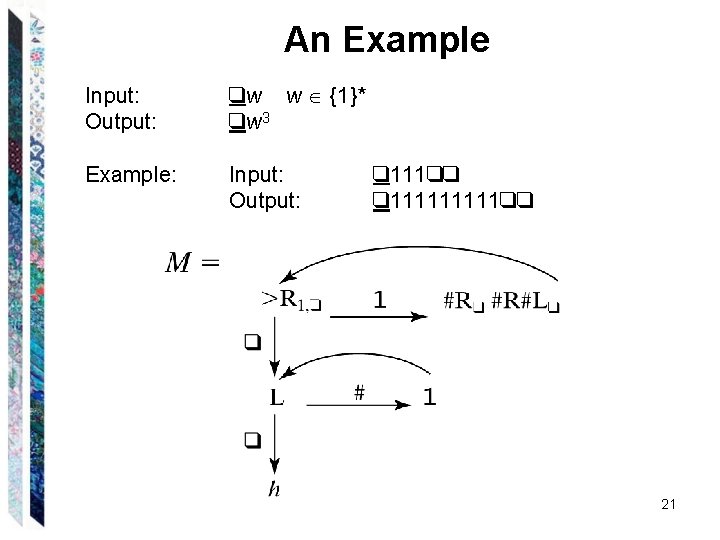
An Example Input: Output: qw w {1}* qw 3 Example: Input: Output: q 111 qq q 11111 qq 21
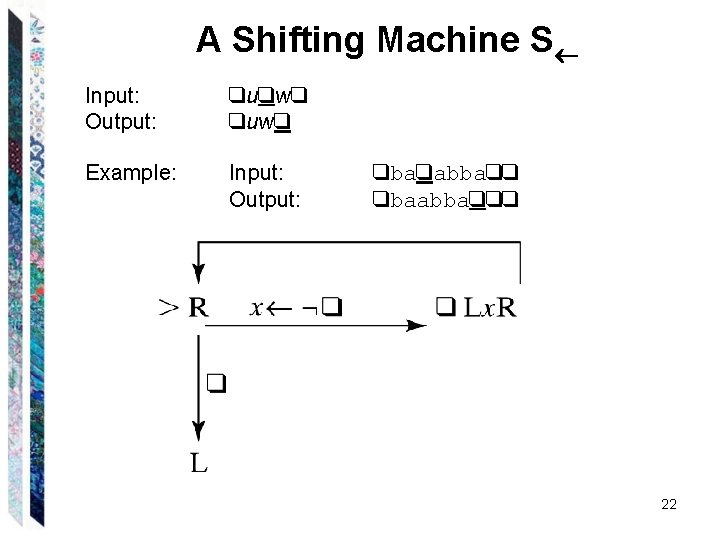
A Shifting Machine S Input: Output: quqwq quwq Example: Input: Output: qbaqabbaqq qbaabbaqqq 22
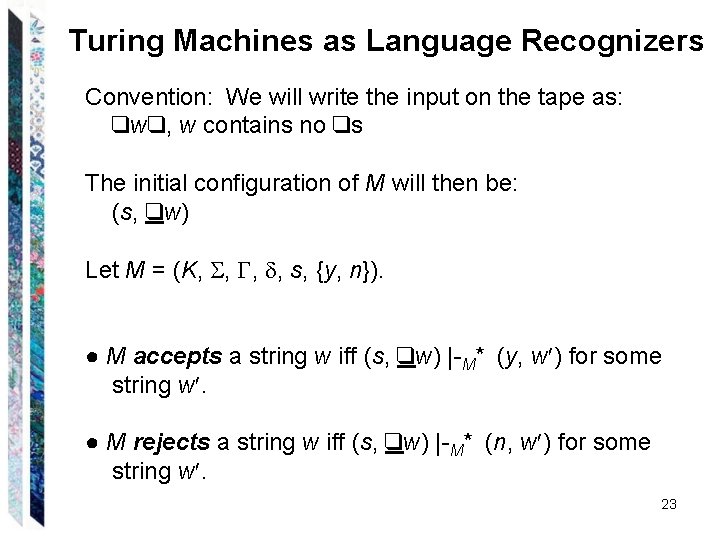
Turing Machines as Language Recognizers Convention: We will write the input on the tape as: qwq, w contains no qs The initial configuration of M will then be: (s, qw) Let M = (K, , s, {y, n}). ● M accepts a string w iff (s, qw) |-M* (y, w ) for some string w. ● M rejects a string w iff (s, qw) |-M* (n, w ) for some string w. 23
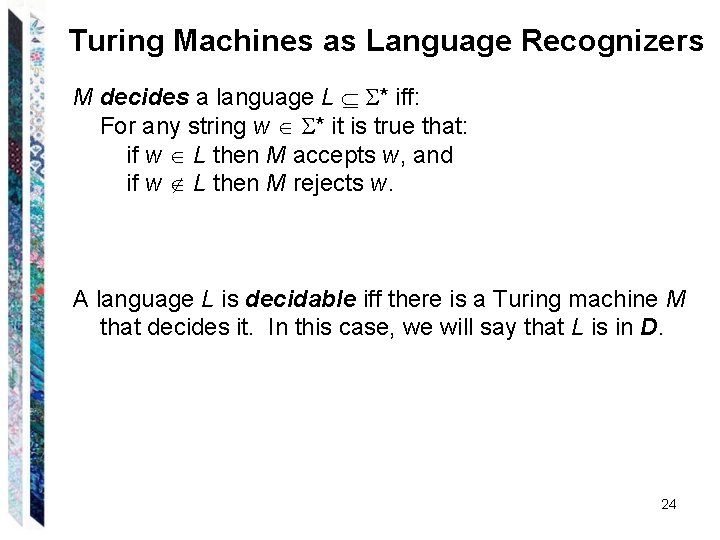
Turing Machines as Language Recognizers M decides a language L * iff: For any string w * it is true that: if w L then M accepts w, and if w L then M rejects w. A language L is decidable iff there is a Turing machine M that decides it. In this case, we will say that L is in D. 24
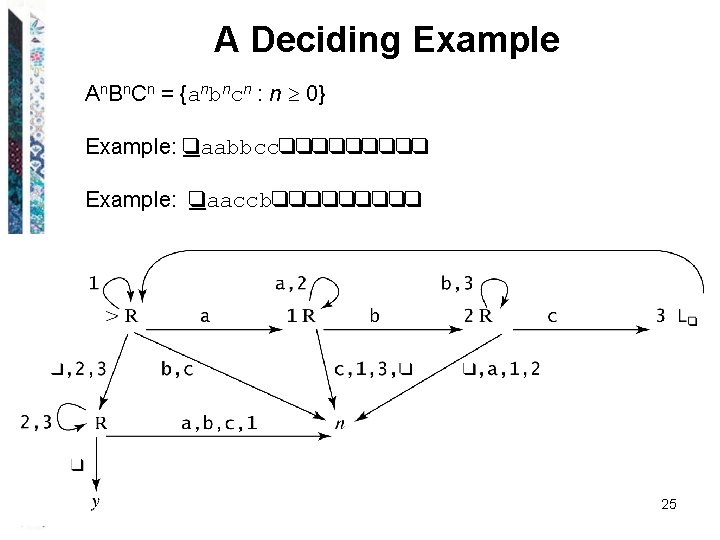
A Deciding Example An. Bn. Cn = {anbncn : n 0} Example: qaabbccqqqqq Example: qaaccbqqqqq 25
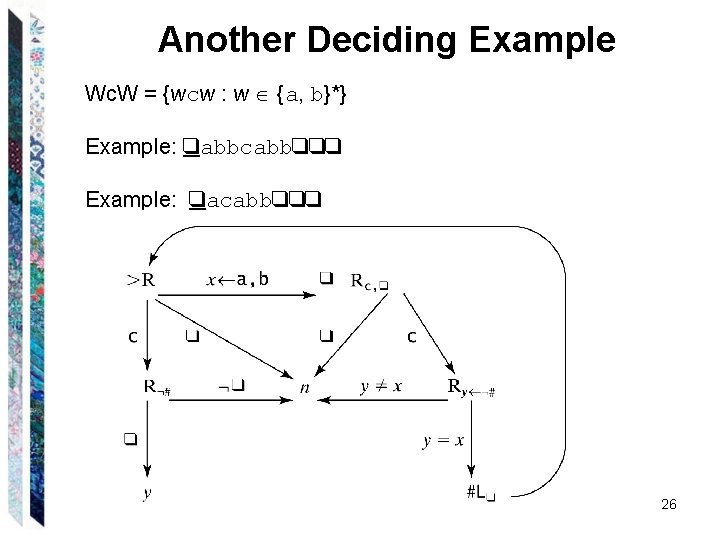
Another Deciding Example Wc. W = {wcw : w {a, b}*} Example: qabbcabbqqq Example: qacabbqqq 26
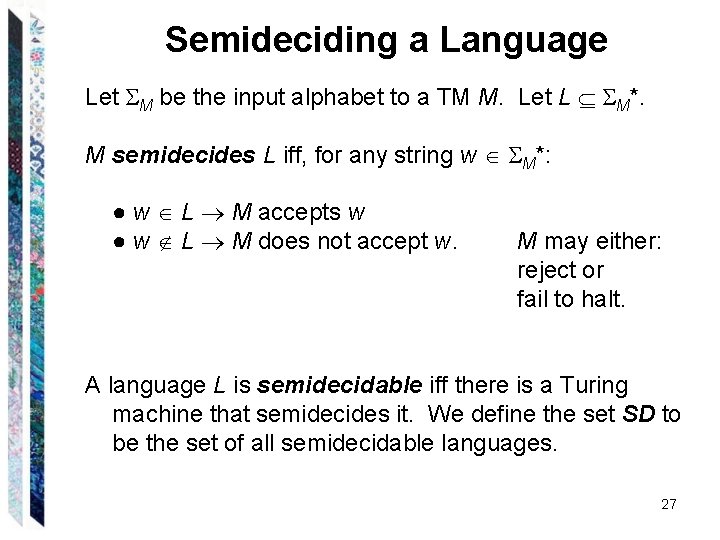
Semideciding a Language Let M be the input alphabet to a TM M. Let L M*. M semidecides L iff, for any string w M*: ● w L M accepts w ● w L M does not accept w. M may either: reject or fail to halt. A language L is semidecidable iff there is a Turing machine that semidecides it. We define the set SD to be the set of all semidecidable languages. 27
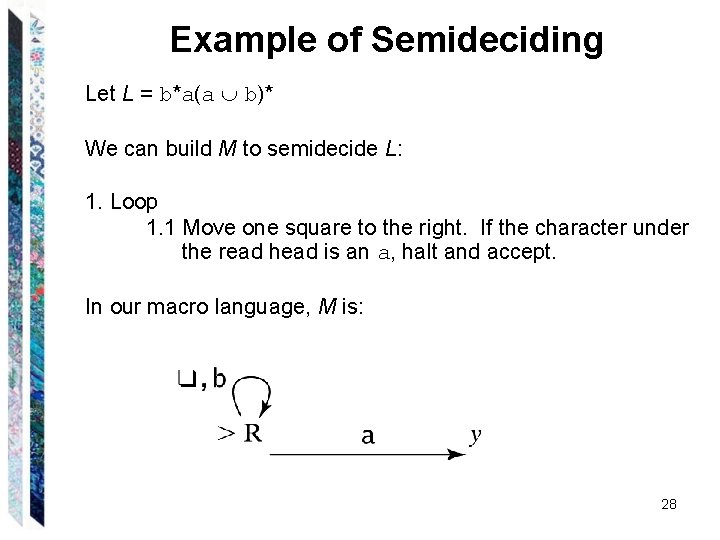
Example of Semideciding Let L = b*a(a b)* We can build M to semidecide L: 1. Loop 1. 1 Move one square to the right. If the character under the read head is an a, halt and accept. In our macro language, M is: 28
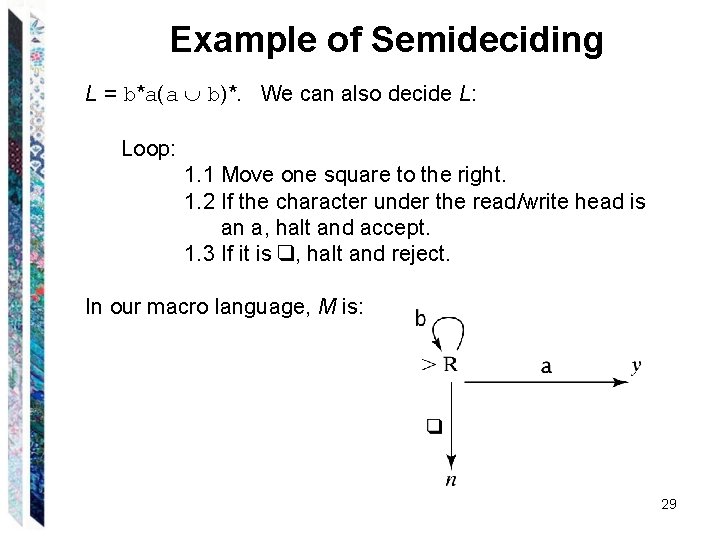
Example of Semideciding L = b*a(a b)*. We can also decide L: Loop: 1. 1 Move one square to the right. 1. 2 If the character under the read/write head is an a, halt and accept. 1. 3 If it is q, halt and reject. In our macro language, M is: 29
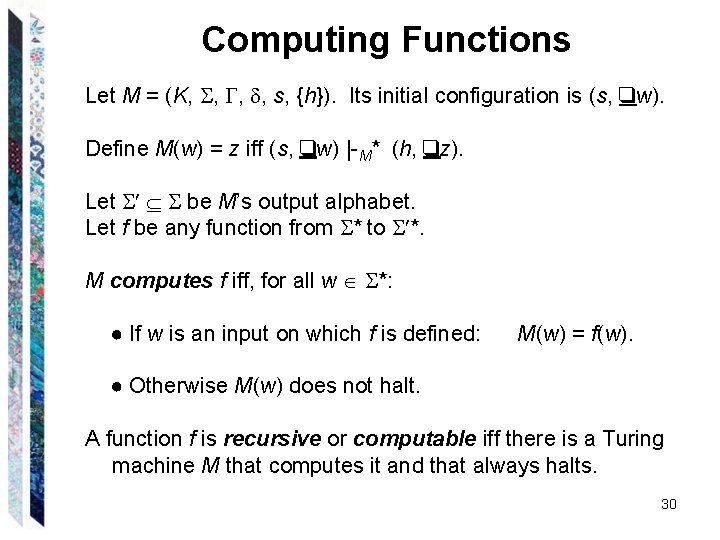
Computing Functions Let M = (K, , s, {h}). Its initial configuration is (s, qw). Define M(w) = z iff (s, qw) |-M* (h, qz). Let be M’s output alphabet. Let f be any function from * to *. M computes f iff, for all w *: ● If w is an input on which f is defined: M(w) = f(w). ● Otherwise M(w) does not halt. A function f is recursive or computable iff there is a Turing machine M that computes it and that always halts. 30
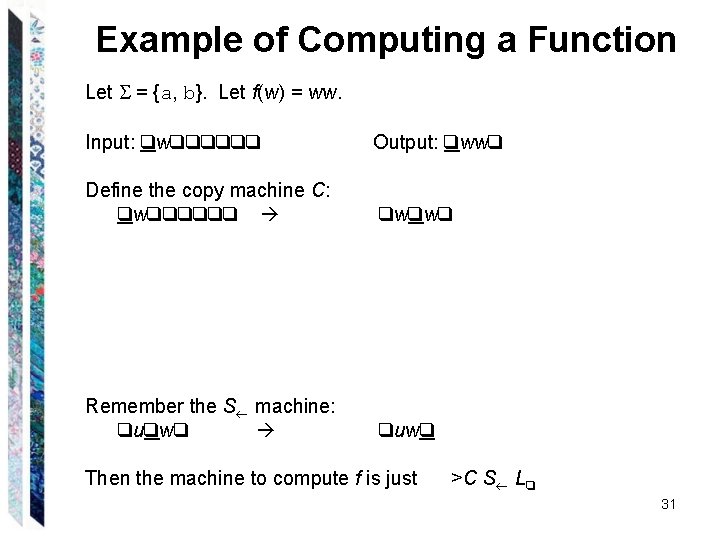
Example of Computing a Function Let = {a, b}. Let f(w) = ww. Input: qwqqqqqq Output: qwwq Define the copy machine C: qwqqqqqq qwqwq Remember the S machine: quqwq quwq Then the machine to compute f is just >C S Lq 31
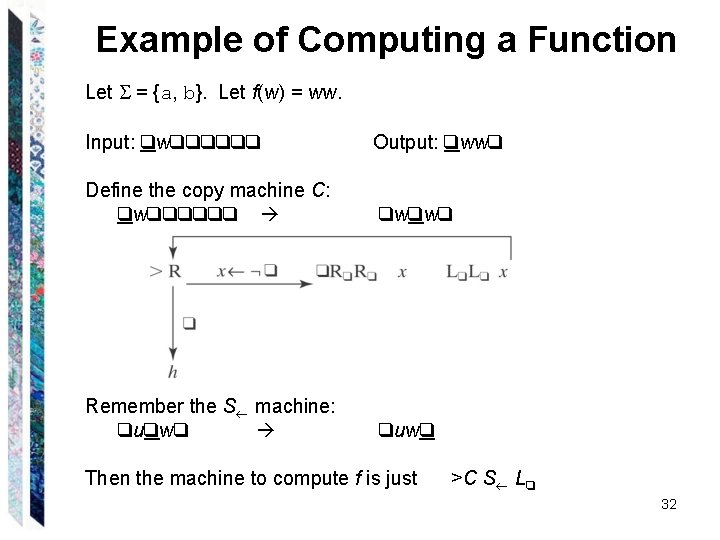
Example of Computing a Function Let = {a, b}. Let f(w) = ww. Input: qwqqqqqq Output: qwwq Define the copy machine C: qwqqqqqq qwqwq Remember the S machine: quqwq quwq Then the machine to compute f is just >C S Lq 32
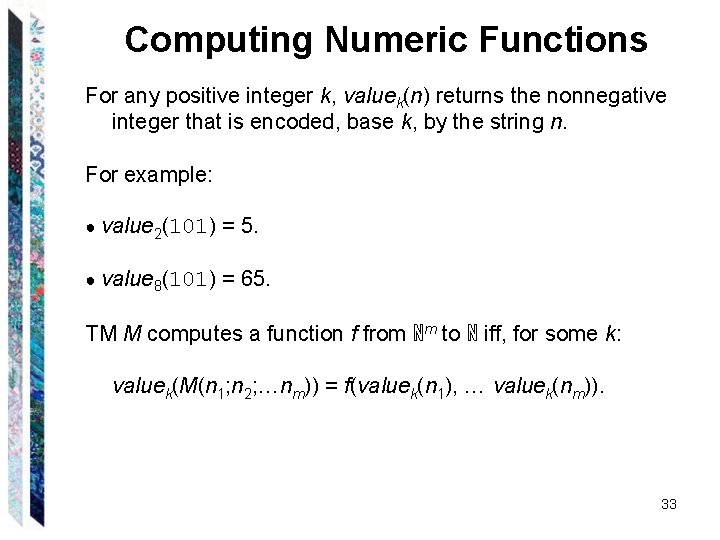
Computing Numeric Functions For any positive integer k, valuek(n) returns the nonnegative integer that is encoded, base k, by the string n. For example: ● value 2(101) = 5. ● value 8(101) = 65. TM M computes a function f from ℕm to ℕ iff, for some k: valuek(M(n 1; n 2; …nm)) = f(valuek(n 1), … valuek(nm)). 33
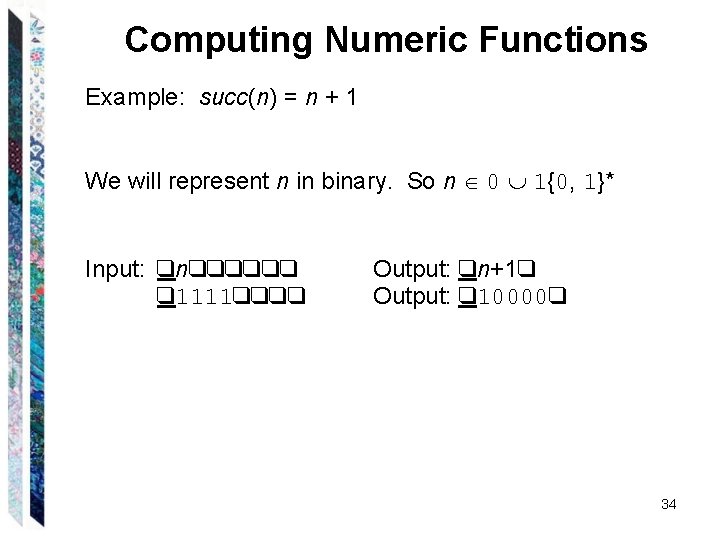
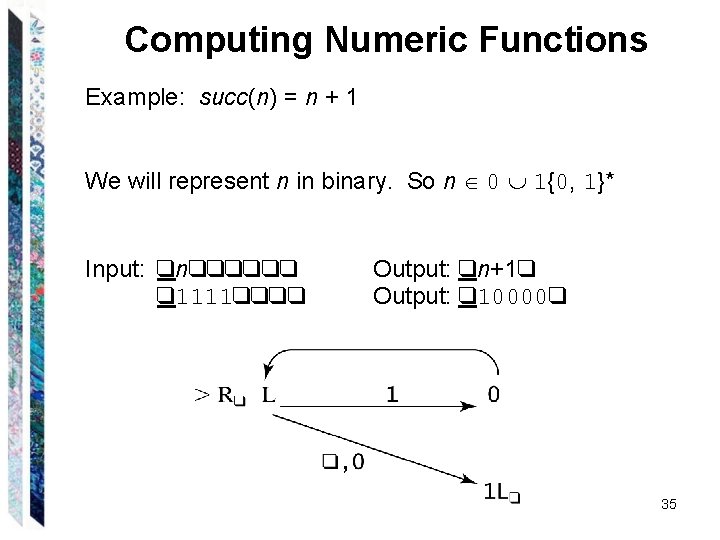
Computing Numeric Functions Example: succ(n) = n + 1 We will represent n in binary. So n 0 1{0, 1}* Input: qnqqqqqq q 1111 qqqq Output: qn+1 q Output: q 10000 q 34
Computing Numeric Functions Example: succ(n) = n + 1 We will represent n in binary. So n 0 1{0, 1}* Input: qnqqqqqq q 1111 qqqq Output: qn+1 q Output: q 10000 q 35
Why Are We Working with Our Hands Tied Behind Our Backs? Turing machines Are more powerful than any of the other formalisms we have studied so far. Turing machines Are a lot harder to work with than all the real computers we have available. Why bother? The very simplicity that makes it hard to program Turing machines makes it possible to reason formally about what they can do. If we can, once, show that anything a real computer can do can be done (albeit clumsily) on a Turing machine, then we have a way to 36 reason about what real computers can do.
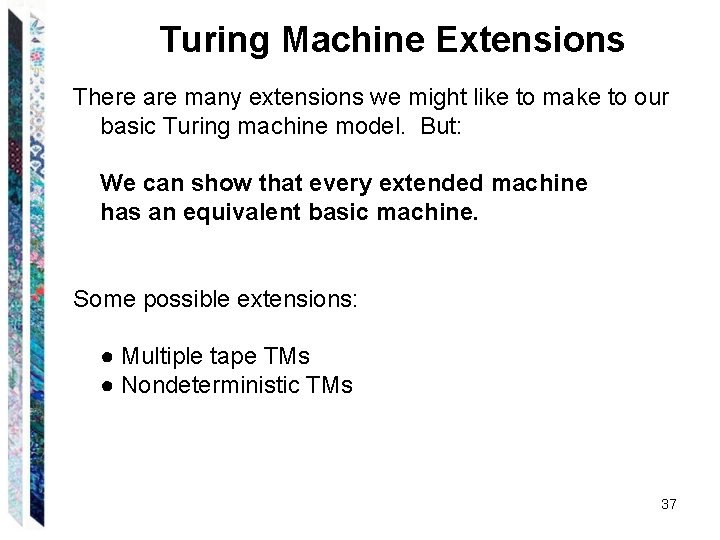
Turing Machine Extensions There are many extensions we might like to make to our basic Turing machine model. But: We can show that every extended machine has an equivalent basic machine. Some possible extensions: ● Multiple tape TMs ● Nondeterministic TMs 37
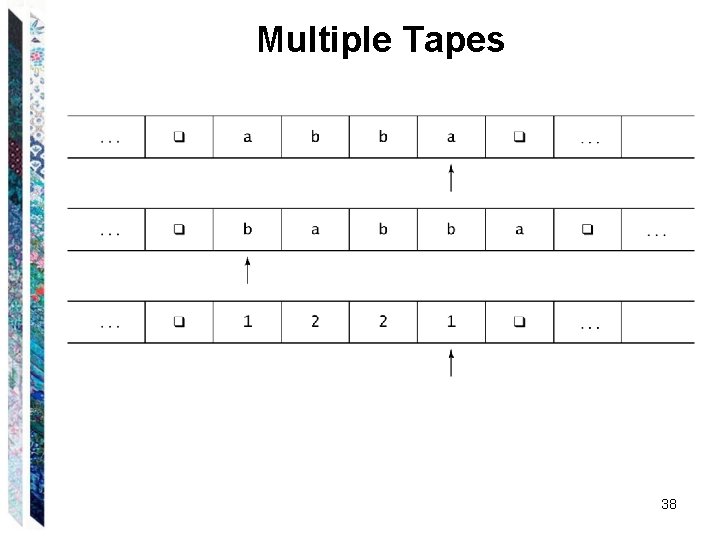
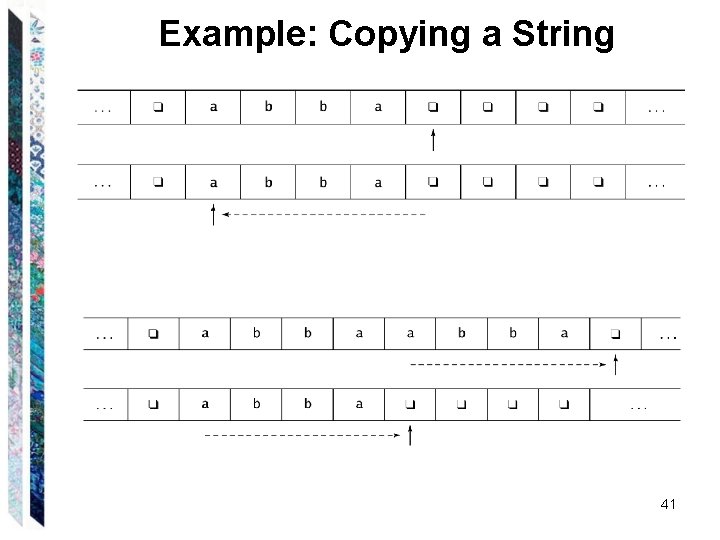
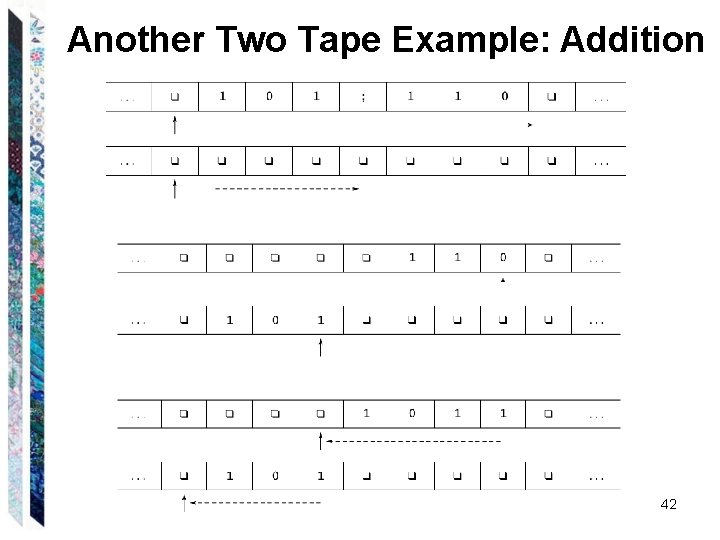
Multiple Tapes 38
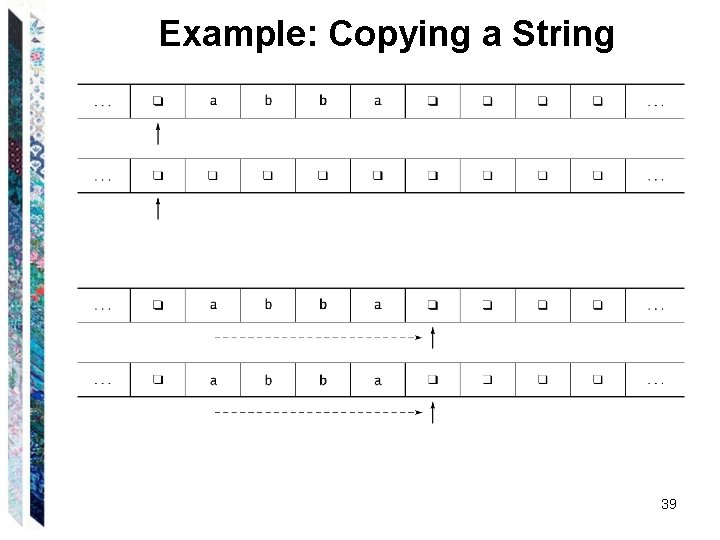
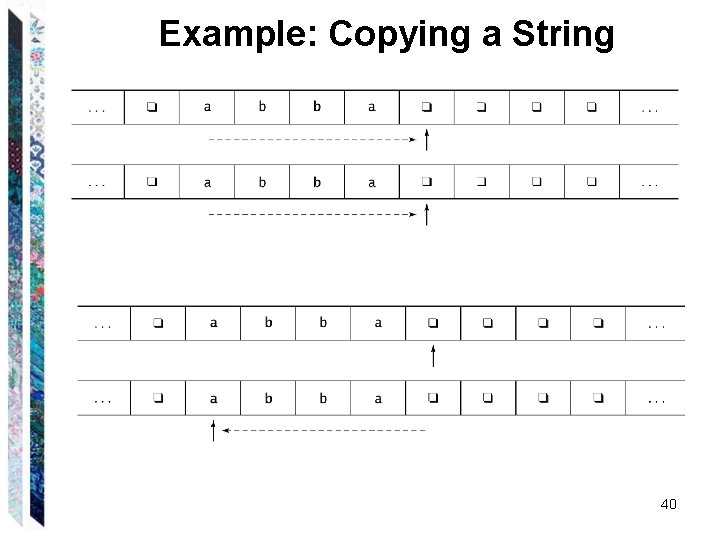
Example: Copying a String 39
Example: Copying a String 40
Example: Copying a String 41
Another Two Tape Example: Addition 42
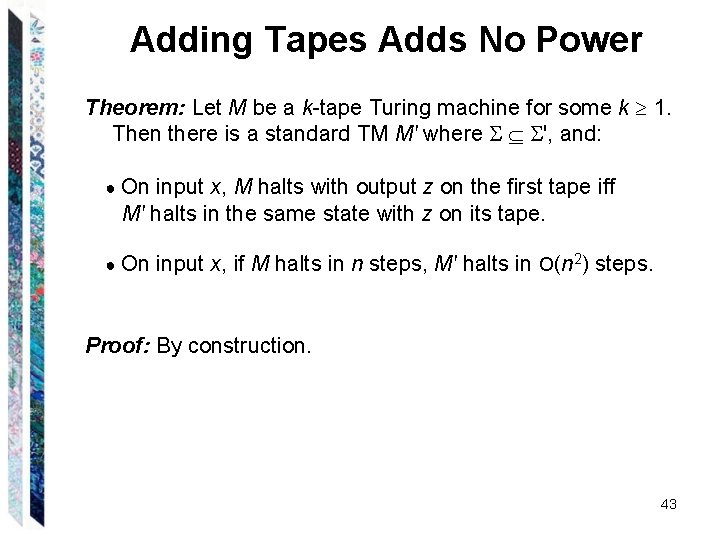
Adding Tapes Adds No Power Theorem: Let M be a k-tape Turing machine for some k 1. Then there is a standard TM M' where ', and: ● On input x, M halts with output z on the first tape iff M' halts in the same state with z on its tape. ● On input x, if M halts in n steps, M' halts in O(n 2) steps. Proof: By construction. 43
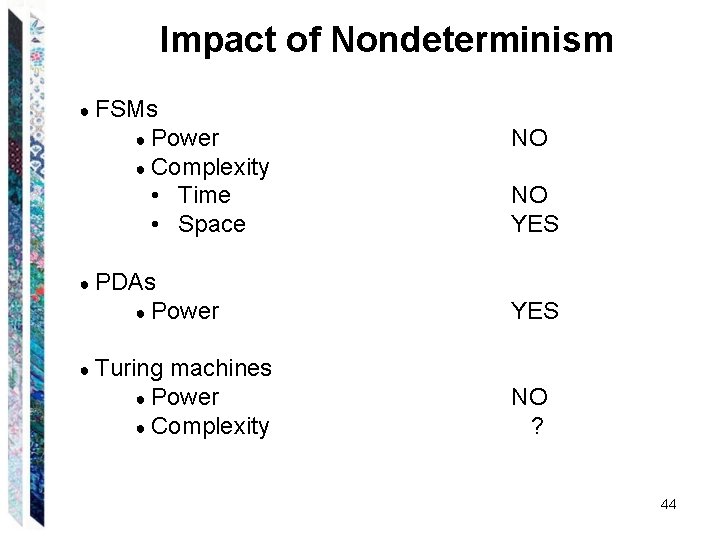
Impact of Nondeterminism ● FSMs ● Power NO ● Complexity • Time • Space NO YES ● PDAs ● Power machines ● Power ● Complexity YES ● Turing NO ? 44
Equivalence of Deterministic and Nondeterministic Turing Machines Theorem: If a nondeterministic TM M decides or semidecides a language, or computes a function, then there is a standard TM M' semideciding or deciding the same language or computing the same function. Proof: (by construction). We must do separate constructions for deciding/semideciding and for function computation. 45