
Turing Machines Busy Beavers and Big Questions about
Turing Machines, Busy Beavers, and Big Questions about Computing David Evans http: //www. cs. virginia. edu/evans
My Research Group • Computer Security: computing in the presence of adversaries • Last summer student projects: – Privacy in Social Networks (Adrienne Felt) – Thwarting Spyware (Meghan Knoll) – Hiding Keys in Software (Carly Simpson) 2

Computer Science = Doing Cool Stuff with Computers? 3
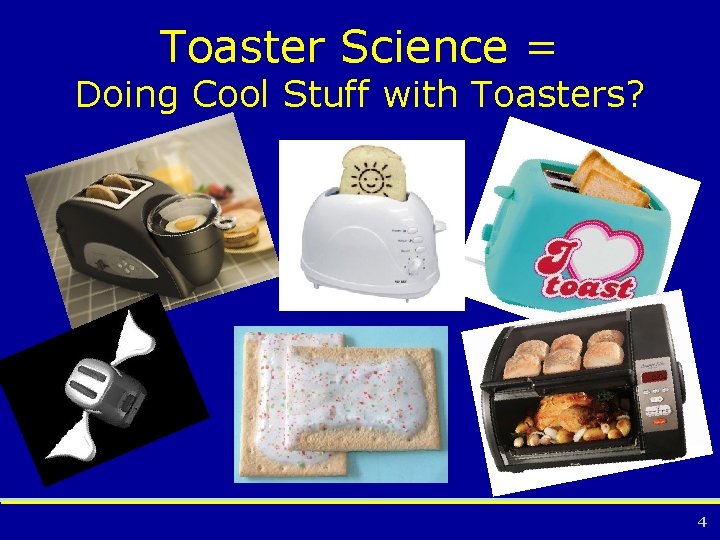
Toaster Science = Doing Cool Stuff with Toasters? 4
Computer Science • Mathematics is about declarative (“what is”) knowledge; Computer Science is about imperative (“how to”) knowledge • The Study of Information Processes Language – How to describe them – How to predict their properties Logic – How to implement them Engineering quickly, cheaply, and reliably 5
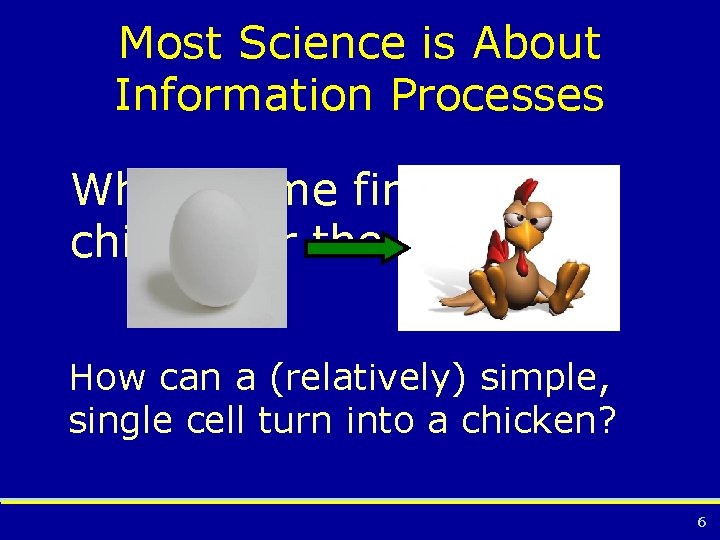
Most Science is About Information Processes Which came first, the chicken or the egg? How can a (relatively) simple, single cell turn into a chicken? 6
Understanding Information Processes • Art: How to describe information processes – Designing programming languages – Inventing algorithms • Science: Predicting properties – What resources will a computation consume? – Will a program produce the correct output? • Engineering: Implementing processes – How to build hardware and software to efficiently carry out information processes 7
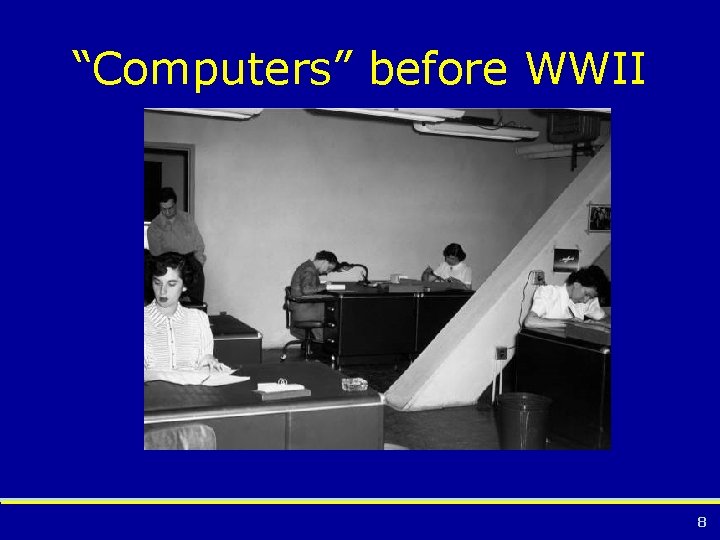
“Computers” before WWII 8
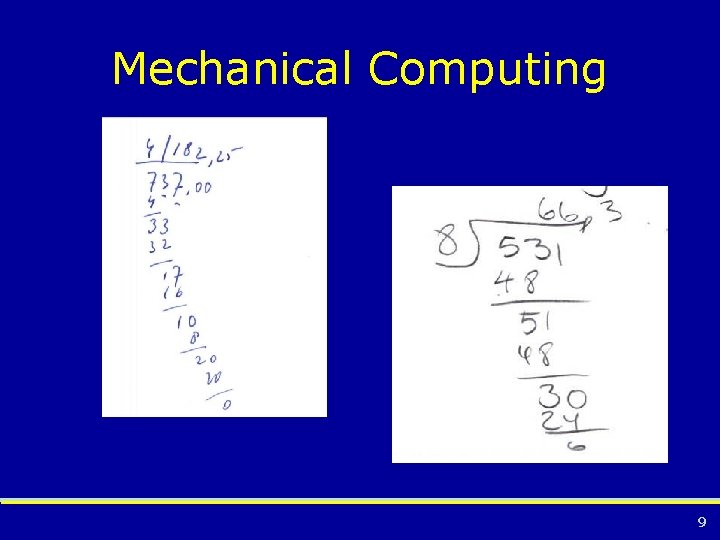
Mechanical Computing 9
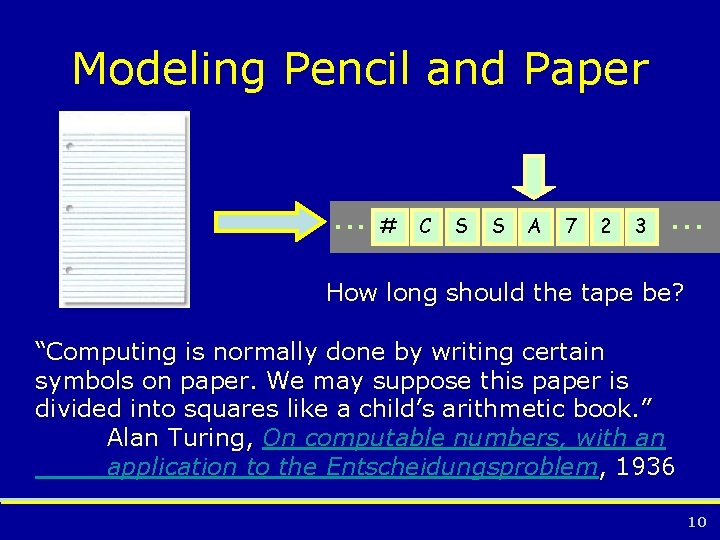
Modeling Pencil and Paper. . . # C S S A 7 2 3 . . . How long should the tape be? “Computing is normally done by writing certain symbols on paper. We may suppose this paper is divided into squares like a child’s arithmetic book. ” Alan Turing, On computable numbers, with an application to the Entscheidungsproblem, 1936 10
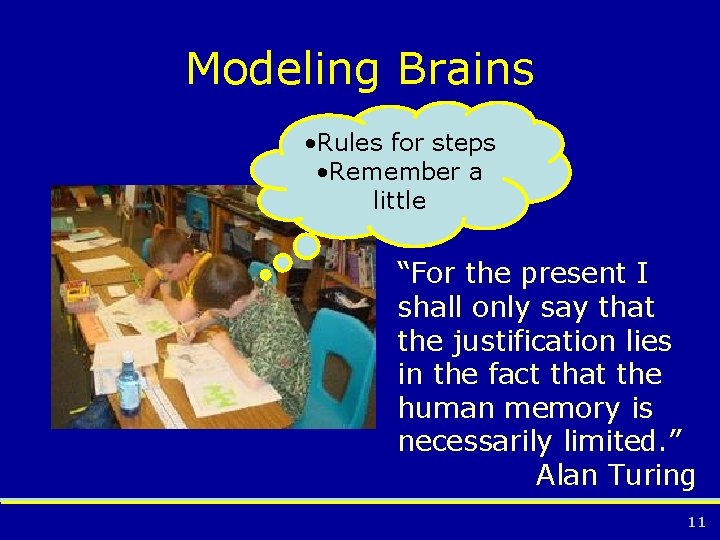
Modeling Brains • Rules for steps • Remember a little “For the present I shall only say that the justification lies in the fact that the human memory is necessarily limited. ” Alan Turing 11

Turing’s Model. . . 0 0 0 0 0 . . . Input: 0 Write: 1 Move: Start A Input: 0 Write: 1 Move: Input: 1 Write: 1 Move: B Input: 1 Write: 1 Move: Halt H 12
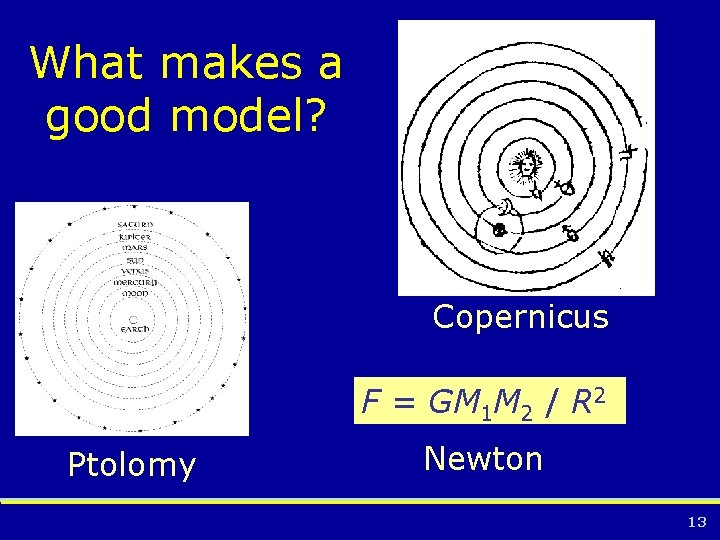
What makes a good model? Copernicus F = GM 1 M 2 / R 2 Ptolomy Newton 13

Questions about Turing’s Model • How well does it match “real” computers? – Can it do everything they can do? – Can they do everything it can do? • Does it help us understand reason about computing? 14
Power of Turing Machine • Can it add? • Can it carry out any computation? • Can it solve any problem? 15
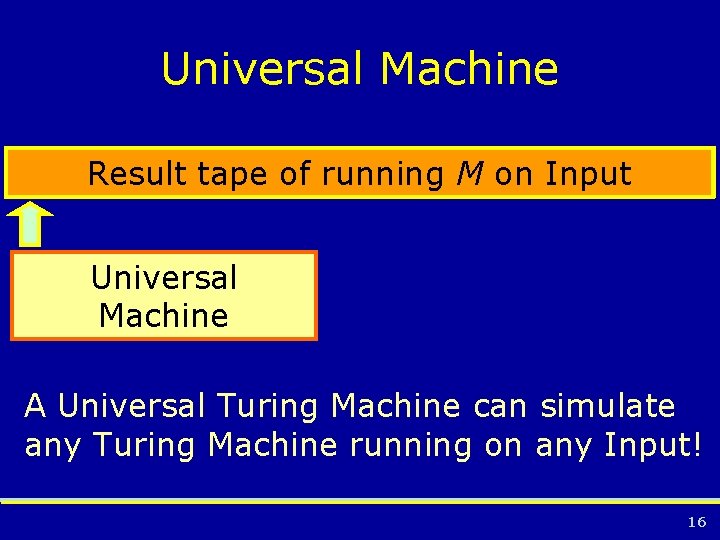
Universal Machine Input Description Result tape of a of Turing running Machine M on M Input Universal Machine A Universal Turing Machine can simulate any Turing Machine running on any Input! 16

Manchester Illuminated Universal Turing Machine, #9 from http: //www. verostko. com/manchester. html 17
Church-Turing Thesis • All mechanical computers are equally powerful* *Except for practical limits like memory size, time, energy, etc. • There exists a Turing machine that can simulate any mechanical computer • Any computer that is powerful enough to simulate a Turing machine, can simulate any mechanical computer 18

What This Means • Your cell phone, watch, i. Pod, etc. has a processor powerful enough to simulate a Turing machine • A Turing machine can simulate the world’s most powerful supercomputer • Thus, your cell phone can simulate the world’s most powerful supercomputer (it’ll just take a lot longer and will run out of memory) 19
Recap • A computer is something that can carry out well-defined steps • All computers are equally powerful – If a machine can simulate any step of another machine, it can simulate the other machine (except for physical limits) – What matters is the program that defines the steps 20

Are there problems computers can’t solve? 21

The “Busy Beaver” Game • Design a Turing Machine that: – Uses two symbols (e. g. , “ 0” and “ 1”) – Starts with a tape of all “ 0”s – Eventually halts (can’t run forever) – Has N states • Goal is to run for as many steps as possible (before halting) Tibor Radó, 1962 22
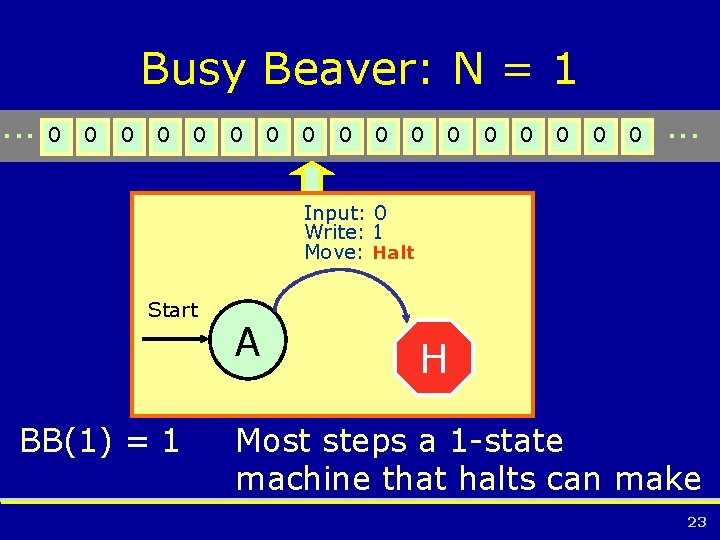
Busy Beaver: N = 1. . . 0 0 0 0 0 . . . Input: 0 Write: 1 Move: Halt Start BB(1) = 1 A H Most steps a 1 -state machine that halts can make 23
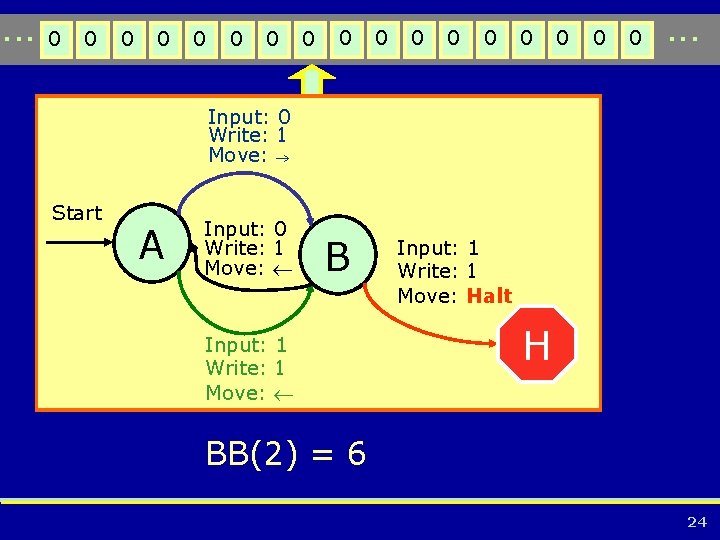
. . . 0 0 0 0 0 . . . Input: 0 Write: 1 Move: Start A Input: 0 Write: 1 Move: B Input: 1 Write: 1 Move: Halt H BB(2) = 6 24

0/0/R B 0/1/R Start A C 1/1/R 0/1/L 1/0/R 1/0/L D F E 0/0/L 0/1/L 1/1/H 1/1/R 0/0/R H 6 -state machine found by Buntrock and Marxen, 2001 25
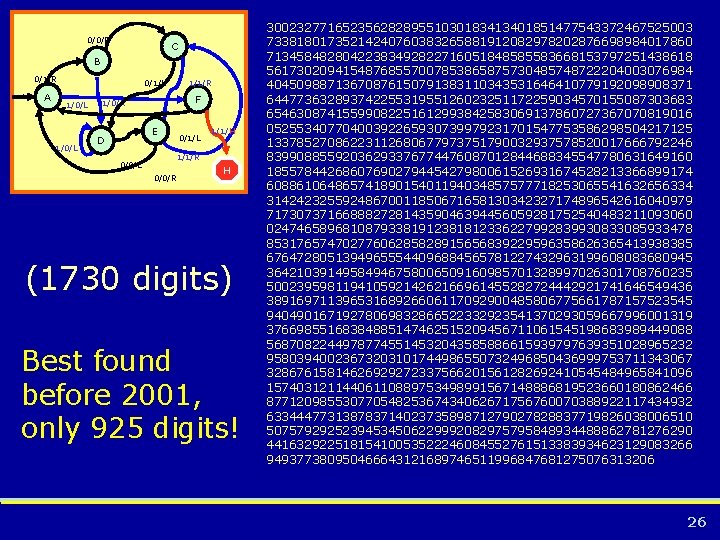
0/0/R C B 0/1/R Start A 0/1/L 1/0/L F 1/0/R E D 1/1/R 0/1/L 1/1/H 1/1/R 0/0/L 0/0/R H (1730 digits) Best found before 2001, only 925 digits! 30023277165235628289551030183413401851477543372467525003 73381801735214240760383265881912082978202876698984017860 71345848280422383492822716051848585583668153797251438618 56173020941548768557007853865875730485748722204003076984 40450988713670876150791383110343531646410779192098908371 64477363289374225531955126023251172259034570155087303683 65463087415599082251612993842583069137860727367070819016 05255340770400392265930739979231701547753586298504217125 13378527086223112680677973751790032937578520017666792246 83990885592036293376774476087012844688345547780631649160 18557844268607690279445427980061526931674528213366899174 60886106486574189015401194034857577718253065541632656334 31424232559248670011850671658130342327174896542616040979 71730737166888272814359046394456059281752540483211093060 02474658968108793381912381812336227992839930833085933478 85317657470277606285828915656839229596358626365413938385 67647280513949655544096884565781227432963199608083680945 36421039149584946758006509160985701328997026301708760235 50023959811941059214262166961455282724442921741646549436 38916971139653168926606117092900485806775661787157523545 94049016719278069832866522332923541370293059667996001319 37669855168384885147462515209456711061545198683989449088 56870822449787745514532043585886615939797639351028965232 95803940023673203101744986550732496850436999753711343067 32867615814626929272337566201561282692410545484965841096 15740312114406110889753498991567148886819523660180862466 87712098553077054825367434062671756760070388922117434932 63344477313878371402373589871279027828837719826038006510 50757929252394534506229992082975795848934488862781276290 44163292251815410053522246084552761513383934623129083266 949377380950466643121689746511996847681275076313206 26
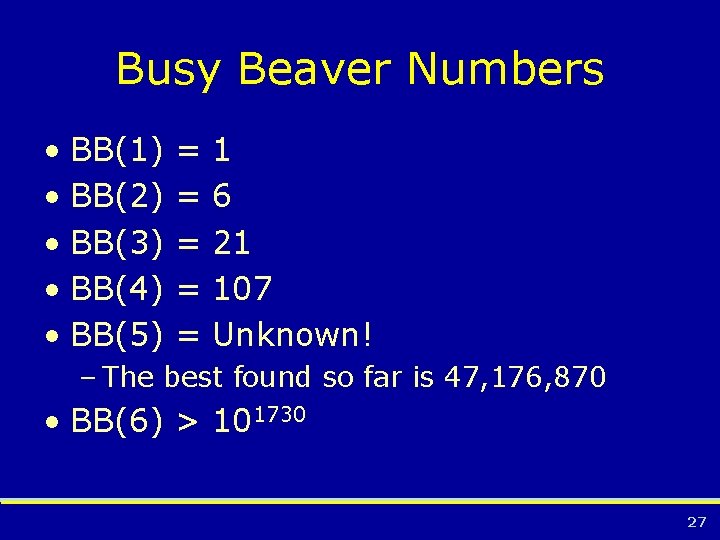
Busy Beaver Numbers • BB(1) • BB(2) • BB(3) • BB(4) • BB(5) = = = 1 6 21 107 Unknown! – The best found so far is 47, 176, 870 • BB(6) > 101730 27
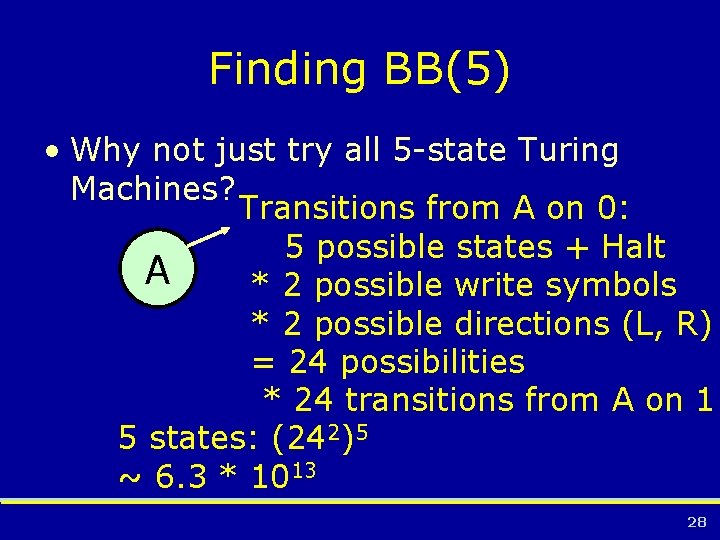
Finding BB(5) • Why not just try all 5 -state Turing Machines? Transitions from A on 0: 5 possible states + Halt A * 2 possible write symbols * 2 possible directions (L, R) = 24 possibilities * 24 transitions from A on 1 5 states: (242)5 ~ 6. 3 * 1013 28
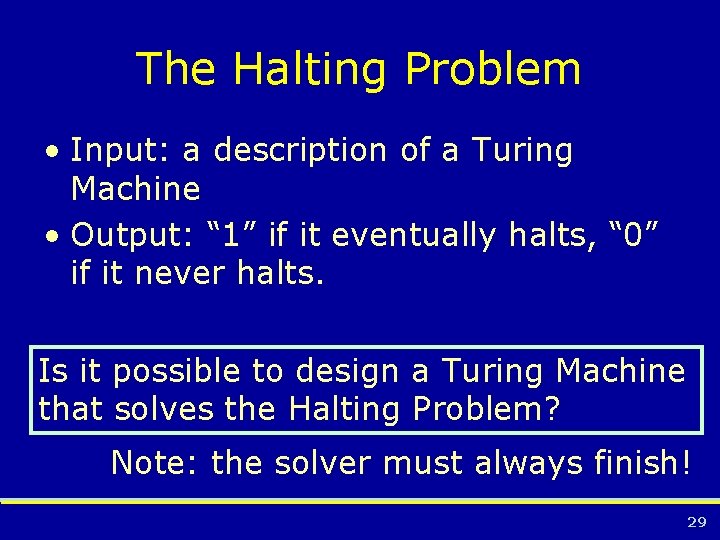
The Halting Problem • Input: a description of a Turing Machine • Output: “ 1” if it eventually halts, “ 0” if it never halts. Is it possible to design a Turing Machine that solves the Halting Problem? Note: the solver must always finish! 29

Example 0/0/R Start A B 1/1/H 0/0/L Halting Problem Solver H 0 (it never halts) 30
Example Halting Problem Solver 31
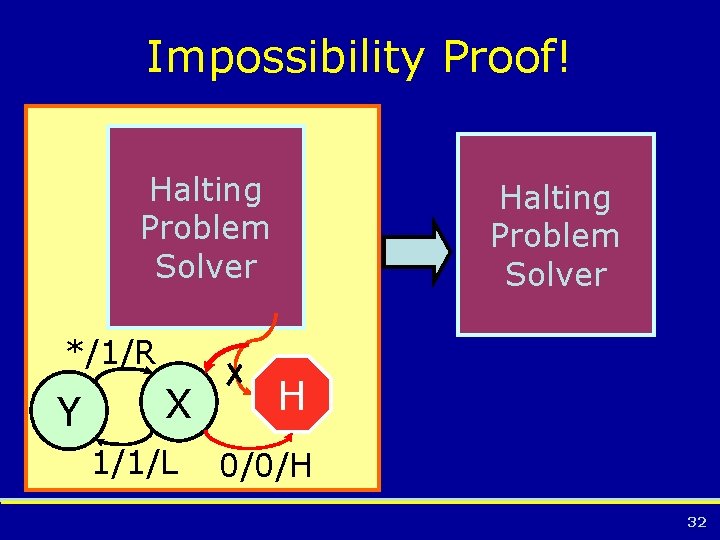
Impossibility Proof! Halting Problem Solver */1/R Y X 1/1/L Halting Problem Solver H 0/0/H 32
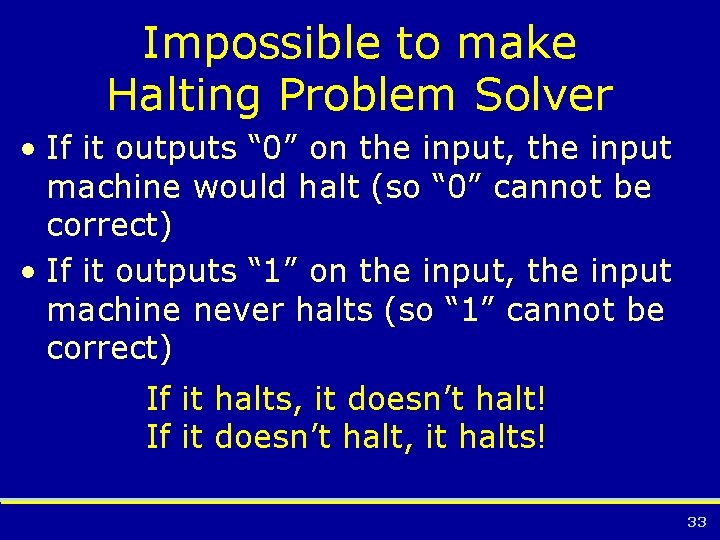
Impossible to make Halting Problem Solver • If it outputs “ 0” on the input, the input machine would halt (so “ 0” cannot be correct) • If it outputs “ 1” on the input, the input machine never halts (so “ 1” cannot be correct) If it halts, it doesn’t halt! If it doesn’t halt, it halts! 33
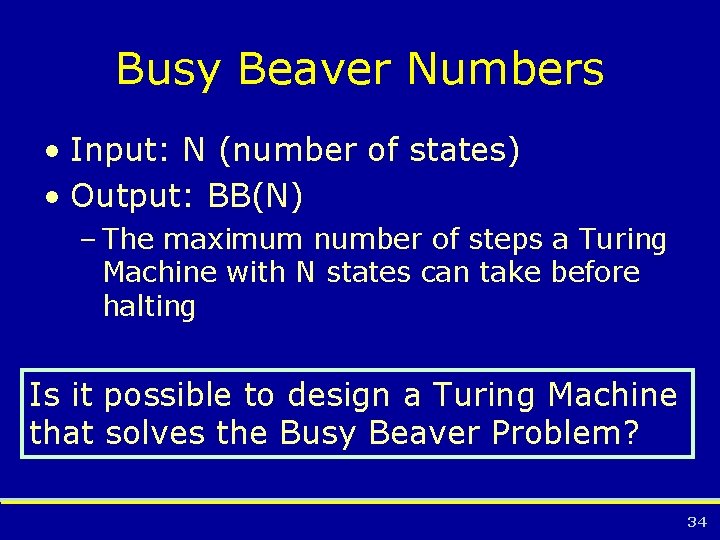
Busy Beaver Numbers • Input: N (number of states) • Output: BB(N) – The maximum number of steps a Turing Machine with N states can take before halting Is it possible to design a Turing Machine that solves the Busy Beaver Problem? 34
Summary • Computer Science is the study of information processes: all about problem solving – Almost all science today depends on computing – All computers are deeply equivalent – Some things cannot be computed by any machine 35
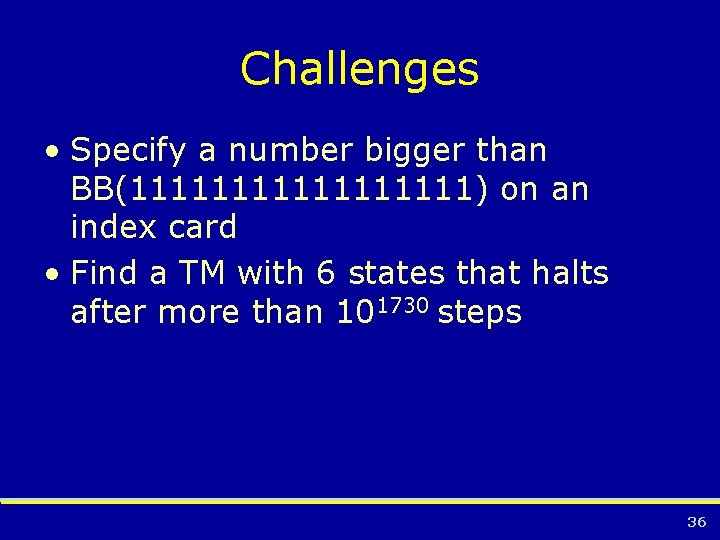
Challenges • Specify a number bigger than BB(111111111) on an index card • Find a TM with 6 states that halts after more than 101730 steps 36
Computer Science at UVa • New Interdisciplinary Major in Computer Science for A&S students • Take CS 150 this Spring – Every scientist needs to understand computing, not just as a tool but as a way of thinking • Lots of opportunities to get involved in research groups 37
Questions http: //www. cs. virginia. edu/evans@cs. virginia. edu 38
- Slides: 38