
Turfgrass Soils by R W Daniels Ph D
Turfgrass Soils by R. W. Daniels Ph. D Original Presentation Landscape New Brunswick, February 2013
Our Topic SPECIFICATIONS SOILS DRAINAGE
Present Day Work Force Life Long Learning Upgrading Present Skills
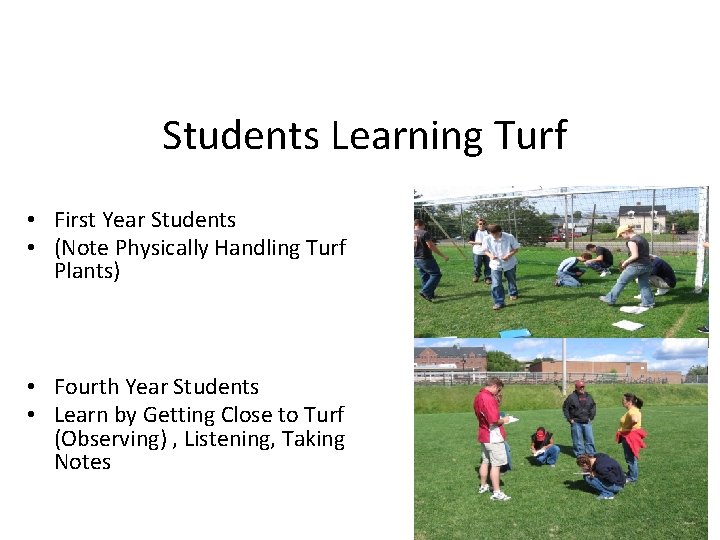
Students Learning Turf • First Year Students • (Note Physically Handling Turf Plants) • Fourth Year Students • Learn by Getting Close to Turf (Observing) , Listening, Taking Notes
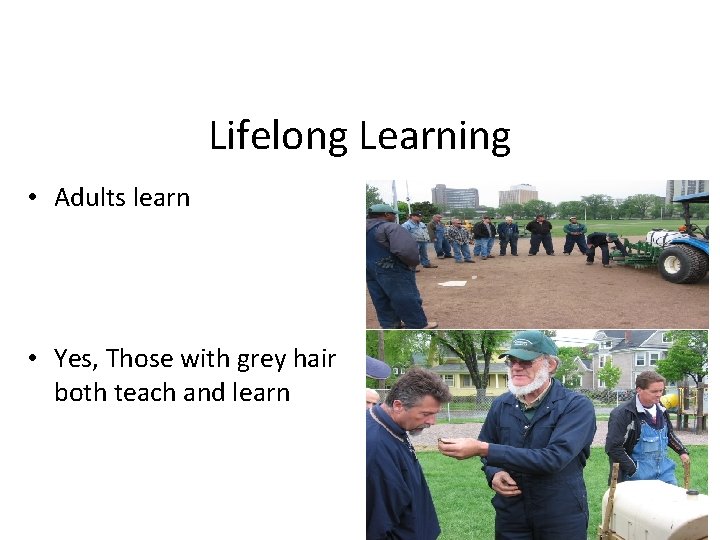
Lifelong Learning • Adults learn • Yes, Those with grey hair both teach and learn
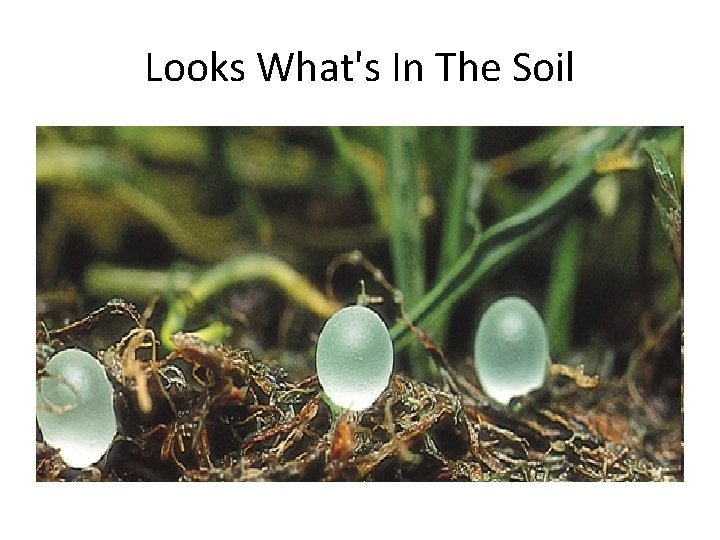
Looks What's In The Soil
Today’s Topics • Soils: Composition, Terms (Structure, Texture), Soil and Water, p. H, Thatch, Selecting Media • Specific Media Problems: Drainage (Surface, Sub-surface, Other), Organic Topdressing, Cultivation (options) • Summary
Initial Topics • Soils: – Composition – Terms – Soil and Water – p. H – Thatch – Selecting Media
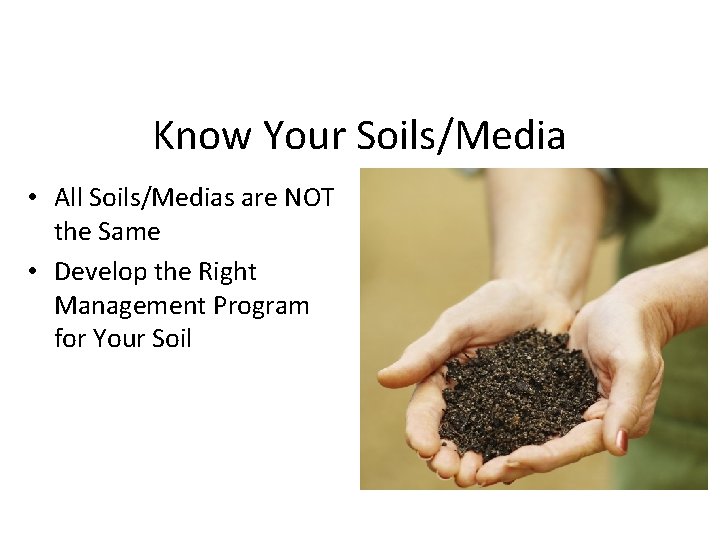
Know Your Soils/Media • All Soils/Medias are NOT the Same • Develop the Right Management Program for Your Soil
Soils In Turfgeass • Relationship and Importance of Soils in Turfgrass Management is Poorly Understood • Lack of Basic Practical Knowledge of Soils • Non Appreciation of Importance of Soils on Drainage, Compaction and Plant Root Growth • GETTING SOILS RIGHT PREVENTS A LOT OF FUTURE PROBLEMS
Functions of Soil • • Supports Plant Provides Nutrients Reservoir for Water Receiver for Oxygen and Carbon Dioxide
Common Mistake in Turf Management • We Base our Decisions on Visual, Above Ground Symptoms • We Try a “Quick Fix” (It Often Works For a Short Period of Time) • With Turfgrass “The Bottom” (Roots) Run “The Top” (Above Ground Visual Vegetation) • Maintain (Establish) a Healthy Plant Root System and Your Worries are Greatly Demised
Causes of “The Problem” • • • Presence of “Hard Pan” Extent of “Layering” Past Management Types of Media Used Topdressing: Material Used, Application Combination of MANY Things
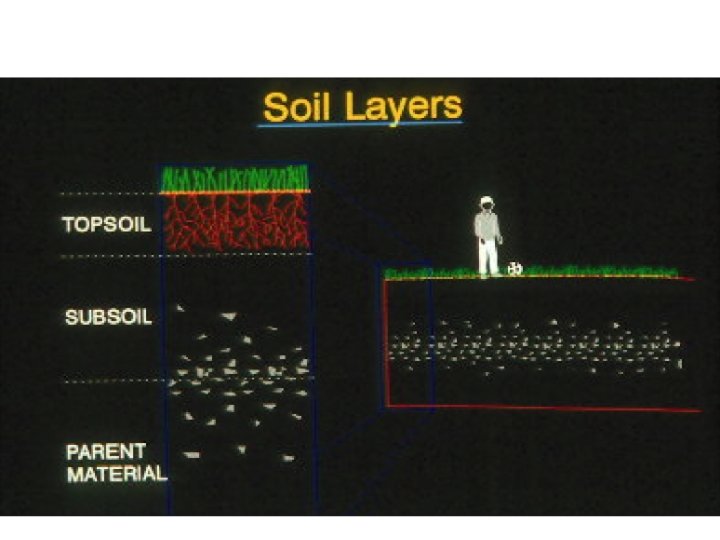
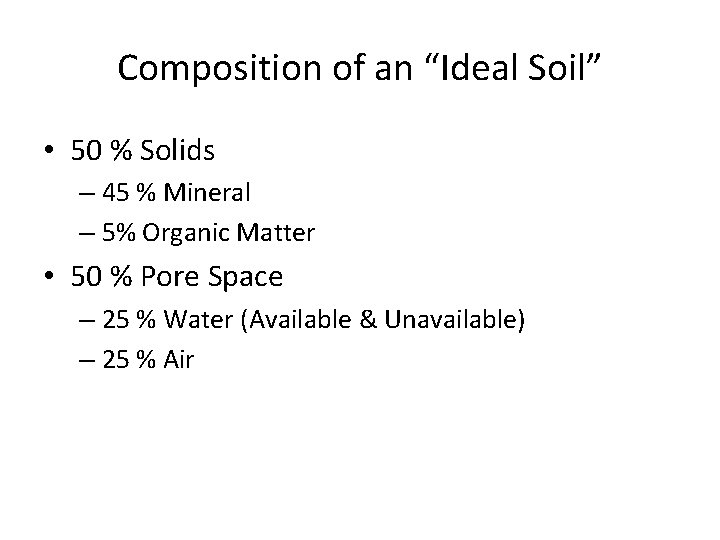
Composition of an “Ideal Soil” • 50 % Solids – 45 % Mineral – 5% Organic Matter • 50 % Pore Space – 25 % Water (Available & Unavailable) – 25 % Air
Soil Phase • Mineral – Various Sizes – Various Chemicals • Organic Matter – – – Decomposed Plant and Animal Residue Energy For Microbes Improves Soil Physical Condition Improves Soil Water Holding Capacity Improves Water Infiltration Is a Source of Nutrients
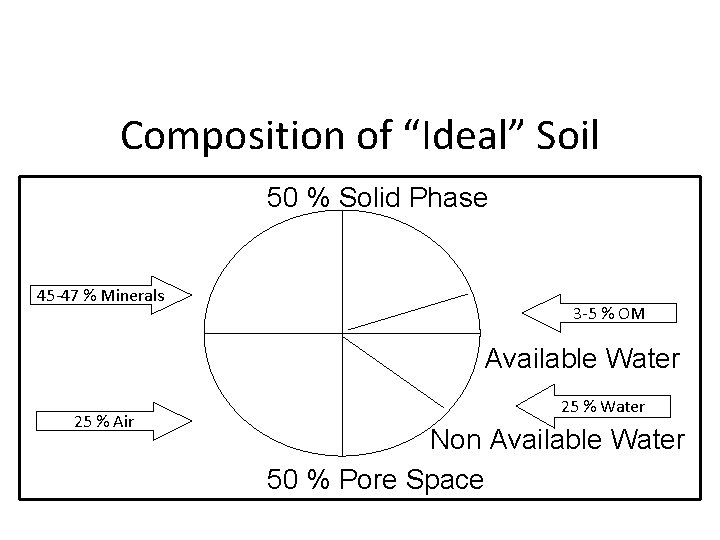
Composition of “Ideal” Soil 50 % Solid Phase 45 -47 % Minerals 3 -5 % OM Available Water 25 % Air 25 % Water Non Available Water 50 % Pore Space
Compacted Media
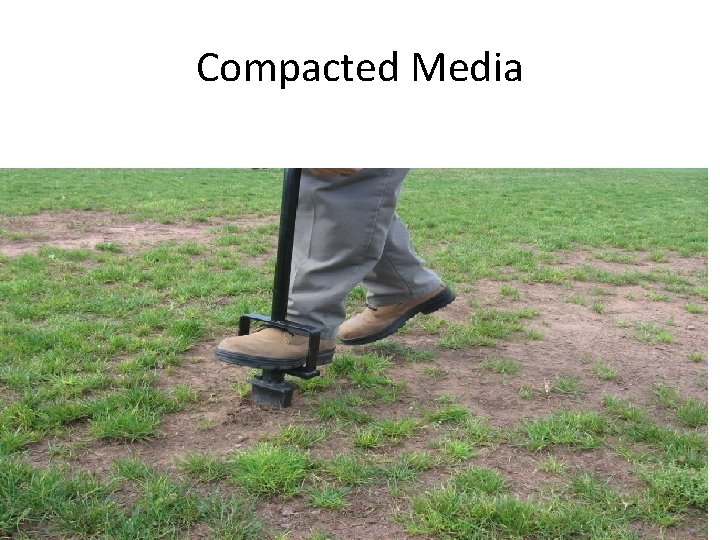
Soil Compaction • Air & Water Relationship Becomes Unbalanced • Wear on Turf “Pushes” Air From Soil • Excess Water “Pushes” Air From Soil • Plant Roots DO NOT Grow In Soil • Plant Roots Grow in AIR SPACES Within Soil
Terms In Soil Description • Soil Structure – Proportion of Sand, Silt, and Clay Particles • Soil Texture – Arrangement of Sand, Silt and Clay Particles • Compaction & Bulk Density • Pore Space
Soil Structure • Cementing Together of Sand, Silt and Clay • Cemented by Organic Matter and Humus • Structure Destroyed by – Traffic, Wear, Machinery etc – High Water Content (Water acts as a Lubricant and Individual Particles Slide Over One Another)
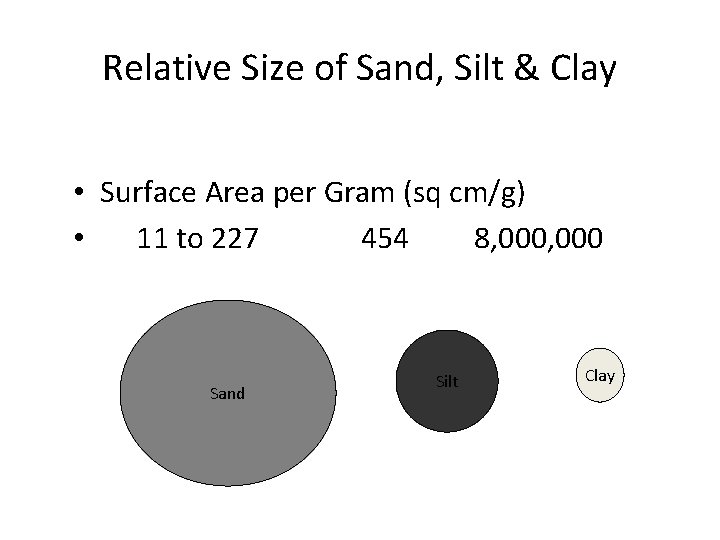
Relative Size of Sand, Silt & Clay • Surface Area per Gram (sq cm/g) • 11 to 227 454 8, 000 Sand Silt Clay
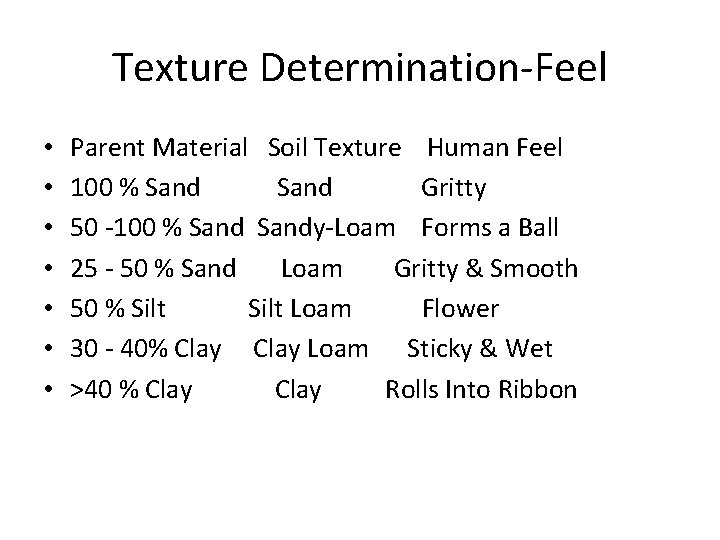
Texture Determination-Feel • • Parent Material Soil Texture Human Feel 100 % Sand Gritty 50 -100 % Sandy-Loam Forms a Ball 25 - 50 % Sand Loam Gritty & Smooth 50 % Silt Loam Flower 30 - 40% Clay Loam Sticky & Wet >40 % Clay Rolls Into Ribbon
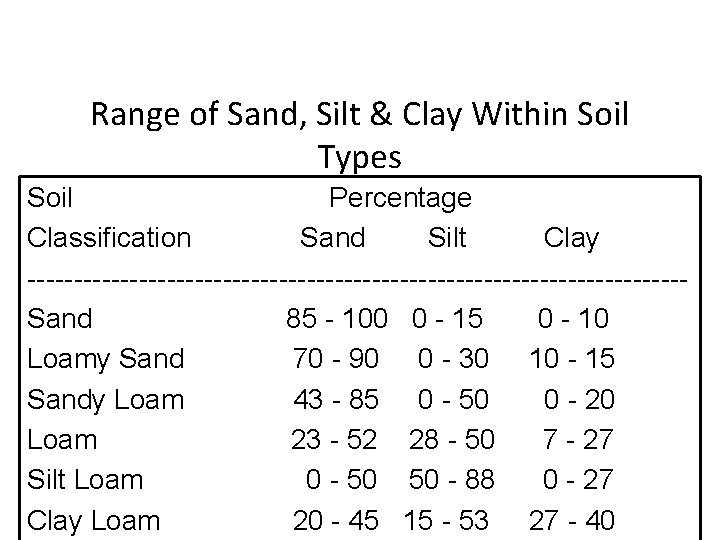
Range of Sand, Silt & Clay Within Soil Types Soil Percentage Classification Sand Silt Clay -----------------------------------Sand 85 - 100 0 - 15 0 - 10 Loamy Sand 70 - 90 0 - 30 10 - 15 Sandy Loam 43 - 85 0 - 50 0 - 20 Loam 23 - 52 28 - 50 7 - 27 Silt Loam 0 - 50 50 - 88 0 - 27 Clay Loam 20 - 45 15 - 53 27 - 40
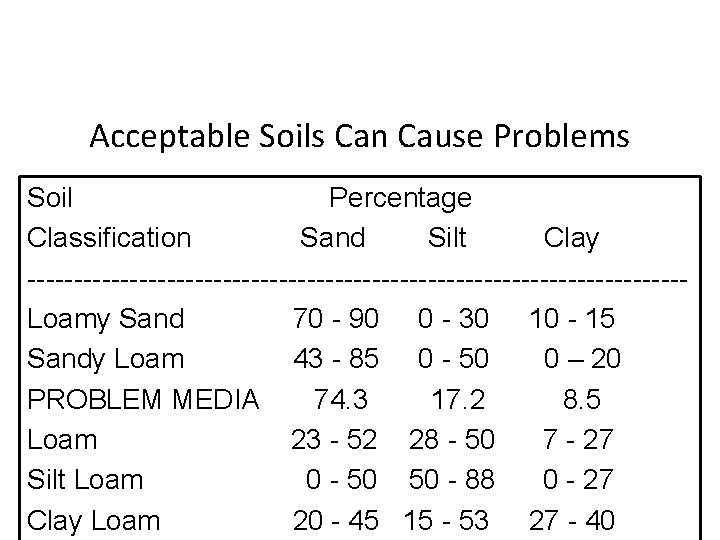
Acceptable Soils Can Cause Problems Soil Percentage Classification Sand Silt Clay -----------------------------------Loamy Sand 70 - 90 0 - 30 10 - 15 Sandy Loam 43 - 85 0 - 50 0 – 20 PROBLEM MEDIA 74. 3 17. 2 8. 5 Loam 23 - 52 28 - 50 7 - 27 Silt Loam 0 - 50 50 - 88 0 - 27 Clay Loam 20 - 45 15 - 53 27 - 40
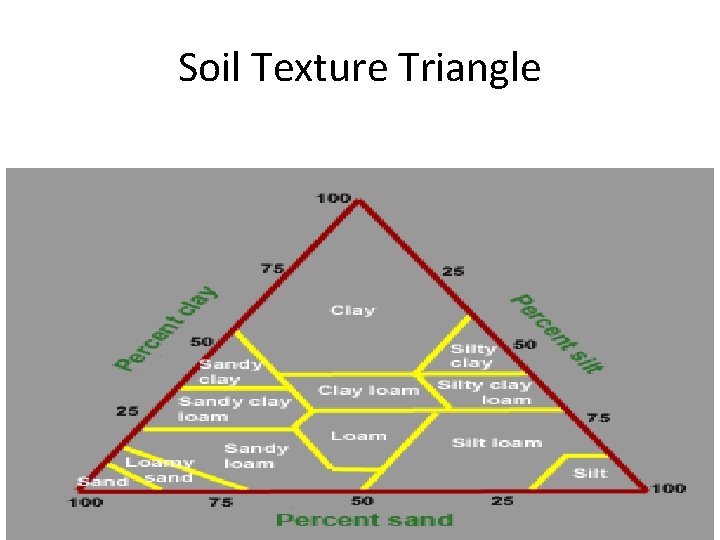
Soil Texture Triangle
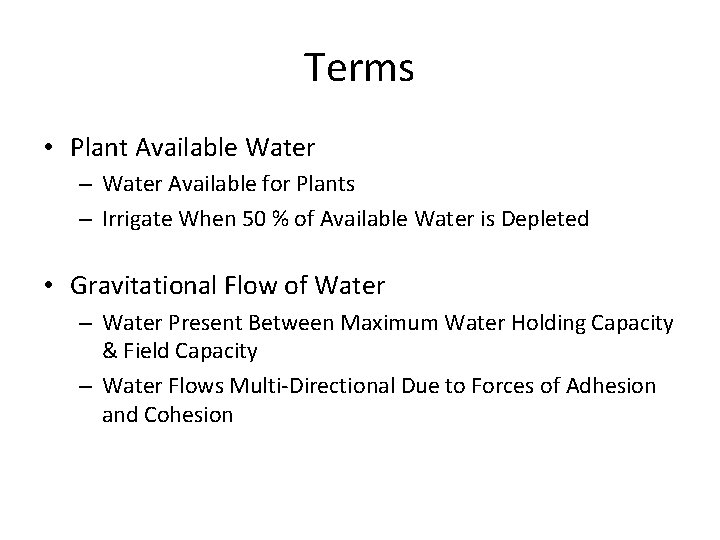
Terms • Plant Available Water – Water Available for Plants – Irrigate When 50 % of Available Water is Depleted • Gravitational Flow of Water – Water Present Between Maximum Water Holding Capacity & Field Capacity – Water Flows Multi-Directional Due to Forces of Adhesion and Cohesion
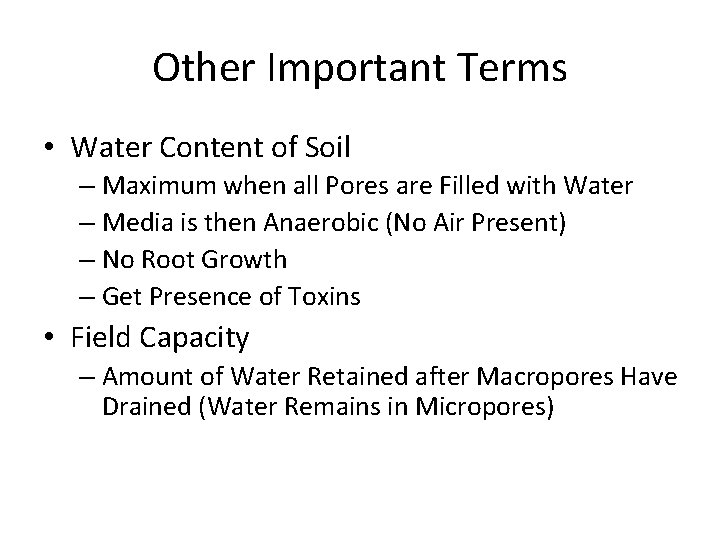
Other Important Terms • Water Content of Soil – Maximum when all Pores are Filled with Water – Media is then Anaerobic (No Air Present) – No Root Growth – Get Presence of Toxins • Field Capacity – Amount of Water Retained after Macropores Have Drained (Water Remains in Micropores)
Soil Porosity • That Portion of Soil Not Occupies by Solids – Area Between and Within Soil Aggregates • • % Pore Space + % Solids = 100 % Large Pores Drain Freely Small Pores Retain Water Ideal Soil of 50 % Pores Space can carry a 150 HP Tractor Without Damaging Surface
Effect of Pore Size • Macropores – Drain Due to Gravity – Drain First • Micropores (Capillary Pores) – Drain Slowly – When Pushed Together Result in Compaction
Soil Texture - Sand • Composed of Large Sized Particles • Drains By Means of Macro-Pores • Characteristics – – – Considered a “Light” Soil Good Internal Drainage High Concentration of Air Good Root Growing Environment Dries Out Rapidly Requires Frequent Watering & Fertilization
Soil Texture - Clay • Composed of Small Sized Particles • Drains By Means of Micro-Pores • Characteristics – – – Considered a “Heavy” Soil Poor Internal Drainage Low Concentration of Air Poor Root Growing Environment Drains Poorly Requires Infrequent Watering & Fertilization
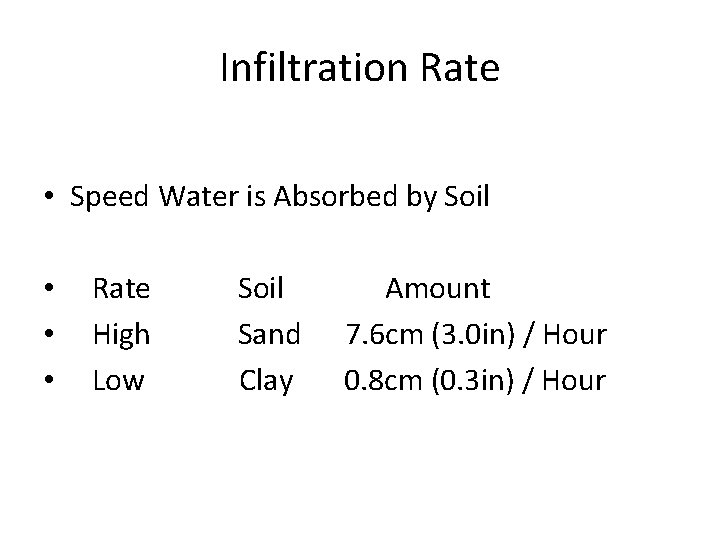
Infiltration Rate • Speed Water is Absorbed by Soil • • • Rate High Low Soil Sand Clay Amount 7. 6 cm (3. 0 in) / Hour 0. 8 cm (0. 3 in) / Hour
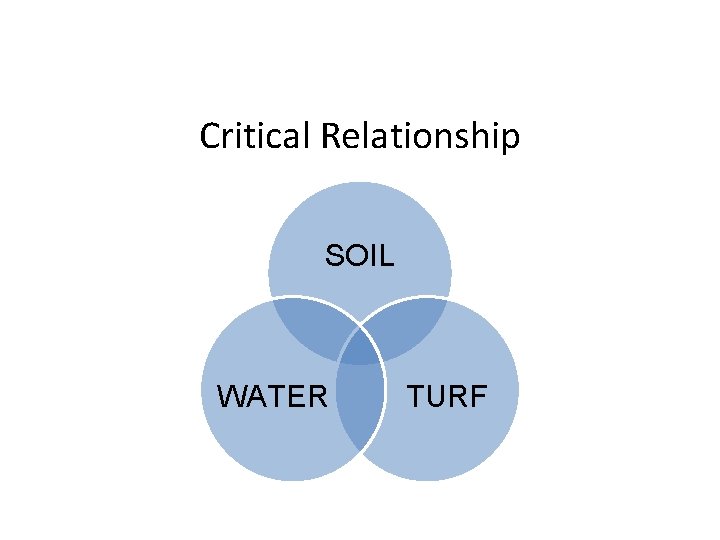
Critical Relationship SOIL WATER TURF
Water Concerns • • • Source of Water Infiltration of Water Throughout Soil Movement of Water Within Soil Profile Control Over Watering Requirement – Plant Species – Turf Usage (Activity Played)
Importance of Water to Plant • 75 to 85 % of Plant is Water • 10 % Loss of Water May Kill Plant • Given Time Plant will Compensate for Reduced Water • Excessive Amounts of Water will also Damage Plant
Function Of Water In Turf Plants • • • Source of Nutrients Medium for Nutrient Transport Regulated Plant Temperature Provides Wilt Control Reduces “Fertilizer Burn”
Excessive Soil Moisture • • Reduces Root Growth Reduced Drought Tolerance Reduced Wear Tolerance Succulent Leaf Growth Increased Disease Susceptibility Increased Nutrient Leaching Increased Compaction
Inadequate Soil Moisture • • • Reduced Plant Growth Plant Discolors Get Temporary Wilting Get Permanent Wilting May Cause Death of Plant
Plant Drought Resistance • Escape………Plant Dies (Annual Bluegrass) • Dormancy…. . Plant Becomes Dormant – Eg Older Varieties of K Bluegrass (Merion) • Adaptation – > Number of Roots & Root Hairs – > Water Absorption Capacity – > Plant Root Growth •
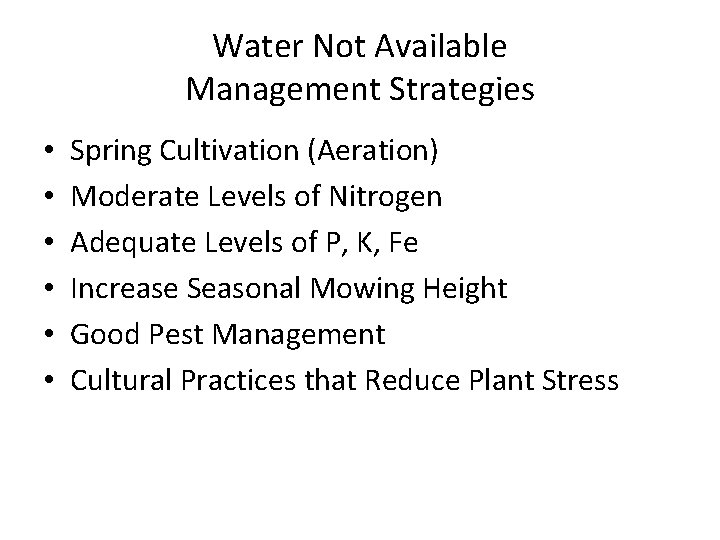
Water Not Available Management Strategies • • • Spring Cultivation (Aeration) Moderate Levels of Nitrogen Adequate Levels of P, K, Fe Increase Seasonal Mowing Height Good Pest Management Cultural Practices that Reduce Plant Stress
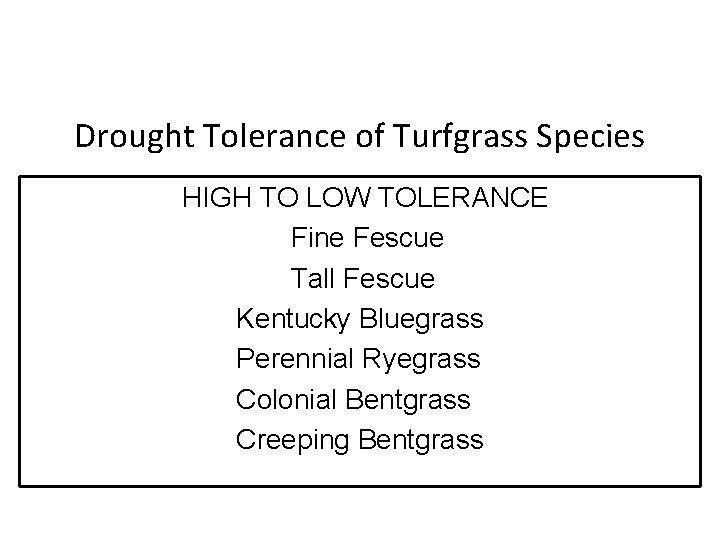
Drought Tolerance of Turfgrass Species HIGH TO LOW TOLERANCE Fine Fescue Tall Fescue Kentucky Bluegrass Perennial Ryegrass Colonial Bentgrass Creeping Bentgrass
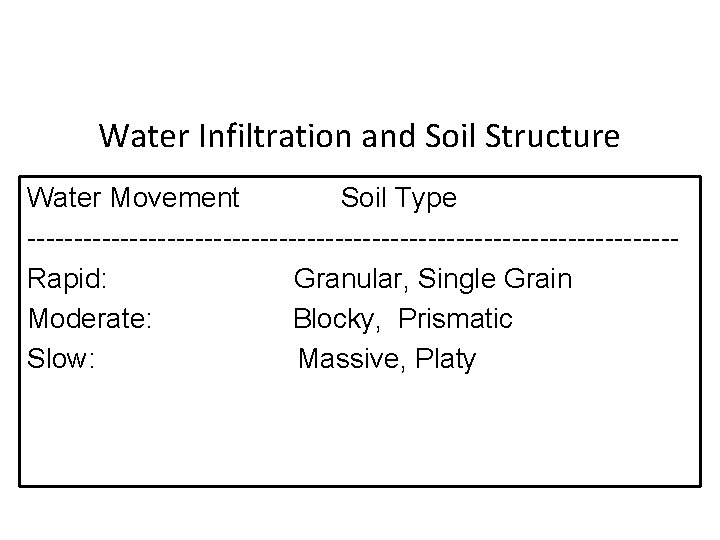
Water Infiltration and Soil Structure Water Movement Soil Type -----------------------------------Rapid: Granular, Single Grain Moderate: Blocky, Prismatic Slow: Massive, Platy
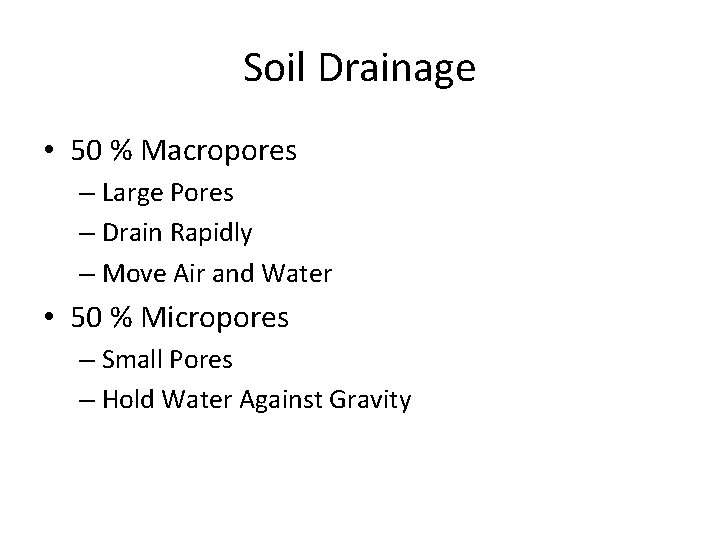
Soil Drainage • 50 % Macropores – Large Pores – Drain Rapidly – Move Air and Water • 50 % Micropores – Small Pores – Hold Water Against Gravity
Soil Moisture Classification • Gravitational…Held By Gravity • Capillary…Held in Small Pores • Hygroscopic…Most Tightly Held
Infiltration Rate • Rate Water is Absorbed – Varies with Soil Texture – Varies with Rate at Which Water is Applied – Varies with Current Environmental Conditions – Varies with Existing Ground Cover – Varies with Existing Topography
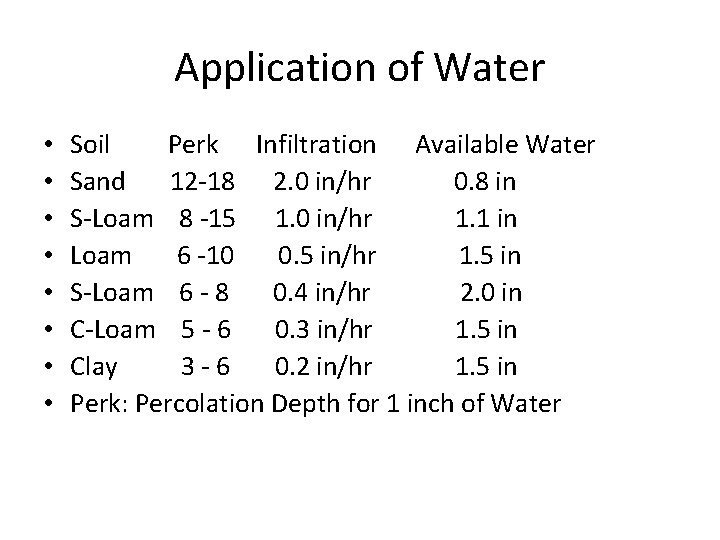
Application of Water • • Soil Perk Infiltration Available Water Sand 12 -18 2. 0 in/hr 0. 8 in S-Loam 8 -15 1. 0 in/hr 1. 1 in Loam 6 -10 0. 5 in/hr 1. 5 in S-Loam 6 - 8 0. 4 in/hr 2. 0 in C-Loam 5 - 6 0. 3 in/hr 1. 5 in Clay 3 -6 0. 2 in/hr 1. 5 in Perk: Percolation Depth for 1 inch of Water
p. H And Soil • p. H is Measurement of The Concentration of H Ions • Is a Logarithmic Scale – Individual Units are Ten X • Turf is Adapted to a p. H Range of 5. 5 to 7. 0 • Low p. H Limits Availability of Essential Elements
Adjusting p. H • • • To Increase p. H Add Limestone Powder, Granulated and Pelletized Forms Vary in Cost, Handling, Rate of Release To Lower p. H Add Sulphur Use Sulphur Based Fertilizers
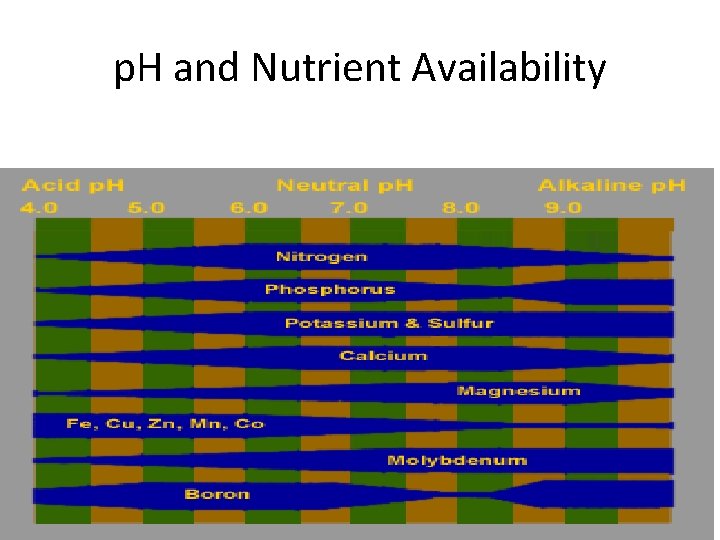
p. H and Nutrient Availability
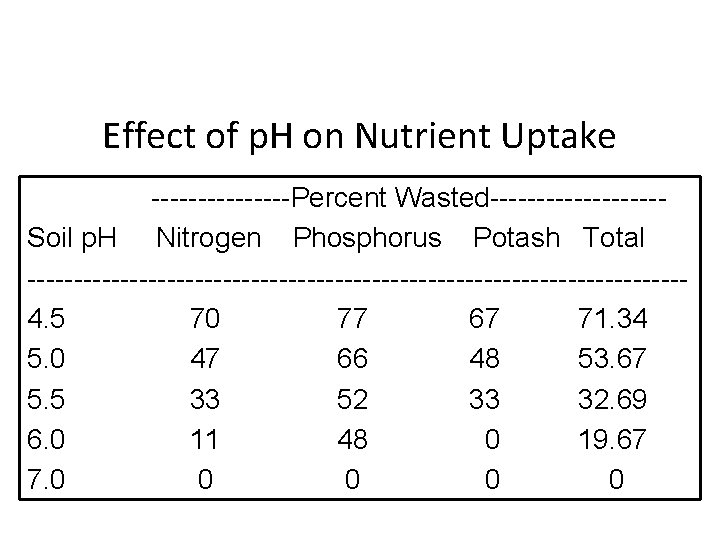
Effect of p. H on Nutrient Uptake --------Percent Wasted---------Soil p. H Nitrogen Phosphorus Potash Total -----------------------------------4. 5 70 77 67 71. 34 5. 0 47 66 48 53. 67 5. 5 33 52 33 32. 69 6. 0 11 48 0 19. 67 7. 0 0 0
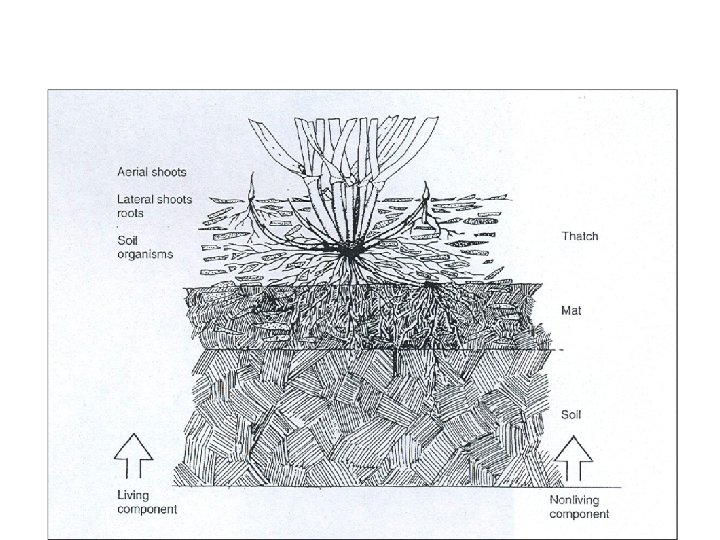
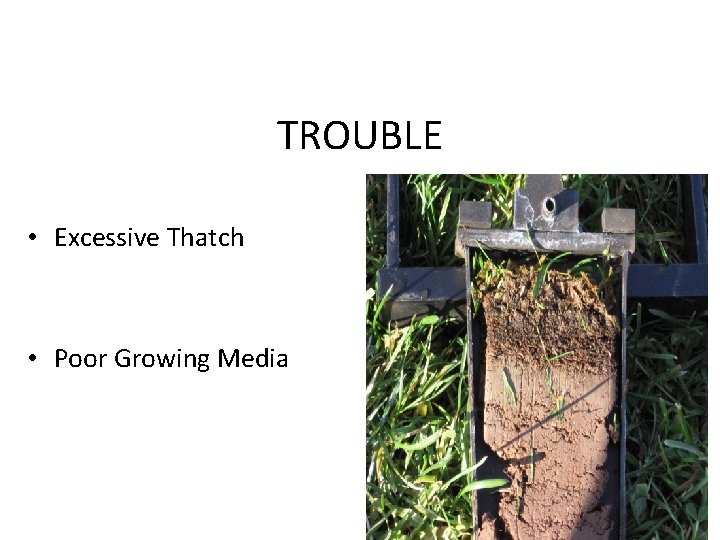
Thatch Excess Accumulation of Material • Consists of Dead Roots, Stems and Leaves • Impedes Plant Growth – < Root Penetration – < Nutrient Take Up – Makes Surface Uneven – Results in Uneven Mowing
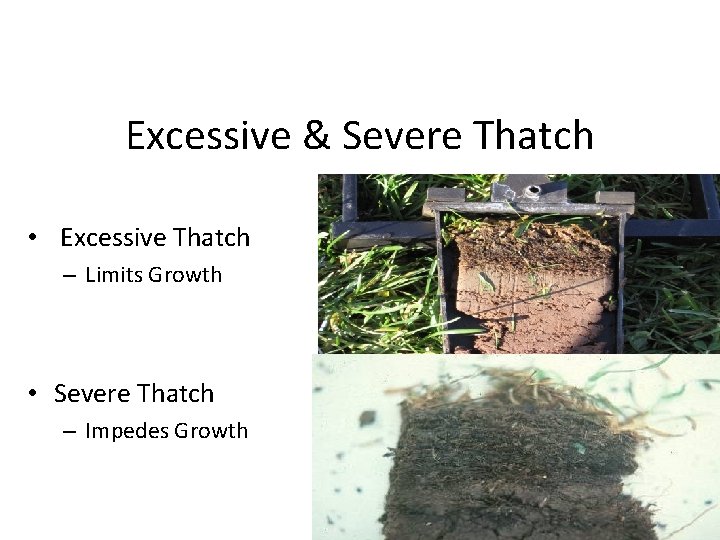
Excessive & Severe Thatch • Excessive Thatch – Limits Growth • Severe Thatch – Impedes Growth
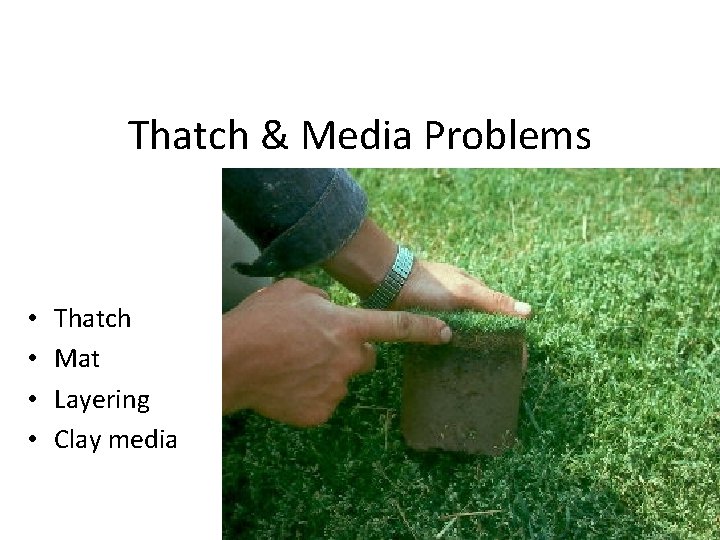
Thatch & Media Problems • • Thatch Mat Layering Clay media
Compaction • Result of Excess Traffic – Decreases Water Infiltration Rate – Decreases Oxygen Concentration – “Wet” Soils Result in Increased Compaction & Less Field Playability – Poor Playing Surface (Uneven, etc)
Effects of Excess Traffic • • • Soil Compacts Percent of Macropores is Reduced Decreased Water Infiltration Rate Decreased Movement of Water Within Soil Less Air Available to Plants
Reducing Field Compaction • Increase Sand Content in Growing Media – Increases Initial Cost of Field – May Decrease Athletes Foot Traction – Increases Maintenance Cost – Increase Seasonal Water Usage – Increases Seasonal Field Usage
Increase Organic Matter Content • • • Increases Water Holding Capacity Increases Nutrient Holding Capacity Decreases Water Infiltration Rates Requires Increase Frequency of Aeration Get Thatch Accumulation
Media Selection • 100 % Soil-Based – Texture – Fertility – Organic Matter Content – Amounts of Silt + Clay • 100 % Sand-Based – Need 80 % Plus Sand Component
Media Selection • Have Media Properly Tested • Specifications Are When Media is First Blended/Mixed • May be Mixed With Loader (Skilled Operator) • Re -Test Media After Mixing/Blending • Once Placed on Site Media “Changes”
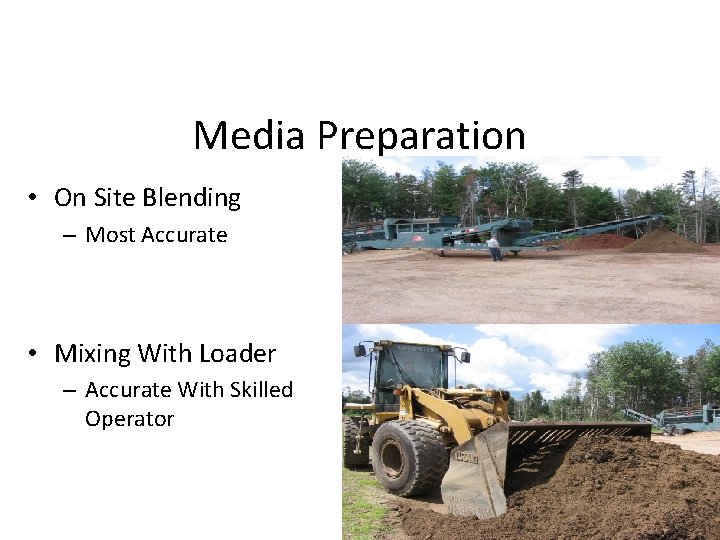
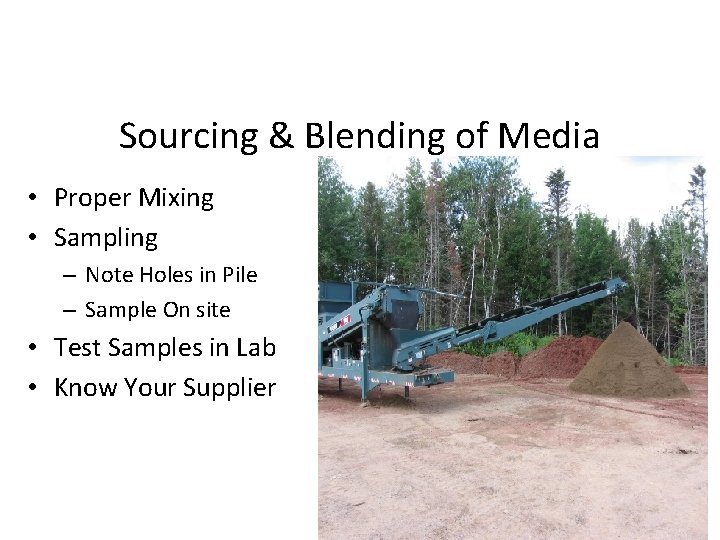
Media Preparation • On Site Blending – Most Accurate • Mixing With Loader – Accurate With Skilled Operator
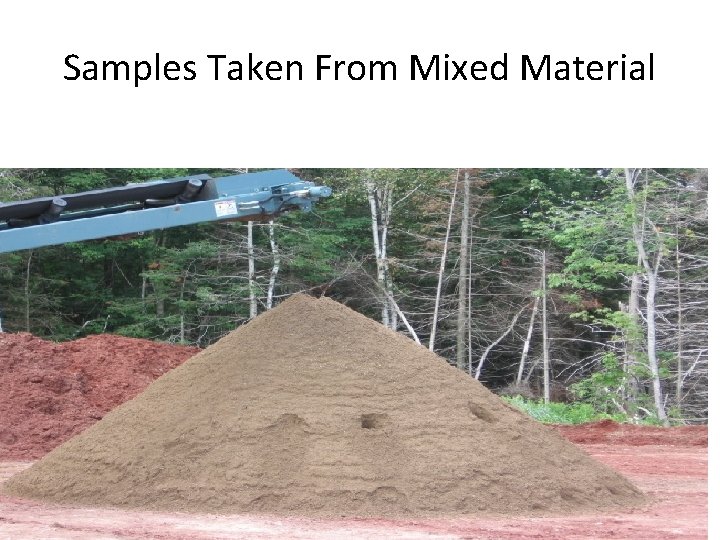
Samples Taken From Mixed Material
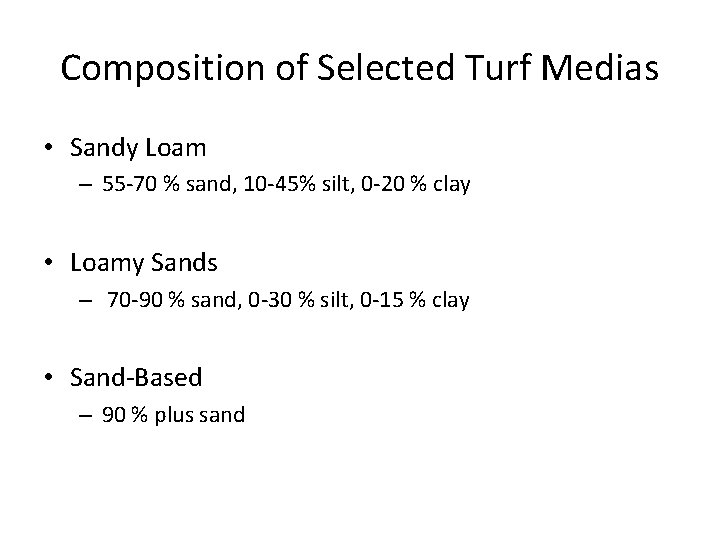
Composition of Selected Turf Medias • Sandy Loam – 55 -70 % sand, 10 -45% silt, 0 -20 % clay • Loamy Sands – 70 -90 % sand, 0 -30 % silt, 0 -15 % clay • Sand-Based – 90 % plus sand
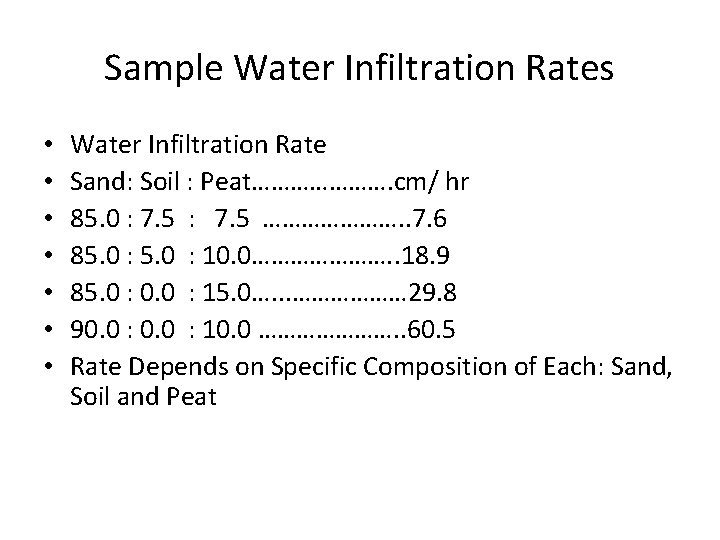
Sample Water Infiltration Rates • • Water Infiltration Rate Sand: Soil : Peat…………………. cm/ hr 85. 0 : 7. 5 …………………. . 7. 6 85. 0 : 10. 0…………………. . 18. 9 85. 0 : 0. 0 : 15. 0…. . . ……………… 29. 8 90. 0 : 10. 0 …………………. . 60. 5 Rate Depends on Specific Composition of Each: Sand, Soil and Peat
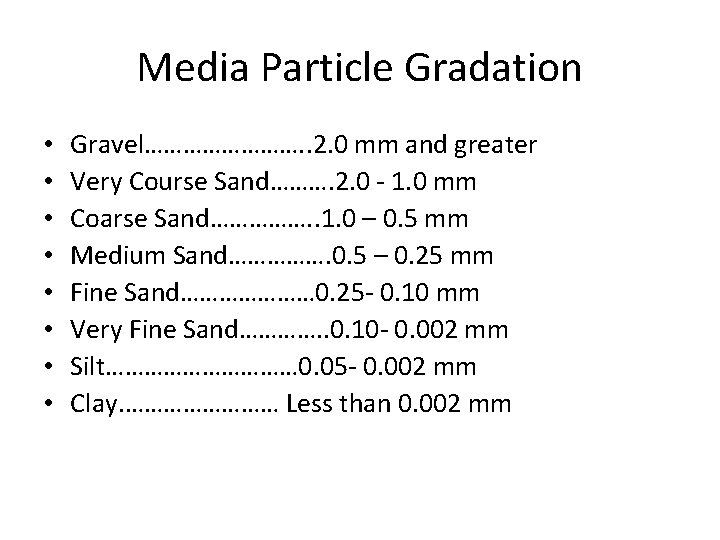
Media Particle Gradation • • Gravel…………. . 2. 0 mm and greater Very Course Sand………. 2. 0 - 1. 0 mm Coarse Sand……………. . 1. 0 – 0. 5 mm Medium Sand……………. 0. 5 – 0. 25 mm Fine Sand………………… 0. 25 - 0. 10 mm Very Fine Sand…………. . 0. 10 - 0. 002 mm Silt…………… 0. 05 - 0. 002 mm Clay. ………… Less than 0. 002 mm
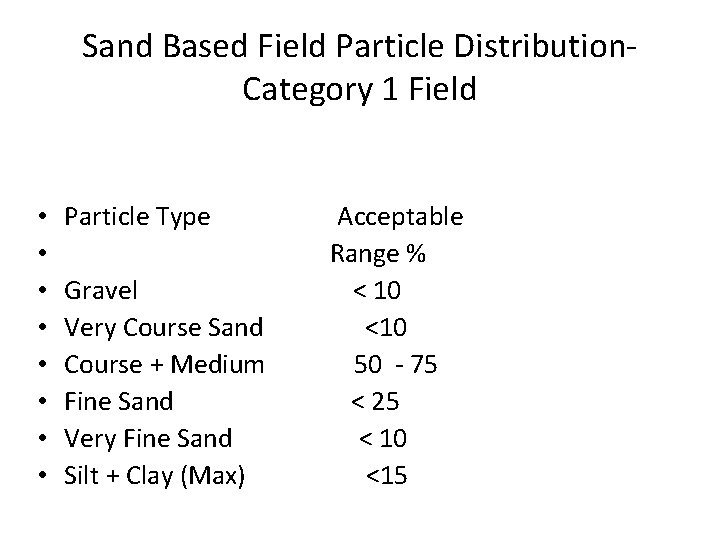
Sand Based Field Particle Distribution. Category 1 Field • • Particle Type Gravel Very Course Sand Course + Medium Fine Sand Very Fine Sand Silt + Clay (Max) Acceptable Range % < 10 <10 50 - 75 < 25 < 10 <15
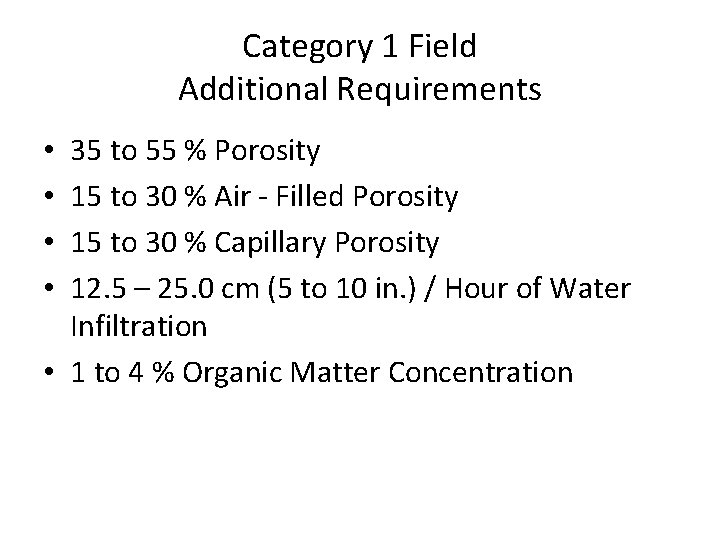
Category 1 Field Additional Requirements 35 to 55 % Porosity 15 to 30 % Air - Filled Porosity 15 to 30 % Capillary Porosity 12. 5 – 25. 0 cm (5 to 10 in. ) / Hour of Water Infiltration • 1 to 4 % Organic Matter Concentration • •
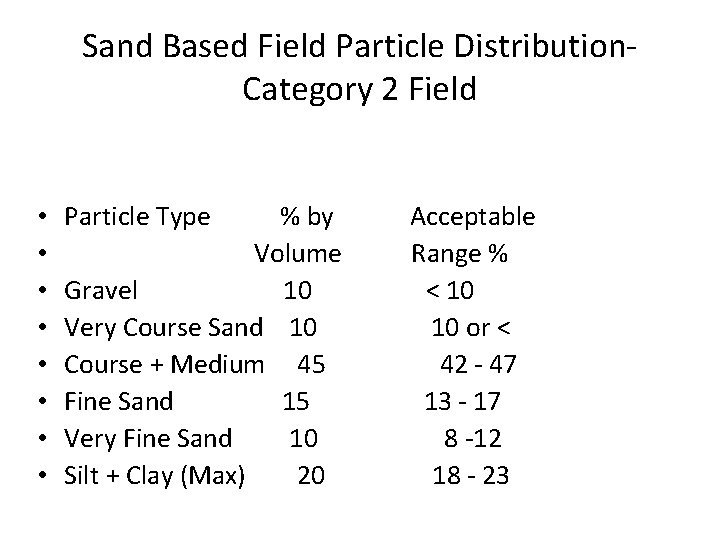
Sand Based Field Particle Distribution. Category 2 Field • • Particle Type % by Volume Gravel 10 Very Course Sand 10 Course + Medium 45 Fine Sand 15 Very Fine Sand 10 Silt + Clay (Max) 20 Acceptable Range % < 10 10 or < 42 - 47 13 - 17 8 -12 18 - 23
Soils Common Occurring Problems and Practical Solutions
Latter Topics • Specific Media Problems: – Drainage (Surface, Sub-surface, Other) – Topdressing (Organic) – Cultivation-Options • Summary
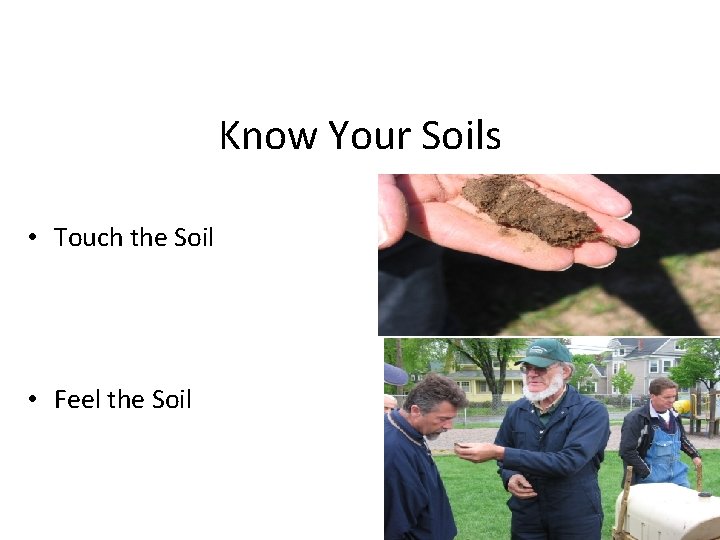
Know Your Soils • Touch the Soil • Feel the Soil
Media Selection • • Get Consistent Supply of Media Set Your Standards-Have Specifications Test Regularly Continually Monitor Quality
Sourcing & Blending of Media • Proper Mixing • Sampling – Note Holes in Pile – Sample On site • Test Samples in Lab • Know Your Supplier
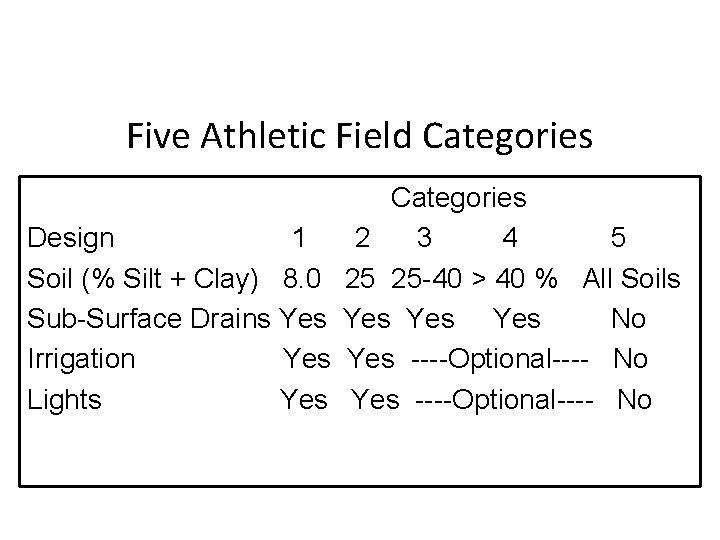
Five Athletic Field Categories Design 1 Soil (% Silt + Clay) 8. 0 Sub-Surface Drains Yes Irrigation Yes Lights Yes Categories 2 3 4 5 25 25 -40 > 40 % All Soils Yes Yes No Yes ----Optional---- No
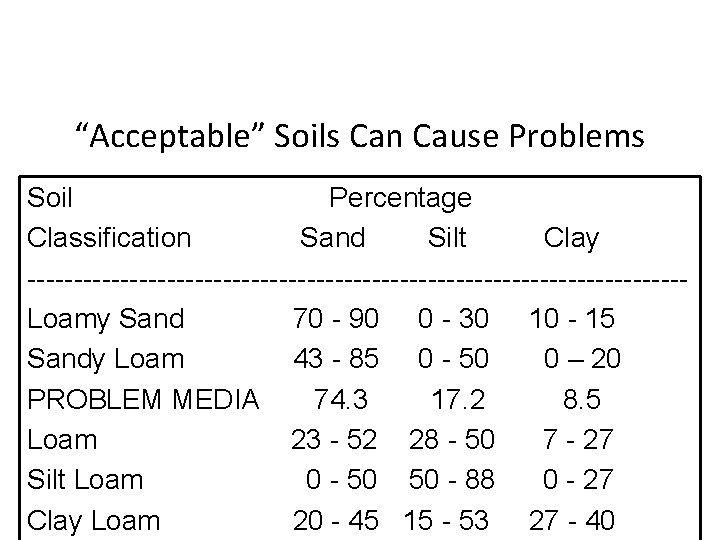
“Acceptable” Soils Can Cause Problems Soil Percentage Classification Sand Silt Clay -----------------------------------Loamy Sand 70 - 90 0 - 30 10 - 15 Sandy Loam 43 - 85 0 - 50 0 – 20 PROBLEM MEDIA 74. 3 17. 2 8. 5 Loam 23 - 52 28 - 50 7 - 27 Silt Loam 0 - 50 50 - 88 0 - 27 Clay Loam 20 - 45 15 - 53 27 - 40
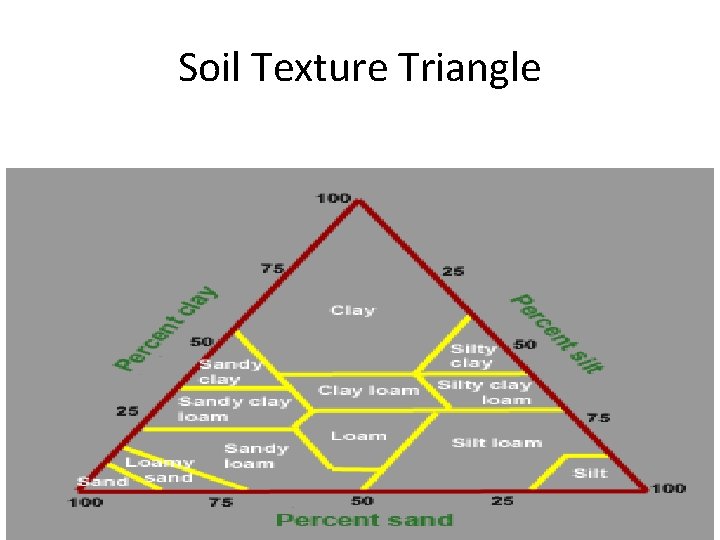
Soil Texture Triangle
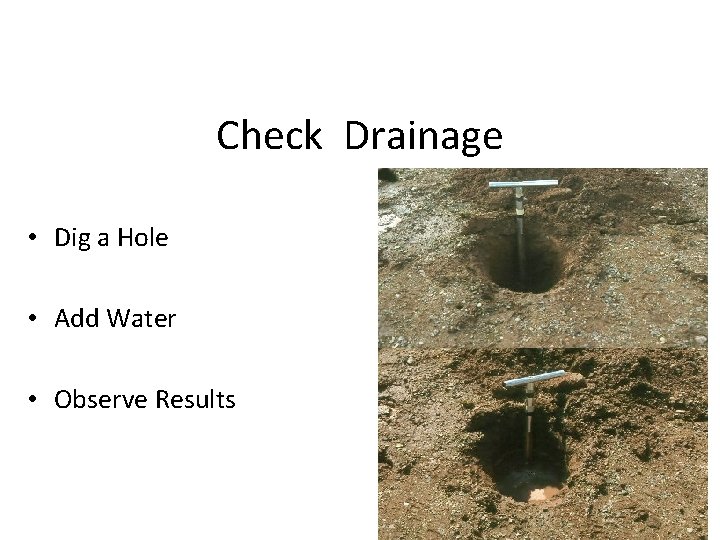
Check Drainage • Dig a Hole • Add Water • Observe Results
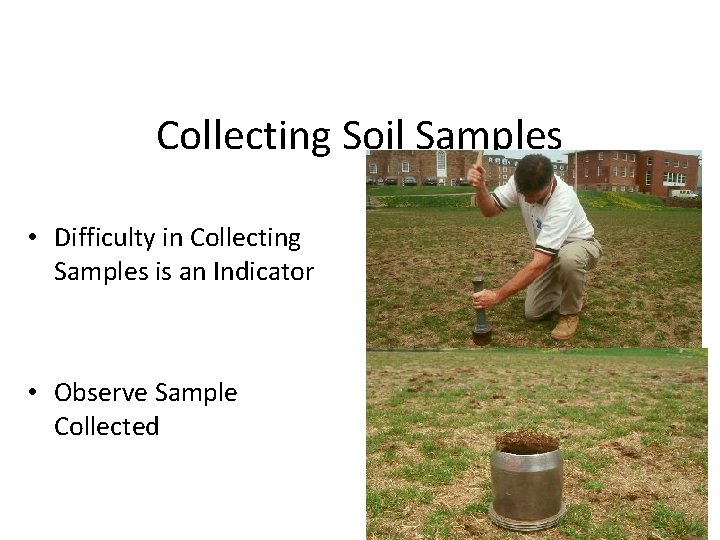
Collecting Soil Samples • Difficulty in Collecting Samples is an Indicator • Observe Sample Collected
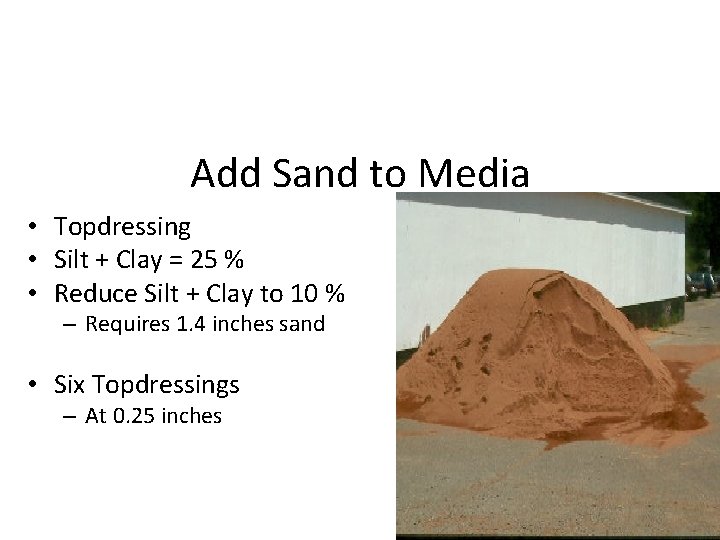
Add Sand to Media • Topdressing • Silt + Clay = 25 % • Reduce Silt + Clay to 10 % – Requires 1. 4 inches sand • Six Topdressings – At 0. 25 inches
Program for Improving Drainage to This Field • 1. 5 inches Sand Required – Improves Top 4. 0 Inches of Media • Year 1 – 2 Topdressing / Year at 0. 25 inches / Application – 0. 5 inches Topdressing / Year – 2 Core Aerations • Repeat in Years 2, and 3 • Have only Improved Top 4. 0 Inches of Growing Media AFTER THREE YEARS
Program (Cont’d) • Have “Hard Pan” (Poorly Drained Media) at and below 4. 0 inch Level • “Deep Tine” (Verti-Drain) – Topdress – How Much Sand Penetrates Below the 4. 0 inch Level? • Is this Cost Efficient? • Field Marginally Improves in Each Year
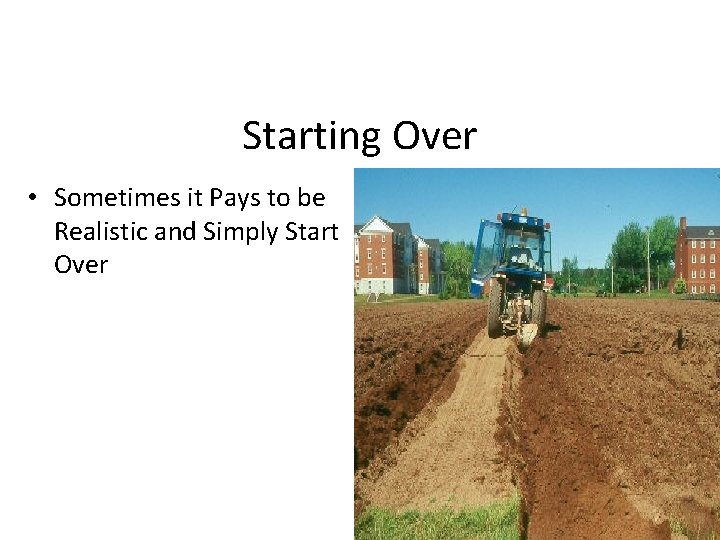
Starting Over • Sometimes it Pays to be Realistic and Simply Start Over
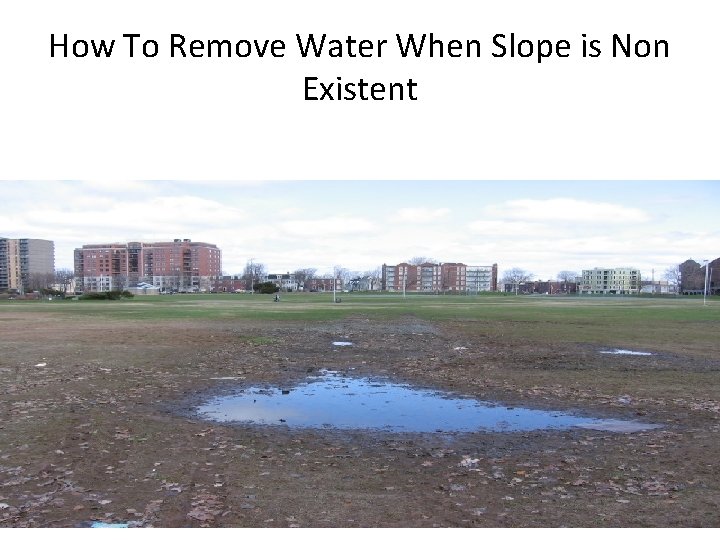
Pitfalls of Construction Surface Drainage • Remove Maximum Amounts of Water by Surface Drainage (Fastest, Easiest & Most Economical) • Drain to Perimeter of Playing Surface • Remove Excess (Drained) Water from Site
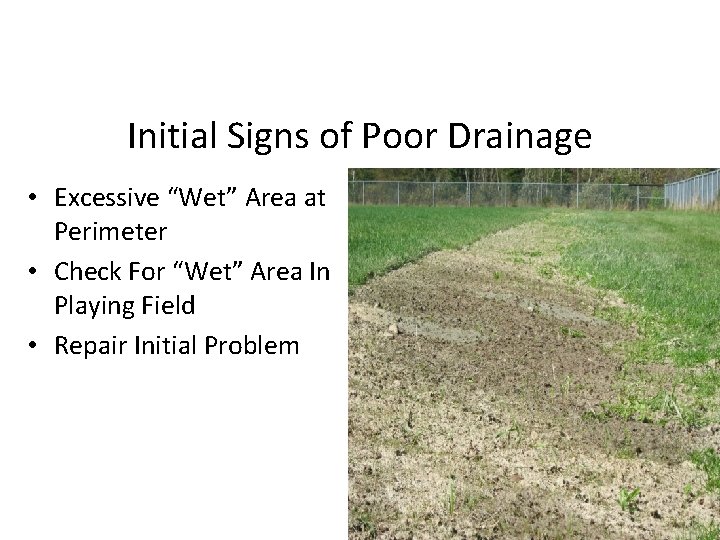
Initial Signs of Poor Drainage • Excessive “Wet” Area at Perimeter • Check For “Wet” Area In Playing Field • Repair Initial Problem
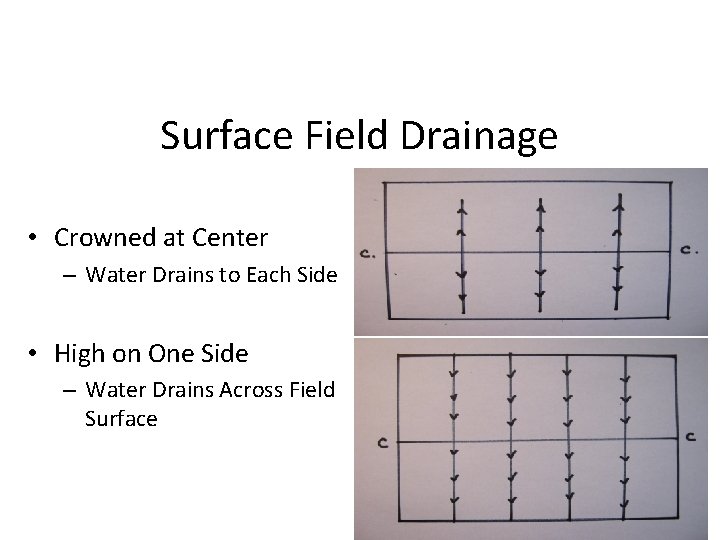
Surface Field Drainage • Crowned at Center – Water Drains to Each Side • High on One Side – Water Drains Across Field Surface
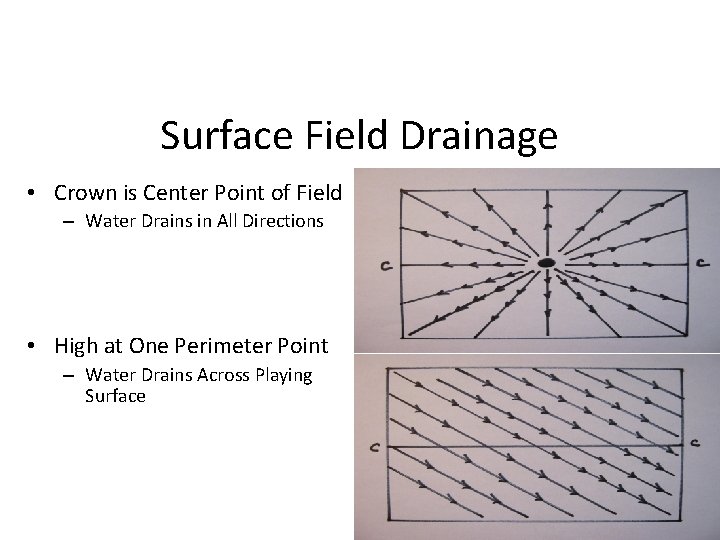
Surface Field Drainage • Crown is Center Point of Field – Water Drains in All Directions • High at One Perimeter Point – Water Drains Across Playing Surface
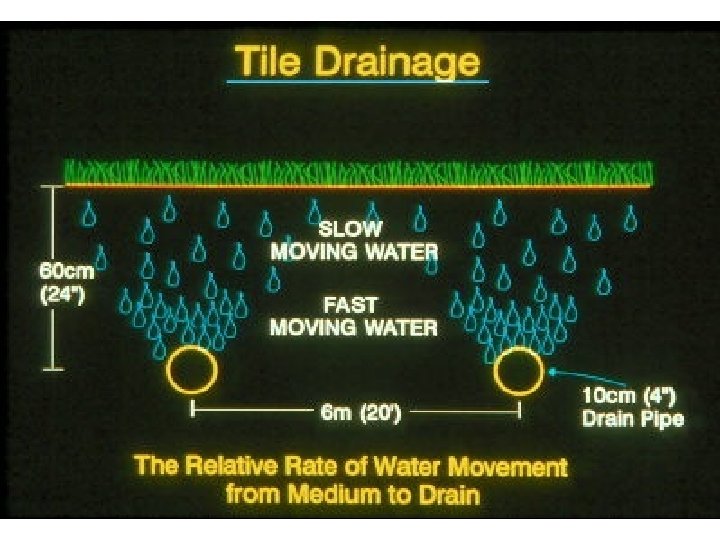
Understanding Drainage • Spacing of Individual Tile Lines MUST Account for: • Gravitational Pull of Water • Water Runs – Sideways (Lateral) Into Tile Lines – Downward in Soil Profile to Tile Lines
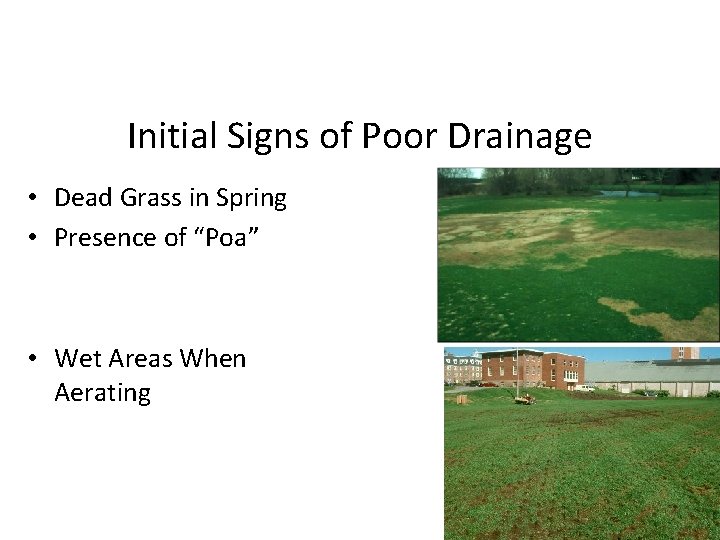
Initial Signs of Poor Drainage • Dead Grass in Spring • Presence of “Poa” • Wet Areas When Aerating
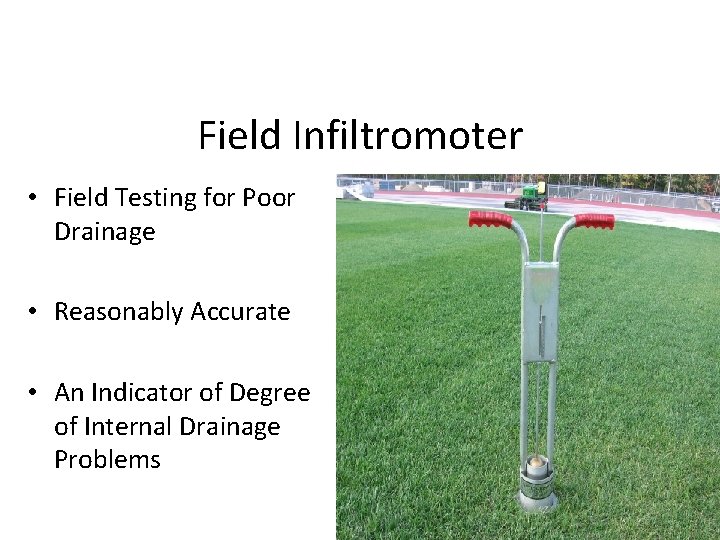
Field Infiltromoter • Field Testing for Poor Drainage • Reasonably Accurate • An Indicator of Degree of Internal Drainage Problems
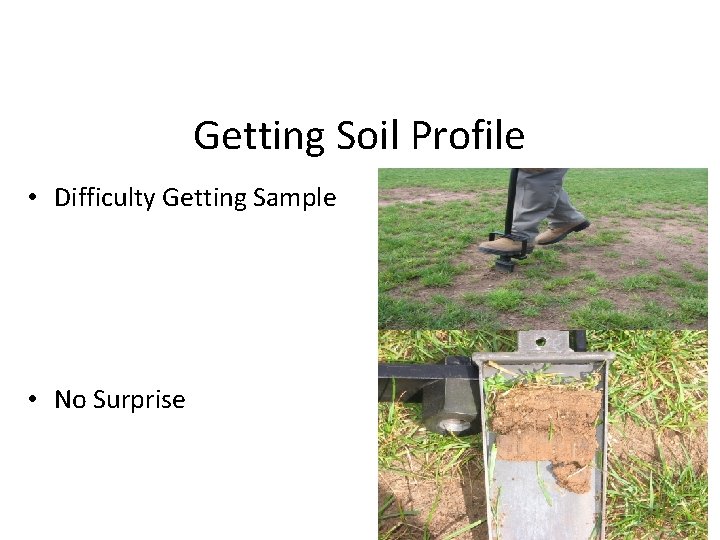
Getting Soil Profile • Difficulty Getting Sample • No Surprise
TROUBLE • Excessive Thatch • Poor Growing Media
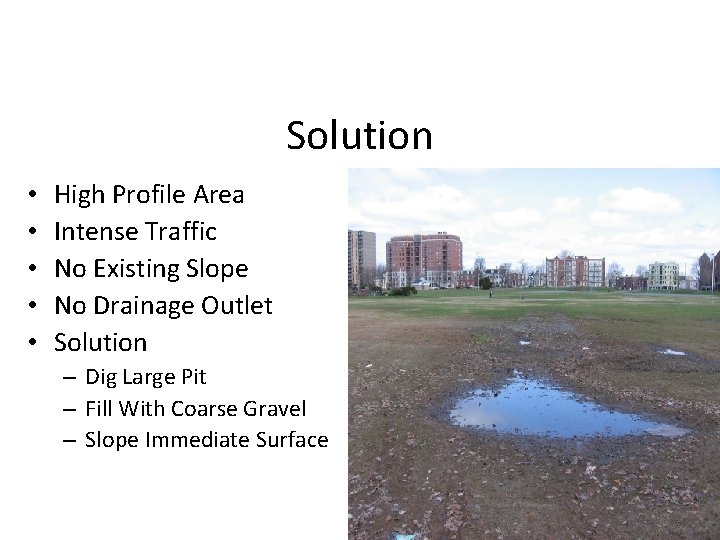
Plan The Project • • • Make On Site Assessment Determine Drainage Pattern Determine Water Outlet Use Proper Material and Personnel Solve the Problem vs Moving it to Another Location
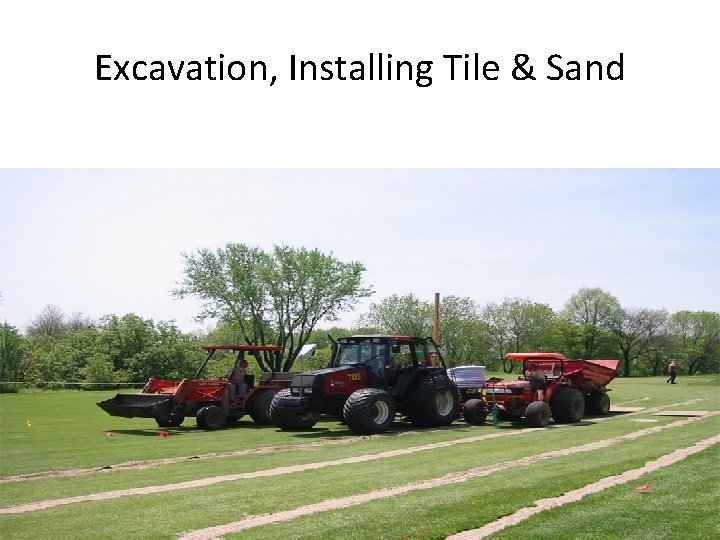
Steps in Sub-Surface (Tile) Drainage. Existing Field • Cover and Protect Existing Turf During Construction • Remove Existing Turf – Keep if Quality is Good – If Keeping, Remove and Store in “Safe” Place • Excavate Drain Lines – Cut “Narrow” Trench – Remove “Excess” Material From Site
Drainage Instillation (Continued) • Add 2. 5 to 5. 0 (1 to 2 in) of “Pea” Gravel 1. 3 to 2. 5 cm (0. 5 to 1. 0 in ) Diameter • Connect Laterals at 45 Degrees • Cover Installed Drains with 10 cm (4 in) Layer of Pea Gravel • Backfill Trench (Use Appropriate Material) • Replace Sod, New Sod or Seed
Excavation, Installing Tile & Sand
How To Remove Water When Slope is Non Existent
Solution • • • High Profile Area Intense Traffic No Existing Slope No Drainage Outlet Solution – Dig Large Pit – Fill With Coarse Gravel – Slope Immediate Surface
Organic Topdressing • • Environmentally Friendly Contributes to Recycling Encouraged by Society Politically Great
Usage of Organic Topdressing • Use Properly (Small Applications) – Good Results • Incorporate into existing media (AERATE) • If Small Amounts are Good, LOTS MUST be GREAT – PROBLEMS………………. LAYERING
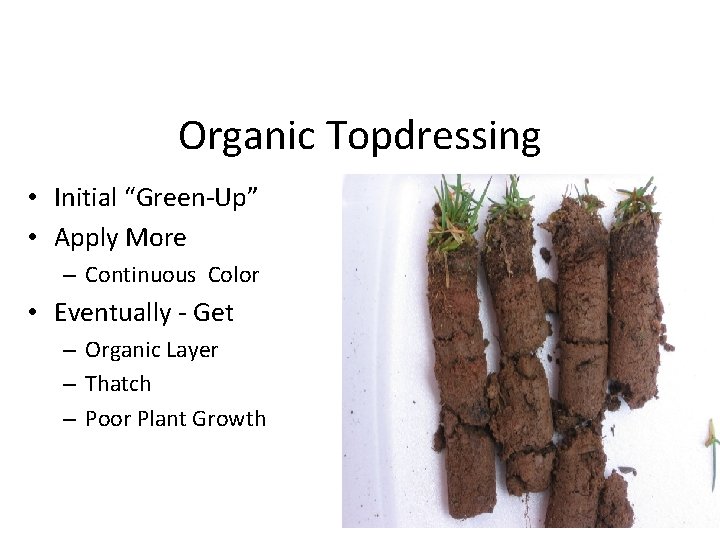
Organic Topdressing • Initial “Green-Up” • Apply More – Continuous Color • Eventually - Get – Organic Layer – Thatch – Poor Plant Growth
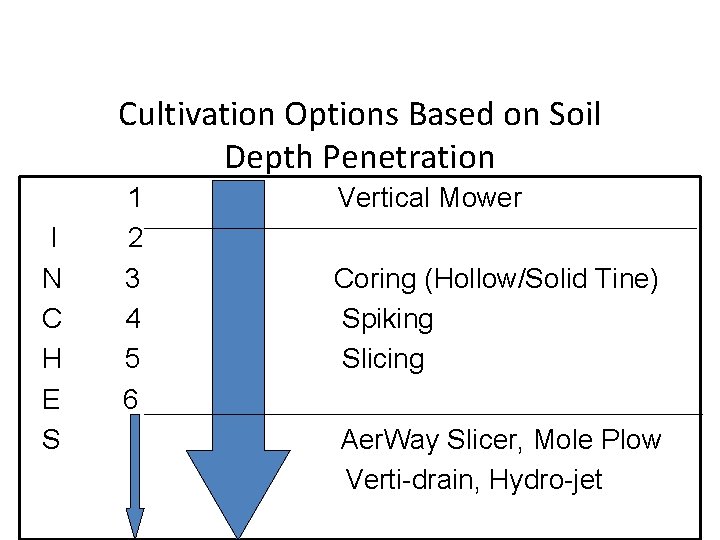
Cultivation Options Based on Soil Depth Penetration I N C H E S 1 2 3 4 5 6 Vertical Mower Coring (Hollow/Solid Tine) Spiking Slicing Aer. Way Slicer, Mole Plow Verti-drain, Hydro-jet
1 to 6 Inches Deep • Coring – Hollow and solid tine • Spiking – Drives a “solid” tine into media • Slicing – Cuts by means of a “slicing” action
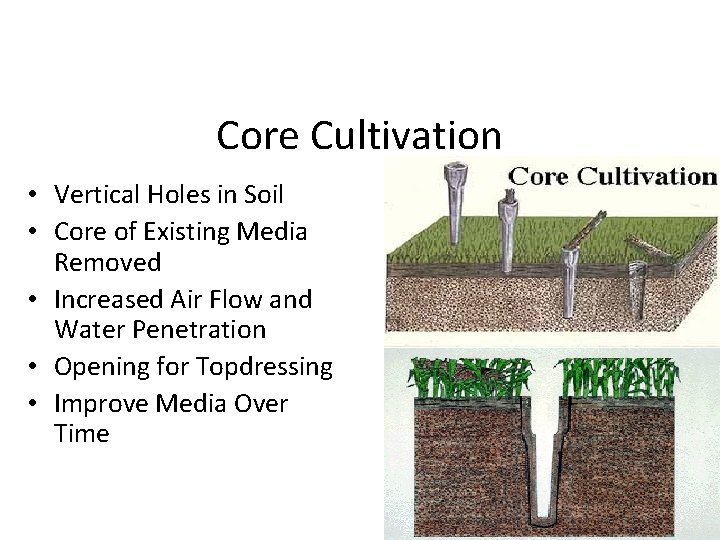
Core Cultivation • Vertical Holes in Soil • Core of Existing Media Removed • Increased Air Flow and Water Penetration • Opening for Topdressing • Improve Media Over Time
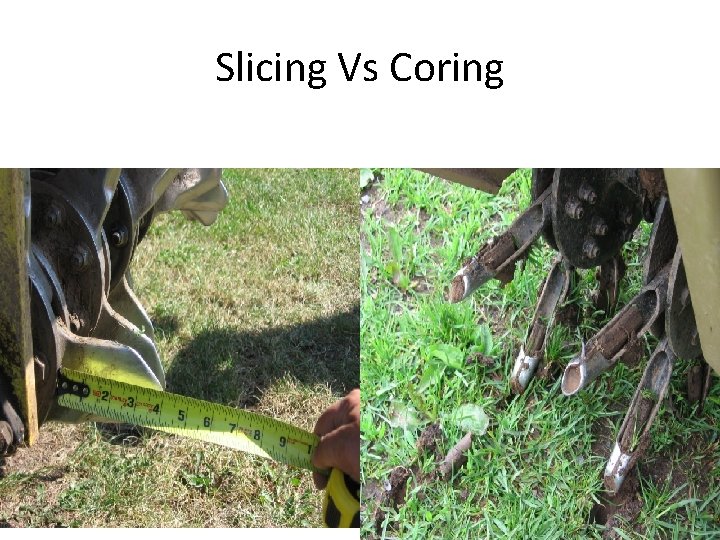
Slicing Vs Coring
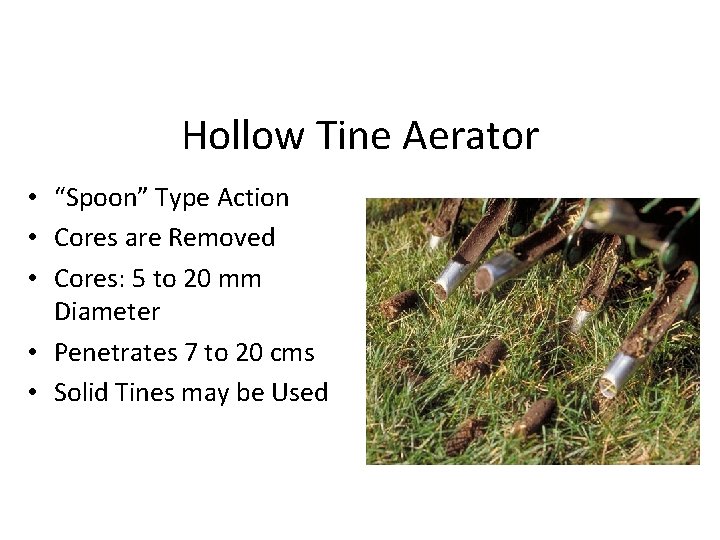
Hollow Tine Aerator • “Spoon” Type Action • Cores are Removed • Cores: 5 to 20 mm Diameter • Penetrates 7 to 20 cms • Solid Tines may be Used
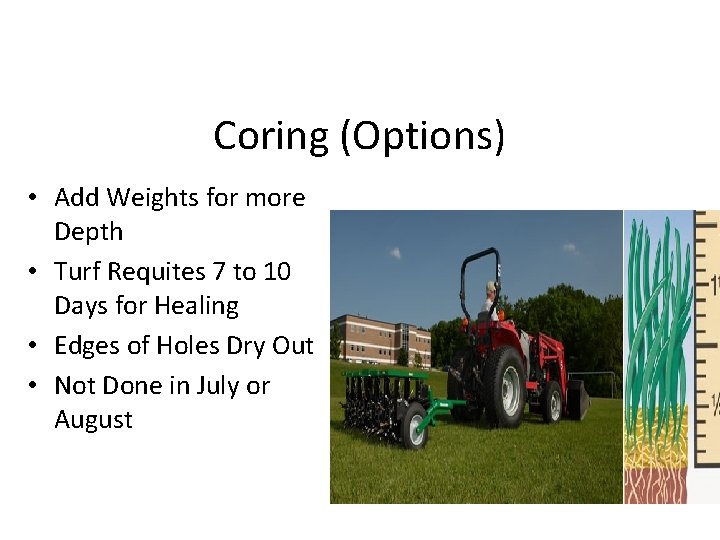
Coring (Options) • Add Weights for more Depth • Turf Requites 7 to 10 Days for Healing • Edges of Holes Dry Out • Not Done in July or August
Topdressing • • • It is a Necessity Hard to do Properly Practice is Often Abused May Result in Permanent Damage Expensive (Material) and Time Consuming (Labor to Apply Material)
Soil Problem-Solutions • Proper Diagnosis – Get Second Opinion, Do Tests • Establish a Plan – Based on Agronomy – Stay With “The Plan” • Be Realistic – Time Involved (years) – Costs (Remedies are NOT cheap) • Few Remedies Equal “Perfection”
Media Specifications • Specify Soil Type: Sandy Loam etc – Specify % Silt + Clay • Specify Percolation (Internal Drainage) • These are the Main Indicators
Future of Turf Care Move From an Approach of Solving Problems with Traditional Products / Practices To How Can We Solve Problems by Altering Seasonal Cultural / Management Programs / Practices
Future - Examples • Carbon Footprint – Products & Practices Which Cause Least Negative Environmental Impact • Example: “Polyon” Fertilizers – Formulation, Application Based on Seasonal Date for Specific Area – One to Two Applications / Season – Provide Acceptable, Consistent Results • Example: “Futura 3000” Perennial Ryegrass – Overwinters Well – Continually Overseeding as Required
- Slides: 113