
TURBULENT MIXING IN THE MIXED LAYERTHERMOCLINE TRANSITION LAYER
TURBULENT MIXING IN THE MIXED LAYER/THERMOCLINE TRANSITION LAYER Bryan Rahter and Louis St. Laurent Florida State University Thanks to: Support from NSF PO Photo of Storm over St. George Island by Russel Grace
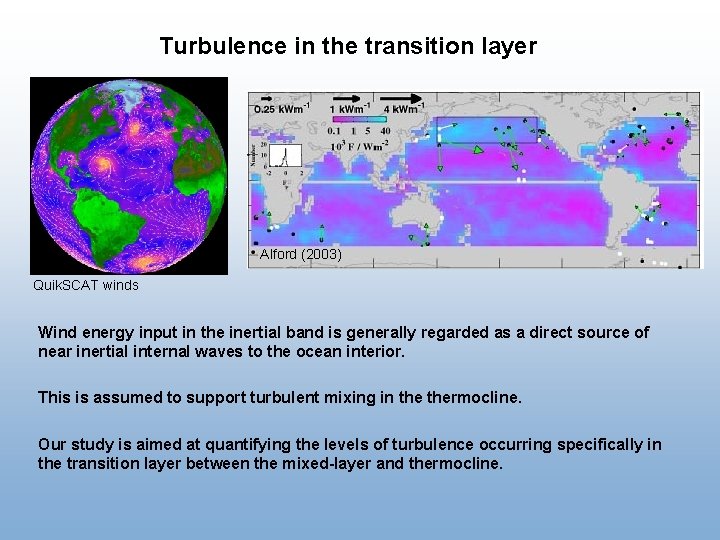
Turbulence in the transition layer Alford (2003) Quik. SCAT winds Wind energy input in the inertial band is generally regarded as a direct source of near inertial internal waves to the ocean interior. This is assumed to support turbulent mixing in thermocline. Our study is aimed at quantifying the levels of turbulence occurring specifically in the transition layer between the mixed-layer and thermocline.
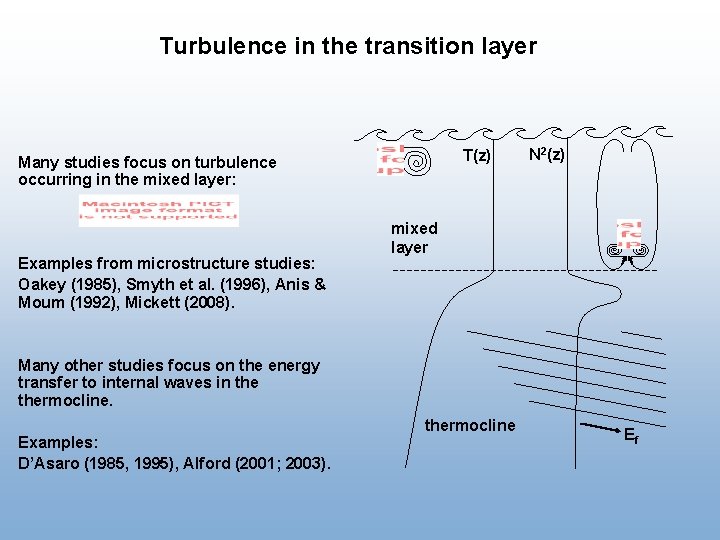
Turbulence in the transition layer T(z) Many studies focus on turbulence occurring in the mixed layer: Examples from microstructure studies: Oakey (1985), Smyth et al. (1996), Anis & Moum (1992), Mickett (2008). N 2(z) mixed layer Many other studies focus on the energy transfer to internal waves in thermocline. Examples: D’Asaro (1985, 1995), Alford (2001; 2003). thermocline Ef
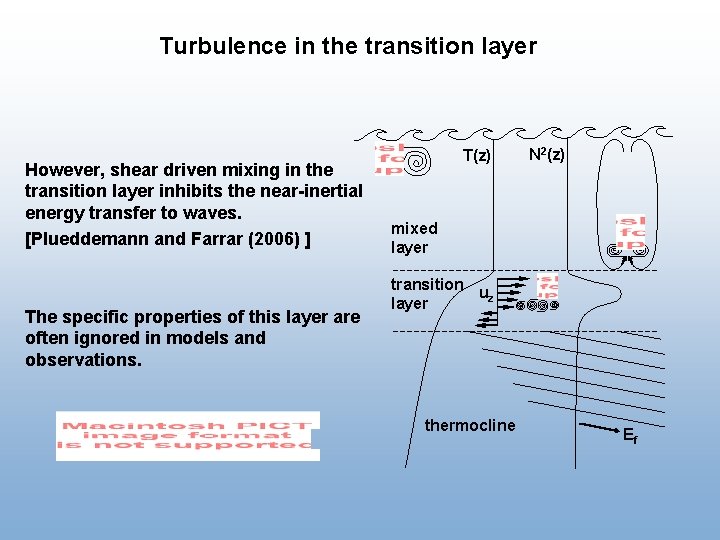
Turbulence in the transition layer However, shear driven mixing in the transition layer inhibits the near-inertial energy transfer to waves. [Plueddemann and Farrar (2006) ] The specific properties of this layer are often ignored in models and observations. T(z) N 2(z) mixed layer transition u z layer thermocline Ef
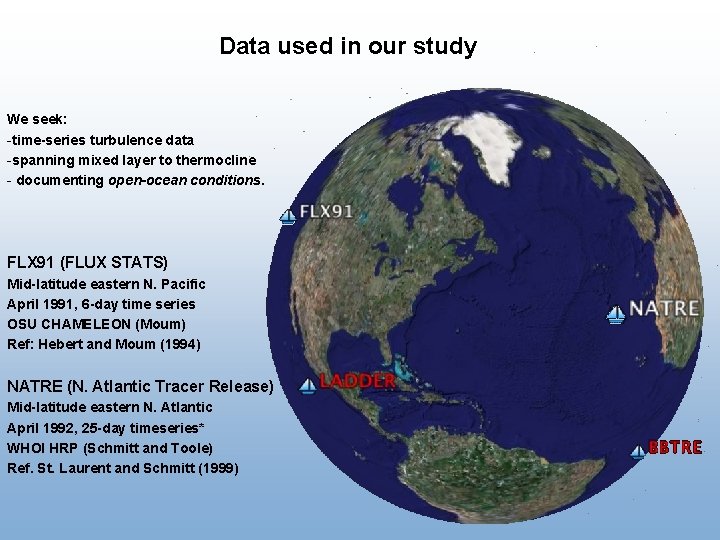
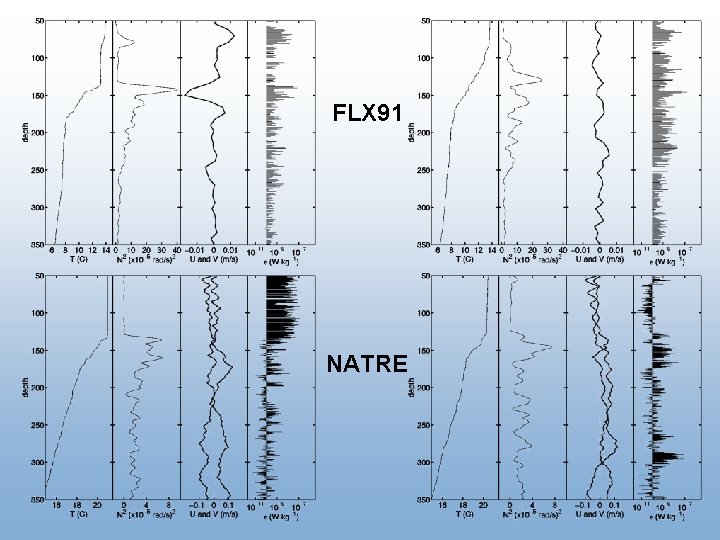
Data used in our study We seek: -time-series turbulence data -spanning mixed layer to thermocline - documenting open-ocean conditions. FLX 91 (FLUX STATS) Mid-latitude eastern N. Pacific April 1991, 6 -day time series OSU CHAMELEON (Moum) Ref: Hebert and Moum (1994) NATRE (N. Atlantic Tracer Release) Mid-latitude eastern N. Atlantic April 1992, 25 -day timeseries* WHOI HRP (Schmitt and Toole) Ref. St. Laurent and Schmitt (1999)
FLX 91 NATRE
FLX 91 time series
NATRE time series
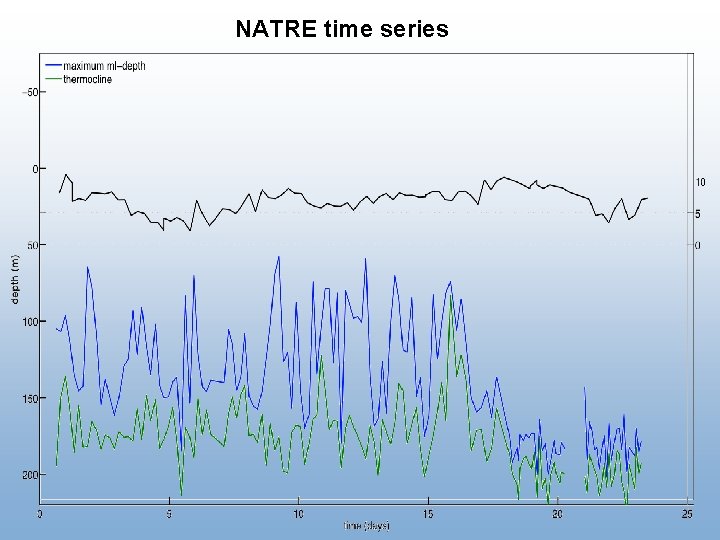
NATRE time series
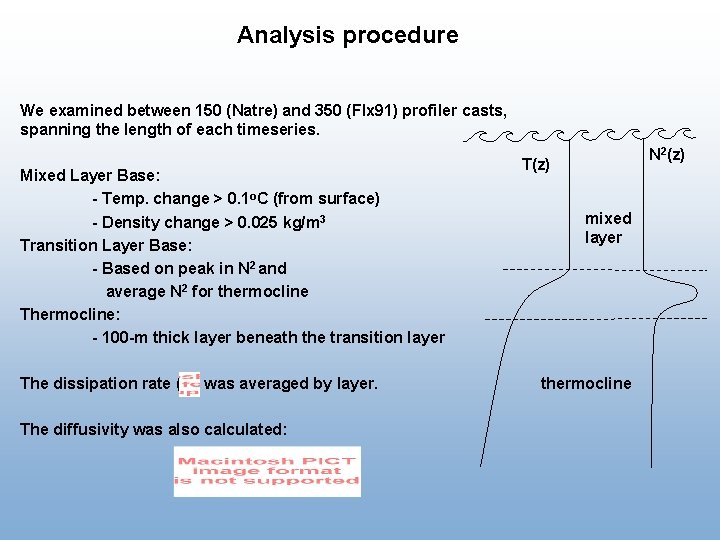
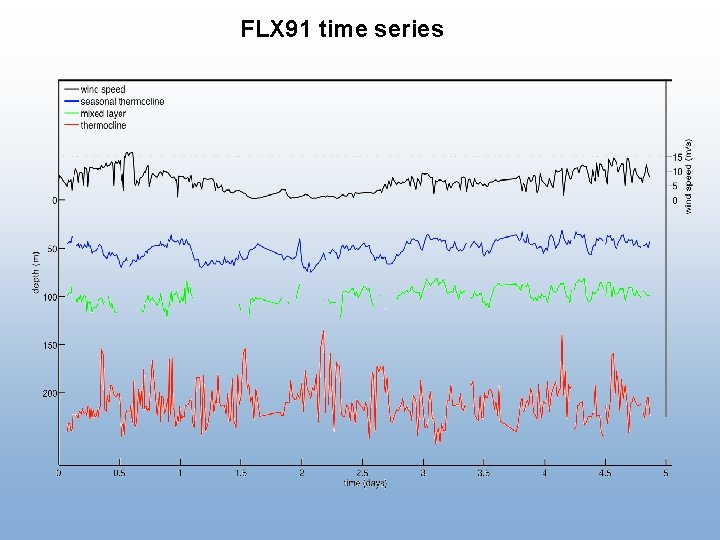
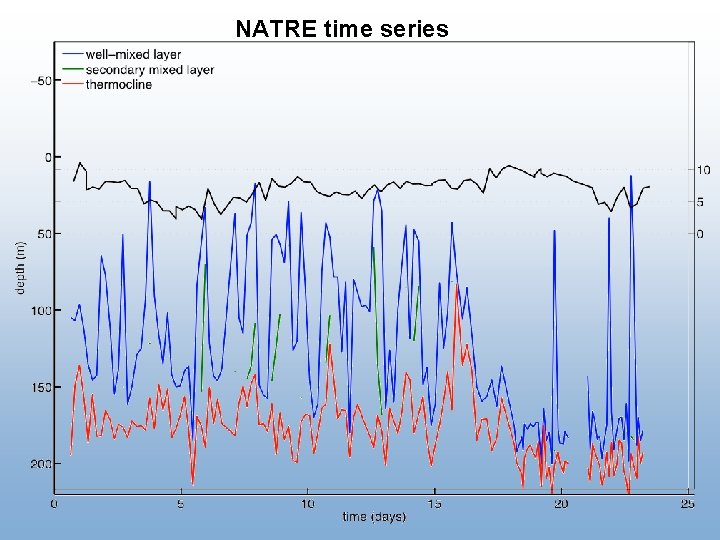
Analysis procedure We examined between 150 (Natre) and 350 (Flx 91) profiler casts, spanning the length of each timeseries. Mixed Layer Base: - Temp. change > 0. 1 o. C (from surface) - Density change > 0. 025 kg/m 3 Transition Layer Base: - Based on peak in N 2 and average N 2 for thermocline Thermocline: - 100 -m thick layer beneath the transition layer The dissipation rate ( ) was averaged by layer. The diffusivity was also calculated: N 2(z) T(z) mixed layer thermocline
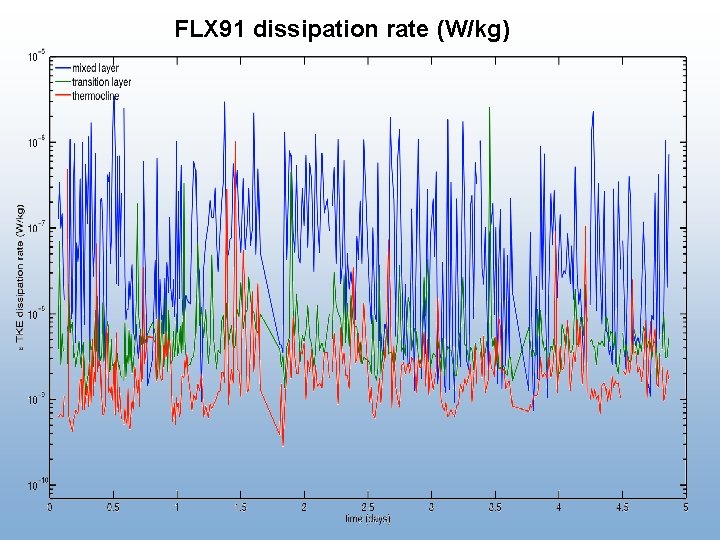
FLX 91 dissipation rate (W/kg)
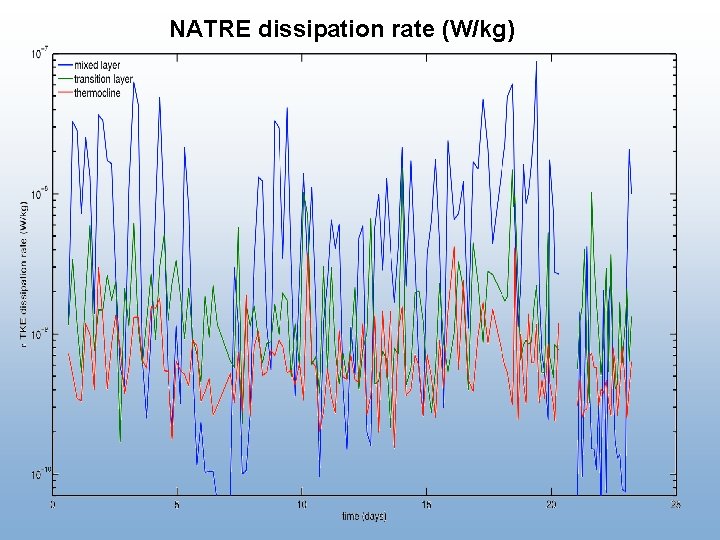
NATRE dissipation rate (W/kg)
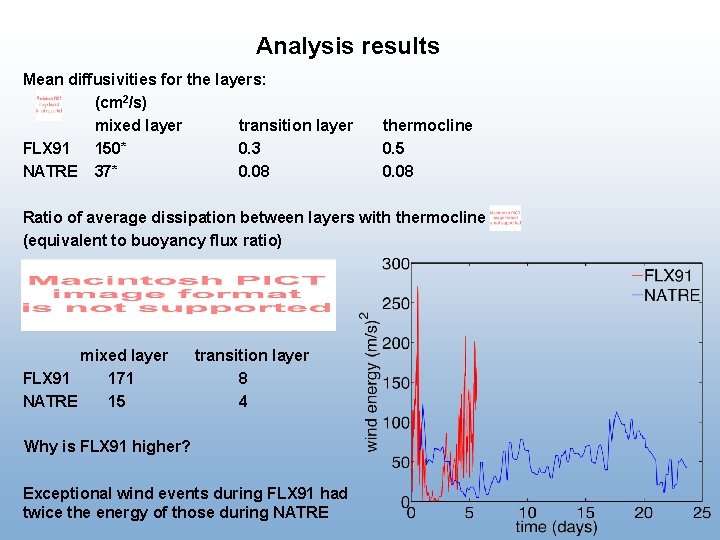
Analysis results Mean diffusivities for the layers: (cm 2/s) mixed layer transition layer FLX 91 150* 0. 3 NATRE 37* 0. 08 thermocline 0. 5 0. 08 Ratio of average dissipation between layers with thermocline (equivalent to buoyancy flux ratio) mixed layer FLX 91 171 NATRE 15 transition layer 8 4 Why is FLX 91 higher? Exceptional wind events during FLX 91 had twice the energy of those during NATRE
Conclusions Transition layer dissipation rates are consistently elevated above thermocline values (by a factor of 4 to 8). It appears that the larger dissipation levels of FLX 91 relative to NATRE were correlated to the peak wind events, rather than mean wind levels which were comparable. Why is this Significant? : - The enhanced dissipation rates in the transition layer represent an energy loss term to near inertial waves emitting from the mixed-layer base. - This implies a reduction in energy available for turbulent mixing in thermocline.
- Slides: 14