
Turbulence Impact Mitigation Workshop 3 Next Generation World

Turbulence Impact Mitigation Workshop 3 Next Generation World Area Forecast System Turbulence Forecasts Presented by Claire Bartholomew, WAFC London and Matt Strahan, WAFC Washington
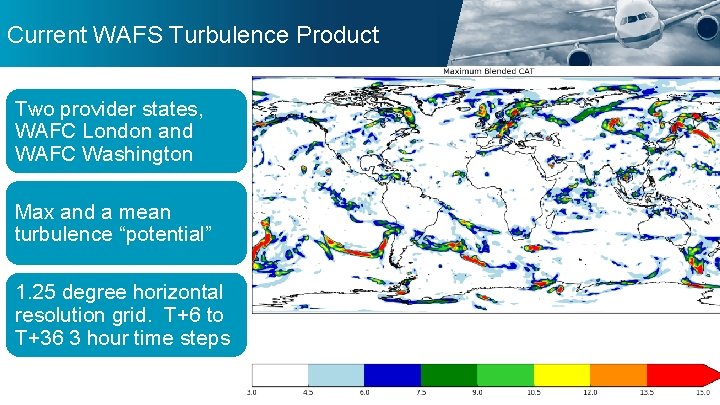
Current WAFS Turbulence Product Two provider states, WAFC London and WAFC Washington Max and a mean turbulence “potential” 1. 25 degree horizontal resolution grid. T+6 to T+36 3 hour time steps
WAFS Improvement Schedule 2020 • Turbulence Severity (EDR) • Horizontal resolution increased to 0. 25 degrees 2022 • Temporal resolution T+6 to T+24 in 1 hour increments • Temporal resolution T+27 to T+48 in 3 hour increments 2024 • Probabilistic Severity (EDR)
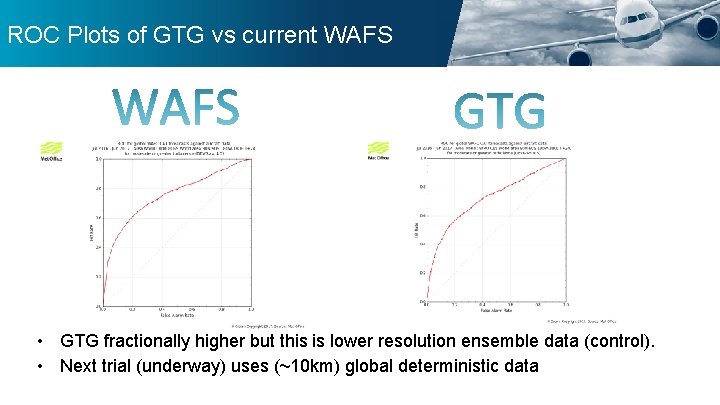
ROC Plots of GTG vs current WAFS • GTG fractionally higher but this is lower resolution ensemble data (control). • Next trial (underway) uses (~10 km) global deterministic data
Turbulence Climatology: AIM • To generate MOG turbulence climatology using database of automated aircraft observations • To attempt identification of turbulence events generated by convection and mountain waves, and start to build a climatology of these Study will ultimately aim: • To identify areas where MOG turbulence is more likely, for use in the aviation community • To provide a basis for future studies of turbulence • To aid future development of turbulence indicators
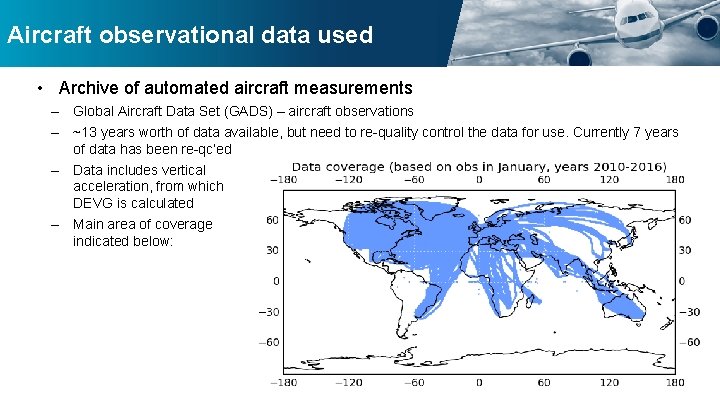
Aircraft observational data used • Archive of automated aircraft measurements – Global Aircraft Data Set (GADS) – aircraft observations – ~13 years worth of data available, but need to re-quality control the data for use. Currently 7 years of data has been re-qc’ed – Data includes vertical acceleration, from which DEVG is calculated – Main area of coverage indicated below:
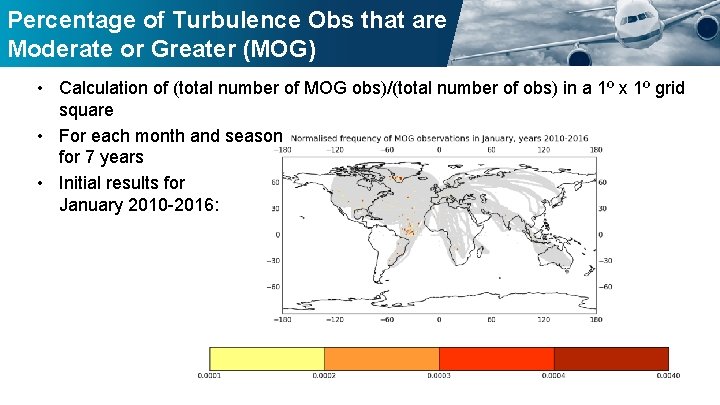
Percentage of Turbulence Obs that are Moderate or Greater (MOG) • Calculation of (total number of MOG obs)/(total number of obs) in a 1º x 1º grid square • For each month and season for 7 years • Initial results for January 2010 -2016:
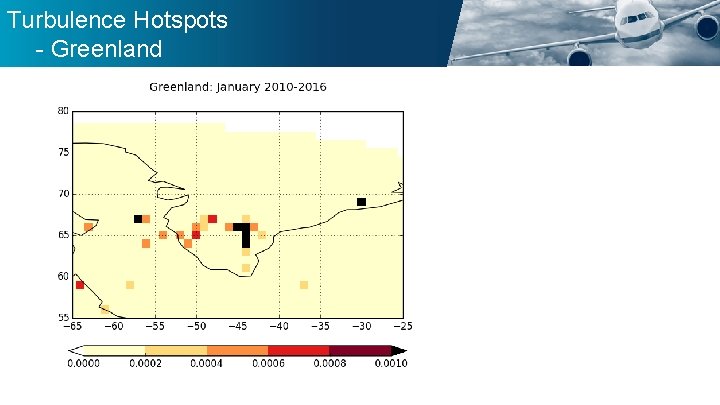
Turbulence Hotspots - Greenland
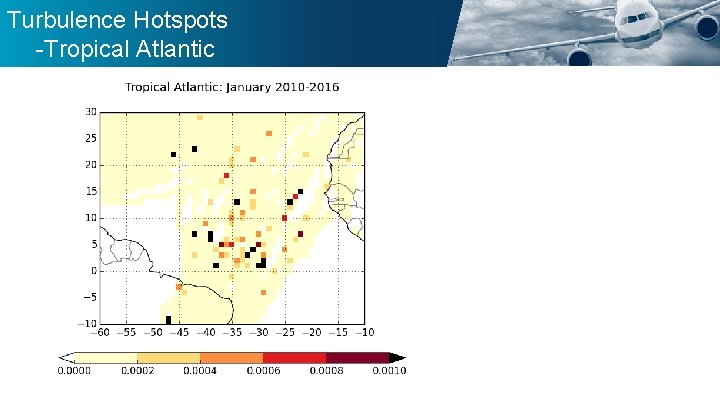
Turbulence Hotspots -Tropical Atlantic
Next Steps Combining with other airlines data Using to verify WAFS turbulence diagnostic Further QC of more recent aircraft observations
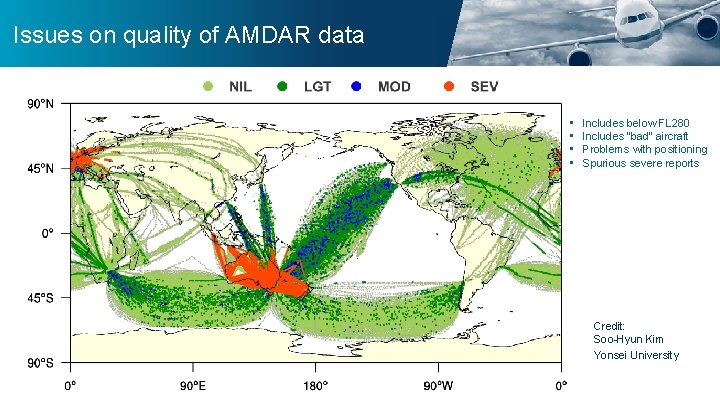
Issues on quality of AMDAR data • • Includes below FL 280 Includes “bad” aircraft Problems with positioning Spurious severe reports Credit: Soo-Hyun Kim Yonsei University
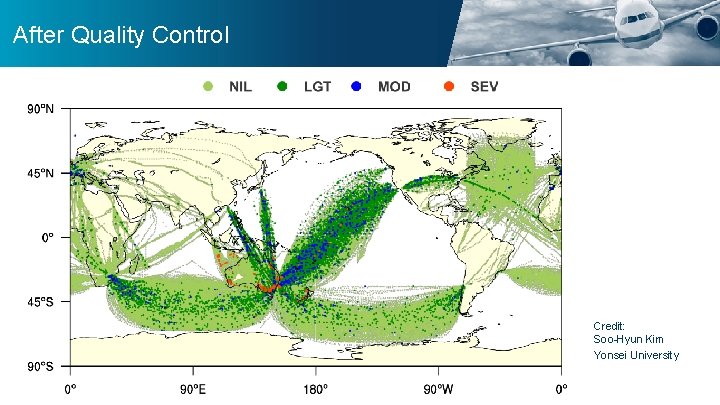
After Quality Control Credit: Soo-Hyun Kim Yonsei University
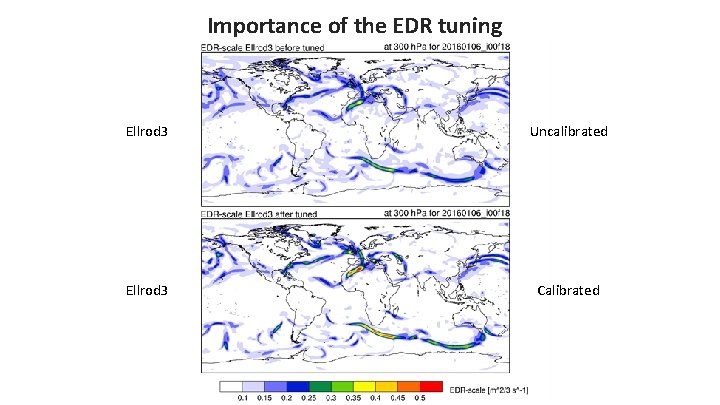
Importance of the EDR tuning Ellrod 3 Uncalibrated Ellrod 3 Calibrated
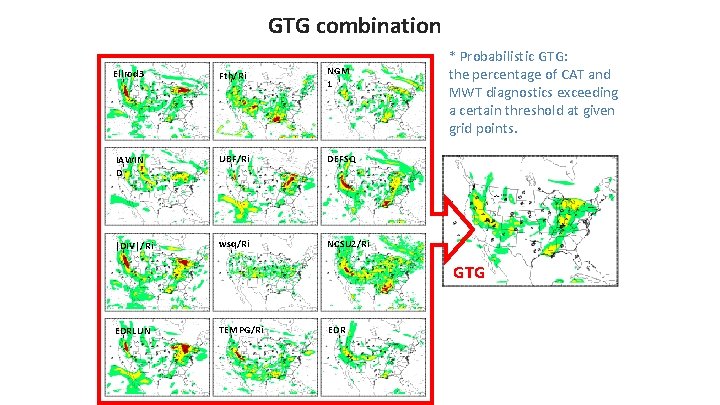
GTG combination Ellrod 3 Fth/Ri NGM 1 IAWIN D UBF/Ri DEFSQ |DIV|/Ri wsq/Ri NCSU 2/Ri * Probabilistic GTG: the percentage of CAT and MWT diagnostics exceeding a certain threshold at given grid points. GTG EDRLUN TEMPG/Ri EDR
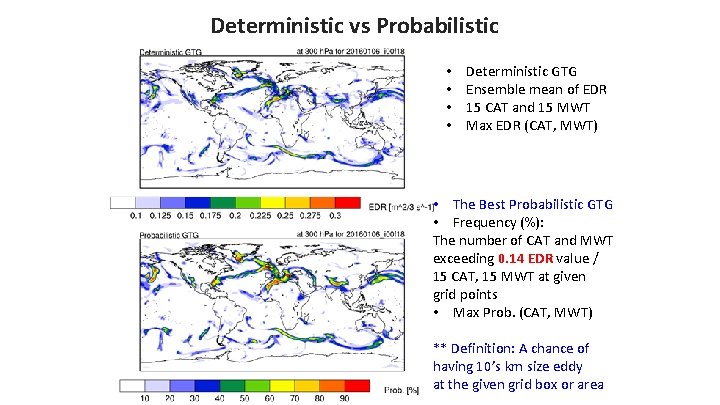
Deterministic vs Probabilistic • • Deterministic GTG Ensemble mean of EDR 15 CAT and 15 MWT Max EDR (CAT, MWT) • The Best Probabilistic GTG • Frequency (%): The number of CAT and MWT exceeding 0. 14 EDR value / 15 CAT, 15 MWT at given grid points • Max Prob. (CAT, MWT) ** Definition: A chance of having 10’s km size eddy at the given grid box or area
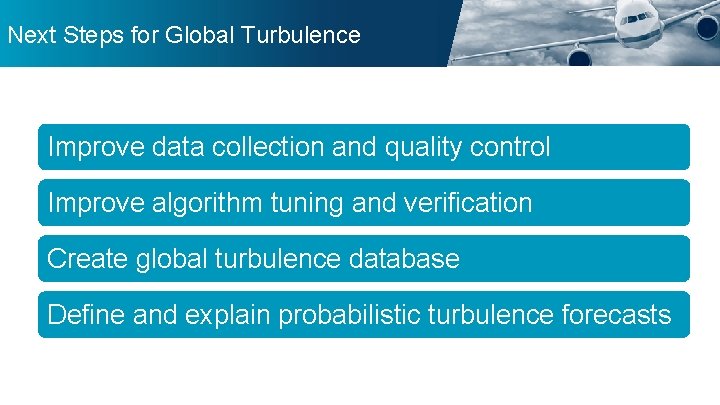
Next Steps for Global Turbulence Improve data collection and quality control Improve algorithm tuning and verification Create global turbulence database Define and explain probabilistic turbulence forecasts
- Slides: 16