
Tuples and Dictionaries Intro to Computer Science CS
![Access Dictionary Elements Access requires [ ], but the key is the index! my.](https://slidetodoc.com/presentation_image_h2/bb87d07faaaf87cbba30415b58a7a275/image-16.jpg "Access Dictionary Elements Access requires [ ], but the key is the index! my.")
- Slides: 21
Tuples and Dictionaries Intro to Computer Science CS 1510, Section 2 Dr. Sarah Diesburg
Homework Assignments PA 07 regular deadline is today - 11/4 New homework PA 08 assigned today Elise is available to help with homework inperson or in email Email: fahrenke@uni. edu 3 -4 pm M/W in WRT 339
Tuples Last time we finished up talking about lists We made an anagram program Today we will briefly go over tuples Like lists, but immutable!
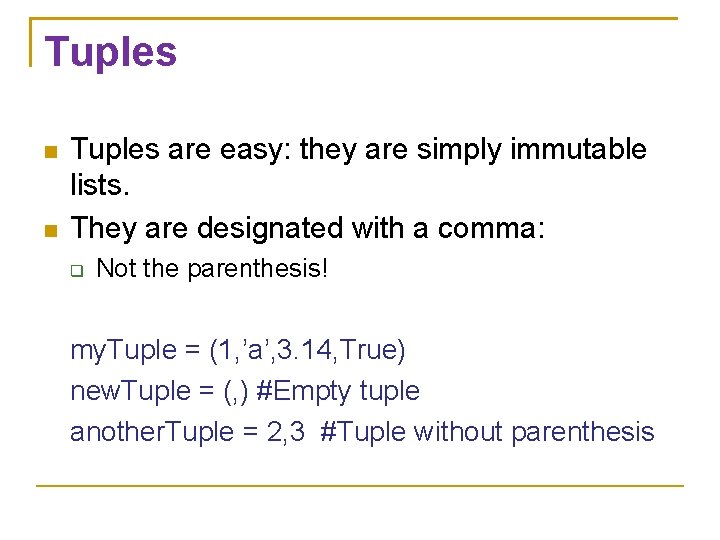
Tuples are easy: they are simply immutable lists. They are designated with a comma: Not the parenthesis! my. Tuple = (1, ’a’, 3. 14, True) new. Tuple = (, ) #Empty tuple another. Tuple = 2, 3 #Tuple without parenthesis
The Question is, Why? The real question is, why have an immutable list, a tuple, as a separate type? An immutable list gives you a data structure with some integrity, some permanency, if you will. You know you cannot accidentally change one.
Lists and Tuples Everything that works with a list works with a tuple except methods that modify the list/tuple. Thus indexing, slicing, len, print all work as expected. However, none of the mutable methods work: append, extend, remove.
Anagram Example with Tuples Let’s see if we can modify our anagram program to use tuples 7
Chapter 9 Dictionaries
More Data Structures We have seen the string and list data structures and their uses. In particular, the dictionary is an important, very useful part of Python as well as generally useful to solve many problems.
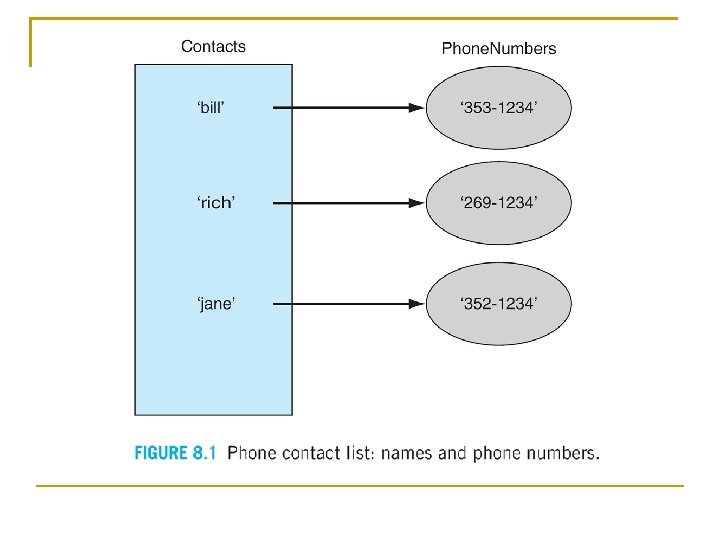
What is a Dictionary? In data structure terms, a dictionary is better termed an associative array or associative list or a map. You can think if it as a list of pairs, where the first element of the pair, the key, is used to retrieve the second element, the value. Thus we map a key to a value.
Key Value Pairs The key acts as a “lookup” to find the associated value. Just like a dictionary, you look up a word by its spelling to find the associated definition. A dictionary can be searched to locate the value associated with a key.
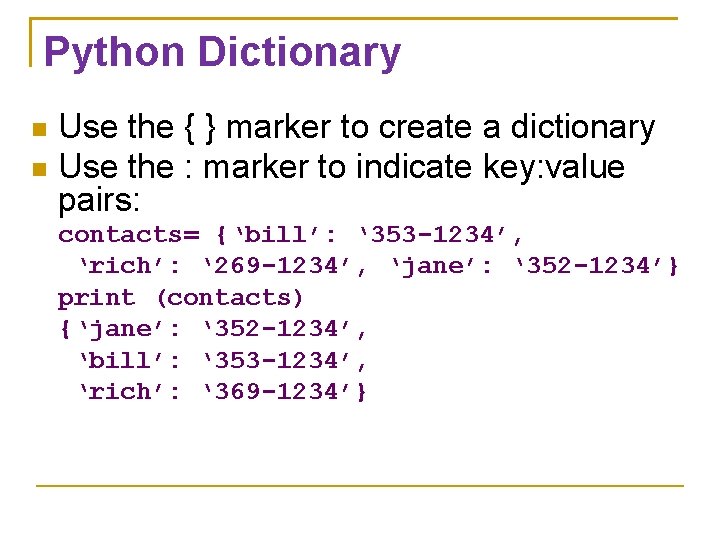
Python Dictionary Use the { } marker to create a dictionary Use the : marker to indicate key: value pairs: contacts= {‘bill’: ‘ 353 -1234’, ‘rich’: ‘ 269 -1234’, ‘jane’: ‘ 352 -1234’} print (contacts) {‘jane’: ‘ 352 -1234’, ‘bill’: ‘ 353 -1234’, ‘rich’: ‘ 369 -1234’}
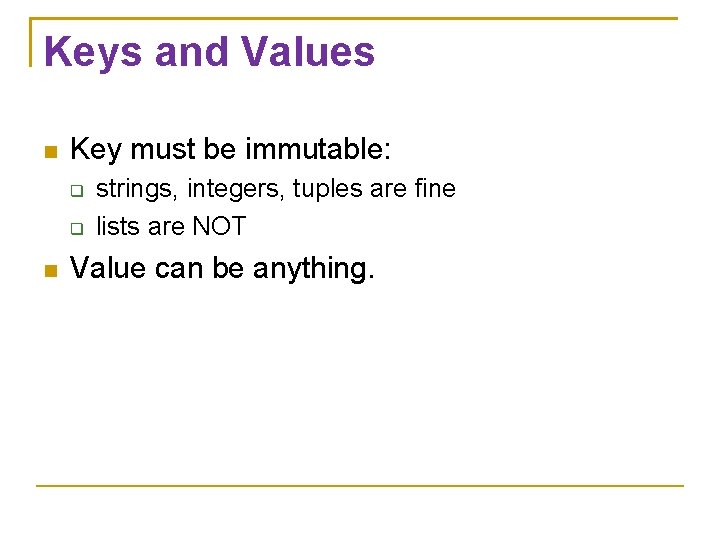
Keys and Values Key must be immutable: strings, integers, tuples are fine lists are NOT Value can be anything.
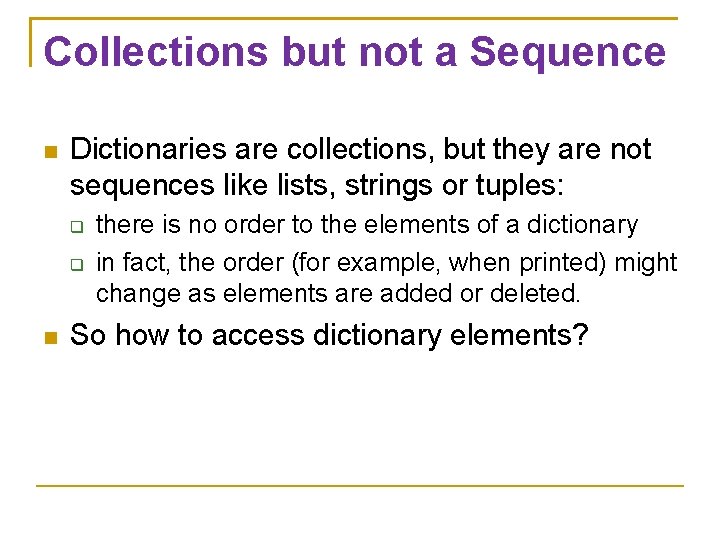
Collections but not a Sequence Dictionaries are collections, but they are not sequences like lists, strings or tuples: there is no order to the elements of a dictionary in fact, the order (for example, when printed) might change as elements are added or deleted. So how to access dictionary elements?
Access Dictionary Elements Access requires [ ], but the key is the index! my. Dict={} an empty dictionary my. Dict[‘bill’]=25 added the pair ‘bill’: 25 print(my. Dict[‘bill’]) prints 25
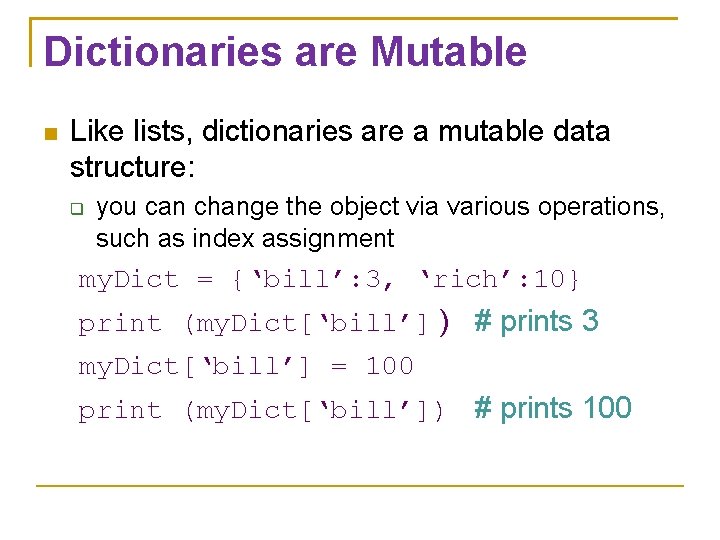
Dictionaries are Mutable Like lists, dictionaries are a mutable data structure: you can change the object via various operations, such as index assignment my. Dict = {‘bill’: 3, ‘rich’: 10} print (my. Dict[‘bill’] ) # prints 3 my. Dict[‘bill’] = 100 print (my. Dict[‘bill’]) # prints 100
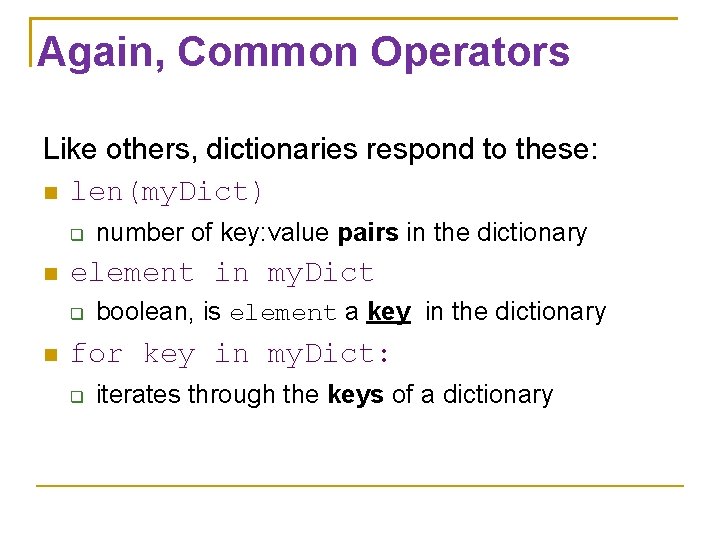
Again, Common Operators Like others, dictionaries respond to these: len(my. Dict) element in my. Dict number of key: value pairs in the dictionary boolean, is element a key in the dictionary for key in my. Dict: iterates through the keys of a dictionary
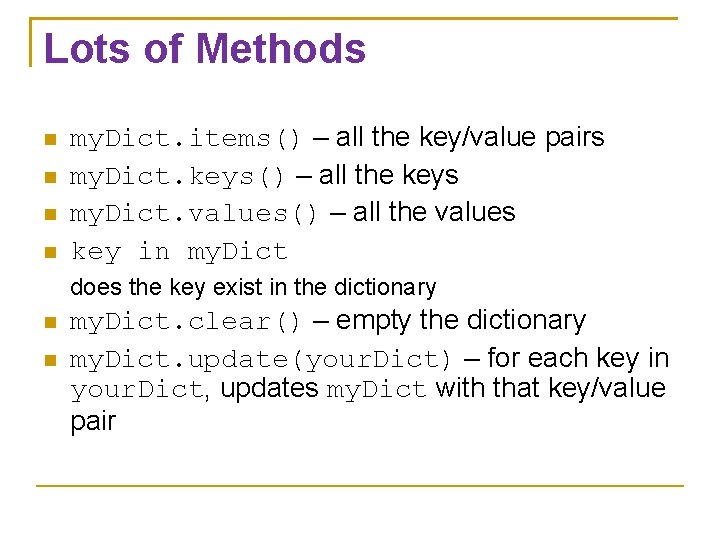
Lots of Methods my. Dict. items() – all the key/value pairs my. Dict. keys() – all the keys my. Dict. values() – all the values key in my. Dict does the key exist in the dictionary my. Dict. clear() – empty the dictionary my. Dict. update(your. Dict) – for each key in your. Dict, updates my. Dict with that key/value pair
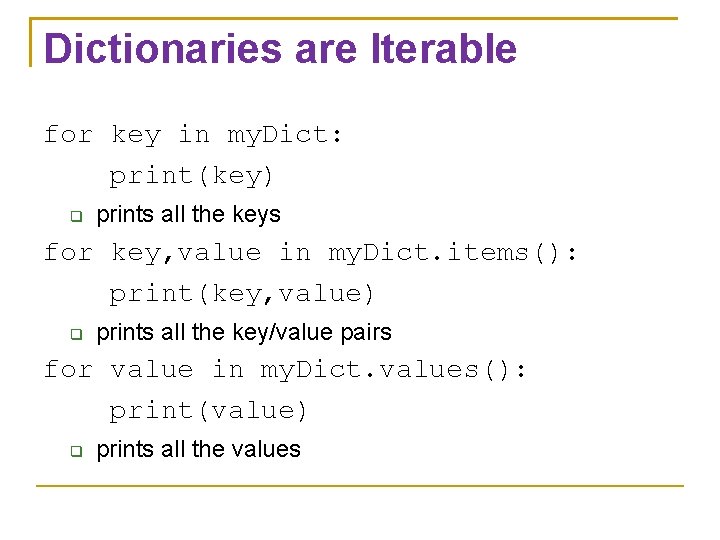
Dictionaries are Iterable for key in my. Dict: print(key) prints all the keys for key, value in my. Dict. items(): print(key, value) prints all the key/value pairs for value in my. Dict. values(): print(value) prints all the values
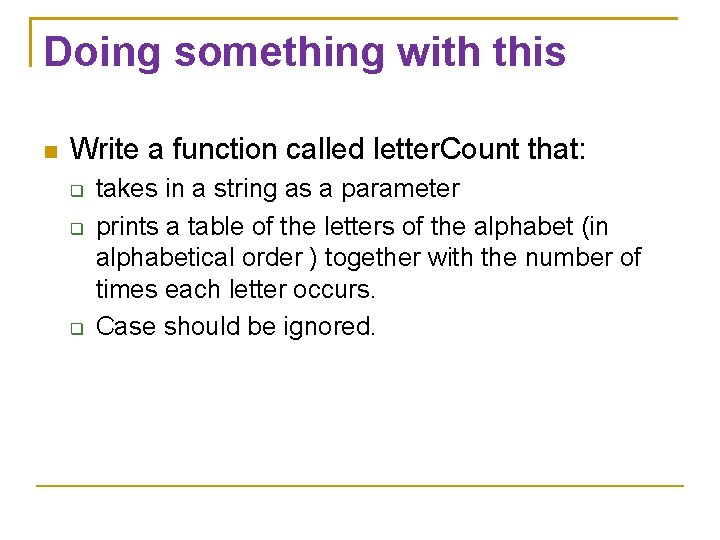
Doing something with this Write a function called letter. Count that: takes in a string as a parameter prints a table of the letters of the alphabet (in alphabetical order ) together with the number of times each letter occurs. Case should be ignored.